Ezekiel 40:41

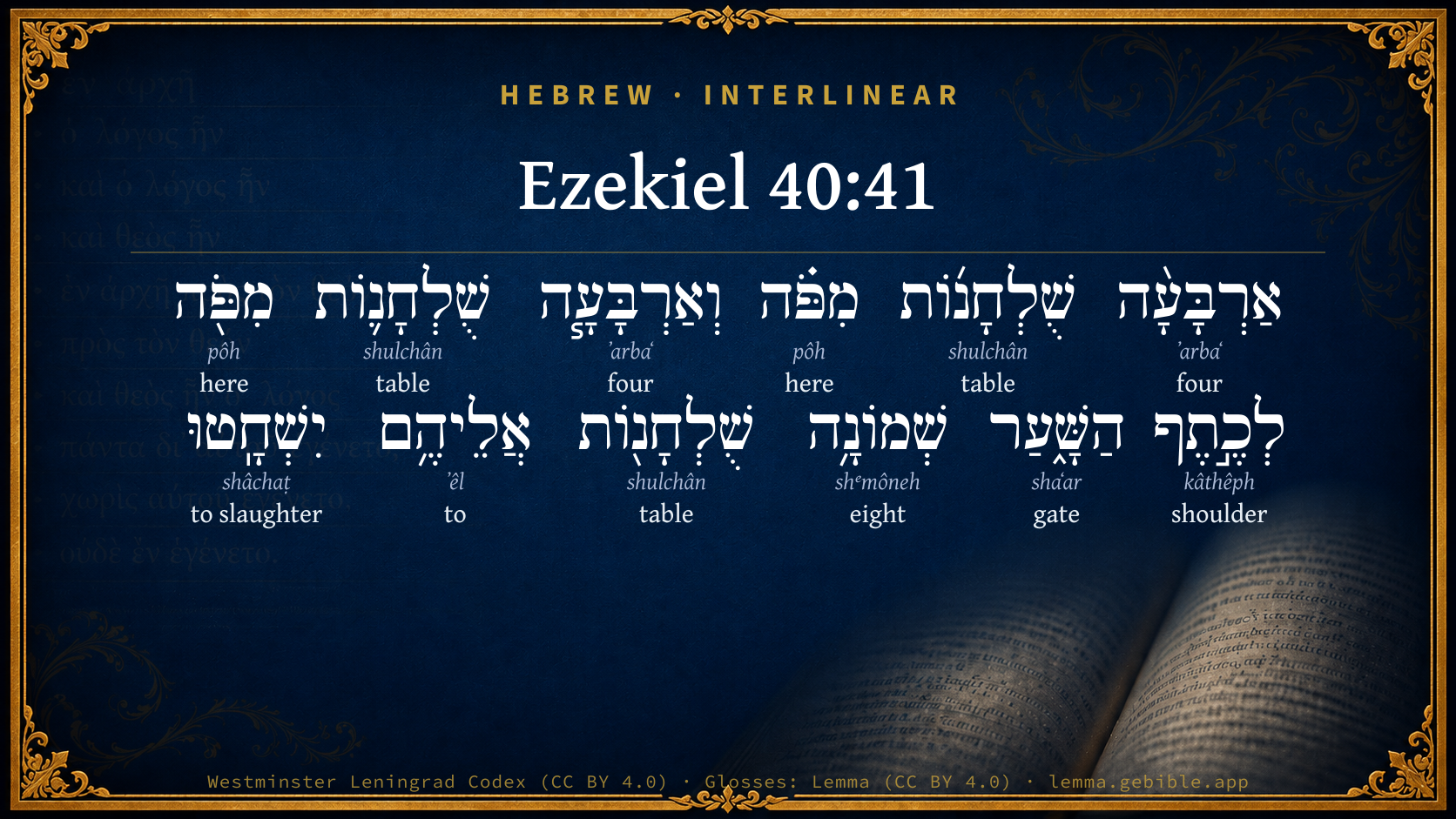
Hebrew (Westminster Leningrad Codex) Ezekiel 40:41 appears in the Hebrew Old Testament. The text above is from the Westminster Leningrad Codex. Each word links to its Strong’s number, a concise gloss, and parsing drawn from the Open Scriptures Hebrew Bible morphology. Click any word for its full Brown-Driver-Briggs (BDB) entry.
Download image
Cite this verse

Ezekiel 40:41 (World English Bible). Public Domain. Lemma interlinear Bible study tool, https://lemma.gebible.app/v/ezekiel/40/41.

Show BibTeX & RIS
BibTeX
RIS
English Translation
Four tables were on this side, and four tables on that side, by the side of the gate; eight tables, whereupon they killed [the sacrifices].
World English Bible · Public Domain
Download a study sheet

One document with this verse’s original text, its word-by-word gloss line, the meaning frame, cross-references with their text, attributed commentary, and full source and license credits — printable, and it pastes into notes with its structure intact.

This verse Autodidact and up

Study sheet (.html) Plain text (.txt)

A passage Seminary Student

Up to 50 verses in one chapter. A passage sheet keeps up to 6 commentary sources and 12 cross-references per verse, in the order this page ranks them, and says so on the sheet whenever that leaves anything out. Ask for a single verse and you get the Autodidact verse sheet above.

Everything on this page stays free to read, with no account — the sheet is a download of what is already on screen, not access to it.

Want to remove ads? Support Godless Engineer
Compare translations 3

The same verse in 3 English versions, stacked beneath the original-language interlinear above. Click any original word for its lexicon entry.

Each is an independent rendering of the whole verse — the interlinear is not word-aligned to these translations.

Highlighted words mark where these versions differ — a whole-verse word diff, not a word-by-word alignment.

  • World English Bible Public Domain
    Four tables were on this side, and four tables on that side, by the side of the gate; eight tables, whereupon they killed [the sacrifices].
  • King James Version Public Domain
    Four tables were on this side, and four tables on that side, by the side of the gate; eight tables, whereupon they slew their sacrifices.
  • unfoldingWord Literal Text CC BY-SA 4.0
    There were four tables on either side by the gate; they slaughtered animals on the eight tables.

unfoldingWord Literal Text — © unfoldingWord, licensed CC BY-SA 4.0. Word-aligned USFM3 via Door43 (git.door43.org/unfoldingWord/en_ult).

Versions to compare (up to 4)

3 of 4 selected

Show all 18 translations

Every available English version of this verse, each an independent rendering of the whole verse.

  • World English Bible Public Domain
    Four tables were on this side, and four tables on that side, by the side of the gate; eight tables, whereupon they killed [the sacrifices].
  • Berean Standard Bible Public Domain
    So there were four tables inside the gateway and four outside—eight tables in all—on which the sacrifices were to be slaughtered.
  • Majority Standard Bible Public Domain
    So there were four tables inside the gateway and four outside—eight tables in all—on which the sacrifices were to be slaughtered.
  • King James Version Public Domain
    Four tables were on this side, and four tables on that side, by the side of the gate; eight tables, whereupon they slew their sacrifices.
  • American Standard Version (1901) Public Domain
    Four tables were on this side, and four tables on that side, by the side of the gate; eight tables, whereupon they slew `the sacrifices'.
  • Revised Version (1885) Public Domain
    Four tables were on this side, and four tables on that side, by the side of the gate; eight tables, whereupon they slew the sacrifices.
  • Geneva Bible (1599) Public Domain
    Foure tables were on this side, and foure tables on that side by the side of the gate, euen eight tables whereupon they slew their sacrifice.
  • Douay-Rheims (1899) Public Domain
    Four tables were on this side, and four tables on that side: at the sides of the gate were eight tables, upon which they slew the victims.
  • Young's Literal Translation Public Domain
    four tables `are' on this side, and four tables on that side, at the side of the gate, eight tables on which they slaughter.
  • Literal Standard Version CC BY-SA 4.0
    four tables [are] on this side and four tables on that side, at the side of the gate, eight tables on which they slaughter.
  • Unlocked Literal Bible CC BY-SA 4.0
    There were four tables on either side by the gate; they slaughtered animals on the eight tables.
  • unfoldingWord Literal Text CC BY-SA 4.0
    There were four tables on either side by the gate; they slaughtered animals on the eight tables.
  • Darby Bible Public Domain
    four tables on this side, and four tables on that side, by the side of the gate, -- eight tables, whereon they slew [the sacrifice],
  • World Messianic Bible Public Domain
    Four tables were on this side, and four tables on that side, by the side of the gate: eight tables, on which they killed the sacrifices.
  • Webster's Bible Public Domain
    Four tables were on this side, and four tables on that side, by the side of the gate; eight tables, upon which they slew their sacrifices.
  • Free Bible Version CC BY-SA 4.0
    So there were four tables on the inside the of gateway and another four outside, making a total of eight tables. This is where the sacrifices were slaughtered.
  • Bible in Basic English Public Domain
    There were four tables on one side and four tables on the other, by the side of the doorway; eight tables, on which they put to death the beasts for the offerings.
  • JPS Tanakh (1917) Public Domain
    Four tables were on this side, and four tables on that side, by the side of the gate; eight tables, whereupon to slay the sacrifices.

Literal Standard Version (2020), Covenant Press — licensed CC BY-SA 4.0. Text via the HelloAO Bible API (eBible.org). Unlocked Literal Bible (unfoldingWord) — licensed CC BY-SA 4.0. Text via the HelloAO Bible API (eBible.org). unfoldingWord Literal Text — © unfoldingWord, licensed CC BY-SA 4.0. Word-aligned USFM3 via Door43 (git.door43.org/unfoldingWord/en_ult). Free Bible Version, Dr. Jonathan Gallagher — licensed CC BY-SA 4.0. Text via the HelloAO Bible API (eBible.org).

Word by word

More ways to search: Search by grammar → Find every occurrence → Compare this word →

Practice this passage: Drill this verse → Learn its vocabulary →

לְכֶ֣תֶף
kâthêph
H3802
“to/for · shoulder of”
Preposition + Noun, Common, Feminine, Singular, Construct
Part of Speech
Preposition + Noun
Type
Common
Gender
Feminine
Number
Singular
State
Construct
Full BDB Definition

Origin: from an unused root meaning to clothe

TWOT: 1059

shoulder, shoulder-blade, side, slope - shoulder, shoulder-blade (of man) - shoulder, shoulder-pieces (of animals) - side, slope (of mountain) - supports (of laver)
  1. אַרְבָּעָ֨ה ʼarbaʻ H702 “four” Adjective, Cardinal number, Masculine, Singular, Absolute
  2. שֻׁלְחָנ֜וֹת shulchân H7979 “tables” Noun, Common, Masculine, Plural, Absolute
  3. מִפֹּ֗ה pôh H6311 “from · here” Preposition + Adverb
  4. וְאַרְבָּעָ֧ה ʼarbaʻ H702 “and · four” Conjunction + Adjective, Cardinal number, Masculine, Singular, Absolute
  5. שֻׁלְחָנ֛וֹת shulchân H7979 “tables” Noun, Common, Masculine, Plural, Absolute
  6. מִפֹּ֖ה pôh H6311 “from · here” Preposition + Adverb
  7. הַשָּׁ֑עַר shaʻar H8179 “the · gate” Particle, Definite Article + Noun, Common, Masculine, Singular, Absolute
  8. שְׁמוֹנָ֥ה shᵉmôneh H8083 “eight” Adjective, Cardinal number, Masculine, Singular, Absolute
  9. שֻׁלְחָנ֖וֹת shulchân H7979 “tables” Noun, Common, Masculine, Plural, Absolute
  10. אֲלֵיהֶ֥ם ʼêl H413 “to · them” Preposition + Suffix, Personal, 3rd Person, Masculine, Plural
  11. יִשְׁחָֽטוּ shâchaṭ H7819 “to slaughter” Verb, Qal, Imperfect, 3rd Person, Masculine, Plural

About this verse

These counts appear in no published source. They are computed here, from the morphology-tagged text and Lemma’s own curated glosses. What Lemma adds →

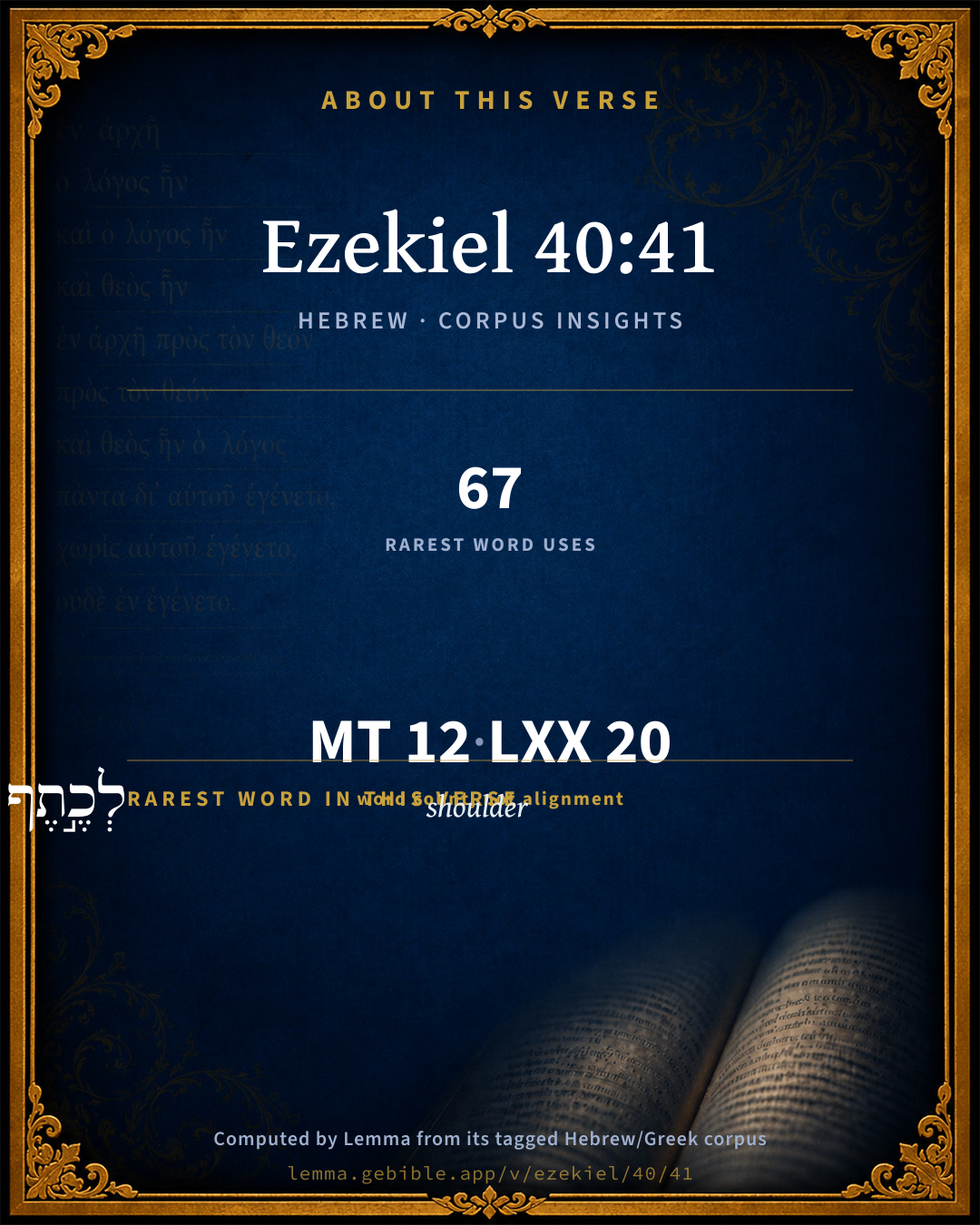
12
words
8
distinct lemmas
Prophets
section

Grammatical profile

  • 1 verb
  • 5 nouns
  • 3 adjectives
  • 1 preposition
  • 2 adverbs

Verb forms

  • יִשְׁחָֽטוּ Qal · Imperfect

Repetition

Words recur within this verse — often emphatic in Hebrew:

  • שֻׁלְחָנ֜וֹת table H7979 ×3
  • אַרְבָּעָ֨ה four H702 ×2
  • מִפֹּ֗ה here H6311 ×2

Hebrew & Septuagint length

In English translation the verse runs 25 words from the Hebrew and 27 from the Septuagint (LXX English) — closely comparable.

A rough comparison of the two English renderings, which tokenize alike — not a word-level alignment.

Word counts can differ between the Hebrew and the Greek without any difference in meaning — e.g. the Hebrew direct-object marker אֵת has no separate Greek word, and Greek often adds the article ὁ.

In the original languages it is 12 Hebrew tokens and 20 Greek tokens — but the two are counted differently (Hebrew bundles its prefixes and suffixes into one token; the Greek is in lemma form), so that isn’t a like-for-like length.

Cross-references

1

Topical passages linked to Ezekiel 40:41 in the Treasury of Scripture Knowledge — connected by theme and wording, ordered by reader-vote popularity; previews shown in the World English Bible.

  • Ezekiel 40:39–40 In the porch of the gate were two tables on this side, and two tables on that side, to kill thereon the burnt offering and the sin-offering and the trespass-offering.

Cross-references courtesy of OpenBible.info (CC BY 4.0).

Hebrew and Greek witnesses Masoretic Hebrew ↔ Greek Septuagint

The same verse in the two great witnesses to the Old Testament, shown verse-for-verse.

These are two independent witnesses, not word-aligned to each other, and the Septuagint is shown in lemma (dictionary) form.

Hebrew Ezekiel 40:41 Masoretic · Westminster Leningrad Codex

אַרְבָּעָ֨ה שֻׁלְחָנ֜וֹת מִפֹּ֗ה וְאַרְבָּעָ֧ה שֻׁלְחָנ֛וֹת מִפֹּ֖ה לְכֶ֣תֶף הַשָּׁ֑עַר שְׁמוֹנָ֥ה שֻׁלְחָנ֖וֹת אֲלֵיהֶ֥ם יִשְׁחָֽטוּ

Four tables were on this side, and four tables on that side, by the side of the gate; eight tables, whereupon they killed [the sacrifices].

World English Bible · Public Domain

Greek LXX Ezekiel 40:41 Septuagint · lemma form

τέσσαρες ἔνθεν καί τέσσαρες ἔνθεν κατά νῶτον ὁ πύλη ἐπί αὐτός σφάζω ὁ θῦμα κατέναντι ὁ ὀκτώ τράπεζα ὁ θῦμα

Four on one side and four on the other side behind the gate; upon them they kill the victims, in front of the eight tables of sacrifices.

LXX2012 (modern English Septuagint) · Public Domain

On this verse, John Gill's Exposition discusses the Septuagint’s reading. Read the note in Commentary ↓

Hebrew: Westminster Leningrad Codex (CC BY 4.0). Greek: Septuagint (public domain); English from LXX2012 (modern English Septuagint) (Public Domain). How the Septuagint differs from the Hebrew →

Targum (Aramaic paraphrase)

1

The Targum is the ancient Jewish Aramaic paraphrase of the Hebrew Scriptures — an interpretive translation, not the Hebrew text itself. Onkelos (literal) and Pseudo-Jonathan (expansive) render the Torah, and Jonathan the Prophets. Coverage is partial: where no permissively-licensed English translation exists for a verse, only the Aramaic is shown. This is verse-level text, not a word-by-word alignment to the Hebrew.

  1. Targum Jonathan Prophets (Joshua–Malachi)
    אַרְבְּעָא פְּתוֹרִין מִכָּא וְאַרְבָּעָה פְּתוֹרִין מִכָּא לְעֶבְרָא דְתַרְעָא תְמַנְיָא פָּתוֹרִין בֵּינֵיהוֹן נִכְסִין:

    (no public-domain English translation for this verse)

    Targum Jonathan — Aramaic: “Mikraot Gedolot” (public domain). English: “Sefaria Community Translation” (CC0 1.0 (public-domain dedication)); “London "Chaldee Paraphrase," 1871” (public domain). Text via Sefaria.

Commentary

Notes on Ezekiel 40:41 from classic Christian and Jewish commentators (each source and its license shown beneath its notes). The classic Christian expositions comment on the surrounding passage and are grouped to its opening verse, so a note may address several verses; the Jewish commentaries on the Tanakh (Rashi and others) are per-verse, so they appear only where the commentator wrote on this verse.

Lemma curates 59 commentaries, every one of them public domain or Creative Commons licensed, each selected and text-cleaned for this edition rather than reprinted as found. About our sources →

Trapp's Complete Commentary

John Trapp

Eze 40:41 Four tables [were] on this side, and four tables on that side, by the side of the gate; eight tables, whereupon they slew [their sacrifices].

Ver. 41. Four tables.] Not altars, nor yet oyster boards, as the Papists scornfully call our communion tables.

John Trapp, A Commentary or Exposition upon All the Books of the Old and New Testament (1647–1656) — public domain. Text from a community e-Sword module.

Adam Clarke's Commentary

Verse 41. Four tables] These were in the porch of the north gate, in the court of the priests: on them they slew, flayed, and cut up the victims. See dddd in the plan. See Clarke on Eze 48:35.

Adam Clarke's Commentary on the Bible (1810–1826) — public domain. Text from a community e-Sword/MySword module.

Ellicott's Commentary for English Readers

(41) Four tables.—The eight tables of this verse are evidently meant to be distinguished from those of Eze_40:40; Eze_40:42, and make twelve tables in all. They stood four on each side of the gate, somewhat nearer, therefore, than the others to the wall of the inner court. They were used for the same sacrificial purpose, except that the others only are mentioned (Eze_40:42) as places “whereupon they laid” the sacrificial instruments.

A Bible Commentary for English Readers, edited by Charles John Ellicott (1878–1897) — public domain. Text from a community e-Sword module.

John Gill's Exposition

And without the inner gate were the chambers of the singers,.... These singers are true believers in Christ, members of Gospel churches; whose duty and privilege it is to sing psalms, hymns, and spiritual songs; which is a part of internal, spiritual, and evangelical worship, Eph 5:19, these are the spiritual harpers, that have harps in their hands, and make melody in their hearts, and are able to sing the songs of electing, redeeming, calling, pardoning, justifying, and adopting grace; these deservedly have a place in the churches of Christ, in the inward court, being inward court worshippers, even all such who sing with the spirit and the understanding; for these chambers were in the inward court: the prophet being brought through the inner northern gate, into the open space between the inward court, saw these chambers; for it follows,

in the inner court, which was at the side of the north gate; in that part of the court which lay near the north gate, where now the prophet and his guide were:

and their prospect was toward the south; that is, some of these chambers, one row of them, were by the side of the north gate, and these faced the south; north and south being opposite to each other:

one at the side of the east gate, having the prospect toward the north: another row of chambers for the singers was in that part of the inner court which was on the side of the east gate, on the north side of it, and so faced the north part of the court. The Septuagint version, if admitted, makes the sense of it more clear, but different,

"and he brought me into the inner court, and behold two chambers in the inner court; one at the back of the gate that looks to the north, bearing to the south; and one at the back of the gate to the south, looking to the north.''

John Gill's Exposition of the Whole Bible (1746–1763) — public domain (CC PDM 1.0). Text via the HelloAO Bible API.

Matthew Poole's English Annotations

Either within the porch two, and without it two, on either side, or else, as some will, four without the porch and gate, in the cloisters on the right and left hand of the gate. However placed, they were eight for number, and designed for slaying the sacrifices on.

Matthew Poole's English Annotations on the Holy Bible (1683–1685) — public domain. Text from a community e-Sword/MySword module.

Lesson kit

Teaching starters — assembled from the data on this page, not authored interpretation. Every prompt links to the verse data it draws on. Edit before teaching.

Ezekiel, in the Prophets, opens this verse with 12 words (8 distinct Hebrew lemmas). Its most distinctive word is kâthêph (“shoulder”). A historical commentator’s framing appears above. Read the whole chapter for the surrounding context.

Discussion questions

  1. How does “shoulder” (kâthêph) shape what this verse is saying?
  2. Ezekiel 40:39–40 shares this passage’s theme. How do the two illuminate each other?
  3. “table” occurs 3× in this one verse. What is the effect of the repetition?
  4. The translations on this page render this verse differently — a whole-verse word diff, not a word-by-word alignment. What might account for the different wordings?
  5. The verb «יִשְׁחָֽטוּ» is Qal Imperfect. How does its form color the action?
  6. Reading how Trapp's Complete Commentary and Adam Clarke's Commentary read this verse, where do the two commentators agree and where do they part?

Things to notice

Reading settings

Reading text

Shown beneath each verse's original-language words.

Old Testament
Old Testament edition

Read the OT as the Masoretic Hebrew (MT) or the Greek Septuagint (LXX).

English shown for the Greek Septuagint (in the Hebrew ↔ Greek comparison).

Comparing translations? Open the Compare panel on any verse page to stack up to four side by side.