
Deuteronomy 16:11

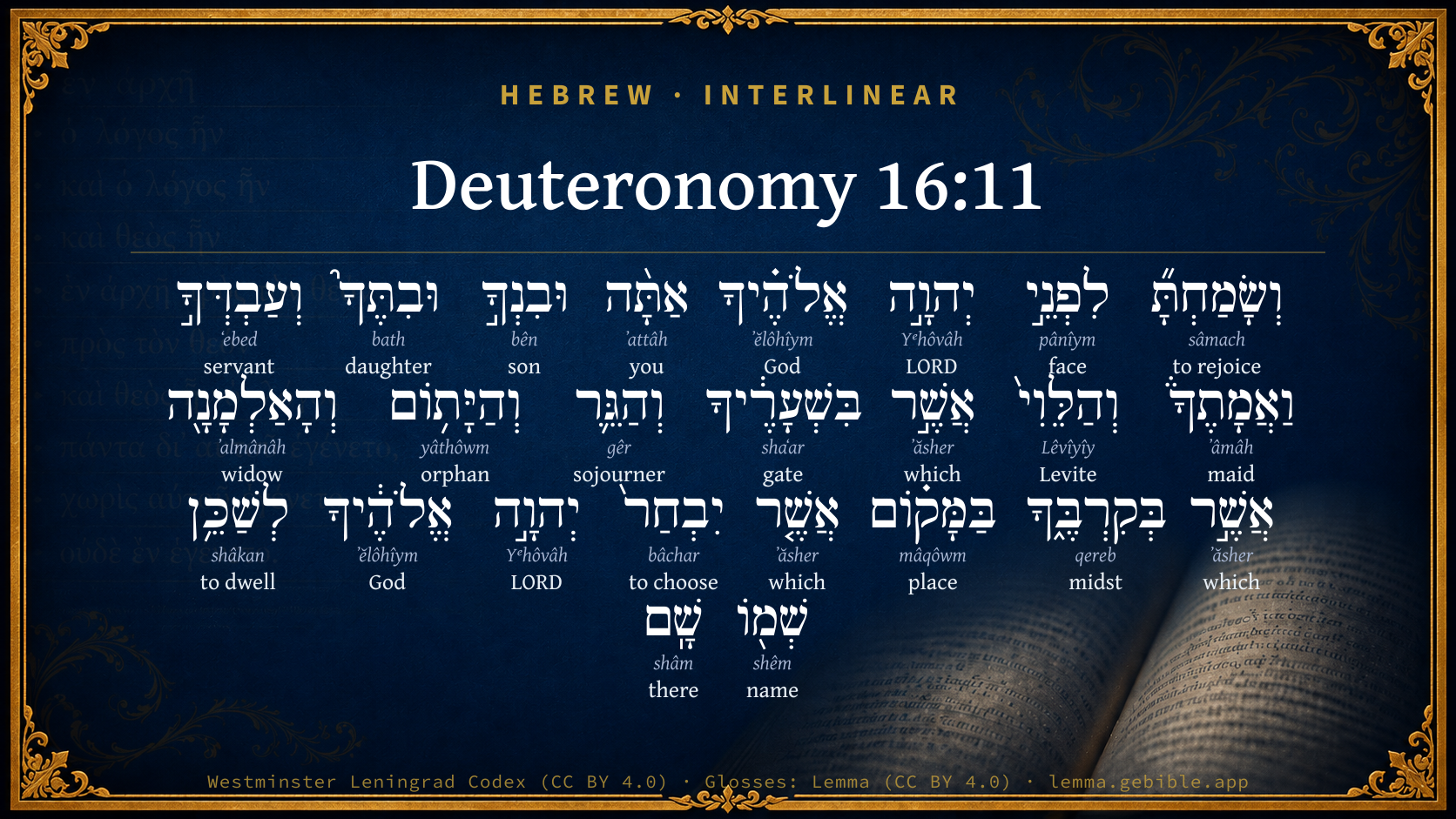
Hebrew (Westminster Leningrad Codex) Deuteronomy 16:11 appears in the Hebrew Old Testament. The text above is from the Westminster Leningrad Codex. Each word links to its Strong’s number, a concise gloss, and parsing drawn from the Open Scriptures Hebrew Bible morphology. Click any word for its full Brown-Driver-Briggs (BDB) entry.
Download image
Cite this verse

Deuteronomy 16:11 (World English Bible). Public Domain. Lemma interlinear Bible study tool, https://lemma.gebible.app/v/deuteronomy/16/11.

Show BibTeX & RIS
BibTeX
RIS
English Translation
and you shall rejoice before Yahweh your God, you, and your son, and your daughter, and your man-servant, and your maid-servant, and the Levite who is within your gates, and the foreigner, and the fatherless, and the widow, who are in the midst of you, in the place which Yahweh your God shall choose, to cause his name to dwell there.
World English Bible · Public Domain
Download a study sheet

One document with this verse’s original text, its word-by-word gloss line, the meaning frame, cross-references with their text, attributed commentary, and full source and license credits — printable, and it pastes into notes with its structure intact.

This verse Autodidact and up

Study sheet (.html) Plain text (.txt)

A passage Seminary Student

Up to 50 verses in one chapter. A passage sheet keeps up to 6 commentary sources and 12 cross-references per verse, in the order this page ranks them, and says so on the sheet whenever that leaves anything out. Ask for a single verse and you get the Autodidact verse sheet above.

Everything on this page stays free to read, with no account — the sheet is a download of what is already on screen, not access to it.

Want to remove ads? Support Godless Engineer
Compare translations 3

The same verse in 3 English versions, stacked beneath the original-language interlinear above. Click any original word for its lexicon entry.

Each is an independent rendering of the whole verse — the interlinear is not word-aligned to these translations.

Highlighted words mark where these versions differ — a whole-verse word diff, not a word-by-word alignment.

  • World English Bible Public Domain
    and you shall rejoice before Yahweh your God, you, and your son, and your daughter, and your man-servant, and your maid-servant, and the Levite who is within your gates, and the foreigner, and the fatherless, and the widow, who are in the midst of you, in the place which Yahweh your God shall choose, to cause his name to dwell there.
  • King James Version Public Domain
    And thou shalt rejoice before the LORD thy God, thou, and thy son, and thy daughter, and thy manservant, and thy maidservant, and the Levite that is within thy gates, and the stranger, and the fatherless, and the widow, that are among you, in the place which the LORD thy God hath chosen to place his name there.
  • unfoldingWord Literal Text CC BY-SA 4.0
    And you will rejoice to the face of Yahweh your God—you and your son and your daughter and your male servant and your female servant and the Levite who within your gates and the foreigner and the fatherless and the widow who among you, in the place that Yahweh your God will choose to make his name stay there.

unfoldingWord Literal Text — © unfoldingWord, licensed CC BY-SA 4.0. Word-aligned USFM3 via Door43 (git.door43.org/unfoldingWord/en_ult).

Versions to compare (up to 4)

3 of 4 selected

Show all 18 translations

Every available English version of this verse, each an independent rendering of the whole verse.

  • World English Bible Public Domain
    and you shall rejoice before Yahweh your God, you, and your son, and your daughter, and your man-servant, and your maid-servant, and the Levite who is within your gates, and the foreigner, and the fatherless, and the widow, who are in the midst of you, in the place which Yahweh your God shall choose, to cause his name to dwell there.
  • Berean Standard Bible Public Domain
    and you shall rejoice before the LORD your God in the place He will choose as a dwelling for His Name—you, your sons and daughters, your menservants and maidservants, and the Levite within your gates, as well as the foreigner, the fatherless, and the widows among you.
  • Majority Standard Bible Public Domain
    and you shall rejoice before the LORD your God in the place He will choose as a dwelling for His Name—you, your sons and daughters, your menservants and maidservants, and the Levite within your gates, as well as the foreigner, the fatherless, and the widows among you.
  • King James Version Public Domain
    And thou shalt rejoice before the LORD thy God, thou, and thy son, and thy daughter, and thy manservant, and thy maidservant, and the Levite that is within thy gates, and the stranger, and the fatherless, and the widow, that are among you, in the place which the LORD thy God hath chosen to place his name there.
  • American Standard Version (1901) Public Domain
    and thou shalt rejoice before Jehovah thy God, thou, and thy son, and thy daughter, and thy man-servant, and thy maid-servant, and the Levite that is within thy gates, and the sojourner, and the fatherless, and the widow, that are in the midst of thee, in the place which Jehovah thy God shall choose, to cause his name to dwell there.
  • Revised Version (1885) Public Domain
    and thou shalt rejoice before the LORD thy God, thou, and thy son, and thy daughter, and thy manservant, and thy maidservant, and the Levite that is within thy gates, and the stranger, and the fatherless, and the widow, that are in the midst of thee, in the place which the LORD thy God shall choose to cause his name to dwell there.
  • Geneva Bible (1599) Public Domain
    And thou shalt reioyce before the Lord thy God, thou and thy sonne, and thy daughter, and thy seruant, and thy maide, and the Leuite that is within thy gates, and the stranger, and the fatherles, and the widowe, that are among you, in the place which the Lord thy God shall chuse to place his Name there,
  • Douay-Rheims (1899) Public Domain
    And thou shalt feast before the Lord thy God, thou, and thy son, and thy daughter, and thy manservant, and thy maidservant, and the Levite that is within thy gates, and the stranger and the fatherless, and the widow, who abide with you: in the place which the Lord thy God shall choose, that his name may dwell there:
  • Young's Literal Translation Public Domain
    And thou hast rejoiced before Jehovah thy God, thou, and thy son, and thy daughter, and thy man-servant, and thy handmaid, and the Levite who `is' within thy gates, and the sojourner, and the fatherless, and the widow, who `are' in thy midst, in the place which Jehovah thy God doth choose to cause His name to tabernacle there,
  • Literal Standard Version CC BY-SA 4.0
    And you have rejoiced before your God YHWH, you, and your son, and your daughter, and your manservant, and your handmaid, and the Levite who [is] within your gates, and the sojourner, and the fatherless, and the widow, who [are] in your midst, in the place which your God YHWH chooses to cause His Name to dwell there,
  • Unlocked Literal Bible CC BY-SA 4.0
    You will rejoice before Yahweh your God—you, your son, your daughter, your male servant, your female servant, the Levite who is within your city gates, and the foreigner, the fatherless, and the widow who are among you, at the place that Yahweh your God will choose for his sanctuary.
  • unfoldingWord Literal Text CC BY-SA 4.0
    And you will rejoice to the face of Yahweh your God—you and your son and your daughter and your male servant and your female servant and the Levite who within your gates and the foreigner and the fatherless and the widow who among you, in the place that Yahweh your God will choose to make his name stay there.
  • Darby Bible Public Domain
    and thou shalt rejoice before Jehovah thy God, thou, and thy son, and thy daughter, and thy bondman, and thy handmaid, and the Levite that is in thy gates, and the stranger, and the fatherless, and the widow that are in thy midst in the place that Jehovah thy God will choose to cause his name to dwell there.
  • World Messianic Bible Public Domain
    You shall rejoice before the LORD your God: you, your son, your daughter, your male servant, your female servant, the Levite who is within your gates, the foreigner, the fatherless, and the widow who are among you, in the place which the LORD your God shall choose to cause his name to dwell there.
  • Webster's Bible Public Domain
    And thou shalt rejoice before the LORD thy God, thou, and thy son, and thy daughter, and thy man-servant, and thy maid-servant, and the Levite that is within thy gates, and the stranger, and the fatherless, and the widow, that are among you, in the place which the LORD thy God hath chosen to place his name there.
  • Free Bible Version CC BY-SA 4.0
    You will celebrate in the Lord's presence in the place where he will choose to live with you. This includes you, your sons and daughters, your male and female slaves, and the Levites who live in your towns, as well as the foreigners, orphans, and widows among you.
  • Bible in Basic English Public Domain
    Then you are to be glad before the Lord your God, you and your son and your daughter, your man-servant and your woman-servant, and the Levite who is with you, and the man from a strange country, and the child without a father, and the widow, who are living among you, in the place marked out by the Lord your God as a resting-place for his name.
  • JPS Tanakh (1917) Public Domain
    And thou shalt rejoice before the LORD thy God, thou, and thy son, and thy daughter, and thy man-servant, and thy maid-servant, and the Levite that is within they gates, and the stranger, and the fatherless, and the widow, that are in the midst of thee, in the place which the LORD thy God shall choose to cause His name to dwell there.

Literal Standard Version (2020), Covenant Press — licensed CC BY-SA 4.0. Text via the HelloAO Bible API (eBible.org). Unlocked Literal Bible (unfoldingWord) — licensed CC BY-SA 4.0. Text via the HelloAO Bible API (eBible.org). unfoldingWord Literal Text — © unfoldingWord, licensed CC BY-SA 4.0. Word-aligned USFM3 via Door43 (git.door43.org/unfoldingWord/en_ult). Free Bible Version, Dr. Jonathan Gallagher — licensed CC BY-SA 4.0. Text via the HelloAO Bible API (eBible.org).

Word by word

More ways to search: Search by grammar → Find every occurrence → Compare this word →

Practice this passage: Drill this verse → Learn its vocabulary →

וְהַיָּת֥וֹם
yâthôwm
H3490
“and · the · orphan”
Conjunction + Particle, Definite Article + Noun, Common, Masculine, Singular, Absolute
Part of Speech
Conjunction + Particle + Noun
Type
Common
Gender
Masculine
Number
Singular
State
Absolute
Full BDB Definition

Origin: from an unused root meaning to be lonely

TWOT: 934a

an orphan, fatherless
  1. וְשָׂמַחְתָּ֞ sâmach H8055 “and · to rejoice” Conjunction + Verb, Qal, Sequential Perfect, 2nd Person, Masculine, Singular
  2. לִפְנֵ֣י pânîym H6440 “to/for · face(s) of” Preposition + Noun, Common, Both, Plural, Construct
  3. יְהוָ֣ה Yᵉhôvâh H3068 “LORD” Noun, Proper
  4. אֱלֹהֶ֗יךָ ʼĕlôhîym H430 “God(s) · your” Noun, Common, Masculine, Plural, Construct + Suffix, Personal, 2nd Person, Masculine, Singular
  5. אַתָּ֨ה ʼattâh H859 “you” Pronoun, Personal, 2nd Person, Masculine, Singular
  6. וּבִנְךָ֣ bên H1121 “and · son · your” Conjunction + Noun, Common, Masculine, Singular, Construct + Suffix, Personal, 2nd Person, Masculine, Singular
  7. וּבִתֶּךָ֮ bath H1323 “and · daughter · your” Conjunction + Noun, Common, Feminine, Singular, Construct + Suffix, Personal, 2nd Person, Masculine, Singular
  8. וְעַבְדְּךָ֣ ʻebed H5650 “and · servant · your” Conjunction + Noun, Common, Masculine, Singular, Construct + Suffix, Personal, 2nd Person, Masculine, Singular
  9. וַאֲמָתֶךָ֒ ʼâmâh H519 “and · maid · your” Conjunction + Noun, Common, Feminine, Singular, Construct + Suffix, Personal, 2nd Person, Masculine, Singular
  10. וְהַלֵּוִי֙ Lêvîyîy H3881 “and · the · Levite” Conjunction + Particle, Definite Article + Noun, Gentilic, Masculine, Singular, Absolute
  11. אֲשֶׁ֣ר ʼăsher H834 “which” Particle, Relative
  12. בִּשְׁעָרֶ֔יךָ shaʻar H8179 “in/at · gates · your” Preposition + Noun, Common, Masculine, Plural, Construct + Suffix, Personal, 2nd Person, Masculine, Singular
  13. וְהַגֵּ֛ר gêr H1616 “and · the · sojourner” Conjunction + Particle, Definite Article + Noun, Common, Masculine, Singular, Absolute
  14. וְהָאַלְמָנָ֖ה ʼalmânâh H490 “and · the · widow” Conjunction + Particle, Definite Article + Noun, Common, Feminine, Singular, Absolute
  15. אֲשֶׁ֣ר ʼăsher H834 “which” Particle, Relative
  16. בְּקִרְבֶּ֑ךָ qereb H7130 “in/at · midst · your” Preposition + Noun, Common, Masculine, Singular, Construct + Suffix, Personal, 2nd Person, Masculine, Singular
  17. בַּמָּק֗וֹם mâqôwm H4725 “in/at the · place” Preposition, Determined + Noun, Common, Masculine, Singular, Absolute
  18. אֲשֶׁ֤ר ʼăsher H834 “which” Particle, Relative
  19. יִבְחַר֙ bâchar H977 “to choose” Verb, Qal, Imperfect, 3rd Person, Masculine, Singular
  20. יְהוָ֣ה Yᵉhôvâh H3068 “LORD” Noun, Proper
  21. אֱלֹהֶ֔יךָ ʼĕlôhîym H430 “God(s) · your” Noun, Common, Masculine, Plural, Construct + Suffix, Personal, 2nd Person, Masculine, Singular
  22. לְשַׁכֵּ֥ן shâkan H7931 “to dwell” Preposition + Verb, Piel, Infinitive Construct
  23. שְׁמ֖וֹ shêm H8034 “name · his” Noun, Common, Masculine, Singular, Construct + Suffix, Personal, 3rd Person, Masculine, Singular
  24. שָֽׁם shâm H8033 “there” Adverb

About this verse

These counts appear in no published source. They are computed here, from the morphology-tagged text and Lemma’s own curated glosses. What Lemma adds →

25
words
21
distinct lemmas
Pentateuch
section

Shared distinctive vocabulary

וְהַיָּת֥וֹם orphan H3490 occurs in 42 verses of the Hebrew Bible. Also found in:

Grammatical profile

  • 3 verbs
  • 17 nouns
  • 1 pronoun
  • 1 adverb
  • 3 particles

Verb forms

  • וְשָׂמַחְתָּ֞ Qal · Sequential Perfect
  • יִבְחַר֙ Qal · Imperfect
  • לְשַׁכֵּ֥ן Piel · Infinitive Construct

Repetition

Words recur within this verse — often emphatic in Hebrew:

  • יְהוָ֣ה LORD H3068 ×2
  • אֱלֹהֶ֗יךָ God H430 ×2
  • אֲשֶׁ֣ר which H834 ×3

Hebrew & Septuagint length

In English translation the verse runs 61 words from the Hebrew and 53 from the Septuagint (LXX English) — closely comparable.

A rough comparison of the two English renderings, which tokenize alike — not a word-level alignment.

Word counts can differ between the Hebrew and the Greek without any difference in meaning — e.g. the Hebrew direct-object marker אֵת has no separate Greek word, and Greek often adds the article ὁ.

Cross-references

10

Topical passages linked to Deuteronomy 16:11 in the Treasury of Scripture Knowledge — connected by theme and wording, ordered by reader-vote popularity; previews shown in the World English Bible.

  • Deuteronomy 12:7 and there you shall eat before Yahweh your God, and you shall rejoice in all that you put your hand to, you and your households, in which Yahweh your God has blessed you.
  • Deuteronomy 12:12 You shall rejoice before Yahweh your God, you, and your sons, and your daughters, and your men-servants, and your maid-servants, and the Levite who is within your gates, because he has no portion nor inheritance with you.
  • Deuteronomy 12:18 but you shall eat them before Yahweh your God in the place which Yahweh your God shall choose, you, and your son, and your daughter, and your man-servant, and your maid-servant, and the Levite who is within your gates: and you shall rejoice before Yahweh your God in all that you put your hand to.
  • Deuteronomy 16:14 and you shall rejoice in your feast, you, and your son, and your daughter, and your man-servant, and your maid-servant, and the Levite, and the foreigner, and the fatherless, and the widow, who are within your gates.
  • Isaiah 64:5 You meet him who rejoices and works righteousness, those who remember you in your ways: behold, you were angry, and we sinned: in them [have we been] of long time; and shall we be saved?
  • Isaiah 66:10–14 Rejoice you with Jerusalem, and be glad for her, all you who love her: rejoice for joy with her, all you who mourn over her;
  • Habakkuk 3:18 Yet I will rejoice in Yahweh. I will be joyful in the God of my salvation!
  • Romans 5:11 Not only so, but we also rejoice in God through our Lord Jesus Christ, through whom we have now received the reconciliation.
  • 2 Corinthians 1:24 Not that we have lordship over your faith, but are fellow workers with you for your joy. For you stand firm in faith.
  • Philippians 4:4 Rejoice in the Lord always! Again I will say, Rejoice!

Cross-references courtesy of OpenBible.info (CC BY 4.0).

Hebrew and Greek witnesses Masoretic Hebrew ↔ Greek Septuagint

The same verse in the two great witnesses to the Old Testament, shown verse-for-verse.

These are two independent witnesses, not word-aligned to each other, and the Septuagint is shown in lemma (dictionary) form.

Hebrew Deuteronomy 16:11 Masoretic · Westminster Leningrad Codex

וְשָׂמַחְתָּ֞ לִפְנֵ֣י יְהוָ֣ה אֱלֹהֶ֗יךָ אַתָּ֨ה וּבִנְךָ֣ וּבִתֶּךָ֮ וְעַבְדְּךָ֣ וַאֲמָתֶךָ֒ וְהַלֵּוִי֙ אֲשֶׁ֣ר בִּשְׁעָרֶ֔יךָ וְהַגֵּ֛ר וְהַיָּת֥וֹם וְהָאַלְמָנָ֖ה אֲשֶׁ֣ר בְּקִרְבֶּ֑ךָ בַּמָּק֗וֹם אֲשֶׁ֤ר יִבְחַר֙ יְהוָ֣ה אֱלֹהֶ֔יךָ לְשַׁכֵּ֥ן שְׁמ֖וֹ שָֽׁם

and you shall rejoice before Yahweh your God, you, and your son, and your daughter, and your man-servant, and your maid-servant, and the Levite who is within your gates, and the foreigner, and the fatherless, and the widow, who are in the midst of you, in the place which Yahweh your God shall choose, to cause his name to dwell there.

World English Bible · Public Domain

Greek LXX Deuteronomy 16:11 Septuagint · lemma form

καί εὐφραίνω ἐναντίον κύριος ὁ θεός σύ σύ καί ὁ υἱός σύ καί ὁ θυγάτηρ σύ ὁ παῖς σύ καί ὁ παιδίσκη σύ καί ὁ λευίτης ὁ ἐν ὁ πόλις σύ καί ὁ προσήλυτος καί ὁ ὀρφανός καί ὁ χήρα ὁ ἐν σύ ἐν ὁ τόπος ὅς ἐάν ἐκλέγω κύριος ὁ θεός σύ ἐπικαλέω ὁ ὄνομα αὐτός ἐκεῖ

And you shall rejoice before the Lord your God, you and your son, and your daughter, your man-servant and your maidservant, and the Levite, and the stranger, and the orphan, and the widow which dwells among you, in whatever place the Lord your God shall choose, that his name should be called there.

LXX2012 (modern English Septuagint) · Public Domain

Hebrew: Westminster Leningrad Codex (CC BY 4.0). Greek: Septuagint (public domain); English from LXX2012 (modern English Septuagint) (Public Domain). How the Septuagint differs from the Hebrew →

Targum (Aramaic paraphrase)

2

The Targum is the ancient Jewish Aramaic paraphrase of the Hebrew Scriptures — an interpretive translation, not the Hebrew text itself. Onkelos (literal) and Pseudo-Jonathan (expansive) render the Torah, and Jonathan the Prophets. Coverage is partial: where no permissively-licensed English translation exists for a verse, only the Aramaic is shown. This is verse-level text, not a word-by-word alignment to the Hebrew.

  1. Targum Onkelos Torah (Genesis–Deuteronomy)
    וְתֶחֱדֵי קֳדָם יְיָ אֱלָהָךְ אַתְּ וּבְרָךְ וּבְרַתָּךְ וְעַבְדָךְ וְאַמְתָךְ וְלֵוָאָה דִי בְקִרְוָיךְ וְגִיוֹרָא וְיִתַּמָא וְאַרְמְלָא דִי בֵינָךְ בְּאַתְרָא דִי יִתִּרְעֵי יְיָ אֱלָהָךְ לְאַשְׁרָאָה שְׁכִנְתֵּהּ תַּמָן

    (no public-domain English translation for this verse)

    Targum Onkelos — Aramaic: “Onkelos Genesis” (public domain); “Onkelos Exodus” (public domain); “Onkelos Leviticus” (public domain); “Onkelos Numbers” (public domain); “Onkelos Deuteronomy” (public domain). English: “Sefaria Community Translation” (CC0 1.0 (public-domain dedication)); “J.W. Etheridge. The Targums of Onkelos and Jonathan Ben Uzziel on the Pentateuch. London: Longmans, Green, 1862” (public domain). Text via Sefaria.

  2. Targum Pseudo-Jonathan Torah (Genesis–Deuteronomy)
    וְתֵיחְדוּן בְּחֶדְוַת חַגָא קֳדָם יְיָ אֱלָהָכוֹן אַתּוּן וּבְנֵיכוֹן וּבְנָתֵיכוֹן וְעַבְדֵיכוֹן וְאַמְהָתֵיכוֹן וְלֵוָאֵי דִי בְקִרְוֵיכוֹן וְגִיּוֹרָא וְיַתְמָא וְאַרְמַלְתָּא דִי בֵינֵיכוֹן בְּאַתְרָא דְיִתְרְעֵי יְיָ אֱלָהָכוֹן לְאַשְׁרָאָה שְׁכִינְתֵּיהּ תַּמָּן

    And you shall rejoice with the joy of the feast before the Lord your God, you and your sons, your daughters, your servants and handmaids, the Levites who are in your cities, and the stranger, the orphan, and the widow who are among you, at the place which the Lord your God will choose where to make His Shekinah to dwell.

    Targum Pseudo-Jonathan — Aramaic: “Targum Jonathan on Genesis” (public domain); “Targum Jonathan on Exodus” (public domain); “Targum Jonathan on Leviticus” (public domain); “Targum Jonathan on Numbers” (public domain); “Targum Jonathan on Deuteronomy” (public domain). English: “The Targum of Jonathan ben Uzziel, trans. J. W. Etheridge, London, 1862” (public domain). Text via Sefaria.

Commentary

Notes on Deuteronomy 16:11 from classic Christian and Jewish commentators (each source and its license shown beneath its notes). The classic Christian expositions comment on the surrounding passage and are grouped to its opening verse, so a note may address several verses; the Jewish commentaries on the Tanakh (Rashi and others) are per-verse, so they appear only where the commentator wrote on this verse.

Lemma curates 59 commentaries, every one of them public domain or Creative Commons licensed, each selected and text-cleaned for this edition rather than reprinted as found. About our sources →

Adam Clarke's Commentary

Verse 11. Thou shalt rejoice] The offerings of the Israelites were to be eaten with festivity, communicated to their friends with liberality, and bestowed on the poor with great generosity, that they might partake with them in these repasts with joy before the Lord. To answer these views it was necessary to eat the flesh while it was fresh, as in that climate putrefaction soon took place; therefore they were commanded to let nothing remain until the morning, De 16:4. This consideration is sufficient to account for the command here, without having recourse to those moral and evangelical reasons that are assigned by the learned and devout Mr. Ainsworth for the command. How beneficent and cheerful is the design of this institution! - Harmer, vol. i., p. 396.

Adam Clarke's Commentary on the Bible (1810–1826) — public domain. Text from a community e-Sword/MySword module.

The Cambridge Bible for Schools and Colleges

gen. ed. J. J. S. Perowne

11. See on Deu_12:5; Deu_12:7; Deu_12:11 f, 18.

The Cambridge Bible for Schools and Colleges (gen. ed. J. J. S. Perowne; Cambridge University Press, 1878–1918) — public domain. Text from a community e-Sword module.

John Gill's Exposition

And thou shalt rejoice before the Lord thy God,.... Make a liberal feast, and keep it cheerfully, in the presence of God, in the place where he resides, thankfully acknowledging all his mercies and favours:

thou, and thy son, and thy manservant, and thy maidservant, and the Levite that is within thy gates; that dwelt in the same city, who were all to come with him to Jerusalem at this feast, and to partake of it with him:

and the stranger, and the fatherless, and the widow, that are among you, in the place which the Lord thy God hath chosen to place his name there; who should be at Jerusalem at this time.

John Gill's Exposition of the Whole Bible (1746–1763) — public domain (CC PDM 1.0). Text via the HelloAO Bible API.

The Pulpit Commentary

Rejoice before the Lord. "The expression, to rejoice before the Lord, denotes here nothing else than to honor him by sacred songs; comp. Spencer, "De Legg. Hebrews Ritual.," p. 881, edit. 3" (Havernick, "Introd.," p. 157). In the place which the Lord thy God hath chosen to place his name there; rather, shall choose, as in ver. 15.

The Pulpit Commentary (1880–1919), ed. H.D.M. Spence-Jones & Joseph S. Exell — public domain. Text from a community e-Sword module.

unfoldingWord translationNotes

Door43 World Missions Community

your son, your daughter, your male servant, your female servant, the Levite

These do not refer to a specific person. It means these types of people in general. AT: "your sons, your daughters, your male servants, your females servants, any Levite" (See: Generic Noun Phrases)

within your city gates

Here "gates" represents cities or towns. AT: "within your towns" (See: Synecdoche)

the foreigner, the fatherless, and the widow

This refers to these types of people in general. AT: "all foreigners, orphans, and widows" (See: Generic Noun Phrases)

fatherless

These are children whose parents have both died and do not have relatives to care for them.

widow

This means a woman whose husband has died and has no children to care for her in her old age.

call to mind

This is an idiom. AT: "remember" (See: Idiom)

translationWords

joy

servant

Levi

gate

alien

sanctuary

call

mind

Egypt

statute

unfoldingWord translationNotes — © Distant Shores Media and the Door43 World Missions Community, licensed CC BY-SA 4.0. Source: git.door43.org/Door43/en_tn.

Rashi

Rabbi Shlomo Yitzchaki (Rashi)

לוי גר יתום ואלמנה THE LEVITE THE STRANGER, THE FATHERLESS, THE WIDOW — these four are Mine, corresponding to four that are yours, viz., בנך ובתך ועבדך ואמתך THY SON, THY DAUGHTER, THY MAN-SERVANT AND THY MAID-SERVANT; if you gladden Mine, I will gladden yours (Midrash Tanchuma, Re'eh 18).

Rashi on the Tanakh — English translations: “The Judaica Press complete Tanach with Rashi, translated by A. J. Rosenberg” (CC BY 4.0); “Pentateuch with Rashi's commentary by M. Rosenbaum and A.M. Silbermann, 1929-1934” (public domain); “The Metsudah Tanach series, Lakewood, N.J” (CC BY 4.0); and “The Book of Joshua, Metsudah Publications, 1997” (CC BY 4.0). Text via Sefaria.

Ramban (Nachmanides)

Rabbi Moshe ben Nachman (Ramban / Nachmanides)

He mentions here [that you are to rejoice] in the place which the Eternal thy G-d shall choose to cause His Name to dwell there, and likewise he said, Three times in a year shall all thy males appear before the Eternal thy G-d in the place which He shall choose. Now, I do not know whether this is to state that after the Sanctuary will be built we should not assemble to bring the festival-offerings except in that place which G-d has chosen, similar to what he said, Thou mayest not sacrifice the Passover-offering within any of thy gates, etc. or that he is explaining here that they are not obligated to go up in pilgrimage on the festivals until such time as G-d will have chosen the place to dwell there.

Ramban (Nachmanides) on the Tanakh — English translation: “Commentary on the Torah by Ramban (Nachmanides). Translated and annotated by Charles B. Chavel. New York, Shilo Pub. House, 1971-1976” (CC BY 4.0). Text via Sefaria.

Lesson kit

Teaching starters — assembled from the data on this page, not authored interpretation. Every prompt links to the verse data it draws on. Edit before teaching.

Deuteronomy, in the Pentateuch, opens this verse with 25 words (21 distinct Hebrew lemmas). Its most distinctive word is yâthôwm (“orphan”). A historical commentator’s framing appears above. Read the whole chapter for the surrounding context.

Discussion questions

  1. The word yâthôwm carries the sense “orphan.” How does it shape the verse?
  2. Exodus 22:22 shares the word «orphan» with this verse. How do the two illuminate each other?
  3. “LORD” occurs 2× in this one verse. What is the effect of the repetition?
  4. These translations render this verse differently; the difference is in the English rendering, not the original. What questions does that raise?
  5. The verb «וְשָׂמַחְתָּ֞» is Qal Sequential Perfect. How does its form color the action?
  6. Reading how Adam Clarke's Commentary and The Cambridge Bible for Schools and Colleges read this verse, where do the two commentators agree and where do they part?

Things to notice

Reading settings

Reading text

Shown beneath each verse's original-language words.

Old Testament
Old Testament edition

Read the OT as the Masoretic Hebrew (MT) or the Greek Septuagint (LXX).

English shown for the Greek Septuagint (in the Hebrew ↔ Greek comparison).

Comparing translations? Open the Compare panel on any verse page to stack up to four side by side.