
Joshua 2:7

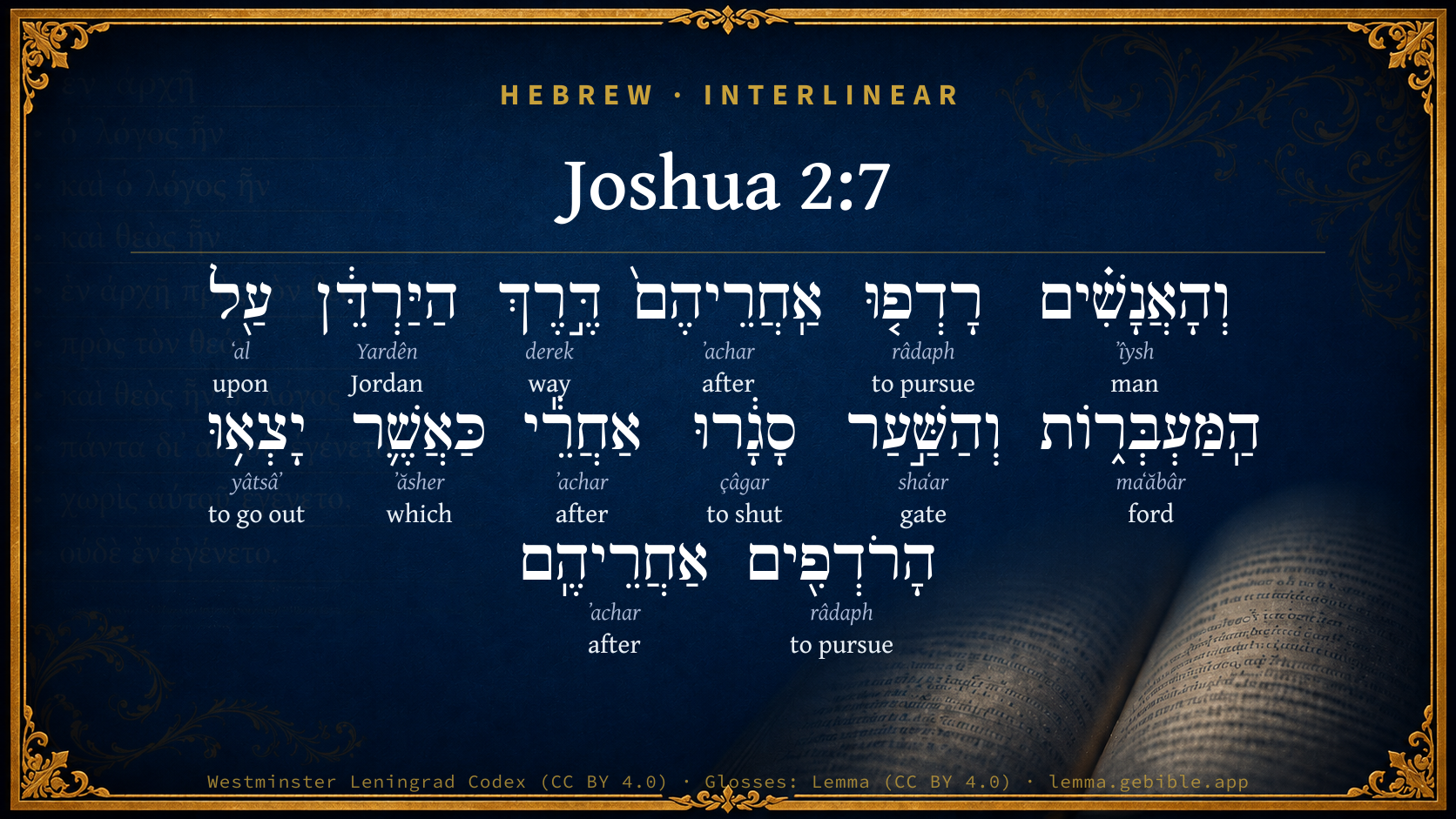
Hebrew (Westminster Leningrad Codex) Joshua 2:7 appears in the Hebrew Old Testament. The text above is from the Westminster Leningrad Codex. Each word links to its Strong’s number, a concise gloss, and parsing drawn from the Open Scriptures Hebrew Bible morphology. Click any word for its full Brown-Driver-Briggs (BDB) entry.
Download image
Cite this verse

Joshua 2:7 (World English Bible). Public Domain. Lemma interlinear Bible study tool, https://lemma.gebible.app/v/joshua/2/7.

Show BibTeX & RIS
BibTeX
RIS
English Translation
The men pursued after them the way to the Jordan to the fords: and as soon as those who pursued after them were gone out, they shut the gate.
World English Bible · Public Domain
Download a study sheet

One document with this verse’s original text, its word-by-word gloss line, the meaning frame, cross-references with their text, attributed commentary, and full source and license credits — printable, and it pastes into notes with its structure intact.

This verse Autodidact and up

Study sheet (.html) Plain text (.txt)

A passage Seminary Student

Up to 50 verses in one chapter. A passage sheet keeps up to 6 commentary sources and 12 cross-references per verse, in the order this page ranks them, and says so on the sheet whenever that leaves anything out. Ask for a single verse and you get the Autodidact verse sheet above.

Everything on this page stays free to read, with no account — the sheet is a download of what is already on screen, not access to it.

Want to remove ads? Support Godless Engineer
Compare translations 3

The same verse in 3 English versions, stacked beneath the original-language interlinear above. Click any original word for its lexicon entry.

Each is an independent rendering of the whole verse — the interlinear is not word-aligned to these translations.

Highlighted words mark where these versions differ — a whole-verse word diff, not a word-by-word alignment.

  • World English Bible Public Domain
    The men pursued after them the way to the Jordan to the fords: and as soon as those who pursued after them were gone out, they shut the gate.
  • King James Version Public Domain
    And the men pursued after them the way to Jordan unto the fords: and as soon as they which pursued after them were gone out, they shut the gate.
  • unfoldingWord Literal Text CC BY-SA 4.0
    So the men pursued after them the road of the Jordan to the fords. And they shut the gate after when the pursuers had gone out after them.

unfoldingWord Literal Text — © unfoldingWord, licensed CC BY-SA 4.0. Word-aligned USFM3 via Door43 (git.door43.org/unfoldingWord/en_ult).

Versions to compare (up to 4)

3 of 4 selected

Show all 18 translations

Every available English version of this verse, each an independent rendering of the whole verse.

  • World English Bible Public Domain
    The men pursued after them the way to the Jordan to the fords: and as soon as those who pursued after them were gone out, they shut the gate.
  • Berean Standard Bible Public Domain
    So the king’s men set out in pursuit of the spies along the road to the fords of the Jordan, and as soon as they had gone out, the gate was shut.
  • Majority Standard Bible Public Domain
    So the king’s men set out in pursuit of the spies along the road to the fords of the Jordan, and as soon as they had gone out, the gate was shut.
  • King James Version Public Domain
    And the men pursued after them the way to Jordan unto the fords: and as soon as they which pursued after them were gone out, they shut the gate.
  • American Standard Version (1901) Public Domain
    And the men pursued after them the way to the Jordan unto the fords: and as soon as they that pursued after them were gone out, they shut the gate.
  • Revised Version (1885) Public Domain
    And the men pursued after them the way to Jordan unto the fords: and as soon as they which pursued after them were gone out, they shut the gate.
  • Geneva Bible (1599) Public Domain
    And certaine men pursued after them, the way to Iorden, vnto the foordes, and as soone as they which pursued after them, were gone out, they shut the gate.
  • Douay-Rheims (1899) Public Domain
    Now they that were sent, pursued after them, by the way that leadeth to the fords of the Jordan: and as soon as they were gone out, the gate was presently shut.
  • Young's Literal Translation Public Domain
    And the men have pursued after them the way of the Jordan, by the fords, and the gate they have shut afterwards, when the pursuers have gone out after them.
  • Literal Standard Version CC BY-SA 4.0
    And the men have pursued after them the way of the Jordan, by the fords, and they have shut the gate afterward when the pursuers have gone out after them.
  • Unlocked Literal Bible CC BY-SA 4.0
    So the men pursued them on the road that leads to the fords of the Jordan. The gate was shut as soon as the pursuers went out.
  • unfoldingWord Literal Text CC BY-SA 4.0
    So the men pursued after them the road of the Jordan to the fords. And they shut the gate after when the pursuers had gone out after them.
  • Darby Bible Public Domain
    And the men pursued after them the way to the Jordan, to the fords; and when they who pursued after them had gone out, they closed the gate.
  • World Messianic Bible Public Domain
    The men pursued them along the way to the fords of the Jordan River. As soon as those who pursued them had gone out, they shut the gate.
  • Webster's Bible Public Domain
    And the men pursued them the way to Jordan to the fords: and as soon as they who pursued them had gone out, they shut the gate.
  • Free Bible Version CC BY-SA 4.0
    The king's messengers went chasing after the men down the road that leads to the Jordan River fords. As soon as the pursuers had left, the city gate was shut behind them.
  • Bible in Basic English Public Domain
    So the men went after them on the road to Jordan as far as the river-crossing: and when they had gone out after them, the door into the town was shut.
  • JPS Tanakh (1917) Public Domain
    And the men pursued after them the way to the Jordan unto the fords; and as soon as they that pursued after them were gone out, the gate was shut.

Literal Standard Version (2020), Covenant Press — licensed CC BY-SA 4.0. Text via the HelloAO Bible API (eBible.org). Unlocked Literal Bible (unfoldingWord) — licensed CC BY-SA 4.0. Text via the HelloAO Bible API (eBible.org). unfoldingWord Literal Text — © unfoldingWord, licensed CC BY-SA 4.0. Word-aligned USFM3 via Door43 (git.door43.org/unfoldingWord/en_ult). Free Bible Version, Dr. Jonathan Gallagher — licensed CC BY-SA 4.0. Text via the HelloAO Bible API (eBible.org).

Word by word

More ways to search: Search by grammar → Find every occurrence → Compare this word →

Practice this passage: Drill this verse → Learn its vocabulary →

הַֽמַּעְבְּר֑וֹת
maʻăbâr
H4569
“the · fords”
Particle, Definite Article + Noun, Common, Feminine, Plural, Absolute
Part of Speech
Particle + Noun
Type
Common
Gender
Feminine
Number
Plural
State
Absolute
Full BDB Definition

Origin: from H5674

TWOT: 1556h

ford, pass, passing - ford - pass - passing, sweep
  1. וְהָאֲנָשִׁ֗ים ʼîysh H376 “and · the · men” Conjunction + Particle, Definite Article + Noun, Common, Masculine, Plural, Absolute
  2. רָדְפ֤וּ râdaph H7291 “to pursue” Verb, Qal, Perfect, 3rd Person, Common, Plural
  3. אַֽחֲרֵיהֶם֙ ʼachar H310 “after · them” Preposition + Suffix, Personal, 3rd Person, Masculine, Plural
  4. דֶּ֣רֶךְ derek H1870 “way of” Noun, Common, Both, Singular, Construct
  5. הַיַּרְדֵּ֔ן Yardên H3383 “the · Jordan” Particle, Definite Article + Noun, Proper
  6. עַ֖ל ʻal H5921 “upon” Preposition
  7. וְהַשַּׁ֣עַר shaʻar H8179 “and · the · gate” Conjunction + Particle, Definite Article + Noun, Common, Masculine, Singular, Absolute
  8. סָגָ֔רוּ çâgar H5462 “to shut” Verb, Qal, Perfect, 3rd Person, Common, Plural
  9. אַחֲרֵ֕י ʼachar H310 “after” Preposition
  10. כַּאֲשֶׁ֛ר ʼăsher H834 “like/as · which” Preposition + Particle, Relative
  11. יָצְא֥וּ yâtsâʼ H3318 “to go out” Verb, Qal, Perfect, 3rd Person, Common, Plural
  12. הָרֹדְפִ֖ים râdaph H7291 “the · pursuing” Particle, Definite Article + Verb, Qal, Participle Active, Masculine, Plural, Absolute
  13. אַחֲרֵיהֶֽם ʼachar H310 “after · them” Preposition + Suffix, Personal, 3rd Person, Masculine, Plural

About this verse

These counts appear in no published source. They are computed here, from the morphology-tagged text and Lemma’s own curated glosses. What Lemma adds →

14
words
11
distinct lemmas
Historical
section

Notable vocabulary

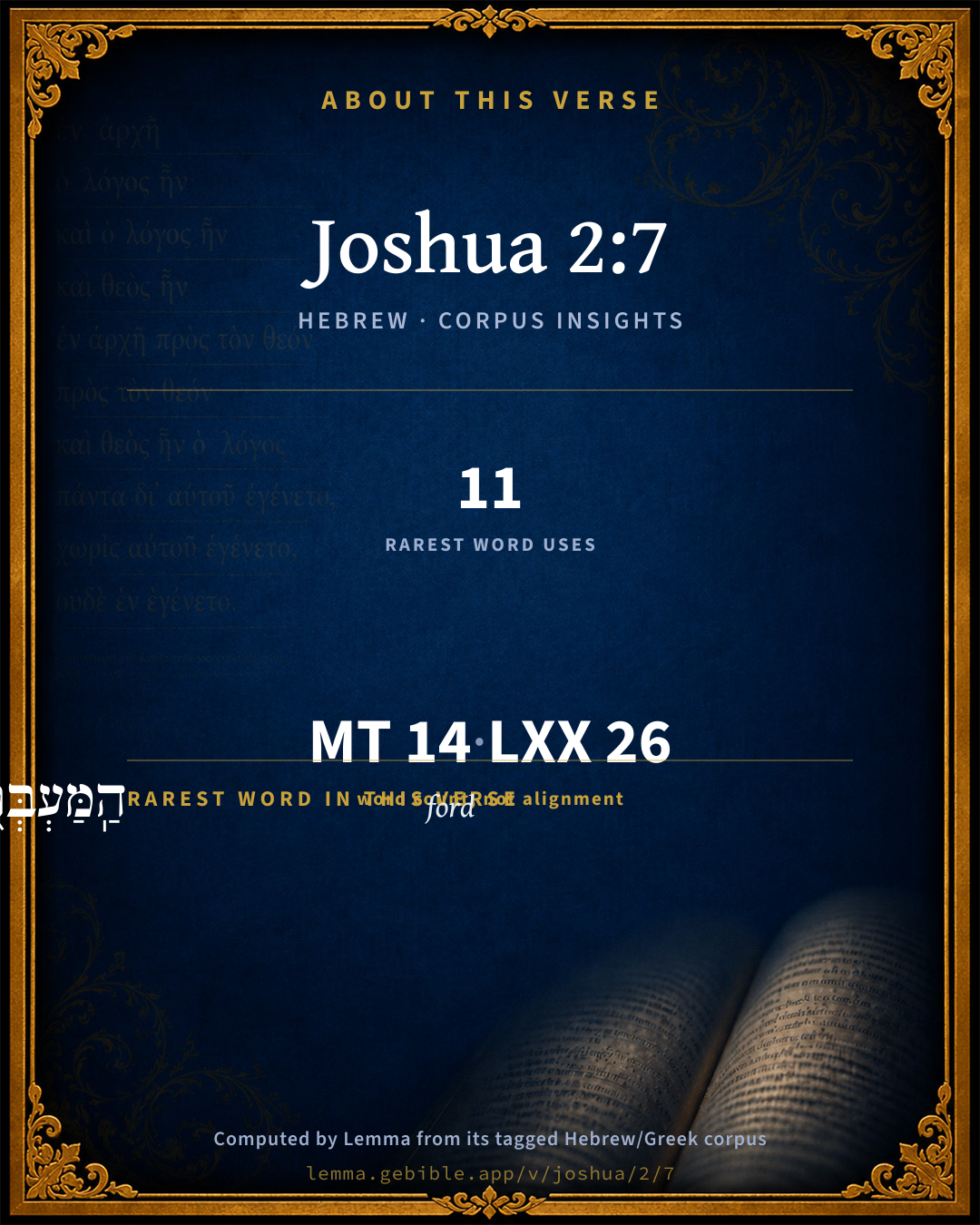
The rarest word here is הַֽמַּעְבְּר֑וֹת ford H4569 — appearing just 11 times in the whole Hebrew Bible.

Shared distinctive vocabulary

הַֽמַּעְבְּר֑וֹת ford H4569 occurs in 11 verses of the Hebrew Bible. Also found in:

Grammatical profile

  • 4 verbs
  • 5 nouns
  • 4 prepositions
  • 1 particle

Verb forms

  • רָדְפ֤וּ Qal · Perfect
  • סָגָ֔רוּ Qal · Perfect
  • יָצְא֥וּ Qal · Perfect
  • הָרֹדְפִ֖ים Qal · Participle Active

Repetition

Words recur within this verse — often emphatic in Hebrew:

  • אַֽחֲרֵיהֶם֙ after H310 ×3
  • רָדְפ֤וּ to pursue H7291 ×2

Hebrew & Septuagint length

In English translation the verse runs 29 words from the Hebrew and 19 from the Septuagint (LXX English) — the Septuagint runs noticeably shorter here. See the side-by-side →

A rough comparison of the two English renderings, which tokenize alike — not a word-level alignment.

Word counts can differ between the Hebrew and the Greek without any difference in meaning — e.g. the Hebrew direct-object marker אֵת has no separate Greek word, and Greek often adds the article ὁ.

In the original languages it is 14 Hebrew tokens and 26 Greek tokens — but the two are counted differently (Hebrew bundles its prefixes and suffixes into one token; the Greek is in lemma form), so that isn’t a like-for-like length.

Cross-references

4

Topical passages linked to Joshua 2:7 in the Treasury of Scripture Knowledge — connected by theme and wording, ordered by reader-vote popularity; previews shown in the World English Bible.

  • Judges 3:28 He said to them, Follow after me; for Yahweh has delivered your enemies the Moabites into your hand. They went down after him, and took the fords of the Jordan against the Moabites, and didn't allow a man to pass over.
  • Joshua 2:5 and it happened about the time of the shutting of the gate, when it was dark, that the men went out; where the men went I don't know: pursue after them quickly; for you will overtake them.
  • Judges 12:5 The Gileadites took the fords of the Jordan against the Ephraimites. It was so, that when [any of] the fugitives of Ephraim said, Let me go over, the men of Gilead said to him, Are you an Ephraimite? If he said, No;
  • Acts 5:23 "We found the prison shut and locked, and the guards standing before the doors, but when we opened them, we found no one inside!"

Cross-references courtesy of OpenBible.info (CC BY 4.0).

Hebrew and Greek witnesses Masoretic Hebrew ↔ Greek Septuagint

The same verse in the two great witnesses to the Old Testament, shown verse-for-verse.

Here the Septuagint runs noticeably shorter than the Hebrew — LXX2012 (modern English Septuagint) 19 words vs World English Bible 29. A rough length comparison of the two English translations, not a word-level alignment — read both below.

These are two independent witnesses, not word-aligned to each other, and the Septuagint is shown in lemma (dictionary) form.

Hebrew Joshua 2:7 Masoretic · Westminster Leningrad Codex

וְהָאֲנָשִׁ֗ים רָדְפ֤וּ אַֽחֲרֵיהֶם֙ דֶּ֣רֶךְ הַיַּרְדֵּ֔ן עַ֖ל הַֽמַּעְבְּר֑וֹת וְהַשַּׁ֣עַר סָגָ֔רוּ אַחֲרֵ֕י כַּאֲשֶׁ֛ר יָצְא֥וּ הָרֹדְפִ֖ים אַחֲרֵיהֶֽם

The men pursued after them the way to the Jordan to the fords: and as soon as those who pursued after them were gone out, they shut the gate.

World English Bible · Public Domain

Greek LXX Joshua 2:7 Septuagint · lemma form

καί ὁ ἀνήρ καταδιώκω ὀπίσω αὐτός ὁδός ὁ ἐπί ὁ ἰορδάνης ἐπί ὁ διάβασις καί ὁ πύλη κλείω καί γίγνομαι ὡς ἐκἔρχομαι ὁ διώκω ὀπίσω αὐτός

And the men followed after them in the way to Jordan to the fords; and the gate was shut.

LXX2012 (modern English Septuagint) · Public Domain

Hebrew: Westminster Leningrad Codex (CC BY 4.0). Greek: Septuagint (public domain); English from LXX2012 (modern English Septuagint) (Public Domain). How the Septuagint differs from the Hebrew →

Targum (Aramaic paraphrase)

1

The Targum is the ancient Jewish Aramaic paraphrase of the Hebrew Scriptures — an interpretive translation, not the Hebrew text itself. Onkelos (literal) and Pseudo-Jonathan (expansive) render the Torah, and Jonathan the Prophets. Coverage is partial: where no permissively-licensed English translation exists for a verse, only the Aramaic is shown. This is verse-level text, not a word-by-word alignment to the Hebrew.

  1. Targum Jonathan Prophets (Joshua–Malachi)
    וְגֻבְרַיָא רְדָפוּ בַּתְרֵיהוֹן אוֹרַח יַרְדֵנָא עַד מְגִזָתָא וְתַרְעָא אֲחָדוּ בָּתַר דִנְפַקוּ רַדְפַיָא בַּתְרֵיהוֹן:

    (no public-domain English translation for this verse)

    Targum Jonathan — Aramaic: “Mikraot Gedolot” (public domain). English: “Sefaria Community Translation” (CC0 1.0 (public-domain dedication)); “London "Chaldee Paraphrase," 1871” (public domain). Text via Sefaria.

Commentary

Notes on Joshua 2:7 from classic Christian and Jewish commentators (each source and its license shown beneath its notes). The classic Christian expositions comment on the surrounding passage and are grouped to its opening verse, so a note may address several verses; the Jewish commentaries on the Tanakh (Rashi and others) are per-verse, so they appear only where the commentator wrote on this verse.

Lemma curates 59 commentaries, every one of them public domain or Creative Commons licensed, each selected and text-cleaned for this edition rather than reprinted as found. About our sources →

Trapp's Complete Commentary

John Trapp

Jos 2:7 And the men pursued after them the way to Jordan unto the fords: and as soon as they which pursued after them were gone out, they shut the gate.

Ver. 7. And the men pursued.] Not once searching the house. Thus God "maketh the wisdom of the wise to perish." {Isa 29:14} See Mat 2:8. Herod went not himself, or sent some assassin to despatch the child Jesus; but sent the wise men to Bethlehem with charge to search, and bring him word. The Dutch have a proverb, Where God intendeth to blind any man, he first closeth up his eyes.

John Trapp, A Commentary or Exposition upon All the Books of the Old and New Testament (1647–1656) — public domain. Text from a community e-Sword module.

Tyndale Open Study Notes

Tyndale Open Resources

2:7 Medium-sized towns such as Jericho had one main gate made of two very large wooden doors reinforced with bronze. The gate was barred for the night and opened again in the morning. By shutting the gate immediately after the pursuers departed, the authorities took a sensible precaution: If the spies had not left the town as Rahab implied, they might still be found in Jericho during the night.

Tyndale Open Study Notes — © Tyndale Open Resources, licensed CC BY-SA 4.0. Text via the HelloAO Bible API.

Jamieson, Fausset & Brown

Robert Jamieson, A. R. Fausset & David Brown

the men pursued after them the way to Jordan unto the fords--That river is crossed at several well-known fords. The first and second immediately below the sea of Galilee; the third and fourth immediately above and below the pilgrims' bathing-place, opposite Jericho.

as soon as they which pursued after them were gone out, they shut the gate--This precaution was to ensure the capture of the spies, should they have been lurking in the city.

Jamieson, Fausset & Brown — Commentary Critical and Explanatory on the Whole Bible (1871) — public domain (CC PDM 1.0). Text via the HelloAO Bible API.

John Calvin's Commentaries

7. And the men pursued, etc. Their great credulity shows that God had blinded them. Although Rahab had gained much by deluding them, a new course of anxiety intervenes; for the gates being shut, the city like a prison excluded the hope of escape. They were therefore again aroused by a serious trial to call upon God. For seeing that this history was written on their report, it is impossible they could have been ignorant of what was then going on, especially as God, for the purpose of magnifying his grace, purposely exposed them to a succession of dangers. And now when they were informed that search was made for them, we infer from the fact of their being still awake, that they were in anxiety and alarm. Their trepidation must have been in no small degree increased when it was told them that their exit was precluded.

It appears, however, that Rahab was not at all dismayed, since she bargains with so much presence of mind, and so calmly, for her own safety and that of her family. And in this composure and firmness her faith, which is elsewhere commended, appears conspicuous. For on human principles she never would have braved the fury of the king and people, and become a suppliant to guests half dead with terror. Many, indeed, think there is something ridiculous in the eulogium bestowed upon her both by St. James and the author of the Epistle to the Hebrews, (James 2:25; Hebrews 11:31,) when they place her in the catalogue of the faithful. But any one who will carefully weigh all the circumstances will easily perceive that she was endowed with a lively faith.

First, If the tree is known by its fruits, we here see no ordinary effects, which are just so many evidences of faith. Secondly, A principle of piety must have given origin to her conviction that the neighboring nations were already in a manner vanquished and laid prostrate, since terror sent from above had filled all minds with dismay. It is true that in profane writers also we meet with similar expressions, which God has extorted from them that he might assert his power to rule and turn the hearts of men in whatever way he pleases. But while these writers prate like parrots, Rahab declaring in sincerity of heart that God has destined the land for the children of Israel, because all the inhabitants have fainted away before them, claims for him a supreme rule over the hearts of men, a rule which the pride of the world denies.

For although the experience of all times has shown that more armies have fallen or been routed by sudden and un-looked for terror than by the force and prowess of the enemy, the impression of this truth has forthwith vanished away, and hence conquerors have always extolled their own valor, and on any prosperous result gloried in their own exertions and talents for war. They have felt, I admit, that daring and courage are occasionally bestowed or withheld by some extraneous cause, and accordingly men confess that in war fortune does much or even reigns supreme. Hence their common proverb with regard to panic terrors, and their vows made as well to Pavor (Dread) as to Jupiter Stator. But it never became a serious and deep-seated impression in their minds, that every man is brave according as God has inspired him with present courage, or cowardly according as he has suppressed his daring. Rahab, however, recognizes the operation of a divine hand in striking the nations of Canaan with dismay, and thus making them as it were by anticipation pronounce their own doom; and she infers that the terror which the children of Israel have inspired is a presage of victory, because they fight under God as their Leader.

In the fact, that while the courage of all had thus melted away, they however prepared to resist with the obstinacy of despair; we see that when the wicked are broken and crushed by the hand of God, they are not so subdued as to receive the yoke, but in their terror and anxiety become incapable of being tamed. Here, too, we have to observe how in a common fear believers differ from unbelievers, and how the faith of Rahab displays itself. She herself was afraid like any other of the people; but when she reflects that she has to do with God, she concludes that her only remedy is to eschew evil by yielding humbly and placidly, as resistance would be altogether unavailing. But what is the course taken by all the wretched inhabitants of the country? Although terror-struck, so far is their perverseness from being overcome that they stimulate each other to the conflict.

John Calvin's Commentaries (1540-1563) — public domain. Text from the Calvin Translation Society English edition (1840s-50s) via the Christian Classics Ethereal Library (ccel.org). Calvin's coverage is partial (roughly two-thirds of the Bible); uncommented books and verses are honest gaps, never fabricated. The 19th-century editor's footnotes and remarks are omitted so the notes are faithfully Calvin's own voice.

John Gill's Exposition

And the men pursued after them,.... As they thought:

the way to Jordan; on the other side of which the people of Israel lay encamped, to which they supposed, according to Rahab's account, these two men directed their course:

unto the fords; the fords of Jordan, the passages through it; for in some places, and at some times, it was fordable; which accounts for the way in which these spies could get over Jordan, see Gen 32:10; it was most reasonable to conclude they would return the same way; and so far the king's messengers went, but further they did not choose to go, because it would be to no purpose, and they might expose themselves to the camp of Israel, which lay on the other side:

and as soon as they which pursued after them were gone out, they shut the gate; that is, either as soon as the king's messengers were gone out of Rahab's house, either the spies, or rather the men of the house, Rahab's servants, shut the door of it to prevent their return, or others coming in; or rather, when they were got out of the city, the watchmen of the city, the porters of the city gates, shut them, that if they were not got out of the city, to prevent their escape, or however to keep out others from entering, that might be on some such design, or worse.

John Gill's Exposition of the Whole Bible (1746–1763) — public domain (CC PDM 1.0). Text via the HelloAO Bible API.

Albert Barnes' Notes on the Bible

The sense is, that “they pursued along the way which leads to Jordan and across the fords;” probably those described in Jdg 3:28.

Albert Barnes' Notes on the Bible (1834–1885) — public domain. Text from a community e-Sword/MySword module.

Haydock's Catholic Bible Commentary

Jordan, where they had probably come over, though perhaps in a boat, (Menochius) and where the messengers concluded they would have the best chance of finding them, as the Israelites were on the opposite side of the river. (Haydock) --- As soon as they were gone out of the city, the guards shut the gate, that if the spies should still be lurking within, they might be hindered from making their escape. (Menochius)

George Leo Haydock (1774–1849), Haydock's Catholic Family Bible and Commentary, 1859 edition — public domain. Excludes Psalms (Douay-Rheims chapter numbering differs from Protestant) and Deuterocanonical books (Catholic canon only).

Matthew Poole's English Annotations

Fords, or passages, i.e. the usual places where people used to pass over Jordan, whether by boats or bridges; or rather, because of the shallowness of the river, which a little after this swelled higher, as the history will tell us, and as it is very usual for rivers to do.

They shut the gate of the city, partly for their security against their approaching enemies; and partly to prevent the escape of the spies, if peradventure Rahab was mistaken, and they yet lurked in the city.

Matthew Poole's English Annotations on the Holy Bible (1683–1685) — public domain. Text from a community e-Sword/MySword module.

Whedon's Commentary on the Bible

Daniel D. Whedon

7. The men pursued after them — That is, the men of Jericho pursued, as they thought, after the spies.

The way to Jordan — The most direct way to the Jordan, the way which they naturally thought the spies, in their hasty flight, would take.

Unto the fords — Hebrews, the crossing places; certain well-known places of shallow water where the Jordan might be waded. There is no intimation that the pursuers crossed the fords. As the plural is used, we infer that there were several places of this kind near Jericho, and that the pursuers took different routes to insure the capture of the fugitives.

They shut the gate — To prevent the escape of the spies should they still be in the city, and to secure the city against the ingress of foes by night.

Daniel D. Whedon (gen. ed.), Commentary on the Old and New Testaments (1874–1909) — public domain. Text from a community e-Sword module.

The Pulpit Commentary

Unto the fords. There were several of these fords. One near Jericho; (cf, Jud_1:3:28 12:5, 6 2Sa_17:22, 24 19:16, 19, 39) one at Bethsean, now Beisan, leading to Succoth; (Jud_1:8:4; cf. Gen_32:22 Gen_33:17. See Robinson, "Biblical Researches" 2:497; Ritter, "Geography of Palestine beside others not mentioned in Scripture. A vivid description of the crossing the Jordan at the fords near Jericho is to be found in Tristrain"s "Land of Israel," p. 520. The ford is almost certainly the one mentioned here, since an hour or two"s ride brought the party to Shittim. These fords were easy to cross save when the Jordan, as was now the case, (Jos_3:15) overflowed its banks. This may have been the reason why the pursuers did not cross the fords, but they pursued the spies to the fords, hoping to find their retreat cut off. This is rendered more probable by the fact (ver. 22) that the pursuers appear to have continued their search after leaving the fords.

The Pulpit Commentary (1880–1919), ed. H.D.M. Spence-Jones & Joseph S. Exell — public domain. Text from a community e-Sword module.

John Wesley's Explanatory Notes

Fords - Or passages, that is, the places where people used to pass over Jordan, whether by boats or bridges. The gate - Of the city, to prevent the escape of the spies, if peradventure Rahab was mistaken, and they yet lurked therein.

John Wesley, Explanatory Notes Upon the Whole Bible (1754–1765) — public domain. Text via the GEBible commentary corpus.

Keil & Delitzsch

C. F. Keil & F. Delitzsch

Upon this declaration on the part of the woman, the king's messengers ("the men") pursued the spies by the road to the Jordan which leads across the fords. Both the circumstances themselves and the usage of the language require that we should interpret the words in this way; for המּעבּרות על cannot mean "as far as the fords," and it is very improbable that the officers should have gone across the fords. If they did not succeed in overtaking the spies and apprehending them before they reached the fords, they certainly could not hope to do this on the other side of the river in the neighbourhood of the Israelitish camp. By "the fords" with the article we are to understand the ford near to Jericho which was generally used at that time (Jdg 3:22; Sa2 19:16.); but whether this was the one which is commonly used now at the mouth of Wady Shaib, almost in a straight line to the east of Jericho, or the more southerly one, el Helu, above the mouth of Wady Hesban (Rob. Pal. ii. p. 254), to the south of the bathing-place of Christian pilgrims, or el Meshra (Lynch, p. 155), or el Mocktaa (Seetzen, ii. p. 320), it is impossible to determine. (On these and other fords near Beisan, and as far up as the Sea of Galilee, see Rob. ii. p. 259, and Ritter Erdk. xv. pp. 549ff.) After the king's messengers had left the town, they shut the gate to prevent the spies from escaping, in case they should be still in the town. כּאשׁר אהרי for אשׁר אהרי is uncommon, but it is analogous to אחרי־כן אשׁר in Gen 6:4.

Jos 2:8-9

Notwithstanding these precautions, the men escaped. As soon as the officers had left Rahab's house, she went to the spies, who were concealed upon the roof, before they had lain down to sleep, which they were probably about to do upon the roof, - a thing of frequent occurrence in the East in summer time, - and confessed to them all that she believed and knew, namely, that God had given the land to the Israelites, and that the dread of them had fallen upon the Canaanites ("us," in contrast with "you," the Israelites, signifies the Canaanites generally, and not merely the inhabitants of Jericho), and despair had seized upon all the inhabitants of the land. The description of the despair of the Canaanites (Jos 2:9) is connected, so far as the expressions are concerned, with Exo 15:15 and Exo 15:16, to show that what Moses and the Israelites had sung after crossing the Red Sea was now fulfilled, that the Lord had fulfilled His promise (Exo 23:27 compared with Deu 2:25 and Deu 11:25), and had put fear and dread upon the Canaanites.

Jos 2:10

The report of the drying up of the Red Sea (Exo 14:15.), of the defeat of the mighty kings of the Amorites, and of the conquest of their kingdoms, had produced this effect upon the Canaanites. Even in the last of these occurrences the omnipotence of God had been visibly displayed, so that what the Lord foretold to Moses (Deu 2:25) had now taken place; it had filled all the surrounding nations with fear and dread of Israel, and the heart and courage of the Canaanites sank in consequence.

Jos 2:11

"When we heard this" - Rahab proceeded to tell them, transferring the feelings of her own heart to her countrymen - "our heart did melt" (it was thus that the Hebrew depicted utter despair; "the hearts of the people melted, and became as water," Jos 7:5), "and there did not remain any more spirit in any one:" i.e., they lost all strength of mind for acting, in consequence of their fear and dread (vid., Jos 5:1, though in Kg1 10:5 this phrase is used to signify being out of one's-self from mere astonishment). "For Jehovah your God is God in heaven above, and upon the earth beneath." To this confession of faith, to which the Israelites were to be brought through the miraculous help of the Lord (Deu 4:39), Rahab also attained; although her confession of faith remained so far behind the faith which Moses at that time demanded of Israel, that she only discerned in Jehovah a Deity (Elohim) in heaven and upon earth, and therefore had not yet got rid of her polytheism altogether, however close she had come to a true and full confession of the Lord. But these miracles of divine omnipotence which led the heart of this sinner with its susceptibility for religious truth to true faith, and thus became to her a savour of life unto life, produced nothing but hardness in the unbelieving hearts of the rest of the Canaanites, so that they could not escape the judgment of death.

Jos 2:12-14

After this confession Rahab entreated the spies to spare her family (father's house), and made them promise her on oath as a sign of their fidelity, that on the capture of Jericho, which is tacitly assumed as self-evident after what had gone before, they would save alive her parents, and brothers and sisters, and all that belonged to them (i.e., according to Jos 6:23, the children and families of her brothers and sisters), and not put them to death; all of which they promised her on oath. "A true token," lit. a sign of truth, i.e., a sign by which they guaranteed the truth of the kindness for which she asked. This sign consisted in nothing but the solemn oath with which they were to confirm their assurance, and, according to Jos 2:14, actually did confirm it. The oath itself was taken in these words, "our soul shall die for you," by which they pledged their life for the life of Rahab and her family in this sense: God shall punish us with death if we are faithless, and do not spare thy life and the lives of thy relations. Though the name of God is not really expressed, it was implied in the fact that the words are described as swearing by Jehovah. But the spies couple their assurance with this condition, "if ye utter not this our business," do not betray us, sc., so that we should be pursued, and our life endangered; "then will we show thee mercy and truth" (cf. Gen 24:27).

Keil & Delitzsch — Biblical Commentary on the Old Testament (1861–1891) — public domain (CC PDM 1.0). Text via the HelloAO Bible API. (Old Testament only.)

Rashi

Rabbi Shlomo Yitzchaki (Rashi)

To the fords. These were places for crossing the water, for the pursuers thought they had turned back to return to the plains of Moav and the Jordan was between them.

And the shut the gate. The gatekeepers shut the gate. this refers to the gate of the city. The pursuers suspected that the spies were still in the city and by shutting the gates, they would be locked in and they would be able to find them.

Rashi on the Tanakh — English translations: “The Judaica Press complete Tanach with Rashi, translated by A. J. Rosenberg” (CC BY 4.0); “Pentateuch with Rashi's commentary by M. Rosenbaum and A.M. Silbermann, 1929-1934” (public domain); “The Metsudah Tanach series, Lakewood, N.J” (CC BY 4.0); and “The Book of Joshua, Metsudah Publications, 1997” (CC BY 4.0). Text via Sefaria.

Lesson kit

Teaching starters — assembled from the data on this page, not authored interpretation. Every prompt links to the verse data it draws on. Edit before teaching.

Joshua, in the Historical, opens this verse with 14 words (11 distinct Hebrew lemmas). Its most distinctive word is maʻăbâr (“ford”). The Greek Septuagint runs shorter here. A historical commentator’s framing appears above. Read the whole chapter for the surrounding context.

Discussion questions

  1. What does “ford” (maʻăbâr) contribute to the verse as a whole?
  2. How does Genesis 32:22, which shares the word «ford», read alongside this verse?
  3. What does the repetition of “after” (3× in this one verse) do in this verse?
  4. The Septuagint runs shorter here than the Hebrew. What might account for the difference?
  5. The translations on this page render this verse differently — a whole-verse word diff, not a word-by-word alignment. What might account for the different wordings?
  6. «רָדְפ֤וּ» is a Qal Perfect verb. How does that grammatical form shape the action described?
  7. Compare how Trapp's Complete Commentary and Tyndale Open Study Notes read this verse. Where do they agree or differ?

Things to notice

Reading settings

Reading text

Shown beneath each verse's original-language words.

Old Testament
Old Testament edition

Read the OT as the Masoretic Hebrew (MT) or the Greek Septuagint (LXX).

English shown for the Greek Septuagint (in the Hebrew ↔ Greek comparison).

Comparing translations? Open the Compare panel on any verse page to stack up to four side by side.