
2 Chronicles 27:3

Hebrew (Westminster Leningrad Codex) 2 Chronicles 27:3 appears in the Hebrew Old Testament. The text above is from the Westminster Leningrad Codex. Each word links to its Strong’s number, a concise gloss, and parsing drawn from the Open Scriptures Hebrew Bible morphology. Click any word for its full Brown-Driver-Briggs (BDB) entry.
Download image
Cite this verse

2 Chronicles 27:3 (World English Bible). Public Domain. Lemma interlinear Bible study tool, https://lemma.gebible.app/v/2-chronicles/27/3.

Show BibTeX & RIS
BibTeX
RIS
English Translation
He built the upper gate of the house of Yahweh, and on the wall of Ophel he built much.
World English Bible · Public Domain
Highlights
  • 1 first appearance in the Hebrew Bible
Full analysis ↓
Download a study sheet

One document with this verse’s original text, its word-by-word gloss line, the meaning frame, cross-references with their text, attributed commentary, and full source and license credits — printable, and it pastes into notes with its structure intact.

This verse Autodidact and up

Study sheet (.html) Plain text (.txt)

A passage Seminary Student

Up to 50 verses in one chapter. A passage sheet keeps up to 6 commentary sources and 12 cross-references per verse, in the order this page ranks them, and says so on the sheet whenever that leaves anything out. Ask for a single verse and you get the Autodidact verse sheet above.

Everything on this page stays free to read, with no account — the sheet is a download of what is already on screen, not access to it.

Want to remove ads? Support Godless Engineer
Compare translations 3

The same verse in 3 English versions, stacked beneath the original-language interlinear above. Click any original word for its lexicon entry.

Each is an independent rendering of the whole verse — the interlinear is not word-aligned to these translations.

Highlighted words mark where these versions differ — a whole-verse word diff, not a word-by-word alignment.

  • World English Bible Public Domain
    He built the upper gate of the house of Yahweh, and on the wall of Ophel he built much.
  • King James Version Public Domain
    He built the high gate of the house of the LORD, and on the wall of Ophel he built much.
  • unfoldingWord Literal Text CC BY-SA 4.0
    He himself built the upper gate of the house of Yahweh, and on the wall of Ophel he built in abundance.

unfoldingWord Literal Text — © unfoldingWord, licensed CC BY-SA 4.0. Word-aligned USFM3 via Door43 (git.door43.org/unfoldingWord/en_ult).

Versions to compare (up to 4)

3 of 4 selected

Show all 18 translations

Every available English version of this verse, each an independent rendering of the whole verse.

  • World English Bible Public Domain
    He built the upper gate of the house of Yahweh, and on the wall of Ophel he built much.
  • Berean Standard Bible Public Domain
    Jotham rebuilt the Upper Gate of the house of the LORD, and he worked extensively on the wall at the hill of Ophel.
  • Majority Standard Bible Public Domain
    Jotham rebuilt the Upper Gate of the house of the LORD, and he worked extensively on the wall at the hill of Ophel.
  • King James Version Public Domain
    He built the high gate of the house of the LORD, and on the wall of Ophel he built much.
  • American Standard Version (1901) Public Domain
    He built the upper gate of the house of Jehovah, and on the wall of Ophel he built much.
  • Revised Version (1885) Public Domain
    He built the upper gate of the house of the LORD, and on the wall of Ophel he built much.
  • Geneva Bible (1599) Public Domain
    He buylt the hie gate of the house of the Lord, and he buylt very much on the wall of the castle.
  • Douay-Rheims (1899) Public Domain
    He built the high gate of the house of the Lord, and on the wall of Ophel he built much.
  • Young's Literal Translation Public Domain
    He hath built the upper gate of the house of Jehovah, and in the wall of Ophel he hath built abundantly;
  • Literal Standard Version CC BY-SA 4.0
    He has built the Upper Gate of the house of YHWH, and in the wall of Ophel he has built abundantly;
  • Unlocked Literal Bible CC BY-SA 4.0
    He built the upper gate of the house of Yahweh, and on the hill of Ophel he built much.
  • unfoldingWord Literal Text CC BY-SA 4.0
    He himself built the upper gate of the house of Yahweh, and on the wall of Ophel he built in abundance.
  • Darby Bible Public Domain
    It was he who built the upper gate of the house of Jehovah, and on the wall of Ophel he built much.
  • World Messianic Bible Public Domain
    He built the upper gate of the LORD’s house, and he built much on the wall of Ophel.
  • Webster's Bible Public Domain
    He built the high gate of the house of the LORD, and on the wall of Ophel he built much.
  • Free Bible Version CC BY-SA 4.0
    Jotham rebuilt the Upper Gate of the Lord's Temple, and did extensive building work on the wall at Ophel.
  • Bible in Basic English Public Domain
    He put up the higher doorway of the house of the Lord, and did much building on the wall of the Ophel.
  • JPS Tanakh (1917) Public Domain
    He built the upper gate of the house of the LORD, and on the wall of Ophel he built much.

Literal Standard Version (2020), Covenant Press — licensed CC BY-SA 4.0. Text via the HelloAO Bible API (eBible.org). Unlocked Literal Bible (unfoldingWord) — licensed CC BY-SA 4.0. Text via the HelloAO Bible API (eBible.org). unfoldingWord Literal Text — © unfoldingWord, licensed CC BY-SA 4.0. Word-aligned USFM3 via Door43 (git.door43.org/unfoldingWord/en_ult). Free Bible Version, Dr. Jonathan Gallagher — licensed CC BY-SA 4.0. Text via the HelloAO Bible API (eBible.org).

Word by word

More ways to search: Search by grammar → Find every occurrence → Compare this word →

Practice this passage: Drill this verse → Learn its vocabulary →

הָעֹ֛פֶל
ʻÔphel
H6077
“the · Ophel”
Particle, Definite Article + Noun, Proper
Part of Speech
Particle + Noun
Type
Proper
Full BDB Definition

Origin: the same as H6076

TWOT: 1662a

Ophel = "hill" - a ridge of hills in Jerusalem, fortified for defense of the city
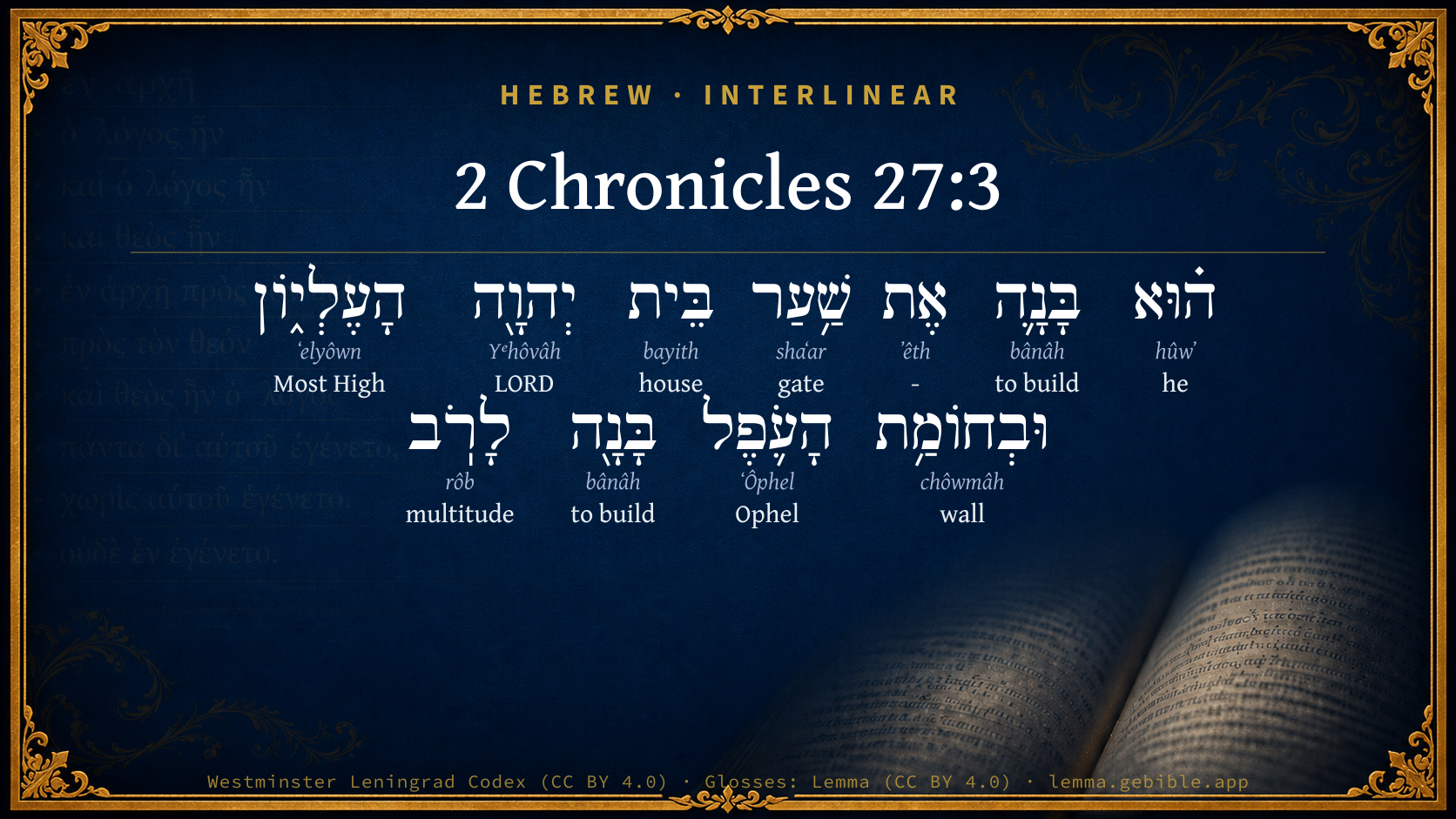
  1. ה֗וּא hûwʼ H1931 “he” Pronoun, Personal, 3rd Person, Masculine, Singular
  2. בָּנָ֛ה bânâh H1129 “to build” Verb, Qal, Perfect, 3rd Person, Masculine, Singular
  3. אֶת ʼêth H853 “-” Particle, Direct Object
  4. שַׁ֥עַר shaʻar H8179 “gate of” Noun, Common, Masculine, Singular, Construct
  5. בֵּית bayith H1004 “house of” Noun, Common, Masculine, Singular, Construct
  6. יְהוָ֖ה Yᵉhôvâh H3068 “LORD” Noun, Proper
  7. הָעֶלְי֑וֹן ʻelyôwn H5945 “the · Most High” Particle, Definite Article + Adjective, Adjective, Masculine, Singular, Absolute
  8. וּבְחוֹמַ֥ת chôwmâh H2346 “and · in/at · wall of” Conjunction + Preposition + Noun, Common, Feminine, Singular, Construct
  9. בָּנָ֖ה bânâh H1129 “to build” Verb, Qal, Perfect, 3rd Person, Masculine, Singular
  10. לָרֹֽב rôb H7230 “to/for · multitude” Preposition + Noun, Common, Both, Singular, Absolute

About this verse

These counts appear in no published source. They are computed here, from the morphology-tagged text and Lemma’s own curated glosses. What Lemma adds →

11
words
10
distinct lemmas
Historical
section

Notable vocabulary

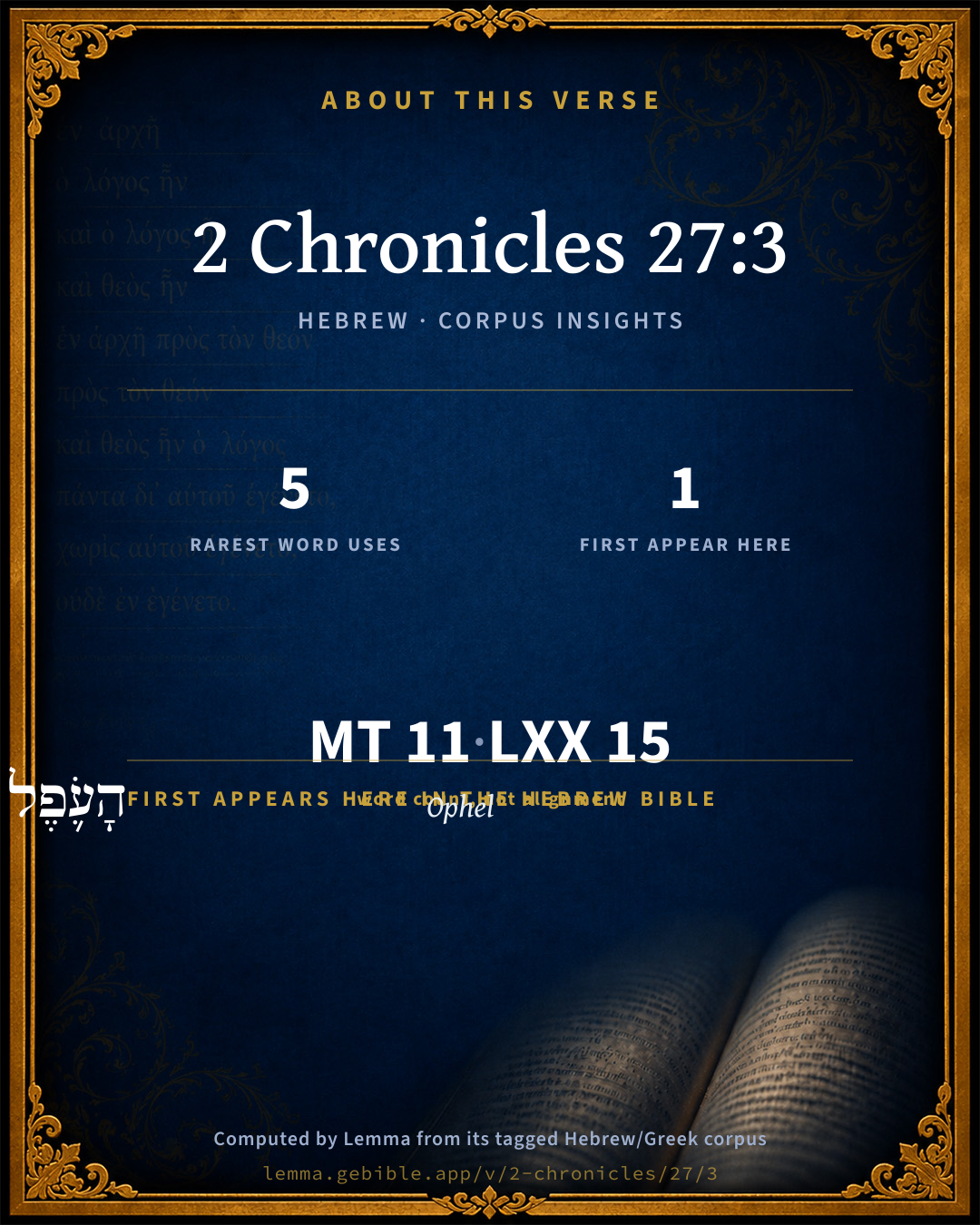
The rarest word here is הָעֹ֛פֶל Ophel H6077 — appearing just 5 times in the whole Hebrew Bible.

First appearance in Scripture

This word makes its first canonical appearance in the Hebrew Bible here:

  • הָעֹ֛פֶל Ophel H6077

Shared distinctive vocabulary

הָעֹ֛פֶל Ophel H6077 occurs in 5 verses of the Hebrew Bible. Also found in:

Grammatical profile

  • 2 verbs
  • 6 nouns
  • 1 adjective
  • 1 pronoun
  • 1 particle

Verb forms

  • בָּנָ֛ה Qal · Perfect
  • בָּנָ֖ה Qal · Perfect

Repetition

A word recurs within this verse — often emphatic in Hebrew:

  • בָּנָ֛ה to build H1129 ×2

Hebrew & Septuagint length

In English translation the verse runs 19 words from the Hebrew and 20 from the Septuagint (LXX English) — closely comparable.

A rough comparison of the two English renderings, which tokenize alike — not a word-level alignment.

Word counts can differ between the Hebrew and the Greek without any difference in meaning — e.g. the Hebrew direct-object marker אֵת has no separate Greek word, and Greek often adds the article ὁ.

In the original languages it is 11 Hebrew tokens and 15 Greek tokens — but the two are counted differently (Hebrew bundles its prefixes and suffixes into one token; the Greek is in lemma form), so that isn’t a like-for-like length.

Cross-references

4

Topical passages linked to 2 Chronicles 27:3 in the Treasury of Scripture Knowledge — connected by theme and wording, ordered by reader-vote popularity; previews shown in the World English Bible.

  • 2 Chronicles 33:14 Now after this he built an outer wall to the city of David, on the west side of Gihon, in the valley, even to the entrance at the fish gate; and he compassed Ophel about [with it], and raised it up to a very great height: and he put valiant captains in all the fortified cities of Judah.
  • Nehemiah 3:26–27 (Now the Nethinim lived in Ophel, to the place over against the water gate toward the east, and the tower that stands out.)
  • 2 Chronicles 23:20 He took the captains of hundreds, and the nobles, and the governors of the people, and all the people of the land, and brought down the king from the house of Yahweh: and they came through the upper gate to the king's house, and set the king on the throne of the kingdom.
  • Jeremiah 20:2 Then Pashhur struck Jeremiah the prophet, and put him in the stocks that were in the upper gate of Benjamin, which was in the house of Yahweh.

Cross-references courtesy of OpenBible.info (CC BY 4.0).

Hebrew and Greek witnesses Masoretic Hebrew ↔ Greek Septuagint

The same verse in the two great witnesses to the Old Testament, shown verse-for-verse.

These are two independent witnesses, not word-aligned to each other, and the Septuagint is shown in lemma (dictionary) form.

Hebrew 2 Chronicles 27:3 Masoretic · Westminster Leningrad Codex

ה֗וּא בָּנָ֛ה אֶת שַׁ֥עַר בֵּית יְהוָ֖ה הָעֶלְי֑וֹן וּבְחוֹמַ֥ת הָעֹ֛פֶל בָּנָ֖ה לָרֹֽב

He built the upper gate of the house of Yahweh, and on the wall of Ophel he built much.

World English Bible · Public Domain

Greek LXX 2 Chronicles 27:3 Septuagint · lemma form

αὐτός οἰκοδομέω ὁ πύλη οἶκος κύριος ὁ ὑψηλός καί ἐν τεῖχος ὁ οφλα οἰκοδομέω πολύς

He built the high gate of the house of the Lord, and he built much in the wall of Opel.

LXX2012 (modern English Septuagint) · Public Domain

Hebrew: Westminster Leningrad Codex (CC BY 4.0). Greek: Septuagint (public domain); English from LXX2012 (modern English Septuagint) (Public Domain). How the Septuagint differs from the Hebrew →

Commentary

Notes on 2 Chronicles 27:3 from classic Christian and Jewish commentators (each source and its license shown beneath its notes). The classic Christian expositions comment on the surrounding passage and are grouped to its opening verse, so a note may address several verses; the Jewish commentaries on the Tanakh (Rashi and others) are per-verse, so they appear only where the commentator wrote on this verse.

Lemma curates 59 commentaries, every one of them public domain or Creative Commons licensed, each selected and text-cleaned for this edition rather than reprinted as found. About our sources →

Trapp's Complete Commentary

John Trapp

2Ch 27:3 He built the high gate of the house of the LORD, and on the wall of Ophel he built much.

Ver. 3. He built the high gate.] See 2Ki 15:35.

And on the wall of Ophel.] This was, saith Adrichomius, a tower of exceeding great height, quasi nube caput inserens, seeming to reach to the very clouds; it was also a strong fort near unto the temple; the habitation of the Nethinims. {Neh 3:26; Neh 11:21} It was burnt by Titus’ soldiers. See 2Ch 36:19.

John Trapp, A Commentary or Exposition upon All the Books of the Old and New Testament (1647–1656) — public domain. Text from a community e-Sword module.

The Biblical Illustrator

Joseph S. Exell

2Ch_27:3

And on the wall of Ophel he built much.

Building on Ophel

Ophel means the mount. Where was the mount? On the southern slope. Why did the king build so much on Ophel? Because it was most accessible to the enemy. Like a wise commander he remembered that no man is stronger than his weakest point, and that no fortification is stronger than its frailest part; so the king built much where the wall was weakest, or where the access of the enemy was most open; and in doing so he gathered up and represented the wisdom and experience of the ages, and anticipated what we and all the sons of time ought to do. What is your weakest point in life? Build much there. (J. Parker, D.D.)

The Biblical Illustrator, edited by Joseph S. Exell (c. 1880s–1900s) — public domain. Text from a community e-Sword module.

Tyndale Open Study Notes

Tyndale Open Resources

27:3-4 Jotham’s rebuilding endeavors were like those of his father; he continued the work of restoration begun by Uzziah. He also constructed fortresses and towers in the forests, providing a network of lookouts and highway defenses within the kingdom and on the frontier.

Tyndale Open Study Notes — © Tyndale Open Resources, licensed CC BY-SA 4.0. Text via the HelloAO Bible API.

Geneva Bible (1599)

Geneva Bible translators

Which was sixscore cubits high, and was for the height called Ophel: it was at the East gate, and mention is made of it, 2 Chron. 3:4.

Geneva Bible (1599) marginal notes — public domain. Text via Bolls.life.

Jamieson, Fausset & Brown

Robert Jamieson, A. R. Fausset & David Brown

He built the high gate of the house of the Lord--situated on the north--that portion of the temple hill which was high compared with the southern part--hence "the higher," or upper gate (see on Kg2 15:35). He built, that is, repaired or embellished.

and on the wall of Ophel--Hebrew, "the Ophel," that is, the mound, or eminence on the southeastern slope of the temple mount, a ridge lying between the valleys Kedron and Tyropœon, called "the lower city" [JOSEPHUS]. He

built much--having the same desire as his father to secure the defense of Jerusalem in every direction.

Jamieson, Fausset & Brown — Commentary Critical and Explanatory on the Whole Bible (1871) — public domain (CC PDM 1.0). Text via the HelloAO Bible API.

Adam Clarke's Commentary

Verse 3. On the wall of Ophel] The wall, says the Targum, of the interior palace. Ophel was some part of the wall of Jerusalem, that was most pregnable, and therefore Jotham fortified it in a particular manner.

Adam Clarke's Commentary on the Bible (1810–1826) — public domain. Text from a community e-Sword/MySword module.

Ellicott's Commentary for English Readers

(3) He built.—He it was that built (pronoun emphatic). He “built,” i.e., restored and beautified. The same statement occurs in 2Ki_15:35.

The high gate.—Rather, the upper gate; i.e., the northern gate of the inner or upper court (Eze_9:2). The north being the holy quarter (Isa_14:13; Psa_48:2), the north gate would be the principal entrance.

And on the wall of Ophel he built much.—The southern slope of the Temple hill was called the Ophel, i.e., “the mound.” Its wall would be the line of fortifications connecting Zion with Moriah, on which Uzziah had already laboured (2Ch_26:9), with the same object of securing the city against attacks from the south and east. Neither this detail nor the next three verses are found in the parallel account. The style and contents of the passage indicate a good ancient source.

Much.—Larôb, “to much;” one of the chronicler’s favourite words.

A Bible Commentary for English Readers, edited by Charles John Ellicott (1878–1897) — public domain. Text from a community e-Sword module.

The Cambridge Bible for Schools and Colleges

gen. ed. J. J. S. Perowne

3. the high gate] R.V. the upper gate; cp. 2Ch_23:20.

Ophel] Cp. 2Ch_33:14; Neh_3:26-27. It was a southern spur of the Temple Hill. Bädeker, p. 21.

The Cambridge Bible for Schools and Colleges (gen. ed. J. J. S. Perowne; Cambridge University Press, 1878–1918) — public domain. Text from a community e-Sword module.

John Gill's Exposition

Moreover, he built cities in the mountains of Judah,.... In the mountainous part of it, the hill country of Judea, Luk 1:65,

and in the forests he built castles and towers; for the safety of travellers, and of shepherds and their flocks, see Ch2 26:10.

John Gill's Exposition of the Whole Bible (1746–1763) — public domain (CC PDM 1.0). Text via the HelloAO Bible API.

Albert Barnes' Notes on the Bible

Ophel was the name given to the long, narrowish, rounded spur or promontory, which intervenes between the central valley of Jerusalem (the Tyropoeon) and the Kidron, or valley of Jehoshaphat. The anxiety of Uzziah and Jotham to fortify their territory indicates a fear of external attack, which at this time was probably felt mainly in connection with Samaria and Syria (2Ki 15:37 note). The faithless trust put in fortifications was rebuked by the prophets of the time Hos 8:14; Isa 2:15.

Albert Barnes' Notes on the Bible (1834–1885) — public domain. Text from a community e-Sword/MySword module.

Haydock's Catholic Bible Commentary

Gate, on the east, repairing (T.) and beautifying it so, (H.) that Jeremias (xxvi. 10,) calls it New. T. --- Ophel, on the walls of the city, (C.) towards the eastern porch of the temple. Josephus) S. Jerom in Isaias xxxii. 14. --- Here the Nathineans dwelt, 2 Esdras iii. 26. C. --- Kimchi, &c. translate, "a citadel." T.

George Leo Haydock (1774–1849), Haydock's Catholic Family Bible and Commentary, 1859 edition — public domain. Excludes Psalms (Douay-Rheims chapter numbering differs from Protestant) and Deuterocanonical books (Catholic canon only).

Matthew Poole's English Annotations

He built, i.e. repaired it; for it was built before, 2Ch 11:5.

The high gate, otherwise called the new gate, Jer 36:10.

The wall of Ophel; a tower upon or near the wall of Jerusalem, which probably he fortified, as his father had done other towers, 2Ch 26:9.

Matthew Poole's English Annotations on the Holy Bible (1683–1685) — public domain. Text from a community e-Sword/MySword module.

The Pulpit Commentary

The high gate. In the parallel, rendered in the Authorized Version the "higher" gate, the Hebrew (wOylj) being the same in both places. The Revised Version shows "upper gate" in both places. It was probably the gate which led from the palace to the temple"s outer court. (2Ch_23:20, and note there) On the wall of Ophel; Hebrew, lph i.e. the ophel, which may be Englished "the swelling ground." It was the extreme south end of the spur which gradually narrowed southward, and which was the continuation of the Bezetha hill, bounded by the brook Kedron on the east, and the Tyropceon on the west. This extreme south part called the Ophel sank into the bounding valleys to the Kedron precipitously and to the Tyropeon gradually. Pp. 328-335 of Condor"s "Handbook" (2nd edit.), and specially pp. 332-334, well repay a thorough study. A ditch was cut across the narrowest part of the ridge, which separated the temple hill itself from the Bezetha hill. In these parts fortifications were built, and no doubt to such it is our text calls attention.

The Pulpit Commentary (1880–1919), ed. H.D.M. Spence-Jones & Joseph S. Exell — public domain. Text from a community e-Sword module.

John Wesley's Explanatory Notes

Built - Repaired it: for it was built before, chap. xi, 5.

John Wesley, Explanatory Notes Upon the Whole Bible (1754–1765) — public domain. Text via the GEBible commentary corpus.

unfoldingWord translationNotes

Door43 World Missions Community

He built the upper gate ... he built much ... he built cities ... he built castles and towers

Since Jotham was king, he may have had his workers build these things. AT: "He had his workers build the upper gate ... he had his workers build many things ... he had his workers build cities ... he had his workers build castles and towers" (See: Metonymy)

the hill of Ophel

This is a hill in Jerusalem. (See: How to Translate Names)

translationWords

gate

Judah

watchtower

unfoldingWord translationNotes — © Distant Shores Media and the Door43 World Missions Community, licensed CC BY-SA 4.0. Source: git.door43.org/Door43/en_tn.

Rashi

Rabbi Shlomo Yitzchaki (Rashi)

and in the wall of the rampart - Heb. עֹפֶל, similar to (Isa. 32:14): “rampart and tower (עפֶל וָבַחַן).” He built strongholds.

Rashi on the Tanakh — English translations: “The Judaica Press complete Tanach with Rashi, translated by A. J. Rosenberg” (CC BY 4.0); “Pentateuch with Rashi's commentary by M. Rosenbaum and A.M. Silbermann, 1929-1934” (public domain); “The Metsudah Tanach series, Lakewood, N.J” (CC BY 4.0); and “The Book of Joshua, Metsudah Publications, 1997” (CC BY 4.0). Text via Sefaria.

Lesson kit

Teaching starters — assembled from the data on this page, not authored interpretation. Every prompt links to the verse data it draws on. Edit before teaching.

2 Chronicles, in the Historical, opens this verse with 11 words (10 distinct Hebrew lemmas). Its most distinctive word is ʻÔphel (“Ophel”). A historical commentator’s framing appears above. Read the whole chapter for the surrounding context.

Discussion questions

  1. What does “Ophel” (ʻÔphel) contribute to the verse as a whole?
  2. The word “Ophel” first appears here in Scripture. What is being introduced at this debut?
  3. 2 Chronicles 33:14 shares the word «Ophel» with this verse. How do the two illuminate each other?
  4. “to build” occurs 2× in this one verse. What is the effect of the repetition?
  5. These translations render this verse differently. What is at stake in choosing one wording over another?
  6. The verb «בָּנָ֛ה» is Qal Perfect. How does its form color the action?
  7. Reading how Trapp's Complete Commentary and The Biblical Illustrator read this verse, where do the two commentators agree and where do they part?

Things to notice

Reading settings

Reading text

Shown beneath each verse's original-language words.

Old Testament
Old Testament edition

Read the OT as the Masoretic Hebrew (MT) or the Greek Septuagint (LXX).

English shown for the Greek Septuagint (in the Hebrew ↔ Greek comparison).

Comparing translations? Open the Compare panel on any verse page to stack up to four side by side.