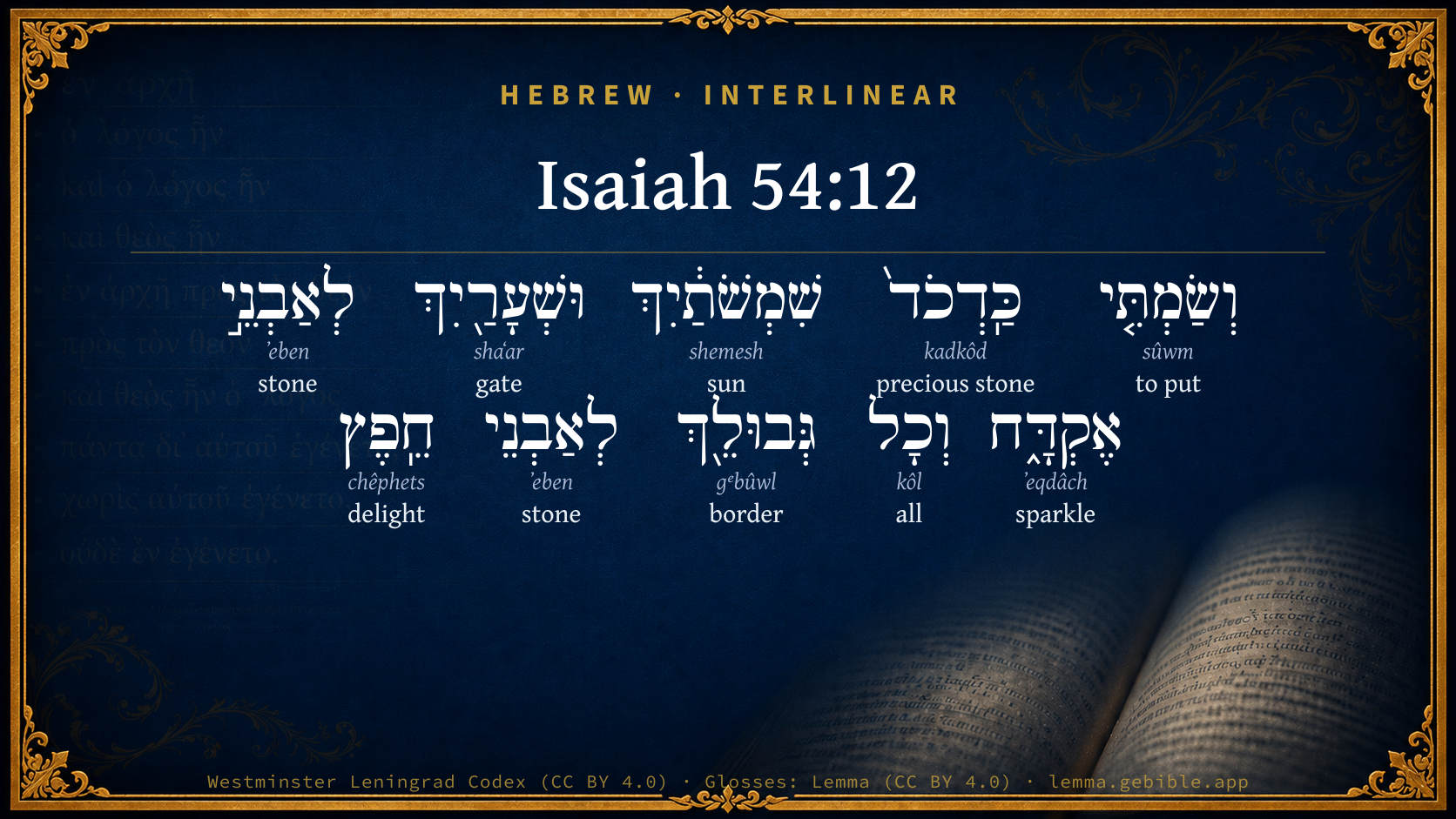
Isaiah 54:12

Hebrew (Westminster Leningrad Codex) Isaiah 54:12 appears in the Hebrew Old Testament. The text above is from the Westminster Leningrad Codex. Each word links to its Strong’s number, a concise gloss, and parsing drawn from the Open Scriptures Hebrew Bible morphology. Click any word for its full Brown-Driver-Briggs (BDB) entry.
Download image
Cite this verse

Isaiah 54:12 (World English Bible). Public Domain. Lemma interlinear Bible study tool, https://lemma.gebible.app/v/isaiah/54/12.

Show BibTeX & RIS
BibTeX
RIS
English Translation
I will make your pinnacles of rubies, and your gates of emeralds, and all your border of precious stones.
World English Bible · Public Domain
Highlights
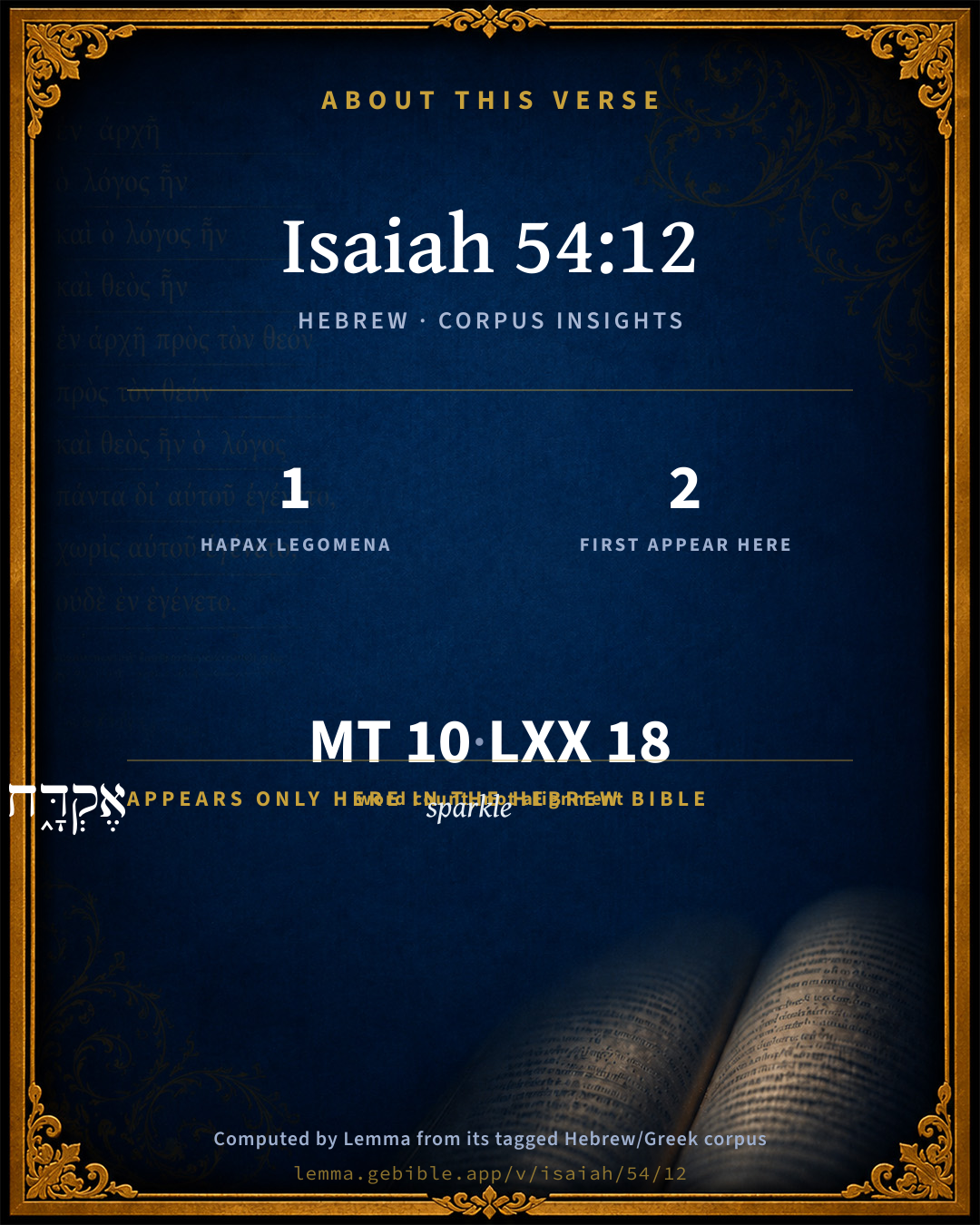
  • 1 hapax legomenon — only here in the Hebrew Bible
  • 2 first appearances in the Hebrew Bible
Full analysis ↓
Download a study sheet

One document with this verse’s original text, its word-by-word gloss line, the meaning frame, cross-references with their text, attributed commentary, and full source and license credits — printable, and it pastes into notes with its structure intact.

This verse Autodidact and up

Study sheet (.html) Plain text (.txt)

A passage Seminary Student

Up to 50 verses in one chapter. A passage sheet keeps up to 6 commentary sources and 12 cross-references per verse, in the order this page ranks them, and says so on the sheet whenever that leaves anything out. Ask for a single verse and you get the Autodidact verse sheet above.

Everything on this page stays free to read, with no account — the sheet is a download of what is already on screen, not access to it.

Want to remove ads? Support Godless Engineer
Compare translations 3

The same verse in 3 English versions, stacked beneath the original-language interlinear above. Click any original word for its lexicon entry.

Each is an independent rendering of the whole verse — the interlinear is not word-aligned to these translations.

Highlighted words mark where these versions differ — a whole-verse word diff, not a word-by-word alignment.

  • World English Bible Public Domain
    I will make your pinnacles of rubies, and your gates of emeralds, and all your border of precious stones.
  • King James Version Public Domain
    And I will make thy windows of agates, and thy gates of carbuncles, and all thy borders of pleasant stones.
  • unfoldingWord Literal Text CC BY-SA 4.0
    And I will make your battlements rubies and your gates into stones of beryl and all of your border into stones of delight.

unfoldingWord Literal Text — © unfoldingWord, licensed CC BY-SA 4.0. Word-aligned USFM3 via Door43 (git.door43.org/unfoldingWord/en_ult).

Versions to compare (up to 4)

3 of 4 selected

Show all 18 translations

Every available English version of this verse, each an independent rendering of the whole verse.

  • World English Bible Public Domain
    I will make your pinnacles of rubies, and your gates of emeralds, and all your border of precious stones.
  • Berean Standard Bible Public Domain
    I will make your pinnacles of rubies, your gates of sparkling jewels, and all your walls of precious stones.
  • Majority Standard Bible Public Domain
    I will make your pinnacles of rubies, your gates of sparkling jewels, and all your walls of precious stones.
  • King James Version Public Domain
    And I will make thy windows of agates, and thy gates of carbuncles, and all thy borders of pleasant stones.
  • American Standard Version (1901) Public Domain
    And I will make thy pinnacles of rubies, and thy gates of carbuncles, and all thy border of precious stones.
  • Revised Version (1885) Public Domain
    And I will make thy pinnacles of rubies, and thy gates of carbuncles, and all thy border of pleasant stones.
  • Geneva Bible (1599) Public Domain
    And I will make thy windowes of emeraudes, and thy gates shining stones, and all thy borders of pleasant stones.
  • Douay-Rheims (1899) Public Domain
    And I will make thy bulwarks of jasper: and thy gates of graven stones, and all thy borders of desirable stones.
  • Young's Literal Translation Public Domain
    And have made of agate thy pinnacles, And thy gates of carbuncle stones, And all thy border of stones of delight,
  • Literal Standard Version CC BY-SA 4.0
    And have made your pinnacles of agate, || And your gates of carbuncle stones, || And all your border of stones of delight,
  • Unlocked Literal Bible CC BY-SA 4.0
    I will make your pinnacles of rubies and your gates of sparkling stones, and your outer wall of beautiful stones.
  • unfoldingWord Literal Text CC BY-SA 4.0
    And I will make your battlements rubies and your gates into stones of beryl and all of your border into stones of delight.
  • Darby Bible Public Domain
    and I will make thy battlements of rubies, and thy gates of carbuncles, and all thy borders of precious stones.
  • World Messianic Bible Public Domain
    I will make your pinnacles of rubies, your gates of sparkling jewels, and all your walls of precious stones.
  • Webster's Bible Public Domain
    And I will make thy windows of agates, and thy gates of carbuncles, and all thy borders of pleasant stones.
  • Free Bible Version CC BY-SA 4.0
    I will make your fortifications out of rubies; I will make your gates out of sparkling beryl. All your walls will be made of precious stones,
  • Bible in Basic English Public Domain
    I will make your towers of rubies, and your doors of carbuncles, and the wall round you will be of all sorts of beautiful stones.
  • JPS Tanakh (1917) Public Domain
    And I will make thy pinnacles of rubies, and thy gates of carbuncles, and all thy border of precious stones.

Literal Standard Version (2020), Covenant Press — licensed CC BY-SA 4.0. Text via the HelloAO Bible API (eBible.org). Unlocked Literal Bible (unfoldingWord) — licensed CC BY-SA 4.0. Text via the HelloAO Bible API (eBible.org). unfoldingWord Literal Text — © unfoldingWord, licensed CC BY-SA 4.0. Word-aligned USFM3 via Door43 (git.door43.org/unfoldingWord/en_ult). Free Bible Version, Dr. Jonathan Gallagher — licensed CC BY-SA 4.0. Text via the HelloAO Bible API (eBible.org).

Word by word

More ways to search: Search by grammar → Find every occurrence → Compare this word →

Practice this passage: Drill this verse → Learn its vocabulary →

אֶקְדָּ֑ח
ʼeqdâch
H688
“sparkle”
Noun, Common, Masculine, Singular, Absolute
Part of Speech
Noun
Type
Common
Gender
Masculine
Number
Singular
State
Absolute
Full BDB Definition

Origin: from H6916

TWOT: 1987b

fiery glow, sparkle - (CLBL) the name of a gem - carbuncle
  1. וְשַׂמְתִּ֤י sûwm H7760 “and · to put” Conjunction + Verb, Qal, Perfect, 1st Person, Common, Singular
  2. כַּֽדְכֹד֙ kadkôd H3539 “precious stone” Noun, Common, Masculine, Singular, Absolute
  3. שִׁמְשֹׁתַ֔יִךְ shemesh H8121 “pinnacles · your” Noun, Common, Both, Plural, Construct + Suffix, Personal, 2nd Person, Feminine, Singular
  4. וּשְׁעָרַ֖יִךְ shaʻar H8179 “and · gates · your” Conjunction + Noun, Common, Masculine, Plural, Construct + Suffix, Personal, 2nd Person, Feminine, Singular
  5. לְאַבְנֵ֣י ʼeben H68 “to/for · stones of” Preposition + Noun, Common, Feminine, Plural, Construct
  6. וְכָל kôl H3605 “and · all of” Conjunction + Noun, Common, Masculine, Singular, Construct
  7. גְּבוּלֵ֖ךְ gᵉbûwl H1366 “border · your” Noun, Common, Masculine, Singular, Construct + Suffix, Personal, 2nd Person, Feminine, Singular
  8. לְאַבְנֵי ʼeben H68 “to/for · stones of” Preposition + Noun, Common, Feminine, Plural, Construct
  9. חֵֽפֶץ chêphets H2656 “delight” Noun, Common, Masculine, Singular, Absolute

About this verse

These counts appear in no published source. They are computed here, from the morphology-tagged text and Lemma’s own curated glosses. What Lemma adds →

10
words
9
distinct lemmas
Prophets
section

Notable vocabulary

1 hapax legomenon — a word that appears only here in the entire Hebrew Bible:

  • אֶקְדָּ֑ח sparkle H688

First appearance in Scripture

These words make their first canonical appearance in the Hebrew Bible here:

  • כַּֽדְכֹד֙ precious stone H3539
  • אֶקְדָּ֑ח sparkle H688

Shared distinctive vocabulary

כַּֽדְכֹד֙ precious stone H3539 occurs in 2 verses of the Hebrew Bible. Also found in:

Grammatical profile

  • 1 verb
  • 9 nouns

Verb forms

  • וְשַׂמְתִּ֤י Qal · Perfect

Repetition

A word recurs within this verse — often emphatic in Hebrew:

  • לְאַבְנֵ֣י stone H68 ×2

Hebrew & Septuagint length

In English translation the verse runs 19 words from the Hebrew and 16 from the Septuagint (LXX English) — closely comparable.

A rough comparison of the two English renderings, which tokenize alike — not a word-level alignment.

Word counts can differ between the Hebrew and the Greek without any difference in meaning — e.g. the Hebrew direct-object marker אֵת has no separate Greek word, and Greek often adds the article ὁ.

In the original languages it is 10 Hebrew tokens and 18 Greek tokens — but the two are counted differently (Hebrew bundles its prefixes and suffixes into one token; the Greek is in lemma form), so that isn’t a like-for-like length.

Hebrew and Greek witnesses Masoretic Hebrew ↔ Greek Septuagint

The same verse in the two great witnesses to the Old Testament, shown verse-for-verse.

These are two independent witnesses, not word-aligned to each other, and the Septuagint is shown in lemma (dictionary) form.

Hebrew Isaiah 54:12 Masoretic · Westminster Leningrad Codex

וְשַׂמְתִּ֤י כַּֽדְכֹד֙ שִׁמְשֹׁתַ֔יִךְ וּשְׁעָרַ֖יִךְ לְאַבְנֵ֣י אֶקְדָּ֑ח וְכָל גְּבוּלֵ֖ךְ לְאַבְנֵי חֵֽפֶץ

I will make your pinnacles of rubies, and your gates of emeralds, and all your border of precious stones.

World English Bible · Public Domain

Greek LXX Isaiah 54:12 Septuagint · lemma form

καί τίθημι ὁ ἔπαλξις σύ ἴασπις καί ὁ πύλη σύ λίθος κρυστάλλος καί ὁ περίβολος σύ λίθος ἐκλεκτός

and I will make your buttresses jasper, and your gates crystal, and your border precious stones.

LXX2012 (modern English Septuagint) · Public Domain

On this verse, The Cambridge Bible for Schools and Colleges discusses the Septuagint’s reading. Read the note in Commentary ↓

Hebrew: Westminster Leningrad Codex (CC BY 4.0). Greek: Septuagint (public domain); English from LXX2012 (modern English Septuagint) (Public Domain). How the Septuagint differs from the Hebrew →

Targum (Aramaic paraphrase)

1

The Targum is the ancient Jewish Aramaic paraphrase of the Hebrew Scriptures — an interpretive translation, not the Hebrew text itself. Onkelos (literal) and Pseudo-Jonathan (expansive) render the Torah, and Jonathan the Prophets. Coverage is partial: where no permissively-licensed English translation exists for a verse, only the Aramaic is shown. This is verse-level text, not a word-by-word alignment to the Hebrew.

  1. Targum Jonathan Prophets (Joshua–Malachi)
    וֶאֱשַׁוֵי בְמַרְגְלִין אָעָךְ וְתַרְעַיִךְ לְאַבְנֵי גְמַר וְכָל תְּחוּמִיךְ לְאַבְנֵי צְרוֹךְ:

    And I will place thy timber with gems, and thy gates shall be of carbuncles, and all thy borders with precious stones.

    Targum Jonathan — Aramaic: “Mikraot Gedolot” (public domain). English: “Sefaria Community Translation” (CC0 1.0 (public-domain dedication)); “London "Chaldee Paraphrase," 1871” (public domain). Text via Sefaria.

Commentary

Notes on Isaiah 54:12 from classic Christian and Jewish commentators (each source and its license shown beneath its notes). The classic Christian expositions comment on the surrounding passage and are grouped to its opening verse, so a note may address several verses; the Jewish commentaries on the Tanakh (Rashi and others) are per-verse, so they appear only where the commentator wrote on this verse.

Lemma curates 59 commentaries, every one of them public domain or Creative Commons licensed, each selected and text-cleaned for this edition rather than reprinted as found. About our sources →

Trapp's Complete Commentary

John Trapp

Isa 54:12 And I will make thy windows of agates, and thy gates of carbuncles, and all thy borders of pleasant stones.

Ver. 12. And I will make thy windows of agates.] Or, Of crystal, which is purus et durus.

And thy gates of carbuncles.] Which are of a flame colour.

And all thy borders.] That is, all thy bordering cities, say the Rabbis. As Plutarch saith of the neighbouring villages of Rome, in Numa’s time, that sucking in the air of that city they breathed righteousness, may be much better affirmed as the Church.

John Trapp, A Commentary or Exposition upon All the Books of the Old and New Testament (1647–1656) — public domain. Text from a community e-Sword module.

The Biblical Illustrator

Joseph S. Exell

Isa_54:12

And I will make thy windows of agates

Agates

Agates are precious stones, partially transparent and uncrystallized.

They are mere varieties of quartz, variously coloured by admixtures of different earths; although the neutral tints arc the most frequent. They generally occur in rounded nodules, or in veins in igneous rocks, dropping out when such rocks decompose by the action of the elements, and being washed down to the places where they are found by mountain streams. They seem to be the product of elements fused by fire; and in this respect they carry out most faithfully the analogy between the condition of the Church and the nature of the promise, o thou afflicted, tempest-tossed, and not comforted, behold, I will make thy windows of agates. Out of those fiery trials precious media of spiritual vision will be constructed for it. (H. Macmillan, LL. D.)

Agate windows

I. Looking at the emblem in this light, we may suppose windows of agates to mean windows of FAITH. Agates are neither transparent as rock crystal, nor opaque as flint; so neither is faith dim as sense, nor bright as heavenly vision. Many things in creation, providence, and redemption are inscrutable to us; and the wider the circle of light spreads around us, the wider does the dark line of our ignorance extend also and touch it at every point. Gazing through these windows we behold things which we see nowhere else. We obtain such a realizing view of Gods presence, such an evidence of His perfections, as elevates and spiritualizes our minds, while, at the same time, it humbles us low by the contrast of our own imperfections and unworthiness. We behold His glory as in a glass, and are changed into the same image, saturated with the reflected light of His holiness, permeated with: the warmth the purity of His love. The altogether lovely One looketh forth at these windows, showing Himself through the lattice in all the beauty of His person, the perfection of His righteousness, and the sufficiency of His grace. We have a satisfying and transforming view of His person, His atonement, His intercession, His example, His commands and promises, His government and kingdom, as revealed in the Gospel; so that we can enjoy His own prophetic benediction, Blessed are they that have not seen, and yet have believed. From these upper windows of the soul we obtain the widest view of the horizon around us, and see glorious glimpses of the land that is very far off. Looking down from that elevation, how small and insignificant do the things that appeared great from their own level appear; how unworthy of the thought we bestowed upon them, or the anxiety with which we regarded them. On these western windows of the soul, too, the departing sun shines with concentrated radiance when all the rest of the horizon is wrapped in twilight gloom. It is from thence that another and a brighter world is discerned opening upon our view, while this world is sinking in shadow.

II. We may regard these windows as WINDOWS OF FEELING. By this it is meant, not that God will smite the smitten, afflict the afflicted, but that He will make those afflictions which the Church already experiences windows of agates--mediums of communication between the soul and the unseen world--means of deeper insight into, and richer experiences of spiritual things. The afflicted Christian is the only one who has just views of life, It takes a long and painful discipline to correct our early impressions, and show us things in their true aspects and relations. Through the dim windows of affliction how changed is the aspect of the world, how cold, and grey, and desolate; all its radiant glow departed; all its beauteous hues reduced to one dull leaden sadness. The tears of sorrow are like spiritual lenses, showing us the world in its true character as a poor, empty, unsatisfying inheritance. One glimpse through the agate windows of sickness, bereavement, or adversity will impress us more with the vanity of the worlds portion, and of a life of sense, than all that the most pensive poetry ever sang, or the most cynical philosophy ever taught. I will make thy windows of agates; not bright and transparent, for our weak eyes, dimmed with pain and weeping, cannot bear the strong sunshine; not dark and opaque, for the soul climbing up and straining to look out and see the light behind the cloud--the beauty beyond the shadow--and baffled in its efforts--would fall back upon itself morbid and despairing. They are windows of agates--neither transparent nor opaque--but mercifully tempered by Him who best knows the requirements of each individual case, and who in all our afflictions is afflicted.

III. We may suppose agate windows to be WINDOWS OF SPIRITUAL CHARACTER. In admiring a piece of beautiful scenery, we find nothing in it except what we ourselves brought to it. Nature wears the colour of the spirit; and her charms are reflections of charms within ourselves. It is so also in moral things. To the pure all things are pure; while the polluted heart finds impurity in the most innocent things. So also in the spiritual world. Its objects become real, tangible, true, worthy of love, and capable of influencing us, only so far as we ourselves are spiritualized. There is no window so clear as holiness of character, spirituality of mind, purity of heart, singleness of aim. Agate windows are most expressive symbols of our spiritual character. The purest agates are only semi-pellucid: while the great majority of specimens are clouded with dim spots, and streaked with dark lines. And so the purest spiritual character in this world is imperfect. The essential transparency remains, but objects seen through it are dim, distorted, and discoloured. Our indistinct and imperfect views of God, of providence, of the scheme of grace, of the eternal realities and transcendent glories of a perfect state--are owing to the imperfection of our own spiritual character, and the imperfect affinity of our hearts for what is best and purest. These windows of agates are of great practical importance. The principal use and design of ordinary windows in a dwelling is to admit light into the rooms, so that the inmates may see to perform their various household duties. And so, the use of these windows of agates, whether they be windows of faith, of feeling, or of spiritual character, is to let the light of heaven shine in upon our life, that we may discharge our various duties as members of the household of faith. We are not to sit all day long with folded hands at these windows, looking out listlessly or sadly, in mere religious reverie, or in despondent abstraction. The light which we gel through them is given to us to work. The light of heaven itself is given for usefulness as well as for beauty. It warms and fertilizes the earth, and ripens the corn. So let the light which streams in upon us through these windows of agates--costly light obtained from faith tried in the furnace; lambent light gleaming from painful afflictions, from the decays of nature; sparkling light struck from sore struggles with sin and self; light coloured by the experience through which it has passed; let that light warm, and quicken, and ripen our souls. (H. Macmillan, LL. D.)

Thy windows of agates:

Rather, as R.V., pinnacles. The word is derived from that for sun, and appears to denote those parts of the building which glitter in the suns rays. Compare the Arab minaret, used primarily of a lantern or lighthouse. Agates (Eze_27:16), sparkling stone, perhaps rubies (R.V.). (Prof. J. Skinner, D. D.)

The clarified vision

The Hebrew word here for window is unusual (shemashoth), and this is the only instance of its translation by window. It means an opening for the sun. It implies the admission into the house of more than ordinary reflected daylight--the sun streams through it. The agate (kadbod) is a glass-clear stone. The writer uses it evidently more because of its clarity than because of its preciousness. As a clear way for the sun, the agate window suggests the desirability of keeping the souls windows transparently clear.

I. THAN GOD, THE SOULS SUN, MAY SHINE IN WITHOUT IMPEDIMENT.

1. The Bible may be the agate window. Through it God shines in on mans mind and spirit.

2. This, similarly, should be the office of religious teaching, as in creed and sermon. How important to keep the media of truth transparent.

II. THAT THE SOUL, LOOKING OUT, MAY SEE ACCURATELY. Bad glass, steam, or stain on a window confuses outlines. A fly in the telescope may twist the observers astronomy. All our views of lifes landscapes greatly depend on the window through which we look out. Sin stains it. Cynicism discolours it. The sun can shine through a hide or a thin shutter. But the soul can look out only through the clear window. God sees us, shines on us, when we do not see Him. Salvation depends not on His seeing us, but on our seeing Him.

III. THAT OUR LIGHT MAY SHINE OUT TO OTHERS. Some one wandering in the darkness may see the light that shines from our life, and be guided to safety. (Homiletic Review.)

Thy gates of carbuncles

The carbuncle

This precious stone is found in the East Indies, in colour is an intense scarlet, and held up between your eye and the sun it is a burning coal. The poet puts it into rhythm as he writes--Like to the burning coal whence comes its name; Among the Greeks as Anthrax known to fame. God sets it high up in Bible crystallography. He cuts it with a Divine chisel, shapes it with a precise geometry, and kindles its fire into an almost supernatural flame of beauty. Its law of symmetry, its law of zones, its law of parallelism, something to excite the amazement of the scientist, chime the cantos of the poet, and arouse the adoration of the Christian. No one but the infinite God could fashion a carbuncle as large as your thumb-nail, and as if to make all ages appreciate this precious stone He ordered it set in the first row of the high-priests breast-plate in olden time and higher up than the onyx and the emerald and the diamond, and in Ezekiels prophecies concerning the splendours of the Tyrian court, the carbuncle is mentioned, the brilliancies of the walls and of the tessellated floors suggested by the Bible sentence, Thou hast walked up and down in the midst of the stones of fire! (T. D. W. Talmage, D. D.)

Gates of carbuncles

In my text it is not a solitary specimen that I hand you, as the keeper of a museum might take down from the shelf a precious stone and allow you to examine it. Nor is it the panel of a door that you might stand and study for its unique carvings or bronzed traceries, but there is a whole gate of it lifted before our admiring and astounded vision, ay! two gates of it: ay! many gates of it: I will make thy gates of carbuncles. What gates Gates of the-Church. Gates of anything worth possessing. Gates of successful enterprise. Gates of salvation. Gates of national achievement. Isaiah, who wrote this text, wrote also all that about Christ as the lamb to the slaughter, and spoke of Christ as saying, I have trodden the winepress alone, and wrote, Who is this that cometh from Eden, with dyed garments from Bozrah. And do you think that Isaiah in my text merely happened to represent the gates, as red gates, as carmine gates, as gates of carbuncle? No. He means that it is through atonement, through blood-red struggle, through agonies we get into anything worth getting into. Heavens gates may well be made of pearl, a bright, pellucid, cheerful crystallization, because all the struggles are over and there is beyond those gates nothing but raptures and cantata and triumphal procession and everlasting holiday and kiss of reunion, and so the twelve gates are twelve pearls, and could De nothing else than pearls. But Christ hung the gates of pardon in His own blood, and the marks of eight fingers and two thumbs are on each gate, and as He lifted the gate it leaned against His forehead and took from it a crimson impress, and all those gates are deeply dyed, and Isaiah was right when he spoke of those gates as gates of carbuncle. (T. D. W. Talmage, D. D.)

Gate of carbuncle before gate of pearl

Mark well and underscore with heavy dashes of the pen the order of the gates. Gate of carbuncle before gate of pearl. Isaiah the Prince saw the one gate centuries before St. John the Exile saw the other. The one you must push open. The other stands open. Gate of a Saviours atonement before the gate of Divine pardon. Gate of poverty before gate of affluence. Gate of earthly trial before gate of heavenly satisfaction. Through much tribulation you enter the kingdom of God if you ever enter it at all. (T. D. W. Talmage, D. D.)

The Biblical Illustrator, edited by Joseph S. Exell (c. 1880s–1900s) — public domain. Text from a community e-Sword module.

Geneva Bible (1599)

Geneva Bible translators

Or, jasper, or pearl.

Geneva Bible (1599) marginal notes — public domain. Text via Bolls.life.

Jamieson, Fausset & Brown

Robert Jamieson, A. R. Fausset & David Brown

windows--rather, "battlements"; literally, "suns"; applied to battlements from their radiated appearance.

agates--rather, "rubies."

carbuncles--literally, "sparkling gems"; the carbuncle when held to the sun becomes like a burning coal.

all thy borders--rather, "thy whole circuit," consisting of precious stones. The glory of the Church on earth, when the Hebrew Church, according to the original design, shall be the metropolis of Christendom.

Jamieson, Fausset & Brown — Commentary Critical and Explanatory on the Whole Bible (1871) — public domain (CC PDM 1.0). Text via the HelloAO Bible API.

The Cambridge Bible for Schools and Colleges

gen. ed. J. J. S. Perowne

12. thy windows] Rather as R.V. pinnacles. The word is derived from that for “sun,” and appears to denote those parts of the building which glitter in the sun’s rays. (Comp. the Arab. “minaret,” used primarily of a lantern or a lighthouse.)

agates] (Eze_27:16) “sparkling” stone, perhaps rubies (so R.V.).

carbuncles] (only here) “fiery” stones; although the LXX. renders “stones of crystal.”

all thy borders] R.V. border, perhaps the outer wall (the περίτειχος, see on ch. Isa_26:1).

The Cambridge Bible for Schools and Colleges (gen. ed. J. J. S. Perowne; Cambridge University Press, 1878–1918) — public domain. Text from a community e-Sword module.

John Gill's Exposition

And I will make thy windows of agates,.... Some sort of which stones, Pliny (x) says, were valued for their clearness like glass; but the stone which bears this name with us is not clear and lucid enough to make windows of. The Septuagint, Vulgate Latin, Syriac, and Arabic versions, render it, "of jasper", a stone more fit for that purpose; and it is interpreted of the jasper in the Talmud (y); so "the light" of the New Jerusalem is said to be like unto the "jasper stone", Rev 21:11. Some take the crystal to be meant, which suits well with windows; the word (z) for which has its name from the sun, because by means of them the rays and light of the sun are let into a house, and illuminate it; these in a figurative sense may design the ministers of the Gospel, who are the lights of the world, especially of the church; and the word and ordinances administered by them, by means of which the light of spiritual knowledge, joy, and comfort, is let into the churches, and into the souls of men, from Christ, the sun of righteousness. The phrase signifies, that in the latter day their ministrations should be very clear and bright, and be greatly owned, and be very successful: "and thy gates of carbuncles"; precious stones so called from their fiery flaming colour. The gates of the New Jerusalem are said to be so many pearls, Rev 21:21 which there, as here, signify the entrance into the church of God, which is through Christ, who is the door into it, and through faith in him, which works by love; these gates will be open in the latter day to receive many, who will come in great numbers, and are called "praise", Isa 60:11, which will be expressed in very warm and lively strains of love and affection, of which the carbuncle may be a symbol:

and all thy borders of pleasant stones; true believers, called "lively stones", and who are pleasant in the sight of God and Christ, and are taken pleasure in by one another; see Psa 102:14. The Septuagint and Arabic versions render it, "thy wall", which agree with Rev 21:18, where the wall of the New Jerusalem is said to be of jasper.

(x) Nat. Hist l. 37. c. 10. (y) T. Bab. Bava Bathra, fol. 75. 1. (z) "a radice, quae solem significat", Sanctius,

John Gill's Exposition of the Whole Bible (1746–1763) — public domain (CC PDM 1.0). Text via the HelloAO Bible API.

Albert Barnes' Notes on the Bible

And I will make thy windows - The word rendered here ‘windows’ is rendered by Jerome propugnacula - ‘fortresses,’ bulwarks, ramparts; and by the Septuagint, Επαλξεις Epalcheis - ‘Bulwarks,’ or rather, pinnacles on the walls. The Hebrew word שׁמשׁות shı̂mâshôt) is evidently derived from שׁמשׁ shemesh (the sun); and has some relation in signification to the sun, either as letting in light, or as having a radiated appearance like the sun. Gesenius renders it, ‘notched battlements, the same as sun, or rays of the sun.’ Faber (Hebrew Archaeol., p. 294) supposes that the name was given to the turrets or battlements here referred to, because they had some resemblance to the rays of the sun. I think it prob able that the prophet refers to some radiated ornament about a building, that had a resemblance to the sun, or to some gilded turrets on the walls of a city. I see no evidence in the ancient versions that the word refers to windows.

Of agates - Agates are a class of silicious, semi-pellucid gems, of many varieties, consisting of quarts-crystal flint, horn-stone, chalcedony, amethyst, jasper, cornelian, etc., variegated with dots, zones, filaments, ramifications, and various figures. They are esteemed the least valuable of all the precious stones. They are found in rocks, and are use, for seals, rings, etc. (Webster.) The Hebrew word כדכד kadekkod, from כדד kâdad, to beat, to pound, and then to strike fire, seems to denote a sparkling gem or ruby. It is not often used. It is rendered by Jerome, Jaspidem. The Septuagint, Ιασπιν Iaspin - ‘Jasper,’ a gem of a green color. It may be observed that it is not probable that such a stone would be used for a window, for the purpose of letting in light.

And thy gates - See Rev 21:21 - ‘And the twelve gates were twelve pearls; every several gate was of one pearl.’ The gates of the city would be made of most precious stones.

Of carbuncles - The carbuncle is a beautiful gem of a deep red color, with a mixture of scarlet, called by the Greeks anthrax, found in the East Indies. It is usually about a quarter of an inch in length. When held up to the sun it loses its deep tinge, and becomes exactly the color of a burning coal (Webster). Hence, its name in Greek. The Hebrew name אקדח 'eqeddâch is derived from קדח qâdach, “to burn,” and denotes a flaming or sparkling gem. The word occurs nowhere else in the Hebrew Bible.

And all thy borders - All thy boundaries; or the whole circuit of thy walls. See Rev 21:18 - ‘And the building of the wall of it was of jasper.’ The idea is, that the whole city would be built in the most splendid manner. Its foundations and all its stones would be laid in the most precious cement; its turrets, towers, battlements, gates, and the circuit of its walls, would be made of the most precious gems. In general, there can be no doubt that this is designed to represent the future glory of the church under the Redeemer, and perhaps also to furnish an emblematic representation of heaven (compare Rev 21:2). Kimchi supposes that this may possibly be taken literally, and that Jerusalem may be yet such as is here described. Abarbanel supposes that it may refer to the time when the Oriental world, where these gems are principally found, shall be converted, and come and join in rebuilding the city and the temple.

But the whole description is one of great beauty as applicable to the church of God; to its glories on earth; and to its glory in heaven. Its future magnificence shall be as much greater than anything which has yet occurred in the history of the church, as a city built of gems would be more magnificent than Jerusalem was in the proudest days of its glory. The language used in this verse is in accordance with the Oriental manner. The style of speaking in the East to denote unexampled splendor is well illustrated in the well-known Oriental tale of Aladdin, who thus gives his instructions: ‘I leave the choice of materials to you, that is to say, porphyry, jasper, agate, lapis lazuli, and the finest marble of the most varied colors. But I expect that in the highest story of the palace, you shall build me a large hall with a dome, and four equal fronts; and that instead of layers of bricks, the walls be made of massy gold and silver, laid alternately: and that each front shall contain six windows, the lattices of all which, except one, which must be left unfinished and imperfect, shall be so enriched with art and symmetry, with diamonds, rubies, and emeralds, that they shall exceed everything of the kind ever seen in the world’ (Pictorial Bible).

Albert Barnes' Notes on the Bible (1834–1885) — public domain. Text from a community e-Sword/MySword module.

Haydock's Catholic Bible Commentary

CHAPTER LIV.

Bulwarks. Hebrew, windows of crystal; (Ezechiel xxvii. 1[].; Calmet) Protestants, "of agate." (Haydock) --- All this is allegorical, like the redemption of the new Jerusalem, Apocalypse. xxi.

George Leo Haydock (1774–1849), Haydock's Catholic Family Bible and Commentary, 1859 edition — public domain. Excludes Psalms (Douay-Rheims chapter numbering differs from Protestant) and Deuterocanonical books (Catholic canon only).

Matthew Poole's English Annotations

Agates; one kind of which stones was transparent like glass, as Pliny writes in his Natural History, b. 37. ch. 10. But some render this word crystal, and the LXX., and some other of the ancients, translate it jasper. But the proper signification of the Hebrew names of precious stones is unknown to the Jews themselves, as hath been noted before. It may suffice us to know that this was some very clear, and transparent, and precious stone.

Thy borders; the utmost parts or walls. The church is here evidently compared to a building, whose foundation, pavement, gates, and windows were named before.

Matthew Poole's English Annotations on the Holy Bible (1683–1685) — public domain. Text from a community e-Sword/MySword module.

The Pulpit Commentary

I will make thy windows of agates. Most moderns translate, "I will make thy battlements," or "thy pinnacles of rubies." The exact meaning is very doubtful. Thy gates of carbuncles. In the Revelation of St. John the gates are each of them composed of one pearl (Rev_21:21) the pearl betokening purity, the carbuncle the glow of devotional feeling. We must not expect consistency in descriptions which are entirely allegorical. All thy borders of pleasant stones; or, all thy boundaries. An enclosing wall seems to be meant. (comp. Rev_21:17)

The Pulpit Commentary (1880–1919), ed. H.D.M. Spence-Jones & Joseph S. Exell — public domain. Text from a community e-Sword module.

John Wesley's Explanatory Notes

Agates - The proper signification of the Hebrew names of precious stones is unknown to the Jews themselves. It may suffice us to know that this was some very clear and transparent, and precious stone. Thy borders - The utmost parts or walls.

John Wesley, Explanatory Notes Upon the Whole Bible (1754–1765) — public domain. Text via the GEBible commentary corpus.

J. A. Alexander on Isaiah

Joseph Addison Alexander

“And I will make thy battlements (or pinnacles) ruby, and thy gates to (be) sparkling gems, and all thy border to (be) stones of pleasure (or delight).” The splendid image of the preceding verse is here continued and completed. The precise kinds of gems here meant are not of much importance. The essential idea, as appears from the etymology of the names, is that of sparkling brilliancy. The last phrase is a more generic term, including all the others, and equivalent to our expression, precious stones. Some put a specific sense on every part of the description, understanding by the antimony of the preceding verse the doctrine of Christ’s blood, by the gates the synods of the church, by the battlements its advocates and champions, etc. Lowth, with better taste and judgment, says that "these seem to be general images to express beauty, magnificence, purity, strength, and solidity, agreeably to the ideas of the eastern nations, and to have never been intended to be strictly scrutinized, or minutely and particularly explained, as if they had each of them some precise moral or spiritual meaning."

Joseph Addison Alexander, The Prophecies of Isaiah (1846–1847; New York: Scribner, 1870–1878) — public domain. Text from a community e-Sword module.

Rashi

Rabbi Shlomo Yitzchaki (Rashi)

jasper Heb. כַּדְכֹד, a kind of precious stone.

your windows Jonathan renders: your woodwork, and Menahem associated it with (Dan. 7:10): “ministered to Him (יְשַׁמְּשׁוּנֵהּ).” (Menahem, apparently renders: your utensils, i.e., the vessels that serve you.) And some interpret it as an expression of a sun (שֶׁמֶשׁ), windows through which the sun shines, and they make opposite it a barrier of kinds of colored glass for beauty, and Midrash Psalms interprets שִׁמְשׁוֹתַיִךְ as well as שֶׁמֶשׁ וּמָגֵן (Ps. 84:12) as “the pinnacles of the wall.”

of carbuncle stones Heb. אֶקְדָּח. Jonathan renders: of gomer stones. Gumrin is the Aramaic translation of גֶּחָלִים, coals. He interprets אֶקְדָּח as an expression similar to (supra 50: 11) “who kindle (קֹדְחֵי) fire,” and they are a type of stones that burn like torches and that is the carbuncle (karbokle in O.F.), an expression of a coal. Others interpret it as an expression of a drill, i.e., huge stones of which the entire opening of the doorway is drilled, and the doorposts, the threshold, and the lintel are all hewn from the stone.

of precious stones Desirable stones [from Jonathan].

Rashi on the Tanakh — English translations: “The Judaica Press complete Tanach with Rashi, translated by A. J. Rosenberg” (CC BY 4.0); “Pentateuch with Rashi's commentary by M. Rosenbaum and A.M. Silbermann, 1929-1934” (public domain); “The Metsudah Tanach series, Lakewood, N.J” (CC BY 4.0); and “The Book of Joshua, Metsudah Publications, 1997” (CC BY 4.0). Text via Sefaria.

Ibn Ezra

Rabbi Abraham ibn Ezra

כדכד Agates. It is hap. leg.; it is the name of a precious stone.

ושמשתיך And thy windows. It is derived from שמש sun. It signifies the apertures, which are closed with glass in stately palaces.

ושעריך And of thy gates. And the windows of thy gates.

אקדח Carbuncles. A precious stone. The א is prosthetic; comp. קדחה is kindled (Deut. 32:22).

To stones that are desired, that are not like those stones which are thrown about, and are of no value.

Ibn Ezra on the Tanakh — English translations: “Sefaria Community Translation” (CC0 1.0 (public-domain dedication)); “Yalkut, Sifsei Chachomim Chumash, Metsudah Publications, 2009” (CC BY 4.0); and “Commentary of Ibn Ezra on Isaiah - trans. by M. Friedlander, 1873” (public domain). Text via Sefaria.

Lesson kit

Teaching starters — assembled from the data on this page, not authored interpretation. Every prompt links to the verse data it draws on. Edit before teaching.

Isaiah, in the Prophets, opens this verse with 10 words (9 distinct Hebrew lemmas). Its most distinctive word is ʼeqdâch (“sparkle”). A historical commentator’s framing appears above. Read the whole chapter for the surrounding context.

Discussion questions

  1. How does “sparkle” (ʼeqdâch) shape what this verse is saying?
  2. 1 word here appears nowhere else in the Hebrew Bible. Why might the author reach for such rare wording?
  3. 2 words make their first appearance in Scripture here. What does this debut establish?
  4. How does Ezekiel 27:16, which shares the word «precious stone», read alongside this verse?
  5. What does the repetition of “stone” (2× in this one verse) do in this verse?
  6. The translations on this page render this verse differently — a whole-verse word diff, not a word-by-word alignment. What might account for the different wordings?
  7. «וְשַׂמְתִּ֤י» is a Qal Perfect verb. How does that grammatical form shape the action described?
  8. Compare how Trapp's Complete Commentary and The Biblical Illustrator read this verse. Where do they agree or differ?

Things to notice

  • 1 word in this verse appears nowhere else in the Hebrew Bible.
  • 2 words make their first canonical appearance in Scripture here.
  • This verse counts 10 Hebrew ↔ 18 Greek words.
  • These translations choose different wording for 14 words in this verse.
  • “stone” occurs 2× in this single verse.

Reading settings

Reading text

Shown beneath each verse's original-language words.

Old Testament
Old Testament edition

Read the OT as the Masoretic Hebrew (MT) or the Greek Septuagint (LXX).

English shown for the Greek Septuagint (in the Hebrew ↔ Greek comparison).

Comparing translations? Open the Compare panel on any verse page to stack up to four side by side.