
Judges 16:2

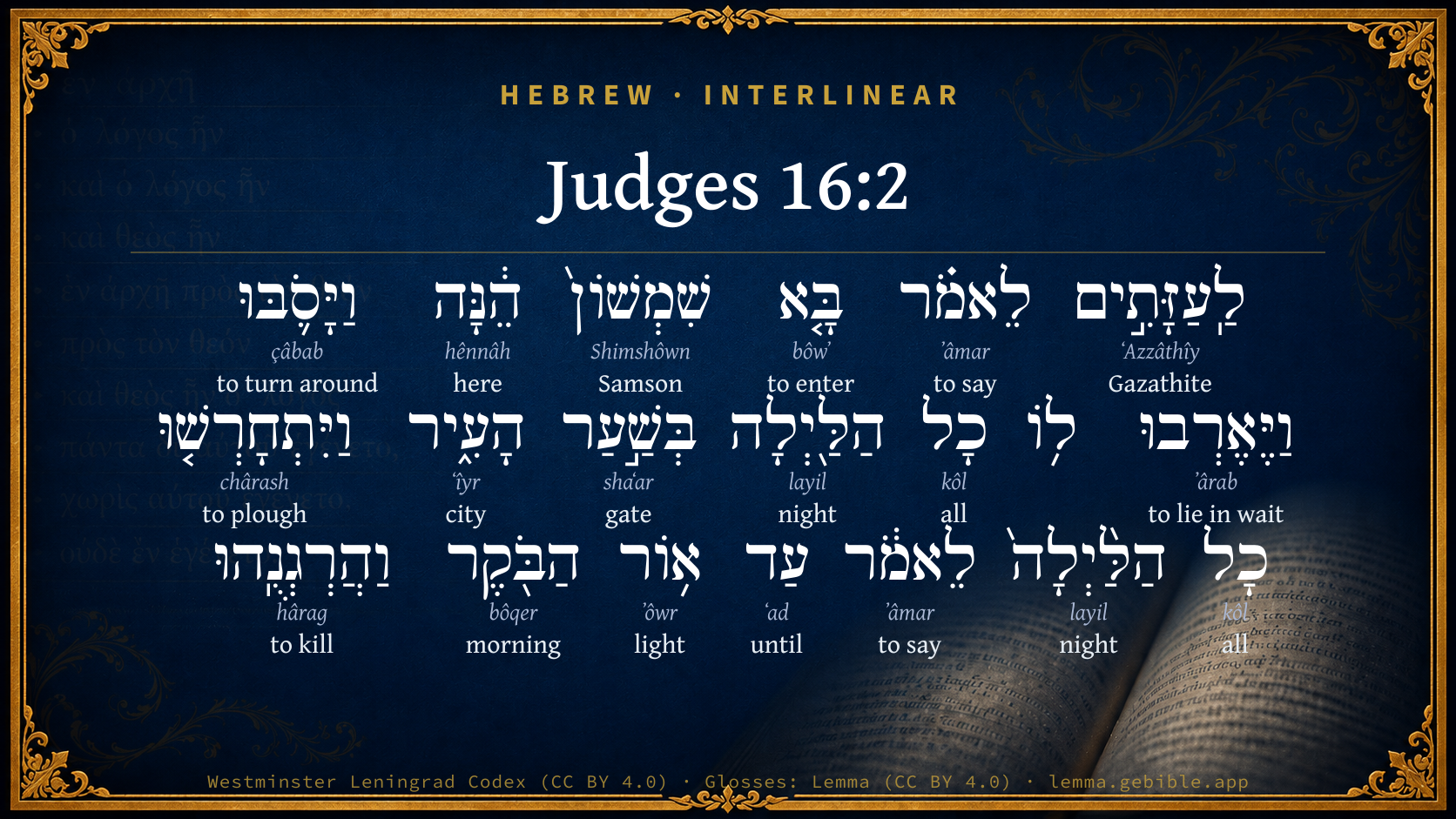
Hebrew (Westminster Leningrad Codex) Judges 16:2 appears in the Hebrew Old Testament. The text above is from the Westminster Leningrad Codex. Each word links to its Strong’s number, a concise gloss, and parsing drawn from the Open Scriptures Hebrew Bible morphology. Click any word for its full Brown-Driver-Briggs (BDB) entry.
Download image
Cite this verse

Judges 16:2 (World English Bible). Public Domain. Lemma interlinear Bible study tool, https://lemma.gebible.app/v/judges/16/2.

Show BibTeX & RIS
BibTeX
RIS
English Translation
[It was told] the Gazites, saying, Samson is come here. They compassed him in, and laid wait for him all night in the gate of the city, and were quiet all the night, saying, [Let be] until morning light, then we will kill him.
World English Bible · Public Domain
Download a study sheet

One document with this verse’s original text, its word-by-word gloss line, the meaning frame, cross-references with their text, attributed commentary, and full source and license credits — printable, and it pastes into notes with its structure intact.

This verse Autodidact and up

Study sheet (.html) Plain text (.txt)

A passage Seminary Student

Up to 50 verses in one chapter. A passage sheet keeps up to 6 commentary sources and 12 cross-references per verse, in the order this page ranks them, and says so on the sheet whenever that leaves anything out. Ask for a single verse and you get the Autodidact verse sheet above.

Everything on this page stays free to read, with no account — the sheet is a download of what is already on screen, not access to it.

Want to remove ads? Support Godless Engineer
Compare translations 3

The same verse in 3 English versions, stacked beneath the original-language interlinear above. Click any original word for its lexicon entry.

Each is an independent rendering of the whole verse — the interlinear is not word-aligned to these translations.

Highlighted words mark where these versions differ — a whole-verse word diff, not a word-by-word alignment.

  • World English Bible Public Domain
    [It was told] the Gazites, saying, Samson is come here. They compassed him in, and laid wait for him all night in the gate of the city, and were quiet all the night, saying, [Let be] until morning light, then we will kill him.
  • King James Version Public Domain
    And it was told the Gazites, saying, Samson is come hither. And they compassed him in, and laid wait for him all night in the gate of the city, and were quiet all the night, saying, In the morning, when it is day, we shall kill him.
  • unfoldingWord Literal Text CC BY-SA 4.0
    to the Gazites, saying, “Samson has come here.” So they encircled and they lay in ambush for him all of the night at the gate of the city. And they kept themselves quiet all of the night, saying, “At the light of the morning, then we will kill him.”

unfoldingWord Literal Text — © unfoldingWord, licensed CC BY-SA 4.0. Word-aligned USFM3 via Door43 (git.door43.org/unfoldingWord/en_ult).

Versions to compare (up to 4)

3 of 4 selected

Show all 18 translations

Every available English version of this verse, each an independent rendering of the whole verse.

  • World English Bible Public Domain
    [It was told] the Gazites, saying, Samson is come here. They compassed him in, and laid wait for him all night in the gate of the city, and were quiet all the night, saying, [Let be] until morning light, then we will kill him.
  • Berean Standard Bible Public Domain
    When the Gazites heard that Samson was there, they surrounded that place and lay in wait for him all night at the city gate. They were quiet throughout the night, saying, “Let us wait until dawn; then we will kill him.”
  • Majority Standard Bible Public Domain
    When the Gazites heard that Samson was there, they surrounded that place and lay in wait for him all night at the city gate. They were quiet throughout the night, saying, “Let us wait until dawn; then we will kill him.”
  • King James Version Public Domain
    And it was told the Gazites, saying, Samson is come hither. And they compassed him in, and laid wait for him all night in the gate of the city, and were quiet all the night, saying, In the morning, when it is day, we shall kill him.
  • American Standard Version (1901) Public Domain
    `And it was told' the Gazites, saying, Samson is come hither. And they compassed him in, and laid wait for him all night in the gate of the city, and were quiet all the night, saying, `Let be' till morning light, then we will kill him.
  • Revised Version (1885) Public Domain
    And it was told the Gazites, saying, Samson is come hither. And they compassed him in, and laid wait for him all night in the gate of the city, and were quiet all the night, saying, Let be till morning light, then we will kill him.
  • Geneva Bible (1599) Public Domain
    And it was tolde to the Azzahites, Samson is come hither. And they went about, and laied wayte for him all night in the gate of the citie, and were quiet all the nyght, saying, Abide till the morning earely, and we shall kill him.
  • Douay-Rheims (1899) Public Domain
    And when the Philistines had beard this, and it was noised about among them, that Samson was come into the city, they surrounded him, setting guards at the gate of the city, and watching there all the night in silence, that in the morning they might kill him as he went out.
  • Young's Literal Translation Public Domain
    `it is told' to the Gazathites, saying, `Samson hath come in hither;' and they go round and lay wait for him all the night at the gate of the city, and keep themselves silent all the night, saying, `Till the light of the morning -- then we have slain him.'
  • Literal Standard Version CC BY-SA 4.0
    [it is told] to the Gazathites, saying, “Samson has come in here”; and they go around and lay wait for him all the night at the gate of the city, and keep themselves silent all the night, saying, “Until the morning light—then we have slain him.”
  • Unlocked Literal Bible CC BY-SA 4.0
    The Gazites were told, “Samson has come here.” The Gazites surrounded the place and in secret, they waited for him all night at the city gate. They kept silent all night. They had said, “Let us wait until daylight, and then let us kill him.”
  • unfoldingWord Literal Text CC BY-SA 4.0
    to the Gazites, saying, “Samson has come here.” So they encircled and they lay in ambush for him all of the night at the gate of the city. And they kept themselves quiet all of the night, saying, “At the light of the morning, then we will kill him.”
  • Darby Bible Public Domain
    The Gazites were told, "Samson has come here," and they surrounded the place and lay in wait for him all night at the gate of the city. They kept quiet all night, saying, "Let us wait till the light of the morning; then we will kill him."
  • World Messianic Bible Public Domain
    The Gazites were told, “Samson is here!” They surrounded him and laid wait for him all night in the gate of the city, and were quiet all the night, saying, “Wait until morning light; then we will kill him.”
  • Webster's Bible Public Domain
    And it was told the Gazites, saying, Samson is come hither. And they encompassed him, and laid wait for him all night in the gate of the city, and were quiet all the night, saying, In the morning when it is day we shall kill him.
  • Free Bible Version CC BY-SA 4.0
    The men of Gaza found out Samson was there, so they gathered to spend the night lying in wait for him at the town gates. They kept quiet all night, whispering to one another, “We'll kill him when it gets light.”
  • Bible in Basic English Public Domain
    And it was said to the Gazites, Samson is here. So they went round, watching for him all day at the doorway of the town, but at night they kept quiet, saying, When daylight comes we will put him to death.
  • JPS Tanakh (1917) Public Domain
    And it was told the Gazites, saying: 'Samson is come hither.' And they compassed him in, and lay in wait for him all night in the gate of the city, and were quiet all the night, saying: 'Let be till morning light, then we will kill him.'

Literal Standard Version (2020), Covenant Press — licensed CC BY-SA 4.0. Text via the HelloAO Bible API (eBible.org). Unlocked Literal Bible (unfoldingWord) — licensed CC BY-SA 4.0. Text via the HelloAO Bible API (eBible.org). unfoldingWord Literal Text — © unfoldingWord, licensed CC BY-SA 4.0. Word-aligned USFM3 via Door43 (git.door43.org/unfoldingWord/en_ult). Free Bible Version, Dr. Jonathan Gallagher — licensed CC BY-SA 4.0. Text via the HelloAO Bible API (eBible.org).

Word by word

More ways to search: Search by grammar → Find every occurrence → Compare this word →

Practice this passage: Drill this verse → Learn its vocabulary →

לַֽעַזָּתִ֣ים
ʻAzzâthîy
H5841
“to/for the · Gazathite”
Preposition, Determined + Noun, Proper
Part of Speech
Preposition + Noun
Type
Proper
Full BDB Definition

Origin: patrial from H5804

TWOT: TWOT

Gazathites or Gazites = see Gaza " the strong" - an inhabitant of the city of Gaza
  1. לֵאמֹ֗ר ʼâmar H559 “to say” Preposition + Verb, Qal, Infinitive Construct
  2. בָּ֤א bôwʼ H935 “to enter” Verb, Qal, Perfect, 3rd Person, Masculine, Singular
  3. שִׁמְשׁוֹן֙ Shimshôwn H8123 “Samson” Noun, Proper
  4. הֵ֔נָּה hênnâh H2008 “here” Adverb
  5. וַיָּסֹ֛בּוּ çâbab H5437 “and · to turn around” Conjunction + Verb, Qal, Sequential Imperfect, 3rd Person, Masculine, Plural
  6. וַיֶּאֶרְבוּ ʼârab H693 “and · to lie in wait” Conjunction + Verb, Qal, Sequential Imperfect, 3rd Person, Masculine, Plural
  7. כָל kôl H3605 “all of” Noun, Common, Masculine, Singular, Construct
  8. הַלַּ֖יְלָה layil H3915 “the · night” Particle, Definite Article + Noun, Common, Masculine, Singular, Absolute
  9. בְּשַׁ֣עַר shaʻar H8179 “in/at · gate of” Preposition + Noun, Common, Masculine, Singular, Construct
  10. הָעִ֑יר ʻîyr H5892 “the · city” Particle, Definite Article + Noun, Common, Feminine, Singular, Absolute
  11. וַיִּתְחָרְשׁ֤וּ chârash H2790 “and · to plough” Conjunction + Verb, Hithpael, Sequential Imperfect, 3rd Person, Masculine, Plural
  12. כָל kôl H3605 “all of” Noun, Common, Masculine, Singular, Construct
  13. הַלַּ֨יְלָה֙ layil H3915 “the · night” Particle, Definite Article + Noun, Common, Masculine, Singular, Absolute
  14. לֵאמֹ֔ר ʼâmar H559 “to say” Preposition + Verb, Qal, Infinitive Construct
  15. עַד ʻad H5704 “until” Preposition
  16. א֥וֹר ʼôwr H216 “light of” Noun, Common, Both, Singular, Construct
  17. הַבֹּ֖קֶר bôqer H1242 “the · morning” Particle, Definite Article + Noun, Common, Masculine, Singular, Absolute
  18. וַהֲרְגְנֻֽהוּ hârag H2026 “and · to kill · him” Conjunction + Verb, Qal, Perfect, 1st Person, Common, Plural + Suffix, Personal, 3rd Person, Masculine, Singular

About this verse

These counts appear in no published source. They are computed here, from the morphology-tagged text and Lemma’s own curated glosses. What Lemma adds →

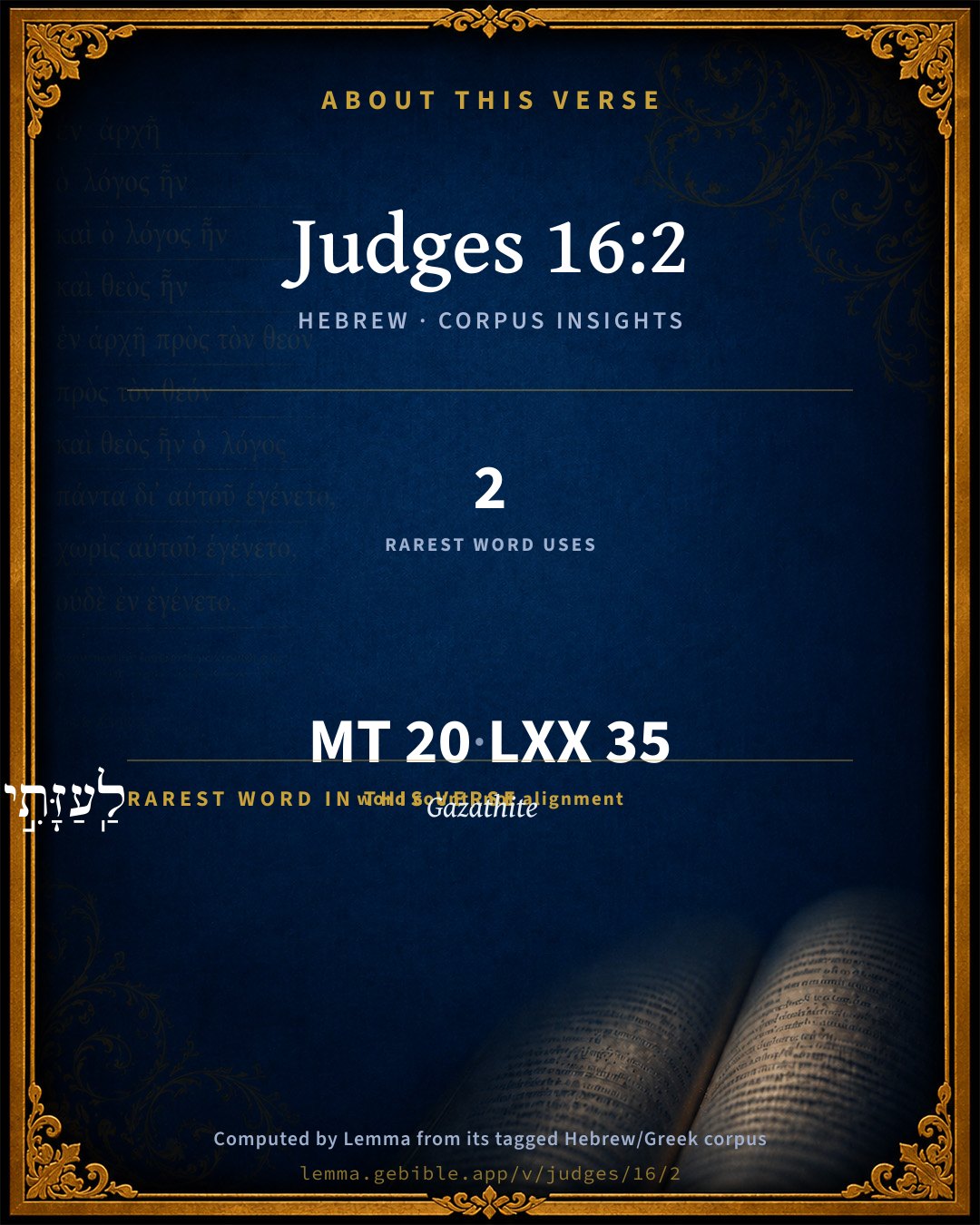
20
words
16
distinct lemmas
Historical
section

Notable vocabulary

The rarest word here is לַֽעַזָּתִ֣ים Gazathite H5841 — appearing just 2 times in the whole Hebrew Bible.

Shared distinctive vocabulary

לַֽעַזָּתִ֣ים Gazathite H5841 occurs in 2 verses of the Hebrew Bible. Also found in:

Grammatical profile

  • 7 verbs
  • 10 nouns
  • 2 prepositions
  • 1 adverb

Verb forms

  • לֵאמֹ֗ר Qal · Infinitive Construct
  • בָּ֤א Qal · Perfect
  • וַיָּסֹ֛בּוּ Qal · Sequential Imperfect
  • וַיֶּאֶרְבוּ Qal · Sequential Imperfect
  • וַיִּתְחָרְשׁ֤וּ Hithpael · Sequential Imperfect
  • לֵאמֹ֔ר Qal · Infinitive Construct
  • וַהֲרְגְנֻֽהוּ Qal · Perfect

Repetition

Words recur within this verse — often emphatic in Hebrew:

  • לֵאמֹ֗ר to say H559 ×2
  • כָל all H3605 ×2
  • הַלַּ֖יְלָה night H3915 ×2

Hebrew & Septuagint length

In English translation the verse runs 44 words from the Hebrew and 49 from the Septuagint (LXX English) — closely comparable.

A rough comparison of the two English renderings, which tokenize alike — not a word-level alignment.

Word counts can differ between the Hebrew and the Greek without any difference in meaning — e.g. the Hebrew direct-object marker אֵת has no separate Greek word, and Greek often adds the article ὁ.

In the original languages it is 20 Hebrew tokens and 35 Greek tokens — but the two are counted differently (Hebrew bundles its prefixes and suffixes into one token; the Greek is in lemma form), so that isn’t a like-for-like length.

Cross-references

9

Topical passages linked to Judges 16:2 in the Treasury of Scripture Knowledge — connected by theme and wording, ordered by reader-vote popularity; previews shown in the World English Bible.

  • Psalms 118:10–12 All the nations surrounded me, But in the name of Yahweh, I cut them off.
  • 1 Samuel 23:26 Saul went on this side of the mountain, and David and his men on that side of the mountain: and David made haste to get away for fear of Saul; for Saul and his men compassed David and his men round about to take them.
  • Acts 9:24 but their plot became known to Saul. They watched the gates both day and night that they might kill him,
  • Judges 15:18 He was very thirsty, and called on Yahweh, and said, You have given this great deliverance by the hand of your servant; and now shall I die for thirst, and fall into the hand of the uncircumcised.
  • 1 Samuel 19:11 Saul sent messengers to David's house, to watch him, and to kill him in the morning: and Michal, David's wife, told him, saying, If you don't save your life tonight, tomorrow you will be slain.
  • Matthew 21:38 But the farmers, when they saw the son, said among themselves, 'This is the heir. Come, let's kill him, and seize his inheritance.'
  • Matthew 27:1 Now when morning had come, all the chief priests and the elders of the people took counsel against Jesus to put him to death:
  • Acts 23:15 Now therefore, you with the council inform the commanding officer that he should bring him down to you tomorrow, as though you were going to judge his case more exactly. We are ready to kill him before he comes near."
  • 2 Corinthians 11:32–33 In Damascus the governor under Aretas the king guarded the city of the Damascenes desiring to arrest me.

Cross-references courtesy of OpenBible.info (CC BY 4.0).

Hebrew and Greek witnesses Masoretic Hebrew ↔ Greek Septuagint

The same verse in the two great witnesses to the Old Testament, shown verse-for-verse.

These are two independent witnesses, not word-aligned to each other, and the Septuagint is shown in lemma (dictionary) form.

Hebrew Judges 16:2 Masoretic · Westminster Leningrad Codex

לַֽעַזָּתִ֣ים לֵאמֹ֗ר בָּ֤א שִׁמְשׁוֹן֙ הֵ֔נָּה וַיָּסֹ֛בּוּ וַיֶּאֶרְבוּ ל֥וֹ כָל הַלַּ֖יְלָה בְּשַׁ֣עַר הָעִ֑יר וַיִּתְחָרְשׁ֤וּ כָל הַלַּ֨יְלָה֙ לֵאמֹ֔ר עַד א֥וֹר הַבֹּ֖קֶר וַהֲרְגְנֻֽהוּ

[It was told] the Gazites, saying, Samson is come here. They compassed him in, and laid wait for him all night in the gate of the city, and were quiet all the night, saying, [Let be] until morning light, then we will kill him.

World English Bible · Public Domain

Greek LXX Judges 16:2 Septuagint · lemma form

καί ἀναἀγγέλλω ὁ γαζαῖος λέγω ἥκω σαμψων ὧδε καί κυκλόω καί ἐνεδρεύω ἐπί αὐτός ὅλος ὁ νύξ ἐν ὁ πύλη ὁ πόλις καί κωφεύω ὅλος ὁ νύξ λέγω ἕως διαφαύσκω ὁ ὄρθρος καί φονεύω αὐτός

And it was reported to the Gazites, saying, Sampson is come here: and they compassed him and laid wait for him all night in the gate of the city, and they were quiet all the night, saying, Let us wait till the dawn appear, and we will kill him.

LXX2012 (modern English Septuagint) · Public Domain

On this verse, The Cambridge Bible for Schools and Colleges discusses the Septuagint’s reading. Read the note in Commentary ↓

Hebrew: Westminster Leningrad Codex (CC BY 4.0). Greek: Septuagint (public domain); English from LXX2012 (modern English Septuagint) (Public Domain). How the Septuagint differs from the Hebrew →

Targum (Aramaic paraphrase)

1

The Targum is the ancient Jewish Aramaic paraphrase of the Hebrew Scriptures — an interpretive translation, not the Hebrew text itself. Onkelos (literal) and Pseudo-Jonathan (expansive) render the Torah, and Jonathan the Prophets. Coverage is partial: where no permissively-licensed English translation exists for a verse, only the Aramaic is shown. This is verse-level text, not a word-by-word alignment to the Hebrew.

  1. Targum Jonathan Prophets (Joshua–Malachi)
    לְעַזָתָאֵי אִתְחַוָה לְמֵימָר אֲתָא שִׁמְשׁוֹן הַלְכָא וְאַסְחֲרוּ וּכְמָנוּ לֵיהּ כָּל לֵילְיָא בְּמַעֲלָנָא דִתְרַע קַרְתָּא וּשְׁתִיקוּ כָּל לֵילְיָא לְמֵימָר עַד נֵיהוֹר צַפְרָא וְנִקְטְלִינֵיהּ:

    (no public-domain English translation for this verse)

    Targum Jonathan — Aramaic: “Mikraot Gedolot” (public domain). English: “Sefaria Community Translation” (CC0 1.0 (public-domain dedication)); “London "Chaldee Paraphrase," 1871” (public domain). Text via Sefaria.

Commentary

Notes on Judges 16:2 from classic Christian and Jewish commentators (each source and its license shown beneath its notes). The classic Christian expositions comment on the surrounding passage and are grouped to its opening verse, so a note may address several verses; the Jewish commentaries on the Tanakh (Rashi and others) are per-verse, so they appear only where the commentator wrote on this verse.

Lemma curates 59 commentaries, every one of them public domain or Creative Commons licensed, each selected and text-cleaned for this edition rather than reprinted as found. About our sources →

Trapp's Complete Commentary

John Trapp

Jdg 16:2 [And it was told] the Gazites, saying, Samson is come hither. And they compassed [him] in, and laid wait for him all night in the gate of the city, and were quiet all the night, saying, In the morning, when it is day, we shall kill him.

Ver. 2. And they compassed him in.] See their sedulity and Samson’s security, but especially God’s superabundant mercy: {1Ti 1:14} the riches of his grace cast in over and above desert or desire. {Eph 2:7 Rom 5:20}

John Trapp, A Commentary or Exposition upon All the Books of the Old and New Testament (1647–1656) — public domain. Text from a community e-Sword module.

Joseph Benson's Commentary

Jdg 16:2. It was told the Gazites, Samson is come hither — The arrival of so extraordinary a man could not be long concealed. And his enemies were willing to improve so favourable an opportunity to destroy him. They compassed him in, &c. — They either beset the house, or lay in wait at the gate of the city; saying, In the morning we will kill him — This, it is probable, they chose to do, rather than to seize upon him in his bed by night; either, because they knew not certainly in what house he was; or, because they thought to do that might cause great terror, and confusion, and mischief among their own people; whereas in the day-time they might more fully discover him, and more certainly use their weapons against him. O that all who indulge any unholy desire might see themselves thus surrounded, and marked for destruction by their spiritual enemies! The more secure they are, the greater is their danger.

Joseph Benson's Commentary on the Old and New Testaments (1811–1818) — public domain. Text from a community e-Sword module.

Geneva Bible (1599)

Geneva Bible translators

Or, to the light of the morning.

Geneva Bible (1599) marginal notes — public domain. Text via Bolls.life.

Adam Clarke's Commentary

Verse 2. They compassed him in] They shut up all the avenues, secured the gates, and set persons in ambush near them, that they might attack him on his leaving the city early the next morning.

Adam Clarke's Commentary on the Bible (1810–1826) — public domain. Text from a community e-Sword/MySword module.

Ellicott's Commentary for English Readers

(2) And it was told.—Our version rightly supplies these words. They are found in all the versions, and there can be no doubt that the word vayyuggar (Gen_22:20) has in this case accidentally dropped out of the text.

They compassed him in.—They apparently did not know in what house he was. The word might mean “they went round the city” (Psa_59:7), i.e., to look for him.

Were quiet—i.e., they made no attack. Thinking that they had secured him, they seem to have retired to rest. (Comp. Act_9:23-24.)

A Bible Commentary for English Readers, edited by Charles John Ellicott (1878–1897) — public domain. Text from a community e-Sword module.

The Cambridge Bible for Schools and Colleges

gen. ed. J. J. S. Perowne

2. And it was told the Gazites] The verb has fallen out by accident; the LXX read it in the text.

all night in the gate] The text makes the Philistines lie in wait all the night, and keep quiet all the night; but there would be no need to keep watch in the gate at night, for the gate would be shut. To relieve the confusion the simplest plan is either to omit the first all the night, or to read all the day. The Philistines patrolled the town and lay in wait [during the day], hoping to catch Samson at the city gate when he went out; at night they could only keep quiet until the morning, and then fall upon their enemy. The last cl. = lit. until the morning dawns and we kill him, until implying the verb wait; for the Hebr. idiom see Driver, Tenses, p. 135, and cf. 1Sa_1:22 etc. Hebrew coordinates clauses which are really subordinate. The marg. ‘or Before’ is not right.

The Cambridge Bible for Schools and Colleges (gen. ed. J. J. S. Perowne; Cambridge University Press, 1878–1918) — public domain. Text from a community e-Sword module.

John Gill's Exposition

And it was told the Gazites,.... The inhabitants of Gaza, the principal ones of it, the magistrates of the city, either by some persons that saw him come in, who knew him, or by the harlot into whose company he fell, to whom he made himself known:

saying, Samson is come hither; the man so famous for his strength, and such an enemy to the Philistines; his name was well known for his great exploits, and rung throughout Palestine, and was a terror to the whole country:

and they compassed him in; not that they surrounded the house where he was, which perhaps they might not certainly know, but they secured all the avenues and gates of the city, made them fast, and placed guards there, that he might not escape their hands:

and laid wait for him all night in the gate; particularly at that gate, where, if he went out for his country, he must pass:

and were quiet all the night; did not attempt to disturb Samson, or seize on him, if they knew where he was; knowing his great strength, and what a tumult might be raised in the city, they said nothing of it to anybody that passed, what they were placed there for, lest it should come to his ears; they made as if they were deaf and dumb, as some interpret it, and heard and knew nothing:

saying, in the morning, when it is day, we shall kill him; when they should better know him, and make sure their blow at him, and do it suddenly, unawares to him, as he came to the gate, to pass through it.

John Gill's Exposition of the Whole Bible (1746–1763) — public domain (CC PDM 1.0). Text via the HelloAO Bible API.

Haydock's Catholic Bible Commentary

Setting. Hebrew, "they laid wait for him all night in the gate,....and were quiet all night, saying, in the morning, when it is day, we shall kill him." They hoped to seize him unawares, (Haydock) as they were afraid to rouse this lion, and hence probably refrained from setting fire to the house: (Calmet) though they might be deterred from doing this, by the fear of the conflagration spreading to other parts of the city, (Haydock) and by an over-ruling Providence. (Salien)

George Leo Haydock (1774–1849), Haydock's Catholic Family Bible and Commentary, 1859 edition — public domain. Excludes Psalms (Douay-Rheims chapter numbering differs from Protestant) and Deuterocanonical books (Catholic canon only).

Matthew Poole's English Annotations

This they chose to do, rather than to seize upon him in his house and bed by night; either because they knew not certainly in what house or place he was; or because they thought that might cause great terror, and confusion, and mischief among their own people; whereas in the day time they might more fully discover him, and more unexpectedly surprise him, and more certainly direct their blows and use their weapons against him.

Matthew Poole's English Annotations on the Holy Bible (1683–1685) — public domain. Text from a community e-Sword/MySword module.

Whedon's Commentary on the Bible

Daniel D. Whedon

2. Samson is come hither — Samson may have thought to pass unrecognized in that large town, but his fame was too extended, and too many Philistine eyes had seen him before. His stalwart form and long growth of hair would also, probably, anywhere attract attention.

Compassed him in — Probably, compassed the city about with spies to guard against a sudden and sly departure of their foe.

Quiet all the night — After night set in they supposed he would not be likely to leave the harlot before the morning, and so the watchmen gave so little heed to the gate of the city that Samson carried it off without their knowledge.

Daniel D. Whedon (gen. ed.), Commentary on the Old and New Testaments (1874–1909) — public domain. Text from a community e-Sword module.

The Pulpit Commentary

And it was told. These words have no doubt accidentally fallen out of the Hebrew text, but they are necessary to the sense, and are expressed in all the ancient versions. We have no clue as to the motive of Samson"s visit to Gaza, whether he was meditating its conquest, or an assault upon its inhabitants, or whether he came merely in the wild spirit of adventure, or upon civil business. We only know that he came there, that, with his usual weakness, he fell into the snare of female blandishments, that the Philistines thought to have caught him and killed him, but that he escaped by his supernatural strength. Gaza is about thirteen hours" march from Thimnathah. They compassed him in. The Hebrew does not express this idea, nor is it what the Gazites did. It should be rendered, They went about and lay in wait for him. Instead of attacking him directly, they took a round-about course, and set an ambush for him in the city gates, probably in the guard-room by the side of the gate, intending when he came forth unsuspectingly in the morning, at the hour of opening the gates, to rush upon him and kill him.

The Pulpit Commentary (1880–1919), ed. H.D.M. Spence-Jones & Joseph S. Exell — public domain. Text from a community e-Sword module.

John Wesley's Explanatory Notes

In the morning - This they chose to do, rather than to seize upon him in his bed by night; either, because they knew not certainly in what house he was; or, because they thought that might cause great terror, and confusion, and mischief among their own people; whereas in the day-time they might more fully discover him, and more certainly use their weapons against him. O that all who indulge any unholy desire, might see themselves thus surrounded, and marked for destruction by their spiritual enemies! The more secure they are, the greater is their danger.

John Wesley, Explanatory Notes Upon the Whole Bible (1754–1765) — public domain. Text via the GEBible commentary corpus.

Rashi

Rabbi Shlomo Yitzchaki (Rashi)

The Azites were informed. It was said to the people of Aza.

They were silent [lit. "They were muted"]. They acted in silence.

Rashi on the Tanakh — English translations: “The Judaica Press complete Tanach with Rashi, translated by A. J. Rosenberg” (CC BY 4.0); “Pentateuch with Rashi's commentary by M. Rosenbaum and A.M. Silbermann, 1929-1934” (public domain); “The Metsudah Tanach series, Lakewood, N.J” (CC BY 4.0); and “The Book of Joshua, Metsudah Publications, 1997” (CC BY 4.0). Text via Sefaria.

Lesson kit

Teaching starters — assembled from the data on this page, not authored interpretation. Every prompt links to the verse data it draws on. Edit before teaching.

Judges, in the Historical, opens this verse with 20 words (16 distinct Hebrew lemmas). Its most distinctive word is ʻAzzâthîy (“Gazathite”). A historical commentator’s framing appears above. Read the whole chapter for the surrounding context.

Discussion questions

  1. What does “Gazathite” (ʻAzzâthîy) contribute to the verse as a whole?
  2. How does Joshua 13:3, which shares the word «Gazathite», read alongside this verse?
  3. What does the repetition of “to say” (2× in this one verse) do in this verse?
  4. These translations render this verse differently; the difference is in the English rendering, not the original. What questions does that raise?
  5. «לֵאמֹ֗ר» is a Qal Infinitive Construct verb. How does that grammatical form shape the action described?
  6. Compare how Trapp's Complete Commentary and Joseph Benson's Commentary read this verse. Where do they agree or differ?

Things to notice

Reading settings

Reading text

Shown beneath each verse's original-language words.

Old Testament
Old Testament edition

Read the OT as the Masoretic Hebrew (MT) or the Greek Septuagint (LXX).

English shown for the Greek Septuagint (in the Hebrew ↔ Greek comparison).

Comparing translations? Open the Compare panel on any verse page to stack up to four side by side.