
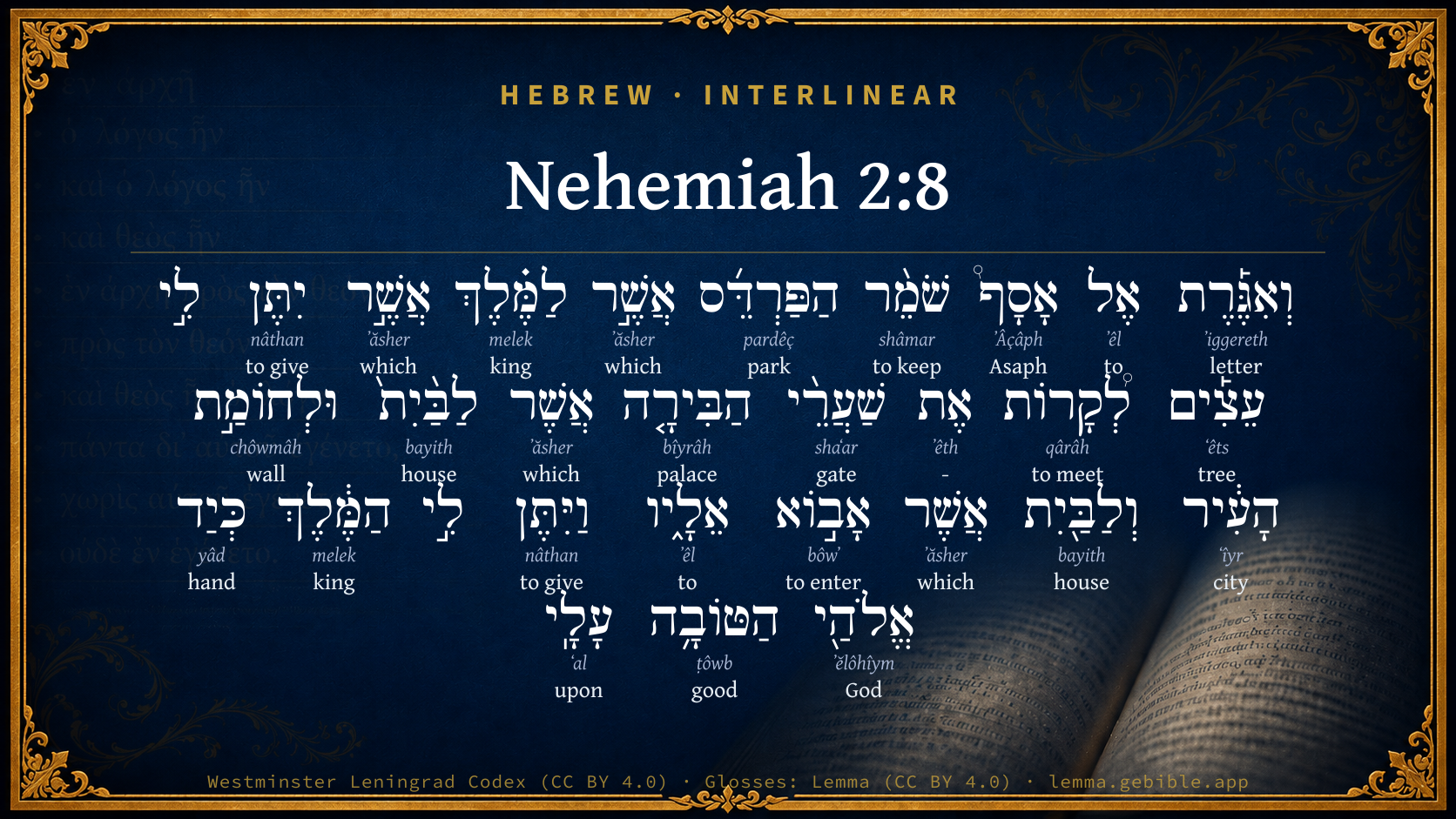
Nehemiah 2:8

Hebrew (Westminster Leningrad Codex) Nehemiah 2:8 appears in the Hebrew Old Testament. The text above is from the Westminster Leningrad Codex. Each word links to its Strong’s number, a concise gloss, and parsing drawn from the Open Scriptures Hebrew Bible morphology. Click any word for its full Brown-Driver-Briggs (BDB) entry.
Download image
Cite this verse

Nehemiah 2:8 (World English Bible). Public Domain. Lemma interlinear Bible study tool, https://lemma.gebible.app/v/nehemiah/2/8.

Show BibTeX & RIS
BibTeX
RIS
English Translation
and a letter to Asaph the keeper of the king's forest, that he may give me timber to make beams for the gates of the castle which appertains to the house, and for the wall of the city, and for the house that I shall enter into. The king granted me, according to the good hand of my God on me.
World English Bible · Public Domain
Highlights
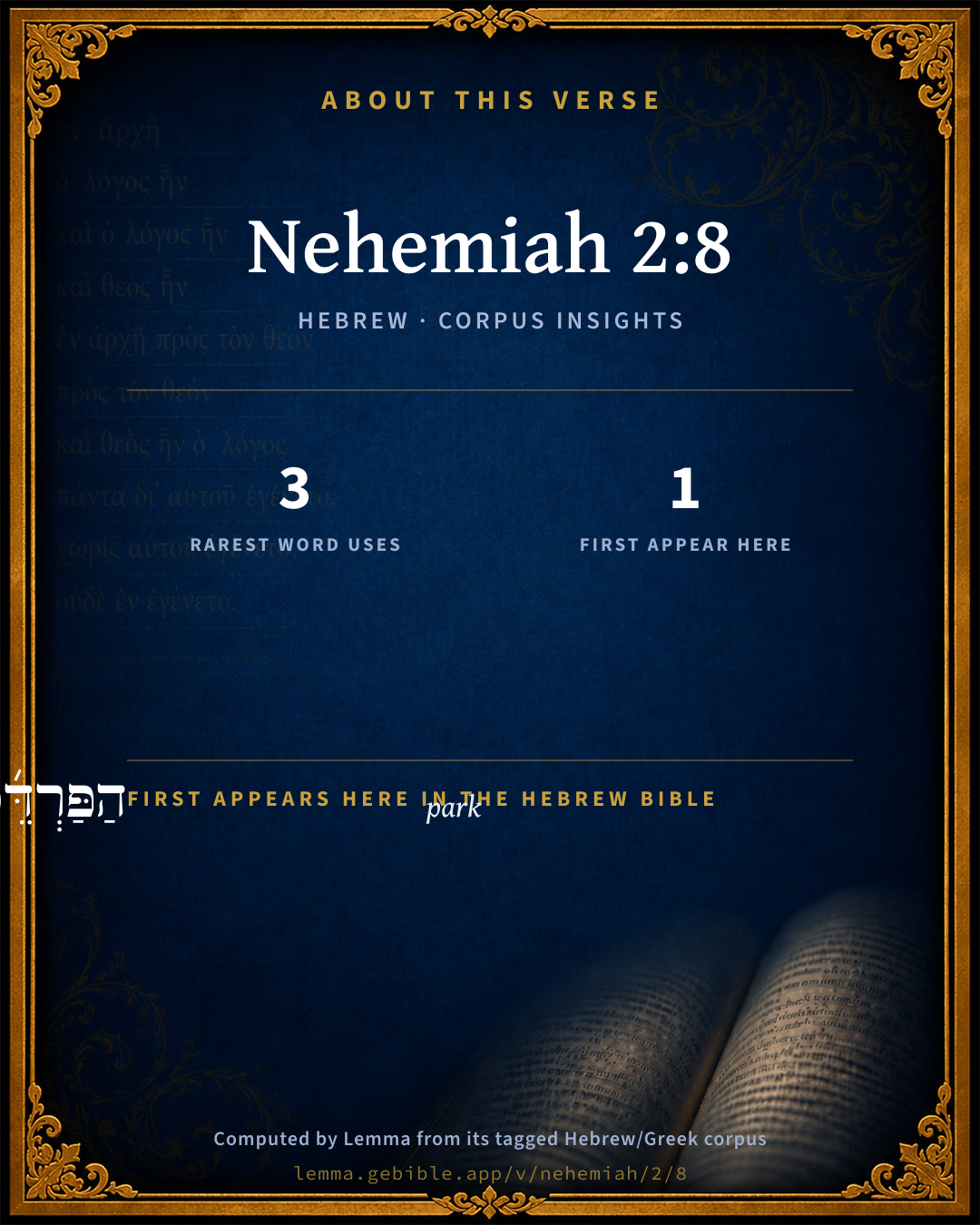
  • 1 first appearance in the Hebrew Bible
Full analysis ↓
Download a study sheet

One document with this verse’s original text, its word-by-word gloss line, the meaning frame, cross-references with their text, attributed commentary, and full source and license credits — printable, and it pastes into notes with its structure intact.

This verse Autodidact and up

Study sheet (.html) Plain text (.txt)

A passage Seminary Student

Up to 50 verses in one chapter. A passage sheet keeps up to 6 commentary sources and 12 cross-references per verse, in the order this page ranks them, and says so on the sheet whenever that leaves anything out. Ask for a single verse and you get the Autodidact verse sheet above.

Everything on this page stays free to read, with no account — the sheet is a download of what is already on screen, not access to it.

Want to remove ads? Support Godless Engineer
Compare translations 3

The same verse in 3 English versions, stacked beneath the original-language interlinear above. Click any original word for its lexicon entry.

Each is an independent rendering of the whole verse — the interlinear is not word-aligned to these translations.

Highlighted words mark where these versions differ — a whole-verse word diff, not a word-by-word alignment.

  • World English Bible Public Domain
    and a letter to Asaph the keeper of the king's forest, that he may give me timber to make beams for the gates of the castle which appertains to the house, and for the wall of the city, and for the house that I shall enter into. The king granted me, according to the good hand of my God on me.
  • King James Version Public Domain
    And a letter unto Asaph the keeper of the king's forest, that he may give me timber to make beams for the gates of the palace which appertained to the house, and for the wall of the city, and for the house that I shall enter into. And the king granted me, according to the good hand of my God upon me.
  • unfoldingWord Literal Text CC BY-SA 4.0
    and a letter to Asaph, the keeper of the forest that belongs to the king, that he will give to me timbers to lay the beams of the gates of the citadel, which is for the house, and for the wall of the city, and for the house into which I will enter.” And the king gave to me, according to the good hand of my God upon me.

unfoldingWord Literal Text — © unfoldingWord, licensed CC BY-SA 4.0. Word-aligned USFM3 via Door43 (git.door43.org/unfoldingWord/en_ult).

Versions to compare (up to 4)

3 of 4 selected

Show all 18 translations

Every available English version of this verse, each an independent rendering of the whole verse.

  • World English Bible Public Domain
    and a letter to Asaph the keeper of the king's forest, that he may give me timber to make beams for the gates of the castle which appertains to the house, and for the wall of the city, and for the house that I shall enter into. The king granted me, according to the good hand of my God on me.
  • Berean Standard Bible Public Domain
    And may I have a letter to Asaph, keeper of the king’s forest, so that he will give me timber to make beams for the gates of the citadel to the temple, for the city wall, and for the house I will occupy.” And because the gracious hand of my God was upon me, the king granted my requests.
  • Majority Standard Bible Public Domain
    And may I have a letter to Asaph, keeper of the king’s forest, so that he will give me timber to make beams for the gates of the citadel to the temple, for the city wall, and for the house I will occupy.” And because the gracious hand of my God was upon me, the king granted my requests.
  • King James Version Public Domain
    And a letter unto Asaph the keeper of the king's forest, that he may give me timber to make beams for the gates of the palace which appertained to the house, and for the wall of the city, and for the house that I shall enter into. And the king granted me, according to the good hand of my God upon me.
  • American Standard Version (1901) Public Domain
    and a letter unto Asaph the keeper of the king's forest, that he may give me timber to make beams for the gates of the castle which appertaineth to the house, and for the wall of the city, and for the house that I shall enter into. And the king granted me, according to the good hand of my God upon me.
  • Revised Version (1885) Public Domain
    and a letter unto Asaph the keeper of the king’s forest, that he may give me timber to make beams for the gates of the castle which appertaineth to the house, and for the wall of the city, and for the house that I shall enter into. And the king granted me, according to the good hand of my God upon me.
  • Geneva Bible (1599) Public Domain
    And letters vnto Asaph the keeper of the Kings parke, that hee may giue me timber to buylde the gates of the palace (which apperteined to the house) and for the walles of the citie, and for the house that I shall enter into. And the King gaue me according to the good hand of my God vpon me.
  • Douay-Rheims (1899) Public Domain
    And a letter to Asaph the keeper of the king's forest, to give me timber that I may cover the gates of the tower of the house, and the walls of the city, and the house that I shall enter into. And the king gave me according to the good hand of my God with me.
  • Young's Literal Translation Public Domain
    and a letter unto Asaph, keeper of the paradise that the king hath, that he give to me trees for beams `for' the gates of the palace that the house hath, and for the wall of the city, and for the house into which I enter;' and the king giveth to me, according to the good hand of my God upon me.
  • Literal Standard Version CC BY-SA 4.0
    and a letter to Asaph, keeper of the paradise that the king has, that he give to me trees for beams [for] the gates of the palace that the house has, and for the wall of the city, and for the house into which I enter”; and the king gives to me, according to the good hand of my God on me.
  • Unlocked Literal Bible CC BY-SA 4.0
    May there also be a letter for Asaph the keeper of the king's forest, so that he may give me timber to make beams for the gates of the fortress next to the temple, and for the wall of the city, and for the house in which I will live.” So because the good hand of God was on me, the king granted me my requests.
  • unfoldingWord Literal Text CC BY-SA 4.0
    and a letter to Asaph, the keeper of the forest that belongs to the king, that he will give to me timbers to lay the beams of the gates of the citadel, which is for the house, and for the wall of the city, and for the house into which I will enter.” And the king gave to me, according to the good hand of my God upon me.
  • Darby Bible Public Domain
    and a letter to Asaph the keeper of the king's forest, that he may give me timber to make beams for the gates of the palace which [appertains] to the house, and for the wall of the city, and for the house that I shall enter into. And the king granted me, according to the good hand of my God upon me.
  • World Messianic Bible Public Domain
    and a letter to Asaph the keeper of the king’s forest, that he may give me timber to make beams for the gates of the citadel by the temple, for the wall of the city, and for the house that I will occupy.” The king granted my requests, because of the good hand of my God on me.
  • Webster's Bible Public Domain
    And a letter to Asaph the keeper of the king's forest, that he may give me timber to make beams for the gates of the palace which appertained to the house, and for the wall of the city, and for the house that I shall enter. And the king granted me, according to the good hand of my God upon me.
  • Free Bible Version CC BY-SA 4.0
    May I also have a letter for Asaph, warden of the king's forest, so he can give me timber to make beams for the gates of Temple fortress, for the city walls, and for the house I will live in.” Because my gracious God was upon me, the king gave me what I asked.
  • Bible in Basic English Public Domain
    And a letter to Asaph, the keeper of the king's park, so that he may give me wood to make boards for the doors of the tower of the house, and for the wall of the town, and for the house which is to be mine. And the king gave me this, for the hand of my God was on me.
  • JPS Tanakh (1917) Public Domain
    and a letter unto Asaph the keeper of the king's park, that he may give me timber to make beams for the gates of the castle which appertaineth to the house, and for the wall of the city, and for the house that I shall enter into.' And the king granted me, according to the good hand of my God upon me.

Literal Standard Version (2020), Covenant Press — licensed CC BY-SA 4.0. Text via the HelloAO Bible API (eBible.org). Unlocked Literal Bible (unfoldingWord) — licensed CC BY-SA 4.0. Text via the HelloAO Bible API (eBible.org). unfoldingWord Literal Text — © unfoldingWord, licensed CC BY-SA 4.0. Word-aligned USFM3 via Door43 (git.door43.org/unfoldingWord/en_ult). Free Bible Version, Dr. Jonathan Gallagher — licensed CC BY-SA 4.0. Text via the HelloAO Bible API (eBible.org).

Word by word

More ways to search: Search by grammar → Find every occurrence → Compare this word →

Practice this passage: Drill this verse → Learn its vocabulary →

הַפַּרְדֵּ֜ס
pardêç
H6508
“the · park”
Particle, Definite Article + Noun, Common, Masculine, Singular, Absolute
Part of Speech
Particle + Noun
Type
Common
Gender
Masculine
Number
Singular
State
Absolute
Full BDB Definition

Origin: of foreign origin

TWOT: 1808

park, preserve, enclosed garden, forest
  1. וְאִגֶּ֡רֶת ʼiggereth H107 “and · letter” Conjunction + Noun, Common, Feminine, Singular, Absolute
  2. אֶל ʼêl H413 “to” Preposition
  3. אָסָף֩ ʼÂçâph H623 “Asaph” Noun, Proper
  4. שֹׁמֵ֨ר shâmar H8104 “keeping” Verb, Qal, Participle Active, Masculine, Singular, Construct
  5. אֲשֶׁ֣ר ʼăsher H834 “which” Particle, Relative
  6. לַמֶּ֗לֶךְ melek H4428 “to/for the · king” Preposition, Determined + Noun, Common, Masculine, Singular, Absolute
  7. אֲשֶׁ֣ר ʼăsher H834 “which” Particle, Relative
  8. יִתֶּן nâthan H5414 “to give” Verb, Qal, Imperfect, 3rd Person, Masculine, Singular
  9. עֵצִ֡ים ʻêts H6086 “trees” Noun, Common, Masculine, Plural, Absolute
  10. לְ֠קָרוֹת qârâh H7136 “to meet” Preposition + Verb, Piel, Infinitive Construct
  11. אֶת ʼêth H853 “-” Particle, Direct Object
  12. שַׁעֲרֵ֨י shaʻar H8179 “gates of” Noun, Common, Masculine, Plural, Construct
  13. הַבִּירָ֤ה bîyrâh H1002 “the · palace” Particle, Definite Article + Noun, Common, Feminine, Singular, Absolute
  14. אֲשֶׁר ʼăsher H834 “which” Particle, Relative
  15. לַבַּ֨יִת֙ bayith H1004 “to/for the · house” Preposition, Determined + Noun, Common, Masculine, Singular, Absolute
  16. וּלְחוֹמַ֣ת chôwmâh H2346 “and · to/for · wall of” Conjunction + Preposition + Noun, Common, Feminine, Singular, Construct
  17. הָעִ֔יר ʻîyr H5892 “the · city” Particle, Definite Article + Noun, Common, Feminine, Singular, Absolute
  18. וְלַבַּ֖יִת bayith H1004 “and · to/for the · house” Conjunction + Preposition, Determined + Noun, Common, Masculine, Singular, Absolute
  19. אֲשֶׁר ʼăsher H834 “which” Particle, Relative
  20. אָב֣וֹא bôwʼ H935 “to enter” Verb, Qal, Imperfect, 1st Person, Common, Singular
  21. אֵלָ֑יו ʼêl H413 “to · him” Preposition + Suffix, Personal, 3rd Person, Masculine, Singular
  22. וַיִּתֶּן nâthan H5414 “and · to give” Conjunction + Verb, Qal, Sequential Imperfect, 3rd Person, Masculine, Singular
  23. הַמֶּ֔לֶךְ melek H4428 “the · king” Particle, Definite Article + Noun, Common, Masculine, Singular, Absolute
  24. כְּיַד yâd H3027 “like/as · hand of” Preposition + Noun, Common, Both, Singular, Construct
  25. אֱלֹהַ֖י ʼĕlôhîym H430 “God(s) · my” Noun, Common, Masculine, Plural, Construct + Suffix, Personal, 1st Person, Common, Singular
  26. הַטּוֹבָ֥ה ṭôwb H2896 “the · good” Particle, Definite Article + Adjective, Adjective, Feminine, Singular, Absolute
  27. עָלָֽי ʻal H5921 “upon · me” Preposition + Suffix, Personal, 1st Person, Common, Singular

About this verse

These counts appear in no published source. They are computed here, from the morphology-tagged text and Lemma’s own curated glosses. What Lemma adds →

30
words
21
distinct lemmas
Historical
section

Notable vocabulary

The rarest word here is הַפַּרְדֵּ֜ס park H6508 — appearing just 3 times in the whole Hebrew Bible.

First appearance in Scripture

This word makes its first canonical appearance in the Hebrew Bible here:

  • הַפַּרְדֵּ֜ס park H6508

Shared distinctive vocabulary

הַפַּרְדֵּ֜ס park H6508 occurs in 3 verses of the Hebrew Bible. Also found in:

Grammatical profile

  • 5 verbs
  • 14 nouns
  • 1 adjective
  • 5 prepositions
  • 5 particles

Verb forms

  • שֹׁמֵ֨ר Qal · Participle Active
  • יִתֶּן Qal · Imperfect
  • לְ֠קָרוֹת Piel · Infinitive Construct
  • אָב֣וֹא Qal · Imperfect
  • וַיִּתֶּן Qal · Sequential Imperfect

Repetition

Words recur within this verse — often emphatic in Hebrew:

  • לַמֶּ֗לֶךְ king H4428 ×2
  • יִתֶּן to give H5414 ×2
  • לַבַּ֨יִת֙ house H1004 ×2
  • אֲשֶׁ֣ר which H834 ×4
  • אֶל to H413 ×2

Cross-references

15

Topical passages linked to Nehemiah 2:8 in the Treasury of Scripture Knowledge — connected by theme and wording, ordered by reader-vote popularity; previews shown in the World English Bible.

  • Ezra 7:6 this Ezra went up from Babylon: and he was a ready scribe in the law of Moses, which Yahweh, the God of Israel, had given; and the king granted him all his request, according to the hand of Yahweh his God on him.
  • Isaiah 66:14 You shall see [it], and your heart shall rejoice, and your bones shall flourish like the tender grass: and the hand of Yahweh shall be known toward his servants; and he will have indignation against his enemies.
  • Nehemiah 7:2 that I gave my brother Hanani, and Hananiah the governor of the castle, charge over Jerusalem; for he was a faithful man, and feared God above many.
  • Daniel 1:9 Now God made Daniel to find kindness and compassion in the sight of the prince of the eunuchs.
  • Nehemiah 2:17–18 Then said I to them, You see the evil case that we are in, how Jerusalem lies waste, and the gates of it are burned with fire: come, and let us build up the wall of Jerusalem, that we be no more a reproach.
  • Genesis 32:28 He said, "Your name will no longer be called 'Jacob,' but, 'Israel,' for you have fought with God and with men, and have prevailed."
  • Ezra 5:5 But the eye of their God was on the elders of the Jews, and they did not make them cease, until the matter should come to Darius, and then answer should be returned by letter concerning it.
  • Ezra 6:22 and kept the feast of unleavened bread seven days with joy: for Yahweh had made them joyful, and had turned the heart of the king of Assyria to them, to strengthen their hands in the work of the house of God, the God of Israel.
  • Ezra 7:9 For on the first [day] of the first month began he to go up from Babylon; and on the first [day] of the fifth month came he to Jerusalem, according to the good hand of his God on him.
  • Ezra 7:27–28 Blessed be Yahweh, the God of our fathers, who has put such a thing as this in the king's heart, to beautify the house of Yahweh which is in Jerusalem;
  • Nehemiah 3:1–32 Then Eliashib the high priest rose up with his brothers the priests, and they built the sheep gate; they sanctified it, and set up the doors of it; even to the tower of Hammeah they sanctified it, to the tower of Hananel.
  • Proverbs 21:1 The king's heart is in Yahweh's hand like the watercourses. He turns it wherever he desires.
  • Acts 7:10 and delivered him out of all his afflictions, and gave him favor and wisdom before Pharaoh, king of Egypt. He made him governor over Egypt and all his house.
  • Acts 26:22 Having therefore obtained the help that is from God, I stand to this day testifying both to small and great, saying nothing but what the prophets and Moses said would happen,
  • 2 Corinthians 8:16 But thanks be to God, who puts the same earnest care for you into the heart of Titus.

Cross-references courtesy of OpenBible.info (CC BY 4.0).

Hebrew and Greek witnesses Masoretic Hebrew ↔ Greek Septuagint

The same verse in the two great witnesses to the Old Testament, shown verse-for-verse.

These are two independent witnesses, not word-aligned to each other, and the Septuagint is shown in lemma (dictionary) form.

Hebrew Nehemiah 2:8 Masoretic · Westminster Leningrad Codex

וְאִגֶּ֡רֶת אֶל אָסָף֩ שֹׁמֵ֨ר הַפַּרְדֵּ֜ס אֲשֶׁ֣ר לַמֶּ֗לֶךְ אֲשֶׁ֣ר יִתֶּן לִ֣י עֵצִ֡ים לְ֠קָרוֹת אֶת שַׁעֲרֵ֨י הַבִּירָ֤ה אֲשֶׁר לַבַּ֨יִת֙ וּלְחוֹמַ֣ת הָעִ֔יר וְלַבַּ֖יִת אֲשֶׁר אָב֣וֹא אֵלָ֑יו וַיִּתֶּן לִ֣י הַמֶּ֔לֶךְ כְּיַד אֱלֹהַ֖י הַטּוֹבָ֥ה עָלָֽי

and a letter to Asaph the keeper of the king's forest, that he may give me timber to make beams for the gates of the castle which appertains to the house, and for the wall of the city, and for the house that I shall enter into. The king granted me, according to the good hand of my God on me.

World English Bible · Public Domain

Greek LXX Structure differs

The Septuagint has no separate book of Nehemiah. Its Greek text is the second half of Esdras B (2 Esdras), chapters 11–23; Ezra is the first half (1–10).

A verse-for-verse comparison isn’t shown here because the chapters and verses don’t line up. Switch to the LXX edition with the MT / LXX toggle above to read the Greek directly.

Hebrew: Westminster Leningrad Codex (CC BY 4.0). Greek: Septuagint (public domain); English from a public-domain English Septuagint. How the Septuagint differs from the Hebrew →

Commentary

Notes on Nehemiah 2:8 from classic Christian and Jewish commentators (each source and its license shown beneath its notes). The classic Christian expositions comment on the surrounding passage and are grouped to its opening verse, so a note may address several verses; the Jewish commentaries on the Tanakh (Rashi and others) are per-verse, so they appear only where the commentator wrote on this verse.

Lemma curates 59 commentaries, every one of them public domain or Creative Commons licensed, each selected and text-cleaned for this edition rather than reprinted as found. About our sources →

Trapp's Complete Commentary

John Trapp

Neh 2:8 And a letter unto Asaph the keeper of the king’s forest, that he may give me timber to make beams for the gates of the palace which [appertained] to the house, and for the wall of the city, and for the house that I shall enter into. And the king granted me, according to the good hand of my God upon me.

Ver. 8. Keeper of the king’s forest] Heb. Paradise; probably so called for the pleasantness of it. Tho French Protestants called their temple or church at Lyons, Paradise, David’s delight, Psa 27:1-14 Psa 84:1-12.

Of the palace that appertained to the house] i.e., to the Temple, which is called the house, by an excellency; as the Scriptures are called the Bible, that is, the Book, as being the only best book, in comparison whereof all other books in the world are no better than waste paper.

And for the house that I shall enter into] i.e., A dwelling house for myself, when once the public is served. Junius understands it of a common hall or shire house, wherein he might sit and judge causes brought before him.

And the king granted me] It was but ask and have, and so it is between God and his people. When there was a speech among some holy men, what was the best trade? one answered, beggary; it is the hardest and richest trade. Common beggary is indeed the poorest and easiest; but prayer he meant. A courtier gets more by one suit oft than a tradesman or merchant haply with twenty years’ labour; so doth a faithful prayer, &c.

According to the good hand] He calleth him his God, as if he loved or cared more for him than for the rest of the world. It is the property of true faith, ιδιοποιεισθαι, to make all its own that it can lay hold upon. {See Trapp on "Ezr 7:6"}

John Trapp, A Commentary or Exposition upon All the Books of the Old and New Testament (1647–1656) — public domain. Text from a community e-Sword module.

The Biblical Illustrator

Joseph S. Exell

Neh_2:8

And the king granted me, according to the good hand of my God upon us.

The power of God in the individual Christian

The secret of success is to have God with us, and what we want in our day is not more machinery or new methods of work, but more of the power of God in individual Christians. Nehemiah, in his prolonged prayerfulness, shows us how this power is to be obtained, for it is when we know God in His fulness and have enlightened communion with the Lord, that we are fitted to become workers together with Him. (W. P. Lockhart.)

Gods hand

I. A spirit of dependence. There breathes forth a feeling of insignificance. The speaker feels scarcely able to trust himself.

1. Mans technical skill. Having arrived at so high a standard in design, construction, and art, we are very apt to think very highly of ourselves. We gaze on the railway, the steam-engine, the ocean-steamer, the tunnel under the hills, and the canal through the land, and fancy we can do anything.

2. Mans natural conceit. There is a great tendency to think more highly of ourselves than we ought to think. Satan employs this tendency to induce man to lift up his hand against God.

II. A spirit of trust. This spirit of reliance will save us from many trials. It will prevent--

1. Anxious care. If we leave our concerns in Gods hand, we shall not be careful and cumbered about many things. It will prevent--

2. Worldly-mindedness of disposition. The spirit that leaves its cares in Gods hand will leave its joys there also.

3. All bitterness of sorrow. (Homilist.)

The recognition of God

He recognised God in all. Not to his favourable circumstances, nor to the opportunity of presenting his petition, nor to the good mood the monarch was in, nor to all of these combined, did he ascribe his success. Secondary causes would not explain the result; it must be traced to its true source--God and God alone must have all the glory. (W. P. Lockhart.)

The Biblical Illustrator, edited by Joseph S. Exell (c. 1880s–1900s) — public domain. Text from a community e-Sword module.

Tyndale Open Study Notes

Tyndale Open Resources

2:8 Temple fortress might refer to the Tower of Hananel or the Tower of the Hundred. • the gracious hand of God was on me: Nehemiah knew that the king granted these requests because God was sovereignly guiding the king to do so.

Tyndale Open Study Notes — © Tyndale Open Resources, licensed CC BY-SA 4.0. Text via the HelloAO Bible API.

Geneva Bible (1599)

Geneva Bible translators

Or, Paradise.

As God moved me to ask, and as he gave me good success therein.

Geneva Bible (1599) marginal notes — public domain. Text via Bolls.life.

Jamieson, Fausset & Brown

Robert Jamieson, A. R. Fausset & David Brown

according to the good hand of my God upon me--The piety of Nehemiah appears in every circumstance. The conception of his patriotic design, the favorable disposition of the king, and the success of the undertaking are all ascribed to God.

Jamieson, Fausset & Brown — Commentary Critical and Explanatory on the Whole Bible (1871) — public domain (CC PDM 1.0). Text via the HelloAO Bible API.

Adam Clarke's Commentary

Verse 8. Asaph the keeper of the king's forest] הפרדס hapardes of the paradise of the king. This I believe is originally a Persian word; it frequently occurs in Arabic, [Arabic] ferdoos, and in Greek, παραδεισος, and in both signifies a pleasant garden, vineyard, pleasure garden, and what we call a paradise.

Above the hall of audience, in the imperial palace at Dehli, the following Persian couplet is inscribed:-

[Persian]

[Persian]

"If there be a paradise on the face of the earth,

this is it, this is it, this is it."

Thus we find that the word is applied to denote splendid apartments, as well as fine gardens; in a word, any place of pleasure and delight. The king's forest mentioned in the text might have been the same to Artaxerxes, as the New Forest was to William the Conqueror, or Windsor Forest to the late amiable sovereign of the British people, GEORGE the THIRD.

And the king granted me, c.] This noble spirited man attributes every thing to God. He might have said, I had been long a faithful servant to the king and he was disposed, in reward of my fidelity, to grant my request; but he would not say so: "He granted my request, because the good hand of my God was upon me." God favoured me, and influenced the king's heart to do what I desired.

Adam Clarke's Commentary on the Bible (1810–1826) — public domain. Text from a community e-Sword/MySword module.

Ellicott's Commentary for English Readers

(8) Keeper of the king’s forest.—Asaph, a Jew, was keeper of an artificial park or pleasure ground near Jerusalem: the Persian pardes, whence our “Paradise.” It was well planted with trees, as timber was to be supplied from it “for the gates of the palace,” rather the fortress, which protected “the house,” or temple, and was known in Roman times as Antonia; also for the city walls; also “for the house that I shall enter into,” that is, Nehemiah’s own house, for his being appointed governor is pre-supposed.

A Bible Commentary for English Readers, edited by Charles John Ellicott (1878–1897) — public domain. Text from a community e-Sword module.

The Cambridge Bible for Schools and Colleges

gen. ed. J. J. S. Perowne

8. Asaph the keeper of the king’s forest] R.V. marg. ‘or park’. The forest or park from which the timber was to be supplied has been identified by some with the forests of Lebanon, by others with the well-wooded ‘plain’ abounding in olives and sycomores (1Ch_27:28) near the coast. In the present day scholars incline to identify it with ‘Solomon’s Garden’ at Etan or Etam, described by Josephus (Ant. VIII. 7.3) as richly wooded and well watered (παραδείσοις … καὶ ναμάτων ἐπιρροαῖς ἐπιτερπὲς ὁμοῦ καὶ πλούσιον) distant about six or seven miles S. from Jerusalem. The ‘pleasure-grounds’ of Solomon may have been handed down as ‘royal domains.’

In a scantily-wooded country like Palestine a well-preserved forest would have constituted a valuable piece of property.

The management of the ‘timber’ was committed to a royal officer, ‘the keeper of the king’s forest’ or ‘park.’ The name Asaph suggests that ‘the keeper’ was a Jew, which would favour the view of the forest being not far from Jerusalem.

‘forest,’ ‘park’ or ‘pleasure-garden.’ The Hebrew word “pardês” (Gr. παράδεισος = English ‘paradise’) is found in the O.T. only in Son_4:13; Ecc_2:5. It is said to be of Persian (= Zend pairidaéza) origin, signifying an ‘enclosure.’ It seems to have been used especially of ‘the royal parks’ or ‘enclosed hunting-grounds’ of the Persian kings, and in this sense to have been received into Hebrew and Greek literature. It occurs with the meaning of a ‘garden’ in Sir_24:30; Sir_40:17; Sir_40:27, Susann. passim. For its technical usage among the Jews for ‘the abode of the blest,’ see, on Luk_23:43, Lightfoot’s Horae Hebraicae.

that he may give me timber] Nehemiah asks for timber for the purpose of building (1) the castle or citadel of Jerusalem, (2) the walls generally, (3) his own house of residence as governor.

the gates of the palace which appertained to the house] R.V. the gates of the castle which appertaineth to the house. The word ‘Birah’ rendered ‘castle’ by the R.V. is of foreign, possibly Babylonian origin, and is represented in the Greek by Βᾶρις. See note on Neh_1:1.

The building here referred to was destined to play an important part in the later history of Jerusalem. It lay on the north side of the Temple (‘the house’), which it was intended to defend, and with which it communicated. It is not mentioned in Neh_12:39, and therefore probably lay inside the circuit of the wall. A special officer commanded it (Neh_7:2) on account of its great importance.

It was rebuilt by the Asmonean princes (1Ma_13:52), and again by Herod the Great, who gave it the name of ‘Antonia,’ after his friend and patron Mark Antony. Into this castle St Paul was carried by the Roman soldiers, when they rescued him from the hands of the mob in the Temple precincts (Act_21:37; Act_22:24).

the wall of the city] The timber would be required especially for the gates and for the towers which commanded the gates.

the house that I shall enter into] By this is apparently intended Nehemiah’s official residence, where he afterwards so generously entertained, Neh_5:17-18. The old interpretation which explained it to mean the Temple gives no satisfactory meaning to the words ‘that I shall enter into.’ Nehemiah was not a priest; and had no right to enter the Temple (see Neh_6:11).

according to the good hand, &c.] Cf. Neh_2:18; Ezr_7:6; Ezr_8:18-22.

The Cambridge Bible for Schools and Colleges (gen. ed. J. J. S. Perowne; Cambridge University Press, 1878–1918) — public domain. Text from a community e-Sword module.

John Gill's Exposition

And a letter unto Asaph the keeper of the king's forest,.... The forest or mountain of Lebanon, which, because of its odoriferous and fruit bearing trees, was more like an orchard or paradise, as this word signifies, and so it is translated in Ecc 2:5 and at the extreme part of it, it seems, there was a city called Paradisus (r); such an officer as here was among the Romans, called Saltuarius (s), and is now among us:

that he may give me timber to make beams for the gates of the palace which appertaineth to the house; not the king's palace near the temple, for that might have occasioned suspicion in the king, that his view was to set up himself as king in Judea; but for the gates of the courts adjoining to the temple, and of the wall of the outward court, and of the wall which was to encompass the mountain of the house, the whole circumference of it:

and for the wall of the city; to make gates of in various places for that, where they stood before:

and for the house which I shall enter into; and dwell in during his stay at Jerusalem:

and the king granted me; all the above favours:

according to the good hand of my God upon me; the kind providence of God, which wrought on the heart of the king, and disposed it towards him, and overruled all things for good.

(r) Ptolem. Geograph. l. 5. c. 15. Plin. Nat. Hist. l. 5. c. 23. (s) Vid. Servium in Virgil. Aeneid. l. 2. ver. 485.

John Gill's Exposition of the Whole Bible (1746–1763) — public domain (CC PDM 1.0). Text via the HelloAO Bible API.

Albert Barnes' Notes on the Bible

The king’s forest - Rather, park. The word used פרדס pardês; compare παράδεισος paradeisos, found only here, in Ecc 2:5, and in Son 4:13), is of Persian, or at any rate of Aryan origin. The Persians signified by pariyadeza a walled enclosure, ornamented with trees, either planted or of natural growth, and containing numerous wild animals. The “paradise” here mentioned must have been in the neighborhood of Jerusalem, and may have corresponded to the earlier “gardens of Solomon.”

The palace - Rather, “the fortress.” The word in the original has the double meaning of “palace” and “fortress,” the fact being that in ancient times palaces were always fortified. “The fortress which pertained to the house (temple)” is first spoken of here. Under the Romans it was called “Antonia.”

Albert Barnes' Notes on the Bible (1834–1885) — public domain. Text from a community e-Sword/MySword module.

Haydock's Catholic Bible Commentary

Forest. Hebrew pordes, "paradise," or garden planted with trees. Pliny ([Natural History?] v. 23.) mentions a "paradise," in Cœlosyria. (Grotius) --- But Nehemias might petition to be supplied with cedars from Libanus, (Tirinus) as they had been given for the temple, 1 Esdras iii. 7. (Haydock) --- Tower. Hebrew bira, means also "a palace or temple." It may designate the porch of the temple, which was 120 cubits high; (2 Paralipomenon iii. 4.; Calmet) though that had been lately repaired by Esdras. (Menochius) --- Others think the doors of the courts are meant, as they were as strong as those of towers. (Vatable) --- They were not yet finished, chap. x. 9. Many believe that (Calmet) Nehemias speaks of the royal palace, which had been almost contiguous to the temple, (Menochius) where he intended to build one for himself, while he should reside in the city. (Tirinus) --- But this might give umbrage to the king. (Calmet) --- He could not, however, intend his favourite to remain without a suitable palace; and the latter seems to have designed not only to repair that which Solomon had founded, but also to erect another house for the governor. (Haydock) --- Good hand; favour, (Menochius) and powerful aid. (Haydock)

George Leo Haydock (1774–1849), Haydock's Catholic Family Bible and Commentary, 1859 edition — public domain. Excludes Psalms (Douay-Rheims chapter numbering differs from Protestant) and Deuterocanonical books (Catholic canon only).

Matthew Poole's English Annotations

The king’s forest; the forest of Libanus, famous for pleasure, and for plenty of choice trees.

Which appertained to the house, to wit, of the king’s palace, which was adjoining to the house of God. Or, of the tower or fence belonging to the house of God, to wit, for the gates of the courts of the temple; for though the temple was built, the courts and other buildings belonging to the temple might yet be unfinished.

The house that I shall enter into; wherewith I may build a house in which I may dwell whilst I am there, and which I may dispose of as I see fit.

Matthew Poole's English Annotations on the Holy Bible (1683–1685) — public domain. Text from a community e-Sword/MySword module.

Whedon's Commentary on the Bible

Daniel D. Whedon

8. Keeper of the king’s forest — The Hebrew word here rendered forest, is פרדס, pardes, a Persian word, from which comes (through the Greek) the word paradise. It occurs in only two other passages, Ecc_2:5, and Son_4:13, and seems to designate an inclosed garden or park, planted with trees and shrubs. “A wide open park, inclosed against injury, yet with its natural beauty unspoiled, with stately forest trees, many of them bearing fruit, watered by clear streams on whose banks roved large herds of antelopes or sheep — this was the scenery which connected itself in the mind of the Greek traveller with the word paradise, and for which his own language supplied no precise equivalent.” — SMITH’S Bib. Dict. The forest, or paradise, mentioned in this verse was one from which Nehemiah wished to procure timber for building purposes, and must have been somewhere in Palestine, and probably not far from Jerusalem. There is no evidence that Nehemiah went as far as Lebanon for materials. Some suggest that the king’s forest may mean the beautiful and well watered gardens which Josephus (viii, 7, 3) mentions as being at Etham, about fifty furlongs from Jerusalem, to which Solomon was wont to ride out in the morning. But the reference may be to all the groves and forests of Palestine, which seem to have been at that time carefully guarded by the kings of Persia, who appointed a special officer to guard them, and see that they were not wantonly destroyed.

The palace which appertained to the house — That is, the palace, fortress, or castle, which was connected with the temple. Not the palace of Solomon, which probably stood on the southern slope of Ophel, and from which that king had a magnificent ascent to the temple, (1Ki_10:5,) for we have elsewhere no hint of any attempt to rebuild the royal palace at Jerusalem, and least of all would Nehemiah have proposed at such a time to build it, for that would look like a design to re-establish the kingdom of Judah. But this palace of the temple, which Nehemiah proposed to build, was probably some such fortress or citadel as that subsequently known as Antonia, called also Baris, (Βαρις seems to have come from בירה, birah, here rendered palace, and includes the meaning both of fortress and palace,) and used under the Asmonean princes as a depository for the vestments of the high priest. Josephus, 15:11, 4.

For the wall — Timber would be used for building the gates of the wall.

The house that I shall enter into — His own residence, or headquarters, while he superintended the building of the wall and gates of the city.

According to the good hand — Compare Ezr_7:6, note.

Daniel D. Whedon (gen. ed.), Commentary on the Old and New Testaments (1874–1909) — public domain. Text from a community e-Sword module.

The Pulpit Commentary

The king"s forest. Patrick supposes the forest on Mount Lebanon to be intended; but Nehemiah would scarcely have desired to transport timber for ordinary building purposes from such a distance. Moreover, the word used is one not applicable to a natural forest, but only to a park, or pleasure-ground planted with trees, and surrounded by a fence or wall. The word is pardes, the Hebrew representative of that Persian term which the Greeks rendered by paradeisov , whence our "paradise." We must understand a royal park in the vicinity of Jerusalem, of which a Jew, Asaph, was the keeper. The palace which appertained to the house. The "house" here spoken of is undoubtedly the temple; and the birah, appertaining to it is, almost certainly, the fortress at the north-west angle of the temple area, which at once commanded and protected it. Josephus says ("Ant. Jud:," 15:11, that this fortress was called Bariv originally. In Roman times it was known as the "Turris Antonia." The house that I shall enter into. The governor"s residence. Nehemiah assumes that the powers for which he asks involve his being appointed governor of Judaea. The king granted me, according to the good hand of my God upon me. Through God"s special favour towards me, the king was induced to grant my request.

Success ascribed to God.

"And the king granted me, according to the good hand of my God upon me." Nehemiah, like Ezra before him, (Ezr_7:6) ascribes the success of his application to the king to the good hand of God;" which had, indeed, been conspicuous. The circumstances which had paved the way for the presentation of his petition, the readiness of the king"s consent to his requests, the largeness of the facilities granted him, all indicated that his God, whose aid he had sought, had ordered events and influenced the monarch"s heart.

I THE GOOD HAND OF GOD IS IN ALL THE SUCCESSES OF HIS SERVANTS. The hand of God is, indeed, in the successes of all; and in their failures and reverses too; and it is always a good hand. For it is the hand of him who is good, who seeks the good of his creatures, and will surely "do good unto those that be good". (Psa_125:4) Nor is it easy to say whether the goodness of God"s hand is most shown in successes or reverses. It is of success, however, that the text speaks; and this comes from God, as he

1. Arranges the events which conduce to success.

2. Supplies the qualities which contribute to it. Wisdom, power, goodness, in ourselves or others.

3. Overrules adverse circumstances or endeavours.

4. Works in ways inconceivable and indescribable to render all efficient.

II THE GOOD HAND OF GOD IS ESPECIALLY CONSPICUOUS IN SOME SUCCESSES. We pass over those effected by the display of Divine power in miracles. Nehemiah records no miracle. The hand of God is especially apparent in successes obtained where

(1) great difficulties are surmounted, or

(2) strenuous opposition is overcome, or

(3) feeble instruments have been employed, or

(4) unexpected valuable help arises, or

(5) many unlikely conditions concur, and

(6) signal good is accomplished.

All these were combined in the successes of the gospel in early times, and in many a revival, reformation, or deliverance in later days.

III THE GOOD HAND OF GOD SHOULD EVER BE DEVOUTLY RECOGNISED AND ACKNOWLEDGED. With admiration, gratitude, and praise. This is meet and right and profitable. To be unable to see God"s hand is to be in the condition of a brute. To shut our eyes and refuse to see it is the part of a determined infidel. To see, and not in suitable ways to acknowledge, is at least to be guilty of impiety, ingratitude, and cowardice.

IV THE GOOD HAND OF GOD WILL BE RECOGNISED AND ACKNOWLEDGED BY GODLY MEN. They have the faith which discerns it, the love which delights to trace its operation, the gratitude which impels to the acknowledgment of it. Especially will this be the case when the success achieved is a manifest answer to their prayers.

The Pulpit Commentary (1880–1919), ed. H.D.M. Spence-Jones & Joseph S. Exell — public domain. Text from a community e-Sword module.

John Wesley's Explanatory Notes

King's forest - Of the forest of Lebanon, famous for choice trees. Palace - Of the king's palace, which was adjoining to the house of God. Enter - That I shall build to dwell in while I am there.

John Wesley, Explanatory Notes Upon the Whole Bible (1754–1765) — public domain. Text via the GEBible commentary corpus.

Rashi

Rabbi Shlomo Yitzchaki (Rashi)

And a letter to Asaph and that you send a letter to Asaph.

the guardian of the king’s orchard He was appointed over the king’s forests.

to make beams This is the intensive conjugation: to make ceilings and beams for the gates of the castles of the Temple Mount, for they had built the Temple as it should be built, but the gates of the walls of the Temple Mount and the wall for the court surrounding the Temple had not yet been built.

and for the wall of the city and to make beams for the wall of the city.

and for the house to which I shall go and to make a house in which I shall dwell for my needs.

and the king gave me all I asked him for.

according to the good hand according to the hand of the Holy One, blessed be He, which was good upon me, to cause me to succeed.

Rashi on the Tanakh — English translations: “The Judaica Press complete Tanach with Rashi, translated by A. J. Rosenberg” (CC BY 4.0); “Pentateuch with Rashi's commentary by M. Rosenbaum and A.M. Silbermann, 1929-1934” (public domain); “The Metsudah Tanach series, Lakewood, N.J” (CC BY 4.0); and “The Book of Joshua, Metsudah Publications, 1997” (CC BY 4.0). Text via Sefaria.

Lesson kit

Teaching starters — assembled from the data on this page, not authored interpretation. Every prompt links to the verse data it draws on. Edit before teaching.

Nehemiah, in the Historical, opens this verse with 30 words (21 distinct Hebrew lemmas). Its most distinctive word is pardêç (“park”). A historical commentator’s framing appears above. Read the whole chapter for the surrounding context.

Discussion questions

  1. What does “park” (pardêç) contribute to the verse as a whole?
  2. This is the first place “park” appears in Scripture (first appears here). What does its debut here establish?
  3. How does Ecclesiastes 2:5, which shares the word «park», read alongside this verse?
  4. What does the repetition of “king” (2× in this one verse) do in this verse?
  5. These translations render this verse differently; the difference is in the English rendering, not the original. What questions does that raise?
  6. «שֹׁמֵ֨ר» is a Qal Participle Active verb. How does that grammatical form shape the action described?
  7. Compare how Trapp's Complete Commentary and The Biblical Illustrator read this verse. Where do they agree or differ?

Things to notice

  • 1 word makes its first canonical appearance in Scripture here.
  • These translations choose different wording for 17 words in this verse.
  • “king” occurs 2× in this single verse.
  • 21 distinct Hebrew lemmas span 30 words in this verse.

Reading settings

Reading text

Shown beneath each verse's original-language words.

Old Testament
Old Testament edition

Read the OT as the Masoretic Hebrew (MT) or the Greek Septuagint (LXX).

English shown for the Greek Septuagint (in the Hebrew ↔ Greek comparison).

Comparing translations? Open the Compare panel on any verse page to stack up to four side by side.