

Deuteronomy 18:6

Hebrew (Westminster Leningrad Codex) Deuteronomy 18:6 appears in the Hebrew Old Testament. The text above is from the Westminster Leningrad Codex. Each word links to its Strong’s number, a concise gloss, and parsing drawn from the Open Scriptures Hebrew Bible morphology. Click any word for its full Brown-Driver-Briggs (BDB) entry.
Download image
Cite this verse

Deuteronomy 18:6 (World English Bible). Public Domain. Lemma interlinear Bible study tool, https://lemma.gebible.app/v/deuteronomy/18/6.

Show BibTeX & RIS
BibTeX
RIS
English Translation
If a Levite comes from any of your gates out of all Israel, where he lives as a foreigner, and comes with all the desire of his soul to the place which Yahweh shall choose;
World English Bible · Public Domain
Download a study sheet

One document with this verse’s original text, its word-by-word gloss line, the meaning frame, cross-references with their text, attributed commentary, and full source and license credits — printable, and it pastes into notes with its structure intact.

This verse Autodidact and up

Study sheet (.html) Plain text (.txt)

A passage Seminary Student

Up to 50 verses in one chapter. A passage sheet keeps up to 6 commentary sources and 12 cross-references per verse, in the order this page ranks them, and says so on the sheet whenever that leaves anything out. Ask for a single verse and you get the Autodidact verse sheet above.

Everything on this page stays free to read, with no account — the sheet is a download of what is already on screen, not access to it.

Want to remove ads? Support Godless Engineer
Compare translations 3

The same verse in 3 English versions, stacked beneath the original-language interlinear above. Click any original word for its lexicon entry.

Each is an independent rendering of the whole verse — the interlinear is not word-aligned to these translations.

Highlighted words mark where these versions differ — a whole-verse word diff, not a word-by-word alignment.

  • World English Bible Public Domain
    If a Levite comes from any of your gates out of all Israel, where he lives as a foreigner, and comes with all the desire of his soul to the place which Yahweh shall choose;
  • King James Version Public Domain
    And if a Levite come from any of thy gates out of all Israel, where he sojourned, and come with all the desire of his mind unto the place which the LORD shall choose;
  • unfoldingWord Literal Text CC BY-SA 4.0
    And if the Levite comes from one of your gates from all Israel where he is living there and desires with all his soul to come to the place that Yahweh will choose,

unfoldingWord Literal Text — © unfoldingWord, licensed CC BY-SA 4.0. Word-aligned USFM3 via Door43 (git.door43.org/unfoldingWord/en_ult).

Versions to compare (up to 4)

3 of 4 selected

Show all 18 translations

Every available English version of this verse, each an independent rendering of the whole verse.

  • World English Bible Public Domain
    If a Levite comes from any of your gates out of all Israel, where he lives as a foreigner, and comes with all the desire of his soul to the place which Yahweh shall choose;
  • Berean Standard Bible Public Domain
    Now if a Levite moves from any town of residence throughout Israel and comes in all earnestness to the place the LORD will choose,
  • Majority Standard Bible Public Domain
    Now if a Levite moves from any town of residence throughout Israel and comes in all earnestness to the place the LORD will choose,
  • King James Version Public Domain
    And if a Levite come from any of thy gates out of all Israel, where he sojourned, and come with all the desire of his mind unto the place which the LORD shall choose;
  • American Standard Version (1901) Public Domain
    And if a Levite come from any of thy gates out of all Israel, where he sojourneth, and come with all the desire of his soul unto the place which Jehovah shall choose;
  • Revised Version (1885) Public Domain
    And if a Levite come from any of thy gates out of all Israel, where he sojourneth, and come with all the desire of his soul unto the place which the LORD shall choose;
  • Geneva Bible (1599) Public Domain
    Also when a Leuite shall come out of any of thy cities of all Israel, where hee remained, and come with all the desire of his heart vnto the place, which the Lord shall chuse,
  • Douay-Rheims (1899) Public Domain
    If a Levite go out of any one of the cities throughout all Israel, in which he dwelleth, and have a longing mind to come to the place which the Lord shall choose,
  • Young's Literal Translation Public Domain
    `And when the Levite cometh from one of thy cities out of all Israel, where he hath sojourned, and hath come with all the desire of his soul unto the place which Jehovah doth choose,
  • Literal Standard Version CC BY-SA 4.0
    And when the Levite comes from one of your cities, out of all Israel where he has sojourned, and has come with all the desire of his soul to the place which YHWH chooses,
  • Unlocked Literal Bible CC BY-SA 4.0
    If a Levite comes from any of your towns out of all Israel from where he is living, and desires with all his soul to come to the place Yahweh will choose,
  • unfoldingWord Literal Text CC BY-SA 4.0
    And if the Levite comes from one of your gates from all Israel where he is living there and desires with all his soul to come to the place that Yahweh will choose,
  • Darby Bible Public Domain
    And if the Levite shall come from one of thy gates out of all Israel, where he sojourneth, and shall come according to all the desire of his soul unto the place which Jehovah will choose,
  • World Messianic Bible Public Domain
    If a Levite comes from any of your gates out of all Israel where he lives, and comes with all the desire of his soul to the place which the LORD shall choose,
  • Webster's Bible Public Domain
    And if a Levite shall come from any of thy gates out of all Israel, where he sojourned, and come with all the desire of his mind to the place which the LORD shall choose;
  • Free Bible Version CC BY-SA 4.0
    If a Levite is convinced he should move from any Israelite town and goes to the place the Lord will choose,
  • Bible in Basic English Public Domain
    And if a Levite, moved by a strong desire, comes from any town in all Israel where he is living to the place marked out by the Lord;
  • JPS Tanakh (1917) Public Domain
    And if a Levite come from any of thy gates out of all Israel, where he sojourneth, and come with all the desire of his soul unto the place which the LORD shall choose;

Literal Standard Version (2020), Covenant Press — licensed CC BY-SA 4.0. Text via the HelloAO Bible API (eBible.org). Unlocked Literal Bible (unfoldingWord) — licensed CC BY-SA 4.0. Text via the HelloAO Bible API (eBible.org). unfoldingWord Literal Text — © unfoldingWord, licensed CC BY-SA 4.0. Word-aligned USFM3 via Door43 (git.door43.org/unfoldingWord/en_ult). Free Bible Version, Dr. Jonathan Gallagher — licensed CC BY-SA 4.0. Text via the HelloAO Bible API (eBible.org).

Word by word

More ways to search: Search by grammar → Find every occurrence → Compare this word →

Practice this passage: Drill this verse → Learn its vocabulary →

אַוַּ֣ת
ʼavvâh
H185
“desire of”
Noun, Common, Feminine, Singular, Construct
Part of Speech
Noun
Type
Common
Gender
Feminine
Number
Singular
State
Construct
Full BDB Definition

Origin: from H183

TWOT: 40b

desire, lust, will (not necessarily evil)
  1. וְכִֽי kîy H3588 “and · that” Conjunction + Conjunction
  2. יָבֹ֨א bôwʼ H935 “to enter” Verb, Qal, Imperfect, 3rd Person, Masculine, Singular
  3. הַלֵּוִ֜י Lêvîyîy H3881 “the · Levite” Particle, Definite Article + Noun, Gentilic, Masculine, Singular, Absolute
  4. מֵאַחַ֤ד ʼechâd H259 “from · one” Preposition + Adjective, Cardinal number, Masculine, Singular, Construct
  5. שְׁעָרֶ֨יךָ֙ shaʻar H8179 “gates · your” Noun, Common, Masculine, Plural, Construct + Suffix, Personal, 2nd Person, Masculine, Singular
  6. מִכָּל kôl H3605 “from · all of” Preposition + Noun, Common, Masculine, Singular, Construct
  7. יִשְׂרָאֵ֔ל Yisrâʼêl H3478 “Israel” Noun, Proper
  8. אֲשֶׁר ʼăsher H834 “which” Particle, Relative
  9. ה֖וּא hûwʼ H1931 “he” Pronoun, Personal, 3rd Person, Masculine, Singular
  10. גָּ֣ר gûwr H1481 “sojourning” Verb, Qal, Participle Active, Masculine, Singular, Absolute
  11. שָׁ֑ם shâm H8033 “there” Adverb
  12. וּבָא֙ bôwʼ H935 “and · to enter” Conjunction + Verb, Qal, Sequential Perfect, 3rd Person, Masculine, Singular
  13. בְּכָל kôl H3605 “in/at · all of” Preposition + Noun, Common, Masculine, Singular, Construct
  14. נַפְשׁ֔וֹ nephesh H5315 “soul · his” Noun, Common, Both, Singular, Construct + Suffix, Personal, 3rd Person, Masculine, Singular
  15. אֶל ʼêl H413 “to” Preposition
  16. הַמָּק֖וֹם mâqôwm H4725 “the · place” Particle, Definite Article + Noun, Common, Masculine, Singular, Absolute
  17. אֲשֶׁר ʼăsher H834 “which” Particle, Relative
  18. יִבְחַ֥ר bâchar H977 “to choose” Verb, Qal, Imperfect, 3rd Person, Masculine, Singular
  19. יְהוָֽה Yᵉhôvâh H3068 “LORD” Noun, Proper

About this verse

These counts appear in no published source. They are computed here, from the morphology-tagged text and Lemma’s own curated glosses. What Lemma adds →

20
words
17
distinct lemmas
Pentateuch
section

Notable vocabulary

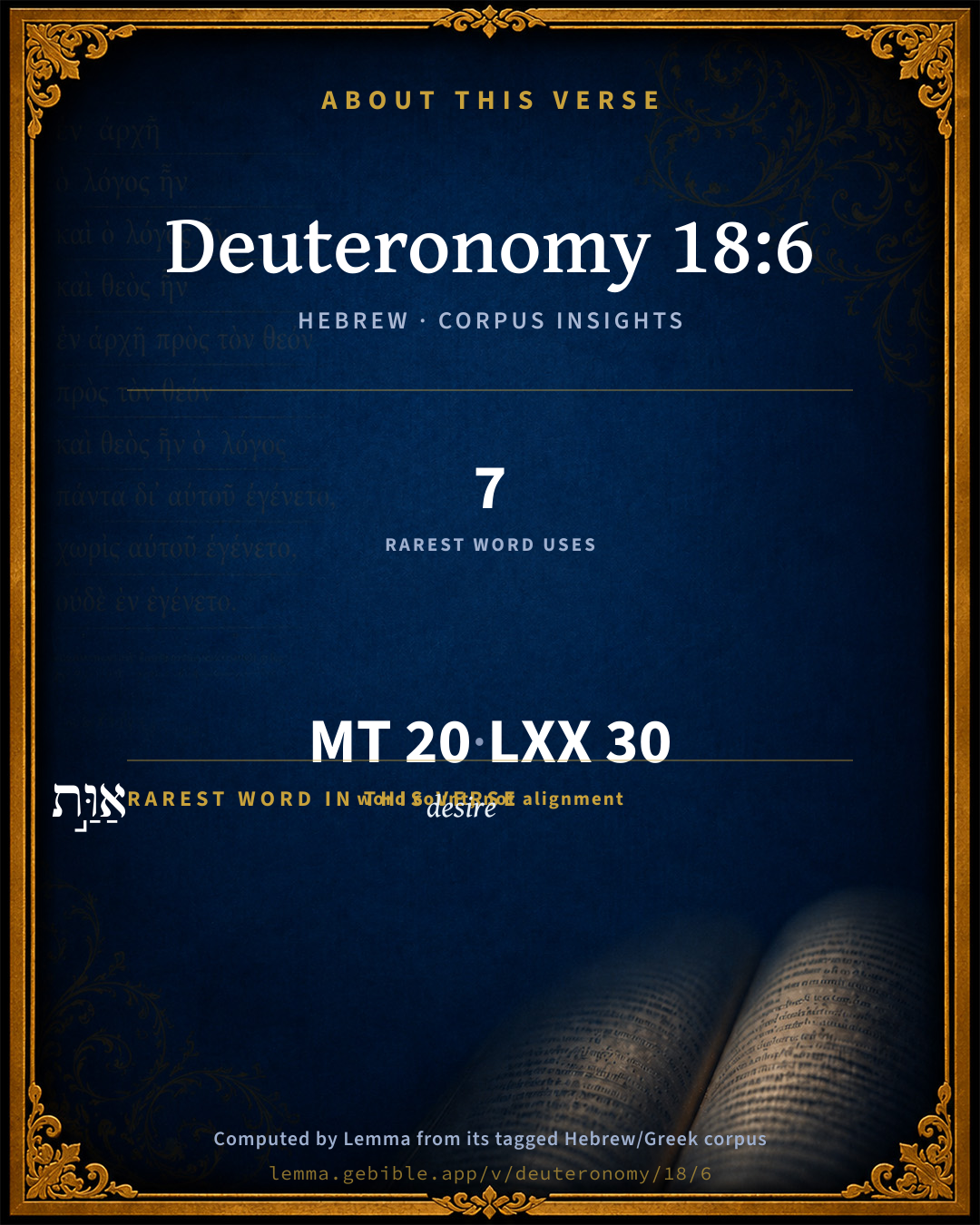
The rarest word here is אַוַּ֣ת desire H185 — appearing just 7 times in the whole Hebrew Bible.

Shared distinctive vocabulary

אַוַּ֣ת desire H185 occurs in 7 verses of the Hebrew Bible. Also found in:

Grammatical profile

  • 4 verbs
  • 9 nouns
  • 1 adjective
  • 1 pronoun
  • 1 preposition
  • 1 conjunction
  • 1 adverb
  • 2 particles

Verb forms

  • יָבֹ֨א Qal · Imperfect
  • גָּ֣ר Qal · Participle Active
  • וּבָא֙ Qal · Sequential Perfect
  • יִבְחַ֥ר Qal · Imperfect

Repetition

Words recur within this verse — often emphatic in Hebrew:

  • יָבֹ֨א to enter H935 ×2
  • מִכָּל all H3605 ×2
  • אֲשֶׁר which H834 ×2

Hebrew & Septuagint length

In English translation the verse runs 35 words from the Hebrew and 33 from the Septuagint (LXX English) — closely comparable.

A rough comparison of the two English renderings, which tokenize alike — not a word-level alignment.

Word counts can differ between the Hebrew and the Greek without any difference in meaning — e.g. the Hebrew direct-object marker אֵת has no separate Greek word, and Greek often adds the article ὁ.

In the original languages it is 20 Hebrew tokens and 30 Greek tokens — but the two are counted differently (Hebrew bundles its prefixes and suffixes into one token; the Greek is in lemma form), so that isn’t a like-for-like length.

Cross-references

10

Topical passages linked to Deuteronomy 18:6 in the Treasury of Scripture Knowledge — connected by theme and wording, ordered by reader-vote popularity; previews shown in the World English Bible.

  • Numbers 35:2–3 Command the children of Israel that they give to the Levites of the inheritance of their possession cities to dwell in; and suburbs for the cities round about them shall you give to the Levites.
  • Deuteronomy 12:5 But to the place which Yahweh your God shall choose out of all your tribes, to put his name there, even to his habitation shall you seek, and there you shall come;
  • Deuteronomy 16:2 You shall sacrifice the Passover to Yahweh your God, of the flock and the herd, in the place which Yahweh shall choose, to cause his name to dwell there.
  • Psalms 26:8 Yahweh, I love the habitation of your house, The place where your glory dwells.
  • Psalms 27:4 One thing I have asked of Yahweh, that I will seek after, That I may dwell in the house of Yahweh all the days of my life, To see Yahweh's beauty, And to inquire in his temple.
  • Psalms 63:1–2 God, you are my God. I will earnestly seek you. My soul thirsts for you, My flesh longs for you, In a dry and weary land, where there is no water.
  • Psalms 84:5 Blessed are those whose strength is in you; Who have set their hearts on a pilgrimage.
  • Psalms 84:10 For a day in your courts is better than a thousand. I would rather be a doorkeeper in the house of my God, Than to dwell in the tents of wickedness.
  • 1 Timothy 3:1 This is a faithful saying: if a man seeks the office of an overseer, he desires a good work.
  • 1 Peter 5:2 Shepherd the flock of God which is among you, exercising the oversight, not under compulsion, but voluntarily, not for dishonest gain, but willingly;

Cross-references courtesy of OpenBible.info (CC BY 4.0).

Hebrew and Greek witnesses Masoretic Hebrew ↔ Greek Septuagint

The same verse in the two great witnesses to the Old Testament, shown verse-for-verse.

These are two independent witnesses, not word-aligned to each other, and the Septuagint is shown in lemma (dictionary) form.

Hebrew Deuteronomy 18:6 Masoretic · Westminster Leningrad Codex

וְכִֽי יָבֹ֨א הַלֵּוִ֜י מֵאַחַ֤ד שְׁעָרֶ֨יךָ֙ מִכָּל יִשְׂרָאֵ֔ל אֲשֶׁר ה֖וּא גָּ֣ר שָׁ֑ם וּבָא֙ בְּכָל אַוַּ֣ת נַפְשׁ֔וֹ אֶל הַמָּק֖וֹם אֲשֶׁר יִבְחַ֥ר יְהוָֽה

If a Levite comes from any of your gates out of all Israel, where he lives as a foreigner, and comes with all the desire of his soul to the place which Yahweh shall choose;

World English Bible · Public Domain

Greek LXX Deuteronomy 18:6 Septuagint · lemma form

ἐάν δέ παραγίγνομαι ὁ λευίτης ἐκ εἷς ὁ πόλις σύ ἐκ πᾶς ὁ υἱός ἰσραήλ οὗ αὐτός παραοἰκέω καθότι ἐπιθυμέω ὁ ψυχή αὐτός εἰς ὁ τόπος ὅς ἄν ἐκλέγω κύριος

And if a Levite come from one of the cities of all the children of Israel, where he himself dwells, accordingly as his mind desires, to the place which he shall have chosen,

LXX2012 (modern English Septuagint) · Public Domain

Hebrew: Westminster Leningrad Codex (CC BY 4.0). Greek: Septuagint (public domain); English from LXX2012 (modern English Septuagint) (Public Domain). How the Septuagint differs from the Hebrew →

Targum (Aramaic paraphrase)

2

The Targum is the ancient Jewish Aramaic paraphrase of the Hebrew Scriptures — an interpretive translation, not the Hebrew text itself. Onkelos (literal) and Pseudo-Jonathan (expansive) render the Torah, and Jonathan the Prophets. Coverage is partial: where no permissively-licensed English translation exists for a verse, only the Aramaic is shown. This is verse-level text, not a word-by-word alignment to the Hebrew.

  1. Targum Onkelos Torah (Genesis–Deuteronomy)
    וַאֲרֵי יֵיתֵי לֵוָאָה מֵחֲדָא מִקִרְוָיךְ מִכָּל יִשְׂרָאֵל דִי הוּא דָר תַּמָן וְיֵיתֵי בְּכָל רְעוּת נַפְשֵׁהּ לְאַתְרָא דִי יִתִּרְעֵי יְיָ

    (no public-domain English translation for this verse)

    Targum Onkelos — Aramaic: “Onkelos Genesis” (public domain); “Onkelos Exodus” (public domain); “Onkelos Leviticus” (public domain); “Onkelos Numbers” (public domain); “Onkelos Deuteronomy” (public domain). English: “Sefaria Community Translation” (CC0 1.0 (public-domain dedication)); “J.W. Etheridge. The Targums of Onkelos and Jonathan Ben Uzziel on the Pentateuch. London: Longmans, Green, 1862” (public domain). Text via Sefaria.

  2. Targum Pseudo-Jonathan Torah (Genesis–Deuteronomy)
    וַאֲרוּם יֵיתֵי לֵיוָאָה מֵחֲדָא מִן קִרְוֵיכוֹן מִן כָּל יִשְרָאֵל דְּהוּא דַיָיר תַּמָּן וְיֵיתֵי בְּכָל כְּרוּךְ דְּרָעֲיָא נַפְשֵׁיהּ לְאַתְרָא דְיִתְרְעֵי יְיָ

    And when a Levite may come from one of your cities out of all Israel where he hath dwelt, and come with all the obligation of his soul’s desire to the place which the Lord will choose,

    Targum Pseudo-Jonathan — Aramaic: “Targum Jonathan on Genesis” (public domain); “Targum Jonathan on Exodus” (public domain); “Targum Jonathan on Leviticus” (public domain); “Targum Jonathan on Numbers” (public domain); “Targum Jonathan on Deuteronomy” (public domain). English: “The Targum of Jonathan ben Uzziel, trans. J. W. Etheridge, London, 1862” (public domain). Text via Sefaria.

Commentary

Notes on Deuteronomy 18:6 from classic Christian and Jewish commentators (each source and its license shown beneath its notes). The classic Christian expositions comment on the surrounding passage and are grouped to its opening verse, so a note may address several verses; the Jewish commentaries on the Tanakh (Rashi and others) are per-verse, so they appear only where the commentator wrote on this verse.

Lemma curates 59 commentaries, every one of them public domain or Creative Commons licensed, each selected and text-cleaned for this edition rather than reprinted as found. About our sources →

Trapp's Complete Commentary

John Trapp

Deu 18:6 And if a Levite come from any of thy gates out of all Israel, where he sojourned, and come with all the desire of his mind unto the place which the LORD shall choose;

Ver. 6. With all the desire of his mind.] To do God better service. A good heart holds the best he can do, but a little of that much that he could gladly give the Lord, and is still devising what to do more. {Psa 116:12}

John Trapp, A Commentary or Exposition upon All the Books of the Old and New Testament (1647–1656) — public domain. Text from a community e-Sword module.

Joseph Benson's Commentary

Deu 18:6. With all the desire of his mind — With full purpose to fix his abode, and to spend his whole time and strength in the service of God. It seems, the several priests were to come from their cities to the temple by turns, before David’s time; and it is certain they did so after it. But if any of them were not contented with this attendance upon God in his tabernacle, and desired more entirely and constantly to devote himself to God’s service there, he was permitted so to do, because this was an eminent act of piety, joined with self-denial, to part with those great conveniences which he enjoyed in the city of his possession.

Joseph Benson's Commentary on the Old and New Testaments (1811–1818) — public domain. Text from a community e-Sword module.

Geneva Bible (1599)

Geneva Bible translators

Meaning, to serve God unfainedly, and not to seek ease.

Geneva Bible (1599) marginal notes — public domain. Text via Bolls.life.

Jamieson, Fausset & Brown

Robert Jamieson, A. R. Fausset & David Brown

if a Levite . . . come with all the desire of his mind--It appears that the Levites served in rotation from the earliest times; but, from their great numbers, it was only at infrequent intervals they could be called into actual service. Should any Levite, however, under the influence of eminent piety, resolve to devote himself wholly and continually to the sacred duties of the sanctuary, he was allowed to realize his ardent wishes; and as he was admitted to a share of the work, so also to a share of the remuneration. Though he might have private property, that was to form no ground for withholding or even diminishing his claim to maintenance like the other ministering priests. The reason or principle of the enactment is obvious (Co1 9:13). At the same time, while every facility was afforded for the admission of such a zealous and self-denying officer, this admission was to be in an orderly manner: he was to minister "as all his brethren"--that is, a Gershonite with Gershonites; a Merarite with Merarites; so that there might be no derangement of the established courses.

Jamieson, Fausset & Brown — Commentary Critical and Explanatory on the Whole Bible (1871) — public domain (CC PDM 1.0). Text via the HelloAO Bible API.

Ellicott's Commentary for English Readers

(6-8) And if a Levite come.—The Levites with the priests were to receive forty-eight cities in Israel, with the suburbs (Num_35:7). There was as yet no provision made by which all could serve in turn at the tabernacle. When David divided them all into courses, priests, Levites, singers (and porters?) alike, there was no longer any need for this provision. The institutions of David prove its antiquity. The only case in history that illustrates it is that of the child Samuel. His father, Elkanah, was a descendant of Korah. He dwelt in Mount Ephraim, and came up to Shiloh year by year. But Samuel was dedicated by his mother to perpetual service there, and as long as the tabernacle continued in Shiloh, the child Samuel “ministered to the Lord before Eli the priest”—not as a priest, but as a Levite in attendance upon the priests.

A Bible Commentary for English Readers, edited by Charles John Ellicott (1878–1897) — public domain. Text from a community e-Sword module.

The Cambridge Bible for Schools and Colleges

gen. ed. J. J. S. Perowne

6. a Levite … from any of thy gates] any of the tribe who had ministered at any of the rural sanctuaries now disestablished by the concentration of the cultus at Jerusalem. Thy gates, see Deu_12:12. Out of all Israel, emphatic addition to the usual phrase.

where he sojourneth] Heb. is a gçr, a landless resident, without portion or inheritance. So in Jdg_17:7; Jdg_19:1. D knows nothing of the Levitical cities of P, Num_35:1-8, Joshua 21.

and come with all the desire of his soul] The construction is uncertain. Some begin the apodosis of this conditional sentence here, then he may come, etc. (Steuern., Berth.), which is not probable; others preferably with the beginning of Deu_18:7 (EVV., Wellh., Addis, Marti); others not till the beginning of Deu_18:8 (Dillm., Driv.). Desire of his soul, see Deu_12:15.

unto the place, etc.] See on Deu_12:5.

The Cambridge Bible for Schools and Colleges (gen. ed. J. J. S. Perowne; Cambridge University Press, 1878–1918) — public domain. Text from a community e-Sword module.

John Gill's Exposition

And if a Levite come from any of thy gates out of Israel, where he sojourned,.... In any of the cities through the land, for they were dispersed all over the country, and employed in instructing and teaching the people; and, excepting the cities which were given them to dwell in out of the various tribes, they were but sojourners:

and come with all the desire of his mind unto the place which the Lord shall choose; the city of Jerusalem, where the temple would be built, and sacrifices offered, at which the Levites were assisting to the priests, and in various parts of the service of the sanctuary; and to which they are supposed to come with an hearty good will, with great eagerness of soul, and a vehement desire of being employed in the work of the Lord. Though Jarchi interprets it of a priest, that comes and offers his freewill offerings, or what he is obliged to, and even in a ward not his own; or, as otherwise expressed, of the priests that come to the feast, who offer in the ward, and serve in the offerings that come by virtue of the feast, as the additions of the feast, though it is not in their own ward; and indeed every priest was a Levite, though every Levite was not a priest; and the description of him after given, as standing ministering in the name of the Lord, best agrees with a priest.

John Gill's Exposition of the Whole Bible (1746–1763) — public domain (CC PDM 1.0). Text via the HelloAO Bible API.

Albert Barnes' Notes on the Bible

These verses presuppose that part of the Levites only will be in residence and officiating at the place of the sanctuary, the others of course dwelling at their own homes in the Levitical cities, or “sojourning” elsewhere; compare the marginal references. But if any Levite out of love for the service of the sanctuary chose to resort to it when he might reside in his own home, he was to have his share in the maintenance which was provided for those ministering in the order of their course.

Deu 18:8

Beside that which cometh of the sale of his patrimony - The Levites had indeed “no part nor inheritance with Israel,” but they might individually possess property, and in fact often did so (compare 1Ki 2:26; Jer 32:7; Act 4:36). The Levite who desired to settle at the place of the sanctuary would probably sell his patrimony when quitting his former home. The text directs that he should, notwithstanding any such private resources, duly enjoy his share of the perquisites provided for the ministers at the sanctuary, and as he was “waiting at the altar” should be “partaker with the altar” 1Co 9:13.

Albert Barnes' Notes on the Bible (1834–1885) — public domain. Text from a community e-Sword/MySword module.

Haydock's Catholic Bible Commentary

Levite. In the days of Moses, all the Levites probably assisted in the service of the tabernacle, when they thought proper. But, after they should be dispersed, he encourages them to come willingly. David afterwards divided the priests and the Levites into classes, which were obliged to serve in their turns, 1 Paralipomenon xxiii., &c. Though he derogated from the words of the law, he followed the spirit of the injunction, which was intended to promote the great glory and decency of religion; and even after this regulation, (Calmet) those who desired, like Samuel, (Menochius) to consecrate their labours to the Lord for life, or for a long time, were in all probability entitled to the privileges here granted. (Calmet)

George Leo Haydock (1774–1849), Haydock's Catholic Family Bible and Commentary, 1859 edition — public domain. Excludes Psalms (Douay-Rheims chapter numbering differs from Protestant) and Deuterocanonical books (Catholic canon only).

Matthew Poole's English Annotations

Either for any private occasions, or to sojourn there for a season, or rather with full purpose to fix his abode, and to spend his whole time and strength in the service of God, as appears by the sale of his patrimony, mentioned Deu 18:8. It seems probable that the several priests were to come from their cities to the temple by turns before David’s time, and it is certain they did so after it. But if any of them were not contented with this seldom attendance upon God in his tabernacle or temple, and desired more entirely and constantly to devote himself to God’s service there, he was permitted so to do, because this was an eminent act of piety joined with self-denial to part with those great conveniencies which he could and did enjoy in the city of his possession, and to oblige himself to more constant and laborious work about the sacrifices, &c.

Matthew Poole's English Annotations on the Holy Bible (1683–1685) — public domain. Text from a community e-Sword/MySword module.

Whedon's Commentary on the Bible

Daniel D. Whedon

6. If a Levite come from any of thy gates — The Levites, so called in contrast with the priests, are to be entitled to a share of the offerings. Not only priests but Levites were employed in the tabernacle and temple service. See Num_18:1-5; 2Ch_31:2.

Daniel D. Whedon (gen. ed.), Commentary on the Old and New Testaments (1874–1909) — public domain. Text from a community e-Sword module.

The Pulpit Commentary

Vers. 6-8. Only a portion of the Levites were engaged in the service of the sanctuary; the rest lived in their towns throughout the country. It might happen, however, that a Levite, moved by pious feeling, would come to the place of the sanctuary to worship there; and it is prescribed that such a one should fare as his brethren the Levites engaged in the service of the sanctuary fared; he should minister along with them, and share with them in the gifts of the worshippers; and this in addition to any private means he might have from the sale of his patrimony. Where he sojourned. The Levite, though not homeless, was regarded as only a sojourner in the land, inasmuch as the tribe had no inheritance (jlj) there. They shall have like portions to eat; literally, they shall eat portion as portion, i.e. share and share alike. That which cometh of the sale of his patrimony; literally, his price upon the house of his fathers, i.e. the produce of the sale effected on the house he inherited from his ancestry (cf. Lev_25:33)

Vers. 6-8. Love to the sanctuary.

God loves those who love the sanctuary.

I LOVE TO THE SANCTUARY SEEN.

1. In desire for it (ver. 6).

2. In pain at being deprived of its ordinances. (Psa_42:1-7 Ps 63 Ps 84)

3. In overstepping the bounds of bare duty in attendance on it (ver. 6).

II LOVE TO THE SANCTUARY REWARDED.

1. By acceptance of those repairing to it.

2. By provision made for them. J.O. (Psa_63:5)

The Pulpit Commentary (1880–1919), ed. H.D.M. Spence-Jones & Joseph S. Exell — public domain. Text from a community e-Sword module.

John Wesley's Explanatory Notes

With all the desire of his mind - With full purpose to fix his abode, and to spend his whole time and strength in the service of God. It seems, the several priests were to come from their cities to the temple by turns, before David's time; and it is certain they did so after it. But if any of them were not contented with this attendance upon God in his tabernacle, or temple, and desired more entirely and constantly to devote himself to God's service there, he was permitted so to do, because this was an eminent act of piety joined with self - denial, to part with those great conveniences which he enjoyed in the city of his possession.

John Wesley, Explanatory Notes Upon the Whole Bible (1754–1765) — public domain. Text via the GEBible commentary corpus.

unfoldingWord translationNotes

Door43 World Missions Community

desires with all his soul

This is an idiom. AT: "strongly desires" or "really wants" (See: Idiom)

then he must serve in the name of Yahweh his God

Here "name" represents Yahweh and his authority. AT: "then he must serve Yahweh his God as a priest" (See: Metonymy)

who stand there before Yahweh

"who serve in the sanctuary in the presence of Yahweh"

his family's inheritance

This is what the priest would inherit from his father.

translationWords

Levi

Israel

soul

Yahweh

servant

unfoldingWord translationNotes — © Distant Shores Media and the Door43 World Missions Community, licensed CC BY-SA 4.0. Source: git.door43.org/Door43/en_tn.

Rashi

Rabbi Shlomo Yitzchaki (Rashi)

וכי יבא הלוי AND IF A LEVITE COME […AND MINISTER] — One might think that Scripture speaks of a “Levite” in the usual sense of the word (i.e. of a לוי and not of a כהן)! Scripture, however, goes on to state, (v. 7) “And he shall minister [in the name of the Lord]”; thus the Levites must be excluded for they are not fit for (not entitled to) service in the Temple (Sifrei Devarim 168:1).

ובא בכל אות נפשו ושרת AND COME WITH ALL THE LONGING OF HIS SOUL …AND MINISTER — This teaches that a priest may come and offer his free-will and obligatory sacrifices even at a time when a priestly shift is in charge to which he does not belong (Bava Kamma 109b). Another explanation: It further teaches regarding priests who appear in the Temple as pilgrims on the festivals that they may offer [with the rota], and do the services connected with the sacrifices that are offered on account of the festival, as for instance, the additional offerings due on festivals — although the shift is not theirs (Sifrei Devarim 168:3; Sukkah 55b).

Rashi on the Tanakh — English translations: “The Judaica Press complete Tanach with Rashi, translated by A. J. Rosenberg” (CC BY 4.0); “Pentateuch with Rashi's commentary by M. Rosenbaum and A.M. Silbermann, 1929-1934” (public domain); “The Metsudah Tanach series, Lakewood, N.J” (CC BY 4.0); and “The Book of Joshua, Metsudah Publications, 1997” (CC BY 4.0). Text via Sefaria.

Lesson kit

Teaching starters — assembled from the data on this page, not authored interpretation. Every prompt links to the verse data it draws on. Edit before teaching.

Deuteronomy, in the Pentateuch, opens this verse with 20 words (17 distinct Hebrew lemmas). Its most distinctive word is ʼavvâh (“desire”). A historical commentator’s framing appears above. Read the whole chapter for the surrounding context.

Discussion questions

  1. What does “desire” (ʼavvâh) contribute to the verse as a whole?
  2. Deuteronomy 12:15 shares the word «desire» with this verse. How do the two illuminate each other?
  3. “to enter” occurs 2× in this one verse. What is the effect of the repetition?
  4. The translations on this page render this verse differently — a whole-verse word diff, not a word-by-word alignment. What might account for the different wordings?
  5. The verb «יָבֹ֨א» is Qal Imperfect. How does its form color the action?
  6. Reading how Trapp's Complete Commentary and Joseph Benson's Commentary read this verse, where do the two commentators agree and where do they part?

Things to notice

Reading settings

Reading text

Shown beneath each verse's original-language words.

Old Testament
Old Testament edition

Read the OT as the Masoretic Hebrew (MT) or the Greek Septuagint (LXX).

English shown for the Greek Septuagint (in the Hebrew ↔ Greek comparison).

Comparing translations? Open the Compare panel on any verse page to stack up to four side by side.