
Jeremiah 17:20

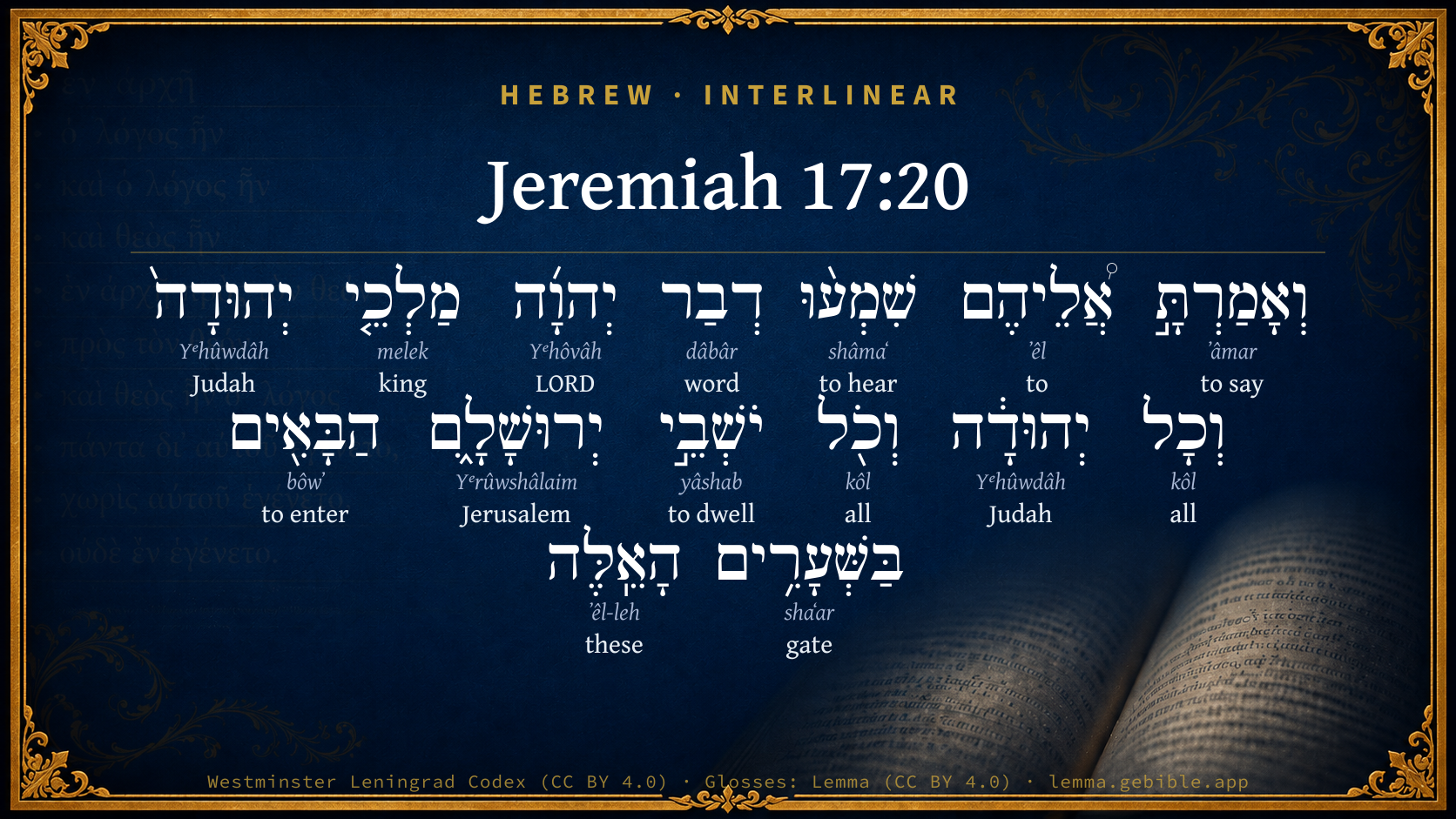
Hebrew (Westminster Leningrad Codex) Jeremiah 17:20 appears in the Hebrew Old Testament. The text above is from the Westminster Leningrad Codex. Each word links to its Strong’s number, a concise gloss, and parsing drawn from the Open Scriptures Hebrew Bible morphology. Click any word for its full Brown-Driver-Briggs (BDB) entry.
Download image
Cite this verse

Jeremiah 17:20 (World English Bible). Public Domain. Lemma interlinear Bible study tool, https://lemma.gebible.app/v/jeremiah/17/20.

Show BibTeX & RIS
BibTeX
RIS
English Translation
and tell them, Hear you the word of Yahweh, you kings of Judah, and all Judah, and all the inhabitants of Jerusalem, that enter in by these gates:
World English Bible · Public Domain
Download a study sheet

One document with this verse’s original text, its word-by-word gloss line, the meaning frame, cross-references with their text, attributed commentary, and full source and license credits — printable, and it pastes into notes with its structure intact.

This verse Autodidact and up

Study sheet (.html) Plain text (.txt)

A passage Seminary Student

Up to 50 verses in one chapter. A passage sheet keeps up to 6 commentary sources and 12 cross-references per verse, in the order this page ranks them, and says so on the sheet whenever that leaves anything out. Ask for a single verse and you get the Autodidact verse sheet above.

Everything on this page stays free to read, with no account — the sheet is a download of what is already on screen, not access to it.

Want to remove ads? Support Godless Engineer
Compare translations 3

The same verse in 3 English versions, stacked beneath the original-language interlinear above. Click any original word for its lexicon entry.

Each is an independent rendering of the whole verse — the interlinear is not word-aligned to these translations.

Highlighted words mark where these versions differ — a whole-verse word diff, not a word-by-word alignment.

  • World English Bible Public Domain
    and tell them, Hear you the word of Yahweh, you kings of Judah, and all Judah, and all the inhabitants of Jerusalem, that enter in by these gates:
  • King James Version Public Domain
    And say unto them, Hear ye the word of the LORD, ye kings of Judah, and all Judah, and all the inhabitants of Jerusalem, that enter in by these gates:
  • unfoldingWord Literal Text CC BY-SA 4.0
    And you shall say to them, ‘Hear the word of Yahweh, kings of Judah and all of Judah, and all of the ones who inhabit Jerusalem, the ones who enter by these gates.

unfoldingWord Literal Text — © unfoldingWord, licensed CC BY-SA 4.0. Word-aligned USFM3 via Door43 (git.door43.org/unfoldingWord/en_ult).

Versions to compare (up to 4)

3 of 4 selected

Show all 18 translations

Every available English version of this verse, each an independent rendering of the whole verse.

  • World English Bible Public Domain
    and tell them, Hear you the word of Yahweh, you kings of Judah, and all Judah, and all the inhabitants of Jerusalem, that enter in by these gates:
  • Berean Standard Bible Public Domain
    Say to them, ‘Hear the word of the LORD, O kings of Judah, all people of Judah and Jerusalem who enter through these gates.
  • Majority Standard Bible Public Domain
    Say to them, ‘Hear the word of the LORD, O kings of Judah, all people of Judah and Jerusalem who enter through these gates.
  • King James Version Public Domain
    And say unto them, Hear ye the word of the LORD, ye kings of Judah, and all Judah, and all the inhabitants of Jerusalem, that enter in by these gates:
  • American Standard Version (1901) Public Domain
    and say unto them, Hear ye the word of Jehovah, ye kings of Judah, and all Judah, and all the inhabitants of Jerusalem, that enter in by these gates:
  • Revised Version (1885) Public Domain
    and say unto them, Hear ye the word of the LORD, ye kings of Judah, and all Judah, and all the inhabitants of Jerusalem, that enter in by these gates;
  • Geneva Bible (1599) Public Domain
    And say vnto them, Heare the word of the Lord, ye Kings of Iudah, and al Iudah, and all the inhabitants of Ierusale, that enter in by these gates.
  • Douay-Rheims (1899) Public Domain
    And thou shalt say to them: Hear the word of the Lord, ye kings of Juda, and all Juda, and all the inhabitant of Jerusalem, that enter in by these gates.
  • Young's Literal Translation Public Domain
    and thou hast said unto them: Hear a word of Jehovah, ye kings of Judah, and all Judah, and all inhabitants of Jerusalem, who are coming in by these gates,
  • Literal Standard Version CC BY-SA 4.0
    and you have said to them: Hear a word of YHWH, you kings of Judah, and all Judah, and all inhabitants of Jerusalem, who are coming in by these gates,”
  • Unlocked Literal Bible CC BY-SA 4.0
    Say to them, 'Hear the word of Yahweh, kings of Judah and all you people of Judah, and every resident of Jerusalem who comes in through these gates.
  • unfoldingWord Literal Text CC BY-SA 4.0
    And you shall say to them, ‘Hear the word of Yahweh, kings of Judah and all of Judah, and all of the ones who inhabit Jerusalem, the ones who enter by these gates.
  • Darby Bible Public Domain
    and say unto them, Hear the word of Jehovah, ye kings of Judah, and all Judah, and all the inhabitants of Jerusalem, that enter in by these gates;
  • World Messianic Bible Public Domain
    Tell them, ‘Hear the LORD’s word, you kings of Judah, all Judah, and all the inhabitants of Jerusalem, that enter in by these gates:
  • Webster's Bible Public Domain
    And say to them, Hear ye the word of the LORD, ye kings of Judah, and all Judah, and all the inhabitants of Jerusalem, that enter by these gates:
  • Free Bible Version CC BY-SA 4.0
    Tell them, Listen to the Lord's message, kings of Judah, and all you people of Judah and Jerusalem who come in through these gates.
  • Bible in Basic English Public Domain
    And say to them, Give ear to the word of the Lord, you kings of Judah, and all the people of Jerusalem who come in by these doors:
  • JPS Tanakh (1917) Public Domain
    and say unto them: Hear ye the word of the LORD, ye kings of Judah, and all Judah, and all the inhabitants of Jerusalem, that enter in by these gates;

Literal Standard Version (2020), Covenant Press — licensed CC BY-SA 4.0. Text via the HelloAO Bible API (eBible.org). Unlocked Literal Bible (unfoldingWord) — licensed CC BY-SA 4.0. Text via the HelloAO Bible API (eBible.org). unfoldingWord Literal Text — © unfoldingWord, licensed CC BY-SA 4.0. Word-aligned USFM3 via Door43 (git.door43.org/unfoldingWord/en_ult). Free Bible Version, Dr. Jonathan Gallagher — licensed CC BY-SA 4.0. Text via the HelloAO Bible API (eBible.org).

Word by word

More ways to search: Search by grammar → Find every occurrence → Compare this word →

Practice this passage: Drill this verse → Learn its vocabulary →

בַּשְּׁעָרִ֥ים
shaʻar
H8179
“in/at the · gates”
Preposition, Determined + Noun, Common, Masculine, Plural, Absolute
Part of Speech
Preposition + Noun
Type
Common
Gender
Masculine
Number
Plural
State
Absolute
Full BDB Definition

Origin: from H8176 in its original sense

TWOT: 2437a

gate - gate (of entrance) - gate (of space inside gate, i.e. marketplace, public meeting place) - city, town - gate (of palace, royal castle, temple, court of tabernacle) - heaven
  1. וְאָמַרְתָּ֣ ʼâmar H559 “and · to say” Conjunction + Verb, Qal, Sequential Perfect, 2nd Person, Masculine, Singular
  2. אֲ֠לֵיהֶם ʼêl H413 “to · them” Preposition + Suffix, Personal, 3rd Person, Masculine, Plural
  3. שִׁמְע֨וּ shâmaʻ H8085 “hear” Verb, Qal, Imperative, 2nd Person, Masculine, Plural
  4. דְבַר dâbâr H1697 “word of” Noun, Common, Masculine, Singular, Construct
  5. יְהוָ֜ה Yᵉhôvâh H3068 “LORD” Noun, Proper
  6. מַלְכֵ֤י melek H4428 “kings of” Noun, Common, Masculine, Plural, Construct
  7. יְהוּדָה֙ Yᵉhûwdâh H3063 “Judah” Noun, Proper
  8. וְכָל kôl H3605 “and · all of” Conjunction + Noun, Common, Masculine, Singular, Construct
  9. יְהוּדָ֔ה Yᵉhûwdâh H3063 “Judah” Noun, Proper
  10. וְכֹ֖ל kôl H3605 “and · all of” Conjunction + Noun, Common, Masculine, Singular, Construct
  11. יֹשְׁבֵ֣י yâshab H3427 “dwelling” Verb, Qal, Participle Active, Masculine, Plural, Construct
  12. יְרוּשָׁלִָ֑ם Yᵉrûwshâlaim H3389 “Jerusalem” Noun, Proper
  13. הַבָּאִ֖ים bôwʼ H935 “the · entering” Particle, Definite Article + Verb, Qal, Participle Active, Masculine, Plural, Absolute
  14. הָאֵֽלֶּה ʼêl-leh H428 “the · these” Particle, Definite Article + Pronoun, Demonstrative, Common, Plural

About this verse

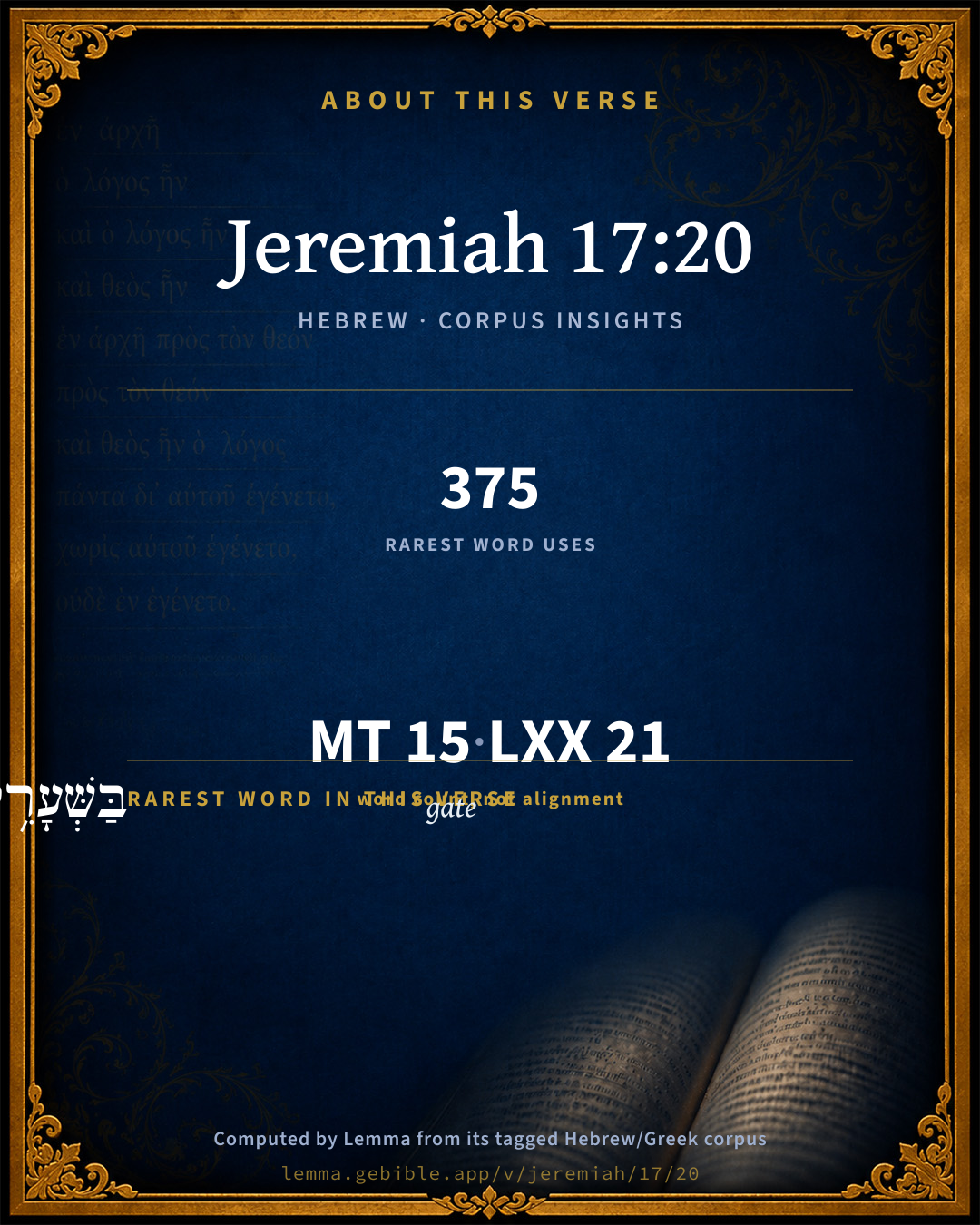
These counts appear in no published source. They are computed here, from the morphology-tagged text and Lemma’s own curated glosses. What Lemma adds →

15
words
13
distinct lemmas
Prophets
section

Grammatical profile

  • 4 verbs
  • 9 nouns
  • 1 pronoun
  • 1 preposition

Verb forms

  • וְאָמַרְתָּ֣ Qal · Sequential Perfect
  • שִׁמְע֨וּ Qal · Imperative
  • יֹשְׁבֵ֣י Qal · Participle Active
  • הַבָּאִ֖ים Qal · Participle Active

Repetition

Words recur within this verse — often emphatic in Hebrew:

  • יְהוּדָה֙ Judah H3063 ×2
  • וְכָל all H3605 ×2

Hebrew & Septuagint length

In the original languages it is 15 Hebrew tokens and 21 Greek tokens — but the two are counted differently (Hebrew bundles its prefixes and suffixes into one token; the Greek is in lemma form), so that isn’t a like-for-like length.

Cross-references

10

Topical passages linked to Jeremiah 17:20 in the Treasury of Scripture Knowledge — connected by theme and wording, ordered by reader-vote popularity; previews shown in the World English Bible.

  • Jeremiah 19:3 and say, Hear you the word of Yahweh, kings of Judah, and inhabitants of Jerusalem: thus says Yahweh of Hosts, the God of Israel, Behold, I will bring evil on this place, which whoever hears, his ears shall tingle.
  • Psalms 49:1–2 Hear this, all you peoples. Listen, all you inhabitants of the world,
  • Jeremiah 22:2 Say, Hear the word of Yahweh, king of Judah, who sits on the throne of David, you, and your servants, and your people who enter in by these gates.
  • Ezekiel 2:7 You shall speak my words to them, whether they will hear, or whether they will forbear; for they are most rebellious.
  • Jeremiah 13:18 Say you to the king and to the queen-mother, Humble yourselves, sit down; for your headdresses are come down, even the crown of your glory.
  • Ezekiel 3:17 Son of man, I have made you a watchman to the house of Israel: therefore hear the word at my mouth, and give them warning from me.
  • Hosea 5:1 "Listen to this, you priests! Listen, house of Israel, And give ear, house of the king! For the judgment is against you; For you have been a snare at Mizpah, And a net spread on Tabor.
  • Amos 4:1 Listen to this word, you cows of Bashan, who are on the mountain of Samaria, who oppress the poor, who crush the needy, who tell their lords, "Bring, and let us drink."
  • Micah 3:1 I said, "Please listen, you heads of Jacob, And rulers of the house of Israel: Isn't it for you to know justice?
  • Revelation 2:29 He who has an ear, let him hear what the Spirit says to the assemblies.

Cross-references courtesy of OpenBible.info (CC BY 4.0).

Hebrew and Greek witnesses Masoretic Hebrew ↔ Greek Septuagint

The same verse in the two great witnesses to the Old Testament, shown verse-for-verse.

These are two independent witnesses, not word-aligned to each other, and the Septuagint is shown in lemma (dictionary) form.

Hebrew Jeremiah 17:20 Masoretic · Westminster Leningrad Codex

וְאָמַרְתָּ֣ אֲ֠לֵיהֶם שִׁמְע֨וּ דְבַר יְהוָ֜ה מַלְכֵ֤י יְהוּדָה֙ וְכָל יְהוּדָ֔ה וְכֹ֖ל יֹשְׁבֵ֣י יְרוּשָׁלִָ֑ם הַבָּאִ֖ים בַּשְּׁעָרִ֥ים הָאֵֽלֶּה

and tell them, Hear you the word of Yahweh, you kings of Judah, and all Judah, and all the inhabitants of Jerusalem, that enter in by these gates:

World English Bible · Public Domain

Greek LXX Structure differs

In the Septuagint, Jeremiah is about an eighth shorter than the Hebrew and arranges its material differently — the Oracles Against the Nations (Hebrew chapters 46–51) appear in the middle of the Greek book, after 25:13. Because the chapter and verse boundaries do not line up, a verse-for-verse comparison with the Hebrew is not shown.

A verse-for-verse comparison isn’t shown here because the chapters and verses don’t line up. Switch to the LXX edition with the MT / LXX toggle above to read the Greek directly.

On this verse, Adam Clarke's Commentary discusses the Septuagint’s reading. Read the note in Commentary ↓

Hebrew: Westminster Leningrad Codex (CC BY 4.0). Greek: Septuagint (public domain); English from a public-domain English Septuagint. How the Septuagint differs from the Hebrew →

Targum (Aramaic paraphrase)

1

The Targum is the ancient Jewish Aramaic paraphrase of the Hebrew Scriptures — an interpretive translation, not the Hebrew text itself. Onkelos (literal) and Pseudo-Jonathan (expansive) render the Torah, and Jonathan the Prophets. Coverage is partial: where no permissively-licensed English translation exists for a verse, only the Aramaic is shown. This is verse-level text, not a word-by-word alignment to the Hebrew.

  1. Targum Jonathan Prophets (Joshua–Malachi)
    וְתֵימַר לְהוֹן קַבִּילוּ פִּתְגָמָא דַייָ מַלְכַיָא דְבֵית יְהוּדָה וְכָל דְבֵית יְהוּדָה וְכָל יַתְבֵי יְרוּשְׁלֵם דְעָלִין בְּתַרְעַיָא הָאִילֵן:

    (no public-domain English translation for this verse)

    Targum Jonathan — Aramaic: “Mikraot Gedolot” (public domain). English: “Sefaria Community Translation” (CC0 1.0 (public-domain dedication)); “London "Chaldee Paraphrase," 1871” (public domain). Text via Sefaria.

Commentary

Notes on Jeremiah 17:20 from classic Christian and Jewish commentators (each source and its license shown beneath its notes). The classic Christian expositions comment on the surrounding passage and are grouped to its opening verse, so a note may address several verses; the Jewish commentaries on the Tanakh (Rashi and others) are per-verse, so they appear only where the commentator wrote on this verse.

Lemma curates 59 commentaries, every one of them public domain or Creative Commons licensed, each selected and text-cleaned for this edition rather than reprinted as found. About our sources →

Trapp's Complete Commentary

John Trapp

Jer 17:20 And say unto them, Hear ye the word of the LORD, ye kings of Judah, and all Judah, and all the inhabitants of Jerusalem, that enter in by these gates:

Ver. 20. Ye kings of Judah.] Magistrates, being lord keepers of both the tables of the law, should carefully see to it that both be duly observed. Our King Edgar made laws for the sanctification of the Lord’s day, Sabbath, as have also our present governors, to their lasting renown. The first blow given to the German churches was on the Lord’s day, which they carelessly observed; for on that day was Prague lost; as was likewise Constantinople on Whitsunday, as they called it. {a}

{a} Jer. Dike, Of Conscience. - Estius in lib. Sentent. Distinc., xi. cap. 2.

John Trapp, A Commentary or Exposition upon All the Books of the Old and New Testament (1647–1656) — public domain. Text from a community e-Sword module.

Jamieson, Fausset & Brown

Robert Jamieson, A. R. Fausset & David Brown

kings--He begins with the kings, as they ought to have repressed such a glaring profanation.

Jamieson, Fausset & Brown — Commentary Critical and Explanatory on the Whole Bible (1871) — public domain (CC PDM 1.0). Text via the HelloAO Bible API.

Adam Clarke's Commentary

Verse 20. Ye kings of Judah, and all Judah] This last clause is wanting in eight of Kennicott's and De Rossi's MSS., in the Arabic, and some copies of the Septuagint.

Adam Clarke's Commentary on the Bible (1810–1826) — public domain. Text from a community e-Sword/MySword module.

John Calvin's Commentaries

He then adds, Thou shalt say to them, Hear the word of Jehovah, ye kings of Judah, and let all the people hear, and let all the citizens of Jerusalem hear, who enter in at these gates. The Prophet was commanded to begin with the king himself, who ought to have repressed so great a licentiousness. It was therefore an intolerable indifference in the king silently to bear this contempt of religion, especially in a matter so easy and so evident; for he could not have pretended that he was unacquainted with it: it was indeed the same as though the Jews intended to triumph against God, and to shew that his law was deemed of no value. Hence the profanation of the Sabbath was a proof of their shamelessness, as they thereby shewed that they cared nothing either for God or for his law. We shall hereafter see how great that wickedness was; but; I shall defer the subject, as I cannot now discuss it at large, and a more convenient opportunity will offer itself.

John Calvin's Commentaries (1540-1563) — public domain. Text from the Calvin Translation Society English edition (1840s-50s) via the Christian Classics Ethereal Library (ccel.org). Calvin's coverage is partial (roughly two-thirds of the Bible); uncommented books and verses are honest gaps, never fabricated. The 19th-century editor's footnotes and remarks are omitted so the notes are faithfully Calvin's own voice.

The Cambridge Bible for Schools and Colleges

gen. ed. J. J. S. Perowne

20. kings] The plural is certainly strange. Cp. the sing, in Jer_22:2. As Co. says, we have here not a concrete situation but a model and abstraction.

The Cambridge Bible for Schools and Colleges (gen. ed. J. J. S. Perowne; Cambridge University Press, 1878–1918) — public domain. Text from a community e-Sword module.

John Gill's Exposition

And say unto them, hear ye the word of the Lord,.... Concerning the sanctification of the sabbath; for this was not of human, but of divine institution:

ye kings of Judah; which must be understood either, as Kimchi thinks, of the then present king and his sons, so called because they would reign after him; for, there was but one king at a time; and who, perhaps, at this time, was Josiah: or else the king and his nobles, the princes of the land, are meant:

and all Judah and all the inhabitants of Jerusalem, that enter in by these gates; the people in the several parts of the land of Judea, that came to Jerusalem either for trade and merchandise, or for worship, and all that dwelt in the metropolis; for the business the prophet had to charge them with concerned them all.

John Gill's Exposition of the Whole Bible (1746–1763) — public domain (CC PDM 1.0). Text via the HelloAO Bible API.

Matthew Poole's English Annotations

The word of the Lord equally concerneth the highest and the lowest, the greatest princes as well as the meanest subjects.

Matthew Poole's English Annotations on the Holy Bible (1683–1685) — public domain. Text from a community e-Sword/MySword module.

The Pulpit Commentary

Jeremiah addresses himself first of all to the kings of Judah. As it would be very unnatural for a public orator to appeal to the yet unborn members of the reigning dynasty, and as there are several indications that the "house of David" was able at this period, as also in that of Isaiah, to exercise a decisive political and civil influence, even, as appears from Jer_21:11, Jer_21:12, monopolizing the judicial functions, it is natural to suppose that "kings of Judah" is here used in a very special sense, via. of the members of the various branches of the royal family, ("The sons of the king," Zep_1:8; comp. Jer_36:26, "Jerahmeel, a king"s son and their descendants, who received the royal title by courtesy (parallels for this will be found in Gesenius"s "Hebrew Thesaurus," s.v. melek). The queen-mother was probably the leader of this plan; "the mistress," as she was called, (see on Jer_13:18) and the royal princes (among whom the "house of Nathan," Zec_12:12, would doubtless be reckoned), constituted in fact a body almost as numerous as they did (according to Brugsch Bey) in Egypt, and politically much more influential; so much so indeed that only a king of unusual force of character, like Hezekiah or Josiah, could venture, and that timidly, to oppose them. The weak-principled Zedekiah seems to have been entirely dominated by this powerful caste, and to have been little more than a maire du palais. (the same sense of the phrase is required in Jer_19:8, and probably in Jer_25:18)

The Pulpit Commentary (1880–1919), ed. H.D.M. Spence-Jones & Joseph S. Exell — public domain. Text from a community e-Sword module.

Lesson kit

Teaching starters — assembled from the data on this page, not authored interpretation. Every prompt links to the verse data it draws on. Edit before teaching.

Jeremiah, in the Prophets, opens this verse with 15 words (13 distinct Hebrew lemmas). Its most distinctive word is shaʻar (“gate”). A historical commentator’s framing appears above. Read the whole chapter for the surrounding context.

Discussion questions

  1. The word shaʻar carries the sense “gate.” How does it shape the verse?
  2. How does Jeremiah 19:3, which shares this passage’s theme, read alongside this verse?
  3. What does the repetition of “Judah” (2× in this one verse) do in this verse?
  4. The translations on this page render this verse differently — a whole-verse word diff, not a word-by-word alignment. What might account for the different wordings?
  5. «וְאָמַרְתָּ֣» is a Qal Sequential Perfect verb. How does that grammatical form shape the action described?
  6. Compare how Trapp's Complete Commentary and Jamieson, Fausset & Brown read this verse. Where do they agree or differ?

Things to notice

Reading settings

Reading text

Shown beneath each verse's original-language words.

Old Testament
Old Testament edition

Read the OT as the Masoretic Hebrew (MT) or the Greek Septuagint (LXX).

English shown for the Greek Septuagint (in the Hebrew ↔ Greek comparison).

Comparing translations? Open the Compare panel on any verse page to stack up to four side by side.