Isaiah 60:18

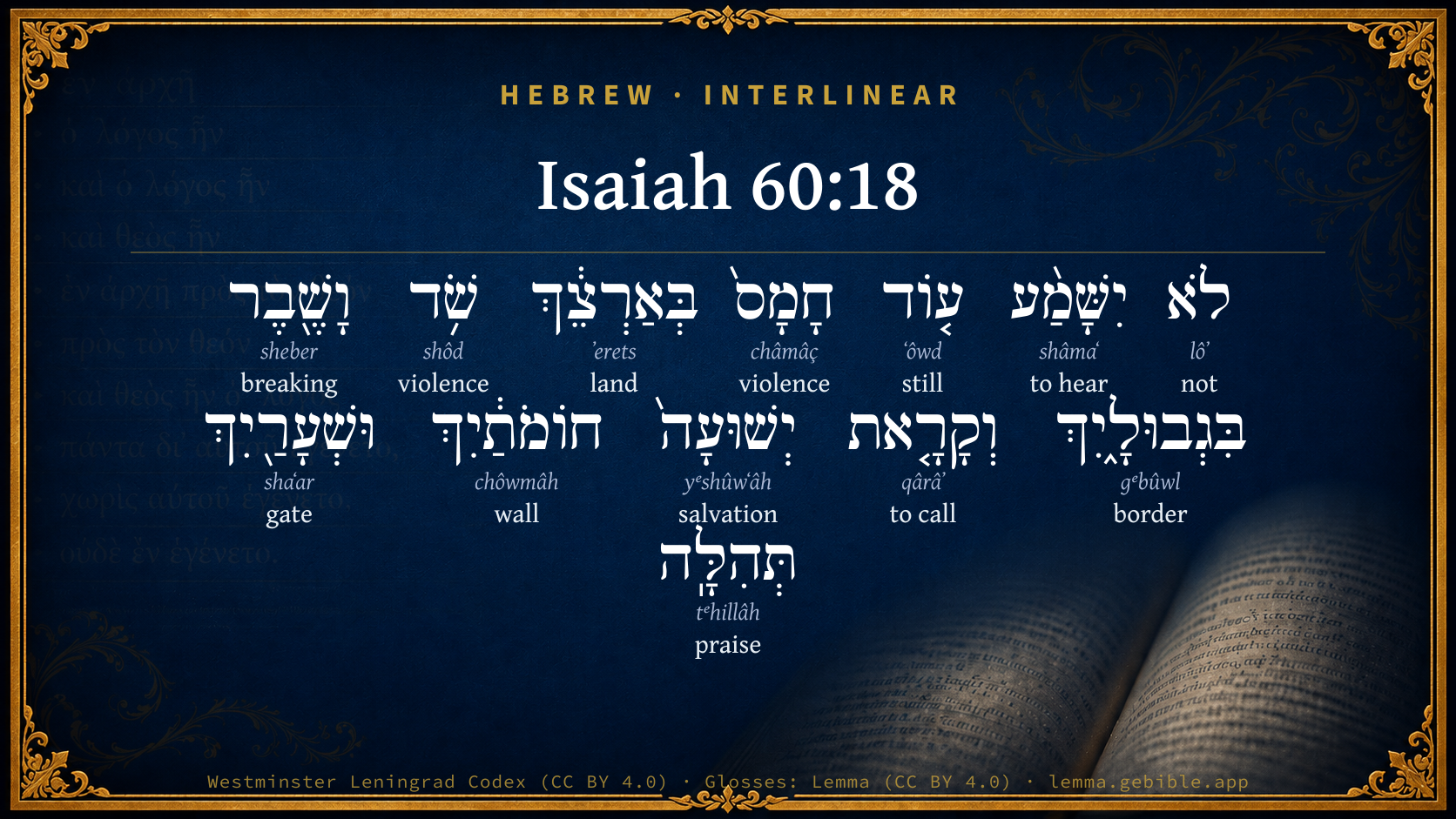
Hebrew (Westminster Leningrad Codex) Isaiah 60:18 appears in the Hebrew Old Testament. The text above is from the Westminster Leningrad Codex. Each word links to its Strong’s number, a concise gloss, and parsing drawn from the Open Scriptures Hebrew Bible morphology. Click any word for its full Brown-Driver-Briggs (BDB) entry.
Download image
Cite this verse

Isaiah 60:18 (World English Bible). Public Domain. Lemma interlinear Bible study tool, https://lemma.gebible.app/v/isaiah/60/18.

Show BibTeX & RIS
BibTeX
RIS
English Translation
Violence shall no more be heard in your land, desolation nor destruction within your borders; but you shall call your walls Salvation, and your gates Praise.
World English Bible · Public Domain
Download a study sheet

One document with this verse’s original text, its word-by-word gloss line, the meaning frame, cross-references with their text, attributed commentary, and full source and license credits — printable, and it pastes into notes with its structure intact.

This verse Autodidact and up

Study sheet (.html) Plain text (.txt)

A passage Seminary Student

Up to 50 verses in one chapter. A passage sheet keeps up to 6 commentary sources and 12 cross-references per verse, in the order this page ranks them, and says so on the sheet whenever that leaves anything out. Ask for a single verse and you get the Autodidact verse sheet above.

Everything on this page stays free to read, with no account — the sheet is a download of what is already on screen, not access to it.

Want to remove ads? Support Godless Engineer
Compare translations 3

The same verse in 3 English versions, stacked beneath the original-language interlinear above. Click any original word for its lexicon entry.

Each is an independent rendering of the whole verse — the interlinear is not word-aligned to these translations.

Highlighted words mark where these versions differ — a whole-verse word diff, not a word-by-word alignment.

  • World English Bible Public Domain
    Violence shall no more be heard in your land, desolation nor destruction within your borders; but you shall call your walls Salvation, and your gates Praise.
  • King James Version Public Domain
    Violence shall no more be heard in thy land, wasting nor destruction within thy borders; but thou shalt call thy walls Salvation, and thy gates Praise.
  • unfoldingWord Literal Text CC BY-SA 4.0
    Violence will no longer be heard in your land; destruction and breaking, within your borders. And you will call your walls Salvation, and your gates, Praise.

unfoldingWord Literal Text — © unfoldingWord, licensed CC BY-SA 4.0. Word-aligned USFM3 via Door43 (git.door43.org/unfoldingWord/en_ult).

Versions to compare (up to 4)

3 of 4 selected

Show all 18 translations

Every available English version of this verse, each an independent rendering of the whole verse.

  • World English Bible Public Domain
    Violence shall no more be heard in your land, desolation nor destruction within your borders; but you shall call your walls Salvation, and your gates Praise.
  • Berean Standard Bible Public Domain
    No longer will violence be heard in your land, nor ruin or destruction within your borders. But you will name your walls Salvation and your gates Praise.
  • Majority Standard Bible Public Domain
    No longer will violence be heard in your land, nor ruin or destruction within your borders. But you will name your walls Salvation and your gates Praise.
  • King James Version Public Domain
    Violence shall no more be heard in thy land, wasting nor destruction within thy borders; but thou shalt call thy walls Salvation, and thy gates Praise.
  • American Standard Version (1901) Public Domain
    Violence shall no more be heard in thy land, desolation nor destruction within thy borders; but thou shalt call thy walls Salvation, and thy gates Praise.
  • Revised Version (1885) Public Domain
    Violence shall no more be heard in thy land, desolation nor destruction within thy borders; but thou shalt call thy walls Salvation, and thy gates Praise.
  • Geneva Bible (1599) Public Domain
    Violence shall no more be heard of in thy land, neither desolation, nor destruction within thy borders: but thou shalt call saluation, thy walles, and praise, thy gates.
  • Douay-Rheims (1899) Public Domain
    Iniquity shall no more be heard in thy land, wasting nor destruction in thy borders, and salvation shall possess thy walls, and praise thy gates.
  • Young's Literal Translation Public Domain
    Violence is not heard any more in thy land, Spoiling and destruction in thy borders, And thou hast called `Salvation' thy walls, And thy gates, `Praise.'
  • Literal Standard Version CC BY-SA 4.0
    Violence is not heard in your land anymore, || Spoiling and destruction in your borders, || And you have called your walls Salvation, || And your gates Praise.
  • Unlocked Literal Bible CC BY-SA 4.0
    Violence will no longer be heard in your land, or devastation nor shattering within your borders; but you will call your walls Salvation, and your gates Praise.
  • unfoldingWord Literal Text CC BY-SA 4.0
    Violence will no longer be heard in your land; destruction and breaking, within your borders. And you will call your walls Salvation, and your gates, Praise.
  • Darby Bible Public Domain
    Violence shall no more be heard in thy land, wasting nor destruction within thy borders; but thou shalt call thy walls Salvation, and thy gates Praise.
  • World Messianic Bible Public Domain
    Violence shall no more be heard in your land, nor desolation or destruction within your borders; but you will call your walls Salvation, and your gates Praise.
  • Webster's Bible Public Domain
    Violence shall no more be heard in thy land, wasting nor destruction within thy borders; but thou shalt call thy walls Salvation, and thy gates Praise.
  • Free Bible Version CC BY-SA 4.0
    There won't be any more violence in your land, no more devastation and destruction within your borders. You will call your walls Salvation, and your gates Praise.
  • Bible in Basic English Public Domain
    Violent acts will no longer be seen in your land, wasting or destruction in your limits; but your walls will be named, Salvation, and your doors Praise.
  • JPS Tanakh (1917) Public Domain
    Violence shall no more be heard in thy land, desolation nor destruction within thy borders; but thou shalt call thy walls Salvation, and thy gates Praise.

Literal Standard Version (2020), Covenant Press — licensed CC BY-SA 4.0. Text via the HelloAO Bible API (eBible.org). Unlocked Literal Bible (unfoldingWord) — licensed CC BY-SA 4.0. Text via the HelloAO Bible API (eBible.org). unfoldingWord Literal Text — © unfoldingWord, licensed CC BY-SA 4.0. Word-aligned USFM3 via Door43 (git.door43.org/unfoldingWord/en_ult). Free Bible Version, Dr. Jonathan Gallagher — licensed CC BY-SA 4.0. Text via the HelloAO Bible API (eBible.org).

Word by word

More ways to search: Search by grammar → Find every occurrence → Compare this word →

Practice this passage: Drill this verse → Learn its vocabulary →

שֹׁ֥ד
shôd
H7701
“violence”
Noun, Common, Masculine, Singular, Absolute
Part of Speech
Noun
Type
Common
Gender
Masculine
Number
Singular
State
Absolute
Full BDB Definition

Origin: from H7736

TWOT: 2331a

havoc, violence, destruction, devastation, ruin - violence, havoc (as social sin) - devastation, ruin
  1. לֹא lôʼ H3808 “not” Particle, Negative
  2. יִשָּׁמַ֨ע shâmaʻ H8085 “to hear” Verb, Niphal, Imperfect, 3rd Person, Masculine, Singular
  3. ע֤וֹד ʻôwd H5750 “still” Adverb
  4. חָמָס֙ châmâç H2555 “violence” Noun, Common, Masculine, Singular, Absolute
  5. בְּאַרְצֵ֔ךְ ʼerets H776 “in/at · land · your” Preposition + Noun, Common, Both, Singular, Construct + Suffix, Personal, 2nd Person, Feminine, Singular
  6. וָשֶׁ֖בֶר sheber H7667 “and · breaking” Conjunction + Noun, Common, Masculine, Singular, Absolute
  7. בִּגְבוּלָ֑יִךְ gᵉbûwl H1366 “in/at · borders · your” Preposition + Noun, Common, Masculine, Plural, Construct + Suffix, Personal, 2nd Person, Feminine, Singular
  8. וְקָרָ֤את qârâʼ H7121 “and · to call” Conjunction + Verb, Qal, Sequential Perfect, 2nd Person, Feminine, Singular
  9. יְשׁוּעָה֙ yᵉshûwʻâh H3444 “salvation” Noun, Common, Feminine, Singular, Absolute
  10. חוֹמֹתַ֔יִךְ chôwmâh H2346 “walls · your” Noun, Common, Feminine, Plural, Construct + Suffix, Personal, 2nd Person, Feminine, Singular
  11. וּשְׁעָרַ֖יִךְ shaʻar H8179 “and · gates · your” Conjunction + Noun, Common, Masculine, Plural, Construct + Suffix, Personal, 2nd Person, Feminine, Singular
  12. תְּהִלָּֽה tᵉhillâh H8416 “praise” Noun, Common, Feminine, Singular, Absolute

About this verse

These counts appear in no published source. They are computed here, from the morphology-tagged text and Lemma’s own curated glosses. What Lemma adds →

13
words
13
distinct lemmas
Prophets
section

Notable vocabulary

The rarest word here is שֹׁ֥ד violence H7701 — appearing just 25 times in the whole Hebrew Bible.

Shared distinctive vocabulary

שֹׁ֥ד violence H7701 occurs in 24 verses of the Hebrew Bible. Also found in:

Grammatical profile

  • 2 verbs
  • 9 nouns
  • 1 adverb
  • 1 particle

Verb forms

  • יִשָּׁמַ֨ע Niphal · Imperfect
  • וְקָרָ֤את Qal · Sequential Perfect

Hebrew & Septuagint length

In English translation the verse runs 26 words from the Hebrew and 29 from the Septuagint (LXX English) — closely comparable.

A rough comparison of the two English renderings, which tokenize alike — not a word-level alignment.

Word counts can differ between the Hebrew and the Greek without any difference in meaning — e.g. the Hebrew direct-object marker אֵת has no separate Greek word, and Greek often adds the article ὁ.

Cross-references

7

Topical passages linked to Isaiah 60:18 in the Treasury of Scripture Knowledge — connected by theme and wording, ordered by reader-vote popularity; previews shown in the World English Bible.

  • Isaiah 26:1 In that day shall this song be sung in the land of Judah: we have a strong city; salvation will he appoint for walls and bulwarks.
  • Isaiah 11:9 They shall not hurt nor destroy in all my holy mountain; for the earth shall be full of the knowledge of Yahweh, as the waters cover the sea.
  • Zechariah 9:8 I will encamp around my house against the army, That none pass through or return; And no oppressor will pass through them any more: For now I have seen with my eyes.
  • Psalms 72:3–7 The mountains shall bring prosperity to the people. The hills bring the fruit of righteousness.
  • Isaiah 2:4 He will judge between the nations, And will decide concerning many peoples; And they shall beat their swords into plowshares, And their spears into pruning-hooks. Nation shall not lift up sword against nation, Neither shall they learn war any more.
  • Micah 4:3 And he will judge between many peoples, And will decide concerning strong nations afar off. They will beat their swords into plowshares, And their spears into pruning hooks. Nation will not lift up sword against nation, Neither will they learn war any more.
  • Revelation 19:1–6 After these things I heard something like a loud voice of a great multitude in heaven, saying, "Hallelujah! Salvation, power, and glory belong to our God:

Cross-references courtesy of OpenBible.info (CC BY 4.0).

Hebrew and Greek witnesses Masoretic Hebrew ↔ Greek Septuagint

The same verse in the two great witnesses to the Old Testament, shown verse-for-verse.

These are two independent witnesses, not word-aligned to each other, and the Septuagint is shown in lemma (dictionary) form.

Hebrew Isaiah 60:18 Masoretic · Westminster Leningrad Codex

לֹא יִשָּׁמַ֨ע ע֤וֹד חָמָס֙ בְּאַרְצֵ֔ךְ שֹׁ֥ד וָשֶׁ֖בֶר בִּגְבוּלָ֑יִךְ וְקָרָ֤את יְשׁוּעָה֙ חוֹמֹתַ֔יִךְ וּשְׁעָרַ֖יִךְ תְּהִלָּֽה

Violence shall no more be heard in your land, desolation nor destruction within your borders; but you shall call your walls Salvation, and your gates Praise.

World English Bible · Public Domain

Greek LXX Isaiah 60:18 Septuagint · lemma form

καί οὐ ἀκούω ἔτι ἀδικία ἐν ὁ γῆ σύ οὐδέ σύντριμμα οὐδέ ταλαιπωρία ἐν ὁ ὅριον σύ ἀλλά καλέω σωτήριον ὁ τεῖχος σύ καί ὁ πύλη σύ γλύμμα

And injustice shall no more be heard in your land, nor destruction nor misery in your coasts; but your walls shall be called Salvation, and your gates Sculptured Work.

LXX2012 (modern English Septuagint) · Public Domain

Hebrew: Westminster Leningrad Codex (CC BY 4.0). Greek: Septuagint (public domain); English from LXX2012 (modern English Septuagint) (Public Domain). How the Septuagint differs from the Hebrew →

Targum (Aramaic paraphrase)

1

The Targum is the ancient Jewish Aramaic paraphrase of the Hebrew Scriptures — an interpretive translation, not the Hebrew text itself. Onkelos (literal) and Pseudo-Jonathan (expansive) render the Torah, and Jonathan the Prophets. Coverage is partial: where no permissively-licensed English translation exists for a verse, only the Aramaic is shown. This is verse-level text, not a word-by-word alignment to the Hebrew.

  1. Targum Jonathan Prophets (Joshua–Malachi)
    לָא יִשְׁתְּמַע עוֹד חִיטְפָא בְּאַרְעִיךְ בִּזָא וּתְבִירָא בִּתְחוּמִיךְ וִיעַרְעוּן פּוּרְקַן עַל שׁוּרָךְ וְעַל תַּרְעָךְ יְהוֹן מְשַׁבְּחִין:

    Violence shall no more be heard in thy land, spoil nor destruction within thy borders; but they shall proclaim salvation on thy walls, and on thy gates there shall be those that praise.

    Targum Jonathan — Aramaic: “Mikraot Gedolot” (public domain). English: “Sefaria Community Translation” (CC0 1.0 (public-domain dedication)); “London "Chaldee Paraphrase," 1871” (public domain). Text via Sefaria.

Commentary

Notes on Isaiah 60:18 from classic Christian and Jewish commentators (each source and its license shown beneath its notes). The classic Christian expositions comment on the surrounding passage and are grouped to its opening verse, so a note may address several verses; the Jewish commentaries on the Tanakh (Rashi and others) are per-verse, so they appear only where the commentator wrote on this verse.

Lemma curates 59 commentaries, every one of them public domain or Creative Commons licensed, each selected and text-cleaned for this edition rather than reprinted as found. About our sources →

Trapp's Complete Commentary

John Trapp

Isa 60:18 Violence shall no more be heard in thy land, wasting nor destruction within thy borders; but thou shalt call thy walls Salvation, and thy gates Praise.

Ver. 18. Violence shall no more be heard in thy land.] The full accomplishment of this is not to be expected here.

But thou shalt call thy walls Salvation,] sc., When thou hast got the great gulf {Luk 16:26} between thee and thine enemies.

And thy gates Praise.] God will continually come to thee with new benefits, and thou shalt go forth to meet him with thanksgiving. {Psa 89:16}

John Trapp, A Commentary or Exposition upon All the Books of the Old and New Testament (1647–1656) — public domain. Text from a community e-Sword module.

The Biblical Illustrator

Joseph S. Exell

Isa_60:18

But thou shalt call thy walls Salvation

Walls, salvation; gates, praise

Consider how salvation is a wall, and how gates are praise.

1. There are three safeties which a sinner wants. He wants to be saved

(1) From the condemnation of his sins.

(2) From the, power of his sins.

(3) From the conflict and presence of His sins.

Therefore a mans salvation comes to him with three unfoldings. This threefold salvation is, to every man that receives it, as a wall. On the one side, towards the adversary, it is a wall of fire; on the other side, as it shows itself to him that is within it, it is shelter. It is beauteous, as with all bright and precious stones, inlaid with all the loveliness and the attributes of God. And whatever comes through that wall to touch a man has first touched and pierced his Saviour; for all the faithfulness of God, and all the power of God, and all the glory of God, and all the work of the great Mediator, go to make the eternity and the sufficiency of that great bulwark.

2. Thou shalt call thy gates Praise. What is praise? The joy of a happy spirit, pouring itself back into the bosom of God as its only fountain. Through the walls of salvation, the Christian enters into a perfect peace--that with a happy heart ha may go out praisingly. In every object in nature, he likes to see some reflection of an unseen world! In every providence, he traces a Fathers hand. He has thoughts high above, that make him walk this world an independent man. Heaven is gilding all the distance to him. He comes at last to Zion with songs and everlasting joy upon his head. (J. Vaughan, M. A.)

Thy gates Praise.

Songs and hymns have ever been the most interesting and inspiring of human compositions; if we draw a line of arbitrary distinction between the two, then I would say that Song represents the music of the blood, while the Hymn represents the music of the soul. It is in song that we utter the music of Nature; it is in the hymn we utter the music of grace and Divine holiness. (E. Paxton Hood.)

The gates of Praise

I do not wonder that the gates of the Church are called Praise. I do not wonder at it, because it is clear that praise opens--no I we cannot tell what are the treasures of wisdom and knowledge until we have passed through the gates of Praise. We do not know what God hath reserved for them that love Him, until we have passed through the gates of Praise. As we sometimes walk on from step to step, from landing-place to landing-place, and scene to scone, until at last we reach some elevation, when the whole of the grand panorama bursts upon our astonished vision, and the walk, and the steep ascent, and the hill, and even the beauties of the way, arc alike forgotten in the overwhelming splendour of the scene; so is it when we are able to pass through, or even to look through, the gates of Praise; even the consolations of prayer are all lost by reason of the glory that excelleth; we step from the finite to the infinite, when we look over the scenery, or breathe the atmosphere of praise. (E. Paxton Hood.)

The gates of Praise.,

I. PRAISE IS THE GATE BY WHICH WE PASS OUT OF OURSELVES.

II. IT IS BY THIS PATH THAT THE BELIEVER PASSES INTO NEW RELATIONS. He enters the Church through the gates of Praise. It is impossible that there can be an ungrateful Christian.

III. Gates within gates, gates to the city, and gates within the city; THE GATEWAY BY WHICH WE PASS TO HIGHER KNOWLEDGE, AND TO HIGHER LIFE, IS PRAISE. (E. Paxton Hood.)

Praise because of salvation

The Rabbins say that when God created the universe He asked the highest seraph what he thought of the work of His hands--and he replied that nothing was wanting but that it should become vocal, and be able audibly to speak its Makers praise. But in the work of salvation it is so: to Him that sitteth on the throne it rises in the grandeur of loud peals of harmony. (E. Paxton Hood.)

The Biblical Illustrator, edited by Joseph S. Exell (c. 1880s–1900s) — public domain. Text from a community e-Sword module.

Joseph Benson's Commentary

Isa 60:18. Violence shall no more be heard, &c. — Neither the threats and triumphs of those that do violence, nor the outcries and complaints of those that suffer it, shall be heard again, but every man shall peaceably enjoy his own. Wasting nor destruction — Of persons or possessions, anywhere within thy borders — Thou shalt be secure from violence and injustice at home, and from invasion and war from abroad. But thou shalt call thy walls Salvation, &c. — They shall be safe and able to defend thee; thou shalt be as safe as salvation itself can make thee. And the protection and security, which God by his providence shall afford thee, shall be to thee continual matter of praise and thanksgiving. This verse, and what follows to the end of the chapter, seems to relate chiefly to that peaceable and happy state which the church shall enjoy in the latter days.

Joseph Benson's Commentary on the Old and New Testaments (1811–1818) — public domain. Text from a community e-Sword module.

MacLaren's Expositions of Holy Scripture

Alexander MacLaren

Isaiah

WALLS AND GATES

Isa 60:18.

The prophet reaches the height of eloquence in his magnificent picture of the restored Jerusalem, ‘the city of the Lord, the Zion of the Holy One of Israel.’ To him the city stands for the embodiment of the nation, and his vision of the future is moulded by his knowledge of the past. Israel and Jerusalem were to him the embodiments of the divine idea of God’s dwelling with men, and of a society founded on the presence of God in its midst. We are not forcing meanings on his words which they will not bear, when we see in the society of men redeemed by Christ the perfect embodiment of his vision. Nor is the prophet of the New Testament doing so when he casts his vision of the future which is to follow Resurrection and Judgment into a like form, and shows us the new Jerusalem coming down out of heaven.

The end of the world’s history is to be, not a garden but a city, a visible community, bound together because God dwells in it, and yet not having lost the blessed characteristics of the Garden from which man set out on his long and devious march.

The Christian form of the prophet’s vision is the Christian Society, and in that society, each individual member possesses his own portion of the common blessings, so that the great words of this text have a personal as well as a general application. We shall best bring out their rich contents by simply taking them as they stand, and considering what is promised by the two eloquent metaphors, which liken salvation to the walls and praise to the gates of the City of God.

I. Salvation is to be the city’s wall.

Another prophet foretold that the returning exiles would dwell in a Jerusalem that had no walls, ‘for I, saith the Lord, will be unto her a wall of fire round about’; and Isaiah sang, ‘We have a strong city; salvation will God appoint for walls and bulwarks.’ There is no need for material defences for the community or the individual whom God defends. Would that the Church had lived up to the height of that great thought! Would that we each believed it true in regard to our own lives! There are three ways in which this promise may be viewed. We may think of ‘salvation’ as meaning God’s purpose to save. And then the comfort and sense of security will be derived from the thought that what He intends He performs, and that nothing can traverse that purpose except our own rebellions self-will. They whom God designs to keep are kept; they whom God wills to save are saved, unless they oppose His will, which opposition is in itself to be lost, and leads to ultimate and irreparable loss.

We may think of salvation as an actually begun work. Then the comfort and sense of security will be derived from that great work by which salvation has begun to be ours. The work of Christ keeps us from all danger, and no foes can make a breach in that wall, nor reach those who stand safe behind its strong towers.

We may think of salvation as a personal experience, and then the comfort and sense of security will be derived from that blessed consciousness of possessing in some measure at least the spirit, not of bondage, but of a son. The consciousness of having ‘salvation’ is our best defence against spiritual foes and our best shield against temporal calamities.

It is good for us to live by faith, to be thrown back on our unseen protector, to feel with the psalmist, ‘Thou, Lord, makest me to dwell in safety, though alone,’ and to see the wall great and high that is drawn round our defenceless tent pitched on the sands of the flat desert.

II. Praise is to be the city’s gate.

As to the Church, this prophecy anticipates the Apostle’s teaching that the whole divine work of Redemption, from its fore-ordination before the foundation of the world, to its application to each sinful soul, is ‘to the end that we should be unto the praise of His glory’ or, as he elsewhere expands and enriches the expression, ‘to the praise of the glory of His grace.’

We are ‘secretaries of His praise.’ A gate is that by which the safe inhabitants go out into the region beyond, and the outgoings of the active life of every Christian should be such as to make manifest the blessings that he enjoys within the shelter of the city’s walls. Only if our hidden life is blessed with a begun salvation will our outward life be vocal with the music of praise. The gate will be praise if, and only if, the wall is salvation.

And praise is the gate by which we should go out into the world, even when the world into which we go is dark and the ways rough and hard. If we have the warm glow of a realised salvation in our hearts, sorrows that are but for a moment will not silence the voice of praise, though they may cast it into a minor key. The praise that rises from a sad heart is yet more melodious in God’s ear than that which carols when all things go well. The bird that sings in a darkened cage makes music to its owner. ‘Songs in the night’ have a singular pathos and thrill the listeners. When we ‘take the cup of salvation’ and call on the name of the Lord, we shall offer to Him the sacrifices of thanksgiving, though He may recall some of the precious gifts that He gave. For He never takes away the wall of salvation which He has built around us, and as long as that wall stands, its gates will be praise. Submission, recognition of His will, and even ‘silence because Thou didst it,’ are praise to His ear.

Alexander MacLaren, Expositions of Holy Scripture (1904–1910) — public domain. Text from a community e-Sword module.

Tyndale Open Study Notes

Tyndale Open Resources

60:18 praise will be on the lips of all who enter there (literally they will call your gates “praise”): Entrance into the city of salvation will be through the metaphorical gates of praise to the Lord for his great salvation.

Tyndale Open Study Notes — © Tyndale Open Resources, licensed CC BY-SA 4.0. Text via the HelloAO Bible API.

Geneva Bible (1599)

Geneva Bible translators

Meaning, not a temporal felicity, but a spiritual, which is fulfilled in Christ’s kingdom.

Geneva Bible (1599) marginal notes — public domain. Text via Bolls.life.

Jamieson, Fausset & Brown

Robert Jamieson, A. R. Fausset & David Brown

(Isa 2:4). Not only shall thy walls keep thee safe from foes, but "Salvation" shall serve as thy walls, converting thy foes into friends, and so ensuring thee perfect safety (Isa 26:1-2).

gates--once the scene of "destruction" when victorious foes burst through them (Neh 1:3); henceforth to be not only the scene of praises, but "Praise" itself; the "gates," as the place of public concourse, were the scene of thanksgivings (Ch2 31:2; Psa 9:14; Psa 24:7; Psa 100:4). "Judah," the favored tribe, means "praise."

Jamieson, Fausset & Brown — Commentary Critical and Explanatory on the Whole Bible (1871) — public domain (CC PDM 1.0). Text via the HelloAO Bible API.

Ellicott's Commentary for English Readers

(18) Violence shall no more . . .—Following the thought of the previous verse, we see in the words a picture of freedom from internal misgovernment rather than from external invasion.

Thou shalt call thy walls Salvation . . . The idea, almost the very phrase, has met us before in Isa_26:1. They probably found a starting-point in the Eastern practice of giving to the walls of a city names that implied a consecration. Thus the walls of Babylon were named Imgur Bel and Nimetti Belkit (Records of the Past, v. 124, 125).

A Bible Commentary for English Readers, edited by Charles John Ellicott (1878–1897) — public domain. Text from a community e-Sword module.

The Cambridge Bible for Schools and Colleges

gen. ed. J. J. S. Perowne

18. wasting nor destruction] ch. Isa_59:7, Isa_51:19.

thou shalt call thy walls Salvation, &c.] This rendering is decidedly preferable to that of most recent commentators: “thou shalt call Salvation thy walls, &c.” Moreover the rule in such cases (although Isa_60:17 furnishes an exception) is that “the nearer obj. is usually def. and the more remote indef.” (Davidson, Syntax, § 76). See also on ch. Isa_26:1.

The Cambridge Bible for Schools and Colleges (gen. ed. J. J. S. Perowne; Cambridge University Press, 1878–1918) — public domain. Text from a community e-Sword module.

John Gill's Exposition

Violence shall no more be heard in thy land,.... It shall be no more committed; no instances of it will be heard of, or any complaints concerning it; neither public nor private oppression: antichristian persecution will now be at an end; those that destroyed the earth with violence and oppression shall be no more; "there will be none to hurt in all the holy mountain", Isa 11:9,

wasting nor destruction within thy borders; no more wars, nor rumours of wars; no more blood shed; no more depopulation of cities, nor destruction of the lives of men; the whore of Rome will have drank up her full cup; and the vials of wrath being poured out upon the antichristian states, there will be a profound peace, and the greatest prosperity everywhere; especially in all those places where the churches of Christ will be, who will no more be exposed to the cruelty of their enemies:

but thou shall call thy walls Salvation, and thy gates Praise; or, "call Salvation thy walls, and Praise thy gates" (h); having no need of any other walls but the salvation of God, temporal and spiritual; nor of any other gates but the praise that will be in the hearts and mouths of the saints, on account of it; though temporal salvation may be included, which will be for walls and bulwarks to the church: yet spiritual and eternal salvation is chiefly meant, which flows from the invariable love of God; is founded upon his unalterable purpose; secured in the act of electing grace; established in the covenant; and completely wrought out by Christ, who has vanquished every enemy, procured every blessing; and whose almighty power, as well as his divine Father's, is and will be concerned for the safety of his people; who will now be in great numbers in the gates of Zion; praising the Lord for electing, redeeming, calling, pardoning, and justifying grace; and for the privileges of the house of the Lord they are admitted to; and for the communion they have with him there; see Isa 26:1. The Targum is,

"and they shall proclaim salvation on thy walls, and on thy gates there shall be they that praise.''

(h) "vocabis salutem muros tuos, et portas tuas laudem", Pagninus, Montanus, Tigurine version.

John Gill's Exposition of the Whole Bible (1746–1763) — public domain (CC PDM 1.0). Text via the HelloAO Bible API.

Albert Barnes' Notes on the Bible

Violence shall no more be heard in thy land - This is a most beautiful description of the peace and prosperity which would prevail in the times of the Messiah. If the gospel, in its purity, should prevail on earth, there would be no more scenes of violence and war. The battle-shout would be heard no more; the cry of violence, the clangor of arms would resound no more. The pure gospel of the Redeemer has never originated one war; never produced one scene of bloodshed; never once prompted to violence and strife. There has been no war in any age or in any land which the principles of the gospel, if acted on by both the contending nations, would not have prevented; there have been no scenes of bloodshed which would not have been avoided if that had been suffered to control the hearts of people. And no one who believes the Bible to be a revelation from God, can doubt that the time will come when the mad passions of kings and nations shall be subdued, and when wars shall cease to be known except in the melancholy and disgraceful records of past events (compare the notes at Isa 2:4).

Wasting - The waste of life and property; the burning of cities, towns, and villages; and the desolution which spreads over farms and plantations on the march of a victorious enemy.

Nor destruction - Hebrew, שׁבר sheber - ‘Breaking.’ The breaking or treading down caused by the march of a triumphant army.

In thy borders - Within thy bounds or limits. Thy whole country shall be peace and prosperity; that is, wherever the gospel shall spread there shall be security and peace.

But thou shalt call thy walls Salvation - Thou shalt live securely within thy walls, and shalt speak of them as furnishing protection or salvation. The time will come when the church shall have no reason to apprehend danger from abroad, and when all shall be peace within.

And thy gates Praise - Because, says Grotius, those who are appointed to watch at their gates shall announce the approach of no enemy, but shall, with the highest security, celebrate the praises of God. Praise would be celebrated in all the places of public concourse, and perfect protection would be ascribed to all her walls; that is, in the church there would be entire security, and everywhere the praises of God would be celebrated.

Albert Barnes' Notes on the Bible (1834–1885) — public domain. Text from a community e-Sword/MySword module.

Haydock's Catholic Bible Commentary

Gates. Jerusalem was not less corrupt after the captivity than before, if we except idolatry. (Calmet) --- Heaven alone enjoys a perfect peace and freedom from sin, (St. Cyril, &c.) though the Church is always holy. (Haydock)

George Leo Haydock (1774–1849), Haydock's Catholic Family Bible and Commentary, 1859 edition — public domain. Excludes Psalms (Douay-Rheims chapter numbering differs from Protestant) and Deuterocanonical books (Catholic canon only).

Matthew Poole's English Annotations

That this and what follows must necessarily be understood of the church triumphant (though there only it will be complete) I see no necessity, neither will obtrude my judgment, but leave it to the judicious, as being more proper in a comment: none to offer violence to this quiet state thou shalt attain to, either within thee, to oppress by injustice, rapine, or fraud, or without thee by hostile invasions; and this the prophet mentions as the effect of good officers in the former verse.

Wasting nor destruction within thy borders; no havoc made among thy people.

Thou shalt call thy walls Salvation; they shall be safe, and able to defend thee; thou shalt bc as safe as salvation itself can make thee. When a thing is said in Scripture to be called so, it often signifies as much as to be so, Isa 26:1; 47:1; 65:7, and it intimates as much as that God will be salvation to his church: when they shall be without gates and walls, he will be their safety, and the matter of their praise; see Isa 26:1; and God’s care of his church is the matter of that exhortation to praise him, Psa 147.

And thy gates Praise; a double metonymy, viz. of the effect, as salvation will cause praise; and of the adjunct, as it is worthy of praise; so that within or upon thy gates and walls thou shalt sing praises.

Matthew Poole's English Annotations on the Holy Bible (1683–1685) — public domain. Text from a community e-Sword/MySword module.

Whedon's Commentary on the Bible

Daniel D. Whedon

18. Her very walls shall suggest nothing else than salvation, or safety, or perfect security.

Her gates — The places where differences are judged or adjusted, shall be utterly without cases to adjudicate, hence they are worthily named, Praise.

Daniel D. Whedon (gen. ed.), Commentary on the Old and New Testaments (1874–1909) — public domain. Text from a community e-Sword module.

The Pulpit Commentary

Violence shall no more be heard in thy land. (comp. Isa_2:4 Isa_11:6-9 Isa_35:9) The entire cessation of war and violence is one of the most characteristic features of the "last times," when swords shall be beaten into ploughshares, and spears into pruning-hooks. "The Prince of Peace" shall ultimately establish peace. It is not surprising that men of earnest religious feeling should have thought, at various times, that they saw the actual commencement of the reign of peace upon earth, so distinctly promised, so earnestly longed for, so necessary for the happiness of mankind. But to a calm and dispassionate observer the nineteenth century seems scarcely more advanced upon the road which leads to this desirable end than the first. Thou shall call thy walls Salvation, and thy gates Praise. The true wall of the city will be the "salvation" of which God assures it, and the true gates will be the "praise," or renown, which it has among the nations of the earth. (comp. Isa_26:1)

The Pulpit Commentary (1880–1919), ed. H.D.M. Spence-Jones & Joseph S. Exell — public domain. Text from a community e-Sword module.

John Wesley's Explanatory Notes

Salvation - They shall be safe, and able to defend thee; thou shalt be as safe, as salvation itself can make thee. Thy gates - Within and upon thy gates and walls, thou shalt sing praises. All this will be fulfilled during the thousand years wherein Christ shall reign upon earth.

John Wesley, Explanatory Notes Upon the Whole Bible (1754–1765) — public domain. Text via the GEBible commentary corpus.

J. A. Alexander on Isaiah

Joseph Addison Alexander

“There shall no more be heard violence in thy land, desolation and ruin in thy borders (or within thy bounds); and thou shalt call salvation thy walls, and thy gates praise. The most natural explanation of the last clause is that which makes it mean that the walls shall afford safety (Isa 26:1) and the gates occasion of praise. Some understand by praise the praise of God for her continued safety; others the praise or fame of her defenses, considered either as arising from victorious resistance to assault, or as preventing it. Thou shalt call, as in many other cases, means, thou shalt have a right and reason so to call them. With this verse compare Isa 65:19-25.

Joseph Addison Alexander, The Prophecies of Isaiah (1846–1847; New York: Scribner, 1870–1878) — public domain. Text from a community e-Sword module.

Ibn Ezra

Rabbi Abraham ibn Ezra

Violence shall not, etc. Repetition of the same idea.

וקראת ישועה חומתיך Some explain it: And salvation will meet thy walls; comp. וֹקראת אתכם הרעה and evil will befall you (Deut. 31:29); others: And salvation shall call unto thy walls; but it is more correct to take וקראת as the second person feminine, and to render it, And thou, Zion, wilt call thy walls salvation. The correctness of this explanation is proved by the words which follow: ושעריך תהלה and thy gates praise. וקראת is to be repeated before ושעריך, according to the rule of ellipsis.

Ibn Ezra on the Tanakh — English translations: “Sefaria Community Translation” (CC0 1.0 (public-domain dedication)); “Yalkut, Sifsei Chachomim Chumash, Metsudah Publications, 2009” (CC BY 4.0); and “Commentary of Ibn Ezra on Isaiah - trans. by M. Friedlander, 1873” (public domain). Text via Sefaria.

Lesson kit

Teaching starters — assembled from the data on this page, not authored interpretation. Every prompt links to the verse data it draws on. Edit before teaching.

Isaiah, in the Prophets, opens this verse with 13 words (13 distinct Hebrew lemmas). Its most distinctive word is shôd (“violence”). A historical commentator’s framing appears above. Read the whole chapter for the surrounding context.

Discussion questions

  1. What does “violence” (shôd) contribute to the verse as a whole?
  2. Job 5:21 shares the word «violence» with this verse. How do the two illuminate each other?
  3. These translations render this verse differently; the difference is in the English rendering, not the original. What questions does that raise?
  4. The verb «יִשָּׁמַ֨ע» is Niphal Imperfect. How does its form color the action?
  5. Reading how Trapp's Complete Commentary and The Biblical Illustrator read this verse, where do the two commentators agree and where do they part?

Things to notice

Reading settings

Reading text

Shown beneath each verse's original-language words.

Old Testament
Old Testament edition

Read the OT as the Masoretic Hebrew (MT) or the Greek Septuagint (LXX).

English shown for the Greek Septuagint (in the Hebrew ↔ Greek comparison).

Comparing translations? Open the Compare panel on any verse page to stack up to four side by side.