Isaiah 29:21

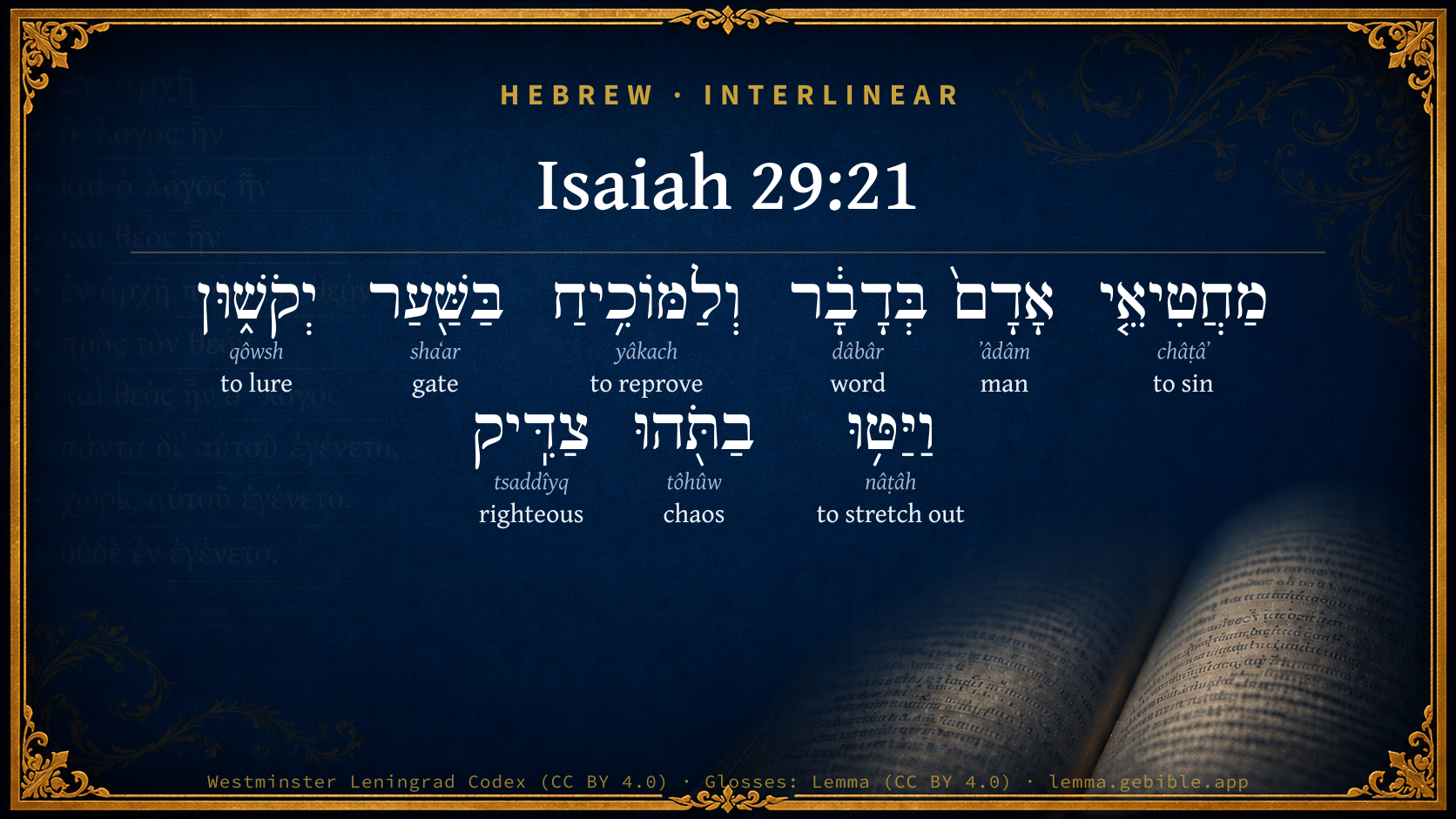
Hebrew (Westminster Leningrad Codex) Isaiah 29:21 appears in the Hebrew Old Testament. The text above is from the Westminster Leningrad Codex. Each word links to its Strong’s number, a concise gloss, and parsing drawn from the Open Scriptures Hebrew Bible morphology. Click any word for its full Brown-Driver-Briggs (BDB) entry.
Download image
Cite this verse

Isaiah 29:21 (World English Bible). Public Domain. Lemma interlinear Bible study tool, https://lemma.gebible.app/v/isaiah/29/21.

Show BibTeX & RIS
BibTeX
RIS
English Translation
that make a man an offender in [his] cause, and lay a snare for him who reproves in the gate, and turn aside the just with a thing of nothing.
World English Bible · Public Domain
Highlights
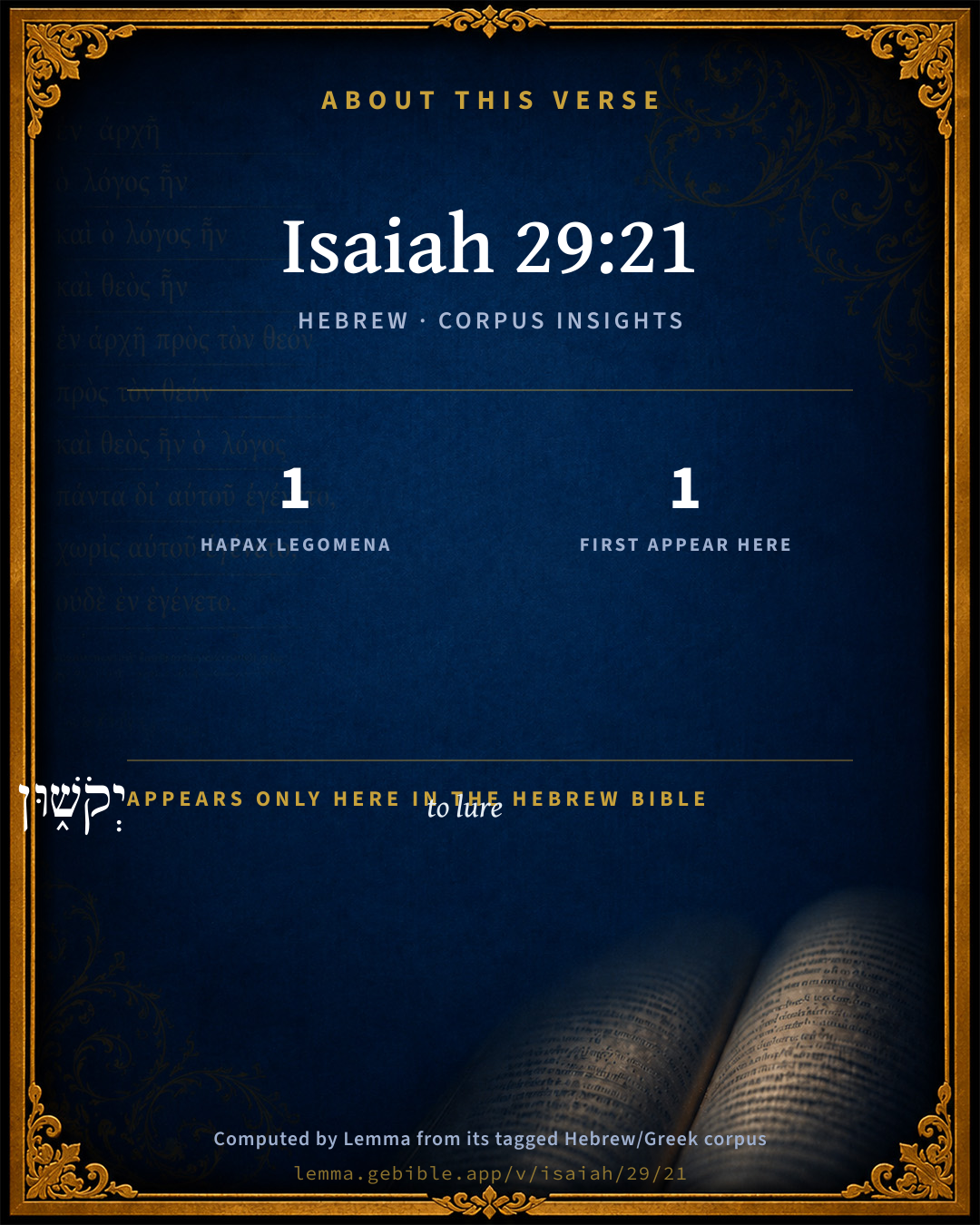
  • 1 hapax legomenon — only here in the Hebrew Bible
  • 1 first appearance in the Hebrew Bible
Full analysis ↓
Download a study sheet

One document with this verse’s original text, its word-by-word gloss line, the meaning frame, cross-references with their text, attributed commentary, and full source and license credits — printable, and it pastes into notes with its structure intact.

This verse Autodidact and up

Study sheet (.html) Plain text (.txt)

A passage Seminary Student

Up to 50 verses in one chapter. A passage sheet keeps up to 6 commentary sources and 12 cross-references per verse, in the order this page ranks them, and says so on the sheet whenever that leaves anything out. Ask for a single verse and you get the Autodidact verse sheet above.

Everything on this page stays free to read, with no account — the sheet is a download of what is already on screen, not access to it.

Want to remove ads? Support Godless Engineer
Compare translations 3

The same verse in 3 English versions, stacked beneath the original-language interlinear above. Click any original word for its lexicon entry.

Each is an independent rendering of the whole verse — the interlinear is not word-aligned to these translations.

Highlighted words mark where these versions differ — a whole-verse word diff, not a word-by-word alignment.

  • World English Bible Public Domain
    that make a man an offender in [his] cause, and lay a snare for him who reproves in the gate, and turn aside the just with a thing of nothing.
  • King James Version Public Domain
    That make a man an offender for a word, and lay a snare for him that reproveth in the gate, and turn aside the just for a thing of nought.
  • unfoldingWord Literal Text CC BY-SA 4.0
    the ones making a man sinful with a word, and they set a trap for the one reproving at the gate, and they turn aside the righteous with emptiness. q1

unfoldingWord Literal Text — © unfoldingWord, licensed CC BY-SA 4.0. Word-aligned USFM3 via Door43 (git.door43.org/unfoldingWord/en_ult).

Versions to compare (up to 4)

3 of 4 selected

Show all 18 translations

Every available English version of this verse, each an independent rendering of the whole verse.

  • World English Bible Public Domain
    that make a man an offender in [his] cause, and lay a snare for him who reproves in the gate, and turn aside the just with a thing of nothing.
  • Berean Standard Bible Public Domain
    those who indict a man with a word, who ensnare the mediator at the gate, and who with false charges deprive the innocent of justice.
  • Majority Standard Bible Public Domain
    those who indict a man with a word, who ensnare the mediator at the gate, and who with false charges deprive the innocent of justice.
  • King James Version Public Domain
    That make a man an offender for a word, and lay a snare for him that reproveth in the gate, and turn aside the just for a thing of nought.
  • American Standard Version (1901) Public Domain
    that make a man an offender in `his' cause, and lay a snare for him that reproveth in the gate, and turn aside the just with a thing of nought.
  • Revised Version (1885) Public Domain
    that make a man an offender in a cause, and lay a snare for him that reproveth in the gate, and turn aside the just with a thing of nought.
  • Geneva Bible (1599) Public Domain
    Which made a man to sinne in ye worde, and tooke him in a snare: which reproued them in the gate, and made the iust to fall without cause.
  • Douay-Rheims (1899) Public Domain
    That made men sin by word, and supplanted him that reproved them in the gate, and declined in vain from the just.
  • Young's Literal Translation Public Domain
    Causing men to sin in word, And for a reprover in the gate lay a snare, And turn aside into emptiness the righteous.
  • Literal Standard Version CC BY-SA 4.0
    Who cause men to sin in word, || And lay a snare for a reprover in the gate, || And turn aside the righteous into emptiness.
  • Unlocked Literal Bible CC BY-SA 4.0
    who by a word make a man out to be an offender. They lay a snare for him who seeks justice at the gate and put the righteous down with empty lies.
  • unfoldingWord Literal Text CC BY-SA 4.0
    the ones making a man sinful with a word, and they set a trap for the one reproving at the gate, and they turn aside the righteous with emptiness. q1
  • Darby Bible Public Domain
    that make a man an offender for a word, and lay a snare for him that reproveth in the gate, and pervert [the judgment of] the righteous by futility.
  • World Messianic Bible Public Domain
    who cause a person to be indicted by a word, and lay a snare for one who reproves in the gate, and who deprive the innocent of justice with false testimony.
  • Webster's Bible Public Domain
    That make a man an offender for a word, and lay a snare for him that reproveth in the gate, and turn aside the just for a thing of naught.
  • Free Bible Version CC BY-SA 4.0
    those who say things to trick others into sin, those who trap people by legal arguments in court, those who lie to mislead the innocent.
  • Bible in Basic English Public Domain
    Who give help to a man in a wrong cause, and who put a net for the feet of him who gives decisions in the public place, taking away a man's right without cause.
  • JPS Tanakh (1917) Public Domain
    That make a man an offender by words, and lay a snare for him that reproveth in the gate, and turn aside the just with a thing of nought.

Literal Standard Version (2020), Covenant Press — licensed CC BY-SA 4.0. Text via the HelloAO Bible API (eBible.org). Unlocked Literal Bible (unfoldingWord) — licensed CC BY-SA 4.0. Text via the HelloAO Bible API (eBible.org). unfoldingWord Literal Text — © unfoldingWord, licensed CC BY-SA 4.0. Word-aligned USFM3 via Door43 (git.door43.org/unfoldingWord/en_ult). Free Bible Version, Dr. Jonathan Gallagher — licensed CC BY-SA 4.0. Text via the HelloAO Bible API (eBible.org).

Word by word

More ways to search: Search by grammar → Find every occurrence → Compare this word →

Practice this passage: Drill this verse → Learn its vocabulary →

יְקֹשׁ֑וּן
qôwsh
H6983
“to lure”
Verb, Qal, Imperfect, 3rd Person, Masculine, Plural + Suffix, n
Part of Speech
Verb
Stem
Qal
Form
Imperfect
Person
3rd Person
Gender
Masculine
Number
Plural
Full BDB Definition

Origin: a primitive root

TWOT: 2006

(Qal) to lay bait or lure, lay a snare, lure
  1. מַחֲטִיאֵ֤י châṭâʼ H2398 “sinning” Verb, Hiphil, Participle Active, Masculine, Plural, Construct
  2. אָדָם֙ ʼâdâm H120 “man” Noun, Common, Masculine, Singular, Absolute
  3. בְּדָבָ֔ר dâbâr H1697 “in/at · word” Preposition + Noun, Common, Masculine, Singular, Absolute
  4. וְלַמּוֹכִ֥יחַ yâkach H3198 “and · to/for the · reproving” Conjunction + Preposition, Determined + Verb, Hiphil, Participle Active, Masculine, Singular, Absolute
  5. בַּשַּׁ֖עַר shaʻar H8179 “in/at the · gate” Preposition, Determined + Noun, Common, Masculine, Singular, Absolute
  6. וַיַּטּ֥וּ nâṭâh H5186 “and · to stretch out” Conjunction + Verb, Hiphil, Sequential Imperfect, 3rd Person, Masculine, Plural
  7. בַתֹּ֖הוּ tôhûw H8414 “in/at the · chaos” Preposition, Determined + Noun, Common, Masculine, Singular, Absolute
  8. צַדִּֽיק tsaddîyq H6662 “righteous” Adjective, Adjective, Masculine, Singular, Absolute

About this verse

These counts appear in no published source. They are computed here, from the morphology-tagged text and Lemma’s own curated glosses. What Lemma adds →

9
words
9
distinct lemmas
Prophets
section

Notable vocabulary

1 hapax legomenon — a word that appears only here in the entire Hebrew Bible:

  • יְקֹשׁ֑וּן to lure H6983

First appearance in Scripture

This word makes its first canonical appearance in the Hebrew Bible here:

  • יְקֹשׁ֑וּן to lure H6983

Shared distinctive vocabulary

בַתֹּ֖הוּ chaos H8414 occurs in 19 verses of the Hebrew Bible. Also found in:

Grammatical profile

  • 4 verbs
  • 4 nouns
  • 1 adjective

Verb forms

  • מַחֲטִיאֵ֤י Hiphil · Participle Active
  • וְלַמּוֹכִ֥יחַ Hiphil · Participle Active
  • יְקֹשׁ֑וּן Qal · Imperfect
  • וַיַּטּ֥וּ Hiphil · Sequential Imperfect

Hebrew & Septuagint length

In English translation the verse runs 30 words from the Hebrew and 30 from the Septuagint (LXX English) — the same length.

A rough comparison of the two English renderings, which tokenize alike — not a word-level alignment.

Word counts can differ between the Hebrew and the Greek without any difference in meaning — e.g. the Hebrew direct-object marker אֵת has no separate Greek word, and Greek often adds the article ὁ.

Cross-references

16

Topical passages linked to Isaiah 29:21 in the Treasury of Scripture Knowledge — connected by theme and wording, ordered by reader-vote popularity; previews shown in the World English Bible.

  • Amos 5:10–12 They hate him who reproves in the gate, And they abhor him who speaks blamelessly.
  • James 5:6 You have condemned, you have murdered the righteous one. He doesn't resist you.
  • Acts 3:14 But you denied the Holy and Righteous One, and asked for a murderer to be granted to you,
  • Judges 12:6 then said they to him, Say now Shibboleth; and he said Sibboleth; for he couldn't manage to pronounce it right: then they laid hold on him, and killed him at the fords of the Jordan. There fell at that time of Ephraim forty-two thousand.
  • Proverbs 28:21 To show partiality is not good; Yet a man will do wrong for a piece of bread.
  • Isaiah 32:7 The instruments of the churl are evil: he devises wicked devices to destroy the humble with lying words, even when the needy speaks right.
  • Jeremiah 18:18 Then said they, Come, and let us devise devices against Jeremiah; for the law shall not perish from the priest, nor counsel from the wise, nor the word from the prophet. Come, and let us strike him with the tongue, and let us not give heed to any of his words.
  • Jeremiah 20:7–10 Yahweh, you have persuaded me, and I was persuaded; you are stronger than I, and have prevailed: I am become a laughing-stock all the day, every one mocks me.
  • Jeremiah 26:2–8 Thus says Yahweh: Stand in the court of Yahweh's house, and speak to all the cities of Judah, which come to worship in Yahweh's house, all the words that I command you to speak to them; don't diminish a word.
  • Ezekiel 13:19 You have profaned me among my people for handfuls of barley and for pieces of bread, to kill the souls who should not die, and to save the souls alive who should not live, by your lying to my people who listen to lies.
  • Amos 7:10–17 Then Amaziah the priest of Beth El sent to Jeroboam king of Israel, saying, "Amos has conspired against you in the midst of the house of Israel. The land is not able to bear all his words.
  • Micah 2:6–7 "Don't you prophesy!" They prophesy. "Don't prophesy about these things. Disgrace won't overtake us."
  • Malachi 3:5 I will come near to you to judgment; and I will be a swift witness against the sorcerers, and against the adulterers, and against the perjurers, and against those who oppress the hireling in his wages, the widow, and the fatherless, and who deprive the foreigner of justice, and don't fear me," says Yahweh of Hosts.
  • Matthew 22:15 Then the Pharisees went and took counsel how they might entrap him in his talk.
  • Matthew 26:15 and said, "What are you willing to give me, that I should deliver him to you?" They weighed out for him thirty pieces of silver.
  • Luke 11:53–54 As he said these things to them, the scribes and the Pharisees began to be terribly angry, and to draw many things out of him;

Cross-references courtesy of OpenBible.info (CC BY 4.0).

Hebrew and Greek witnesses Masoretic Hebrew ↔ Greek Septuagint

The same verse in the two great witnesses to the Old Testament, shown verse-for-verse.

These are two independent witnesses, not word-aligned to each other, and the Septuagint is shown in lemma (dictionary) form.

Hebrew Isaiah 29:21 Masoretic · Westminster Leningrad Codex

מַחֲטִיאֵ֤י אָדָם֙ בְּדָבָ֔ר וְלַמּוֹכִ֥יחַ בַּשַּׁ֖עַר יְקֹשׁ֑וּן וַיַּטּ֥וּ בַתֹּ֖הוּ צַדִּֽיק

that make a man an offender in [his] cause, and lay a snare for him who reproves in the gate, and turn aside the just with a thing of nothing.

World English Bible · Public Domain

Greek LXX Isaiah 29:21 Septuagint · lemma form

καί ὁ ποιέω ἁμαρτάνω ἄνθρωπος ἐν λόγος πᾶς δέ ὁ ἐλέγχω ἐν πύλη πρόσκομμα τίθημι καί πλαγιόω ἐν ἄδικος δίκαιος

and they that cause men to sin by a word: and men shall make all that reprove in the gates an offense, because they have unjustly turned aside the righteous.

LXX2012 (modern English Septuagint) · Public Domain

On this verse, John Gill's Exposition discusses the Septuagint’s reading. Read the note in Commentary ↓

Hebrew: Westminster Leningrad Codex (CC BY 4.0). Greek: Septuagint (public domain); English from LXX2012 (modern English Septuagint) (Public Domain). How the Septuagint differs from the Hebrew →

Targum (Aramaic paraphrase)

1

The Targum is the ancient Jewish Aramaic paraphrase of the Hebrew Scriptures — an interpretive translation, not the Hebrew text itself. Onkelos (literal) and Pseudo-Jonathan (expansive) render the Torah, and Jonathan the Prophets. Coverage is partial: where no permissively-licensed English translation exists for a verse, only the Aramaic is shown. This is verse-level text, not a word-by-word alignment to the Hebrew.

  1. Targum Jonathan Prophets (Joshua–Malachi)
    מְחַיְבִין בְּנֵי אֱנָשָׁא בְּמִלֵיהוֹן וְלִדְמוֹכַח לְהוֹן בֵּית דִינָא בְתַרְעָא פִתְגָמֵי אוֹרַיְתָא בָּעָן לֵיהּ תַּקָלָא וְאַסְטִיאוּ בִשְׁקַר דִין זַכָּאִין:

    All that declare the sons of men guilty on account of their words. The court of justice that is in the gate seeks to ensnare him, who reproves them with the words of the law. They turn aside the just by false judgment.

    Targum Jonathan — Aramaic: “Mikraot Gedolot” (public domain). English: “Sefaria Community Translation” (CC0 1.0 (public-domain dedication)); “London "Chaldee Paraphrase," 1871” (public domain). Text via Sefaria.

Commentary

Notes on Isaiah 29:21 from classic Christian and Jewish commentators (each source and its license shown beneath its notes). The classic Christian expositions comment on the surrounding passage and are grouped to its opening verse, so a note may address several verses; the Jewish commentaries on the Tanakh (Rashi and others) are per-verse, so they appear only where the commentator wrote on this verse.

Lemma curates 59 commentaries, every one of them public domain or Creative Commons licensed, each selected and text-cleaned for this edition rather than reprinted as found. About our sources →

Adam Clarke's Commentary

Verse 21. Him that reproveth in the gate - "Him that pleaded in the gate"] "They are heard by the treasurer, master of the horse, and other principal officers of the regency of Algiers, who sit constantly in the gate of the palace for that purpose:" that is, the distribution of justice. - Shaw's Travels, p. 315, fol. He adds in the note, "That we read of the elders in the gate. De 21:15; De 25:7; and, Isa 29:21; Am 5:10, of him that reproveth and rebuketh in the gate. The Ottoman court likewise seems to have been called the Porte, from the distribution of justice and the despatch of public business that is carried on in the gates of it."

Adam Clarke's Commentary on the Bible (1810–1826) — public domain. Text from a community e-Sword/MySword module.

Trapp's Complete Commentary

John Trapp

Isa 29:21 That make a man an offender for a word, and lay a snare for him that reproveth in the gate, and turn aside the just for a thing of nought.

Ver. 21. That make a man an offender for a word.] When he meant no hurt, or by perverting and misconstruing his speeches. Thus they sought to trap Christ in his speeches; and thus they dealt by many of the martyrs and confessors. To say, the Lord, and not our Lord, is called by Stephen Gardner symbolum haereticorum, a note of a heretic. {a} Dr Storie’s rule to know a heretic was, they will say, the Lord, and we praise God, and, the living God. {b} Robert Cook was abjured for saying that the blessing with a shoe sole was as good as the bishop’s blessing. {c} Another for saying that alms should not be given until it did sweat in a man’s hand. {d} Mrs Catismore for saying that when men go to offer to images, they did it to show their new gear; and that images were but carpenters’ chips; and that folks go on pilgrimage more for the green way than for devotion. {e} Philip Brasier for saying that when any miracle is done, the priests anoint the images, and make men believe these images sweat in labouring for them, &c. {f} "Every day they wrest my words," saith David of his enemies. {Psa 56:5} As the spleen is subservient to the liver, to take from it only the most putrid and feculent blood; so do detractors pick out the worst of everything, to lay it in a man’s dish, or allege it against him.

And lay a snare for him that reproveth.] {See Trapp on "Amo 5:10"} Freedom of speech used by the Waldenses in blaming and reproving the vices and errors of great ones, effecit ut plures nefariae affingerentur eis opiniones, a quibus ornnino fuerant alieni, made them hardly thought and spoken of. {g}

{a} Acts and Mon,. fol. 1116.

{b} Ibid., 1803.

{c} Ibid., 952.

{d} Ibid., 765.

{e} Ibid., 763.

{f} Ibid., 952.

{g} Girard.

John Trapp, A Commentary or Exposition upon All the Books of the Old and New Testament (1647–1656) — public domain. Text from a community e-Sword module.

Tyndale Open Study Notes

Tyndale Open Resources

29:21 The false testimony that led to the oppression of the poor through trickery in the courts of Isaiah’s era would end. Because of God’s work in their hearts, the people would turn from their sinful behavior of the past.

Tyndale Open Study Notes — © Tyndale Open Resources, licensed CC BY-SA 4.0. Text via the HelloAO Bible API.

Geneva Bible (1599)

Geneva Bible translators

They that went about to find fault with the Prophet’s words, and would not abide admonitions, but would entangle them and bring them into danger.

Geneva Bible (1599) marginal notes — public domain. Text via Bolls.life.

Jamieson, Fausset & Brown

Robert Jamieson, A. R. Fausset & David Brown

Rather, "Who make a man guilty in his cause" [GESENIUS], that is, unjustly condemn him. "A man" is in the Hebrew a poor man, upon whom such unjust condemnations might be practiced with more impunity than on the rich; compare Isa 29:19, "the meek . . . the poor."

him that reproveth--rather, "pleadeth"; one who has a suit at issue.

gate--the place of concourse in a city, where courts of justice were held (Rut 4:11; Pro 31:23; Amo 5:10, Amo 5:12).

just--one who has a just cause; or, Jesus Christ, "the Just One" [HORSLEY].

for a thing of naught--rather, "through falsehood," "by a decision that is null in justice" [BARNES]. Compare as to Christ, Pro 28:21; Mat 26:15; Act 3:13-14; Act 8:33.

Jamieson, Fausset & Brown — Commentary Critical and Explanatory on the Whole Bible (1871) — public domain (CC PDM 1.0). Text via the HelloAO Bible API.

Ellicott's Commentary for English Readers

(21) That make a man an offender for a word . . .—The words indicate that Isaiah had been accused, as Jeremiah was afterwards (Jer_37:13), of being unpatriotic, because he had rebuked the sins of Israel and its rulers. Another interpretation gives, “that make men sinners in word,” i.e., suborn false witnesses against him. The former seems preferable, but the general drift of the passage is the same. The “snare” was laid for the “righteous man,” precisely because he “reproved in the gate:” i.e., preached in the open air in the places of public concourse, even in the presence of the rulers and judges as they sat there.

Turn aside the just.—The phrase is used in Exo_23:6; Amo_5:12; Mal_3:5, for the deliberate perversion of justice.

A thing of nought.—The Hebrew word is once more the tohu (“without form”) of Gen_1:1. The accusations brought against the prophet were, as we say, incoherent, absolutely chaotic in their falsehood.

A Bible Commentary for English Readers, edited by Charles John Ellicott (1878–1897) — public domain. Text from a community e-Sword module.

The Cambridge Bible for Schools and Colleges

gen. ed. J. J. S. Perowne

21. That make a man an offender for a word] The verb rendered “make an offender” usually means “lead into sin” (Exo_23:33; Ecc_5:6, &c.); and is so understood in R.V. marg. “make men to offend by their words.” Here, however, the second part of the verse seems to shew that it is used in a declarative sense (= “make a man out to be an offender”). for a word should be translated either by a (false) word; or (as R.V.) in a cause.

him that reproveth in the gate] (cf. Amo_5:10). The person indicated may be either a judge (“umpire, as Job_9:33) or a private individual who stands up for justice in the place of public assembly.

turn aside the just (from his right, ch. Isa_10:2; Amo_5:12) for a thing of nought] rather, as R.V. with a thing of nought, “on an empty pretext.”

The Cambridge Bible for Schools and Colleges (gen. ed. J. J. S. Perowne; Cambridge University Press, 1878–1918) — public domain. Text from a community e-Sword module.

John Gill's Exposition

That make a man an offender for a word,.... Inadvertently spoken, unwarily dropped, without any bad design or ill meaning; or for a word misplaced or misconstrued; or for preaching and professing the word of God, the Gospel of salvation, and adhering to it; which is the true character of the persecutors of good men in all ages: some render the words, "who make a man sin by a word" (e); by their words and doctrines; and so apply it to the false prophets, as Jarchi does; and very well agrees with the Pharisees in Christ's time, who made men to sin, to transgress the word of God, by their traditions. The Targum is,

"who condemn the sons of men by their words;''

or for them; particularly for their words of reproof, for which they make them offenders, or pronounce them guilty, as follows:

and lay a snare for him that reproveth in the gate; either for just judges, who sat in the gate of the city, and faithfully reproved and punished men for their sins; or for such that had boldness and courage enough to reprove wicked men openly, and before all, for their wickedness, the gate being a public place, where people pass and repass; and such that sin openly should be reproved openly; and particularly the true prophets of the Lord may be referred to, who sometimes were sent to publish their messages, which were frequently reproofs of the people, in the gates of the city; but, above all, Christ seems to be respected, who in the most public manner inveighed against the Scribes and Pharisees for their wickedness, on account of which they sought to entangle him in his talk, and to lay snares for his life; see Mat 22:15,

and turn aside the just for a thing of nought; the Targum is,

"that falsely pervert the judgment of the innocent;''

that turn away their judgment, decline doing them justice, but condemn them on frivolous pretences, for just nothing at all, what is mere emptiness and vanity: Christ is eminently the "just" One, righteous in himself, and the author of righteousness to others; yet, on account of things for which there were no foundation, and contrary to all justice, he was proceeded against as a criminal.

(e) "qui verbie faciunt ut peccent homines", Castalio; "peccare facientes hominem in verbo", Pagninus, Montanus. And to the same sense the Septuagint, V. L. Syr. and Arab.

John Gill's Exposition of the Whole Bible (1746–1763) — public domain (CC PDM 1.0). Text via the HelloAO Bible API.

Albert Barnes' Notes on the Bible

That make a man an offender - literally, ‘who cause a man to sin’ (מחטיאי machăṭı̂y'ēy); that is, who hold a man to be guilty, or a criminal. Lowth renders this singularly enough:

‘Who bewildered the poor man in speaking.’

Grotius supposes it means, ‘Who on account of the word of God, that is, the true prophecy, treat men as guilty of crime.’ Calvin supposes it means, ‘Who bear with impatience the reproofs and denunciation of the prophets, and who endeavor to pervert and distort their meaning.’ Hence, he supposes, they proposed artful and captious questions by which they might ensnare them. Others suppose that it refers to the fact that they led people into sin by their new doctrines and false views. The connection, however, seems to require that it should be understood of judicial proceedings, and the sense is probably correctly expressed by Noyes:

‘Who condemned the poor man in his cause.’

This interpretation is also that which is proposed by Rosenmuller and Gesenius. According to the interpretation above suggested, the word rendered ‘who make an offender,’ means the same as who holds one guilty, that is, condemns.

A man - (אדם 'âdâm). It is well known that this word stands in contradistinction to אישׁ 'ı̂ysh, and denotes usually a poor man, a man in humble life, in opposition to one who is rich or of more elevated rank. This is probably the sense here, and the meaning is, that they condemned the poor man; that is, that they were partial in their judgments.

For a word - (בדבר bedâbâr). “In” a word; denoting the same as “a cause” that is tried before a court of justice. So Exo 18:16 : ‘When they have “a matter” (דבר dâbâr “a word”), they come unto me.’ So Exo 18:22 : ‘And it shoji be that every great “matter” (Hebrew every great “word”) that they shall bring unto me.’ So Exo 22:8 (in the English version 9): ‘For all manner of trespass,’ Hebrew for every word of trespass; that is, for every suit concerning a breach of trust. So also Exo 24:14 : ‘If any man have “any matters” to do,’ (Hebrew, ‘any “words, ‘“) that is, if anyone has a law suit.

And lay a snare - To lay a snare is to devise a plan to deceive, or get into their possession; as birds are caught in snares that are concealed from their view.

That reproveth - Or rather, that “contended” or “pleaded;” that is, that had a cause. The word יכח yâkach means often to contend with any one; to strive; to seek to confute; to attempt to defend or justify, as in a court of law Job 13:15; Job 19:5; Job 16:21; Job 22:4. It is also applied to deciding a case in law, or pronouncing a decision Isa 11:3-4; Gen 31:37; Job 9:33. Here it means one who has brought a suit, or who is engaged in a legal cause.

In the gate - Gates of cities being places of concourse, were usually resorted to for transacting business, and courts were usually held in them Gen 23:10, Gen 23:18; Deu 17:5, Deu 17:8; Deu 21:19; Deu 22:15; Deu 25:6-7; Rth 4:1. The sense is, they endeavored to pervert justice, and to bring the man who had a cause before them, completely within their power, so that they might use him for their own purposes, at the same time that they seemed to be deciding the cause justly.

And turn aside the just - The man who has a just or righteous cause.

For a thing of nought - Or a decision which is empty, vain (בתהו batôhû), and which should be regarded as null and void,

Albert Barnes' Notes on the Bible (1834–1885) — public domain. Text from a community e-Sword/MySword module.

Haydock's Catholic Bible Commentary

Gate. False prophets rose up against those who spoke the truth, and condemned them unjustly. (Calmet) --- The just, Christ. (Menochius)

George Leo Haydock (1774–1849), Haydock's Catholic Family Bible and Commentary, 1859 edition — public domain. Excludes Psalms (Douay-Rheims chapter numbering differs from Protestant) and Deuterocanonical books (Catholic canon only).

Matthew Poole's English Annotations

That make a man an offender; that condemn and punish a man as if he were a great criminal.

For a word; for a verbal reproof, as appears from the next clause.

For him that reproveth; for God’s faithful prophets and ministers, whose office it is to reprove ungodly men, such as these were.

In the gate, publicly; which they took for a great affront and disgrace; although the reproof ought to be public, where the sin is public and scandalous. He mentions the gate, because there the people used to assemble, both upon civil and sacred accounts, and there prophets used to deliver their prophecies; of which see Jer 7:2; 17:19.

Turn aside, to wit, from judgment, as this phrase is more fully delivered, Isa 10:2, or from his right; which is elsewhere called the perverting, or overturning, or overthrowing of a man’s right or judgment, as Deu 27:19; Pro 17:23; Lam 3:35.

The just; the faithful prophets and ministers of God, and among others Christ, who is oft called the just or righteous one, both in the Old and New Testament.

For a thing of nought; not for any great advantage, but for a trifle, which is a great aggravation of their injustice. Or, with vanity, i.e. with vain and frivolous pretences, or without any colour of reason or justice.

Matthew Poole's English Annotations on the Holy Bible (1683–1685) — public domain. Text from a community e-Sword/MySword module.

The Pulpit Commentary

That make a man an offender for a word. The meaning of this clause is very doubtful. Kay translates, "That lead men into sin by words;" Mr. Cheyne, "That make out people to be sinners by their words," i.e. by bearing false witness against them; while Delitzsch upholds the rendering of the Authorized Version. Mr. Vance Smith has other suggestions ("Prophecies," p, 171). There seems to be, on the whole, no sufficient reason for setting aside the authorized rendering, which condemns one form of oppression the severe punishment of mere words. And lay a snare for him that reproveth in the gate. "The gate" was the place where judgment was given and public assemblies held. If any one boldly stood up and reproved the oppressors "in the gate," they instantly set to work to lay a trap for him and bring him to ruin. And turn aside the just for a thing of naught; rather, and deprive the just of their right by empty charges. "Turning aside the just" means turning them from their; (Amo_5:12 Exo_23:6) and bat tohu is not for nothing" but by nothing," i.e. by some vain empty pretence.

The Pulpit Commentary (1880–1919), ed. H.D.M. Spence-Jones & Joseph S. Exell — public domain. Text from a community e-Sword module.

John Wesley's Explanatory Notes

That make a man - That condemn a man, as if he was a great criminal. For him - For God's faithful prophets and ministers. The gate - There the people used to assemble, both upon civil and sacred accounts, and there prophets used to deliver their prophecies. Turn - From his right. The just - The faithful ministers of God. Nought - Not for any great advantage, but for a trifle.

John Wesley, Explanatory Notes Upon the Whole Bible (1754–1765) — public domain. Text via the GEBible commentary corpus.

J. A. Alexander on Isaiah

Joseph Addison Alexander

“Making a man a sinner for a word, and for him disputing in the gate they laid a snare, and turned aside the righteous through deceit.” An amplification of the last phrase in the foregoing verse. Some understand the first clause to mean, seducing people into sin by their words. It is much more common to explain the whole phrase to mean unjustly condemning a man in his cause, which agrees well with the obvious allusion to forensic process in the remainder of the verse. The English and many other early versions explain the clause to mean accusing or condemning men for a mere error of the tongue or lips. The general sense is plain, viz. that they embrace all opportunities and use all arts to wrong the guiltless. Most of the modern writers take the word translated ‘disputing’, in the sense of arguing, pleading in the gate, (i.e., the court, often held in the gates of oriental cities). The other explanation supposes the gate to be mentioned only as a place of public concourse. By the turning aside of the righteous (i.e., of the party who is in the right) we are here to understand the depriving him of that which is his due. For the meaning and usage of the figure, see the commentary on Isa 10:2. The last words have been variously understood to mean through falsehood (with particular reference to false testimony), or by means of a judgment which is null and void, or for nothing i e. without just cause. In either case the phrase describes the perversion or abuse of justice by dishonest mean, and thus agrees with the expressions used in the foregoing clauses.

Joseph Addison Alexander, The Prophecies of Isaiah (1846–1847; New York: Scribner, 1870–1878) — public domain. Text from a community e-Sword module.

Rashi

Rabbi Shlomo Yitzchaki (Rashi)

Those who cause man to sin by a word They are the false prophets.

and him who reproves in the gate they trap (יְקשׁוּן. Jonathan renders:) And for the one who reproves them, they seek for him a stumblingblock. (יְקשׁוּן is) an expression related to מוֹקֵשׁ, a trap.

and they mislead the righteous through fraud And they pervert with fraud the cause of the just [from Jonathan].

Rashi on the Tanakh — English translations: “The Judaica Press complete Tanach with Rashi, translated by A. J. Rosenberg” (CC BY 4.0); “Pentateuch with Rashi's commentary by M. Rosenbaum and A.M. Silbermann, 1929-1934” (public domain); “The Metsudah Tanach series, Lakewood, N.J” (CC BY 4.0); and “The Book of Joshua, Metsudah Publications, 1997” (CC BY 4.0). Text via Sefaria.

Ibn Ezra

Rabbi Abraham ibn Ezra

מחטיאי אדם בדבר That make a man an offender for a word, that watch the words of man, and accuse him, in order to see him punished; or that cause others to sin by their words.

יקושון They lay a snare. Comp. מוקש snare (Deut. 7:16). R. Moses Hakkohen explains יקושון they rebuke, comparing it with התקששו וקשו be rebuked and rebuke (Zeph. 2:1), and says that the ש ought to have a Dagesh.

Ibn Ezra on the Tanakh — English translations: “Sefaria Community Translation” (CC0 1.0 (public-domain dedication)); “Yalkut, Sifsei Chachomim Chumash, Metsudah Publications, 2009” (CC BY 4.0); and “Commentary of Ibn Ezra on Isaiah - trans. by M. Friedlander, 1873” (public domain). Text via Sefaria.

Lesson kit

Teaching starters — assembled from the data on this page, not authored interpretation. Every prompt links to the verse data it draws on. Edit before teaching.

Isaiah, in the Prophets, opens this verse with 9 words (9 distinct Hebrew lemmas). Its most distinctive word is qôwsh (“to lure”). A historical commentator’s framing appears above. Read the whole chapter for the surrounding context.

Discussion questions

  1. The word qôwsh carries the sense “to lure.” How does it shape the verse?
  2. 1 word here appears nowhere else in the Hebrew Bible. Why might the author reach for such rare wording?
  3. This is the first place “to lure” appears in Scripture (first appears here). What does its debut here establish?
  4. How does Genesis 1:2, which shares the word «chaos», read alongside this verse?
  5. These translations render this verse differently; the difference is in the English rendering, not the original. What questions does that raise?
  6. «מַחֲטִיאֵ֤י» is a Hiphil Participle Active verb. How does that grammatical form shape the action described?
  7. Compare how Adam Clarke's Commentary and Trapp's Complete Commentary read this verse. Where do they agree or differ?

Things to notice

  • 1 word in this verse appears nowhere else in the Hebrew Bible.
  • 1 word makes its first canonical appearance in Scripture here.
  • These translations choose different wording for 24 words in this verse.
  • 9 distinct Hebrew lemmas span 9 words in this verse.

Reading settings

Reading text

Shown beneath each verse's original-language words.

Old Testament
Old Testament edition

Read the OT as the Masoretic Hebrew (MT) or the Greek Septuagint (LXX).

English shown for the Greek Septuagint (in the Hebrew ↔ Greek comparison).

Comparing translations? Open the Compare panel on any verse page to stack up to four side by side.