
1 Kings 8:37

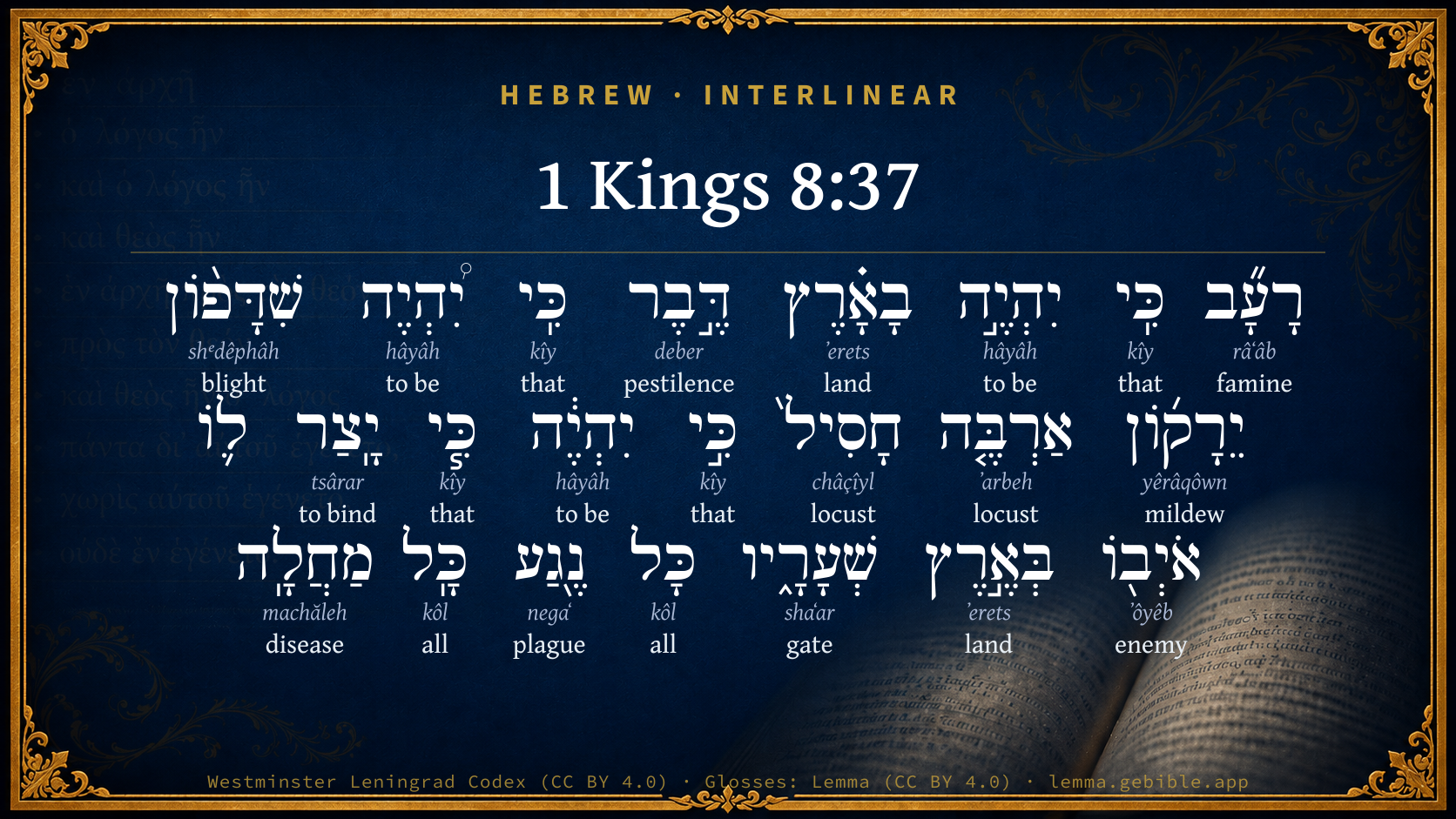
Hebrew (Westminster Leningrad Codex) 1 Kings 8:37 appears in the Hebrew Old Testament. The text above is from the Westminster Leningrad Codex. Each word links to its Strong’s number, a concise gloss, and parsing drawn from the Open Scriptures Hebrew Bible morphology. Click any word for its full Brown-Driver-Briggs (BDB) entry.
Download image
Cite this verse

1 Kings 8:37 (World English Bible). Public Domain. Lemma interlinear Bible study tool, https://lemma.gebible.app/v/1-kings/8/37.

Show BibTeX & RIS
BibTeX
RIS
English Translation
If there be in the land famine, if there be pestilence, if there be blasting [or] mildew, locust [or] caterpillar; if their enemy besiege them in the land of their cities; whatever plague, whatever sickness there be;
World English Bible · Public Domain
Highlights
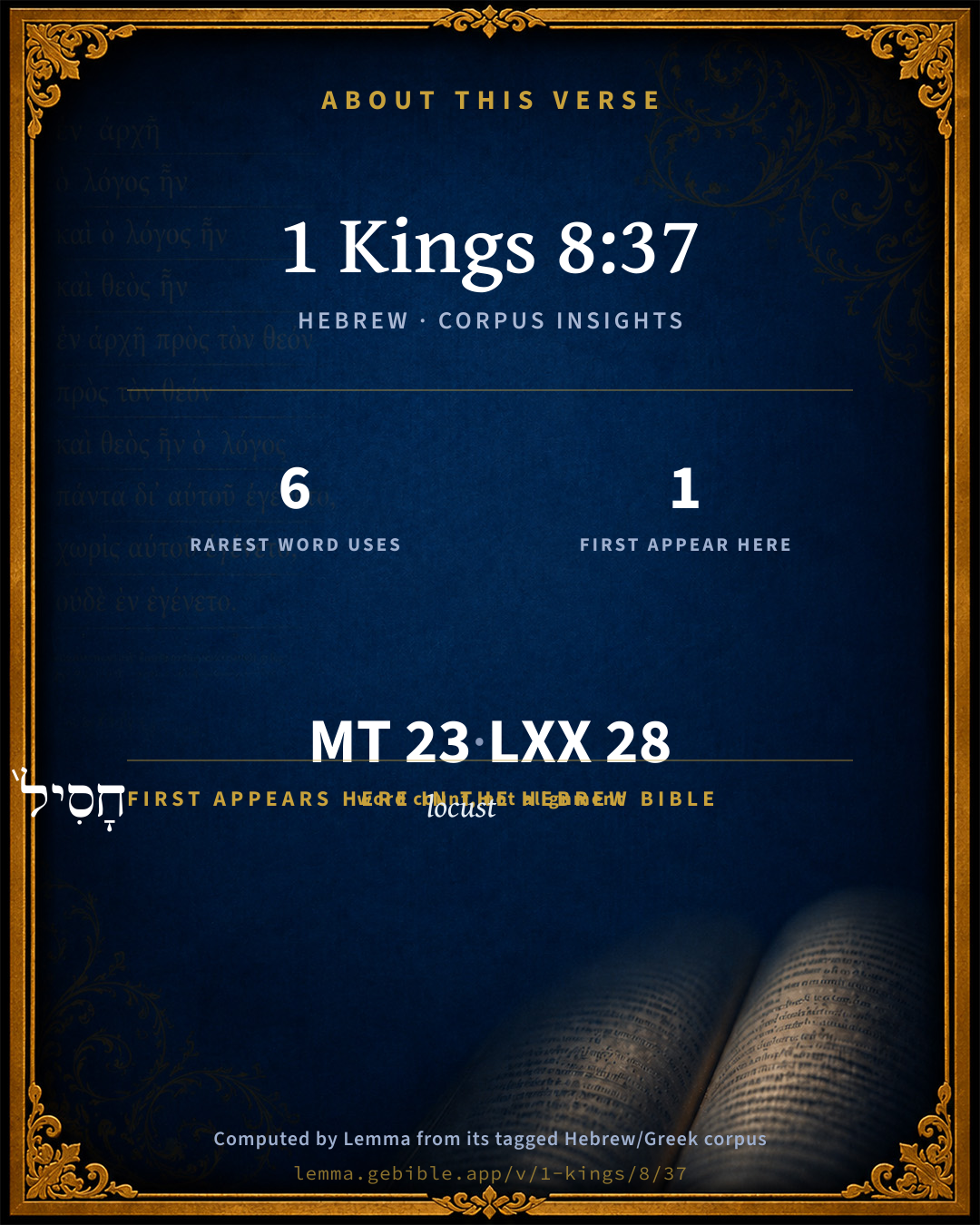
  • 1 first appearance in the Hebrew Bible
Full analysis ↓
Download a study sheet

One document with this verse’s original text, its word-by-word gloss line, the meaning frame, cross-references with their text, attributed commentary, and full source and license credits — printable, and it pastes into notes with its structure intact.

This verse Autodidact and up

Study sheet (.html) Plain text (.txt)

A passage Seminary Student

Up to 50 verses in one chapter. A passage sheet keeps up to 6 commentary sources and 12 cross-references per verse, in the order this page ranks them, and says so on the sheet whenever that leaves anything out. Ask for a single verse and you get the Autodidact verse sheet above.

Everything on this page stays free to read, with no account — the sheet is a download of what is already on screen, not access to it.

Want to remove ads? Support Godless Engineer
Compare translations 3

The same verse in 3 English versions, stacked beneath the original-language interlinear above. Click any original word for its lexicon entry.

Each is an independent rendering of the whole verse — the interlinear is not word-aligned to these translations.

Highlighted words mark where these versions differ — a whole-verse word diff, not a word-by-word alignment.

  • World English Bible Public Domain
    If there be in the land famine, if there be pestilence, if there be blasting [or] mildew, locust [or] caterpillar; if their enemy besiege them in the land of their cities; whatever plague, whatever sickness there be;
  • King James Version Public Domain
    If there be in the land famine, if there be pestilence, blasting, mildew, locust, or if there be caterpillar; if their enemy besiege them in the land of their cities; whatsoever plague, whatsoever sickness there be;
  • unfoldingWord Literal Text CC BY-SA 4.0
    If famine is in the land, if is pestilence, if is blight, mildew, locust, grasshopper, if his enemy makes narrow to him in the land of his gates, any plague, any sickness,

unfoldingWord Literal Text — © unfoldingWord, licensed CC BY-SA 4.0. Word-aligned USFM3 via Door43 (git.door43.org/unfoldingWord/en_ult).

Versions to compare (up to 4)

3 of 4 selected

Show all 18 translations

Every available English version of this verse, each an independent rendering of the whole verse.

  • World English Bible Public Domain
    If there be in the land famine, if there be pestilence, if there be blasting [or] mildew, locust [or] caterpillar; if their enemy besiege them in the land of their cities; whatever plague, whatever sickness there be;
  • Berean Standard Bible Public Domain
    When famine or plague comes upon the land, or blight or mildew or locusts or grasshoppers, or when their enemy besieges them in their cities, whatever plague or sickness may come,
  • Majority Standard Bible Public Domain
    When famine or plague comes upon the land, or blight or mildew or locusts or grasshoppers, or when their enemy besieges them in their cities, whatever plague or sickness may come,
  • King James Version Public Domain
    If there be in the land famine, if there be pestilence, blasting, mildew, locust, or if there be caterpillar; if their enemy besiege them in the land of their cities; whatsoever plague, whatsoever sickness there be;
  • American Standard Version (1901) Public Domain
    If there be in the land famine, if there be pestilence, if there be blasting `or' mildew, locust `or' caterpillar; if their enemy besiege them in the land of their cities; whatsoever plague, whatsoever sickness there be;
  • Revised Version (1885) Public Domain
    If there be in the land famine, if there be pestilence, if there be blasting or mildew, locust or caterpiller; if their enemy besiege them in the land of their cities; whatsoever plague, whatsoever sickness there be;
  • Geneva Bible (1599) Public Domain
    When there shalbe famine in the land, when there shalbe pestilence, when there shall be blasting, mildewe, grashopper or caterpiller, when their enemie shall besiege them in the cities of their lande, or any plague, or any sickenesse,
  • Douay-Rheims (1899) Public Domain
    If a famine arise in the land, or a pestilence, or corrupt air, or blasting, or locust, or mildew, if their enemy afflict them besieging the gates, whatsoever plague, whatsoever infirmity,
  • Young's Literal Translation Public Domain
    `Famine -- when it is in the land; pestilence -- when it is; blasting, mildew, locust; caterpillar -- when it is; when its enemy hath distressed it in the land `in' its gates, any plague, any sickness, --
  • Literal Standard Version CC BY-SA 4.0
    Famine—when it is in the land; pestilence—when it is [in the land]; blasting, mildew, locust; caterpillar—when it is [in the land]; when its enemy has distressed it in the land [in] its gates, any plague, any sickness—
  • Unlocked Literal Bible CC BY-SA 4.0
    Suppose there is famine in the land, or suppose that there is disease, blight or mildew, locusts or caterpillars; or suppose that an enemy attacks the city gates in their land, or that there is any plague or sickness—
  • unfoldingWord Literal Text CC BY-SA 4.0
    If famine is in the land, if is pestilence, if is blight, mildew, locust, grasshopper, if his enemy makes narrow to him in the land of his gates, any plague, any sickness,
  • Darby Bible Public Domain
    If there be famine in the land, if there be pestilence, if there be blight, mildew, locust, caterpillar; if their enemy besiege them in the land of their gates; whatever plague, whatever sickness there be:
  • World Messianic Bible Public Domain
    “If there is famine in the land, if there is pestilence, if there is blight, mildew, locust or caterpillar; if their enemy besieges them in the land of their cities, whatever plague, whatever sickness there is,
  • Webster's Bible Public Domain
    If there shall be in the land famine, if there shall be pestilence, blasting, mildew, locust, or if there shall be caterpillar; if their enemy shall besiege them in the land of their cities, whatever plague, whatever sickness there shall be;
  • Free Bible Version CC BY-SA 4.0
    If there is famine in the land, or disease, or blight or mildew on the crops, or if there are locusts or caterpillars, or if an enemy comes to lay siege to the towns in the land—it can be whatever kind of plague or whatever kind of disease—
  • Bible in Basic English Public Domain
    If there is no food in the land, or if there is disease, or if the fruits of the earth are damaged through heat or water, locust or worm; if their towns are shut in by their attackers; whatever trouble, whatever disease there may be:
  • JPS Tanakh (1917) Public Domain
    If there be in the land famine, if there be pestilence, if there be blasting or mildew, locust or caterpillar; if their enemy besiege them in the land of their cities; whatsoever plague, whatsoever sickness there be;

Literal Standard Version (2020), Covenant Press — licensed CC BY-SA 4.0. Text via the HelloAO Bible API (eBible.org). Unlocked Literal Bible (unfoldingWord) — licensed CC BY-SA 4.0. Text via the HelloAO Bible API (eBible.org). unfoldingWord Literal Text — © unfoldingWord, licensed CC BY-SA 4.0. Word-aligned USFM3 via Door43 (git.door43.org/unfoldingWord/en_ult). Free Bible Version, Dr. Jonathan Gallagher — licensed CC BY-SA 4.0. Text via the HelloAO Bible API (eBible.org).

Word by word

More ways to search: Search by grammar → Find every occurrence → Compare this word →

Practice this passage: Drill this verse → Learn its vocabulary →

שִׁדָּפ֨וֹן
shᵉdêphâh
H7711
“blight”
Noun, Common, Masculine, Singular, Absolute
Part of Speech
Noun
Type
Common
Gender
Masculine
Number
Singular
State
Absolute
Full BDB Definition

Origin: from H7710

TWOT: 2335a , 2335b

blighted or blasted thing, blighted, blasted (noun feminine) - blight (of crops) (noun masculine)
  1. רָעָ֞ב râʻâb H7458 “famine” Noun, Common, Masculine, Singular, Absolute
  2. כִּֽי kîy H3588 “that” Conjunction
  3. יִהְיֶ֣ה hâyâh H1961 “to be” Verb, Qal, Imperfect, 3rd Person, Masculine, Singular
  4. בָאָ֗רֶץ ʼerets H776 “in/at the · land” Preposition, Determined + Noun, Common, Both, Singular, Absolute
  5. דֶּ֣בֶר deber H1698 “pestilence” Noun, Common, Masculine, Singular, Absolute
  6. כִּֽי kîy H3588 “that” Conjunction
  7. יִ֠הְיֶה hâyâh H1961 “to be” Verb, Qal, Imperfect, 3rd Person, Masculine, Singular
  8. יֵרָק֜וֹן yêrâqôwn H3420 “mildew” Noun, Common, Masculine, Singular, Absolute
  9. אַרְבֶּ֤ה ʼarbeh H697 “locust” Noun, Common, Masculine, Singular, Absolute
  10. חָסִיל֙ châçîyl H2625 “locust” Noun, Common, Masculine, Singular, Absolute
  11. כִּ֣י kîy H3588 “that” Conjunction
  12. יִהְיֶ֔ה hâyâh H1961 “to be” Verb, Qal, Imperfect, 3rd Person, Masculine, Singular
  13. כִּ֧י kîy H3588 “that” Conjunction
  14. יָֽצַר tsârar H6887 “to bind” Verb, Hiphil, Imperfect, 3rd Person, Masculine, Singular
  15. אֹיְב֖וֹ ʼôyêb H341 “enemy · him” Verb, Qal, Participle Active, Masculine, Singular, Construct + Suffix, Personal, 3rd Person, Masculine, Singular
  16. בְּאֶ֣רֶץ ʼerets H776 “in/at · land of” Preposition + Noun, Common, Both, Singular, Construct
  17. שְׁעָרָ֑יו shaʻar H8179 “gates · his” Noun, Common, Masculine, Plural, Construct + Suffix, Personal, 3rd Person, Masculine, Singular
  18. כָּל kôl H3605 “all of” Noun, Common, Masculine, Singular, Construct
  19. נֶ֖גַע negaʻ H5061 “plague” Noun, Common, Masculine, Singular, Absolute
  20. כָּֽל kôl H3605 “all of” Noun, Common, Masculine, Singular, Construct
  21. מַחֲלָֽה machăleh H4245 “disease” Noun, Common, Feminine, Singular, Absolute

About this verse

These counts appear in no published source. They are computed here, from the morphology-tagged text and Lemma’s own curated glosses. What Lemma adds →

23
words
15
distinct lemmas
Historical
section

Notable vocabulary

The rarest word here is שִׁדָּפ֨וֹן blight H7711 — appearing just 6 times in the whole Hebrew Bible.

First appearance in Scripture

This word makes its first canonical appearance in the Hebrew Bible here:

  • חָסִיל֙ locust H2625

Shared distinctive vocabulary

שִׁדָּפ֨וֹן blight H7711 occurs in 6 verses of the Hebrew Bible. Also found in:

Grammatical profile

  • 5 verbs
  • 13 nouns
  • 1 preposition
  • 4 conjunctions

Verb forms

  • יִהְיֶ֣ה Qal · Imperfect
  • יִ֠הְיֶה Qal · Imperfect
  • יִהְיֶ֔ה Qal · Imperfect
  • יָֽצַר Hiphil · Imperfect
  • אֹיְב֖וֹ Qal · Participle Active

Repetition

Words recur within this verse — often emphatic in Hebrew:

  • יִהְיֶ֣ה to be H1961 ×3
  • בָאָ֗רֶץ land H776 ×2
  • כָּל all H3605 ×2
  • כִּֽי that H3588 ×4

Hebrew & Septuagint length

In English translation the verse runs 37 words from the Hebrew and 40 from the Septuagint (LXX English) — closely comparable.

A rough comparison of the two English renderings, which tokenize alike — not a word-level alignment.

Word counts can differ between the Hebrew and the Greek without any difference in meaning — e.g. the Hebrew direct-object marker אֵת has no separate Greek word, and Greek often adds the article ὁ.

In the original languages it is 23 Hebrew tokens and 28 Greek tokens — but the two are counted differently (Hebrew bundles its prefixes and suffixes into one token; the Greek is in lemma form), so that isn’t a like-for-like length.

Cross-references

16

Topical passages linked to 1 Kings 8:37 in the Treasury of Scripture Knowledge — connected by theme and wording, ordered by reader-vote popularity; previews shown in the World English Bible.

  • Deuteronomy 28:21–22 Yahweh will make the pestilence cleave to you, until he have consumed you from off the land, where you go in to possess it.
  • Leviticus 26:16 I also will do this to you: I will appoint terror over you, even consumption and fever, that shall consume the eyes, and make the soul to pine away; and you will sow your seed in vain, for your enemies will eat it.
  • Deuteronomy 28:38–42 You shall carry much seed out into the field, and shall gather little in; for the locust shall consume it.
  • 2 Chronicles 20:9 If evil come on us, the sword, judgment, or pestilence, or famine, we will stand before this house, and before you, (for your name is in this house), and cry to you in our affliction, and you will hear and save.
  • Leviticus 26:25–46 I will bring a sword upon you, that will execute the vengeance of the covenant; and you will be gathered together within your cities: and I will send the pestilence among you; and you will be delivered into the hand of the enemy.
  • Deuteronomy 28:25 Yahweh will cause you to be struck before your enemies; you shall go out one way against them, and shall flee seven ways before them: and you shall be tossed back and forth among all the kingdoms of the earth.
  • Deuteronomy 28:52–61 They shall besiege you in all your gates, until your high and fortified walls come down, in which you trusted, throughout all your land; and they shall besiege you in all your gates throughout all your land, which Yahweh your God has given you.
  • 2 Kings 6:25–29 There was a great famine in Samaria: and, behold, they besieged it, until a donkey's head was sold for eighty [pieces] of silver, and the fourth part of a kab of dove's dung for five [pieces] of silver.
  • 1 Chronicles 21:12 either three years of famine; or three months to be consumed before your foes, while the sword of your enemies overtakes you; or else three days the sword of Yahweh, even pestilence in the land, and the angel of Yahweh destroying throughout all the borders of Israel. Now therefore consider what answer I shall return to him who sent me.
  • 2 Chronicles 6:28–31 If there be in the land famine, if there be pestilence, if there be blasting or mildew, locust or caterpillar; if their enemies besiege them in the land of their cities; whatever plague or whatever sickness there be;
  • Psalms 105:34–35 He spoke, and the locusts came, And the grasshoppers, without number,
  • Jeremiah 32:2 Now at that time the king of Babylon's army was besieging Jerusalem; and Jeremiah the prophet was shut up in the court of the guard, which was in the king of Judah's house.
  • Jeremiah 39:1–3 It happened when Jerusalem was taken, (in the ninth year of Zedekiah king of Judah, in the tenth month, came Nebuchadrezzar king of Babylon and all his army against Jerusalem, and besieged it;
  • Ezekiel 14:21 For thus says the Lord Yahweh: How much more when I send my four sore judgments on Jerusalem, the sword, and the famine, and the evil animals, and the pestilence, to cut off from it man and animal!
  • Joel 1:4–7 What the swarming locust has left, the great locust has eaten. What the great locust has left, the grasshopper has eaten. What the grasshopper has left, the caterpillar has eaten.
  • Joel 2:25–26 I will restore to you the years that the swarming locust has eaten, The great locust, the grasshopper, and the caterpillar, My great army, which I sent among you.

Cross-references courtesy of OpenBible.info (CC BY 4.0).

Hebrew and Greek witnesses Masoretic Hebrew ↔ Greek Septuagint

The same verse in the two great witnesses to the Old Testament, shown verse-for-verse.

These are two independent witnesses, not word-aligned to each other, and the Septuagint is shown in lemma (dictionary) form.

Hebrew 1 Kings 8:37 Masoretic · Westminster Leningrad Codex

רָעָ֞ב כִּֽי יִהְיֶ֣ה בָאָ֗רֶץ דֶּ֣בֶר כִּֽי יִ֠הְיֶה שִׁדָּפ֨וֹן יֵרָק֜וֹן אַרְבֶּ֤ה חָסִיל֙ כִּ֣י יִהְיֶ֔ה כִּ֧י יָֽצַר ל֛וֹ אֹיְב֖וֹ בְּאֶ֣רֶץ שְׁעָרָ֑יו כָּל נֶ֖גַע כָּֽל מַחֲלָֽה

If there be in the land famine, if there be pestilence, if there be blasting [or] mildew, locust [or] caterpillar; if their enemy besiege them in the land of their cities; whatever plague, whatever sickness there be;

World English Bible · Public Domain

Greek LXX 1 Kings 8:37 Septuagint · lemma form

λιμός ἐάν γίγνομαι θάνατος ἐάν γίγνομαι ὅτι εἰμί ἐμπυρισμός βροῦχος ἐρυσίβη ἐάν γίγνομαι καί ἐάν θλίβω αὐτός ἐχθρός αὐτός ἐν εἷς ὁ πόλις αὐτός πᾶς συνάντημα πᾶς πόνος

If there should be famine, if there should be death, because there should be blasting, locust, or if there be mildew, and if their enemy oppress them in any one of their cities, with regard to every calamity, every trouble,

LXX2012 (modern English Septuagint) · Public Domain

On this verse, The Cambridge Bible for Schools and Colleges discusses the Septuagint’s reading. Read the note in Commentary ↓

Hebrew: Westminster Leningrad Codex (CC BY 4.0). Greek: Septuagint (public domain); English from LXX2012 (modern English Septuagint) (Public Domain). How the Septuagint differs from the Hebrew →

Targum (Aramaic paraphrase)

1

The Targum is the ancient Jewish Aramaic paraphrase of the Hebrew Scriptures — an interpretive translation, not the Hebrew text itself. Onkelos (literal) and Pseudo-Jonathan (expansive) render the Torah, and Jonathan the Prophets. Coverage is partial: where no permissively-licensed English translation exists for a verse, only the Aramaic is shown. This is verse-level text, not a word-by-word alignment to the Hebrew.

  1. Targum Jonathan Prophets (Joshua–Malachi)
    כַּפְנָא אֲרֵי יְהֵי בְאַרְעָא מוֹתָא אֲרֵי יְהֵי שִׁדָפוֹנָא יַרְקָנָא גוֹבָא שְׁמוֹטָא אֲרֵי יְהֵי אֲרֵי יְעִיקוּן לֵיהּ בַּעֲלֵי דְבָבֵיהוֹן בְּאַרְעָא קִירְוֵיהוֹן כָּל מַכְתַּשׁ כָּל מְרָע:

    (no public-domain English translation for this verse)

    Targum Jonathan — Aramaic: “Mikraot Gedolot” (public domain). English: “Sefaria Community Translation” (CC0 1.0 (public-domain dedication)); “London "Chaldee Paraphrase," 1871” (public domain). Text via Sefaria.

Commentary

Notes on 1 Kings 8:37 from classic Christian and Jewish commentators (each source and its license shown beneath its notes). The classic Christian expositions comment on the surrounding passage and are grouped to its opening verse, so a note may address several verses; the Jewish commentaries on the Tanakh (Rashi and others) are per-verse, so they appear only where the commentator wrote on this verse.

Lemma curates 59 commentaries, every one of them public domain or Creative Commons licensed, each selected and text-cleaned for this edition rather than reprinted as found. About our sources →

Trapp's Complete Commentary

John Trapp

1Ki 8:37 If there be in the land famine, if there be pestilence, blasting, mildew, locust, [or] if there be caterpiller; if their enemy besiege them in the land of their cities; whatsoever plague, whatsoever sickness [there be];

Ver. 37. If blasting mildew, &c.] These, the very heathens acknowledged to be God’s judgments upon a land, and therefore had their feasts called Rubigalia and Floralia, to prevent them. {a}

Whatsoever sickness there be.] Physicians reckon up two thousand, and more.

{a} Plin., lib. xviii,

John Trapp, A Commentary or Exposition upon All the Books of the Old and New Testament (1647–1656) — public domain. Text from a community e-Sword module.

Joseph Benson's Commentary

1Ki 8:37. If there be in the land famine — Which arose sometimes from other causes besides want of rain. If their enemy besiege them in the land of their cities — In their gates, whereby they should be so straitened, that none could go in or out. Whatsoever plague — The word נגע, negang, here rendered plague, properly signifies some extraordinary stroke by the hand of God. Whatsoever sickness there be — For Solomon believed whatever calamity befel other people, might light on Israel.

Joseph Benson's Commentary on the Old and New Testaments (1811–1818) — public domain. Text from a community e-Sword module.

Tyndale Open Study Notes

Tyndale Open Resources

8:37-40 Solomon prayed concerning various disasters caused by individual or corporate sin (Lev 26:16, 19-26; Deut 28:21-22, 38-40, 42, 58-61). Solomon again asked that if God’s people confessed and truly repented, God would deal justly so that all might live in reverence before him (Deut 8:6; 2 Chr 7:14; Prov 1:7; 9:10; 15:33).

Tyndale Open Study Notes — © Tyndale Open Resources, licensed CC BY-SA 4.0. Text via the HelloAO Bible API.

Geneva Bible (1599)

Geneva Bible translators

Hebrew, in the land of their gates.

Geneva Bible (1599) marginal notes — public domain. Text via Bolls.life.

Adam Clarke's Commentary

Verse 37. If there be in the land famine - pestilence] The FOURTH case includes several kinds of evils:

1. Famine; a scarcity or total want of bread, necessarily springing from the preceding cause, drought.

2. Pestilence; any general and contagious disease.

3. Blasting; any thing by which the crops are injured, so that the ear is never matured; but instead of wholesome grain, there is a black offensive dust.

4. Mildew; any thing that vitiates or corrodes the texture of the stalk, destroys the flowers and blossoms, or causes the young shaped fruits to fall off their stems.

5. Locust, a well known curse in the East, a species of grasshopper that multiplies by millions, and covers the face of the earth for many miles square, destroying every green thing; leaving neither herb nor grass upon the earth, nor leaf nor bark upon the trees.

6. Caterpillar; the locust in its young or nympha state. The former refers to locusts brought by winds from other countries and settling on the land; the latter, to the young locusts bred in the land.

7. An enemy, having attacked their defenced cities, the keys and barriers of the land.

8. Any other kind of plague; that which affects the surface of the body; blotch, blain, leprosy, ophthalmia, c.

9. Sickness whatever impaired the strength, or affected the intestines, disturbing or destroying their natural functions.

All such cases were to be brought before the Lord, the persons having a deep sense of the wickedness which induced God thus to afflict, or permit them to be afflicted: for only those who knew the plague of their own hearts, (1Kg 8:38), the deep-rooted moral corruption of their nature, and the destructive nature and sinfulness of sin, were likely to pray in such a manner as to induce God to hear and forgive.

Adam Clarke's Commentary on the Bible (1810–1826) — public domain. Text from a community e-Sword/MySword module.

Ellicott's Commentary for English Readers

(37-40) If there be pestilence.—He then passes on to the various plagues threatened in the Law—famine, pestilence, blasting of the corn, mildew on the fruit, locust and caterpillar (see Lev_26:25-26; Deu_28:22-24; Deu_28:38-42), the distress of siege, so terribly depicted (Deu_28:52-57), and so often terribly fulfilled (not least in the last great siege of Jerusalem), and adds, to sum up all, “whatsoever plague, whatsoever sickness there be.” Through any, or all of these, he pictures each man as brought to “know the plague of his own heart”—that is, as startled into a consciousness of sin, and recognition of it as the true “plague,” the cause of all outward plagues, and so drawn to prayer of penitence and of godly fear.

Thou only, knowest the hearts . . . of men. The emphasis laid on this knowledge of the heart (as in Psa_11:4; Psa_139:2-4; Jer_17:9-10) as the special attribute of Deity, though, of course, belonging to all vital religion, yet marks especially the leading thought of the Psalms and the Proverbs, which always realise the presence of God, not so much in the outer spheres of Nature and history, as in the soul of man itself. It carries with it, as here, the conviction that, under the general dealings of God’s righteousness with man, there lies an individuality of judgment, making them to each exactly what his spiritual condition needs. The plague, for example, which cuts off one man unrepentant in his sins, may be to another a merciful “deliverance out of the miseries of this sinful world.”

A Bible Commentary for English Readers, edited by Charles John Ellicott (1878–1897) — public domain. Text from a community e-Sword module.

The Cambridge Bible for Schools and Colleges

gen. ed. J. J. S. Perowne

37. If there be in the land famine] In this verse the king gathers together various judgements which God had threatened on His people if they sinned. For famine cf. Lev_26:20; Deu_11:17 : for blasting and mildew, Deu_28:22; for locust, Deu_28:38. The particular insect rendered ‘caterpillar’ in this verse is not mentioned in the Pentateuch, but we know from Joe_2:25, that some other kind, or stage of development, of locust is meant by it. In Deu_28:42 we have mention of an insect, also rendered ‘locust,’ which has a different name in the original from that spoken of in 1Ki_8:38 of the same chapter. The siege by an enemy is threatened in Deu_28:52.

in the land of their cities] The Hebrew word translated ‘cities’ usually signifies ‘gates,’ and it is so rendered Deu_28:52 ‘He shall besiege thee in all thy gates.’ But in ‘gates’ the ‘cities,’ which alone possessed them, are implied. The LXX. and other versions have ‘in one of their cities.’ The Vulg. has ‘gates.’

The Cambridge Bible for Schools and Colleges (gen. ed. J. J. S. Perowne; Cambridge University Press, 1878–1918) — public domain. Text from a community e-Sword module.

John Gill's Exposition

Through want of rain, or any other cause, as there had been a three years' famine in the time of David, and it is supposed it might be again, though Canaan was a land flowing with milk and honey:

if there be pestilence; as there had been, for David's numbering the people:

blasting; or blights, occasioned by the east wind:

mildew; a kind of clammy dew, which falling on plants, corn, &c. corrupts and destroys them, see Amo 4:9,

locust, or

if there be caterpillar; creatures very pernicious to the fruits of the earth, and cause a scarcity of them, see Joe 1:4,

if their enemy besiege them in the land of their cities; so that they cannot go out to gather the increase of the earth, or till their land:

whatsoever plague, whatsoever sickness there be; whatever stroke from the hand of God, or what judgment or calamity soever befalls.

John Gill's Exposition of the Whole Bible (1746–1763) — public domain (CC PDM 1.0). Text via the HelloAO Bible API.

Albert Barnes' Notes on the Bible

In the land of their cities - literally, “in the land of their gates.” Hence, the marginal translation “jurisdiction,” because judgments were pronounced in the town gates Deu 16:18. Another reading gives “in one of their cities.”

Albert Barnes' Notes on the Bible (1834–1885) — public domain. Text from a community e-Sword/MySword module.

Haydock's Catholic Bible Commentary

Mildew. Hebrew also, "a bruchus," or a young locust. Protestants, "caterpillar."

George Leo Haydock (1774–1849), Haydock's Catholic Family Bible and Commentary, 1859 edition — public domain. Excludes Psalms (Douay-Rheims chapter numbering differs from Protestant) and Deuterocanonical books (Catholic canon only).

Matthew Poole's English Annotations

Caterpillar, i.e. the plague of locusts, or caterpillars, infesting a land by their great numbers, and venomous or noxious qualities; of which see Exo 10:4,5; Deu 28:42; Psa 105:34,35.

Whatsoever plague; that chiefly signifies an extraordinary judgment sent from God.

Matthew Poole's English Annotations on the Holy Bible (1683–1685) — public domain. Text from a community e-Sword/MySword module.

Whedon's Commentary on the Bible

Daniel D. Whedon

37. Blasting — Destruction of grain by a pernicious east wind. Com.

Gen_41:6. Deu_28:22; Amo_4:9.

Mildew — ירקון, yellowness. A disease of grain, produced in the East by a hot, poisonous wind which turns the ears yellow.

Locust — A destructive insect, swarms of which frequently devastate Palestine and neighbouring lands. See on Exo_10:4. Says an Eastern traveller: “With the burning south winds there come from the interior of Arabia and from the most southern parts of Persia clouds of locusts, whose ravages to these countries are as grievous, and nearly as sudden, as those of the heaviest hail in Europe. We witnessed them twice. It is difficult to express the effect produced on us by the sight of the whole atmosphere filled on all sides and to a great height by an innumerable quantity of these insects, whose flight was slow and uniform, and whose noise resembled that of rain; the sky was darkened, and the light of the sun was considerably weakened. In a moment the terraces of the houses, the streets, and all the fields were covered by these insects, and in two days they had nearly devoured all the leaves of the plants.” — Olivier.

Caterpillar — The word חסיל, chasil, from חסל, to strip off, or devour, can hardly designate the caterpillar, though, besides here and the parallel passage in 2Ch_6:28, it is so rendered in Psa_78:46; Isa_34:4; Joe_1:4; Joe_2:25. In Deu_28:38 the ravages of the locusts are represented by the verb חסל, and it is therefore better to understand by the word chasil a kind of locust, specially noted for stripping off and devouring the very last vestige of vegetation, even after other destructive insects had gone before it. Compare Joe_1:4.

Daniel D. Whedon (gen. ed.), Commentary on the Old and New Testaments (1874–1909) — public domain. Text from a community e-Sword module.

The Pulpit Commentary

If there be in the land famine Heb. Famine should there be, etc. The word is emphatic by position. Famine is denounced, Lev_26:20, 26 Deu_28:33, if there be pestilence Leviticus Jer_14:12 Jer_24:10 Amo_4:10 Eze_6:12, etc., blasting same word (Gen_41:6 Amo_4:9 Deu_28:22) , mildew lit. paleness, clwrothv, locust, or if there be caterpillar It is uncertain whether lysij; lit., devourer, here rendered "caterpillar," is not an adjective and an appellation of the locust = devouring locust. Deu_28:38 (hBraj Wnlsa "the locust shall consume it") certainly favours this view. But the Chronicles and the Verss. distinguish it here (by the introduction of "and" between the two words) as a separate plague. It is also similarly distinguished, Joe_1:4 Psa_78:46. Gesen. considers it to be a species of locust); if their enemy besiege them in the land of their cities Heb. his gates, but "the land of his gates" hardly yields sense. It is noteworthy that the LXX (with most of the Verss.) reads ejn mia twn polewn aujtou. Thenius, consequently, to bring the Hebrew text into harmony, would substitute wyry tjab for wyr rab. Another suggested emendation is wyr rab, "in the land, even in their gates." But it is doubtful whether any alteration is really required. "The land of their gates" (cf. "land of their captivity," 2Ch_6:37 Jer_30:10, etc.) may perhaps be interpreted the land where their gates (i.e., fortified cities) are. The marg. "Jurisdiction the gate being the place of judgment (Pro_22:22 2Sa_15:2) is altogether out of the question); whatsoever plague, whatsoever Heb. every plague, etc. wickness there be.

The Pulpit Commentary (1880–1919), ed. H.D.M. Spence-Jones & Joseph S. Exell — public domain. Text from a community e-Sword module.

unfoldingWord translationNotes

Door43 World Missions Community

blight or mildew

These are agricultural terms that refer to the death of crops from either too little or too much rain, respectively.

locusts or caterpillars

A "locust" is a type of grasshopper that causes destruction by eating crops. The word "caterpillar" refers to an early growth stage of the locust.

prayers and requests are made by a person or by all your people Israel

This can be stated in active form. AT: "a person, or all your people Israel, prays and makes a request" (See: Active or Passive)

prayers and requests

The words "prayer" and "request" mean basically the same thing and emphasize that the person is sincere as he makes his request. See how you translated similar words in 1 Kings 8:28. AT: "requests" (See: Doublet)

knowing the plague in his own heart

Possible meanings are 1) The person's sin is spoken of as if it were a plague. AT: "knowing the sin in his own heart" or 2) The "plague" is a metonym for the sins that the disasters are a punishment for. AT: "knowing in his heart that the plague is the result of his own sin" (See: Metaphor and Metonymy)

translationWords

famine

adversary

gate

plague

pray

heart

unfoldingWord translationNotes — © Distant Shores Media and the Door43 World Missions Community, licensed CC BY-SA 4.0. Source: git.door43.org/Door43/en_tn.

Rashi

Rabbi Shlomo Yitzchaki (Rashi)

Rot. When the wheat does not grow up on the stalk to make an ear.

Rashi on the Tanakh — English translations: “The Judaica Press complete Tanach with Rashi, translated by A. J. Rosenberg” (CC BY 4.0); “Pentateuch with Rashi's commentary by M. Rosenbaum and A.M. Silbermann, 1929-1934” (public domain); “The Metsudah Tanach series, Lakewood, N.J” (CC BY 4.0); and “The Book of Joshua, Metsudah Publications, 1997” (CC BY 4.0). Text via Sefaria.

Lesson kit

Teaching starters — assembled from the data on this page, not authored interpretation. Every prompt links to the verse data it draws on. Edit before teaching.

1 Kings, in the Historical, opens this verse with 23 words (15 distinct Hebrew lemmas). Its most distinctive word is shᵉdêphâh (“blight”). A historical commentator’s framing appears above. Read the whole chapter for the surrounding context.

Discussion questions

  1. The word shᵉdêphâh carries the sense “blight.” How does it shape the verse?
  2. This is the first place “locust” appears in Scripture (first appears here). What does its debut here establish?
  3. How does Deuteronomy 28:22, which shares the word «blight», read alongside this verse?
  4. What does the repetition of “to be” (3× in this one verse) do in this verse?
  5. These translations render this verse differently; the difference is in the English rendering, not the original. What questions does that raise?
  6. «יִהְיֶ֣ה» is a Qal Imperfect verb. How does that grammatical form shape the action described?
  7. Compare how Trapp's Complete Commentary and Joseph Benson's Commentary read this verse. Where do they agree or differ?

Things to notice

Reading settings

Reading text

Shown beneath each verse's original-language words.

Old Testament
Old Testament edition

Read the OT as the Masoretic Hebrew (MT) or the Greek Septuagint (LXX).

English shown for the Greek Septuagint (in the Hebrew ↔ Greek comparison).

Comparing translations? Open the Compare panel on any verse page to stack up to four side by side.