Isaiah 22:7

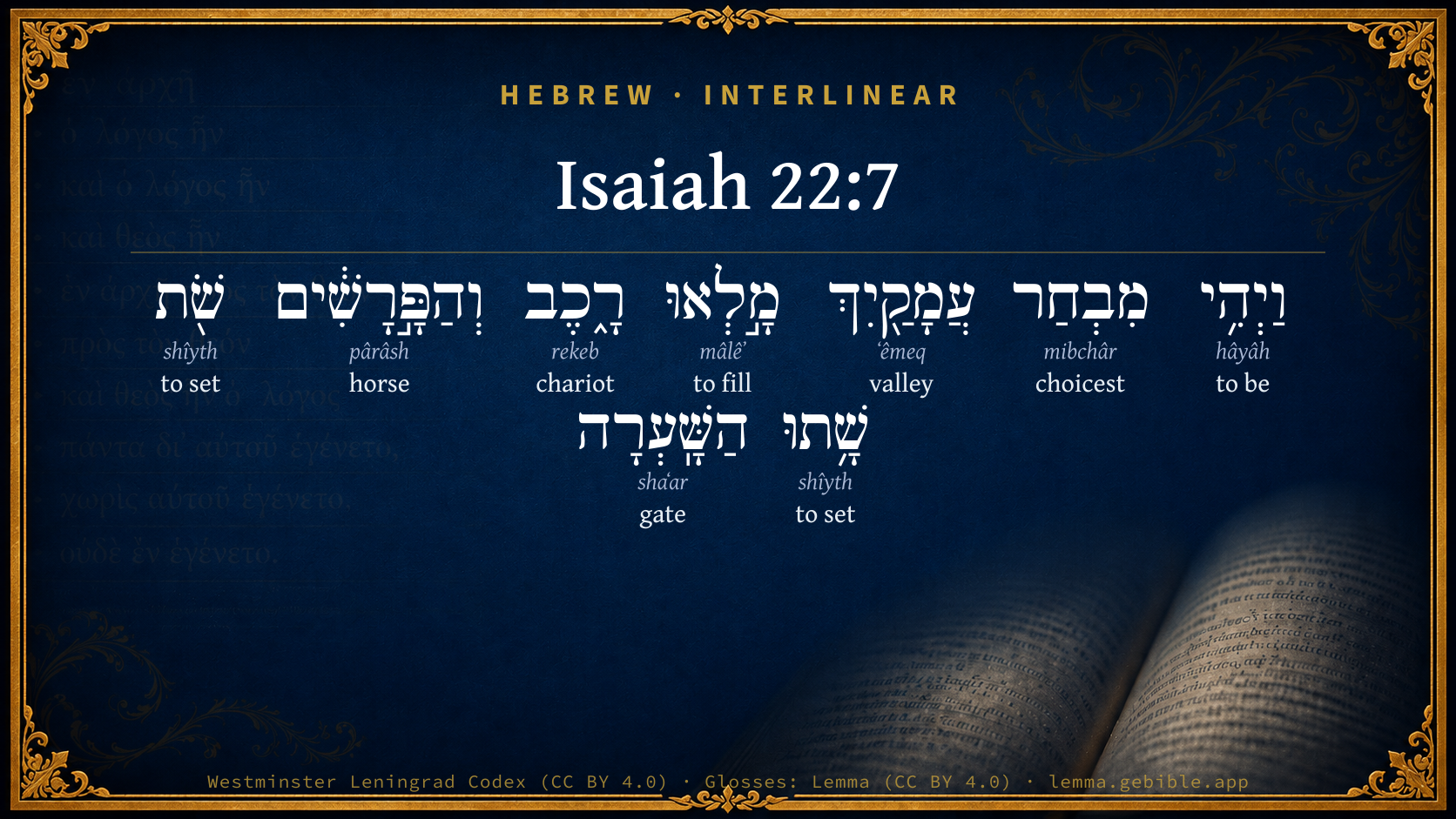
Hebrew (Westminster Leningrad Codex) Isaiah 22:7 appears in the Hebrew Old Testament. The text above is from the Westminster Leningrad Codex. Each word links to its Strong’s number, a concise gloss, and parsing drawn from the Open Scriptures Hebrew Bible morphology. Click any word for its full Brown-Driver-Briggs (BDB) entry.
Download image
Cite this verse

Isaiah 22:7 (World English Bible). Public Domain. Lemma interlinear Bible study tool, https://lemma.gebible.app/v/isaiah/22/7.

Show BibTeX & RIS
BibTeX
RIS
English Translation
It happened that your choicest valleys were full of chariots, and the horsemen set themselves in array at the gate.
World English Bible · Public Domain
Download a study sheet

One document with this verse’s original text, its word-by-word gloss line, the meaning frame, cross-references with their text, attributed commentary, and full source and license credits — printable, and it pastes into notes with its structure intact.

This verse Autodidact and up

Study sheet (.html) Plain text (.txt)

A passage Seminary Student

Up to 50 verses in one chapter. A passage sheet keeps up to 6 commentary sources and 12 cross-references per verse, in the order this page ranks them, and says so on the sheet whenever that leaves anything out. Ask for a single verse and you get the Autodidact verse sheet above.

Everything on this page stays free to read, with no account — the sheet is a download of what is already on screen, not access to it.

Want to remove ads? Support Godless Engineer
Compare translations 3

The same verse in 3 English versions, stacked beneath the original-language interlinear above. Click any original word for its lexicon entry.

Each is an independent rendering of the whole verse — the interlinear is not word-aligned to these translations.

Highlighted words mark where these versions differ — a whole-verse word diff, not a word-by-word alignment.

  • World English Bible Public Domain
    It happened that your choicest valleys were full of chariots, and the horsemen set themselves in array at the gate.
  • King James Version Public Domain
    And it shall come to pass, that thy choicest valleys shall be full of chariots, and the horsemen shall set themselves in array at the gate.
  • unfoldingWord Literal Text CC BY-SA 4.0
    And it happened, the choicest of your valleys became full chariotry, and the horsemen, setting, set the gate.

unfoldingWord Literal Text — © unfoldingWord, licensed CC BY-SA 4.0. Word-aligned USFM3 via Door43 (git.door43.org/unfoldingWord/en_ult).

Versions to compare (up to 4)

3 of 4 selected

Show all 18 translations

Every available English version of this verse, each an independent rendering of the whole verse.

  • World English Bible Public Domain
    It happened that your choicest valleys were full of chariots, and the horsemen set themselves in array at the gate.
  • Berean Standard Bible Public Domain
    Your choicest valleys are full of chariots, and horsemen are posted at the gates.
  • Majority Standard Bible Public Domain
    Your choicest valleys are full of chariots, and horsemen are posted at the gates.
  • King James Version Public Domain
    And it shall come to pass, that thy choicest valleys shall be full of chariots, and the horsemen shall set themselves in array at the gate.
  • American Standard Version (1901) Public Domain
    And it came to pass, that thy choicest valleys were full of chariots, and the horsemen set themselves in array at the gate.
  • Revised Version (1885) Public Domain
    And it came to pass, that thy choicest valleys were full of chariots, and the horsemen set themselves in array at the gate.
  • Geneva Bible (1599) Public Domain
    And thy chiefe valleis were full of charets, and the horsemen set themselues in aray against the gate.
  • Douay-Rheims (1899) Public Domain
    And thy choice valleys shall be full of chariots, and the horseman shall place themselves in the gate.
  • Young's Literal Translation Public Domain
    And it cometh to pass, The choice of thy valleys have been full of chariots, And the horsemen place themselves diligently at the gate.
  • Literal Standard Version CC BY-SA 4.0
    And it comes to pass, || The choice of your valleys have been full of chariots, || And the horsemen diligently place themselves at the gate.
  • Unlocked Literal Bible CC BY-SA 4.0
    It will come about that your choicest valleys will be full of chariots, and the horsemen will take their positions at the gate.
  • unfoldingWord Literal Text CC BY-SA 4.0
    And it happened, the choicest of your valleys became full chariotry, and the horsemen, setting, set the gate.
  • Darby Bible Public Domain
    And it shall come to pass [that] thy choicest valleys shall be full of chariots, and the horsemen shall set themselves in array at the gate.
  • World Messianic Bible Public Domain
    Your choicest valleys were full of chariots, and the horsemen set themselves in array at the gate.
  • Webster's Bible Public Domain
    And it shall come to pass, that thy choicest valleys shall be full of chariots, and the horsemen shall set themselves in array at the gate.
  • Free Bible Version CC BY-SA 4.0
    Your most productive valleys are now full of enemy chariots; and their cavalry are at your gates!
  • Bible in Basic English Public Domain
    And your most fertile valleys were full of war-carriages, and the horsemen took up their positions in front of the town.
  • JPS Tanakh (1917) Public Domain
    And it came to pass, when thy choicest valleys were full of chariots, and the horsemen set themselves in array at the gate,

Literal Standard Version (2020), Covenant Press — licensed CC BY-SA 4.0. Text via the HelloAO Bible API (eBible.org). Unlocked Literal Bible (unfoldingWord) — licensed CC BY-SA 4.0. Text via the HelloAO Bible API (eBible.org). unfoldingWord Literal Text — © unfoldingWord, licensed CC BY-SA 4.0. Word-aligned USFM3 via Door43 (git.door43.org/unfoldingWord/en_ult). Free Bible Version, Dr. Jonathan Gallagher — licensed CC BY-SA 4.0. Text via the HelloAO Bible API (eBible.org).

Word by word

More ways to search: Search by grammar → Find every occurrence → Compare this word →

Practice this passage: Drill this verse → Learn its vocabulary →

About this verse

These counts appear in no published source. They are computed here, from the morphology-tagged text and Lemma’s own curated glosses. What Lemma adds →

9
words
8
distinct lemmas
Prophets
section

Notable vocabulary

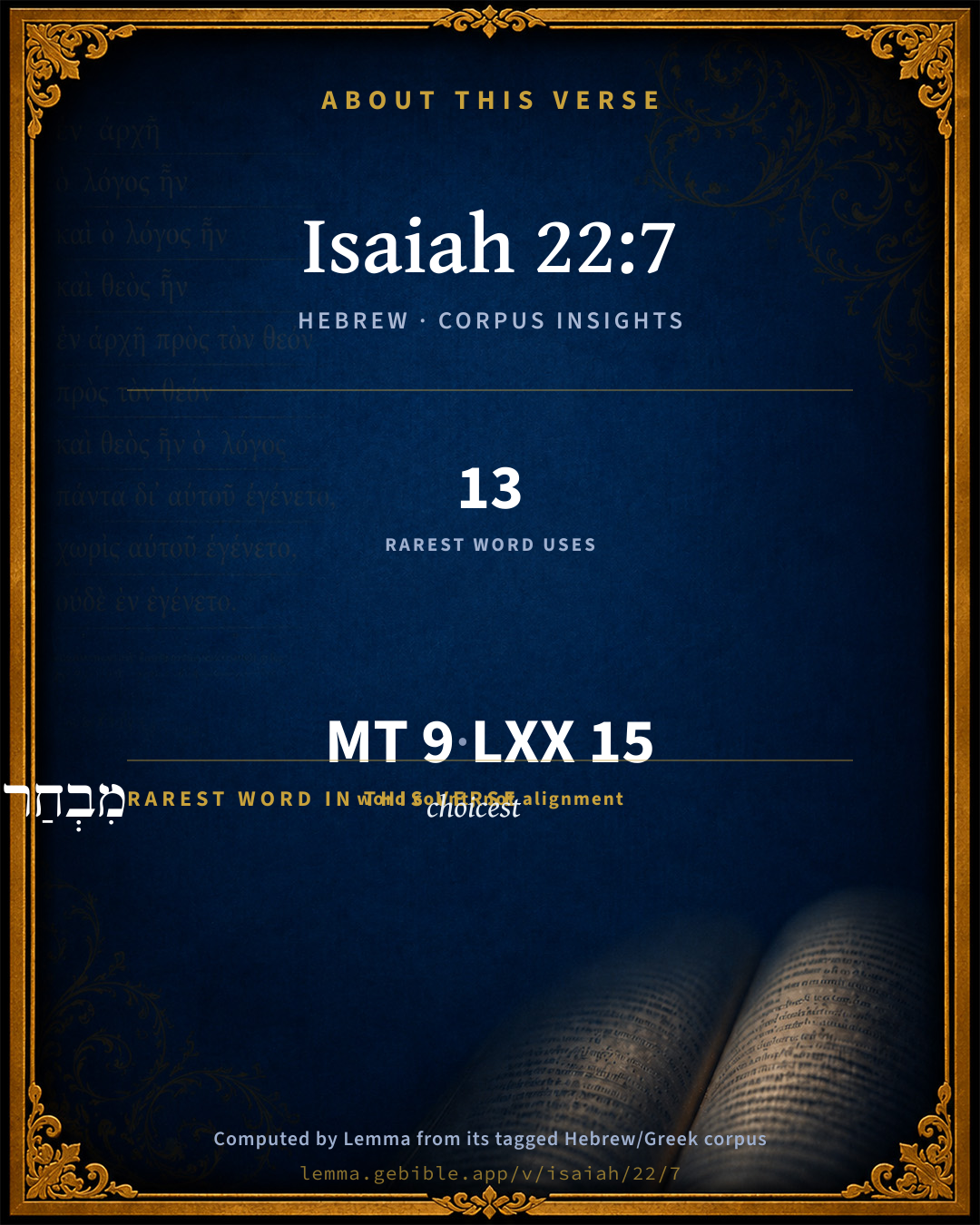
The rarest word here is מִבְחַר choicest H4005 — appearing just 13 times in the whole Hebrew Bible.

Shared distinctive vocabulary

מִבְחַר choicest H4005 occurs in 13 verses of the Hebrew Bible. Also found in:

Grammatical profile

  • 4 verbs
  • 5 nouns

Verb forms

  • וַיְהִ֥י Qal · Sequential Imperfect
  • מָ֣לְאוּ Qal · Perfect
  • שֹׁ֖ת Qal · Infinitive Absolute
  • שָׁ֥תוּ Qal · Perfect

Repetition

A word recurs within this verse — often emphatic in Hebrew:

  • שֹׁ֖ת to set H7896 ×2

Hebrew & Septuagint length

In English translation the verse runs 20 words from the Hebrew and 20 from the Septuagint (LXX English) — the same length.

A rough comparison of the two English renderings, which tokenize alike — not a word-level alignment.

Word counts can differ between the Hebrew and the Greek without any difference in meaning — e.g. the Hebrew direct-object marker אֵת has no separate Greek word, and Greek often adds the article ὁ.

In the original languages it is 9 Hebrew tokens and 15 Greek tokens — but the two are counted differently (Hebrew bundles its prefixes and suffixes into one token; the Greek is in lemma form), so that isn’t a like-for-like length.

Cross-references

4

Topical passages linked to Isaiah 22:7 in the Treasury of Scripture Knowledge — connected by theme and wording, ordered by reader-vote popularity; previews shown in the World English Bible.

  • Isaiah 8:7–8 now therefore, behold, the Lord brings up on them the waters of the River, strong and many, [even] the king of Assyria and all his glory: and it shall come up over all its channels, and go over all its banks;
  • Isaiah 10:28–32 He is come to Aiath, he is passed through Migron; at Michmash he lays up his baggage;
  • Jeremiah 39:1–3 It happened when Jerusalem was taken, (in the ninth year of Zedekiah king of Judah, in the tenth month, came Nebuchadrezzar king of Babylon and all his army against Jerusalem, and besieged it;
  • Isaiah 37:34 By the way that he came, by the same shall he return, and he shall not come to this city, says Yahweh.

Cross-references courtesy of OpenBible.info (CC BY 4.0).

Hebrew and Greek witnesses Masoretic Hebrew ↔ Greek Septuagint

The same verse in the two great witnesses to the Old Testament, shown verse-for-verse.

These are two independent witnesses, not word-aligned to each other, and the Septuagint is shown in lemma (dictionary) form.

Hebrew Isaiah 22:7 Masoretic · Westminster Leningrad Codex

וַיְהִ֥י מִבְחַר עֲמָקַ֖יִךְ מָ֣לְאוּ רָ֑כֶב וְהַפָּ֣רָשִׁ֔ים שֹׁ֖ת שָׁ֥תוּ הַשָּֽׁעְרָה

It happened that your choicest valleys were full of chariots, and the horsemen set themselves in array at the gate.

World English Bible · Public Domain

Greek LXX Isaiah 22:7 Septuagint · lemma form

καί εἰμί ὁ ἐκλεκτός φάραγξ σύ πίμπλημι ἅρμα ὁ δέ ἱππεύς ἐνφράσσω ὁ πύλη σύ

And it shall be that your choice valleys shall be filled with chariots, and horsemen shall block up your gates.

LXX2012 (modern English Septuagint) · Public Domain

Hebrew: Westminster Leningrad Codex (CC BY 4.0). Greek: Septuagint (public domain); English from LXX2012 (modern English Septuagint) (Public Domain). How the Septuagint differs from the Hebrew →

Targum (Aramaic paraphrase)

1

The Targum is the ancient Jewish Aramaic paraphrase of the Hebrew Scriptures — an interpretive translation, not the Hebrew text itself. Onkelos (literal) and Pseudo-Jonathan (expansive) render the Torah, and Jonathan the Prophets. Coverage is partial: where no permissively-licensed English translation exists for a verse, only the Aramaic is shown. This is verse-level text, not a word-by-word alignment to the Hebrew.

  1. Targum Jonathan Prophets (Joshua–Malachi)
    וַהֲוָה שְׁפַר מִשְׁרָךְ אִתְמְלִיאוּ רְתִיכִין וּפָרָשִׁין מְמַנָן עַל תַּרְעִין:

    And it shall come to pass that the most beautiful of thy valleys shall be filled with chariots; and the horsemen shall be set against the gates.

    Targum Jonathan — Aramaic: “Mikraot Gedolot” (public domain). English: “Sefaria Community Translation” (CC0 1.0 (public-domain dedication)); “London "Chaldee Paraphrase," 1871” (public domain). Text via Sefaria.

Commentary

Notes on Isaiah 22:7 from classic Christian and Jewish commentators (each source and its license shown beneath its notes). The classic Christian expositions comment on the surrounding passage and are grouped to its opening verse, so a note may address several verses; the Jewish commentaries on the Tanakh (Rashi and others) are per-verse, so they appear only where the commentator wrote on this verse.

Lemma curates 59 commentaries, every one of them public domain or Creative Commons licensed, each selected and text-cleaned for this edition rather than reprinted as found. About our sources →

Trapp's Complete Commentary

John Trapp

Isa 22:7 And it shall come to pass, [that] thy choicest valleys shall be full of chariots, and the horsemen shall set themselves in array at the gate.

Ver. 7. Thy choicest valleys shall be full of chariots.] Iron chariots armed with scythes. These were, saith Vegetius, first a terror, and then a scorn.

In array at the gate,] sc., To force entrance into the city. {as Jdg 9:44; Jdg 9:52}

John Trapp, A Commentary or Exposition upon All the Books of the Old and New Testament (1647–1656) — public domain. Text from a community e-Sword module.

Tyndale Open Study Notes

Tyndale Open Resources

22:7 The Kidron and Hinnom valleys were located to the east and south of Jerusalem.

Tyndale Open Study Notes — © Tyndale Open Resources, licensed CC BY-SA 4.0. Text via the HelloAO Bible API.

Jamieson, Fausset & Brown

Robert Jamieson, A. R. Fausset & David Brown

valleys--east, north, and south of Jerusalem: Hinnom on the south side was the richest valley.

in array at the gate--Rab-shakeh stood at the upper pool close to the city (Isa 36:11-13).

Jamieson, Fausset & Brown — Commentary Critical and Explanatory on the Whole Bible (1871) — public domain (CC PDM 1.0). Text via the HelloAO Bible API.

Ellicott's Commentary for English Readers

(7) That thy choicest valleys . . .—These were the valleys of Gibeon, Rephaim, Hinnom, and Jehoshaphat, which encircled Jerusalem on the west and south. They are painted as filled with the chariots and cavalry of the Assyrian army, ready to make their attack on the very gate of the city, the “great gate” named in Sennacherib’s inscription (Records of the Past, i. 39).

A Bible Commentary for English Readers, edited by Charles John Ellicott (1878–1897) — public domain. Text from a community e-Sword module.

The Cambridge Bible for Schools and Colleges

gen. ed. J. J. S. Perowne

7. And it shall come to pass] strictly, And it came to pass, in the scene beheld by the prophet.

set themselves … gate] take up their station towards the gate.

The Cambridge Bible for Schools and Colleges (gen. ed. J. J. S. Perowne; Cambridge University Press, 1878–1918) — public domain. Text from a community e-Sword module.

John Gill's Exposition

And it shall come to pass, that thy choicest valleys,.... The valleys that were near Jerusalem, that used to be covered with the choicest corn or vines, or with grass and flocks of sheep, and used to be exceeding delightful and pleasant:

shall be full of chariots; where they can be more easily driven than on mountains; these were chariots not for pleasure, but for war; chariots full of soldiers, to fight against and besiege Jerusalem:

and the horsemen shall set themselves in array at the gate: to take them that come out of the city, and to force their way into it; as well as to protect and defend the foot, while they made the assault, and scaled the walls, and to be ready when the gates were opened to them.

John Gill's Exposition of the Whole Bible (1746–1763) — public domain (CC PDM 1.0). Text via the HelloAO Bible API.

Albert Barnes' Notes on the Bible

Thy choicest valleys - Hebrew, ‘The choice of thy galleys;’ meaning the most fertile and most valued lands in the vicinity of the city. The rich and fertile vales around Jerusalem would be occupied by the armies of the Assyrian monarch. What occurs in this verse and the following verses to Isa 22:14, is a prophetic description of what is presented historically in Isa. 36, and 2 Chr. 32. The coincidence is so exact, that it leaves no room to doubt that the invasion here described was that which took place under Sennacherib.

Set themselves in array - Hebrew, ‘Placing shall place themselves;’ that is, they shall be drawn up for battle; they shall besiege the city, and guard it from all ingress or egress. Rabshakeh, sent by Sennacherib to besiege the city, took his station at the upper pool, and was so near the city that he could converse with the people on the walls Isa 36:11-13.

Albert Barnes' Notes on the Bible (1834–1885) — public domain. Text from a community e-Sword/MySword module.

Matthew Poole's English Annotations

Thy choicest valleys shall be full of chariots: valleys were the most proper places for the use of chariots: see Jos 17:16.

The horsemen shall set themselves in array at the gate, to assist and defend the footmen whilst they made their assault, and withal to prevent and take those who endeavoured to escape.

Matthew Poole's English Annotations on the Holy Bible (1683–1685) — public domain. Text from a community e-Sword/MySword module.

The Pulpit Commentary

And it shall come to pass, etc. This verse and the next are closely connected, and introduce the new subject of the preparations which the Jews made for their defense. Translate, And it came to pass, when thy choicest valleys were full of chariots (or, troops), and the horsemen had set themselves in array toward the gate, that then did he draw off the cavorting of Judah, etc.

The Pulpit Commentary (1880–1919), ed. H.D.M. Spence-Jones & Joseph S. Exell — public domain. Text from a community e-Sword module.

John Wesley's Explanatory Notes

Valleys - Valleys were the most proper places for the use of chariots. Gate - To assist the footmen while they made their assault, and to prevent those who endeavoured to escape.

John Wesley, Explanatory Notes Upon the Whole Bible (1754–1765) — public domain. Text via the GEBible commentary corpus.

J. A. Alexander on Isaiah

Joseph Addison Alexander

“And it came to pass (that) the choice of thy valleys (thy choicest valleys) were full of chariots, and the horsemen drew up (or took up a position) towards the gate.” The Prophet sees something which he did not see before. He had seen the chariots and horsemen coming; but now he sees the valleys around full of them. The future form adopted by some versions is entirely unauthorized. Whatever be the real date of the events described, the Prophet evidently meant to speak of them as past or present, and we have neither right nor reason to depart from his chosen form of expression. The address is to Jerusalem. The valleys are mentioned as the only places where the cavalry or chariots could be useful or could act at all. As the only level approach to Jerusalem is on the north, that quarter may be specially intended, and the gate may be a gate on that side of the city.

Joseph Addison Alexander, The Prophecies of Isaiah (1846–1847; New York: Scribner, 1870–1878) — public domain. Text from a community e-Sword module.

Rashi

Rabbi Shlomo Yitzchaki (Rashi)

laid [siege] to the gate (Lit., laid to the gate.) They laid siege to the gates. There is a similar expression in Kings (II 20:12) in the war with Ben Hadad, “Lay on!” And they laid siege to the city.

Rashi on the Tanakh — English translations: “The Judaica Press complete Tanach with Rashi, translated by A. J. Rosenberg” (CC BY 4.0); “Pentateuch with Rashi's commentary by M. Rosenbaum and A.M. Silbermann, 1929-1934” (public domain); “The Metsudah Tanach series, Lakewood, N.J” (CC BY 4.0); and “The Book of Joshua, Metsudah Publications, 1997” (CC BY 4.0). Text via Sefaria.

Ibn Ezra

Rabbi Abraham ibn Ezra

Thy valleys. The second person refers to Jerusalem. שת שתו.

They prepare, the forts, the trenches, and all the instruments of war.

Ibn Ezra on the Tanakh — English translations: “Sefaria Community Translation” (CC0 1.0 (public-domain dedication)); “Yalkut, Sifsei Chachomim Chumash, Metsudah Publications, 2009” (CC BY 4.0); and “Commentary of Ibn Ezra on Isaiah - trans. by M. Friedlander, 1873” (public domain). Text via Sefaria.

Lesson kit

Teaching starters — assembled from the data on this page, not authored interpretation. Every prompt links to the verse data it draws on. Edit before teaching.

Isaiah, in the Prophets, opens this verse with 9 words (8 distinct Hebrew lemmas). Its most distinctive word is mibchâr (“choicest”). A historical commentator’s framing appears above. Read the whole chapter for the surrounding context.

Discussion questions

  1. The word mibchâr carries the sense “choicest.” How does it shape the verse?
  2. Genesis 23:6 shares the word «choicest» with this verse. How do the two illuminate each other?
  3. “to set” occurs 2× in this one verse. What is the effect of the repetition?
  4. The translations on this page render this verse differently — a whole-verse word diff, not a word-by-word alignment. What might account for the different wordings?
  5. The verb «וַיְהִ֥י» is Qal Sequential Imperfect. How does its form color the action?
  6. Reading how Trapp's Complete Commentary and Tyndale Open Study Notes read this verse, where do the two commentators agree and where do they part?

Things to notice

Reading settings

Reading text

Shown beneath each verse's original-language words.

Old Testament
Old Testament edition

Read the OT as the Masoretic Hebrew (MT) or the Greek Septuagint (LXX).

English shown for the Greek Septuagint (in the Hebrew ↔ Greek comparison).

Comparing translations? Open the Compare panel on any verse page to stack up to four side by side.