
Ezekiel 40:3

Hebrew (Westminster Leningrad Codex) Ezekiel 40:3 appears in the Hebrew Old Testament. The text above is from the Westminster Leningrad Codex. Each word links to its Strong’s number, a concise gloss, and parsing drawn from the Open Scriptures Hebrew Bible morphology. Click any word for its full Brown-Driver-Briggs (BDB) entry.
Download image
Cite this verse

Ezekiel 40:3 (World English Bible). Public Domain. Lemma interlinear Bible study tool, https://lemma.gebible.app/v/ezekiel/40/3.

Show BibTeX & RIS
BibTeX
RIS
English Translation
He brought me there; and, behold, there was a man, whose appearance was like the appearance of brass, with a line of flax in his hand, and a measuring reed; and he stood in the gate.
World English Bible · Public Domain
Download a study sheet

One document with this verse’s original text, its word-by-word gloss line, the meaning frame, cross-references with their text, attributed commentary, and full source and license credits — printable, and it pastes into notes with its structure intact.

This verse Autodidact and up

Study sheet (.html) Plain text (.txt)

A passage Seminary Student

Up to 50 verses in one chapter. A passage sheet keeps up to 6 commentary sources and 12 cross-references per verse, in the order this page ranks them, and says so on the sheet whenever that leaves anything out. Ask for a single verse and you get the Autodidact verse sheet above.

Everything on this page stays free to read, with no account — the sheet is a download of what is already on screen, not access to it.

Want to remove ads? Support Godless Engineer
Compare translations 3

The same verse in 3 English versions, stacked beneath the original-language interlinear above. Click any original word for its lexicon entry.

Each is an independent rendering of the whole verse — the interlinear is not word-aligned to these translations.

Highlighted words mark where these versions differ — a whole-verse word diff, not a word-by-word alignment.

  • World English Bible Public Domain
    He brought me there; and, behold, there was a man, whose appearance was like the appearance of brass, with a line of flax in his hand, and a measuring reed; and he stood in the gate.
  • King James Version Public Domain
    And he brought me thither, and, behold, there was a man, whose appearance was like the appearance of brass, with a line of flax in his hand, and a measuring reed; and he stood in the gate.
  • unfoldingWord Literal Text CC BY-SA 4.0
    Then he brought me there. Behold, a man! His appearance was like the appearance of bronze. A linen cord and a measuring stick were in his hand, and he stood in the city gate.

unfoldingWord Literal Text — © unfoldingWord, licensed CC BY-SA 4.0. Word-aligned USFM3 via Door43 (git.door43.org/unfoldingWord/en_ult).

Versions to compare (up to 4)

3 of 4 selected

Show all 18 translations

Every available English version of this verse, each an independent rendering of the whole verse.

  • World English Bible Public Domain
    He brought me there; and, behold, there was a man, whose appearance was like the appearance of brass, with a line of flax in his hand, and a measuring reed; and he stood in the gate.
  • Berean Standard Bible Public Domain
    So He took me there, and I saw a man whose appearance was like bronze. He was standing in the gateway with a linen cord and a measuring rod in his hand.
  • Majority Standard Bible Public Domain
    So He took me there, and I saw a man whose appearance was like bronze. He was standing in the gateway with a linen cord and a measuring rod in his hand.
  • King James Version Public Domain
    And he brought me thither, and, behold, there was a man, whose appearance was like the appearance of brass, with a line of flax in his hand, and a measuring reed; and he stood in the gate.
  • American Standard Version (1901) Public Domain
    And he brought me thither; and, behold, there was a man, whose appearance was like the appearance of brass, with a line of flax in his hand, and a measuring reed; and he stood in the gate.
  • Revised Version (1885) Public Domain
    And he brought me thither, and behold, there was a man, whose appearance was like the appearance of brass, with a line of flax in his hand, and a measuring reed; and he stood in the gate.
  • Geneva Bible (1599) Public Domain
    And he brought me thither, and beholde, there was a man, whose similitude was to looke to, like brasse, with a linnen thread in his hand, and a reede to measure with: and he stoode at the gate.
  • Douay-Rheims (1899) Public Domain
    And he brought me in thither, and behold a man, whose appearance was like the appearance of brass, with a line of flax in his hand, and a measuring reed in his hand, and he stood in the gate.
  • Young's Literal Translation Public Domain
    And He bringeth me in thither, and lo, a man, his appearance as the appearance of brass, and a thread of flax in his hand, and a measuring-reed, and he is standing at the gate,
  • Literal Standard Version CC BY-SA 4.0
    And He brings me in there, and behold, a man, his appearance as the appearance of bronze, and a thread of flax in his hand, and a measuring-reed, and he is standing at the gate,
  • Unlocked Literal Bible CC BY-SA 4.0
    Then he brought me there. Behold, a man! His appearance was like the appearance of bronze. A linen cord and a measuring stick were in his hand, and he stood in the city gate.
  • unfoldingWord Literal Text CC BY-SA 4.0
    Then he brought me there. Behold, a man! His appearance was like the appearance of bronze. A linen cord and a measuring stick were in his hand, and he stood in the city gate.
  • Darby Bible Public Domain
    And he brought me thither, and behold, there was a man whose appearance was like the appearance of brass, with a flax-cord in his hand, and a measuring-reed; and he stood in the gate.
  • World Messianic Bible Public Domain
    He brought me there; and, behold, there was a man whose appearance was like the appearance of bronze, with a line of flax in his hand and a measuring reed; and he stood in the gate.
  • Webster's Bible Public Domain
    And he brought me thither, and behold, there was a man, whose appearance was like the appearance of brass, with a line of flax in his hand, and a measuring reed; and he stood in the gate.
  • Free Bible Version CC BY-SA 4.0
    When he took me there I saw a man who looked like shining bronze. He was holding a linen cord and a measuring rod as he stood in the entrance way.
  • Bible in Basic English Public Domain
    He took me there, and I saw a man, looking like brass, with a linen cord in his hand and a measuring rod: and he was stationed in the doorway.
  • JPS Tanakh (1917) Public Domain
    And He brought me thither, and, behold, there was a man, whose appearance was like the appearance of brass, with a line of flax in his hand, and a measuring reed; and he stood in the gate.

Literal Standard Version (2020), Covenant Press — licensed CC BY-SA 4.0. Text via the HelloAO Bible API (eBible.org). Unlocked Literal Bible (unfoldingWord) — licensed CC BY-SA 4.0. Text via the HelloAO Bible API (eBible.org). unfoldingWord Literal Text — © unfoldingWord, licensed CC BY-SA 4.0. Word-aligned USFM3 via Door43 (git.door43.org/unfoldingWord/en_ult). Free Bible Version, Dr. Jonathan Gallagher — licensed CC BY-SA 4.0. Text via the HelloAO Bible API (eBible.org).

Word by word

More ways to search: Search by grammar → Find every occurrence → Compare this word →

Practice this passage: Drill this verse → Learn its vocabulary →

וּפְתִיל
pâthîyl
H6616
“and · cord of”
Conjunction + Noun, Common, Masculine, Singular, Construct
Part of Speech
Conjunction + Noun
Type
Common
Gender
Masculine
Number
Singular
State
Construct
Full BDB Definition

Origin: from H6617

TWOT: 1857a

cord, thread (twisted)
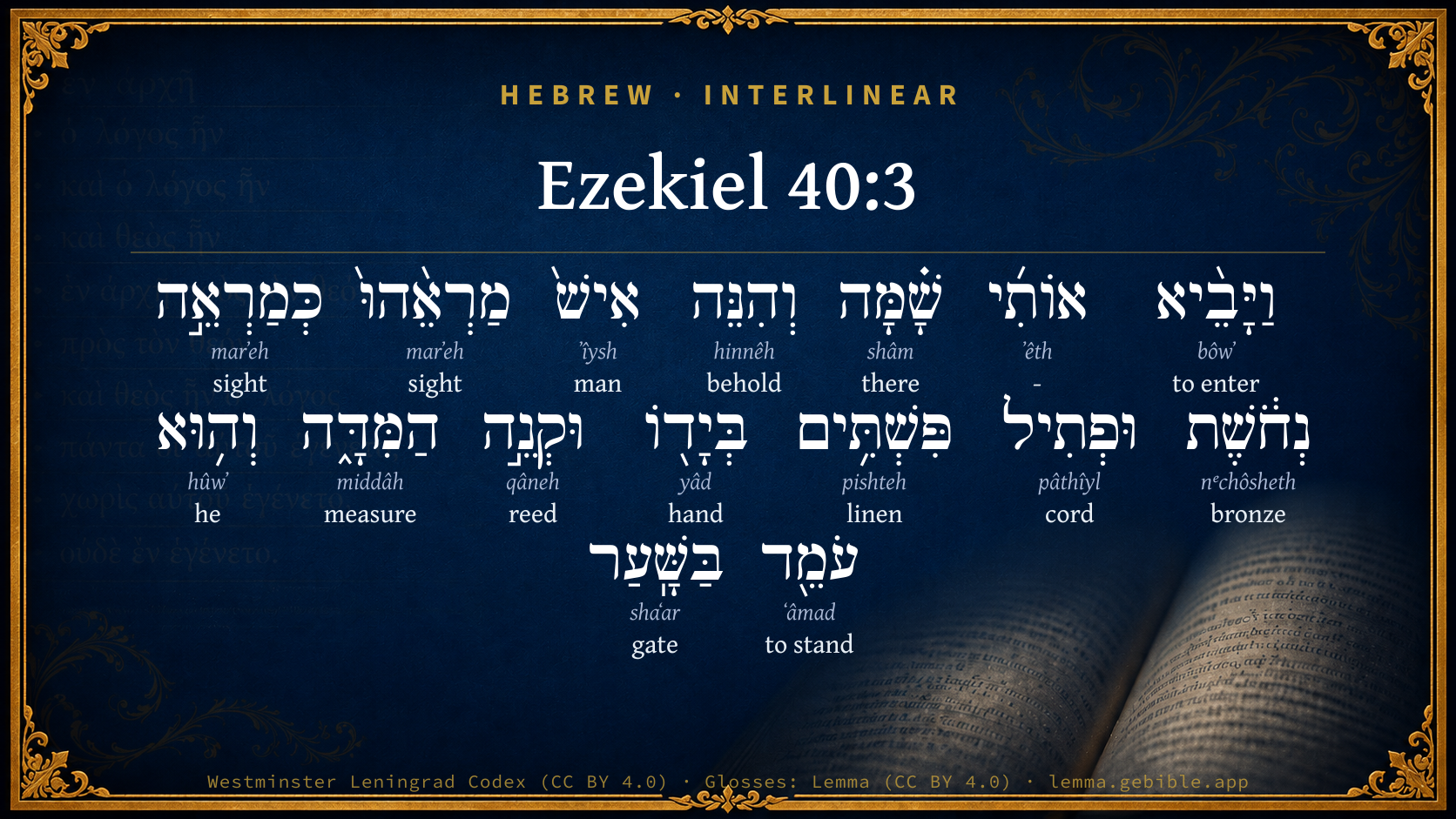
  1. וַיָּבֵ֨יא bôwʼ H935 “and · to enter” Conjunction + Verb, Hiphil, Sequential Imperfect, 3rd Person, Masculine, Singular
  2. אוֹתִ֜י ʼêth H853 “- · me” Particle, Direct Object + Suffix, Personal, 1st Person, Common, Singular
  3. שָׁ֗מָּה shâm H8033 “there · toward” Adverb + Suffix, Demonstrative
  4. וְהִנֵּה hinnêh H2009 “and · behold” Conjunction + Particle, Demonstrative
  5. אִישׁ֙ ʼîysh H376 “man” Noun, Common, Masculine, Singular, Absolute
  6. מַרְאֵ֨הוּ֙ marʼeh H4758 “sight · his” Noun, Common, Masculine, Singular, Construct + Suffix, Personal, 3rd Person, Masculine, Singular
  7. כְּמַרְאֵ֣ה marʼeh H4758 “like/as · sight of” Preposition + Noun, Common, Masculine, Singular, Construct
  8. נְחֹ֔שֶׁת nᵉchôsheth H5178 “bronze” Noun, Common, Feminine, Singular, Absolute
  9. פִּשְׁתִּ֥ים pishteh H6593 “linen” Noun, Common, Masculine, Plural, Absolute
  10. בְּיָד֖וֹ yâd H3027 “in/at · hand · his” Preposition + Noun, Common, Both, Singular, Construct + Suffix, Personal, 3rd Person, Masculine, Singular
  11. וּקְנֵ֣ה qâneh H7070 “and · reed of” Conjunction + Noun, Common, Masculine, Singular, Construct
  12. הַמִּדָּ֑ה middâh H4060 “the · measure” Particle, Definite Article + Noun, Common, Feminine, Singular, Absolute
  13. וְה֥וּא hûwʼ H1931 “and · he” Conjunction + Pronoun, Personal, 3rd Person, Masculine, Singular
  14. עֹמֵ֖ד ʻâmad H5975 “standing” Verb, Qal, Participle Active, Masculine, Singular, Absolute
  15. בַּשָּֽׁעַר shaʻar H8179 “in/at the · gate” Preposition, Determined + Noun, Common, Masculine, Singular, Absolute

About this verse

These counts appear in no published source. They are computed here, from the morphology-tagged text and Lemma’s own curated glosses. What Lemma adds →

16
words
15
distinct lemmas
Prophets
section

Notable vocabulary

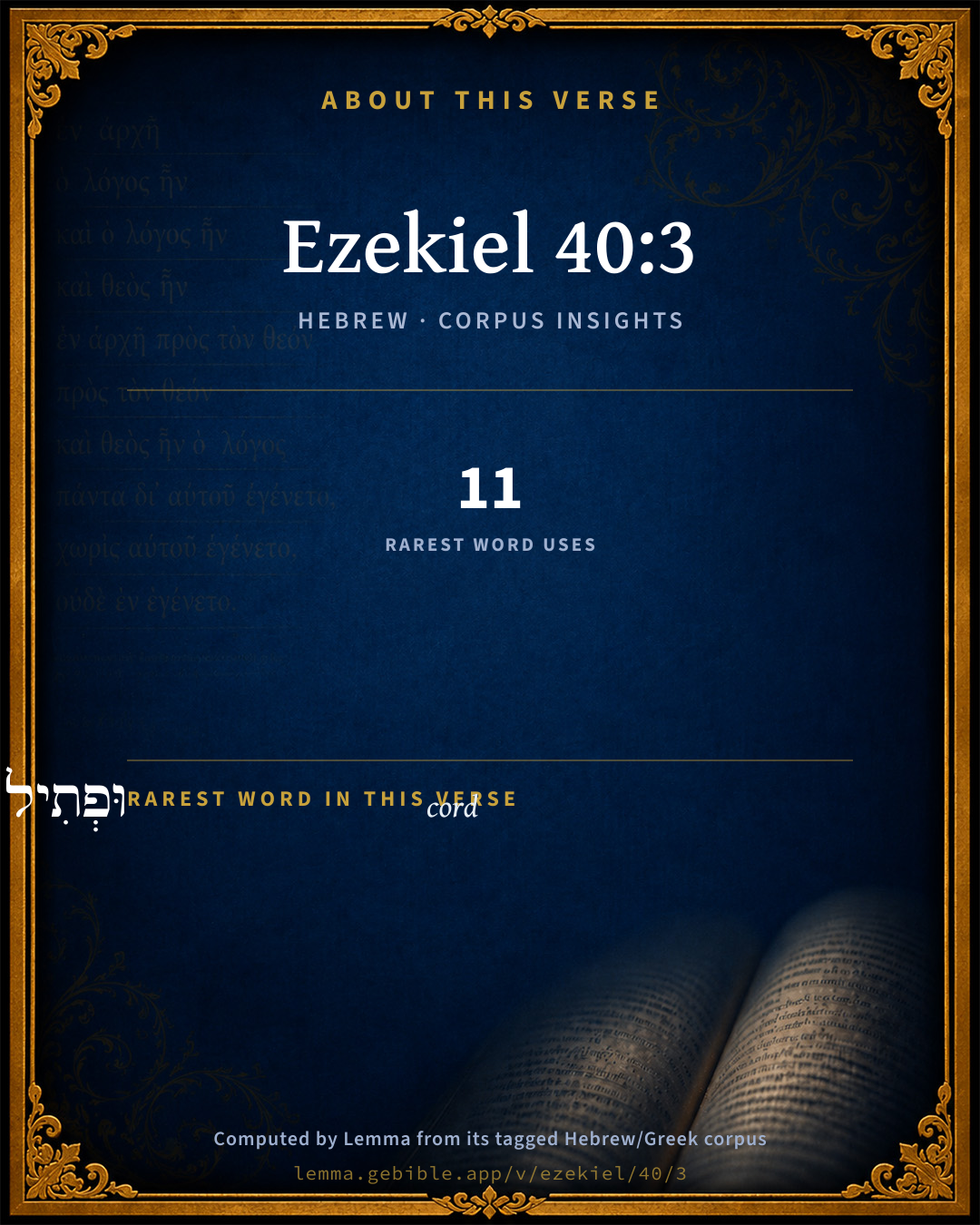
The rarest word here is וּפְתִיל cord H6616 — appearing just 11 times in the whole Hebrew Bible.

Shared distinctive vocabulary

וּפְתִיל cord H6616 occurs in 11 verses of the Hebrew Bible. Also found in:

Grammatical profile

  • 2 verbs
  • 10 nouns
  • 1 pronoun
  • 1 adverb
  • 2 particles

Verb forms

  • וַיָּבֵ֨יא Hiphil · Sequential Imperfect
  • עֹמֵ֖ד Qal · Participle Active

Repetition

A word recurs within this verse — often emphatic in Hebrew:

  • מַרְאֵ֨הוּ֙ sight H4758 ×2

Hebrew & Septuagint length

In English translation the verse runs 36 words from the Hebrew and 42 from the Septuagint (LXX English) — closely comparable.

A rough comparison of the two English renderings, which tokenize alike — not a word-level alignment.

Word counts can differ between the Hebrew and the Greek without any difference in meaning — e.g. the Hebrew direct-object marker אֵת has no separate Greek word, and Greek often adds the article ὁ.

Cross-references

10

Topical passages linked to Ezekiel 40:3 in the Treasury of Scripture Knowledge — connected by theme and wording, ordered by reader-vote popularity; previews shown in the World English Bible.

  • Ezekiel 47:3 When the man went forth eastward with the line in his hand, he measured one thousand cubits, and he caused me to pass through the waters, waters that were to the ankles.
  • Revelation 11:1 A reed like a rod was given to me. Someone said, "Rise, and measure God's temple, and the altar, and those who worship in it.
  • Ezekiel 1:7 Their feet were straight feet; and the sole of their feet was like the sole of a calf's foot; and they sparkled like burnished brass.
  • Daniel 10:5–6 I lifted up my eyes, and looked, and, behold, a man clothed in linen, whose loins were girded with pure gold of Uphaz:
  • Revelation 1:15 His feet were like burnished brass, as if it had been refined in a furnace. His voice was like the voice of many waters.
  • Revelation 21:15 He who spoke with me had for a measure, a golden reed, to measure the city, its gates, and its walls.
  • Zechariah 2:1–2 I lifted up my eyes, and saw, and, behold, a man with a measuring line in his hand.
  • Ezekiel 1:27 I saw as it were glowing metal, as the appearance of fire within it round about, from the appearance of his loins and upward; and from the appearance of his loins and downward I saw as it were the appearance of fire, and there was brightness round about him.
  • Isaiah 28:17 I will make justice the line, and righteousness the plummet; and the hail shall sweep away the refuge of lies, and the waters shall overflow the hiding-place.
  • Isaiah 8:20 To the law and to the testimony! if they don't speak according to this word, surely there is no morning for them.

Cross-references courtesy of OpenBible.info (CC BY 4.0).

Hebrew and Greek witnesses Masoretic Hebrew ↔ Greek Septuagint

The same verse in the two great witnesses to the Old Testament, shown verse-for-verse.

These are two independent witnesses, not word-aligned to each other, and the Septuagint is shown in lemma (dictionary) form.

Hebrew Ezekiel 40:3 Masoretic · Westminster Leningrad Codex

וַיָּבֵ֨יא אוֹתִ֜י שָׁ֗מָּה וְהִנֵּה אִישׁ֙ מַרְאֵ֨הוּ֙ כְּמַרְאֵ֣ה נְחֹ֔שֶׁת וּפְתִיל פִּשְׁתִּ֥ים בְּיָד֖וֹ וּקְנֵ֣ה הַמִּדָּ֑ה וְה֥וּא עֹמֵ֖ד בַּשָּֽׁעַר

He brought me there; and, behold, there was a man, whose appearance was like the appearance of brass, with a line of flax in his hand, and a measuring reed; and he stood in the gate.

World English Bible · Public Domain

Greek LXX Ezekiel 40:3 Septuagint · lemma form

καί εἰςἄγω ἐγώ ἐκεῖ καί ἰδού ἀνήρ καί ὁ ὅρασις αὐτός εἰμί ὡσεί ὅρασις χαλκοῦς στίλβων καί ἐν ὁ χείρ αὐτός εἰμί σπαρτίον οἰκοδόμος καί κάλαμος μέτρον καί αὐτός ἵστημι ἐπί ὁ πύλη

And he brought me in there, and, behold, there was a man, and the appearance of him was as the appearance of shining brass, and in his hand was a builder's line, and a measuring reed; and he stood at the gate.

LXX2012 (modern English Septuagint) · Public Domain

On this verse, The Pulpit Commentary discusses the Septuagint’s reading. Read the note in Commentary ↓

Hebrew: Westminster Leningrad Codex (CC BY 4.0). Greek: Septuagint (public domain); English from LXX2012 (modern English Septuagint) (Public Domain). How the Septuagint differs from the Hebrew →

Targum (Aramaic paraphrase)

1

The Targum is the ancient Jewish Aramaic paraphrase of the Hebrew Scriptures — an interpretive translation, not the Hebrew text itself. Onkelos (literal) and Pseudo-Jonathan (expansive) render the Torah, and Jonathan the Prophets. Coverage is partial: where no permissively-licensed English translation exists for a verse, only the Aramaic is shown. This is verse-level text, not a word-by-word alignment to the Hebrew.

  1. Targum Jonathan Prophets (Joshua–Malachi)
    וְאָעֵיל יָתִי לְתַמָן וְהָא גַבְרָא חֶזְוֵיהּ כַּחֲזוּ נְחָשָׁא וְחוּט דְכִיתְנָא בִּידֵיהּ וּקְנֵי מְשַׁחְתָּא וְהָא קָאֵים בְּתַרְעָא:

    (no public-domain English translation for this verse)

    Targum Jonathan — Aramaic: “Mikraot Gedolot” (public domain). English: “Sefaria Community Translation” (CC0 1.0 (public-domain dedication)); “London "Chaldee Paraphrase," 1871” (public domain). Text via Sefaria.

Commentary

Notes on Ezekiel 40:3 from classic Christian and Jewish commentators (each source and its license shown beneath its notes). The classic Christian expositions comment on the surrounding passage and are grouped to its opening verse, so a note may address several verses; the Jewish commentaries on the Tanakh (Rashi and others) are per-verse, so they appear only where the commentator wrote on this verse.

Lemma curates 59 commentaries, every one of them public domain or Creative Commons licensed, each selected and text-cleaned for this edition rather than reprinted as found. About our sources →

Trapp's Complete Commentary

John Trapp

Eze 40:3 And he brought me thither, and, behold, [there was] a man, whose appearance [was] like the appearance of brass, with a line of flax in his hand, and a measuring reed; and he stood in the gate.

Ver. 3. And, behold, there was a man.] Christ the sovereign architect of his Church. {as Rev 11:1} This might well be brought in with an Ecce Behold. He appeared after another manner in that first dreadful vision. {Eze 1:1}

Whose appearance was like the appearance of brass.] Bright and durable; importing Christ’s purity and eternity.

With a line of flax in his hand.] Christ’s measuring line is the Holy Scripture and the preaching of the Word; so is also his measuring rod here said to be of reed, but in Rev 11:1 of gold. Both these are in Christ’s hand, to show that the power and efficacy of the Word read or preached is from him alone. {1Co 3:9-18 2Co 10:13-17}

John Trapp, A Commentary or Exposition upon All the Books of the Old and New Testament (1647–1656) — public domain. Text from a community e-Sword module.

Joseph Benson's Commentary

Eze 40:3-5. Behold, there was a man — The same no doubt that appeared to the prophet, Eze 1:20, (where see the note,) whose name is the Branch, and who builds the temple of the Lord, Zec 6:12-13; whose appearance was like the appearance of brass — Bright and sparkling, Rev 1:15. With a line of flax in his hand — The use of the line was to measure the land of Israel, and of the reed to take the dimensions of the buildings in and about the temple; as also to set out several portions of land belonging to the sanctuary and city, to the prince and people: see the margin. And he stood in the gate — Probably the north gate, being the first entrance the prophet may be supposed to have arrived at, as he came from Chaldea, which lay northward of Judea. Son of man, behold, &c., and hear — Take notice of what thou seest, so that thou mayest afterward tell it to thy people. And, behold, a wall on the outside — A wall went round the whole compass, or square, of the holy mountain, whereon the temple was situate, to separate the holy ground from that which was common: see Eze 42:20. And in the man’s hand a measuring-reed of six cubits long, &c. — Here is explained what sort of a cubit is meant in the following delineation of the temple, namely, one that consisted of six hand-breadths, or one hand-breadth over the cubit used in Chaldea, where he now lived. This is the measure of a Scripture cubit, generally agreed to be equivalent to eighteen inches, or a foot and a half of our measure. See Bishop Cumberland, Of Scripture Weights and Measures, p. 36, &c. According to Michaelis, the Hebrew measures are, 1. The finger’s-breadth: 2. Four fingers, or a hand-breadth: 3. The ell; the smaller of five hand-breadths, the larger of six: 4. The rod, of six ells. He also allows the rabbinical account, that a finger is equal to the length of six barley grains. So he measured the breadth of the building — That is, of the outward wall, which was three yards high, and three yards broad. This wall surrounded a part which corresponded to the court of the Gentiles, and served as a security against the precipices of the mount on which the temple stood.

Joseph Benson's Commentary on the Old and New Testaments (1811–1818) — public domain. Text from a community e-Sword module.

Tyndale Open Study Notes

Tyndale Open Resources

40:3 a man whose face shone like bronze: An angelic guide would host Ezekiel’s tour of the Temple. The bronze color is reminiscent of the heavenly creatures described in the opening vision (see 1:7). Unlike the guide for his previous visionary tour of the earthly Temple in chs 8–11, this guide was armed only with a linen measuring cord and a measuring rod, implements of construction rather than destruction. Measurement is a key theme in the chapters that follow, enabling the prophet to highlight the importance of certain parts of the Temple by making them larger and more precisely determined than other parts.

Tyndale Open Study Notes — © Tyndale Open Resources, licensed CC BY-SA 4.0. Text via the HelloAO Bible API.

Geneva Bible (1599)

Geneva Bible translators

Which was an Angel in form of a man, that came to measure out this building.

Geneva Bible (1599) marginal notes — public domain. Text via Bolls.life.

Jamieson, Fausset & Brown

Robert Jamieson, A. R. Fausset & David Brown

man--The Old Testament manifestations of heavenly beings as men prepared men's minds for the coming incarnation.

brass--resplendent.

line--used for longer measurements (Zac 2:1).

reed--used in measuring houses (Rev 21:15). It marked the straightness of the walls.

Jamieson, Fausset & Brown — Commentary Critical and Explanatory on the Whole Bible (1871) — public domain (CC PDM 1.0). Text via the HelloAO Bible API.

Adam Clarke's Commentary

Verse 3. A man, whose appearance was like - brass] Like bright polished brass, which strongly reflected the rays of light. Probably he had what we would term a nimbus or glory round his head. This was either an angel; or, as some think, a personal appearance of our blessed Lord.

Adam Clarke's Commentary on the Bible (1810–1826) — public domain. Text from a community e-Sword/MySword module.

Ellicott's Commentary for English Readers

(3) A line of flax . . . a measuring reed.—The former for the longer, the latter for the shorter measures, a characteristic definiteness in details.

A Bible Commentary for English Readers, edited by Charles John Ellicott (1878–1897) — public domain. Text from a community e-Sword module.

The Cambridge Bible for Schools and Colleges

gen. ed. J. J. S. Perowne

3. there was a man] The “man” is not to be identified with Jehovah himself, who brought the prophet to him. It is scarcely necessary to enquire who the man is. He is a creation of the prophet’s own mind, a living symbol of the revelation of God. This revelation personified has the attributes of Jehovah himself; hence the man is like bright brass (Eze_1:7), and speaks with authority (Eze_40:4). Cf. Eze_44:2; Eze_44:5.

a line of flax] For measuring greater dimensions (Eze_47:3), as the reed usually for smaller.

in the gate] Or, at. The east gateway is meant, Eze_40:6.

The Cambridge Bible for Schools and Colleges (gen. ed. J. J. S. Perowne; Cambridge University Press, 1878–1918) — public domain. Text from a community e-Sword module.

John Gill's Exposition

And he brought me thither,.... Being brought into the land of Israel in vision, and to a high mountain in it, by which were as the frame of a city; he was from thence brought to the city or temple itself, which looked like one:

and, behold, a note of attention and admiration:

there was a man; one in human form; not a created angel, but the Messiah, the builder and owner of the city and temple, whom it was proper the prophet should first have a view of; and by whom he was to be made acquainted with the several parts and dimensions of those buildings: he is called a "man", not that he was a mere man, but the eternal God; or otherwise he would not have been fit to be the architect or builder of such a fabric; nor as yet was he really man, but is so called, because it was determined he should, and it was agreed by him that he would become man, and it was foretold as a certain thing; and besides, he often appeared in a human form before his incarnation, as he now did, being most suitable to the prophet, and making himself more familiar to him; as well as it was preludium of his future incarnation, and of what he be when this vision would be fulfilled:

whose appearance was like the appearance of brass; denoting the glory and splendour of his divine Person, being the brightness of his Father's glory; also the glory of his human nature, in his state of exaltation, and the glory of his office, as Mediator; and especially the glory and brightness he will appear in when this vision will take place, with which he shall enlighten the whole earth, and slay antichrist; see Rev 18:1, also it may denote his purity and holiness in both his natures, divine and human; not only in the former, but in the latter, in which he is free from sin, original and actual; and even now from sin imputed, having made full satisfaction for it, without which he will appear when he comes a second time, Heb 9:28, this may likewise point at his great strength, as God, and man, and Mediator; who has made the world, and holds all creatures in being; who is the mighty Redeemer of his people; has bore their sins, and conquered their enemies; supports their persons; bears their burdens, and supplies them with strength: once more, it may intend his duration; who, though he was once dead, is alive, and lives for ever; his priesthood is unchangeable; his kingdom an everlasting one; and he the same yesterday, today, and for ever, and his years fail not:

with a line of flax in his hand, and a measuring reed: one in one hand, and the other in the other hand; the one to measure greater, the other lesser matters; and both signify the sacred Scriptures, the rule and measure of faith and practice; and to which, in the latter day, all will be reduced; the doctrines then preached will be quite agreeable to them; the ordinances will be administered as they were first delivered; the form, order, and discipline of the churches, will be according to the primitive pattern; there will be no deviation from it; see Zac 2:1,

and he stood in the gate; of the house or temple, as being Lord and proprietor of it; having the keys of it, to open and shut, let in and keep out, at his pleasure; see Heb 3:6 and as the guide of the prophet, to lead him into each of the courts and apartments, and give him the dimensions of them, that he might show them to the house of Israel, to be observed by them; and here, as Cocceius observes, he stands, invites and calls persons to come into his house, and partake of all the privileges and entertainments of it; see Pro 1:20, yea, here he stands, as being not so much the doorkeeper, as the door and gate itself; as he is the way to his Father, the gate that leads to eternal life, so the door into a Gospel church; see Joh 14:6.

John Gill's Exposition of the Whole Bible (1746–1763) — public domain (CC PDM 1.0). Text via the HelloAO Bible API.

Albert Barnes' Notes on the Bible

The appearance of brass - Brightly shining.

A line of flax - For measuring the ground plan.

A measuring reed - For the walls (compare Jer 31:38-39). To measure implied a separation for sacred purposes. The measurements are:

(1) exact, to show that the promise is certain;

(2) equal, to denote harmony;

(3) vast, to mark majesty and grandeur.

Albert Barnes' Notes on the Bible (1834–1885) — public domain. Text from a community e-Sword/MySword module.

Haydock's Catholic Bible Commentary

Brass: shining. (Haydock) --- This angel waited for the prophet at the northern gate, but introduced him by that looking towards the east, ver. 16. --- Line. It seems never to have been used. (Calmet)

George Leo Haydock (1774–1849), Haydock's Catholic Family Bible and Commentary, 1859 edition — public domain. Excludes Psalms (Douay-Rheims chapter numbering differs from Protestant) and Deuterocanonical books (Catholic canon only).

Matthew Poole's English Annotations

He brought me; the Lord by his Spirit, as Eze 40:1.

Thither: see Eze 40:1.

A man; the same, no doubt, which appeared to the prophet, Eze 1:26, whose name is The Branch, and who builds the temple, Zec 6:12,13.

Whose appearance, whose fashion and colour, was like burnished brass; so Rev 1:15; much like to that Eze 1:27; and speaks glory and strength.

A line of flax; a plumbline, a mason’s line, to discover the rectitude of the building, or its defects.

In the gate; not in the east gate, but in the north gate next toward the east.

Matthew Poole's English Annotations on the Holy Bible (1683–1685) — public domain. Text from a community e-Sword/MySword module.

Whedon's Commentary on the Bible

Daniel D. Whedon

3. A man — This was a representative of Jehovah (Dan_10:5-6) whose face shone with heavenly glory. (Compare Eze_1:26-27; Rev_1:13.) He carried in his hand the instruments for measuring the temple and surroundings — the reed for short and the line for long distances. (Compare Eze_47:3.) He probably stood in the north gate (Eze_40:2). He came afterward to the east gate, which was the main entrance (Eze_40:6).

Daniel D. Whedon (gen. ed.), Commentary on the Old and New Testaments (1874–1909) — public domain. Text from a community e-Sword module.

The Pulpit Commentary

The word "thither" carries the thought back to ver. 1. When the prophet had been brought into the land of Israel, to the mountain and to the building, he perceived a man, whoso appearance was like the appearance of brass, or, according to the LXX, "shining or polished brass," calkou stilbontov, as in Eze_1:7 a description recalling those of the likeness of Jehovah in Eze_1:26, Eze_1:27, of the angel who appeared to Daniel, (Dan_10:6) and of the glorified Christ, (Rev_1:15) and suggesting ideas of strength, beauty, and durability. In his hand he carried a line of flax and a measuring-reed (kaneh hammidah, or "reed of measuring," reed having been the customary material out of which such rods were made; compare the Assyrian for a measuring-reed qanu, the Greek kanwn, and the Latin canna). Possibly he carried these as "emblems of building activity" (Hengstenberg), and because "he had many and different things to measure" (Kliefoth); but most likely the line was meant to measure large dimensions (comp. Eze_47:3) and such as could not be taken by a straight stick, as e.g. the girth of pillars, and the rod to measure smaller dimensions, like those of the gates and walls of the temple. Hitzig"s conjecture, that the line was linen because the place to be measured was the sanctuary, whose priests were obliged to clothe themselves in linen, Kliefoth rightly pronounces artificial and inaccurate, since the line was made, not of manufactured flax, or linen, but of the raw material. That the "man" was Jehovah or the Angel of the Presence (comp. Eze_9:2) the analogy of Amo_8:7, 8 and the statement of Ezekiel in Eze_44:2, 5 would seem to suggest; only it is not certain in the last of these passages that the speaker was "the man" and not rather "the God of Israel," who had already taken possession of the house, (see Eze_43:2) and whose voice is once at least distinguished from that of the man. (see Eze_43:6) Accordingly, Kliefoth, Smend, and others identify the "man" with the ordinary angelus interpres (cf. Rev_21:9) The gate in which he stood "waiting for the new comer" was manifestly the north gate, since Ezekiel came from the north, though Havernick and Smend put in a plea for the east gate, on the grounds that it was the principal entrance to the sanctuary, and the distance between it and the north gate, five hundred cubits, was too great to be passed over so slightly as in ver. 6.

The man with the measuring-reed.

We shall lose ourselves in a jungle of fancies if we attempt to see mystical allusions in the various measurements of Ezekiel"s prophetic city. What we may call Pythagorean theology, the exegesis that runs riot among the numbers and dates of prophecy, has done much to suggest doubt as to the plain, direct use of the Bible. We have no evidence that the measurements of the exalted city contain any spiritual symbolism. Neither, as Hengstenberg has wisely pointed out, are the proportions of the city so colossal as to suggest an unheard-of splendor of size. The new Jerusalem is much smaller than Babylon; it would be but an insignificant suburb if it were joined on to our huge London. But mere bigness is no commendation for a city. Athens and Jerusalem were far smaller than Nineveh and Babylon; yet they took a far more important place in the history of man. Why, then, does Ezekiel call attention to the man with the measuring-reed? And why does he give the exact details of the plan of the city and temple? However we may shun mysticism in favor of prosaic literalism, we must not forget that Ezekiel was a prophet, not an architect. Why, then, does he fill his pages with these architectural details? Ezekiel must mean to suggest certain characteristics of the happy future.

I REALITY. Ezekiel here comes down to concrete facts. There is nothing that so impresses men with a sense of reality as a vivid presentation of details. Much religious teaching is unimpressive because it is too general and abstract. Christ"s teaching was very concrete; he dwelt on illustrative specimens, rather than on general principles. Therefore "the common people heard him gladly," Reality marked off the teaching of Christ from the dry discussions of rabbinical lore. A significant rebuke of much religious teaching is unconsciously conveyed by the remark of the rustic who, on hearing that some one had been to Jerusalem, exclaimed with amazement, "I thought Jerusalem was only a Bible town!

II DEFINITENESS. The new Jerusalem is to be no city of cloudland, its golden streets and rosy domes passing one into another and melting while we gaze at it. Here we have sharp outlines as well as solid substances. Many people sadly need a man with the measuring-reed to define their religions notions. We are suffering from a violent reaction against the old exactness of theological definition, according to which heavenly things were most minutely mapped out without a shadow of doubt. We now greatly lack precision of thought. Men"s ideas are generally hazy. They want outline.

III ORDER. The several parts being measured off will stand in their allotted places. The private house will not trespass on the line of the street, nor will one builder interfere with the foundations of another. There is order in the kingdom of religion. We need it

(1) in thought, that our ideas may be rightly arranged;

(2) in work, that we may not clash with one another;

(3) in the social element of religion, that each may take his place. The Church is not a mob.

IV DIVINE DIRECTION Ezekiel wrote as a prophet, as a messenger of God. Moses was to make the tabernacle after the pattern shown to him in the mount. (Exo_25:40) God cares for the smallest details of his people"s life and work. We should seek for his guidance in these matters.

HOMILIES BY J.R. THOMSON Ver. 3. Measurement.

It strikes the reader of this prophetic book as strange that several chapters towards its close should be chiefly occupied with measurements of the temple which Ezekiel saw in his vision. The reed and the line seem at first sight to have little to do with a prophetic vision. Especially does this seem the case when it is perceived to how large an extent these measurements are a repetition of those found in earlier books of the Scriptures. But reflection will show us that measurements such as are here described may suggest thoughts very helpful to the devout, religious mind.

I MEASUREMENTS ARE NECESSARY IN ORDER TO THE EXPLANATION OF PROPORTION ORDER, AND BEAUTY. It is well known to students of science that mathematical relations are found to exist where an ordinary observer would little expect to find them. When they come to ask whether explanation can be given of such differences as those which obtain between different colors and different sounds, they are led to investigations which show that regular variations in the number of vibrations in a second, whether of the ether or of the atmosphere, account for the differences in question. When they come to ask why the heavenly bodies fulfill their regular movements and preserve their beautiful harmony, they are led to investigations which issue in the discovery that mathematical laws govern as the phrase is the movements which excite our wonder and admiration. These are but familiar illustrations of a principle which is recognized throughout the material universe. If we may use such language with reverence, we may say that the cosmos is evidently the work of a great Mathematician, Measurer, and Mechanic. When we turn from the works of nature to works of art, we are confronted by the same principle. If a building, whether a temple or a palace, be erected, it is constructed upon principles which involve numerical relations and measurements. The sculptor measures his proportions in trunk and head and limb; the poet measures the feet in his verse. Wherever we find order and beauty, we have but to look below the surface, and we shall discover numbers and measurements.

II MEASUREMENTS ARE EVIDENCES OF MIND. There are different grades of intelligence, and this is nowhere more obvious than in the varying degrees in which human workmanship is regulated by mathematical principles. The rudest wigwam is a proof of design and of adaptation, of the possession by the builder of some powers of space-measurement. But a complicated machine, such as a watch or a steam-engine, bears unmistakable evidence of mathematical as well as of manipulative ability. If a temple be constructed, of vast size, of harmonious proportions, of symmetry, containing many parts all bound into an organic unity, it speaks to every beholder of a mind a mind capable and cultured, a mind patient and comprehensive. To those who believe in the existence of God, the material universe is full of evidences of his unequalled and supreme intellect; the measurements of the scientific observer are sufficient to establish this conviction. The universe is God"s temple, and all its lines are laid down, all its parts are coordinated, in such a manner as to evince what, in human language, we may term measurements the most complete and the most exact. To the deeply reflecting mind, the existence of the spiritual temple is even more eloquent concerning the attributes and especially the comprehensive and foreseeing wisdom of the Eternal.

III MATERIAL MEASUREMENTS ARE PROPERLY SYMBOLICAL OF THE SPIRITUAL. A reflecting reader of these chapters will hardly rest in any conclusions regarding a structure of stone, of timber, of precious metal. Whatever may be his canon of interpretation, whether he adopts the literal or the figurative principle, whether or not he looks for a material temple still to be reared upon the soil of Palestine, certain it is that for him the material and perishable constructions of human skill and labor are chiefly interesting as the embodiment of thought and the suggestion of eternal realities. The universe is God"s temple; the body of Christ was God"s temple; the Church is the chosen and sacred temple of the Eternal and Supreme. The thoughts of those who meditate upon these remarkable chapters of Ezekiel will be sadly misdirected if they do not ascend to him who is both the Architect of the sanctuary and the one supreme Deity to whom is directed all the sacrifice and all the worship presented within its hallowed precincts. T.

HOMILIES BY W. CLARKSON Ver. 3. Divine measurement.

Assuming that the realization of this vision is found in no actual structure ever built by the hand of man, but in that great spiritual edifice, the Church of Jesus Christ, which is still in course of erection, we ask what it is that is measured by the tape, or the reed, which the heavenly messenger holds in his hand. What are the heights and the depths and the lengths that are seen and reckoned in the kingdom of Christ? They are those of

I SINCERITY. There may be much singing and many "prayers," and much preaching; there may be multiplied activities of many kinds; but if there be not sincerity and simplicity of heart, there will be nothing for the measuring angel to record. If, however, in the culture of our own character or in the work we do for our Lord, our hearts go forth in genuine endeavor, if we think and feel what we say, if we mean what we do, if the purpose of our soul is toward God and toward the honor of his Name, then we are really "building; " and the more of spirituality and of earnestness there is in our effort, the higher will the figure be which the recording angel enters in his book.

II TRUSTFULNESS. Without faith it is impossible to please God" in anything we undertake for him. The measure of our trustfulness is, to a large extent, the degree of our acceptableness. Trustfulness is in the freeness and fullness of the grace of God, in the presence and the promises of the Son of God, in the power of the Spirit of God to enlighten and to renew. The more of this element in our personal relations with God and in our Christian walk, the higher the sacred fabric rises in the reckoning of the heavenly world.

III LOVE. This is an essential element in all Christian edification.

1. Love to Christ himself. The restraining love, which keeps back from all evil; the constraining love, which inspires to cheerful and prompt obedience; the submissive love, which knows how to endure as seeing the Invisible One; the lasting love, which outlives all the changes and triumphs over all the difficulties of human life.

2. Love to Christian men; which is more and better than being drawn toward the amiable and the attractive; which consists in the outgoing of the heart toward all the disciples of Jesus Christ because they are such, even though in taste and temper and habit of life they may differ from ourselves; which includes the willingness to acknowledge all that love Christ, and to work with them in every open way.

3. Love to those outside the Christian pale the love of a holy pity for men who are wrong because they are wrong, which shows itself in active, practical, self-denying labor to raise and to restore them. The practical question for each man and for every Church to ask is this When the measuring angel comes to us, and applies his reed to our worship, our work, our life, what is the entry he makes? what is his measurement? There may be balance-sheets and attendances, activities and engagements, which are very satisfactory in the human estimate, but if simplicity, trustfulness, love, be not found, there is nothing to count in the reckoning of Heaven. C. (see 1Co 13)

The Pulpit Commentary (1880–1919), ed. H.D.M. Spence-Jones & Joseph S. Exell — public domain. Text from a community e-Sword module.

John Wesley's Explanatory Notes

A man - The same no doubt that appeared to the prophet, chap. i, 26, whose name is the branch, and who builds the temple, Zech vi, 12, 13, whose colour was like burnished brass; Rev. i, 15, which speaks glory and strength. A line - A plumb-line, a mason's line to discover the rectitude of the building, or its defects. In the gate - In the north gate, next toward the east.

John Wesley, Explanatory Notes Upon the Whole Bible (1754–1765) — public domain. Text via the GEBible commentary corpus.

Scofield Reference Notes

C. I. Scofield

a man

The theophanies. Dan 8:15; Dan 10:6; Dan 10:10; Dan 10:18; Gen 12:7; Rev 1:9.

The Scofield Reference Bible (1917 edition), notes by C. I. Scofield — public domain. Text from a community e-Sword module.

unfoldingWord translationNotes

Door43 World Missions Community

he brought me there

"Yahweh brought me to the place that had the buildings"

Behold

Ezekiel was surprised by what he saw.

His appearance was like the appearance of bronze

The abstract noun "appearance" can be translated as a verb. AT: "The way he appeared was like the way bronze appears" (See: Abstract Nouns)

linen cord

"a rope made of linen." This is a tool for measuring very long distances.

linen

This is a type of cloth. See how you translated this in Ezekiel 9:2.

measuring stick

This is a tool for measuring shorter distances.

Son of man

"Son of a human being" or "Son of humanity." God calls Ezekiel this to emphasize that Ezekiel is only a human being. God is eternal and powerful, but humans are not. See how you translated this in Ezekiel 2:1. AT: "Mortal person" or "Human"

fix your mind on

This idiom means "pay attention to" or "think about." (See: Idiom)

the house of Israel

The word "house" is a metonym for the family that lives in the house, in this case the Israelites, the descendants of Jacob over many years. See how you translated this in Ezekiel 3:1. AT: "the Israelite people group" (See: Metonymy)

translationWords

bronze

gate

Son of Man

mind

reveal

report

house

unfoldingWord translationNotes — © Distant Shores Media and the Door43 World Missions Community, licensed CC BY-SA 4.0. Source: git.door43.org/Door43/en_tn.

Rashi

Rabbi Shlomo Yitzchaki (Rashi)

like...copper Like the shine of the Living Beings (above 1:7): “and they sparkled like the color of burnished copper.”

with a linen cord in his hand For measuring land, there is nothing better than linen cord.

and a measuring rod with which to measure the thickness of the wall and the length and width of the gates.

Rashi on the Tanakh — English translations: “The Judaica Press complete Tanach with Rashi, translated by A. J. Rosenberg” (CC BY 4.0); “Pentateuch with Rashi's commentary by M. Rosenbaum and A.M. Silbermann, 1929-1934” (public domain); “The Metsudah Tanach series, Lakewood, N.J” (CC BY 4.0); and “The Book of Joshua, Metsudah Publications, 1997” (CC BY 4.0). Text via Sefaria.

Lesson kit

Teaching starters — assembled from the data on this page, not authored interpretation. Every prompt links to the verse data it draws on. Edit before teaching.

Ezekiel, in the Prophets, opens this verse with 16 words (15 distinct Hebrew lemmas). Its most distinctive word is pâthîyl (“cord”). A historical commentator’s framing appears above. Read the whole chapter for the surrounding context.

Discussion questions

  1. What does “cord” (pâthîyl) contribute to the verse as a whole?
  2. Genesis 38:18 shares the word «cord» with this verse. How do the two illuminate each other?
  3. “sight” occurs 2× in this one verse. What is the effect of the repetition?
  4. These translations render this verse differently; the difference is in the English rendering, not the original. What questions does that raise?
  5. The verb «וַיָּבֵ֨יא» is Hiphil Sequential Imperfect. How does its form color the action?
  6. Reading how Trapp's Complete Commentary and Joseph Benson's Commentary read this verse, where do the two commentators agree and where do they part?

Things to notice

Reading settings

Reading text

Shown beneath each verse's original-language words.

Old Testament
Old Testament edition

Read the OT as the Masoretic Hebrew (MT) or the Greek Septuagint (LXX).

English shown for the Greek Septuagint (in the Hebrew ↔ Greek comparison).

Comparing translations? Open the Compare panel on any verse page to stack up to four side by side.