
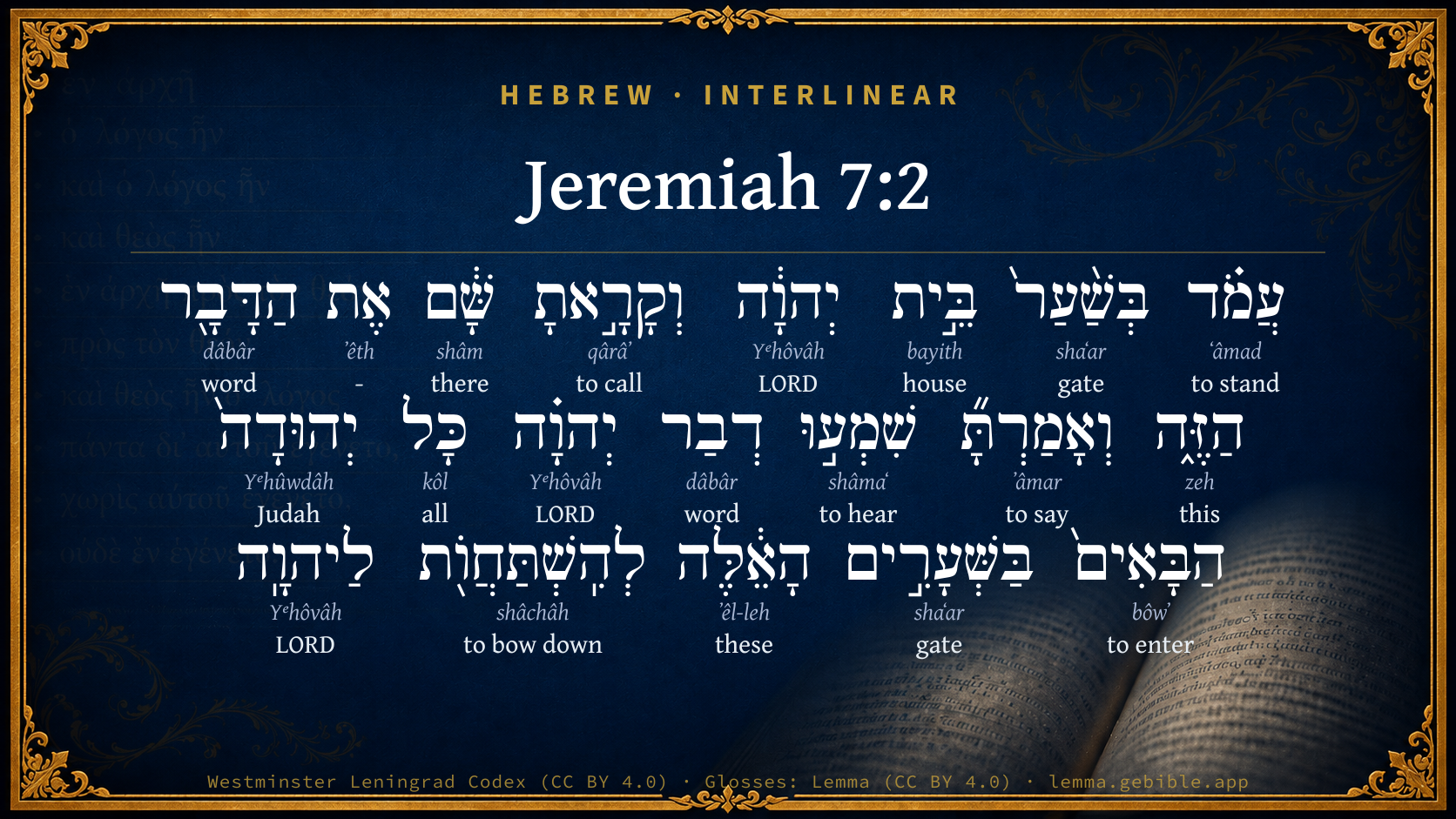
Jeremiah 7:2

Hebrew (Westminster Leningrad Codex) Jeremiah 7:2 appears in the Hebrew Old Testament. The text above is from the Westminster Leningrad Codex. Each word links to its Strong’s number, a concise gloss, and parsing drawn from the Open Scriptures Hebrew Bible morphology. Click any word for its full Brown-Driver-Briggs (BDB) entry.
Download image
Cite this verse

Jeremiah 7:2 (World English Bible). Public Domain. Lemma interlinear Bible study tool, https://lemma.gebible.app/v/jeremiah/7/2.

Show BibTeX & RIS
BibTeX
RIS
English Translation
Stand in the gate of Yahweh's house, and proclaim there this word, and say, Hear the word of Yahweh, all you of Judah, who enter in at these gates to worship Yahweh.
World English Bible · Public Domain
Download a study sheet

One document with this verse’s original text, its word-by-word gloss line, the meaning frame, cross-references with their text, attributed commentary, and full source and license credits — printable, and it pastes into notes with its structure intact.

This verse Autodidact and up

Study sheet (.html) Plain text (.txt)

A passage Seminary Student

Up to 50 verses in one chapter. A passage sheet keeps up to 6 commentary sources and 12 cross-references per verse, in the order this page ranks them, and says so on the sheet whenever that leaves anything out. Ask for a single verse and you get the Autodidact verse sheet above.

Everything on this page stays free to read, with no account — the sheet is a download of what is already on screen, not access to it.

Want to remove ads? Support Godless Engineer
Compare translations 3

The same verse in 3 English versions, stacked beneath the original-language interlinear above. Click any original word for its lexicon entry.

Each is an independent rendering of the whole verse — the interlinear is not word-aligned to these translations.

Highlighted words mark where these versions differ — a whole-verse word diff, not a word-by-word alignment.

  • World English Bible Public Domain
    Stand in the gate of Yahweh's house, and proclaim there this word, and say, Hear the word of Yahweh, all you of Judah, who enter in at these gates to worship Yahweh.
  • King James Version Public Domain
    Stand in the gate of the LORD's house, and proclaim there this word, and say, Hear the word of the LORD, all ye of Judah, that enter in at these gates to worship the LORD.
  • unfoldingWord Literal Text CC BY-SA 4.0
    “Stand at the gate of the house of Yahweh and proclaim there this word! And you shall say, ‘Hear the word of Yahweh, all of Judah, who enter these gates to bow down to Yahweh.

unfoldingWord Literal Text — © unfoldingWord, licensed CC BY-SA 4.0. Word-aligned USFM3 via Door43 (git.door43.org/unfoldingWord/en_ult).

Versions to compare (up to 4)

3 of 4 selected

Show all 18 translations

Every available English version of this verse, each an independent rendering of the whole verse.

  • World English Bible Public Domain
    Stand in the gate of Yahweh's house, and proclaim there this word, and say, Hear the word of Yahweh, all you of Judah, who enter in at these gates to worship Yahweh.
  • Berean Standard Bible Public Domain
    “Stand in the gate of the house of the LORD and proclaim this message: Hear the word of the LORD, all you people of Judah who enter through these gates to worship the LORD.
  • Majority Standard Bible Public Domain
    “Stand in the gate of the house of the LORD and proclaim this message: Hear the word of the LORD, all you people of Judah who enter through these gates to worship the LORD.
  • King James Version Public Domain
    Stand in the gate of the LORD's house, and proclaim there this word, and say, Hear the word of the LORD, all ye of Judah, that enter in at these gates to worship the LORD.
  • American Standard Version (1901) Public Domain
    Stand in the gate of Jehovah's house, and proclaim there this word, and say, Hear the word of Jehovah, all ye of Judah, that enter in at these gates to worship Jehovah.
  • Revised Version (1885) Public Domain
    Stand in the gate of the LORD’S house, and proclaim there this word, and say, Hear the word of the LORD, all ye of Judah, that enter in at these gates to worship the LORD.
  • Geneva Bible (1599) Public Domain
    Stand in the gate of the Lordes house and crie this woorde there, and say, Heare the woorde of the Lord, all yee of Iudah that enter in at these gates to worship the Lord.
  • Douay-Rheims (1899) Public Domain
    Stand in the gate of the house of the Lord, and proclaim there this word, and say: Hear ye the word of the Lord, all ye men of Juda, that enter in at these gates, to adore the Lord.
  • Young's Literal Translation Public Domain
    Stand in the gate of the house of Jehovah, and thou hast proclaimed there this word, and hast said, Hear a word of Jehovah, all ye of Judah, who are coming in at these gates, to bow before Jehovah:
  • Literal Standard Version CC BY-SA 4.0
    “Stand in the gate of the house of YHWH, and you have proclaimed this word there, and have said, Hear a word of YHWH, all you of Judah, who are coming in at these gates, to bow before YHWH.”
  • Unlocked Literal Bible CC BY-SA 4.0
    “Stand at the gate of Yahweh's house and proclaim this word! Say, 'Hear the word of Yahweh, all you of Judah, you who enter these gates to worship Yahweh.
  • unfoldingWord Literal Text CC BY-SA 4.0
    “Stand at the gate of the house of Yahweh and proclaim there this word! And you shall say, ‘Hear the word of Yahweh, all of Judah, who enter these gates to bow down to Yahweh.
  • Darby Bible Public Domain
    Stand in the gate of Jehovah's house, and proclaim there this word, and say, Hear ye the word of Jehovah, all Judah, that enter in at these gates to worship Jehovah.
  • World Messianic Bible Public Domain
    “Stand in the gate of the LORD’s house, and proclaim this word there, and say, ‘Hear the LORD’s word, all you of Judah, who enter in at these gates to worship the LORD.’”
  • Webster's Bible Public Domain
    Stand in the gate of the LORD'S house, and proclaim there this word, and say, Hear the word of the LORD, all ye of Judah, that enter in at these gates to worship the LORD.
  • Free Bible Version CC BY-SA 4.0
    Go and stand in the entrance to the Lord's Temple, and deliver this message: Listen to what the Lord has to say, all of you from Judah who are coming in through these gates to worship the Lord.
  • Bible in Basic English Public Domain
    Take your place in the doorway of the Lord's house, and give out this word there, and say, Give ear to the word of the Lord, all you of Judah who come inside these doors to give worship to the Lord.
  • JPS Tanakh (1917) Public Domain
    Stand in the gate of the LORD'S house, and proclaim there this word, and say: Hear the word of the LORD, all ye of Judah, that enter in at these gates to worship the LORD.

Literal Standard Version (2020), Covenant Press — licensed CC BY-SA 4.0. Text via the HelloAO Bible API (eBible.org). Unlocked Literal Bible (unfoldingWord) — licensed CC BY-SA 4.0. Text via the HelloAO Bible API (eBible.org). unfoldingWord Literal Text — © unfoldingWord, licensed CC BY-SA 4.0. Word-aligned USFM3 via Door43 (git.door43.org/unfoldingWord/en_ult). Free Bible Version, Dr. Jonathan Gallagher — licensed CC BY-SA 4.0. Text via the HelloAO Bible API (eBible.org).

Word by word

More ways to search: Search by grammar → Find every occurrence → Compare this word →

Practice this passage: Drill this verse → Learn its vocabulary →

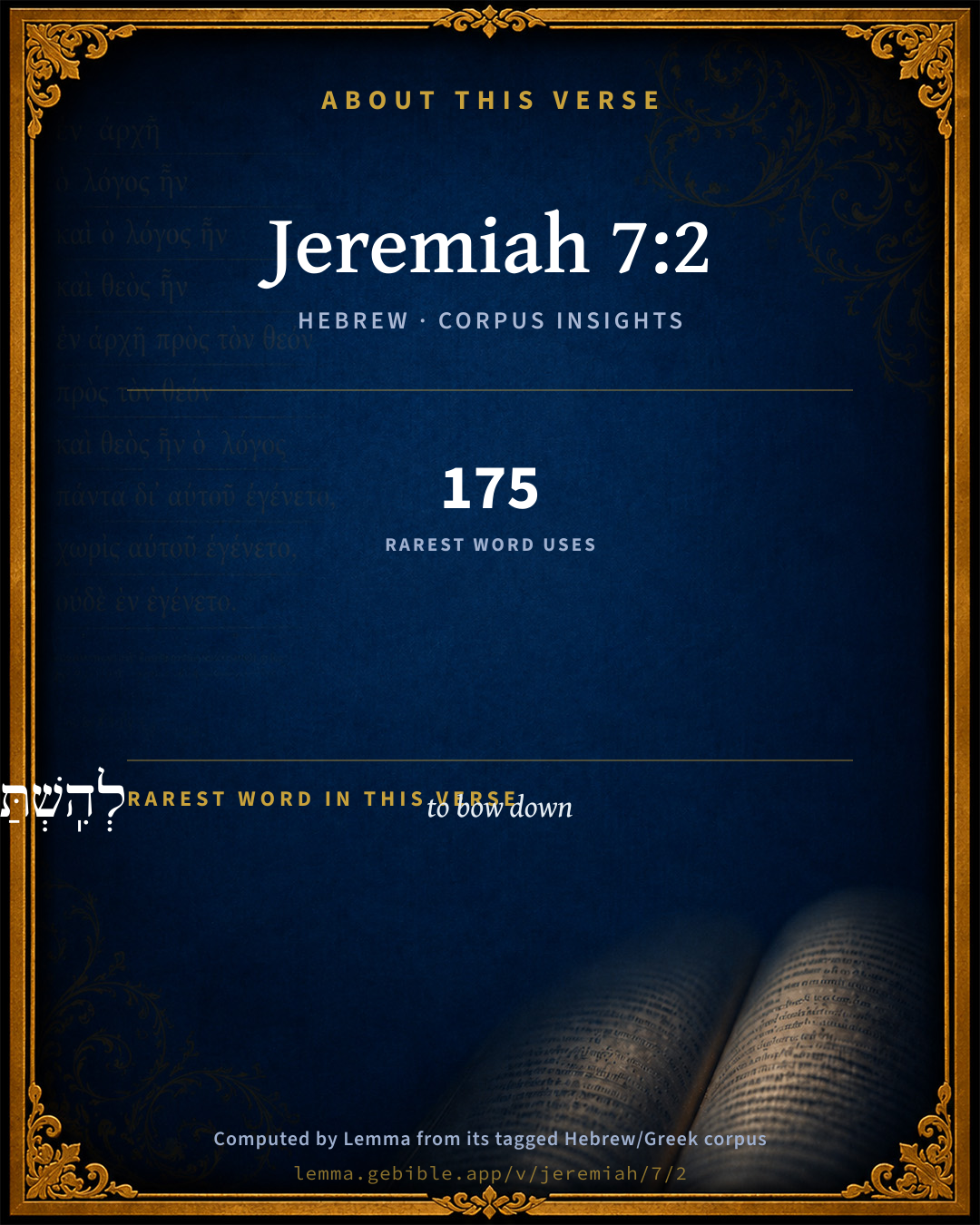
לְהִֽשְׁתַּחֲוֺ֖ת
shâchâh
H7812
“to bow down”
Preposition + Verb, Hithpael, Infinitive Construct
Part of Speech
Preposition + Verb
Stem
Hithpael
Form
Infinitive Construct
Full BDB Definition

Origin: a primitive root

TWOT: 2360

to bow down - (Qal) to bow down - (Hiphil) to depress (figuratively) - (Hithpael) - to bow down, prostrate oneself - before superior in homage - before God in worship - before false gods - before angel
  1. עֲמֹ֗ד ʻâmad H5975 “stand” Verb, Qal, Imperative, 2nd Person, Masculine, Singular
  2. בְּשַׁ֨עַר֙ shaʻar H8179 “in/at · gate of” Preposition + Noun, Common, Masculine, Singular, Construct
  3. בֵּ֣ית bayith H1004 “house of” Noun, Common, Masculine, Singular, Construct
  4. יְהוָ֔ה Yᵉhôvâh H3068 “LORD” Noun, Proper
  5. וְקָרָ֣אתָ qârâʼ H7121 “and · to call” Conjunction + Verb, Qal, Sequential Perfect, 2nd Person, Masculine, Singular
  6. שָּׁ֔ם shâm H8033 “there” Adverb
  7. אֶת ʼêth H853 “-” Particle, Direct Object
  8. הַדָּבָ֖ר dâbâr H1697 “the · word” Particle, Definite Article + Noun, Common, Masculine, Singular, Absolute
  9. הַזֶּ֑ה zeh H2088 “the · this” Particle, Definite Article + Pronoun, Demonstrative, Masculine, Singular
  10. וְאָמַרְתָּ֞ ʼâmar H559 “and · to say” Conjunction + Verb, Qal, Sequential Perfect, 2nd Person, Masculine, Singular
  11. שִׁמְע֣וּ shâmaʻ H8085 “hear” Verb, Qal, Imperative, 2nd Person, Masculine, Plural
  12. דְבַר dâbâr H1697 “word of” Noun, Common, Masculine, Singular, Construct
  13. יְהוָ֗ה Yᵉhôvâh H3068 “LORD” Noun, Proper
  14. כָּל kôl H3605 “all of” Noun, Common, Masculine, Singular, Construct
  15. יְהוּדָה֙ Yᵉhûwdâh H3063 “Judah” Noun, Proper
  16. הַבָּאִים֙ bôwʼ H935 “the · entering” Particle, Definite Article + Verb, Qal, Participle Active, Masculine, Plural, Absolute
  17. בַּשְּׁעָרִ֣ים shaʻar H8179 “in/at the · gates” Preposition, Determined + Noun, Common, Masculine, Plural, Absolute
  18. הָאֵ֔לֶּה ʼêl-leh H428 “the · these” Particle, Definite Article + Pronoun, Demonstrative, Common, Plural
  19. לַיהוָֽה Yᵉhôvâh H3068 “to/for · LORD” Preposition + Noun, Proper

About this verse

These counts appear in no published source. They are computed here, from the morphology-tagged text and Lemma’s own curated glosses. What Lemma adds →

20
words
16
distinct lemmas
Prophets
section

Grammatical profile

  • 6 verbs
  • 10 nouns
  • 2 pronouns
  • 1 adverb
  • 1 particle

Verb forms

  • עֲמֹ֗ד Qal · Imperative
  • וְקָרָ֣אתָ Qal · Sequential Perfect
  • וְאָמַרְתָּ֞ Qal · Sequential Perfect
  • שִׁמְע֣וּ Qal · Imperative
  • הַבָּאִים֙ Qal · Participle Active
  • לְהִֽשְׁתַּחֲוֺ֖ת Hithpael · Infinitive Construct

Repetition

Words recur within this verse — often emphatic in Hebrew:

  • יְהוָ֔ה LORD H3068 ×3
  • בְּשַׁ֨עַר֙ gate H8179 ×2
  • הַדָּבָ֖ר word H1697 ×2

Cross-references

32

Topical passages linked to Jeremiah 7:2 in the Treasury of Scripture Knowledge — connected by theme and wording, ordered by reader-vote popularity; previews shown in the World English Bible.

  • Jeremiah 26:2 Thus says Yahweh: Stand in the court of Yahweh's house, and speak to all the cities of Judah, which come to worship in Yahweh's house, all the words that I command you to speak to them; don't diminish a word.
  • Isaiah 1:10 Hear the word of Yahweh, you rulers of Sodom! Listen to the law of our God, you people of Gomorrah!
  • Jeremiah 22:1–2 Thus said Yahweh: Go down to the house of the king of Judah, and speak there this word,
  • Ezekiel 2:4–5 The children are impudent and stiff-hearted: I do sent you to them; and you shall tell them, Thus says the Lord Yahweh.
  • Amos 7:16 Now therefore listen to the word of Yahweh: 'You say, Don't prophesy against Israel, and don't preach against the house of Isaac.'
  • Revelation 3:22 He who has an ear, let him hear what the Spirit says to the assemblies."
  • 1 Kings 22:19 [Micaiah] said, Therefore hear you the word of Yahweh: I saw Yahweh sitting on his throne, and all the host of heaven standing by him on his right hand and on his left.
  • Proverbs 1:20–21 Wisdom calls aloud in the street. She utters her voice in the public squares.
  • Proverbs 8:2–3 On the top of high places by the way, Where the paths meet, she stands.
  • Jeremiah 2:4 Hear you the word of Yahweh, O house of Jacob, and all the families of the house of Israel:
  • Jeremiah 10:1 Hear the word which Yahweh speaks to you, house of Israel!
  • Jeremiah 17:19–20 Thus said Yahweh to me: Go, and stand in the gate of the children of the people, through which the kings of Judah come in, and by which they go out, and in all the gates of Jerusalem;
  • Jeremiah 19:2–3 and go forth to the valley of the son of Hinnom, which is by the entry of the gate Harsith, and proclaim there the words that I shall tell you;
  • Jeremiah 19:14 Then came Jeremiah from Topheth, where Yahweh had sent him to prophesy; and he stood in the court of Yahweh's house, and said to all the people:
  • Jeremiah 34:4 Yet hear the word of Yahweh, O Zedekiah king of Judah: thus says Yahweh concerning you, You shall not die by the sword;
  • Jeremiah 44:24 Moreover Jeremiah said to all the people, and to all the women, Hear the word of Yahweh, all Judah who are in the land of Egypt:
  • Hosea 5:1 "Listen to this, you priests! Listen, house of Israel, And give ear, house of the king! For the judgment is against you; For you have been a snare at Mizpah, And a net spread on Tabor.
  • Micah 1:2 Hear, you peoples, all of you. Listen, O earth, and all that is therein: And let the Lord Yahweh be witness against you, The Lord from his holy temple.
  • Jeremiah 36:6 therefore go you, and read in the scroll, which you have written from my mouth, the words of Yahweh in the ears of the people in Yahweh's house on the fast-day; and also you shall read them in the ears of all Judah who come out of their cities.
  • Jeremiah 36:10 Then read Baruch in the book the words of Jeremiah in the house of Yahweh, in the chamber of Gemariah the son of Shaphan, the scribe, in the upper court, at the entry of the new gate of Yahweh's house, in the ears of all the people.
  • John 18:20 Jesus answered him, "I spoke openly to the world. I always taught in synagogues, and in the temple, where the Jews always meet. I said nothing in secret.
  • Acts 5:20 "Go stand and speak in the temple to the people all the words of this life."
  • Acts 5:42 Every day, in the temple and at home, they never stopped teaching and preaching Jesus, the Christ.
  • Micah 3:1 I said, "Please listen, you heads of Jacob, And rulers of the house of Israel: Isn't it for you to know justice?
  • Micah 3:9 Please listen to this, you heads of the house of Jacob, And rulers of the house of Israel, Who abhor justice, And pervert all equity.
  • Matthew 13:9 He who has ears to hear, let him hear."
  • Revelation 2:7 He who has an ear, let him hear what the Spirit says to the assemblies. To him who overcomes I will give to eat of the tree of life, which is in the Paradise of my God.
  • Revelation 2:11 He who has an ear, let him hear what the Spirit says to the assemblies. He who overcomes won't be harmed by the second death.
  • Revelation 2:17 He who has an ear, let him hear what the Spirit says to the assemblies. To him who overcomes, to him I will give of the hidden manna, and I will give him a white stone, and on the stone a new name written, which no one knows but he who receives it.
  • Revelation 2:29 He who has an ear, let him hear what the Spirit says to the assemblies.
  • Revelation 3:6 He who has an ear, let him hear what the Spirit says to the assemblies.
  • Revelation 3:13 He who has an ear, let him hear what the Spirit says to the assemblies.

Cross-references courtesy of OpenBible.info (CC BY 4.0).

Hebrew and Greek witnesses Masoretic Hebrew ↔ Greek Septuagint

The same verse in the two great witnesses to the Old Testament, shown verse-for-verse.

These are two independent witnesses, not word-aligned to each other, and the Septuagint is shown in lemma (dictionary) form.

Hebrew Jeremiah 7:2 Masoretic · Westminster Leningrad Codex

עֲמֹ֗ד בְּשַׁ֨עַר֙ בֵּ֣ית יְהוָ֔ה וְקָרָ֣אתָ שָּׁ֔ם אֶת הַדָּבָ֖ר הַזֶּ֑ה וְאָמַרְתָּ֞ שִׁמְע֣וּ דְבַר יְהוָ֗ה כָּל יְהוּדָה֙ הַבָּאִים֙ בַּשְּׁעָרִ֣ים הָאֵ֔לֶּה לְהִֽשְׁתַּחֲוֺ֖ת לַיהוָֽה

Stand in the gate of Yahweh's house, and proclaim there this word, and say, Hear the word of Yahweh, all you of Judah, who enter in at these gates to worship Yahweh.

World English Bible · Public Domain

Greek LXX Structure differs

In the Septuagint, Jeremiah is about an eighth shorter than the Hebrew and arranges its material differently — the Oracles Against the Nations (Hebrew chapters 46–51) appear in the middle of the Greek book, after 25:13. Because the chapter and verse boundaries do not line up, a verse-for-verse comparison with the Hebrew is not shown.

A verse-for-verse comparison isn’t shown here because the chapters and verses don’t line up. Switch to the LXX edition with the MT / LXX toggle above to read the Greek directly.

Hebrew: Westminster Leningrad Codex (CC BY 4.0). Greek: Septuagint (public domain); English from a public-domain English Septuagint. How the Septuagint differs from the Hebrew →

Targum (Aramaic paraphrase)

1

The Targum is the ancient Jewish Aramaic paraphrase of the Hebrew Scriptures — an interpretive translation, not the Hebrew text itself. Onkelos (literal) and Pseudo-Jonathan (expansive) render the Torah, and Jonathan the Prophets. Coverage is partial: where no permissively-licensed English translation exists for a verse, only the Aramaic is shown. This is verse-level text, not a word-by-word alignment to the Hebrew.

  1. Targum Jonathan Prophets (Joshua–Malachi)
    קוּם בִּתְרַע בֵּית מַקְדְּשָׁא דַייָ וְתִתְנַבֵּי תַמָן יַת פִּתְגָמָא הָדֵין וְתֵימַר קַבִּילוּ פִּתְגָמָא דַייָ כָּל דְבֵית יְהוּדָה דְעָלִין בְּתַרְעַיָא הָאִילֵין לְמִסְגַד קֳדָם יְיָ:

    (no public-domain English translation for this verse)

    Targum Jonathan — Aramaic: “Mikraot Gedolot” (public domain). English: “Sefaria Community Translation” (CC0 1.0 (public-domain dedication)); “London "Chaldee Paraphrase," 1871” (public domain). Text via Sefaria.

Commentary

Notes on Jeremiah 7:2 from classic Christian and Jewish commentators (each source and its license shown beneath its notes). The classic Christian expositions comment on the surrounding passage and are grouped to its opening verse, so a note may address several verses; the Jewish commentaries on the Tanakh (Rashi and others) are per-verse, so they appear only where the commentator wrote on this verse.

Lemma curates 59 commentaries, every one of them public domain or Creative Commons licensed, each selected and text-cleaned for this edition rather than reprinted as found. About our sources →

Trapp's Complete Commentary

John Trapp

Jer 7:2 Stand in the gate of the LORD’S house, and proclaim there this word, and say, Hear the word of the LORD, all [ye of] Judah, that enter in at these gates to worship the LORD.

Ver. 2. Stand in the gate of the Lord’s house.] The east gate, which was the most famous and most frequented of the people, and therefore fittest for the purpose.

And proclaim there this word.] Stand there with this word (as once the angel with a terrible sword did at the porch of paradise) to excommunicate, as it were, this hypocritical people; and do it verbis non tantum disertis sed et exertis, plainly and boldly.

John Trapp, A Commentary or Exposition upon All the Books of the Old and New Testament (1647–1656) — public domain. Text from a community e-Sword module.

Joseph Benson's Commentary

Jer 7:2. Stand in the gates of the Lord’s house — Namely, the east gate of the temple, which led directly to it, where he delivered this discourse, before all the people who entered there. And proclaim there this word — Proclaiming signifies both the authority by which he spake, and the divulging of what he spake plainly and boldly. And as it was in so public a place, namely, at the entrance of the court of the people, not of that of the priests, that he uttered this prophecy, so possibly it might be at one of the three feasts, when all the males from all parts of the country were to appear before the Lord in the courts of his house. In that case he would have many collected together to preach to, and that was the most seasonable time to admonish them not to trust in their privileges.

Joseph Benson's Commentary on the Old and New Testaments (1811–1818) — public domain. Text from a community e-Sword module.

Adam Clarke's Commentary

Verse 2. Stand in the gate of the Lord's house] There was a show of public worship kept up. The temple was considered God's residence; the usual ceremonies of religion restored by Josiah were still observed; and the people were led to consider the temple and its services as sacred things, which would be preservatives to them in case of the threatened invasion.

Adam Clarke's Commentary on the Bible (1810–1826) — public domain. Text from a community e-Sword/MySword module.

John Calvin's Commentaries

Here the Prophet gives a short account of the sermon, in which he severely reproved the people, because his labor had been useless, though he had sharply and severely reproved them. He says then, that he had a command from above to stand at the gate of the Temple. This was indeed usually done by the prophets: but God seems to have intended that this reproof should be heard by all. He says further, that he was commanded to address the whole tribe of Judah

It is hence probable, and what may be easily concluded, that this discourse was delivered on a feast — day, when there was the usual assembly of the people. He could not indeed have made this address on other days; for then the inhabitants of the city only frequented the Temple. But on the feast — days they usually came from the neighboring towns and from the whole country to celebrate God’s rightful worship, which had been prescribed in the law. Since then Jeremiah addressed the whole tribe of Judah, we hence conclude, that he spoke not only to the inhabitants of the city, but also to the whole tribe, which came together to keep the feast — day.

Now the object of his sermon was, to exhort them seriously to repent, if they wished God to be reconciled to them. So the Prophet shews, that God did not regard their sacrifices and external rites, and that this was not the way, as they thought, of appeasing him. For after they had celebrated the feast, every one returned home, as though they all, after having made an expiation, had God propitious to them. The Prophet shews here, that the way of worshipping God was very different, which was to reform their lives.

John Calvin's Commentaries (1540-1563) — public domain. Text from the Calvin Translation Society English edition (1840s-50s) via the Christian Classics Ethereal Library (ccel.org). Calvin's coverage is partial (roughly two-thirds of the Bible); uncommented books and verses are honest gaps, never fabricated. The 19th-century editor's footnotes and remarks are omitted so the notes are faithfully Calvin's own voice.

Ellicott's Commentary for English Readers

(2) The gate of the Lord’s house.—As a priest, Jeremiah would have access to all parts of the Temple. On some day when the courts were thronged with worshippers (Jer_7:10), probably a fast-day specially appointed, he stands at the inner gate of one of the courts, possibly, as in Jer_17:19, that by which the king entered in ceremonial state, and looking about on the multitudes that thronged it, speaks to them “the word of the Lord,” the message which he had been specially commissioned to deliver.

A Bible Commentary for English Readers, edited by Charles John Ellicott (1878–1897) — public domain. Text from a community e-Sword module.

The Cambridge Bible for Schools and Colleges

gen. ed. J. J. S. Perowne

2. the gate] In Jer_26:2 “the court” (perhaps the “new gate” of Jer_36:10), probably between the inner and outer court, in the latter of which the crowd from city and country would assemble on a fast day or festival. The sympathy of numbers would naturally provoke the attack which followed (Jer_26:7 ff.).

The Cambridge Bible for Schools and Colleges (gen. ed. J. J. S. Perowne; Cambridge University Press, 1878–1918) — public domain. Text from a community e-Sword module.

John Gill's Exposition

Stand in the gate of the Lord's house,.... That is, of the temple, and the court of it. This gate, as Kimchi says, was the eastern gate, which was the principal gate of all; see Jer 26:2,

and proclaim there this word, and say; with a loud voice, as follows:

hear ye the word of the Lord, all ye of Judah; the inhabitants of the several parts of Judea, which came to the temple to worship; very probably it was a feast day, as Calvin conjectures; either the passover, or pentecost, or feast of tabernacles, when all the males in Israel appeared in court:

that enter in at these gates to worship the Lord; there were seven gates belonging to the court, three on the north, three on the south, and one in the east, the chief of all, as Kimchi, Abarbinel, and Ben Melech observe; and this agrees with the account in the Misna (k). The names of them were these; on the south side were these three, the watergate, the gate of the firstlings; or the gate of offering, and the gate of kindling; on the north were these three, the gate Nitzotz, called also the gate of the song, the gate Korban, sometimes called the gate of women, and Beth Moked; and the gate in the east was the gate Nicanor, and this gate was the most frequented; and therefore Jeremiah was ordered to stand here, and deliver his message.

(k) Middot, c. 1. sect. 4, 5.

John Gill's Exposition of the Whole Bible (1746–1763) — public domain (CC PDM 1.0). Text via the HelloAO Bible API.

Haydock's Catholic Bible Commentary

Gate, before all the people. This discourse ends [in] chap. xiii. (Calmet)

George Leo Haydock (1774–1849), Haydock's Catholic Family Bible and Commentary, 1859 edition — public domain. Excludes Psalms (Douay-Rheims chapter numbering differs from Protestant) and Deuterocanonical books (Catholic canon only).

Matthew Poole's English Annotations

Stand in the gate, viz. the east gate, which was chiefly frequented; this being the public place of going out and coming in, and where the people were then wont to assemble, Jer 26:2,10; and he is said to stand, because he was to execute the office of a preacher, Jer 26:2, not of a judge, where the posture would rather have been sitting.

The Lord’s house; the temple, Jer 7:4,10.

Proclaim there: the place notes the vanity of their confidence, who, notwithstanding all their provocations, yet placed their safety much in the privileges of the temple, glorying much in that; and the manner. proclaiming, signifies both the authority by which he spake, and the divulging of what he spake plainly and boldly, which as it was in a public place, viz. the court of the people, not the court of the priests, (from which it is distinguished, 2Ch 4:9) and therefore said at these gates, viz. the several gates that were in the wall of the court, of which there were six, three on the south side and three on the north; so, possibly, it might be at some public time of the people’s resorting thither from all quarters, Psa 122:4,5, when all the males were to meet, Exo 23:17; see Joh 7:37; and therefore said,

all ye of Judah. This word; the message that I send thee with.

The word of the Lord: see Jer 2:4.

Matthew Poole's English Annotations on the Holy Bible (1683–1685) — public domain. Text from a community e-Sword/MySword module.

The Pulpit Commentary

Stand in the gate; i.e. not an outer gate (for the outer court would be filled with the people whom Jeremiah was to address), but one of the three gates which led from the inner court to the outer. Probably it was the gate where Baruch recited the prophecies of Jeremiah at a later period, and which is designated "the new gate of the Lord"s house," and said to have been situated in the "upper" i.e. inner court. (Jer_36:10 Jer_26:10) We may conjecture that either one of the three great festivals or some extraordinary fast had brought a large number of people together at the temple.

The indispensable condition of all grace.

"Amend your ways," etc. See how this demand for amendment is reiterated in this chapter and throughout this prophecy. And we observe

I IT IS EVER SO.

1. See the Word of God. The prodigal had to come away from the far country first. John the Baptist, our Lord, and his apostles all preached repentance before pardon. The Law comes before the gospel

2. Conscience confirms the justice of this demand. We feel it to be a monstrous thing that, without any turning from sin even in purpose, there should be an expectation of God"s grace.

3. Men make this same demand of those who rebel against their laws.

4. God"s providence upholds this demand. The constitution of things is for the obedient and against the transgressor (cf. Butler"s "Analogy").

II AND THE REASONS ARE BECAUSE SIN:

1. Outrages God. What order or happiness can there be in that household where the authority of the head is openly set at naught?

2. Is dogged by sorrow and death. The avenging deities were said to be shod with wool, so that their footsteps, ever following the transgressor, were not heard. It was the vision of sin and its awful issues that caused Jesus to sigh, to be troubled in spirit, and to weep; it was his agony. Now, God would save us, but cannot until we have done with wickedness.

3. Binds the soul to enmity against God. Deeds of wrong are the devil"s sacraments, whereby he seals on the soul his own impress and pledges the soul to serve him. Every solitary act of sin deepens that impress and makes that pledge more irrevocable. Therefore, if the soul is to be.saved, that bond must be broken.

4. Amendment in conduct is the first step towards the restoration of the soul. A man may break off ill-doing, and yet his heart be very far from right with God. Still, because every victory over sin strengthens the conscience and weakens the power of sin, its held is thus loosened upon the soul, and the work of restoration is so far advanced.

III BUT COMPLIANCE WITH THIS MOST RIGHTEOUS DEMAND IS.

1. Often very difficult. Ask the drunkard, the impure, the worldling, the gambler, if they find it easy to break away from their besetting sins. How like a set of fiends they clamor for their wonted indulgence! "Hoc opus hic labor est.

2. But never impossible. No; for along with every Divine command goes forth the strength needed for obedience. How absurd, on mere human principles, for our Lord to bid the man with the withered hand to stretch it forth; the palsied to rise, take up his bed, and walk; and Lazarus to come forth from his tomb! But all these facts are recorded to encourage those who would turn to the Lord, but yet "are sore let and hindered." We often askOh, how shall feeble flesh and blood Burst through the bonds of sin? The holy kingdom of our God, What soul shall enter in?

And there could be but one sad answer were it not that he who gives the command gives also the needed help. YesThere is a way for man to rise To that sublime abode; An offering and a sacrifice, A Holy Spirit"s energies, An Advocate with God.

3. And ever blessed. (Cf. vers. 3, 7) All those precious sentences with which the sermon on the mount opens, and which we call the Beatitudes, were addressed to those who had resolved, by God"s grace, to amend their ways. Christ has no other word for them than that they are blessed, and what his Word affirms all they who have followed his leading do with grateful heart confirm. Yes, "blessed are they that do his commandments, that they may have right to the tree of life, and may enter in through the gates into the city.

4. But if refused, is awfully avenged. Too often it is refused. It was so here. All manner of excuse attempted, and though these "lying words" (ver. 4) were and are exposed again, the refusal is persisted in, and then "the wrath of God arises, and there is no remedy." "From all such hardness of heart and contempt of thy Holy Word and commandment, good Lord, deliver us. C.

The Pulpit Commentary (1880–1919), ed. H.D.M. Spence-Jones & Joseph S. Exell — public domain. Text from a community e-Sword module.

John Wesley's Explanatory Notes

The gate - The east gate, which was the publick place of going out and coming in, and where the people were then wont to assemble. Proclaim - Proclaiming signifies both the authority by which he spake, and the divulging of what he spake plainly and boldly; possibly, it might be at some publick time, when all the males were to meet.

John Wesley, Explanatory Notes Upon the Whole Bible (1754–1765) — public domain. Text via the GEBible commentary corpus.

Lesson kit

Teaching starters — assembled from the data on this page, not authored interpretation. Every prompt links to the verse data it draws on. Edit before teaching.

Jeremiah, in the Prophets, opens this verse with 20 words (16 distinct Hebrew lemmas). Its most distinctive word is shâchâh (“to bow down”). A historical commentator’s framing appears above. Read the whole chapter for the surrounding context.

Discussion questions

  1. What does “to bow down” (shâchâh) contribute to the verse as a whole?
  2. Jeremiah 26:2 shares this passage’s theme. How do the two illuminate each other?
  3. “LORD” occurs 3× in this one verse. What is the effect of the repetition?
  4. These translations render this verse differently; the difference is in the English rendering, not the original. What questions does that raise?
  5. The verb «עֲמֹ֗ד» is Qal Imperative. How does its form color the action?
  6. Reading how Trapp's Complete Commentary and Joseph Benson's Commentary read this verse, where do the two commentators agree and where do they part?

Things to notice

Reading settings

Reading text

Shown beneath each verse's original-language words.

Old Testament
Old Testament edition

Read the OT as the Masoretic Hebrew (MT) or the Greek Septuagint (LXX).

English shown for the Greek Septuagint (in the Hebrew ↔ Greek comparison).

Comparing translations? Open the Compare panel on any verse page to stack up to four side by side.