Nehemiah 12:30

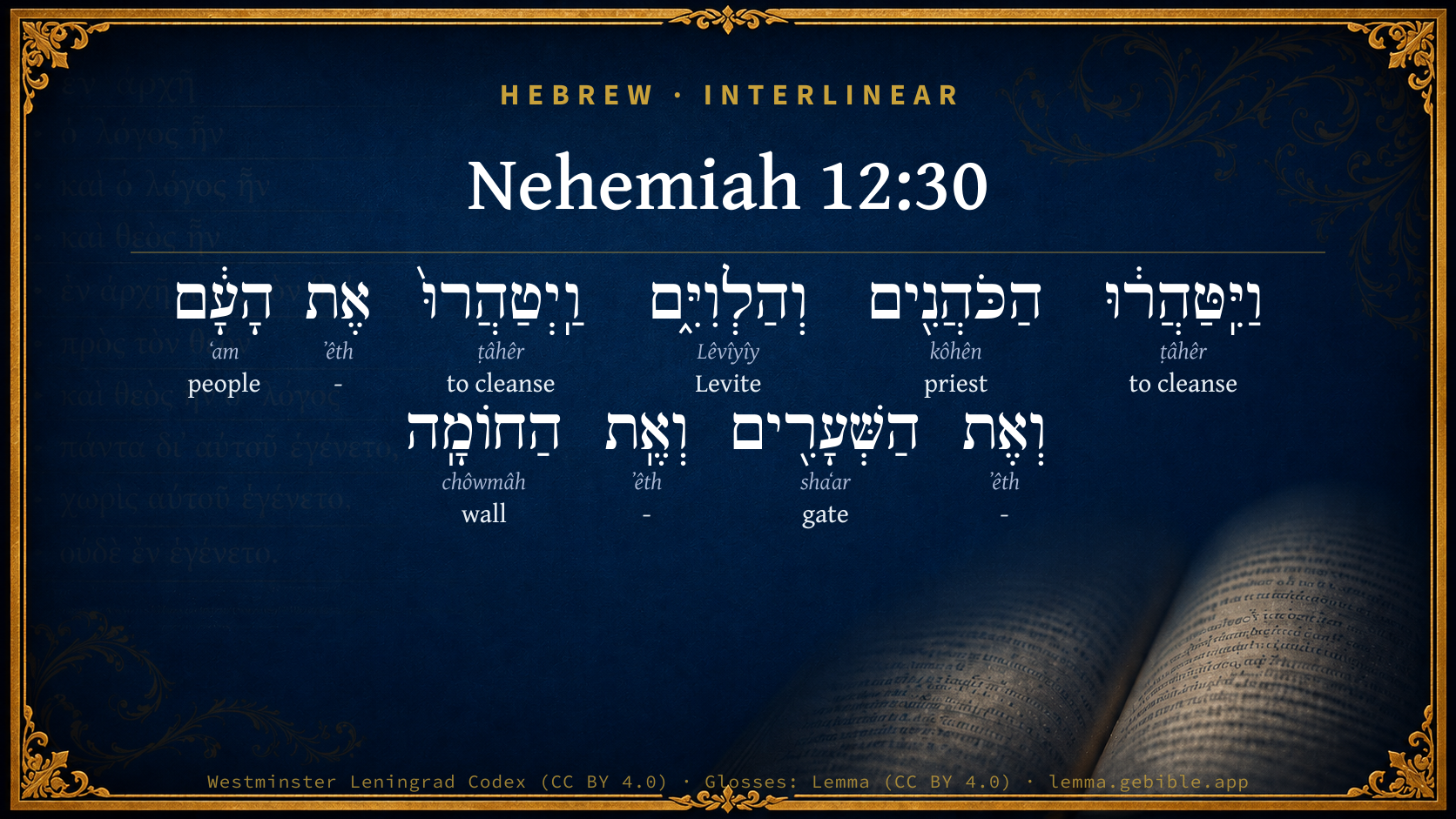
Hebrew (Westminster Leningrad Codex) Nehemiah 12:30 appears in the Hebrew Old Testament. The text above is from the Westminster Leningrad Codex. Each word links to its Strong’s number, a concise gloss, and parsing drawn from the Open Scriptures Hebrew Bible morphology. Click any word for its full Brown-Driver-Briggs (BDB) entry.
Download image
Cite this verse

Nehemiah 12:30 (World English Bible). Public Domain. Lemma interlinear Bible study tool, https://lemma.gebible.app/v/nehemiah/12/30.

Show BibTeX & RIS
BibTeX
RIS
English Translation
The priests and the Levites purified themselves; and they purified the people, and the gates, and the wall.
World English Bible · Public Domain
Download a study sheet

One document with this verse’s original text, its word-by-word gloss line, the meaning frame, cross-references with their text, attributed commentary, and full source and license credits — printable, and it pastes into notes with its structure intact.

This verse Autodidact and up

Study sheet (.html) Plain text (.txt)

A passage Seminary Student

Up to 50 verses in one chapter. A passage sheet keeps up to 6 commentary sources and 12 cross-references per verse, in the order this page ranks them, and says so on the sheet whenever that leaves anything out. Ask for a single verse and you get the Autodidact verse sheet above.

Everything on this page stays free to read, with no account — the sheet is a download of what is already on screen, not access to it.

Want to remove ads? Support Godless Engineer
Compare translations 3

The same verse in 3 English versions, stacked beneath the original-language interlinear above. Click any original word for its lexicon entry.

Each is an independent rendering of the whole verse — the interlinear is not word-aligned to these translations.

Highlighted words mark where these versions differ — a whole-verse word diff, not a word-by-word alignment.

  • World English Bible Public Domain
    The priests and the Levites purified themselves; and they purified the people, and the gates, and the wall.
  • King James Version Public Domain
    And the priests and the Levites purified themselves, and purified the people, and the gates, and the wall.
  • unfoldingWord Literal Text CC BY-SA 4.0
    And the priests and the Levites purified themselves. And they purified the people, and the gates, and the wall.

unfoldingWord Literal Text — © unfoldingWord, licensed CC BY-SA 4.0. Word-aligned USFM3 via Door43 (git.door43.org/unfoldingWord/en_ult).

Versions to compare (up to 4)

3 of 4 selected

Show all 18 translations

Every available English version of this verse, each an independent rendering of the whole verse.

  • World English Bible Public Domain
    The priests and the Levites purified themselves; and they purified the people, and the gates, and the wall.
  • Berean Standard Bible Public Domain
    After the priests and Levites had purified themselves, they purified the people, the gates, and the wall.
  • Majority Standard Bible Public Domain
    After the priests and Levites had purified themselves, they purified the people, the gates, and the wall.
  • King James Version Public Domain
    And the priests and the Levites purified themselves, and purified the people, and the gates, and the wall.
  • American Standard Version (1901) Public Domain
    And the priests and the Levites purified themselves; and they purified the people, and the gates, and the wall.
  • Revised Version (1885) Public Domain
    And the priests and the Levites purified themselves; and they purified the people, and the gates, and the wall.
  • Geneva Bible (1599) Public Domain
    And the Priests and Leuites were purified, and clensed the people, and the gates, and the wall.
  • Douay-Rheims (1899) Public Domain
    And the priests and the Levites purified, and they purified the people, and the gates, and the wall.
  • Young's Literal Translation Public Domain
    and the priests and the Levites are cleansed, and they cleanse the people, and the gates, and the wall.
  • Literal Standard Version CC BY-SA 4.0
    and the priests and the Levites are cleansed, and they cleanse the people, and the gates, and the wall.
  • Unlocked Literal Bible CC BY-SA 4.0
    The priests and the Levites purified themselves, and then they purified the people, the gates, and the wall.
  • unfoldingWord Literal Text CC BY-SA 4.0
    And the priests and the Levites purified themselves. And they purified the people, and the gates, and the wall.
  • Darby Bible Public Domain
    And the priests and the Levites purified themselves; and they purified the people, and the gates and the wall.
  • World Messianic Bible Public Domain
    The priests and the Levites purified themselves; and they purified the people, the gates, and the wall.
  • Webster's Bible Public Domain
    And the priests and the Levites purified themselves, and purified the people, and the gates, and the wall.
  • Free Bible Version CC BY-SA 4.0
    Once the priests and the Levites had purified themselves, they purified the people, the gates, and the wall.
  • Bible in Basic English Public Domain
    And the priests and the Levites made themselves clean; and they made the people clean, and the doorways and the wall.
  • JPS Tanakh (1917) Public Domain
    And the priests and the Levites purified themselves; and they purified the people, and the gates, and the wall.

Literal Standard Version (2020), Covenant Press — licensed CC BY-SA 4.0. Text via the HelloAO Bible API (eBible.org). Unlocked Literal Bible (unfoldingWord) — licensed CC BY-SA 4.0. Text via the HelloAO Bible API (eBible.org). unfoldingWord Literal Text — © unfoldingWord, licensed CC BY-SA 4.0. Word-aligned USFM3 via Door43 (git.door43.org/unfoldingWord/en_ult). Free Bible Version, Dr. Jonathan Gallagher — licensed CC BY-SA 4.0. Text via the HelloAO Bible API (eBible.org).

Word by word

More ways to search: Search by grammar → Find every occurrence → Compare this word →

Practice this passage: Drill this verse → Learn its vocabulary →

וַיִּֽטַּהֲר֔וּ
ṭâhêr
H2891
“and · to cleanse”
Conjunction + Verb, Hithpael, Sequential Imperfect, 3rd Person, Masculine, Plural
Part of Speech
Conjunction + Verb
Stem
Hithpael
Form
Sequential Imperfect
Person
3rd Person
Gender
Masculine
Number
Plural
Full BDB Definition

Origin: a primitive root

TWOT: 792

to be clean, be pure - (Qal) - to be clean (physically - of disease) - to be clean ceremonially - to purify, be clean morally, made clean - (Piel) - to cleanse, purify - physically - ceremonially - morally - to pronounce clean - to perform the ceremony of cleansing - (Pual) to be cleansed, be pronounced clean - (Hithpael) - to purify oneself - ceremonially - morally - to present oneself for purification
  1. הַכֹּהֲנִ֖ים kôhên H3548 “the · priests” Particle, Definite Article + Noun, Common, Masculine, Plural, Absolute
  2. וְהַלְוִיִּ֑ם Lêvîyîy H3881 “and · the · Levites” Conjunction + Particle, Definite Article + Noun, Gentilic, Masculine, Plural, Absolute
  3. וַֽיְטַהֲרוּ֙ ṭâhêr H2891 “and · to cleanse” Conjunction + Verb, Piel, Sequential Imperfect, 3rd Person, Masculine, Plural
  4. אֶת ʼêth H853 “-” Particle, Direct Object
  5. הָעָ֔ם ʻam H5971 “the · people” Particle, Definite Article + Noun, Common, Masculine, Singular, Absolute
  6. וְאֶת ʼêth H853 “and · -” Conjunction + Particle, Direct Object
  7. הַשְּׁעָרִ֖ים shaʻar H8179 “the · gates” Particle, Definite Article + Noun, Common, Masculine, Plural, Absolute
  8. וְאֶֽת ʼêth H853 “and · -” Conjunction + Particle, Direct Object
  9. הַחוֹמָֽה chôwmâh H2346 “the · wall” Particle, Definite Article + Noun, Common, Feminine, Singular, Absolute

About this verse

These counts appear in no published source. They are computed here, from the morphology-tagged text and Lemma’s own curated glosses. What Lemma adds →

10
words
7
distinct lemmas
Historical
section

Grammatical profile

  • 2 verbs
  • 5 nouns
  • 3 particles

Verb forms

  • וַיִּֽטַּהֲר֔וּ Hithpael · Sequential Imperfect
  • וַֽיְטַהֲרוּ֙ Piel · Sequential Imperfect

Repetition

A word recurs within this verse — often emphatic in Hebrew:

  • וַיִּֽטַּהֲר֔וּ to cleanse H2891 ×2

Cross-references

12

Topical passages linked to Nehemiah 12:30 in the Treasury of Scripture Knowledge — connected by theme and wording, ordered by reader-vote popularity; previews shown in the World English Bible.

  • Exodus 19:10 Yahweh said to Moses, "Go to the people, and sanctify them today and tomorrow, and let them wash their garments,
  • 2 Chronicles 29:5 and said to them, Hear me, you Levites; now sanctify yourselves, and sanctify the house of Yahweh, the God of your fathers, and carry forth the filthiness out of the holy place.
  • Ezra 6:21 The children of Israel who had come again out of the captivity, and all such as had separated themselves to them from the filthiness of the nations of the land, to seek Yahweh, the God of Israel, ate,
  • Job 1:5 It was so, when the days of their feasting had run their course, that Job sent and sanctified them, and rose up early in the morning, and offered burnt offerings according to the number of them all. For Job said, "It may be that my sons have sinned, and renounced God in their hearts." Thus did Job continually.
  • Genesis 35:2 Then Jacob said to his household, and to all who were with him, "Put away the foreign gods that are among you, purify yourselves, change your garments.
  • Exodus 19:15 He said to the people, "Be ready by the third day. Don't have sexual relations with a woman."
  • Numbers 19:2–20 This is the statute of the law which Yahweh has commanded, saying, Speak to the children of Israel, that they bring you a red heifer without spot, in which is no blemish, [and] on which never came yoke.
  • 2 Chronicles 29:34 But the priests were too few, so that they could not flay all the burnt offerings: therefore their brothers the Levites helped them, until the work was ended, and until the priests had sanctified themselves; for the Levites were more upright in heart to sanctify themselves than the priests.
  • Nehemiah 13:22 I commanded the Levites that they should purify themselves, and that they should come and keep the gates, to sanctify the Sabbath day. Remember to me, my God, this also, and spare me according to the greatness of your loving kindness.
  • Nehemiah 13:30 Thus cleansed I them from all foreigners, and appointed charges for the priests and for the Levites, everyone in his work;
  • Hebrews 5:1 For every high priest, being taken from among men, is appointed for men in things pertaining to God, that he may offer both gifts and sacrifices for sins.
  • Hebrews 5:3 Because of this, he must offer sacrifices for sins for the people, as well as for himself.

Cross-references courtesy of OpenBible.info (CC BY 4.0).

Hebrew and Greek witnesses Masoretic Hebrew ↔ Greek Septuagint

The same verse in the two great witnesses to the Old Testament, shown verse-for-verse.

These are two independent witnesses, not word-aligned to each other, and the Septuagint is shown in lemma (dictionary) form.

Hebrew Nehemiah 12:30 Masoretic · Westminster Leningrad Codex

וַיִּֽטַּהֲר֔וּ הַכֹּהֲנִ֖ים וְהַלְוִיִּ֑ם וַֽיְטַהֲרוּ֙ אֶת הָעָ֔ם וְאֶת הַשְּׁעָרִ֖ים וְאֶֽת הַחוֹמָֽה

The priests and the Levites purified themselves; and they purified the people, and the gates, and the wall.

World English Bible · Public Domain

Greek LXX Structure differs

The Septuagint has no separate book of Nehemiah. Its Greek text is the second half of Esdras B (2 Esdras), chapters 11–23; Ezra is the first half (1–10).

A verse-for-verse comparison isn’t shown here because the chapters and verses don’t line up. Switch to the LXX edition with the MT / LXX toggle above to read the Greek directly.

Hebrew: Westminster Leningrad Codex (CC BY 4.0). Greek: Septuagint (public domain); English from a public-domain English Septuagint. How the Septuagint differs from the Hebrew →

Commentary

Notes on Nehemiah 12:30 from classic Christian and Jewish commentators (each source and its license shown beneath its notes). The classic Christian expositions comment on the surrounding passage and are grouped to its opening verse, so a note may address several verses; the Jewish commentaries on the Tanakh (Rashi and others) are per-verse, so they appear only where the commentator wrote on this verse.

Lemma curates 59 commentaries, every one of them public domain or Creative Commons licensed, each selected and text-cleaned for this edition rather than reprinted as found. About our sources →

Trapp's Complete Commentary

John Trapp

Neh 12:30 And the priests and the Levites purified themselves, and purified the people, and the gates, and the wall.

Ver. 30. Purified themselves, and purified the people] But first themselves; because whoso would reform others must begin with himself, as Lyra here notes.

John Trapp, A Commentary or Exposition upon All the Books of the Old and New Testament (1647–1656) — public domain. Text from a community e-Sword module.

The Biblical Illustrator

Joseph S. Exell

Neh_12:30

And the priests and the Levites purified themselves, and purified the people.

Beginning at the right place

I. A pure church may make a sound commonwealth. They purified themselves. Like priest, like people. Cleric and laie act and react on each other. Be ye clean, that bear the vessels of the Lord. Elis sons. Uzzah may not sustain the ark.

II. To a pure people all things are pure. They purified the people and the gates and the wall. Citizens and city; sanctuary and house; Gods work and their own.

All things are sacred;

The eye of God is on them all,

And hallows all.

Jesus revealed God in the minutest. Peters vision. The present preparatory. I think our fathers had a better, grander, a diviner idea even of common life than we have when they spoke of the trades and professions of men as being their calling. There is a great thought in this word. It makes all the men, streets, shops, and warehouses to me as I walk along Divine objects. I feel that I am in a Divine place when I think of the men about me as following their calling. I feel that there is a God above men; that there is a God in human society; a God in the shops and counting-houses of London, touching and teaching every human being; and that every man is occupying the place, and putting his hand to the work to which God has called him. Sometimes you may see a man at a certain calling which is but preparatory. He is meant for something else. Providence opens the way, and he goes up higher and does another thing. God has given us a spiritual vocation--a Divine calling in Christ Jesus--and we are to walk worthy of that vocation here, doing all worldly things in a spiritual manner, preparatory to a higher calling which shall come one day, when we shall enter upon other forms of duty and service, to which the present inferior forms of duty and service faithfully fulfilled shall gradually prepare and fit us. (T. Binney.)

The Biblical Illustrator, edited by Joseph S. Exell (c. 1880s–1900s) — public domain. Text from a community e-Sword module.

Tyndale Open Study Notes

Tyndale Open Resources

12:30 The dedication ceremony required that the priests and Levites be purified and ready to enter the Temple area (see Exod 19:10; Num 8:5-7).

Tyndale Open Study Notes — © Tyndale Open Resources, licensed CC BY-SA 4.0. Text via the HelloAO Bible API.

Adam Clarke's Commentary

Verse 30. The priests and the Levites purified themselves] This consisted in washings, abstinence from wine, and other matters, which, on all other occasions, were lawful. And as to the purifying of the gates and the walls, nothing was requisite but to remove all filth from the former, and all rubbish that might have been laid against the latter.

Adam Clarke's Commentary on the Bible (1810–1826) — public domain. Text from a community e-Sword/MySword module.

Ellicott's Commentary for English Readers

(30) Purified themselves.—Before consecration to God there must be purification from defilement. It is made emphatic that both priests and Levites purified themselves, that is, by offerings and ablutions (comp. 2Ch_29:15; Ezr_6:20): the gates and the wall by being sprinkled.

A Bible Commentary for English Readers, edited by Charles John Ellicott (1878–1897) — public domain. Text from a community e-Sword module.

The Cambridge Bible for Schools and Colleges

gen. ed. J. J. S. Perowne

30. purified themselves] Cf. Ezr_6:20. The description of the sacrifices offered by Hezekiah on the occasion of a national purification should be compared, 2Ch_29:20-24.

the people … the gates … the walls] i.e. the people were purified in order that they might engage in the solemn dedication of their city walls without violation of the laws of purity. ‘The gates and walls’ were probably sprinkled, both as a sign of the dedication and to remove defilement from the path of the sacred procession.

The Cambridge Bible for Schools and Colleges (gen. ed. J. J. S. Perowne; Cambridge University Press, 1878–1918) — public domain. Text from a community e-Sword module.

John Gill's Exposition

And after them went Hoshaiah, and half of the princes of Judah. The other half of them, with Hoshaiah at the head of them.

And after them went Hoshaiah, and half of the princes of Judah. The other half of them, with Hoshaiah at the head of them.

Nehemiah 12:33

neh 12:33

neh 12:33

neh 12:33And Azariah, Ezra, and Meshullam. Not Ezra the priest and the scribe, for he has another place assigned him in this procession, Neh 12:36, but this seems to be one of the princes.

John Gill's Exposition of the Whole Bible (1746–1763) — public domain (CC PDM 1.0). Text via the HelloAO Bible API.

Haydock's Catholic Bible Commentary

Were purified first, that they might purify the rest. (Haydock) --- Priests were obliged to abstain from wine, and from their wives, while they were on duty. See 2 Paralipomenon xxix. 34., and xxxv. 2., &c. Levites were to wash their garments, Leviticus viii. 21. All lepers, &c., required a certain purification, ibid. v. 2. 6.[Leviticus viii. 2, 6.?] and Numbers xix. 16. Care was taken that no dead body was found on the walls. These were probably sprinkled with water, &c., like the tabernacle, Leviticus viii. 11.

George Leo Haydock (1774–1849), Haydock's Catholic Family Bible and Commentary, 1859 edition — public domain. Excludes Psalms (Douay-Rheims chapter numbering differs from Protestant) and Deuterocanonical books (Catholic canon only).

Matthew Poole's English Annotations

Partly by sprinkling the water of purification upon them, by which the tabernacle and sacred utensils were purified, Num 8; and partly by solemn prayers and sacrifices.

Matthew Poole's English Annotations on the Holy Bible (1683–1685) — public domain. Text from a community e-Sword/MySword module.

Whedon's Commentary on the Bible

Daniel D. Whedon

30. Purified themselves… people… gates… wall — This was probably done by the sprinkling of water, (Num_19:18,) and the offering of sacrifices. Compare 2Ch_29:21.

Daniel D. Whedon (gen. ed.), Commentary on the Old and New Testaments (1874–1909) — public domain. Text from a community e-Sword module.

The Pulpit Commentary

The priests and the Levites purified themselves. On this occasion there is no preference of the Levites over the priests, as in 2Ch_29:34 and Ezr_6:20. Both classes were, it would seem, equally zealous, and equally forward to purify themselves. And the gates and wall. Inanimate things might contract legal defilement. (Deu_23:14 Lev_14:34-53) In case either the wall or the gates should be in any such way unclean, they were made to undergo a legal purification before the ceremony of the dedication began.

The Pulpit Commentary (1880–1919), ed. H.D.M. Spence-Jones & Joseph S. Exell — public domain. Text from a community e-Sword module.

John Wesley's Explanatory Notes

Purified themselves - They that would be instrumental to sanctify others, must sanctify themselves, and set themselves apart for God, with purity of mind and sincerity of intention.

John Wesley, Explanatory Notes Upon the Whole Bible (1754–1765) — public domain. Text via the GEBible commentary corpus.

Rashi

Rabbi Shlomo Yitzchaki (Rashi)

purified themselves First they purified themselves, and afterwards they purified the others.

and the gates and the wall that there should be no uncleanliness in the city.

Rashi on the Tanakh — English translations: “The Judaica Press complete Tanach with Rashi, translated by A. J. Rosenberg” (CC BY 4.0); “Pentateuch with Rashi's commentary by M. Rosenbaum and A.M. Silbermann, 1929-1934” (public domain); “The Metsudah Tanach series, Lakewood, N.J” (CC BY 4.0); and “The Book of Joshua, Metsudah Publications, 1997” (CC BY 4.0). Text via Sefaria.

Lesson kit

Teaching starters — assembled from the data on this page, not authored interpretation. Every prompt links to the verse data it draws on. Edit before teaching.

Nehemiah, in the Historical, opens this verse with 10 words (7 distinct Hebrew lemmas). Its most distinctive word is ṭâhêr (“to cleanse”). A historical commentator’s framing appears above. Read the whole chapter for the surrounding context.

Discussion questions

  1. What does “to cleanse” (ṭâhêr) contribute to the verse as a whole?
  2. How does Exodus 19:10, which shares this passage’s theme, read alongside this verse?
  3. What does the repetition of “to cleanse” (2× in this one verse) do in this verse?
  4. «וַיִּֽטַּהֲר֔וּ» is a Hithpael Sequential Imperfect verb. How does that grammatical form shape the action described?
  5. Compare how Trapp's Complete Commentary and The Biblical Illustrator read this verse. Where do they agree or differ?

Things to notice

Reading settings

Reading text

Shown beneath each verse's original-language words.

Old Testament
Old Testament edition

Read the OT as the Masoretic Hebrew (MT) or the Greek Septuagint (LXX).

English shown for the Greek Septuagint (in the Hebrew ↔ Greek comparison).

Comparing translations? Open the Compare panel on any verse page to stack up to four side by side.