Deuteronomy 32:17

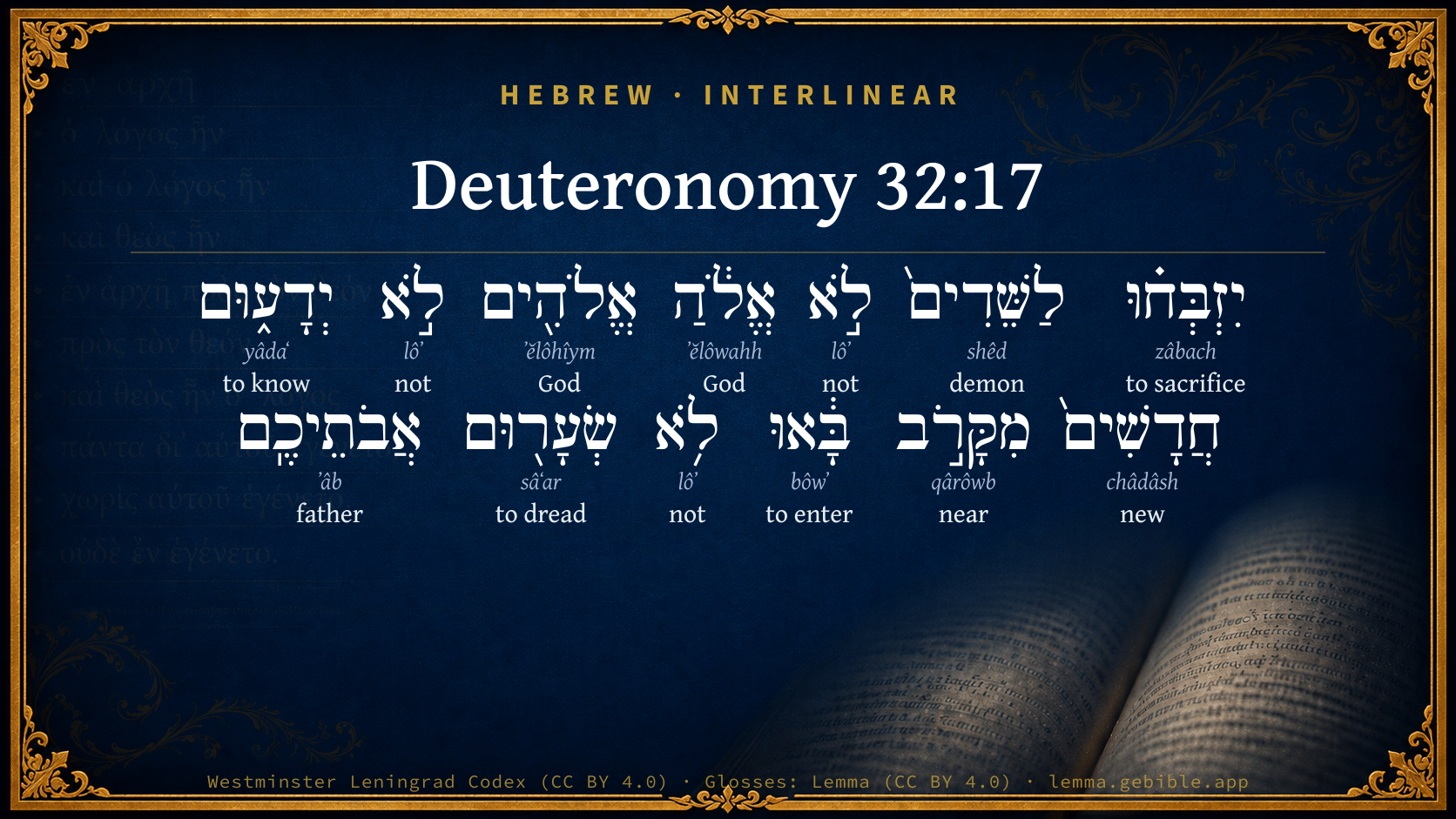
Hebrew (Westminster Leningrad Codex) Deuteronomy 32:17 appears in the Hebrew Old Testament. The text above is from the Westminster Leningrad Codex. Each word links to its Strong’s number, a concise gloss, and parsing drawn from the Open Scriptures Hebrew Bible morphology. Click any word for its full Brown-Driver-Briggs (BDB) entry.
Download image
Cite this verse

Deuteronomy 32:17 (World English Bible). Public Domain. Lemma interlinear Bible study tool, https://lemma.gebible.app/v/deuteronomy/32/17.

Show BibTeX & RIS
BibTeX
RIS
English Translation
They sacrificed to demons, [which were] no God, To gods that they didn't know, To new [gods] that came up of late, Which your fathers didn't dread.
World English Bible · Public Domain
Highlights
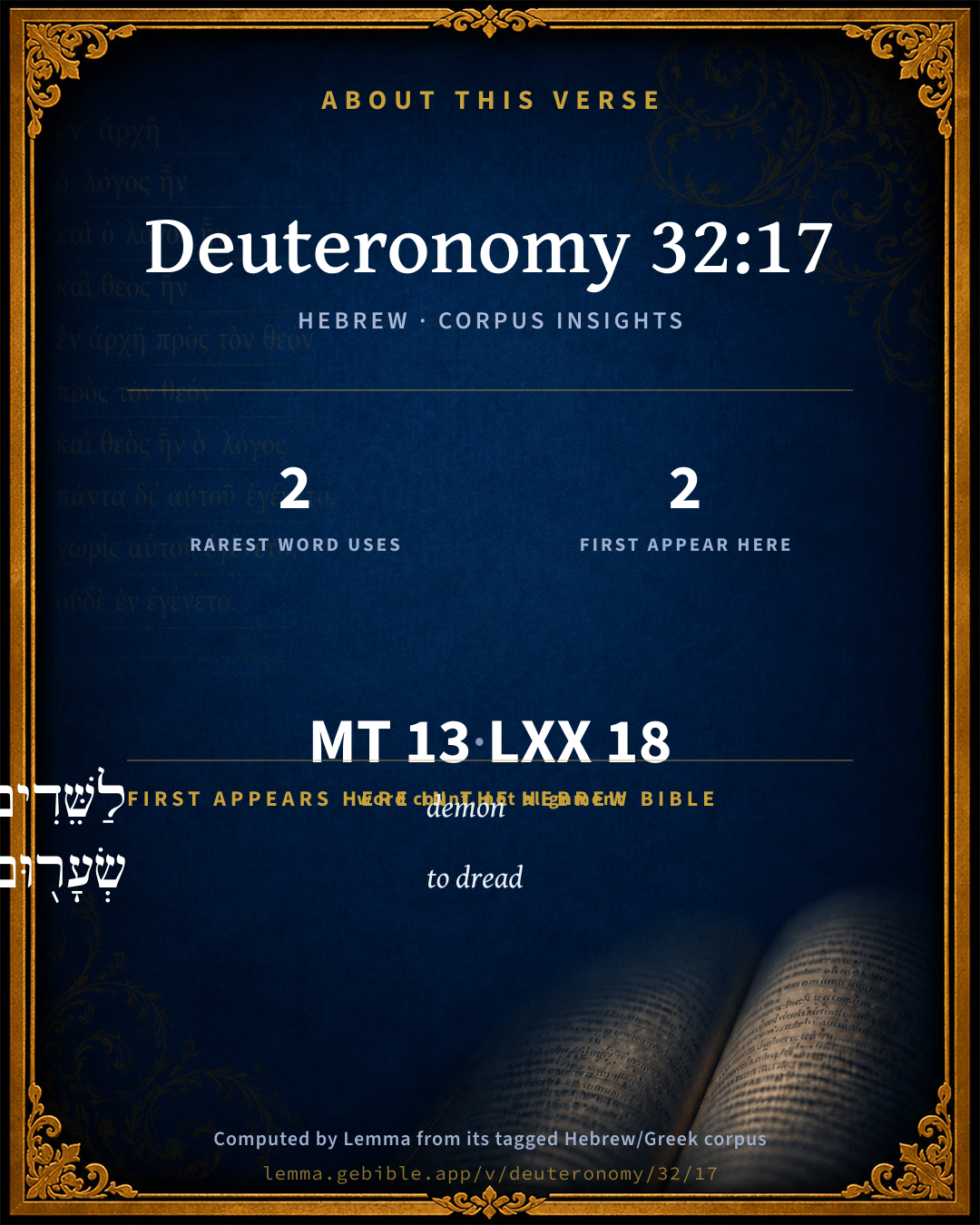
  • 2 first appearances in the Hebrew Bible
Full analysis ↓
Download a study sheet

One document with this verse’s original text, its word-by-word gloss line, the meaning frame, cross-references with their text, attributed commentary, and full source and license credits — printable, and it pastes into notes with its structure intact.

This verse Autodidact and up

Study sheet (.html) Plain text (.txt)

A passage Seminary Student

Up to 50 verses in one chapter. A passage sheet keeps up to 6 commentary sources and 12 cross-references per verse, in the order this page ranks them, and says so on the sheet whenever that leaves anything out. Ask for a single verse and you get the Autodidact verse sheet above.

Everything on this page stays free to read, with no account — the sheet is a download of what is already on screen, not access to it.

Want to remove ads? Support Godless Engineer
Compare translations 3

The same verse in 3 English versions, stacked beneath the original-language interlinear above. Click any original word for its lexicon entry.

Each is an independent rendering of the whole verse — the interlinear is not word-aligned to these translations.

Highlighted words mark where these versions differ — a whole-verse word diff, not a word-by-word alignment.

  • World English Bible Public Domain
    They sacrificed to demons, [which were] no God, To gods that they didn't know, To new [gods] that came up of late, Which your fathers didn't dread.
  • King James Version Public Domain
    They sacrificed unto devils, not to God; to gods whom they knew not, to new gods that came newly up, whom your fathers feared not.
  • unfoldingWord Literal Text CC BY-SA 4.0
    They sacrificed to demons, not God, gods they had not known, new ones come recently, your fathers had not feared.

unfoldingWord Literal Text — © unfoldingWord, licensed CC BY-SA 4.0. Word-aligned USFM3 via Door43 (git.door43.org/unfoldingWord/en_ult).

Versions to compare (up to 4)

3 of 4 selected

Show all 18 translations

Every available English version of this verse, each an independent rendering of the whole verse.

  • World English Bible Public Domain
    They sacrificed to demons, [which were] no God, To gods that they didn't know, To new [gods] that came up of late, Which your fathers didn't dread.
  • Berean Standard Bible Public Domain
    They sacrificed to demons, not to God, to gods they had not known, to newly arrived gods, which your fathers did not fear.
  • Majority Standard Bible Public Domain
    They sacrificed to demons, not to God, to gods they had not known, to newly arrived gods, which your fathers did not fear.
  • King James Version Public Domain
    They sacrificed unto devils, not to God; to gods whom they knew not, to new gods that came newly up, whom your fathers feared not.
  • American Standard Version (1901) Public Domain
    They sacrificed unto demons, `which were' no God, To gods that they knew not, To new `gods' that came up of late, Which your fathers dreaded not.
  • Revised Version (1885) Public Domain
    They sacrificed unto demons, which were no God, To gods whom they knew not, To new gods that came up of late, Whom your fathers dreaded not.
  • Geneva Bible (1599) Public Domain
    They offred vnto deuils, not to God, but to gods whome they knew not: new gods that came newly vp, whome their fathers feared not.
  • Douay-Rheims (1899) Public Domain
    They sacrificed to devils and not to God: to gods whom they knew not: that were newly come up, whom their fathers worshipped not.
  • Young's Literal Translation Public Domain
    They sacrifice to demons -- no god! Gods they have not known -- New ones -- from the vicinity they came; Not feared them have your fathers!
  • Literal Standard Version CC BY-SA 4.0
    They sacrifice to the demons, not God, || To gods they have not known, || New ones—they came from the vicinity; Your fathers have not feared them!
  • Unlocked Literal Bible CC BY-SA 4.0
    They sacrificed to demons, which are not God— gods they had not known, gods that recently appeared, gods your fathers did not fear.
  • unfoldingWord Literal Text CC BY-SA 4.0
    They sacrificed to demons, not God, gods they had not known, new ones come recently, your fathers had not feared.
  • Darby Bible Public Domain
    They sacrificed unto demons who are not +God; To gods whom they knew not, To new ones, who came newly up, Whom your fathers revered not.
  • World Messianic Bible Public Domain
    They sacrificed to demons, not God, to gods that they didn’t know, to new gods that came up recently, which your fathers didn’t dread.
  • Webster's Bible Public Domain
    They sacrificed to devils, not to God; to gods which they knew not, to new gods that came newly up, whom your fathers feared not.
  • Free Bible Version CC BY-SA 4.0
    You offered sacrifices to demons instead of God, to gods you didn't know anything about, to brand-new gods that your forefathers didn't worship.
  • Bible in Basic English Public Domain
    They made offerings to evil spirits which were not God, to gods who were strange to them, which had newly come up, not feared by your fathers.
  • JPS Tanakh (1917) Public Domain
    They sacrificed unto demons, no-gods, gods that they knew not, new gods that came up of late, which your fathers dreaded not.

Literal Standard Version (2020), Covenant Press — licensed CC BY-SA 4.0. Text via the HelloAO Bible API (eBible.org). Unlocked Literal Bible (unfoldingWord) — licensed CC BY-SA 4.0. Text via the HelloAO Bible API (eBible.org). unfoldingWord Literal Text — © unfoldingWord, licensed CC BY-SA 4.0. Word-aligned USFM3 via Door43 (git.door43.org/unfoldingWord/en_ult). Free Bible Version, Dr. Jonathan Gallagher — licensed CC BY-SA 4.0. Text via the HelloAO Bible API (eBible.org).

Word by word

More ways to search: Search by grammar → Find every occurrence → Compare this word →

Practice this passage: Drill this verse → Learn its vocabulary →

לַשֵּׁדִים֙
shêd
H7700
“to/for the · demons”
Preposition, Determined + Noun, Common, Masculine, Plural, Absolute
Part of Speech
Preposition + Noun
Type
Common
Gender
Masculine
Number
Plural
State
Absolute
Full BDB Definition

Origin: from H7736

TWOT: 2330

demon
  1. יִזְבְּח֗וּ zâbach H2076 “to sacrifice” Verb, Qal, Imperfect, 3rd Person, Masculine, Plural
  2. לֹ֣א lôʼ H3808 “not” Particle, Negative
  3. אֱלֹ֔הַ ʼĕlôwahh H433 “God” Noun, Common, Masculine, Singular, Absolute
  4. אֱלֹהִ֖ים ʼĕlôhîym H430 “God(s)” Noun, Common, Masculine, Plural, Absolute
  5. לֹ֣א lôʼ H3808 “not” Particle, Negative
  6. יְדָע֑וּם yâdaʻ H3045 “to know · them” Verb, Qal, Perfect, 3rd Person, Common, Plural + Suffix, Personal, 3rd Person, Masculine, Plural
  7. חֲדָשִׁים֙ châdâsh H2319 “new” Adjective, Adjective, Masculine, Plural, Absolute
  8. מִקָּרֹ֣ב qârôwb H7138 “from · near” Preposition + Adjective, Adjective, Masculine, Singular, Absolute
  9. בָּ֔אוּ bôwʼ H935 “to enter” Verb, Qal, Perfect, 3rd Person, Common, Plural
  10. לֹ֥א lôʼ H3808 “not” Particle, Negative
  11. שְׂעָר֖וּם sâʻar H8175 “to dread · them” Verb, Qal, Perfect, 3rd Person, Common, Plural + Suffix, Personal, 3rd Person, Masculine, Plural
  12. אֲבֹתֵיכֶֽם ʼâb H1 “fathers · your” Noun, Common, Masculine, Plural, Construct + Suffix, Personal, 2nd Person, Masculine, Plural

About this verse

These counts appear in no published source. They are computed here, from the morphology-tagged text and Lemma’s own curated glosses. What Lemma adds →

13
words
11
distinct lemmas
Pentateuch
section

Notable vocabulary

The rarest word here is לַשֵּׁדִים֙ demon H7700 — appearing just 2 times in the whole Hebrew Bible.

First appearance in Scripture

These words make their first canonical appearance in the Hebrew Bible here:

  • לַשֵּׁדִים֙ demon H7700
  • שְׂעָר֖וּם to dread H8175

Shared distinctive vocabulary

לַשֵּׁדִים֙ demon H7700 occurs in 2 verses of the Hebrew Bible. Also found in:

Grammatical profile

  • 4 verbs
  • 4 nouns
  • 2 adjectives
  • 3 particles

Verb forms

  • יִזְבְּח֗וּ Qal · Imperfect
  • יְדָע֑וּם Qal · Perfect
  • בָּ֔אוּ Qal · Perfect
  • שְׂעָר֖וּם Qal · Perfect

Repetition

A word recurs within this verse — often emphatic in Hebrew:

Hebrew & Septuagint length

In English translation the verse runs 27 words from the Hebrew and 25 from the Septuagint (LXX English) — closely comparable.

A rough comparison of the two English renderings, which tokenize alike — not a word-level alignment.

Word counts can differ between the Hebrew and the Greek without any difference in meaning — e.g. the Hebrew direct-object marker אֵת has no separate Greek word, and Greek often adds the article ὁ.

In the original languages it is 13 Hebrew tokens and 18 Greek tokens — but the two are counted differently (Hebrew bundles its prefixes and suffixes into one token; the Greek is in lemma form), so that isn’t a like-for-like length.

Cross-references

11

Topical passages linked to Deuteronomy 32:17 in the Treasury of Scripture Knowledge — connected by theme and wording, ordered by reader-vote popularity; previews shown in the World English Bible.

  • Deuteronomy 28:64 Yahweh will scatter you among all peoples, from the one end of the earth even to the other end of the earth; and there you shall serve other gods, which you have not known, you nor your fathers, even wood and stone.
  • Judges 5:8 They chose new gods; Then was war in the gates: Was there a shield or spear seen Among forty thousand in Israel?
  • Leviticus 17:7 They shall no more sacrifice their sacrifices to the goat idols, after which they play the prostitute. This shall be a statute forever to them throughout their generations.'
  • Deuteronomy 32:21 They have moved me to jealousy with that which is not God; They have provoked me to anger with their vanities: I will move them to jealousy with those who are not a people; I will provoke them to anger with a foolish nation.
  • Psalms 106:37–38 Yes, they sacrificed their sons and their daughters to demons.
  • Isaiah 44:8 Don't fear, neither be afraid: haven't I declared to you of old, and shown it? You are my witnesses. Is there a God besides me? Indeed, there is not. I don't know any Rock.
  • 1 Timothy 4:1 But the Spirit says expressly that in later times some will fall away from the faith, paying attention to seducing spirits and doctrines of demons,
  • Jeremiah 10:15 They are vanity, a work of delusion: in the time of their visitation they shall perish.
  • 1 Corinthians 8:4 Therefore concerning the eating of things sacrificed to idols, we know that no idol is anything in the world, and that there is no other God but one.
  • 1 Corinthians 10:19–20 What am I saying then? That a thing sacrificed to idols is anything, or that an idol is anything?
  • Revelation 9:20 The rest of mankind, who were not killed with these plagues, didn't repent of the works of their hands, that they wouldn't worship demons, and the idols of gold, and of silver, and of brass, and of stone, and of wood; which can neither see, nor hear, nor walk.

Cross-references courtesy of OpenBible.info (CC BY 4.0).

Hebrew and Greek witnesses Masoretic Hebrew ↔ Greek Septuagint

The same verse in the two great witnesses to the Old Testament, shown verse-for-verse.

These are two independent witnesses, not word-aligned to each other, and the Septuagint is shown in lemma (dictionary) form.

Hebrew Deuteronomy 32:17 Masoretic · Westminster Leningrad Codex

יִזְבְּח֗וּ לַשֵּׁדִים֙ לֹ֣א אֱלֹ֔הַ אֱלֹהִ֖ים לֹ֣א יְדָע֑וּם חֲדָשִׁים֙ מִקָּרֹ֣ב בָּ֔אוּ לֹ֥א שְׂעָר֖וּם אֲבֹתֵיכֶֽם

They sacrificed to demons, [which were] no God, To gods that they didn't know, To new [gods] that came up of late, Which your fathers didn't dread.

World English Bible · Public Domain

Greek LXX Deuteronomy 32:17 Septuagint · lemma form

θύω δαιμόνιον καί οὐ θεός θεός ὅς οὐ οἶδα καινός πρόσφατος ἥκω ὅς οὐ οἶδα ὁ πατήρ αὐτός

They sacrificed to devils, and not to God; to gods whom they knew not: new and fresh gods came in, whom their fathers knew not.

LXX2012 (modern English Septuagint) · Public Domain

On this verse, Adam Clarke's Commentary discusses the Septuagint’s reading. Read the note in Commentary ↓

Hebrew: Westminster Leningrad Codex (CC BY 4.0). Greek: Septuagint (public domain); English from LXX2012 (modern English Septuagint) (Public Domain). How the Septuagint differs from the Hebrew →

Targum (Aramaic paraphrase)

2

The Targum is the ancient Jewish Aramaic paraphrase of the Hebrew Scriptures — an interpretive translation, not the Hebrew text itself. Onkelos (literal) and Pseudo-Jonathan (expansive) render the Torah, and Jonathan the Prophets. Coverage is partial: where no permissively-licensed English translation exists for a verse, only the Aramaic is shown. This is verse-level text, not a word-by-word alignment to the Hebrew.

  1. Targum Onkelos Torah (Genesis–Deuteronomy)
    דבָּחוּ לשֵׁדין דִלֵית בְּהוֹן צְרוֹךְ דַחֲלָן דְלָא יְדָעֻנוּן חַדְתִּין דִי מִקָרִיב אִתְעֲבִידוּ לָא אִתְעַסְקוּ בְהוֹן אֲבָהָתְכוֹן

    (no public-domain English translation for this verse)

    Targum Onkelos — Aramaic: “Onkelos Genesis” (public domain); “Onkelos Exodus” (public domain); “Onkelos Leviticus” (public domain); “Onkelos Numbers” (public domain); “Onkelos Deuteronomy” (public domain). English: “Sefaria Community Translation” (CC0 1.0 (public-domain dedication)); “J.W. Etheridge. The Targums of Onkelos and Jonathan Ben Uzziel on the Pentateuch. London: Longmans, Green, 1862” (public domain). Text via Sefaria.

  2. Targum Pseudo-Jonathan Torah (Genesis–Deuteronomy)
    יְדַבְּחוּן לְטַעֲווֹת דִמְתִילִין לְשֵׁידִין דְלֵית בְּהוֹן מִדַעַם דִצְרִיךְ טַעֲוָון דְלָא יַדְעוּנוּן דַחֲלָן חֲדַתַּן דִמִזְמַן קָרִיב אִתְעֲבִידוּ וְלָא אִתְעַסְקוּ בְּהוֹן אַבְהַתְכוֹן

    They sacrificed to idols, resembling devils, in whom there is no profit, to idols which they had not known, new gods lately made, with which your fathers had nothing to do;

    Targum Pseudo-Jonathan — Aramaic: “Targum Jonathan on Genesis” (public domain); “Targum Jonathan on Exodus” (public domain); “Targum Jonathan on Leviticus” (public domain); “Targum Jonathan on Numbers” (public domain); “Targum Jonathan on Deuteronomy” (public domain). English: “The Targum of Jonathan ben Uzziel, trans. J. W. Etheridge, London, 1862” (public domain). Text via Sefaria.

Commentary

Notes on Deuteronomy 32:17 from classic Christian and Jewish commentators (each source and its license shown beneath its notes). The classic Christian expositions comment on the surrounding passage and are grouped to its opening verse, so a note may address several verses; the Jewish commentaries on the Tanakh (Rashi and others) are per-verse, so they appear only where the commentator wrote on this verse.

Lemma curates 59 commentaries, every one of them public domain or Creative Commons licensed, each selected and text-cleaned for this edition rather than reprinted as found. About our sources →

Trapp's Complete Commentary

John Trapp

Deu 32:17 They sacrificed unto devils, not to God; to gods whom they knew not, to new [gods that] came newly up, whom your fathers feared not.

Ver. 17. They sacrificed unto devils.] {See Trapp on "Lev 17:7"}

To new gods that came newly up.] Such as are all Popish he-saints and she-saints; concerning whom Bellarmine himself cannot but yield, that Cum scriberentur Scripturae, nondum coeperat usus vovendi Sanctis. {a} There was no vowing, or bowing either, to saints departed, when the Scriptures were written. And a loaf of the like leaven are those new lights, and all subtleties, whereby our sectaries would distinguish themselves from Brownists. Are they not all, or most of them, borrowed out of Mr H. Jacob’s books, who was but of yesterday? The Antinomians usually call upon their hearers to mark; it may be they shall hear some new truth that they never heard before; when the thing is either false, or, if true, no more than ordinarily is taught by others.

{a} Bellarm. de cultu sanct., cap. 5.

John Trapp, A Commentary or Exposition upon All the Books of the Old and New Testament (1647–1656) — public domain. Text from a community e-Sword module.

The Biblical Illustrator

Joseph S. Exell

Deu_32:17

They sacrificed unto devils.

Devil worship

I. The devil of sensuality. This includes intemperance, debauchery, and the gratification of all the lower animal appetites. Do not men everywhere sacrifice intellect, genius, time, money, health, and even life itself at its infernal shrine?

II. The devil of avarice. Greed of gain, desire for wealth, is the inspiration of millions in this mercenary age. Truth, honesty, conscience, self-respect, moral freedom, peace, and honour are all sacrificed to this grim deity.

III. The devil of vanity. Love of show, desire for popular applause. Fortunes are sacrificed to this devil.

IV. The devil of sectarianism. A greater devil than this can scarcely be found. To it men sacrifice truth, charity, moral nobleness. (Homilist.)

The Biblical Illustrator, edited by Joseph S. Exell (c. 1880s–1900s) — public domain. Text from a community e-Sword module.

Tyndale Open Study Notes

Tyndale Open Resources

32:17 demons: In the ancient Near East, the gods were thought to protect individuals and places from harm, but worshiping these pagan deities actually amounted to worshiping evil spirits (cp. 1 Cor 10:20-21; Rev 9:20). • New gods were false deities that Israel had never before encountered.

Tyndale Open Study Notes — © Tyndale Open Resources, licensed CC BY-SA 4.0. Text via the HelloAO Bible API.

Geneva Bible (1599)

Geneva Bible translators

Scripture calleth new, whatsoever man inventeth, be the error never so old.

Geneva Bible (1599) marginal notes — public domain. Text via Bolls.life.

Jamieson, Fausset & Brown

Robert Jamieson, A. R. Fausset & David Brown

They sacrificed unto devils--(See on Lev 17:7).

Jamieson, Fausset & Brown — Commentary Critical and Explanatory on the Whole Bible (1871) — public domain (CC PDM 1.0). Text via the HelloAO Bible API.

Adam Clarke's Commentary

Verse 17. They sacrificed unto devils] The original word שדים shedim has been variously understood. The Syriac, Chaldee, Targums of Jerusalem and Jonathan, and the Samaritan, retain the original word: the Vulgate, Septuagint, Arabic, Persic, Coptic, and Anglo-Saxon, have devils or demons. The Septuagint has εθυσαν δαιμονιοις, they sacrificed to demons: the Vulgate copies the Septuagint: the Arabic has [Arabic] sheeateen, the plural of [Arabic] Sheetan, Satan, by which the rebellious angels appear to be intended, as the word comes from the root [Arabic] shatana, he was obstinate, proud, refractory, went far away. And it is likely that these fallen spirits, having utterly lost the empire at which they aimed, got themselves worshipped under various forms and names in different places. The Anglo-Saxon has [Anglo-Saxon], devils.

New gods that came newly up] מקרב באו mikkarob bau, "which came up from their neighbours;" viz., the Moabites and Amorites, whose gods they received and worshipped on their way through the wilderness, and often afterwards.

Adam Clarke's Commentary on the Bible (1810–1826) — public domain. Text from a community e-Sword/MySword module.

Ellicott's Commentary for English Readers

(17) They sacrificed unto devils, not to God.—St. Paul repeats this expression in 1Co_11:20.

Gods that came newly up.—Literally, that came from close at hand. Compare the description of the idol in Isa_44:15, easily made from the firewood; and see also Wis_13:13, “A carpenter taking a crooked piece of wood, and full of knots, hath carved it diligently, when he had nothing else to do”—a comment on the passage in Isaiah 44

A Bible Commentary for English Readers, edited by Charles John Ellicott (1878–1897) — public domain. Text from a community e-Sword module.

The Cambridge Bible for Schools and Colleges

gen. ed. J. J. S. Perowne

17. demons] Heb. shedîm, only here and in Psa_106:37, ‘certainly a Babylonian loan-word,’ shedu, a good demon figured in the bull-colossi that guarded the entrances to temples (Zimmern, KAT3[152], 455 f., 460–2, 649); but according to Psa_106:37 human sacrifices were offered them, which of course does not preclude the idea that they were protective spirits.

[152] Die Keilinschriften und das AIte Testament, 3rd edition (1903), by H. Zimmern and H. Winckler.

no God] Heb. ’Eloah as in Deu_32:15.

whom they had not known] Deu_11:28, Deu_13:2; Deu_13:6; Deu_13:13, Deu_28:64.

new ones lately come in] Or arrived.

dreaded] Lit. bristled or shuddered at, Heb. sacar, as in Jer_2:12, Eze_27:35; Eze_32:10. Some, however, translate knew, on the strength of the Ar. sacara.

The Cambridge Bible for Schools and Colleges (gen. ed. J. J. S. Perowne; Cambridge University Press, 1878–1918) — public domain. Text from a community e-Sword module.

John Gill's Exposition

Of the rock that begat thee thou art unmindful,.... The same with the rock of salvation, Deu 32:15; repeated and expressed in different words, that their wretched ingratitude might be taken notice of and observed: begetting is ascribed to this rock, as regeneration is to Christ, Jo1 2:29; and was true of some among the Jews: some choose to render the words, "the rock of thy kindred" (k); being a near kinsman, a brother through his incarnation, which aggravated their unmindfulness of him:

and hast forgotten God that formed thee: for the rock they were unmindful of and forgot is the true God and eternal life, the essential Word of God, as both the Targums of Jonathan and Jerusalem interpret it; him the Jewish nation forgot; they forgot the characters given of him in the promises and prophecies of the Old Testament; and therefore they knew him not when he came and fulfilled the voices of the prophets they were ignorant of in condemning him: hence they were unmindful of his person, his offices, his works, his benefits, and the great salvation by him; as indeed too many are that call themselves Christians: some observe that the word here used signifies bringing forth children with pain, and so way respect the bitter sorrows and sufferings of Christ, sometimes expressed by a word (l) which signifies the pains of women in childbirth, Act 2:24; and called the travail of his soul, Isa 53:11; and so a further aggravation of their ingratitude, that they should forget him that suffered so much, at least on account of some of them; for, those he endured to bring forth children unto God, or to gather together the children of God, scattered abroad both in Judea and in the whole world, Joh 11:51.

(k) "rupem cognationis tuae", i.e. "fratrum tuorum", Van Till; see Rom. ix. 4, 5. (l) "parturientis te", Montanus; "parturitorem tuum", Van Till.

John Gill's Exposition of the Whole Bible (1746–1763) — public domain (CC PDM 1.0). Text via the HelloAO Bible API.

Haydock's Catholic Bible Commentary

Devils. Hebrew, "to the destroyers, or to those of the fields." See Leviticus xvii. 7., and Baruch iv. 7, 35. (Calmet) --- Knew not. Septuagint, "revered not." (Haydock) --- Hebrew may be, "who knew them not," who had bestowed nothing upon them, chap. xxix. 26. --- Come up. Hebrew, "of the neighbourhood;" gods whose origin they knew, (Calmet) as well as the people who had given them that title; (Haydock) gods of human invention. (Menochius) --- Novelty allureth to the worship of idols and to heresy. (Worthington)

George Leo Haydock (1774–1849), Haydock's Catholic Family Bible and Commentary, 1859 edition — public domain. Excludes Psalms (Douay-Rheims chapter numbering differs from Protestant) and Deuterocanonical books (Catholic canon only).

Matthew Poole's English Annotations

Unto devils, i.e. unto idols, which the devils brought into the world in opposition to God, in and by which the devils ofttimes manifested themselves unto men, and gave them answers, and received their worship. Compare 1Co 10:20. The Gentiles pretended to worship God in those idols, and the devils which inspired them deluded the nations with false pretences that they were a sort of lower gods. Moses therefore takes off this mask, and shows the Israelites that these pretended gods were really devils, those great enemies of mankind, and therefore that it was the height of madness to honour or worship them.

Not to God: this he saith, either because though at first they joined God and idols together in worship, yet at last they quite forsook God, and adhered to idols only; or because God utterly rejected those sacrifices which they offered to him together with idols, and took them for no sacrifices. See 1Co 10:21.

Whom they knew not, or, who never knew them, i.e. never showed any kindness to them, or did them any good; for so words of knowledge are oft used, as Psa 1:6; Hos 13:5.

That came newly up; not simply or absolutely, for some of these gods had been worshipped for many generations, and had a fair pretence of long antiquity, but comparatively to the true God, who is the Ancient of days, Dan 7:9, and who was worshipped from the beginning of the world. To this original and first antiquity Moses recalls them; as also our Saviour doth recall the Jews to the first institution, Mat 19:8. And therefore we may safely follow both their patterns in despising all pretences of antiquity, which are contrary to God’s first institutions contained (as all confess) in the Holy Scriptures.

Whom your fathers feared not, i.e. served not, worshipped not, but justly despised and abhorred them.

Matthew Poole's English Annotations on the Holy Bible (1683–1685) — public domain. Text from a community e-Sword/MySword module.

Whedon's Commentary on the Bible

Daniel D. Whedon

17. They sacrificed unto devils, not to God — The word rendered devils is destroyers; Sept. δαιμονια: wicked spirits, demons. The people of God will leave his service, and worship at the shrines of the gods of the heathen.

Daniel D. Whedon (gen. ed.), Commentary on the Old and New Testaments (1874–1909) — public domain. Text from a community e-Sword module.

The Pulpit Commentary

Devils; shedim, a word which occurs only here and in Psa_106:37. It stands connected with the verb dWv, to rule, and means primarily "lords." The LXX render by daimo demons. In Assyrian it is said to be a name for demigods. Not to God; rather, to a not God, a composite term in apposition to shedim; the meaning is rightly given in the margin of the Authorized Version, "which were not God." To new gods that came newly up. The word rendered by "newly" (bwOrq) properly means "near;" it is an adjective both of place and of time; here it is the latter, equal to of a near time, recently gods recently invented or discovered.

The Pulpit Commentary (1880–1919), ed. H.D.M. Spence-Jones & Joseph S. Exell — public domain. Text from a community e-Sword module.

John Wesley's Explanatory Notes

Unto devils - Unto idols, which the devils brought into the world in opposition to God, in and by which the devils often manifested themselves to men, and gave them answers, and received their worship. The Gentiles pretended to worship God in those idols, and the devils which inspired them, deluded the nations with pretenses that they were a sort of lower gods. Moses takes off this mark, and shews the Israelites that these pretended gods were really devils, and therefore that it was the height of madness to honour or worship them. Not to God - For God utterly rejected those sacrifices which they offered to him together with idols. They knew not - Or, who never knew them, that is, never shewed any kindness to them, or did them any good: New gods - Not simply or absolutely, for some of these had been worshipped for many generations, but comparatively to the true God, who is the ancient of days, chap. vii, 9, and who was worshipped from the beginning of the world. Feared not - Served not, worshipped not.

John Wesley, Explanatory Notes Upon the Whole Bible (1754–1765) — public domain. Text via the GEBible commentary corpus.

unfoldingWord translationNotes

Door43 World Missions Community

General Information:

Moses continues to speak his song to the Israelites. (See: Forms of You)

They sacrificed

"The people of Israel sacrificed"

gods that recently appeared

This means the Israelites recently learned about these gods.

your fathers

Moses is speaking to the Israelites as many people, so the word "your" is plural. (See: Forms of You)

You have deserted ... your father ... you forgot ... gave you

Moses is speaking to the Israelites as if they were one man, so all instances of "you" and "your" are singular. (See: Forms of You)

You have deserted the Rock

Here Yahweh is called the rock because he is strong and protective. AT: "You have left the protective care of Yahweh" (See: Metaphor)

the Rock

This a proper name that Moses gives to Yahweh, who, like a rock, is strong and able to protect his people. See how you translated this in Deuteronomy 32:4. (See: Metaphor)

who became your father ... who gave you birth

This compares Yahweh to a father and a mother. This means God caused them to live and to be a nation. AT: "who fathered you ... who gave life to you" (See: Metaphor)

translationWords

sacrifice

demon

God

false god

know

ancestor

fear

unfoldingWord translationNotes — © Distant Shores Media and the Door43 World Missions Community, licensed CC BY-SA 4.0. Source: git.door43.org/Door43/en_tn.

Rashi

Rabbi Shlomo Yitzchaki (Rashi)

לא אלה — Understand this as the Targum does: They sacrifice unto devils in which is no utility, for if there were at least any utility in them to the world (as e.g:, the sun, moon and stars) God’s jealousy would not have been so intense (lit. — doubled) as it is now. (Sifrei Devarim 318:13).

חדשים מקרב באו [THEY SACRIFICED … TO GODS] THAT CAME UP RECENTLY — i.e. with which even the heathen nations were not familiar. Indeed, if a heathen saw them he would say, “This is a Jewish idol” (Sifrei Devarim 318:14).

לא שערום אבתיכם — This means, which your fathers feared not; more literally it means: Their hair (שער) did not stand up on end because of them — for it is the nature of a person’s hair to stand up out of fear. Thus is it (the word שערום) explained in Sifrei Devarim 318:15. But it is also possible to explain it as being connected with the noun in (Isaiah 13:21) “And שעירים shall dance there”; שעירים are demons (satyrs), and the meaning of our verse would then be: your fathers never made these satyrs.

Rashi on the Tanakh — English translations: “The Judaica Press complete Tanach with Rashi, translated by A. J. Rosenberg” (CC BY 4.0); “Pentateuch with Rashi's commentary by M. Rosenbaum and A.M. Silbermann, 1929-1934” (public domain); “The Metsudah Tanach series, Lakewood, N.J” (CC BY 4.0); and “The Book of Joshua, Metsudah Publications, 1997” (CC BY 4.0). Text via Sefaria.

Ramban (Nachmanides)

Rabbi Moshe ben Nachman (Ramban / Nachmanides)

THEY SACRIFICED UNTO THE DEMONS, NO-GODS. I have [already] explained this.

Ramban (Nachmanides) on the Tanakh — English translation: “Commentary on the Torah by Ramban (Nachmanides). Translated and annotated by Charles B. Chavel. New York, Shilo Pub. House, 1971-1976” (CC BY 4.0). Text via Sefaria.

Lesson kit

Teaching starters — assembled from the data on this page, not authored interpretation. Every prompt links to the verse data it draws on. Edit before teaching.

Deuteronomy, in the Pentateuch, opens this verse with 13 words (11 distinct Hebrew lemmas). Its most distinctive word is shêd (“demon”). A historical commentator’s framing appears above. Read the whole chapter for the surrounding context.

Discussion questions

  1. How does “demon” (shêd) shape what this verse is saying?
  2. 2 words here appear for the first time in Scripture. What is being introduced at this debut?
  3. Psalms 106:37 shares the word «demon» with this verse. How do the two illuminate each other?
  4. “not” occurs 3× in this one verse. What is the effect of the repetition?
  5. These translations render this verse differently; the difference is in the English rendering, not the original. What questions does that raise?
  6. The verb «יִזְבְּח֗וּ» is Qal Imperfect. How does its form color the action?
  7. Reading how Trapp's Complete Commentary and The Biblical Illustrator read this verse, where do the two commentators agree and where do they part?

Things to notice

Reading settings

Reading text

Shown beneath each verse's original-language words.

Old Testament
Old Testament edition

Read the OT as the Masoretic Hebrew (MT) or the Greek Septuagint (LXX).

English shown for the Greek Septuagint (in the Hebrew ↔ Greek comparison).

Comparing translations? Open the Compare panel on any verse page to stack up to four side by side.