Psalms 127:5

Hebrew (Westminster Leningrad Codex) Psalms 127:5 appears in the Hebrew Old Testament. The text above is from the Westminster Leningrad Codex. Each word links to its Strong’s number, a concise gloss, and parsing drawn from the Open Scriptures Hebrew Bible morphology. Click any word for its full Brown-Driver-Briggs (BDB) entry.
Download image
Cite this verse

Psalms 127:5 (World English Bible). Public Domain. Lemma interlinear Bible study tool, https://lemma.gebible.app/v/psalms/127/5.

Show BibTeX & RIS
BibTeX
RIS
English Translation
Happy is the man who has his quiver full of them. They won't be disappointed when they speak with their enemies in the gate.
World English Bible · Public Domain
Download a study sheet

One document with this verse’s original text, its word-by-word gloss line, the meaning frame, cross-references with their text, attributed commentary, and full source and license credits — printable, and it pastes into notes with its structure intact.

This verse Autodidact and up

Study sheet (.html) Plain text (.txt)

A passage Seminary Student

Up to 50 verses in one chapter. A passage sheet keeps up to 6 commentary sources and 12 cross-references per verse, in the order this page ranks them, and says so on the sheet whenever that leaves anything out. Ask for a single verse and you get the Autodidact verse sheet above.

Everything on this page stays free to read, with no account — the sheet is a download of what is already on screen, not access to it.

Want to remove ads? Support Godless Engineer
Compare translations 3

The same verse in 3 English versions, stacked beneath the original-language interlinear above. Click any original word for its lexicon entry.

Each is an independent rendering of the whole verse — the interlinear is not word-aligned to these translations.

Highlighted words mark where these versions differ — a whole-verse word diff, not a word-by-word alignment.

  • World English Bible Public Domain
    Happy is the man who has his quiver full of them. They won't be disappointed when they speak with their enemies in the gate.
  • King James Version Public Domain
    Happy is the man that hath his quiver full of them: they shall not be ashamed, but they shall speak with the enemies in the gate.
  • unfoldingWord Literal Text CC BY-SA 4.0
    The happinesses of the man who has filled his quiver of them! They will not have shame when they speak with adversaries in the gate.

unfoldingWord Literal Text — © unfoldingWord, licensed CC BY-SA 4.0. Word-aligned USFM3 via Door43 (git.door43.org/unfoldingWord/en_ult).

Versions to compare (up to 4)

3 of 4 selected

Show all 18 translations

Every available English version of this verse, each an independent rendering of the whole verse.

  • World English Bible Public Domain
    Happy is the man who has his quiver full of them. They won't be disappointed when they speak with their enemies in the gate.
  • Berean Standard Bible Public Domain
    Blessed is the man whose quiver is full of them. He will not be put to shame when he confronts the enemies at the gate.
  • Majority Standard Bible Public Domain
    Blessed is the man whose quiver is full of them. He will not be put to shame when he confronts the enemies at the gate.
  • King James Version Public Domain
    Happy is the man that hath his quiver full of them: they shall not be ashamed, but they shall speak with the enemies in the gate.
  • American Standard Version (1901) Public Domain
    Happy is the man that hath his quiver full of them: They shall not be put to shame, When they speak with their enemies in the gate. Psalm 128 A Song of Ascents.
  • Revised Version (1885) Public Domain
    Happy is the man that hath his quiver full of them: they shall not be ashamed, when they speak with their enemies in the gate.
  • Geneva Bible (1599) Public Domain
    Blessed is the man, that hath his quiuer full of them: for they shall not be ashamed, when they speake with their enemies in the gate.
  • Douay-Rheims (1899) Public Domain
    They that sow in tears shall reap in joy.
  • Young's Literal Translation Public Domain
    O the happiness of the man Who hath filled his quiver with them, They are not ashamed, For they speak with enemies in the gate!
  • Literal Standard Version CC BY-SA 4.0
    O the blessedness of the man || Who has filled his quiver with them, || They are not ashamed, || For they speak with enemies in the gate!
  • Unlocked Literal Bible CC BY-SA 4.0
    How blessed is the man that has his quiver full of them. He will not be put to shame when he confronts his enemies in the gate.
  • unfoldingWord Literal Text CC BY-SA 4.0
    The happinesses of the man who has filled his quiver of them! They will not have shame when they speak with adversaries in the gate.
  • Darby Bible Public Domain
    Happy is the man that hath filled his quiver with them. They shall not be ashamed when they speak with enemies in the gate.
  • World Messianic Bible Public Domain
    Happy is the man who has his quiver full of them. They won’t be disappointed when they speak with their enemies in the gate.
  • Webster's Bible Public Domain
    Happy is the man that hath his quiver full of them: they shall not be ashamed, but they shall speak with the enemies in the gate.
  • Free Bible Version CC BY-SA 4.0
    Happy is the father who fills his quiver with them! Such fathers will not be embarrassed when they confront their enemies at the city gate.
  • Bible in Basic English Public Domain
    Happy is the man who has a good store of them; he will not be put to shame, but his cause will be supported by them against his haters.
  • JPS Tanakh (1917) Public Domain
    Happy is the man that hath his quiver full of them; they shall not be put to shame, when they speak with their enemies in the gate.

Literal Standard Version (2020), Covenant Press — licensed CC BY-SA 4.0. Text via the HelloAO Bible API (eBible.org). Unlocked Literal Bible (unfoldingWord) — licensed CC BY-SA 4.0. Text via the HelloAO Bible API (eBible.org). unfoldingWord Literal Text — © unfoldingWord, licensed CC BY-SA 4.0. Word-aligned USFM3 via Door43 (git.door43.org/unfoldingWord/en_ult). Free Bible Version, Dr. Jonathan Gallagher — licensed CC BY-SA 4.0. Text via the HelloAO Bible API (eBible.org).

Word by word

More ways to search: Search by grammar → Find every occurrence → Compare this word →

Practice this passage: Drill this verse → Learn its vocabulary →

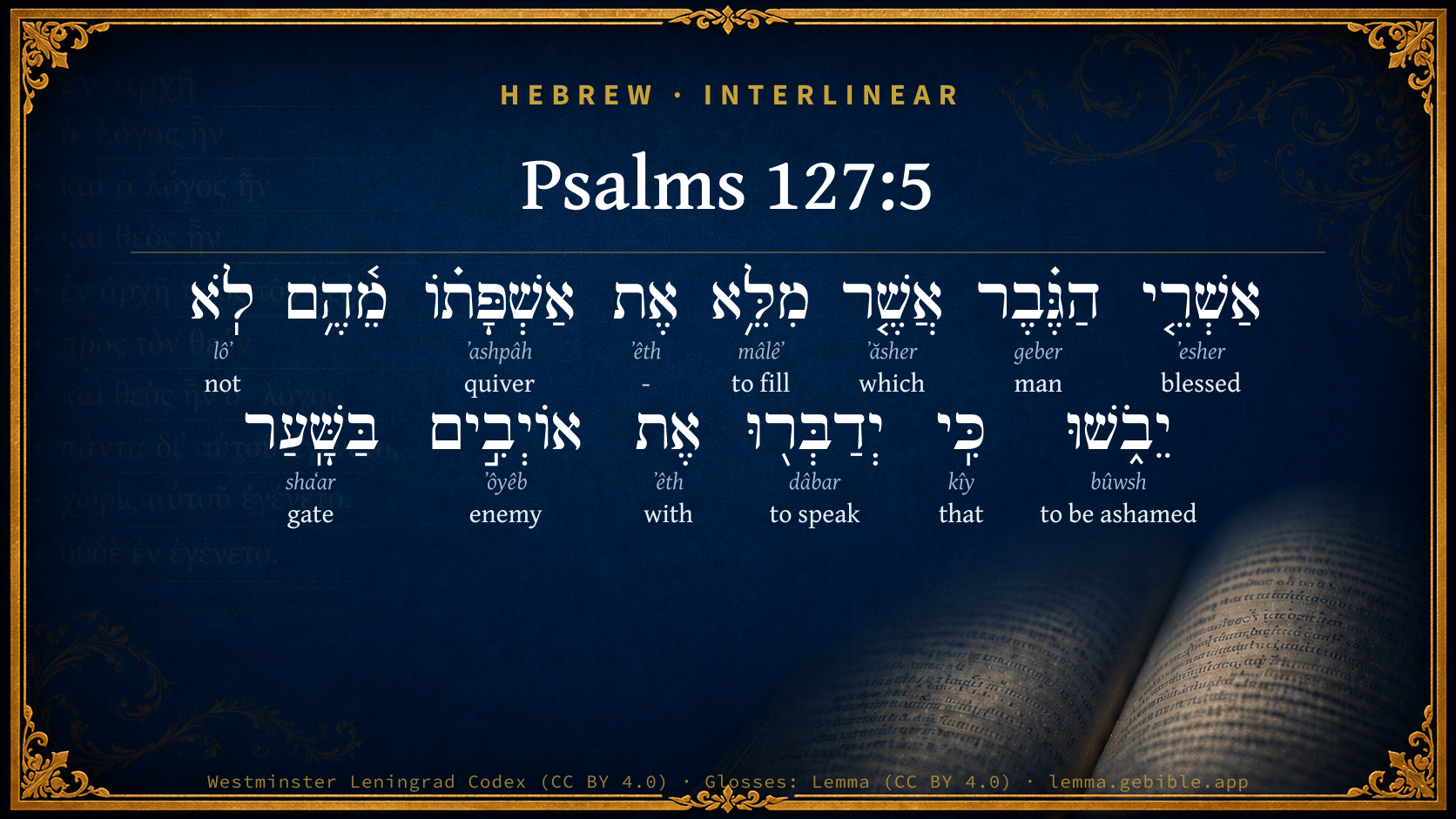
אַשְׁפָּת֗וֹ
ʼashpâh
H827
“quiver · his”
Noun, Common, Feminine, Singular, Construct + Suffix, Personal, 3rd Person, Masculine, Singular
Part of Speech
Noun
Type
Common
Gender
Feminine
Number
Singular
State
Construct
Full BDB Definition

Origin: perhaps from the same as H825 (in the sense of covering)

TWOT: 182a

quiver (for arrows) - of home, of God's instruments (figuratively)
  1. אַשְׁרֵ֤י ʼesher H835 “blessed” Noun, Common, Masculine, Plural, Absolute
  2. הַגֶּ֗בֶר geber H1397 “the · man” Particle, Definite Article + Noun, Common, Masculine, Singular, Absolute
  3. אֲשֶׁ֤ר ʼăsher H834 “which” Particle, Relative
  4. מִלֵּ֥א mâlêʼ H4390 “to fill” Verb, Piel, Perfect, 3rd Person, Masculine, Singular
  5. אֶת ʼêth H853 “-” Particle, Direct Object
  6. לֹֽא lôʼ H3808 “not” Particle, Negative
  7. יֵבֹ֑שׁוּ bûwsh H954 “to be ashamed” Verb, Qal, Imperfect, 3rd Person, Masculine, Plural
  8. כִּֽי kîy H3588 “that” Conjunction
  9. יְדַבְּר֖וּ dâbar H1696 “to speak” Verb, Piel, Imperfect, 3rd Person, Masculine, Plural
  10. אֶת ʼêth H854 “with” Preposition
  11. אוֹיְבִ֣ים ʼôyêb H341 “enemy” Verb, Qal, Participle Active, Masculine, Plural, Absolute
  12. בַּשָּֽׁעַר shaʻar H8179 “in/at the · gate” Preposition, Determined + Noun, Common, Masculine, Singular, Absolute

About this verse

These counts appear in no published source. They are computed here, from the morphology-tagged text and Lemma’s own curated glosses. What Lemma adds →

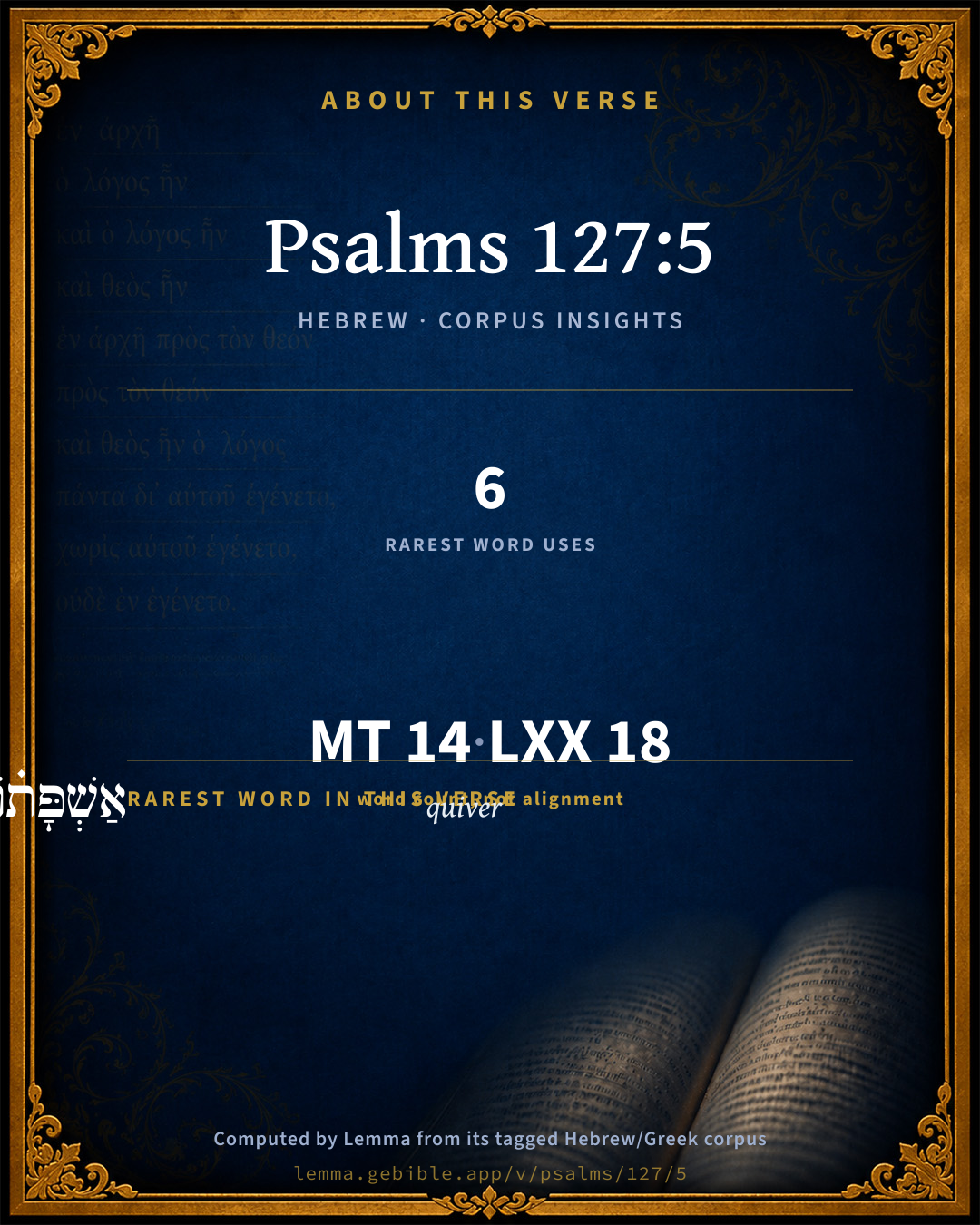
14
words
13
distinct lemmas
Wisdom
section

Notable vocabulary

The rarest word here is אַשְׁפָּת֗וֹ quiver H827 — appearing just 6 times in the whole Hebrew Bible.

Shared distinctive vocabulary

אַשְׁפָּת֗וֹ quiver H827 occurs in 6 verses of the Hebrew Bible. Also found in:

Grammatical profile

  • 4 verbs
  • 4 nouns
  • 2 prepositions
  • 1 conjunction
  • 3 particles

Verb forms

  • מִלֵּ֥א Piel · Perfect
  • יֵבֹ֑שׁוּ Qal · Imperfect
  • יְדַבְּר֖וּ Piel · Imperfect
  • אוֹיְבִ֣ים Qal · Participle Active

Hebrew & Septuagint length

In English translation the verse runs 24 words from the Hebrew and 26 from the Septuagint (LXX English) — closely comparable.

A rough comparison of the two English renderings, which tokenize alike — not a word-level alignment.

Word counts can differ between the Hebrew and the Greek without any difference in meaning — e.g. the Hebrew direct-object marker אֵת has no separate Greek word, and Greek often adds the article ὁ.

In the original languages it is 14 Hebrew tokens and 18 Greek tokens — but the two are counted differently (Hebrew bundles its prefixes and suffixes into one token; the Greek is in lemma form), so that isn’t a like-for-like length.

Cross-references

4

Topical passages linked to Psalms 127:5 in the Treasury of Scripture Knowledge — connected by theme and wording, ordered by reader-vote popularity; previews shown in the World English Bible.

  • Proverbs 27:11 Be wise, my son, And bring joy to my heart, Then I can answer my tormentor.
  • Job 42:12–16 So Yahweh blessed the latter end of Job more than his beginning. He had fourteen thousand sheep, six thousand camels, one thousand yoke of oxen, and a thousand female donkeys.
  • Genesis 50:23 Joseph saw Ephraim's children to the third generation. The children also of Machir, the son of Manasseh, were born on Joseph's knees.
  • Job 5:4 His children are far from safety, They are crushed in the gate. Neither is there any to deliver them,

Cross-references courtesy of OpenBible.info (CC BY 4.0).

Hebrew and Greek witnesses Masoretic Hebrew ↔ Greek Septuagint

The same verse in the two great witnesses to the Old Testament, shown verse-for-verse.

You’re reading Greek Psalm 126 (Hebrew Psalm 127). The Septuagint counts the superscription, so verse numbers can differ from the Hebrew — chapter-level alignment, not verse-by-verse. Numbering follows Rahlfs.

These are two independent witnesses, not word-aligned to each other, and the Septuagint is shown in lemma (dictionary) form.

Hebrew Psalms 127:5 Masoretic · Westminster Leningrad Codex

אַשְׁרֵ֤י הַגֶּ֗בֶר אֲשֶׁ֤ר מִלֵּ֥א אֶת אַשְׁפָּת֗וֹ מֵ֫הֶ֥ם לֹֽא יֵבֹ֑שׁוּ כִּֽי יְדַבְּר֖וּ אֶת אוֹיְבִ֣ים בַּשָּֽׁעַר

Happy is the man who has his quiver full of them. They won't be disappointed when they speak with their enemies in the gate.

World English Bible · Public Domain

Greek LXX Greek Psalm 126:5 Septuagint · lemma form

μακάριος ἄνθρωπος ὅς πληρόω ὁ ἐπιθυμία αὐτός ἐκ αὐτός οὐ κατααἰσχύνω ὅταν λαλέω ὁ ἐχθρός αὐτός ἐν πύλη

Blessed is the man who shall satisfy his desire with them: they shall not be ashamed when they shall speak to their enemies in the gates.

LXX2012 (modern English Septuagint) · Public Domain

On this verse, John Gill's Exposition discusses the Septuagint’s reading. Read the note in Commentary ↓

Hebrew: Westminster Leningrad Codex (CC BY 4.0). Greek: Septuagint (public domain); English from LXX2012 (modern English Septuagint) (Public Domain). How the Septuagint differs from the Hebrew →

Commentary

Notes on Psalms 127:5 from classic Christian and Jewish commentators (each source and its license shown beneath its notes). The classic Christian expositions comment on the surrounding passage and are grouped to its opening verse, so a note may address several verses; the Jewish commentaries on the Tanakh (Rashi and others) are per-verse, so they appear only where the commentator wrote on this verse.

Lemma curates 59 commentaries, every one of them public domain or Creative Commons licensed, each selected and text-cleaned for this edition rather than reprinted as found. About our sources →

Trapp's Complete Commentary

John Trapp

Psa 127:5 Happy [is] the man that hath his quiver full of them: they shall not be ashamed, but they shall speak with the enemies in the gate.

Ver. 5. Happy is the man that hath his quiver] That is, his house, full of them, so they be good children; for else to be childless is a mercy, it is ευτυχης ατυχια, a blessed misery, saith Euripides; and Aristotle concludeth that πολυγονια is no blessing, unless it be ευγενεια, that is, to have a numerous issue, unless they be virtuous.

They shall not be ashamed] Neither father nor children, se enim illi mutuo muniunt ac firmant, they help each other.

But they shall speak with the enemies] Periment, saith Tremellius, they shall foil them, and nonsuit them.

John Trapp, A Commentary or Exposition upon All the Books of the Old and New Testament (1647–1656) — public domain. Text from a community e-Sword module.

J. A. Alexander on Psalms

Joseph Addison Alexander

5. (Psa 127:5) Happy the man who has filled his quiver with them—they shall not be put to shame--they shall speak with adversaries in the gate. The first clause carries out the figure of arrows in the verse preceding. The mention of the gate, in the last clause, as the place both of commercial and judicial business, seems to mark a transition from martial to forensic conflict, and to shew that the enemies or adversaries here meant are adverse parties in litigation. See above, on Psa 69:12. For a striking contrast to this picture, see Job 5:4. This last example, although perfectly in keeping with the views of the ancient Israelites in general, seems peculiarly natural and life-like in a psalm of Solomon.

Joseph Addison Alexander, The Psalms Translated and Explained (1850) — public domain. Text from a community e-Sword module.

Geneva Bible (1599)

Geneva Bible translators

Such children shall be able to stop their adversaries’ mouths, when their godly life is maliciously accused before Judges.

Geneva Bible (1599) marginal notes — public domain. Text via Bolls.life.

Adam Clarke's Commentary

Verse 5. Happy is the man that hath his quiver full of them] This is generally supposed to mean his house full of children, as his quiver if full of arrows; but I submit whether it be not more congenial to the metaphors in the text to consider it as applying to the wife: "Happy is the man who has a breeding or fruitful wife;" this is the gravida sagittis pharetra "the quiver pregnant with arrows." But it may be thought the metaphor is not natural. I think otherwise: and I know it to be in the Jewish style, and the style of the times of the captivity, when this Psalm was written, and we find the pudendum muliebre, or human matrix, thus denominated, Ecclus 26:12: Κατεναντι παντος πασσαλου καθησεται, και εναντι βελους ανοιξει φαρετραν. The reader may consult the place in the Apocrypha, where he will find the verse well enough translated.

With the enemies in the gate.] "When he shall contend with his adversaries in the gate of the house of judgment."-Targum. The reference is either to courts of justice, which were held at the gates of cities, or to robbers who endeavour to force their way into a house to spoil the inhabitants of their goods. In the first case a man falsely accused, who has a numerous family, has as many witnesses in his behalf as he has children. And in the second case he is not afraid of marauders, because his house is well defended by his active and vigorous sons. It is, I believe, to this last that the psalmist refers.

This Psalm may be entitled, "The Soliloquy of the happy Householder: - The poor man with a large loving family, and in annual expectation of an increase, because his wife, under the Divine blessing, is fruitful." All are blessed of the Lord, and his hand is invariably upon them for good.

ANALYSIS OF THE HUNDRED AND TWENTY-SEVENTH PSALM

The Jews were at this time very busy in rebuilding their temple, and the houses and walls of their city; and the prophet teaches them that without the assistance of God, nothing will be blessed or preserved, and that their children are his especial blessing also. This the prophet shows by these words repeated, nisi, nisi, frustra, frustra, and proves it by an induction.

I. In civil affairs, whether in house or city.

1. "Except the Lord build the house," c. God must be the chief builder in the family his blessing and help must be prayed for, for the nourishment of wife, children, servants, cattle, &c.

2. "Except the Lord keep the city," &c. And so it is in kingdoms and commonwealths. The Jews had now a trowel in one hand, and a sword in the other, for fear of their enemies: but the prophet tells them that the Lord must be their protector and keeper, else their watch, magistrates, judges, &c., would be of little value.

And this he illustrates by an elegant hypothesis of an industrious man who strives to be rich, but looks not to God.

1. "He riseth early." He is up with the rising of the sun.

2. "He sits up late." Takes little rest.

3. "He eats the bread of sorrow." Defrauds himself of necessary food. His mind is full of anxiety and fear: but all this without God's blessing is vain: "It is vain for you to rise up early," &c. On the contrary, he who loves and fears God has God's blessing: "For so he gives his beloved sleep," in the place of fear and distraction.

II. The prophet then sets down the blessing a man possesses in his children. In reference to their birth,

1. "Lo, children are a heritage," &c. They are alone the Lord's gift.

2. As regarding their education: being brought up in the fear of the Lord, they become generous spirits: "As arrows are in the hand of a mighty man," &c. enabled to do great actions, and to defend themselves and others.

And the benefit will redound to the father in his old age.

1. "Happy is the man that hath," &c. Of such good children.

2. "He shall not be ashamed," &c. He shall be able to defend himself, and keep out all injuries, being fortified by his children. And if it so happen that he has a cause pending in the gate, to be tried before the judges, he shall have the patronage of his children, and not suffer in his plea for want of advocates: his sons shall stand up in a just cause for him.

Adam Clarke's Commentary on the Bible (1810–1826) — public domain. Text from a community e-Sword/MySword module.

John Calvin's Commentaries

5. They shall not be ashamed when they speak with their enemies in the gate. Here Solomon describes such children as, distinguished by uprightness and integrity, have no hesitation in rendering an account of their life, that they may shut the mouths of the malevolent and of calumniators. In ancient times, as is well known, judicial assemblies “Legitimos conventus.” — Lat. “Les assemblees Judiciales.” — Fr.

John Calvin's Commentaries (1540-1563) — public domain. Text from the Calvin Translation Society English edition (1840s-50s) via the Christian Classics Ethereal Library (ccel.org). Calvin's coverage is partial (roughly two-thirds of the Bible); uncommented books and verses are honest gaps, never fabricated. The 19th-century editor's footnotes and remarks are omitted so the notes are faithfully Calvin's own voice.

Ellicott's Commentary for English Readers

(5) They.—Not the sons. There is here one of the sudden changes of number in which Hebrew poetry abounds. (See especially Psa_107:43.) Parents who have large families of sons are evidently intended. From the figure of the warrior and the arrows we should expect here, too, a martial image. They shall not be discomfited, but they shall challenge their enemies in the gates. In illustration may be quoted:

“Therefore men pray to have around their hearth,

Obedient offspring, to requite their foes

With harm, and honour whom their father loves;

But he whose issue is unprofitable,

Begets what else but sorrow to himself,

And store of laughter to his enemies?”

SOPH.: Antig., 641

On the other hand, it is the habit of Hebrew poetry to accumulate metaphors, and the gate is so commonly spoken of as the place of public resort, where legal cases were decided (Isa_29:21; Amo_5:12, &c), that it is quite as likely that the allusion here is to the support which a man’s just cause would receive when evidently backed up by a long retinue of stalwart sons. This view certainly receives support from Job_5:4, where we have the very opposite picture of a tyrant’s sons, not only unable to support their father, but themselves “crushed in the gate;” and the phrase “speak with their enemies” in this same verse may be illustrated from Jos_20:4; Jer_12:1.

A Bible Commentary for English Readers, edited by Charles John Ellicott (1878–1897) — public domain. Text from a community e-Sword module.

The Cambridge Bible for Schools and Colleges

gen. ed. J. J. S. Perowne

5. his quiver] The figure of the preceding verse is continued.

they] i.e. the fathers of such numerous families.

but they shall speak &c.] Rather, when they speak with enemies in the gate. The open space by the city gate was the place where justice was administered and the citizens met for business or social intercourse (Deu_21:19; Psa_69:12). ‘Speak’ may be used in the technical sense of ‘pleading a cause’ (Jos_20:4), or in a general sense; and the meaning will be that a man with a stalwart family to support him runs no risk of being wronged by powerful enemies through the maladministration of justice, as was too commonly the case (Job_5:4, and the prophets passim): or that in ordinary business and intercourse he will meet with respect as a man of influence and consideration. This explanation is preferable to that which supposes the reference to be to war. In that case ‘speak’ must denote the ‘parley’ which might take place before the assault on a town. When the enemy demands the surrender of the town, it may boldly defy its assailants if it is well manned by a numerous population.

Professor Bevan suggests that the allusion may be to ‘boasting-matches’ like the Mufâchara of the Arabs. Before a battle the champion of the tribe would step in front of the ranks, and proclaim to the enemy the nobility and prowess of his tribe. Even in times of peace it was a common occurrence in Arab society for poets to engage in such rivalries, and sometimes they led to fierce and bloody tribal feuds. In such contests the strength of a family would naturally form an important element. See Goldziher, Muhammedanische Studien, 1. 54 ff.

The Cambridge Bible for Schools and Colleges (gen. ed. J. J. S. Perowne; Cambridge University Press, 1878–1918) — public domain. Text from a community e-Sword module.

John Gill's Exposition

Happy is the man that hath his quiver full of them,.... That is, his house full of them; called a quiver, referring to arrows before mentioned, this being the case in which they are put up: to have many children was always reckoned a great temporal blessing and happiness; see Job 1:2. The Septuagint, Vulgate Latin, Ethiopic, and Arabic versions, render it, "that fills his desire" has as many as he desires or wishes for: the Targum,

"who fills his school of them:''

so Jarchi interprets the children, of the disciples of the wise men. It may be applied to young converts, the children of Christ and of the church; which, when numerous, is a blessing to him and her; see Isa 49:20;

they shall not be ashamed; the father and his children, as Aben Ezra; parents rather are meant, who are not ashamed when they have many children: with the Romans (z), those that had wives and children were preferred in honour to senior persons that had none; and they that had most to those that had fewest; and so with the Persians; See Gill on Est 5:11;

but they shall speak with the enemies in the gate: where courts of judicature were kept; and so the Targum,

"in the gate of the house of judgment.''

The sense is, that their children should stand and plead the cause of their parents against their adversaries in courts of judicature; or publicly before the eyes of all, as Aben Ezra: and spiritually may design such of Christ's seed who are set for the defence of the Gospel, are valiant for the truth on earth, and earnestly contend for it; meet the enemy in the gate, publicly oppose him, and behave themselves like men, and are strong.

(z) A. Gell. Noct. Attic. l. 2. c. 15.

Next: Psalms Chapter 128

John Gill's Exposition of the Whole Bible (1746–1763) — public domain (CC PDM 1.0). Text via the HelloAO Bible API.

Albert Barnes' Notes on the Bible

Happy is the man - Hebrew, The happiness of the man. See the notes at Psa 1:1.

That hath his quiver full of them - The quiver is a case in which arrows are carried; and as a man - a hunter or warrior - feels secure when he has his quiver full of arrows, so a man is blessed in proportion to the number of his sons. This is in accordance with the idea often presented in the Bible, and the promise often made there of a numerous posterity as a proof of the divine favor.

They shall not be ashamed - They shall not turn back discomfited, hanging their heads with shame and confusion. See the notes at Job 6:20.

But they shall speak with the enemies in the gate - Margin, “shall subdue, or destroy.” The Hebrew word, however, means “to speak;” and the meaning is, that they would “speak” to their foes in the place of conflict - for a battle occurred often in the gate of a city, as the possession of a gate, or an entrance to a city was of so much importance to those who attacked, and those who defended it. The idea is, that they would speak with effect; they would distinguish themselves; they would let their presence be known. The connection does not allow us to understand this of forensic controversy, or of transactions in business, though these were usually performed at the gates of cities. The meaning is, that they would do honor to the family, and gratify the heart of the parent, by their valor in defending their city and home, or in attacking the cities of the enemies of their country. The psalm is designed to inculcate the lesson of dependence on God for success in everything.

Albert Barnes' Notes on the Bible (1834–1885) — public domain. Text from a community e-Sword/MySword module.

Matthew Poole's English Annotations

That hath his quiver full of them; who hath a numerous issue; which as it is a great blessing in itself, so Solomon’s want of it made it more valuable in his eyes.

They shall not be ashamed; such parents fear not the reproach of barrenness, which was grievous, especially among the Jews; of which see Luk 1:25; nor any other shame from their enemies.

They shall speak with the enemies in the gate; they shall courageously plead their cause in courts of judicature, which were in the gates, Deu 21:19; 25:7, not fearing to be crushed by the might of their adversaries, as weak and helpless persons frequently are.

Matthew Poole's English Annotations on the Holy Bible (1683–1685) — public domain. Text from a community e-Sword/MySword module.

The Treasury of David

Charles H. Spurgeon

Ver. 5. Happy is the man that hath his quiver full of them. Those who have no children bewail the fact; those who have few children see them soon gone, and the house is silent, and their life has lost a charm; those who have many gracious children are upon the whole the happiest. Of course a large number of children means a large number of trials; but when these are met by faith in the Lord it also means a mass of love, and a multitude of joys. The writer of this comment gives it as his own observation, that he has seen the most frequent unhappiness in marriages which are unfruitful; that he has himself been most grateful for two of the best of sons; but as they have both grown up, and he has no child at home, he has without a tinge of murmuring, or even wishing that he were otherwise circumstanced, felt that it might have been a blessing to have had a more numerous family: he therefore heartily agrees with the Psalmist's verdict herein expressed. He has known a family in which there were some twelve daughters and three sons, and he never expects to witness upon earth greater domestic felicity than fell to the lot of their parents, who rejoiced in all their children, as the children also rejoiced in their parents and in one another. When sons and daughters are arrows, it is well to have a quizzer full of them; but if they are only sticks, knotty and useless, the fewer of them tim better. While those are blessed whose quiver is full, there is no reason to doubt that many are blessed who have no quiver at all; for a quiet life may not need such a warlike weapon. Moreover, a quiver may be small and yet full; and then the blessing is obtained. In any case we may be sure that a man's life consisteth not in the abundance of children that he possesseth.

They shall not be ashamed, but they shall speak with the enemies in the gate. They can meet foes both in law and in fight. Nobody cares to meddle with a man who can gather a clan of brave sons about him. He speaks to purpose whose own sons make his words emphatic by the resolve to carry out their father's wishes. This is the blessing of Abraham, the old covenant benediction, "Thy seed shall possess the gate of his enemies"; and it is sure to all the beloved of the Lord in some sense or other. Doth not the Lord Jesus thus triumph in his seed? Looked at literally, this favour cometh of the Lord: without his will there would be no children to build up the house, and without his grace there would be no good children to be their parent's strength. If this must be left with the Lord, let us leave every other thing in the same hands. He will undertake for us and prosper our trustful endeavours, and we shall enjoy a tranquil life, and prove ourselves to be our Lord's beloved by the calm and quiet of our spirit. We need not doubt that if God gives us children as a reward he will also send us the food and raiment which he knows they need.

He who is the father of a host of spiritual children is unquestionably happy. He can answer all opponents by pointing to souls who have been saved by his means. Converts are emphatically the heritage of the Lord, and the reward of the preacher's soul travail. By these, under the power of the Holy Ghost, the city of the church is both built up and watched, and the Lord has the glory of it.

Ver. 5. Happy is the man that hath his quiver full of them. Dr. Guthrie used to say, "I am rich in nothing but children." They were eleven in number.

Ver. 5. Quiver full. Many children make many prayers, and many prayers bring much blessing. German Proverb.

Ver. 5. The Rev. Moses Browne had twelve children. On one remarking to him, "Sir, you have just as many children as Jacob", he replied, "Yes, and I have Jacob's God to provide for them." G. S. Bowes.

Ver. 5. I remember a great man coming into my house, at Waltham, and seeing all my children standing in the order of their age and stature, said, "These are they that make rich men poor." But he straight received this answer, "Nay, my lord, these are they that make a poor man rich; for there is not one of these whom we would part with for all your wealth." It is easy to observe that none are so gripple and hard fisted as the childless; whereas those, who, for the maintenance of large families, are inured to frequent disbursements, find such experience of Divine providence in the faithful management of their affairs, as that they lay out with more cheerfulness what they receive. Wherein their care must be abated when God takes it off from them to himself; and, if they be not wanting to themselves, their faith gives them ease in casting their burden upon him, who hath more power and more right to it, since our children are more his than our own. He that feedeth the young ravens, can he fail the best of his creatures? Joseph Hall, 1574-1656.

Ver. 5. They shall not be ashamed, etc. Able enough he shall be to defend himself, and keep off all injuries, being fortified by his children; and if it happen that he hath a cause depending in the gate, and to be tried before the judges, he shall have the patronage of his children, and not suffer in his plea for want of advocates; his sons will stand up in a just cause for him. William Nicholson (1671), in "David's Harp Strung and Tuned"

Ver. 5. But they shall speak. "But destroy" is the marginal version, and is here much more emphatic than the rendering "speak." For this sense see 2Ch 22:10. Others refer it to litigation, when they shall successfully defend the cause of their parents. But as I do not see how their number or rigour could add weight to their evidence in a judicial cause, I prefer the sense given. Benjamin Boothroyd, 1768-1836.

Ver. 5. With the enemies in the gate. Probably the Psalmist alludes here to the defence of a besieged city; the gate was very commonly the point of attack, and the taking of it rendered the conquest of the place easy: compare Ge 22:17 23:60. Daniel Cresswell (1776-1844), in "The Psalms...with Critical and Explanatory Notes, "1843.

Ver. 5.

This is the pride, the glory of a man,

To train obedient children in his house,

Prompt on his enemies to avenge his wrongs,

And with the father's zeal in honour high

To hold his friends.

Sophocles' "Antigone." R. Potter's Translation.

Charles H. Spurgeon's The Treasury of David (1869–1885) — public domain. Psalms only. Text from a community e-Sword/MySword module.

Whedon's Commentary on the Bible

Daniel D. Whedon

5. Quiver full of them—The figure is elliptical. The idea is, that of protection, vindication. As the warrior is safe—able to defend himself— with his quiver full of arrows, so the parent with numerous children.

They shall… speak with the enemies in the gate—The language here is forensic. The “gate” was the place of judgment, (Deu_21:19,) and to “speak with” adversaries “in the gate,” was to conduct the suit, and to overcome them. Compare Pro_27:11. The same word rendered “speak,” in the text, means destroyed in 2Ch_22:10, and subdue in Psa_18:47; Psa_47:3. Such a man “need not fear lest he should be put to shame—that is, lose his cause; his stalwart sons would not suffer might to prevail against right.”—Perowne. Not… ashamed, is equal to having abundant proof to meet the allegation, and to overcome.

Daniel D. Whedon (gen. ed.), Commentary on the Old and New Testaments (1874–1909) — public domain. Text from a community e-Sword module.

The Pulpit Commentary

Happy is the man that hath his quiver full of them. Happy the man whose quiver contains many such arrows, and who is thus sure of abundant protection. They shall not be ashamed, but they shall speak with the enemies in the gate; rather, when they shall speak (Hengstenberg, Kay, Cheyne, Revised Version). "The gate" was the place where judgment was given, and where consequently adversaries were apt to meet, as they pushed their respective causes. There might be collisions on such occasions; and, in any case, a man with several lusty sons to take his part would have an advantage.

Children a man"s security.

The sons of a man"s youth-time are specially mentioned, because they would naturally grow up to be a support and protection to their father in his old age, when he would most need their support, If he should be involved in a lawsuit, his stalwart sons would not suffer might to prevail against right. Some think the reference is to a battle fought with besiegers at the gates. But the peaceful association is better. Unjust judges, malicious accusers, and false witnesses were shy and faint-hearted before a family so capable of defending itself.

I CHILDREN A SECURITY AGAINST POVERTY. How this comes round to the aged is sadly illustrated by the number of old people who end their days in a workhouse; and by the number of cases in which business men keep too long in business, and fail to adjust their methods to new times. Many an old man has wrecked a good business simply by keeping it on too long. If there are children, they arrest the decaying process, bring in new life, and so keep away the poverty which would otherwise enter as an armed man.

II CHILDREN A SECURITY AGAINST AFFLICTION. There is nothing sadder than the aged man, in invalid condition, tended only by strangers. No matter what may be the form which the decay of nature takes, there is relief the best relief if the aged parent is tended and cared for by his own children. And there are annals of heroism, which relate the self-denying devotion of children, who have taken away well-nigh all the bitterness and strain of last months of affliction.

III CHILDREN ARE A SECURITY AGAINST ENEMIES. For a man may suffer, worthily or unworthily, through his own weaknesses, or through persistent malice, right up to the close of his life. It makes one sad to think of David, not only groaning about enemies in his old age, but speaking bitterly about them. But they rage in vain, and must leave the old man in peace, if his sons are round him, and defending him. To him they may be "sons of peace. R.T.

The Pulpit Commentary (1880–1919), ed. H.D.M. Spence-Jones & Joseph S. Exell — public domain. Text from a community e-Sword module.

John Wesley's Explanatory Notes

Full - Who hath a numerous issue. Shall speak - They shall courageously plead their cause in courts of judicature, not fearing to be crushed by the might of their adversaries.

John Wesley, Explanatory Notes Upon the Whole Bible (1754–1765) — public domain. Text via the GEBible commentary corpus.

Rashi

Rabbi Shlomo Yitzchaki (Rashi)

Praiseworthy is the man who has filled his quiver with those arrows. אשפה is the arrowcase, called cuyvre in Old French.

they will not be ashamed when they talk to the enemies in the gate Torah scholars who defeat one another in halachah and appear as enemies to one another (addendum).

Rashi on the Tanakh — English translations: “The Judaica Press complete Tanach with Rashi, translated by A. J. Rosenberg” (CC BY 4.0); “Pentateuch with Rashi's commentary by M. Rosenbaum and A.M. Silbermann, 1929-1934” (public domain); “The Metsudah Tanach series, Lakewood, N.J” (CC BY 4.0); and “The Book of Joshua, Metsudah Publications, 1997” (CC BY 4.0). Text via Sefaria.

Lesson kit

Teaching starters — assembled from the data on this page, not authored interpretation. Every prompt links to the verse data it draws on. Edit before teaching.

Psalms, in the Wisdom, opens this verse with 14 words (13 distinct Hebrew lemmas). Its most distinctive word is ʼashpâh (“quiver”). A historical commentator’s framing appears above. Read the whole chapter for the surrounding context.

Discussion questions

  1. How does “quiver” (ʼashpâh) shape what this verse is saying?
  2. How does Job 39:23, which shares the word «quiver», read alongside this verse?
  3. These translations render this verse differently; the difference is in the English rendering, not the original. What questions does that raise?
  4. «מִלֵּ֥א» is a Piel Perfect verb. How does that grammatical form shape the action described?
  5. Compare how Trapp's Complete Commentary and J. A. Alexander on Psalms read this verse. Where do they agree or differ?

Things to notice

Reading settings

Reading text

Shown beneath each verse's original-language words.

Old Testament
Old Testament edition

Read the OT as the Masoretic Hebrew (MT) or the Greek Septuagint (LXX).

English shown for the Greek Septuagint (in the Hebrew ↔ Greek comparison).

Comparing translations? Open the Compare panel on any verse page to stack up to four side by side.