
Ezekiel 48:31

Hebrew (Westminster Leningrad Codex) Ezekiel 48:31 appears in the Hebrew Old Testament. The text above is from the Westminster Leningrad Codex. Each word links to its Strong’s number, a concise gloss, and parsing drawn from the Open Scriptures Hebrew Bible morphology. Click any word for its full Brown-Driver-Briggs (BDB) entry.
Download image
Cite this verse

Ezekiel 48:31 (World English Bible). Public Domain. Lemma interlinear Bible study tool, https://lemma.gebible.app/v/ezekiel/48/31.

Show BibTeX & RIS
BibTeX
RIS
English Translation
and the gates of the city shall be after the names of the tribes of Israel, three gates northward: the gate of Reuben, one; the gate of Judah, one; the gate of Levi, one.
World English Bible · Public Domain
Download a study sheet

One document with this verse’s original text, its word-by-word gloss line, the meaning frame, cross-references with their text, attributed commentary, and full source and license credits — printable, and it pastes into notes with its structure intact.

This verse Autodidact and up

Study sheet (.html) Plain text (.txt)

A passage Seminary Student

Up to 50 verses in one chapter. A passage sheet keeps up to 6 commentary sources and 12 cross-references per verse, in the order this page ranks them, and says so on the sheet whenever that leaves anything out. Ask for a single verse and you get the Autodidact verse sheet above.

Everything on this page stays free to read, with no account — the sheet is a download of what is already on screen, not access to it.

Want to remove ads? Support Godless Engineer
Compare translations 3

The same verse in 3 English versions, stacked beneath the original-language interlinear above. Click any original word for its lexicon entry.

Each is an independent rendering of the whole verse — the interlinear is not word-aligned to these translations.

Highlighted words mark where these versions differ — a whole-verse word diff, not a word-by-word alignment.

  • World English Bible Public Domain
    and the gates of the city shall be after the names of the tribes of Israel, three gates northward: the gate of Reuben, one; the gate of Judah, one; the gate of Levi, one.
  • King James Version Public Domain
    And the gates of the city shall be after the names of the tribes of Israel: three gates northward; one gate of Reuben, one gate of Judah, one gate of Levi.
  • unfoldingWord Literal Text CC BY-SA 4.0
    will be three gates, named for tribes of Israel: one gate for Reuben, one gate for Judah, and one gate for Levi.

unfoldingWord Literal Text — © unfoldingWord, licensed CC BY-SA 4.0. Word-aligned USFM3 via Door43 (git.door43.org/unfoldingWord/en_ult).

Versions to compare (up to 4)

3 of 4 selected

Show all 18 translations

Every available English version of this verse, each an independent rendering of the whole verse.

  • World English Bible Public Domain
    and the gates of the city shall be after the names of the tribes of Israel, three gates northward: the gate of Reuben, one; the gate of Judah, one; the gate of Levi, one.
  • Berean Standard Bible Public Domain
    the gates of the city will be named after the tribes of Israel. On the north side there will be three gates: the gate of Reuben, the gate of Judah, and the gate of Levi.
  • Majority Standard Bible Public Domain
    the gates of the city will be named after the tribes of Israel. On the north side there will be three gates: the gate of Reuben, the gate of Judah, and the gate of Levi.
  • King James Version Public Domain
    And the gates of the city shall be after the names of the tribes of Israel: three gates northward; one gate of Reuben, one gate of Judah, one gate of Levi.
  • American Standard Version (1901) Public Domain
    and the gates of the city shall be after the names of the tribes of Israel, three gates northward: the gate of Reuben, one; the gate of Judah, one; the gate of Levi, one.
  • Revised Version (1885) Public Domain
    and the gates of the city shall be after the names of the tribes of Israel; three gates northward: the gate of Reuben, one; the gate of Judah, one; the gate of Levi, one:
  • Geneva Bible (1599) Public Domain
    And the gates of the citie shalbe after the names of the tribes of Israel, the gates Northwarde, one gate of Reuben, one gate of Iudah, and one gate of Leui.
  • Douay-Rheims (1899) Public Domain
    And the gates of the city according to the names of the tribes of Israel, three gates on the north side, the gate of Ruben one, the gate of Juda one, the gate of Levi one.
  • Young's Literal Translation Public Domain
    And the gates of the city `are' according to the names of the tribes of Israel; three gates northward: the gate of Reuben one, the gate of Judah one, the gate of Levi one.
  • Literal Standard Version CC BY-SA 4.0
    and the gates of the city [are] according to the names of the tribes of Israel; three gates northward—one gate of Reuben, one gate of Judah, one gate of Levi.
  • Unlocked Literal Bible CC BY-SA 4.0
    will be three gates, named for tribes of Israel: one gate for Reuben, one gate for Judah, and one gate for Levi.
  • unfoldingWord Literal Text CC BY-SA 4.0
    will be three gates, named for tribes of Israel: one gate for Reuben, one gate for Judah, and one gate for Levi.
  • Darby Bible Public Domain
    And the gates of the city shall be after the names of the tribes of Israel: three gates northward: the gate of Reuben, one; the gate of Judah, one; the gate of Levi, one.
  • World Messianic Bible Public Domain
    and the gates of the city shall be named after the tribes of Israel, three gates northward: the gate of Reuben, one; the gate of Judah, one; the gate of Levi, one.
  • Webster's Bible Public Domain
    And the gates of the city shall be after the names of the tribes of Israel: three gates northward; one gate of Reuben, one gate of Judah, one gate of Levi.
  • Free Bible Version CC BY-SA 4.0
    The city gates are to be named after the tribes of Israel. There will be three gates on the north side: the gates of Reuben, Judah, and Levi.
  • Bible in Basic English Public Domain
    And the doors of the town are to be named by the names of the tribes of Israel; three doors on the north, one for Reuben, one for Judah, one for Levi;
  • JPS Tanakh (1917) Public Domain
    and the gates of the city shall be after the names of the tribes of Israel; three gates northward: the gate of Reuben, one; the gate of Judah, one; the gate of Levi, one;

Literal Standard Version (2020), Covenant Press — licensed CC BY-SA 4.0. Text via the HelloAO Bible API (eBible.org). Unlocked Literal Bible (unfoldingWord) — licensed CC BY-SA 4.0. Text via the HelloAO Bible API (eBible.org). unfoldingWord Literal Text — © unfoldingWord, licensed CC BY-SA 4.0. Word-aligned USFM3 via Door43 (git.door43.org/unfoldingWord/en_ult). Free Bible Version, Dr. Jonathan Gallagher — licensed CC BY-SA 4.0. Text via the HelloAO Bible API (eBible.org).

Word by word

More ways to search: Search by grammar → Find every occurrence → Compare this word →

Practice this passage: Drill this verse → Learn its vocabulary →

לֵוִ֖י
Lêvîy
H3878
“Levi”
Noun, Proper
Part of Speech
Noun
Type
Proper
Full BDB Definition

Origin: from H3867

TWOT: 1093

Levi = "joined to" - the 3rd son of Jacob by Leah and progenitor of tribe of Levites
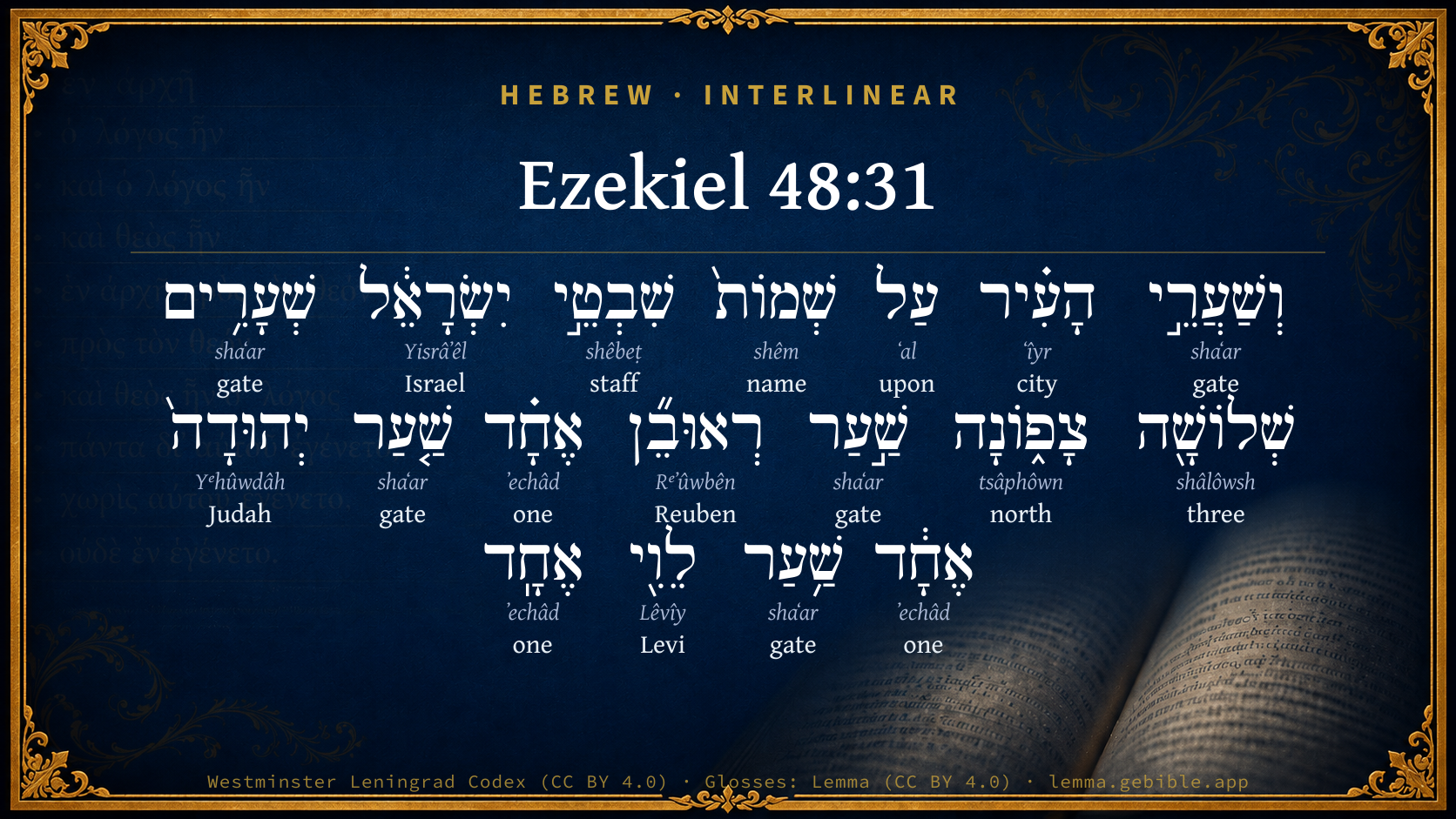
  1. וְשַׁעֲרֵ֣י shaʻar H8179 “and · gates of” Conjunction + Noun, Common, Masculine, Plural, Construct
  2. הָעִ֗יר ʻîyr H5892 “the · city” Particle, Definite Article + Noun, Common, Feminine, Singular, Absolute
  3. עַל ʻal H5921 “upon” Preposition
  4. שְׁמוֹת֙ shêm H8034 “names of” Noun, Common, Masculine, Plural, Construct
  5. שִׁבְטֵ֣י shêbeṭ H7626 “staffs of” Noun, Common, Masculine, Plural, Construct
  6. יִשְׂרָאֵ֔ל Yisrâʼêl H3478 “Israel” Noun, Proper
  7. שְׁעָרִ֥ים shaʻar H8179 “gates” Noun, Common, Masculine, Plural, Absolute
  8. שְׁלוֹשָׁ֖ה shâlôwsh H7969 “three” Adjective, Cardinal number, Masculine, Singular, Absolute
  9. צָפ֑וֹנָה tsâphôwn H6828 “north · toward” Noun, Common, Feminine, Singular, Absolute + Suffix, Demonstrative
  10. שַׁ֣עַר shaʻar H8179 “gate of” Noun, Common, Masculine, Singular, Construct
  11. רְאוּבֵ֞ן Rᵉʼûwbên H7205 “Reuben” Noun, Proper
  12. אֶחָ֗ד ʼechâd H259 “one” Adjective, Cardinal number, Masculine, Singular, Absolute
  13. שַׁ֤עַר shaʻar H8179 “gate of” Noun, Common, Masculine, Singular, Construct
  14. יְהוּדָה֙ Yᵉhûwdâh H3063 “Judah” Noun, Proper
  15. אֶחָ֔ד ʼechâd H259 “one” Adjective, Cardinal number, Masculine, Singular, Absolute
  16. שַׁ֥עַר shaʻar H8179 “gate of” Noun, Common, Masculine, Singular, Construct
  17. אֶחָֽד ʼechâd H259 “one” Adjective, Cardinal number, Masculine, Singular, Absolute

About this verse

These counts appear in no published source. They are computed here, from the morphology-tagged text and Lemma’s own curated glosses. What Lemma adds →

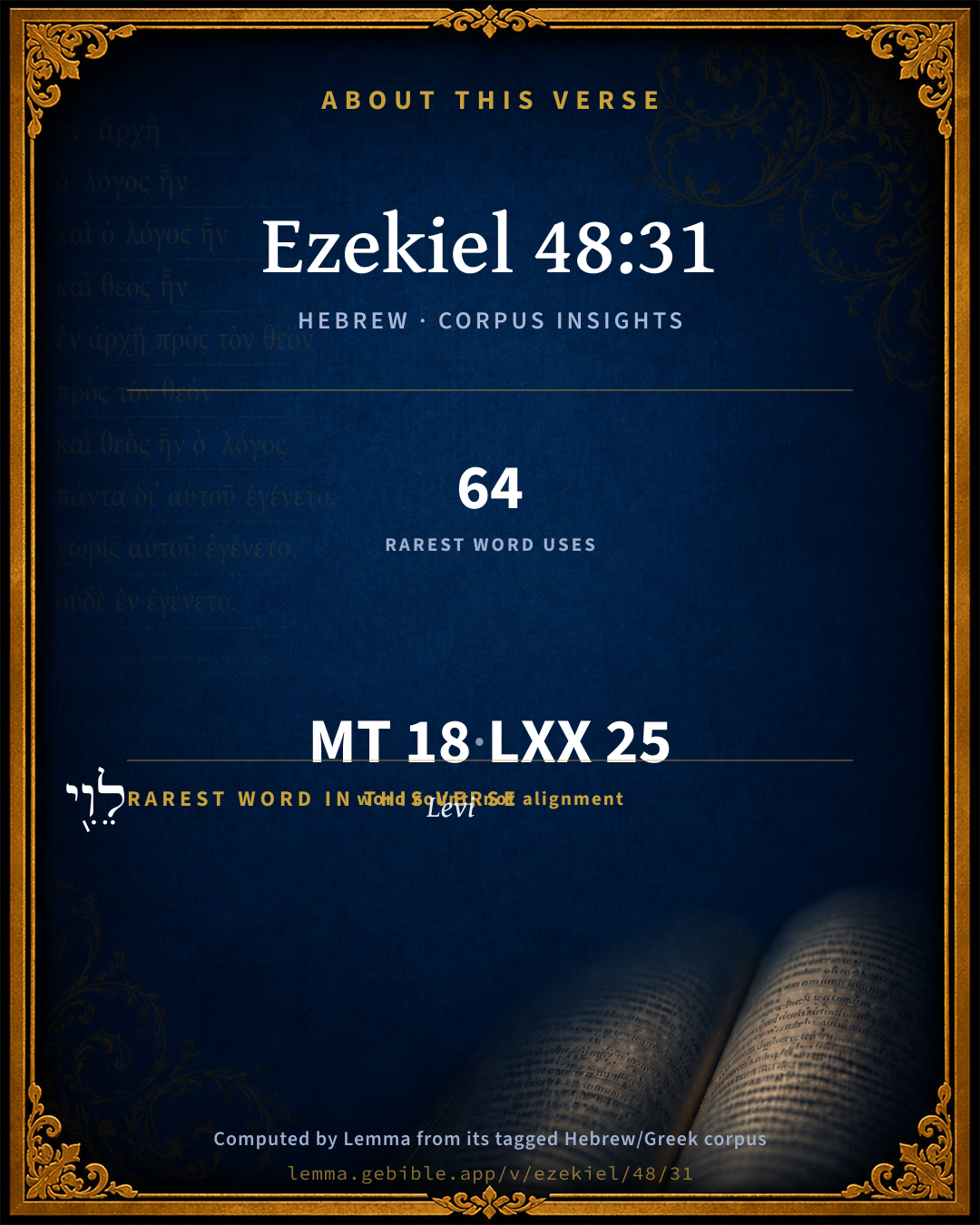
18
words
12
distinct lemmas
Prophets
section

Grammatical profile

  • 13 nouns
  • 4 adjectives
  • 1 preposition

Repetition

Words recur within this verse — often emphatic in Hebrew:

  • וְשַׁעֲרֵ֣י gate H8179 ×5
  • אֶחָ֗ד one H259 ×3

Hebrew & Septuagint length

In English translation the verse runs 34 words from the Hebrew and 36 from the Septuagint (LXX English) — closely comparable.

A rough comparison of the two English renderings, which tokenize alike — not a word-level alignment.

Word counts can differ between the Hebrew and the Greek without any difference in meaning — e.g. the Hebrew direct-object marker אֵת has no separate Greek word, and Greek often adds the article ὁ.

In the original languages it is 18 Hebrew tokens and 25 Greek tokens — but the two are counted differently (Hebrew bundles its prefixes and suffixes into one token; the Greek is in lemma form), so that isn’t a like-for-like length.

Cross-references

6

Topical passages linked to Ezekiel 48:31 in the Treasury of Scripture Knowledge — connected by theme and wording, ordered by reader-vote popularity; previews shown in the World English Bible.

  • Revelation 21:12–13 having a great and high wall; having twelve gates, and at the gates twelve angels; and names written on them, which are the names of the twelve tribes of the children of Israel.
  • Isaiah 26:1–2 In that day shall this song be sung in the land of Judah: we have a strong city; salvation will he appoint for walls and bulwarks.
  • Isaiah 54:12 I will make your pinnacles of rubies, and your gates of emeralds, and all your border of precious stones.
  • Isaiah 60:11 Your gates also shall be open continually; they shall not be shut day nor night; that men may bring to you the wealth of the nations, and their kings led captive.
  • Revelation 21:21 The twelve gates were twelve pearls. Each one of the gates was made of one pearl. The street of the city was pure gold, like transparent glass.
  • Revelation 21:25 Its gates will in no way be shut by day (for there will be no night there),

Cross-references courtesy of OpenBible.info (CC BY 4.0).

Hebrew and Greek witnesses Masoretic Hebrew ↔ Greek Septuagint

The same verse in the two great witnesses to the Old Testament, shown verse-for-verse.

These are two independent witnesses, not word-aligned to each other, and the Septuagint is shown in lemma (dictionary) form.

Hebrew Ezekiel 48:31 Masoretic · Westminster Leningrad Codex

וְשַׁעֲרֵ֣י הָעִ֗יר עַל שְׁמוֹת֙ שִׁבְטֵ֣י יִשְׂרָאֵ֔ל שְׁעָרִ֥ים שְׁלוֹשָׁ֖ה צָפ֑וֹנָה שַׁ֣עַר רְאוּבֵ֞ן אֶחָ֗ד שַׁ֤עַר יְהוּדָה֙ אֶחָ֔ד שַׁ֥עַר לֵוִ֖י אֶחָֽד

and the gates of the city shall be after the names of the tribes of Israel, three gates northward: the gate of Reuben, one; the gate of Judah, one; the gate of Levi, one.

World English Bible · Public Domain

Greek LXX Ezekiel 48:31 Septuagint · lemma form

καί ὁ πύλη ὁ πόλις ἐπί ὄνομα φυλή ὁ ἰσραήλ πύλη τρεῖς πρός βορέας πύλη ρουβην εἷς καί πύλη ιουδα εἷς καί πύλη λευί εἷς

And the gates of the city shall be after the names of the tribes of Israel: three gates northward; the gate of Ruben, one, and the gate of Juda, one, and the gate of Levi, one.

LXX2012 (modern English Septuagint) · Public Domain

Hebrew: Westminster Leningrad Codex (CC BY 4.0). Greek: Septuagint (public domain); English from LXX2012 (modern English Septuagint) (Public Domain). How the Septuagint differs from the Hebrew →

Targum (Aramaic paraphrase)

1

The Targum is the ancient Jewish Aramaic paraphrase of the Hebrew Scriptures — an interpretive translation, not the Hebrew text itself. Onkelos (literal) and Pseudo-Jonathan (expansive) render the Torah, and Jonathan the Prophets. Coverage is partial: where no permissively-licensed English translation exists for a verse, only the Aramaic is shown. This is verse-level text, not a word-by-word alignment to the Hebrew.

  1. Targum Jonathan Prophets (Joshua–Malachi)
    וְתַרְעֵי קַרְתָּא עַל שְׁמָהַת שִׁבְטַיָא דְיִשְׂרָאֵל תַּרְעִין תְּלָתָא פְּתִיחִין לְצִפּוּנָא תְּרַע רְאוּבֵן חָד תְּרַע יְהוּדָה חָד תְּרַע לְוֵי חָד:

    (no public-domain English translation for this verse)

    Targum Jonathan — Aramaic: “Mikraot Gedolot” (public domain). English: “Sefaria Community Translation” (CC0 1.0 (public-domain dedication)); “London "Chaldee Paraphrase," 1871” (public domain). Text via Sefaria.

Commentary

Notes on Ezekiel 48:31 from classic Christian and Jewish commentators (each source and its license shown beneath its notes). The classic Christian expositions comment on the surrounding passage and are grouped to its opening verse, so a note may address several verses; the Jewish commentaries on the Tanakh (Rashi and others) are per-verse, so they appear only where the commentator wrote on this verse.

Lemma curates 59 commentaries, every one of them public domain or Creative Commons licensed, each selected and text-cleaned for this edition rather than reprinted as found. About our sources →

Matthew Henry's Commentary

We have here a further account of the city that should be built for the metropolis of this glorious land, and to be the receptacle of those who would come from all parts to worship in the sanctuary adjoining. It is nowhere called Jerusalem, nor is the land which we have had such a particular account of the dividing of any where called the land of Canaan; for the old names are forgotten, to intimate that the old things are done away, behold all things have become new. Now, concerning this city, observe here, 1. The measures of its out-lets, and the grounds belonging to it, for its several conveniences; each way its appurtenances extended 4500 measures 18,000 in all, Eze 48:35. But what these measures were is uncertain. It is never said, in all this chapter, whether so many reeds (as our translation determines by inserting that word, Eze 48:8, each reed containing six cubits and span, Eze 40:5, and why should the measurer appear with the measuring reed in his hand of that length if he did not measure with that, except where it is expressly said he measured by cubits?) or whether, as others think, it is so many cubits, because those are mentioned Eze 45:2 and Eze 47:3. Yet that makes me incline rather to think that where cubits are not mentioned must be intended so many lengths of the measuring reed. But those who understand it of so many cubits are not agreed whether it be meant of the common cubit, which was half a yard, or the geometrical cubit, which, for better expedition, is supposed to be mostly used in surveying lands, which, some say, contained six cubits, others about three cubits and a half, so making 1000 cubits the same with 1000 paces, that is, an English mile. But our being left at this uncertainty is an intimation that these things are to be understood spiritually, and that what is principally meant is that there is an exact and just proportion observed by Infinite Wisdom in modelling the gospel church, which though now we cannot discern we shall when we come to heaven. 2. The number of its gates. It had twelve gates in all, three on each side, which was very agreeable when it lay four square; and these twelve gates were inscribed to the twelve tribes. Because the city was to be served out of all the tribes of Israel (Eze 48:19) it was fit that each tribe should have its gate; and, Levi being here taken in, to keep to the number twelve Ephraim and Manasseh are made one in Joseph, Eze 48:32. On the north side were the gates of Reuben, Judah, and Levi (Eze 48:31), on the east the gates of Joseph, Benjamin, and Dan (Eze 48:32), on the south the gates of Simeon, Issachar, and Zebulun (Eze 48:33), and on the west the gates of Gad, Asher, and Naphtali, Eze 48:34. Conformable to this, in St. John's vision, the new Jerusalem (for so the holy city is called there, though not here) has twelve gates, three on a side, and on them are written the names of the twelve tribes of the children of Israel, Rev 21:12, Rev 21:13. Note, Into the church of Christ, both militant and triumphant, there is a free access by faith for all that come of every tribe, from every quarter. Christ has opened the kingdom of heaven for all believers. Whoever will may come and take of the water of life, of the tree of life, freely. 3. The name given to this city: From that day, when it shall be newly-erected according to this model, the name of it shall be, not, as before, Jerusalem - The vision of peace, but which is the original of that, and more than equivalent to it, Jehovah Shammah - The Lord is there, Eze 48:35. This intimated, (1.) That the captives, after their return, should have manifest tokens of God's presence with them and his residence among them, both in his ordinances and his providences. They shall have no occasion to ask, as their fathers did, Is the Lord among us, or is he not? for they shall see and say that he is with them of a truth. And then, though their troubles were many and threatening, they were like the bush which burned but was not consumed, because the Lord was there. But when God departed from their temple, when he said, Migremus hinc - Let us go hence, their house was soon left unto them desolate. Being no longer his, it was not much longer theirs. (2.) That the gospel-church should likewise have the presence of God in it, though not in the Shechinah, as of old, yet in a token of it no less sure, that of his Spirit. Where the gospel is faithfully preached, gospel ordinances are duly administered, and God is worshipped in the name of Jesus Christ only, it may truly be said, The Lord is there; for faithful is he that has said, and he will be as good as his word, Lo, I am with you always even unto the end of the world. The Lord is there in his church, to rule and govern it, to protect and defend it, and graciously to accept and own his sincere worshippers, and to be nigh unto them in all that they call upon him for. This should engage us to keep close to the communion of saints, for the Lord is there; and then whither shall we go to better ourselves? Nay, it is true of every good Christian; he dwells in God, and God in him; whatever soul has in it a living principle of grace, it may be truly said, The Lord is There. (3.) That the glory and happiness of heaven should consist chiefly in this, that the Lord is there. St. John's representation of that blessed state does indeed far exceed this in many respects. That is all gold, and pearls, and precious stones; it is much larger than this, and much brighter, for it needs not the light of the sun. But, in making the presence of God the principal matter of its bliss, they both agree. There the happiness of the glorified saints is made to be that God himself shall be with them (Rev 21:3), that he who sits on the throne shall dwell among them, Rev 7:15. And here it is made to crown the bliss of this holy city that the Lord is there. Let us therefore give all diligence to make sure to ourselves a place in that city, that we may be for ever with the Lord.

Matthew Henry's Commentary on the Whole Bible (1708–1710) — public domain (CC PDM 1.0). Text via the HelloAO Bible API.

Trapp's Complete Commentary

John Trapp

Eze 48:31 And the gates of the city [shall be] after the names of the tribes of Israel: three gates northward; one gate of Reuben, one gate of Judah, one gate of Levi.

Ver. 31. And the gates of the city.] Through which all the Israel of God, both Jews and Gentiles from all parts, qua data porta, ruunt, do enter into the Church of Christ, flowing and flocking thereto, as waters do to the sea, and as the doves to their windows.

Three gates northward.] Twelve in all; the reason whereof, see in the note on Rev 21:13.

One gate of Levi.] Who, though he had no lot in the land, yet he had a gate into the city, as Vatablus here noteth.

John Trapp, A Commentary or Exposition upon All the Books of the Old and New Testament (1647–1656) — public domain. Text from a community e-Sword module.

Joseph Benson's Commentary

Eze 48:31. And the gates of the city shall be after the names of the tribes of Israel — It had twelve gates in all, three on each side, which was very proper, since it lay four-square; and these twelve gates were inscribed to the twelve tribes. Because the city was to be served out of all the tribes of Israel, Eze 48:19, it was fit that each tribe should have its gate; and Levi being here taken in to keep to the number twelve, Ephraim and Manasseh are made one in Joseph. Conformable to this, in St. John’s vision, Rev 21:12-13, the New Jerusalem (for so the holy city is called there, though not here) has twelve gates, three on a side, and on them are written the names of the twelve tribes of the children of Israel. Observe, reader, into the church of Christ, whether militant or triumphant, there is a free access by faith for all that come, of every tribe, from every quarter. Christ has opened the kingdom of heaven for all believers. Whoever will may come, and take of the water of life, and of the tree of life, freely.

Joseph Benson's Commentary on the Old and New Testaments (1811–1818) — public domain. Text from a community e-Sword module.

Jamieson, Fausset & Brown

Robert Jamieson, A. R. Fausset & David Brown

gates-- (Rev 21:12, &c.). The twelve gates bear the names of the twelve tribes to imply that all are regarded as having an interest in it.

Jamieson, Fausset & Brown — Commentary Critical and Explanatory on the Whole Bible (1871) — public domain (CC PDM 1.0). Text via the HelloAO Bible API.

The Cambridge Bible for Schools and Colleges

gen. ed. J. J. S. Perowne

31. The measurement proceeds from W. to E. The gate Reuben was thus the westmost on the north of the city; Judah in the centre and Levi towards the east.

The Cambridge Bible for Schools and Colleges (gen. ed. J. J. S. Perowne; Cambridge University Press, 1878–1918) — public domain. Text from a community e-Sword module.

Matthew Poole's English Annotations

So then it is probable these gates were built at equal distance from the corners and from each other.

Matthew Poole's English Annotations on the Holy Bible (1683–1685) — public domain. Text from a community e-Sword/MySword module.

The Pulpit Commentary

Vers. 31-34The gates of the city. These should be twelve in number, three on each side, and named after the twelve tribes. (comp. Rev_21:12) The gates leading northward should be those of Reuben, Judah, and Levi, all children of Leah, (Gen_29:32, Gen_29:35) as Keil observes, "the firstborn in age, the firstborn by virtue of the patriarchal blessing, and the one chosen by Jehovah for his own service in the place of the firstborn." The same three occupy the first three places and in the same order in the blessing of Moses. (Deu_33:6-8) Towards the east should lead the gates of Joseph, Benjamin, and Dan, the first and second sons of Rachel, and the third a son of Rachel"s handmaid. (Gen_30:6, 24 35:18) In the blessing of Moses Benjamin precedes Joseph. (Deu_33:12, Deu_33:13) The south gates receive the names of Simeon, Issachar, and Zebulun, again all sons of Leah. The west gates are those of Gad, Asher, and Naphtali, that is, two sons of Leah"s handmaid and one of Rachel"s. It is observable that in the naming of the gates Levi resumes his place among the tribes, which necessitates the substitution of Joseph the original tribe-father instead of Ephraim anti Manasseh his two sons. (On the phrase, one gate of Judah, literally, the gate of Judah one, see on ver. 1.)

The city gates.

I THE CITY GATES ARE FOR EGRESS. The citizens are not to remain always immured in their streets and houses. They are to go forth to the country till their vineyards, lead their flocks over the hills, visit their neighbors.

1. It is bad to be always in society. Christ called his disciples away from the multitude to a desert place, to rest awhile.

2. It is desirable to cultivate the spirit of enterprise. We English have our island home guarded by the friendly sea, but we take care to have many gates, and to go forth over the wide world. We travel and trade; in discovery and adventure the hardy vigor of the British race finds scope, and grows by exercise. It will be a misfortune for England if this spirit of enterprise gives place to a more indolent, self-indulgent tone of life. The same spirit should be seen in the Church. We ought to have more energy and daring, not content to enjoy our privileges at home, but eager to go forth and do some fresh service for our Master.

3. It is a Christian duty to carry missionary work out into the world. Christians should go out of the gates of Christendom to bring the standard of the gospel into heathen lands.

II THE CITY GATES ARE FOR INGRESS.

1. Strangers should be welcomed. The gates of the city of God are open day and night. (Rev_21:25) The heavenly Jerusalem is always ready to welcome new guests. The city is to be a metropolis of man, a center and home for all travelers in the weary journey of life. It is utterly contrary to the spirit of Christ for a Church to show any spirit of exclusiveness, any desire to keep its privileges to itself. Christianity is for the world. "Whosoever will, let him come,

2. The citizens should return home. "Man goeth forth unto his work, and to his labor, until the evening". (Psa_104:23) "Then the ploughman homeward plods his weary way." After work in the fields comes rest in the home. We cannot be always engaged in Christian enterprises. It would not be healthy for a Church to be wholly absorbed in mission work. It must also have its own loving fellowship and refreshing worship.

III THE CITY GATES ARE FOR PROTECTION. They are gates, not gaps. The well cared-for city of the olden times had massive gates with stout locks and bars, and perhaps a portcullis at each gate for additional protection. The city of God has ample means of warding off the attack of the enemy of souls. God has not cast his people out in a waste, howling wilderness to be a prey to evil creatures. He has called them into "a city which hath foundations" and walls and gates. Christ himself is the Lord of this new Jerusalem, and all are safe who are with him. "There is now no condemnation to them that are in Christ Jesus". (Rom_8:1)

IV THE CITY GATES MUST BE MANNED BY THE PEOPLE.

1. They need guards. The garrison of Jerusalem must concentrate its attention on the gates. Christ is the Captain, we are the soldiers; under him it becomes our duty to hold the gates. The sick, the aged, and women and children, are kept in the city while the men sally forth to attack the enemy. The gates must be guarded for the sake of the human trust within. The Church should guard the young, the feeble, the tempted,

2. The guards are severally apportioned. Each gate seems to be named after the tribe to whose soldiers it is allotted. There are various branches of the Christian Church, and there is separate work for each body of Christians. If one gate is taken, the city is endangered. Faithfulness is needed in all classes of Christians for the security of the whole Church.

Vers. 31-34God the Accessible One.

Admitting to the sacred city, in the midst of which, was " the sanctuary of the Lord" (ver. 10), were twelve gates, three on each side of it, and bearing the names of the twelve tribes of Israel. Surely the significance of this arrangement was that the Divine Sovereign was always accessible to all his people; that he desired to be approached by them all in order that they might have fellowship with him, and that he might confer blessing upon them. In that kingdom, of which the vision is prophetic, the Divine Lord is accessible to all; and it is not only true that he may be approached by all who will seek him, but that it is his express, his strong desire that all his children should freely draw near to him and hold converse with him. God, as revealed and related to us in Jesus Christ, is accessible

I AT ALL TIMES. The gates into the kingdom, or into the near presence of God, shall "in no wise be shut," either day or night. There may be days and hours when we may be offered unusual facilities for coming before God, but there is no day and there is no hour when we may not draw nigh unto him, when he is not willing and even desirous that we should pour our prayers or our praises into his ear.

II FROM ALL DIRECTIONS. These gates looked in all directions north, south, east, and west. From all the four quarters of the land the children of Israel were to draw near to the sacred city and to the more sacred sanctuary of the Lord. From all possible directions are we now to approach God.

1. All geographical directions. There is no sort of favoritism anywhere. As well be born in any one place under heaven as in any other. There is no Jerusalem, no Gerizim, no Mecca, no Benares, no Rome, in the kingdom of Christ.

Where"er we seek thee, thou art found, And every place is hallowed ground.

2. All moral directions. We may approach God from a great variety of spiritual standpoints.

(1) From that of the burdened sinner seeking forgiveness and release.

(2) From that of the son who has been painfully conscious of a long estrangement or a growing coldness, and who is anxious for full reconciliation and for close and happy, perhaps renewed, intercourse with his Father.

(3) From that of a rejoicing spirit longing to bring his gladness in holy and happy gratitude to the altar of the Lord.

(4) From that of the troubled and sorrowful soul seeking comfort of him who "raiseth up them that are bowed down.

(5) From that of the seeker after righteousness, who is longing for more complete deliverance from evil and greater likeness to his Divine Leader, asking for the cleansing and renewing influences of the Spirit of God.

(6) From that of the earnest worker in the vineyard, pleading for the effectuating power which alone will make his efforts to be crowned with a true success. But from whatsoever direction a man draws near to God he will find an open gate, a welcome, a response. But there is now one Name only that is inscribed. All entrance is

III THROUGH JESUS CHRIST. He is "the Door," and "no man cometh unto the Father but by him." By him both Jew and Gentile "have access unto the Father". (Joh_10:7 Joh_14:6; Eph_2:18) Jesus Christ is our Mediator; (1Ti_2:5) he is the one Propitiation for our sins, having offered the one sacrifice for sins forever. (1Jn_2:2; Heb_9:26 Heb_10:12) It is through him we come, and it is his Name we plead. (Joh_16:23) He is the open Door, and whether we approachas sinners seeking reconciliation, or as children or friends seeking communion and blessing, we have constant admission to the ever-accessible Father of our spirits. C.

The Pulpit Commentary (1880–1919), ed. H.D.M. Spence-Jones & Joseph S. Exell — public domain. Text from a community e-Sword module.

Lesson kit

Teaching starters — assembled from the data on this page, not authored interpretation. Every prompt links to the verse data it draws on. Edit before teaching.

Ezekiel, in the Prophets, opens this verse with 18 words (12 distinct Hebrew lemmas). Its most distinctive word is Lêvîy (“Levi”). A historical commentator’s framing appears above. Read the whole chapter for the surrounding context.

Discussion questions

  1. What does “Levi” (Lêvîy) contribute to the verse as a whole?
  2. How does Revelation 21:12–13, which shares this passage’s theme, read alongside this verse?
  3. What does the repetition of “gate” (5× in this one verse) do in this verse?
  4. These translations render this verse differently. What is at stake in choosing one wording over another?
  5. Compare how Matthew Henry's Commentary and Trapp's Complete Commentary read this verse. Where do they agree or differ?

Things to notice

Reading settings

Reading text

Shown beneath each verse's original-language words.

Old Testament
Old Testament edition

Read the OT as the Masoretic Hebrew (MT) or the Greek Septuagint (LXX).

English shown for the Greek Septuagint (in the Hebrew ↔ Greek comparison).

Comparing translations? Open the Compare panel on any verse page to stack up to four side by side.