
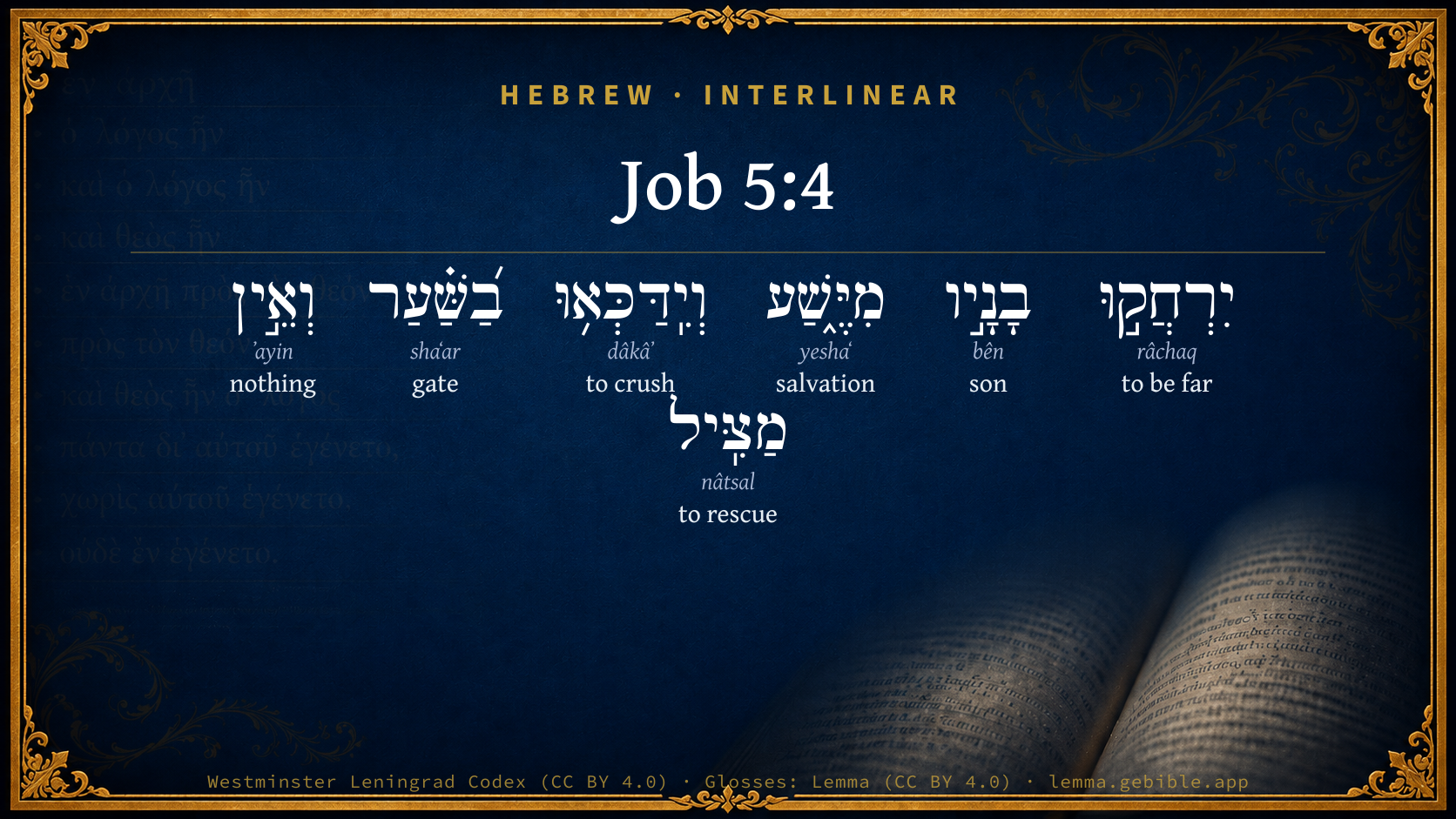
Job 5:4

Hebrew (Westminster Leningrad Codex) Job 5:4 appears in the Hebrew Old Testament. The text above is from the Westminster Leningrad Codex. Each word links to its Strong’s number, a concise gloss, and parsing drawn from the Open Scriptures Hebrew Bible morphology. Click any word for its full Brown-Driver-Briggs (BDB) entry.
Download image
Cite this verse

Job 5:4 (World English Bible). Public Domain. Lemma interlinear Bible study tool, https://lemma.gebible.app/v/job/5/4.

Show BibTeX & RIS
BibTeX
RIS
English Translation
His children are far from safety, They are crushed in the gate. Neither is there any to deliver them,
World English Bible · Public Domain
Download a study sheet

One document with this verse’s original text, its word-by-word gloss line, the meaning frame, cross-references with their text, attributed commentary, and full source and license credits — printable, and it pastes into notes with its structure intact.

This verse Autodidact and up

Study sheet (.html) Plain text (.txt)

A passage Seminary Student

Up to 50 verses in one chapter. A passage sheet keeps up to 6 commentary sources and 12 cross-references per verse, in the order this page ranks them, and says so on the sheet whenever that leaves anything out. Ask for a single verse and you get the Autodidact verse sheet above.

Everything on this page stays free to read, with no account — the sheet is a download of what is already on screen, not access to it.

Want to remove ads? Support Godless Engineer
Compare translations 3

The same verse in 3 English versions, stacked beneath the original-language interlinear above. Click any original word for its lexicon entry.

Each is an independent rendering of the whole verse — the interlinear is not word-aligned to these translations.

Highlighted words mark where these versions differ — a whole-verse word diff, not a word-by-word alignment.

  • World English Bible Public Domain
    His children are far from safety, They are crushed in the gate. Neither is there any to deliver them,
  • King James Version Public Domain
    His children are far from safety, and they are crushed in the gate, neither is there any to deliver them.
  • unfoldingWord Literal Text CC BY-SA 4.0
    His children are far from safety, and they are crushed at the gate, and none rescuing,

unfoldingWord Literal Text — © unfoldingWord, licensed CC BY-SA 4.0. Word-aligned USFM3 via Door43 (git.door43.org/unfoldingWord/en_ult).

Versions to compare (up to 4)

3 of 4 selected

Show all 18 translations

Every available English version of this verse, each an independent rendering of the whole verse.

  • World English Bible Public Domain
    His children are far from safety, They are crushed in the gate. Neither is there any to deliver them,
  • Berean Standard Bible Public Domain
    His sons are far from safety, crushed in court without a defender.
  • Majority Standard Bible Public Domain
    His sons are far from safety, crushed in court without a defender.
  • King James Version Public Domain
    His children are far from safety, and they are crushed in the gate, neither is there any to deliver them.
  • American Standard Version (1901) Public Domain
    His children are far from safety, And they are crushed in the gate, Neither is there any to deliver them:
  • Revised Version (1885) Public Domain
    His children are far from safety, and they are crushed in the gate, neither is there any to deliver them.
  • Geneva Bible (1599) Public Domain
    His children shalbe farre from saluation, and they shall be destroyed in the gate, and none shall deliuer them.
  • Douay-Rheims (1899) Public Domain
    His children shall be far from safety, and shall be destroyed in the gate, and there shall be none to deliver them.
  • Young's Literal Translation Public Domain
    Far are his sons from safety, And they are bruised in the gate, And there is no deliverer.
  • Literal Standard Version CC BY-SA 4.0
    His sons are far from safety, || And they are bruised in the gate, || And there is no deliverer.
  • Unlocked Literal Bible CC BY-SA 4.0
    His children are far from safety; they are crushed in the city gate. There is no one to rescue them.
  • unfoldingWord Literal Text CC BY-SA 4.0
    His children are far from safety, and they are crushed at the gate, and none rescuing,
  • Darby Bible Public Domain
    His children are far from safety, and they are crushed in the gate, and there is no deliverer:
  • World Messianic Bible Public Domain
    His children are far from safety. They are crushed in the gate. Neither is there any to deliver them,
  • Webster's Bible Public Domain
    His children are far from safety, and they are crushed in the gate, neither is there any to deliver them.
  • Free Bible Version CC BY-SA 4.0
    His sons are never safe; they are crushed in court with no one to defend them.
  • Bible in Basic English Public Domain
    Now his children have no safe place, and they are crushed before the judges, for no one takes up their cause.
  • JPS Tanakh (1917) Public Domain
    His children are far from safety, and are crushed in the gate, with none to deliver them.

Literal Standard Version (2020), Covenant Press — licensed CC BY-SA 4.0. Text via the HelloAO Bible API (eBible.org). Unlocked Literal Bible (unfoldingWord) — licensed CC BY-SA 4.0. Text via the HelloAO Bible API (eBible.org). unfoldingWord Literal Text — © unfoldingWord, licensed CC BY-SA 4.0. Word-aligned USFM3 via Door43 (git.door43.org/unfoldingWord/en_ult). Free Bible Version, Dr. Jonathan Gallagher — licensed CC BY-SA 4.0. Text via the HelloAO Bible API (eBible.org).

Word by word

More ways to search: Search by grammar → Find every occurrence → Compare this word →

Practice this passage: Drill this verse → Learn its vocabulary →

וְיִֽדַּכְּא֥וּ
dâkâʼ
H1792
“and · to crush”
Conjunction + Verb, Hithpael, Imperfect, 3rd Person, Masculine, Plural
Part of Speech
Conjunction + Verb
Stem
Hithpael
Form
Imperfect
Person
3rd Person
Gender
Masculine
Number
Plural
Full BDB Definition

Origin: a primitive root (compare H1794 )

TWOT: 427

to crush, be crushed, be contrite, be broken - (Niphal) - to be crushed - to be contrite (figuratively) - (Piel) to crush - (Pual) - to be crushed, be shattered - to be made contrite - (Hithpael) to allow oneself to be crushed
  1. יִרְחֲק֣וּ râchaq H7368 “to be far” Verb, Qal, Imperfect, 3rd Person, Masculine, Plural
  2. בָנָ֣יו bên H1121 “sons · his” Noun, Common, Masculine, Plural, Construct + Suffix, Personal, 3rd Person, Masculine, Singular
  3. מִיֶּ֑שַׁע yeshaʻ H3468 “from · salvation” Preposition + Noun, Common, Masculine, Singular, Absolute
  4. בַ֝שַּׁ֗עַר shaʻar H8179 “in/at the · gate” Preposition, Determined + Noun, Common, Masculine, Singular, Absolute
  5. וְאֵ֣ין ʼayin H369 “and · nothing” Conjunction + Particle, Negative
  6. מַצִּֽיל nâtsal H5337 “rescuing” Verb, Hiphil, Participle Active, Masculine, Singular, Absolute

About this verse

These counts appear in no published source. They are computed here, from the morphology-tagged text and Lemma’s own curated glosses. What Lemma adds →

7
words
7
distinct lemmas
Wisdom
section

Notable vocabulary

The rarest word here is וְיִֽדַּכְּא֥וּ to crush H1792 — appearing just 18 times in the whole Hebrew Bible.

Shared distinctive vocabulary

וְיִֽדַּכְּא֥וּ to crush H1792 occurs in 18 verses of the Hebrew Bible. Also found in:

Grammatical profile

  • 3 verbs
  • 3 nouns
  • 1 particle

Verb forms

  • יִרְחֲק֣וּ Qal · Imperfect
  • וְיִֽדַּכְּא֥וּ Hithpael · Imperfect
  • מַצִּֽיל Hiphil · Participle Active

Hebrew & Septuagint length

In English translation the verse runs 19 words from the Hebrew and 24 from the Septuagint (LXX English) — closely comparable.

A rough comparison of the two English renderings, which tokenize alike — not a word-level alignment.

Word counts can differ between the Hebrew and the Greek without any difference in meaning — e.g. the Hebrew direct-object marker אֵת has no separate Greek word, and Greek often adds the article ὁ.

Cross-references

13

Topical passages linked to Job 5:4 in the Treasury of Scripture Knowledge — connected by theme and wording, ordered by reader-vote popularity; previews shown in the World English Bible.

  • Psalms 127:5 Happy is the man who has his quiver full of them. They won't be disappointed when they speak with their enemies in the gate.
  • Job 18:16–19 His roots shall be dried up beneath, Above shall his branch be cut off.
  • Psalms 119:155 Salvation is far from the wicked, For they don't seek your statutes.
  • Exodus 20:5 you shall not bow yourself down to them, nor serve them, for I, Yahweh your God, am a jealous God, visiting the iniquity of the fathers on the children, on the third and on the fourth generation of those who hate me,
  • Job 1:19 and, behold, there came a great wind from the wilderness, and struck the four corners of the house, and it fell on the young men, and they are dead. I alone have escaped to tell you."
  • Job 4:10–11 The roaring of the lion, and the voice of the fierce lion, The teeth of the young lions, are broken.
  • Job 8:4 If your children have sinned against him, He has delivered them into the hand of their disobedience;
  • Job 10:7 Although you know that I am not wicked, There is no one who can deliver out of your hand.
  • Job 27:14 If his children are multiplied, it is for the sword. His offspring shall not be satisfied with bread.
  • Psalms 7:2 Lest they tear apart my soul like a lion, Ripping it in pieces, while there is none to deliver.
  • Psalms 109:9–15 Let his children be fatherless, And his wife a widow.
  • Amos 5:12 For I know how many your offenses, And how great are your sins-- You who afflict the just, Who take a bribe, And who turn aside the needy in the courts.
  • Luke 13:4–5 Or those eighteen, on whom the tower in Siloam fell, and killed them; do you think that they were worse offenders than all the men who dwell in Jerusalem?

Cross-references courtesy of OpenBible.info (CC BY 4.0).

Hebrew and Greek witnesses Masoretic Hebrew ↔ Greek Septuagint

The same verse in the two great witnesses to the Old Testament, shown verse-for-verse.

These are two independent witnesses, not word-aligned to each other, and the Septuagint is shown in lemma (dictionary) form.

Hebrew Job 5:4 Masoretic · Westminster Leningrad Codex

יִרְחֲק֣וּ בָנָ֣יו מִיֶּ֑שַׁע וְיִֽדַּכְּא֥וּ בַ֝שַּׁ֗עַר וְאֵ֣ין מַצִּֽיל

His children are far from safety, They are crushed in the gate. Neither is there any to deliver them,

World English Bible · Public Domain

Greek LXX Job 5:4 Septuagint · lemma form

πόρρω γίγνομαι ὁ υἱός αὐτός ἀπό σωτηρία κολαβρίζομαι δέ ἐπί θύρα ἥσσων καί οὐ εἰμί ὁ ἐκαἱρέω

Let their children be far from safety, and let them be crushed at the doors of vile men, and let there be no deliverer.

LXX2012 (modern English Septuagint) · Public Domain

Hebrew: Westminster Leningrad Codex (CC BY 4.0). Greek: Septuagint (public domain); English from LXX2012 (modern English Septuagint) (Public Domain). How the Septuagint differs from the Hebrew →

Commentary

Notes on Job 5:4 from classic Christian and Jewish commentators (each source and its license shown beneath its notes). The classic Christian expositions comment on the surrounding passage and are grouped to its opening verse, so a note may address several verses; the Jewish commentaries on the Tanakh (Rashi and others) are per-verse, so they appear only where the commentator wrote on this verse.

Lemma curates 59 commentaries, every one of them public domain or Creative Commons licensed, each selected and text-cleaned for this edition rather than reprinted as found. About our sources →

Trapp's Complete Commentary

John Trapp

Job 5:4 His children are far from safety, and they are crushed in the gate, neither [is there] any to deliver [them].

Ver. 4. His children are far from safety] This is one principal root of wicked men, viz. their children, which have their very name in Hebrew from building, because by them the house is built up, and way made to greatest honours by friendships and affinities of other great families. These are far from safety, that is, they are in a great deal of danger (Lavater); or, by their intemperance, they run into many diseases and disasters; by their evil practices they come under the lash of the law, and without repentance under the danger of damnation too; salvation is far from them, Psa 119:155 Isa 59:11.

They are crushed in the gate] That is, they are cast in judgment, all goes against them, and sentence pronounced upon them, as it befell Haman’s children, and David’s enemies, Psa 109:7.

Neither is there any to deliver them] None to plead for them, or rescue them, Pro 31:8-9; none to extend mercy to them, nor any to favour those fatherless children, Psa 109:12, and that because their fathers were pitiless, Job 5:13-14, Haman for instance.

John Trapp, A Commentary or Exposition upon All the Books of the Old and New Testament (1647–1656) — public domain. Text from a community e-Sword module.

Joseph Benson's Commentary

Job 5:4. His children — Whose greatness he designed in all his enterprises, supposing his family would be established for ever; are far from safety — Are exposed to dangers and calamities, and can neither preserve themselves, nor the inheritance which their fathers left them. There is no question but he glances here at the death of Job’s children; and they are crushed in the gate — That is, in the place of judicature, to which they are brought for their offences, and where they find severe judges, and few or no friends; because, being wickedly educated, and trusting to their own greatness, they had been insolent and injurious to all their neighbours; as also because those many persons, whom their powerful fathers had defrauded or oppressed, seek for justice and the recovery of their rights, which they easily obtain, against persons who plainly declared, by their actions, that they neither feared God nor regarded man, and therefore were hated by all sorts of people. Neither is there any to deliver them — They can find no advocates or assistants who are either able or willing to help them: for, as their hand was formerly against every man, so now every man’s hand is against them. Justice, therefore, takes hold on them, and will not let them escape.

Joseph Benson's Commentary on the Old and New Testaments (1811–1818) — public domain. Text from a community e-Sword module.

Tyndale Open Study Notes

Tyndale Open Resources

5:4 The court (literally the gate) was the site of legal and commercial deliberations in which Job had participated (29:7; see Deut 21:19-21; Ruth 4:1-11).

Tyndale Open Study Notes — © Tyndale Open Resources, licensed CC BY-SA 4.0. Text via the HelloAO Bible API.

Geneva Bible (1599)

Geneva Bible translators

Though God sometimes suffer the fathers to pass in this world, yet his judgments will light upon their wicked children.

By public judgment they shall be condemned, and none shall pity them.

Geneva Bible (1599) marginal notes — public domain. Text via Bolls.life.

Jamieson, Fausset & Brown

Robert Jamieson, A. R. Fausset & David Brown

His children . . . crushed in the gate--A judicial formula. The gate was the place of judgment and of other public proceedings (Psa 127:5; Pro 22:22; Gen 23:10; Deu 21:19). Such propylæa have been found in the Assyrian remains. Eliphaz obliquely alludes to the calamity which cut off Job's children.

Jamieson, Fausset & Brown — Commentary Critical and Explanatory on the Whole Bible (1871) — public domain (CC PDM 1.0). Text via the HelloAO Bible API.

Adam Clarke's Commentary

Verse 4. His children are far from safety] His posterity shall not continue in prosperity. Ill gotten, ill spent; whatever is got by wrong must have God's curse on it.

They are crushed in the gate] The Targum says, They shall be bruised in the gate of hell, in the day of the great judgment. There is reference here to a custom which I have often had occasion to notice: viz., that in the Eastern countries the court-house, or tribunal of justice, was at the GATE of the city; here the magistrates attended, and hither the plaintiff and defendant came for justice.

Adam Clarke's Commentary on the Bible (1810–1826) — public domain. Text from a community e-Sword/MySword module.

Ellicott's Commentary for English Readers

(4) They are crushed.—Rather, perhaps, they crush one another. Their internal rivalries and dissensions bring them to ruin. They exemplify the house divided against itself.

A Bible Commentary for English Readers, edited by Charles John Ellicott (1878–1897) — public domain. Text from a community e-Sword module.

The Cambridge Bible for Schools and Colleges

gen. ed. J. J. S. Perowne

4. they are crushed in the gate] The gate of the town is the seat of the Oriental court of law, where justice is administered, ch. Job_29:7, Job_31:21; Psa_127:5. The words are crushed might be reciprocal, “crush one another;” more likely the word means exactly, “must let themselves be crushed,” as the last clause indicates: having none to deliver them. In the East he has right who has power (ch. Job_22:8), and the poor, who cannot bribe the judge or find powerful men to speak for them, go to the wall.

The iniquity of the father is visited upon the children, Exo_20:5, a law of providence which does not quite meet Job’s approval, ch. Job_21:19-20. That this principle created difficulty to thoughtful men about this time appears also from Eze_18:19 seq.

4, 5. These verses describe the desolation that befell the home and family of the man who hardened himself against God. The speaker falls here into the present tenses because, though he is describing an instance which he saw, the instance illustrates a general truth.

The Cambridge Bible for Schools and Colleges (gen. ed. J. J. S. Perowne; Cambridge University Press, 1878–1918) — public domain. Text from a community e-Sword module.

John Gill's Exposition

His children are far from safety,.... From outward safety, from evils and dangers, to which they are liable and exposed, not only from men, who hate them for their father's sake, who have been oppressors of them, or from God, who visits the iniquity of the fathers upon the children; and from spiritual and eternal safety or "salvation", or from salvation in the world to come, as the Targum, they treading in their fathers steps, and imitating their actions:

and they are crushed in the gate; or openly, publicly, as Aben Ezra and others; or in the courts of judicature whither they are brought by those their parents had oppressed, and where they are cast, and have no favour shown them; or literally by the falling of the gate upon them; and perhaps some reference is had to Job's children being crushed in the gate or door of the house, through which they endeavoured to get when it fell upon them and destroyed them; the Targum is,"and are crushed in the gates of hell, in the day of the great judgment:"

neither is there any to deliver them; neither God nor man, they having no interest in either, or favour with, partly on account of their father's ill behaviour, and partly on account of their own; and sad is the case of men when it is such, see Psa 50:21.

John Gill's Exposition of the Whole Bible (1746–1763) — public domain (CC PDM 1.0). Text via the HelloAO Bible API.

Albert Barnes' Notes on the Bible

His children are far from safety - That is, this is soon manifest by their being cut off or subjected to calamity. The object of Eliphaz is, to state the result of his own observation, and to show how calamity overtook the wicked though they even prospered for a time. He begins with that which a man would feel most - the calamity which comes upon his children, and says that God would punish him in them. Every word of this would go to the heart of Job; for he could not but feel that it was aimed at him, and that the design was to prove that the calamities that had come upon his children were a proof of his own wickedness and of the divine displeasure. It is remarkable that Job listens to this with the utmost patience. There is no interruption of the speaker; no breaking in upon the argument of his friend; no mark of uneasiness. Oriental politeness required that a speaker should be heard attentively through whatever he might say. See the Introduction, Section 7. Cutting and severe, therefore, as this strain of remark must have been, the sufferer sat meekly and heard it all, and waited for the appropriate time when an answer might be returned.

And they are crushed in the gate - The gate of a city in ancient times was the chief place of concourse, and was the place where public business was usually transacted, and where courts of justice were held; see Gen 23:10; Deu 21:19; Deu 25:6-7; Rth 4:1 ff: Psa 127:5; Pro 22:22. The Greeks also held their courts in some public place of business. Hence, the forum, ἀγορά agora, was also a place for fairs. See Jahn’s Archaeology, section 247. Some suppose that the meaning here is, that they were oppressed and trodden down by the concourse in the gate. But the more probable meaning is, that they found no one to advocate their cause; that they were subject to oppression and injustice in judicial decisions, and then when their parent was dead, no one would stand up to vindicate them from respect to his memory. The idea is, that though there might be temporary prosperity, yet that it would not be long before heavy calamities would come upon the children of the wicked.

Albert Barnes' Notes on the Bible (1834–1885) — public domain. Text from a community e-Sword/MySword module.

Haydock's Catholic Bible Commentary

Gate, in judgment. (Menochius)

George Leo Haydock (1774–1849), Haydock's Catholic Family Bible and Commentary, 1859 edition — public domain. Excludes Psalms (Douay-Rheims chapter numbering differs from Protestant) and Deuterocanonical books (Catholic canon only).

Matthew Poole's English Annotations

His children; whose greatness and happiness he designed in all his enterprises, supposing that his family was and would be established for ever.

Are far from safety, i.e. are exposed to great dangers and calamities in this life, and can neither preserve themselves, nor the great inheritance which their fathers got and left for them. Thus to be far from peace, Lam 3:17, is to be involved in desperate troubles.

In the gate, i.e. in the place of judicature; to which they are brought for their offences, and where they will find severe judges, and few or no friends; partly because, being wickedly educated, and trusting to their own greatness, they were insolent and injurious to all their neighbours; and partly because those many persons whom their powerful fathers defrauded or oppressed do seek for justice, and the recovery of their rights, which they easily obtain against such persons as plainly declared by their actions that they neither feared God nor reverenced him, and therefore were hated by all sorts of men.

Neither is there any to deliver them; they can find no advocates nor assistants, who are either able or willing to help them; but, like Ishmael, as their hand was formerly against every man, so now every man’s hand is against them.

Matthew Poole's English Annotations on the Holy Bible (1683–1685) — public domain. Text from a community e-Sword/MySword module.

Whedon's Commentary on the Bible

Daniel D. Whedon

4. His children — In the East the fate of the children was involved in that of the parent, as in the case of Haman’s ten sons, who were hanged on the gallows. Est_9:13-14. The merciful legislation of Moses was arrayed against such monstrous perversion of justice. Deu_24:16. Are crushed — Davidson unnecessarily supposes the verb to be reflexive, that the children crushed each other by “family feuds and ruinous litigations.” “In the gate,” (Job_31:21; see also Job_29:7,) plainly points to courts of justice before which fatherless children, having no natural defender, would fare badly, even to being crushed.

In the gate of the city the great assemblies of people were held, (Pro_1:21,) whether for reading the law and proclamations, (Neh_8:1; Neh_8:3,) or for the administration of justice, (Jos_20:4; Rth_4:1,) or even for market purposes. (2Ki_7:1.) The sculptures found by Botta (plate 18) represent the king sitting at the gate in an arm-chair, the seat of judgment. This Oriental custom is transmitted in the title of the court of the Sultan, The Sublime Porte — the word “porte” signifying gate. In the Koran (Sura xxiii, 79) we read: “We have opened against them the gate of supreme judgment.” See note on Mat_16:19.

Daniel D. Whedon (gen. ed.), Commentary on the Old and New Testaments (1874–1909) — public domain. Text from a community e-Sword module.

The Pulpit Commentary

His children are far from safety. The sins of the fathers arc visited upon the children. Eliphaz makes covert allusion to the death of Job"s children. (Job_1:19) Feeling, however, that he is on delicate ground, he goes on into details which in no way fit their case. And (he says) they are crushed in the gate; i.e. they are oppressed, crushed, by litigations. The house once smitten of God, human beasts of prey enter in; claims are made against the children; lawsuits commenced; all the arts of chicanery set in motion; every effort made to strip them of their last penny. (For the sense here assigned to "the gate," see Job_29:7 and Job_31:21) Neither is there any to deliver them. No one intercedes on their behalf, undertakes their detente in the courts, or makes any effort to avert their ruin. This picture of legal oppression accords very closely with what we know of the East in all ages. (comp. Isa_1:17, 23 3:14, 15 5:23 10:2, etc.) Oriental cowardice causes men to shrink from casting in their lot with those whom Misfortune has marked as her own.

The Pulpit Commentary (1880–1919), ed. H.D.M. Spence-Jones & Joseph S. Exell — public domain. Text from a community e-Sword module.

John Wesley's Explanatory Notes

Children - Whose greatness he designed in all his enterprizes, supposing his family would be established forever. Safely - Are exposed to dangers and calamities, and can neither preserve themselves, nor the inheritance which their fathers left them. There is no question but he glances here, at the death of Job's children.

John Wesley, Explanatory Notes Upon the Whole Bible (1754–1765) — public domain. Text via the GEBible commentary corpus.

unfoldingWord translationNotes

Door43 World Missions Community

General Information:

These verses continue the earlier use of parallelism, here emphasizing in different ways the idea that the children of foolish people are never safe. (See: Parallelism)

His children are far from safety

"His" refers to the foolish person or the foolish people in Job 5:02. AT: "Their children are never safe"

are crushed

Here being crushed represents being oppressed, taken advantage of, at court. This idea may be put into active form. AT: "someone crushes them" (See: Metaphor and Active or Passive)

city gate

The city gate, functioning as a court, was the place where disputes were resolved and where judgments were given.

There is no one to rescue them

"There is no one to help the foolish people's children out of their hardship"

they even take it from among the thorns

This perhaps refers to parts of a field where the worst crops grow, because of thorn plants present.

The thirsty pant for their wealth

Here greedy people are spoken of as if they were thirsty, and the wealth of the foolish person is spoken of as if it were something that they could drink. (See: Metaphor)

translationWords

children

gate

harvest

consume

unfoldingWord translationNotes — © Distant Shores Media and the Door43 World Missions Community, licensed CC BY-SA 4.0. Source: git.door43.org/Door43/en_tn.

Rashi

Rabbi Shlomo Yitzchaki (Rashi)

May his sons distance themselves from salvation This is the curse with which I cursed him.

and may they be crushed It is punctuated with a dagesh: וְיִדַּכְּאוּ, and may they be crushed, but if it was punctuated without a dagesh (וִידַכְּאוּ), it would mean that they should crush others.

Rashi on the Tanakh — English translations: “The Judaica Press complete Tanach with Rashi, translated by A. J. Rosenberg” (CC BY 4.0); “Pentateuch with Rashi's commentary by M. Rosenbaum and A.M. Silbermann, 1929-1934” (public domain); “The Metsudah Tanach series, Lakewood, N.J” (CC BY 4.0); and “The Book of Joshua, Metsudah Publications, 1997” (CC BY 4.0). Text via Sefaria.

Lesson kit

Teaching starters — assembled from the data on this page, not authored interpretation. Every prompt links to the verse data it draws on. Edit before teaching.

Job, in the Wisdom, opens this verse with 7 words (7 distinct Hebrew lemmas). Its most distinctive word is dâkâʼ (“to crush”). A historical commentator’s framing appears above. Read the whole chapter for the surrounding context.

Discussion questions

  1. How does “to crush” (dâkâʼ) shape what this verse is saying?
  2. Job 4:19 shares the word «to crush» with this verse. How do the two illuminate each other?
  3. The translations on this page render this verse differently — a whole-verse word diff, not a word-by-word alignment. What might account for the different wordings?
  4. The verb «יִרְחֲק֣וּ» is Qal Imperfect. How does its form color the action?
  5. Reading how Trapp's Complete Commentary and Joseph Benson's Commentary read this verse, where do the two commentators agree and where do they part?

Things to notice

Reading settings

Reading text

Shown beneath each verse's original-language words.

Old Testament
Old Testament edition

Read the OT as the Masoretic Hebrew (MT) or the Greek Septuagint (LXX).

English shown for the Greek Septuagint (in the Hebrew ↔ Greek comparison).

Comparing translations? Open the Compare panel on any verse page to stack up to four side by side.