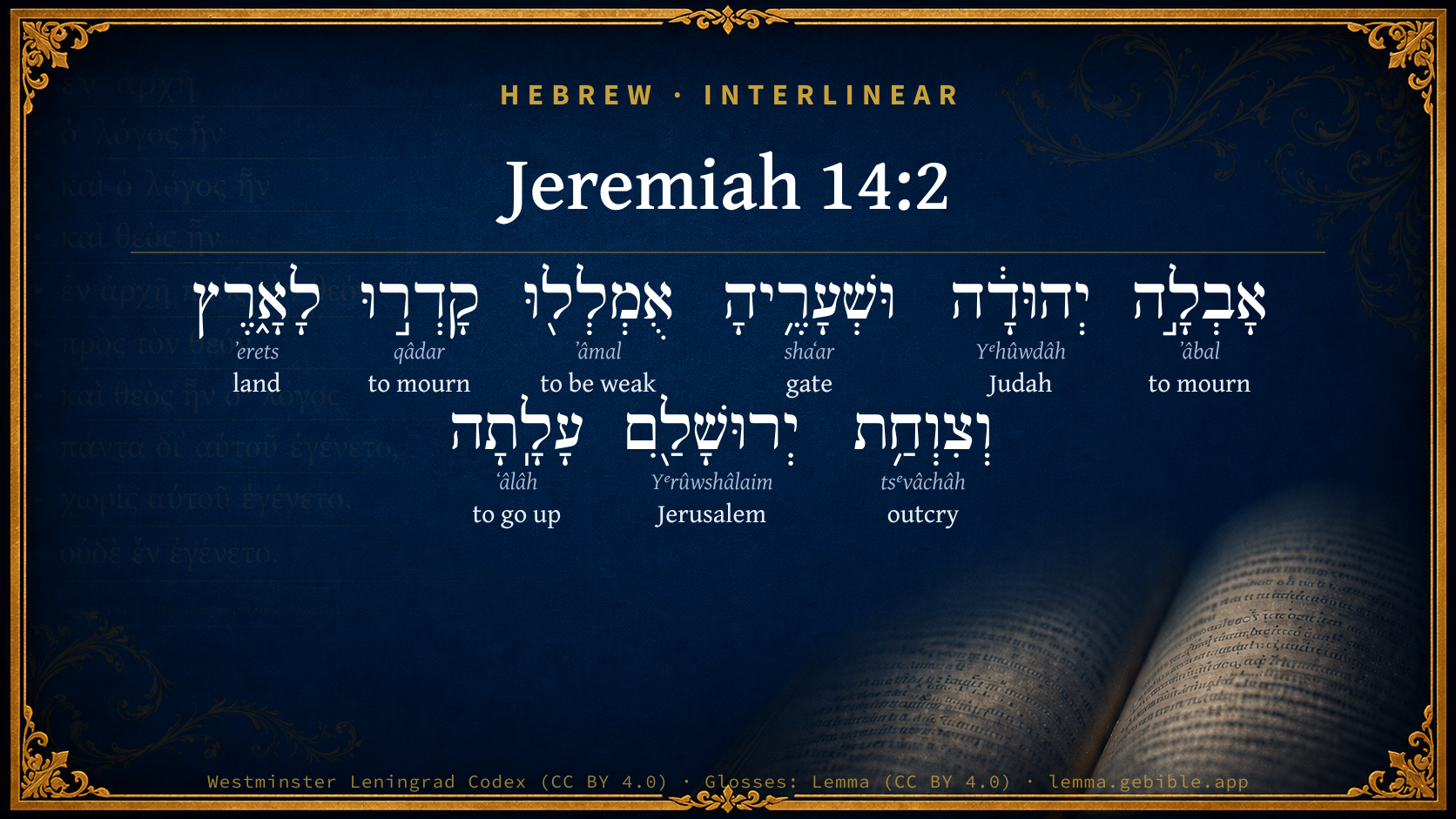
Jeremiah 14:2

Hebrew (Westminster Leningrad Codex) Jeremiah 14:2 appears in the Hebrew Old Testament. The text above is from the Westminster Leningrad Codex. Each word links to its Strong’s number, a concise gloss, and parsing drawn from the Open Scriptures Hebrew Bible morphology. Click any word for its full Brown-Driver-Briggs (BDB) entry.
Download image
Cite this verse

Jeremiah 14:2 (World English Bible). Public Domain. Lemma interlinear Bible study tool, https://lemma.gebible.app/v/jeremiah/14/2.

Show BibTeX & RIS
BibTeX
RIS
English Translation
Judah mourns, and the gates of it languish, they sit in black on the ground; and the cry of Jerusalem is gone up.
World English Bible · Public Domain
Download a study sheet

One document with this verse’s original text, its word-by-word gloss line, the meaning frame, cross-references with their text, attributed commentary, and full source and license credits — printable, and it pastes into notes with its structure intact.

This verse Autodidact and up

Study sheet (.html) Plain text (.txt)

A passage Seminary Student

Up to 50 verses in one chapter. A passage sheet keeps up to 6 commentary sources and 12 cross-references per verse, in the order this page ranks them, and says so on the sheet whenever that leaves anything out. Ask for a single verse and you get the Autodidact verse sheet above.

Everything on this page stays free to read, with no account — the sheet is a download of what is already on screen, not access to it.

Want to remove ads? Support Godless Engineer
Compare translations 3

The same verse in 3 English versions, stacked beneath the original-language interlinear above. Click any original word for its lexicon entry.

Each is an independent rendering of the whole verse — the interlinear is not word-aligned to these translations.

Highlighted words mark where these versions differ — a whole-verse word diff, not a word-by-word alignment.

  • World English Bible Public Domain
    Judah mourns, and the gates of it languish, they sit in black on the ground; and the cry of Jerusalem is gone up.
  • King James Version Public Domain
    Judah mourneth, and the gates thereof languish; they are black unto the ground; and the cry of Jerusalem is gone up.
  • unfoldingWord Literal Text CC BY-SA 4.0
    “Judah mourns, and her gates languish; they mourn for the land, and the cry of Jerusalem goes up.

unfoldingWord Literal Text — © unfoldingWord, licensed CC BY-SA 4.0. Word-aligned USFM3 via Door43 (git.door43.org/unfoldingWord/en_ult).

Versions to compare (up to 4)

3 of 4 selected

Show all 18 translations

Every available English version of this verse, each an independent rendering of the whole verse.

  • World English Bible Public Domain
    Judah mourns, and the gates of it languish, they sit in black on the ground; and the cry of Jerusalem is gone up.
  • Berean Standard Bible Public Domain
    “Judah mourns and her gates languish. Her people wail for the land, and a cry goes up from Jerusalem.
  • Majority Standard Bible Public Domain
    “Judah mourns and her gates languish. Her people wail for the land, and a cry goes up from Jerusalem.
  • King James Version Public Domain
    Judah mourneth, and the gates thereof languish; they are black unto the ground; and the cry of Jerusalem is gone up.
  • American Standard Version (1901) Public Domain
    Judah mourneth, and the gates thereof languish, they sit in black upon the ground; and the cry of Jerusalem is gone up.
  • Revised Version (1885) Public Domain
    Judah mourneth, and the gates thereof languish, they sit in black upon the ground; and the cry of Jerusalem is gone up.
  • Geneva Bible (1599) Public Domain
    Iudah hath mourned, and the gates thereof are desolate, they haue bene brought to heauinesse vnto the grounde, and the cry of Ierusalem goeth vp.
  • Douay-Rheims (1899) Public Domain
    Judea hath mourned, and the gates thereof are fallen, and are become obscure on the ground, and the cry of Jerusalem is gone up.
  • Young's Literal Translation Public Domain
    Mourned hath Judah, and her gates have languished, They have mourned to the earth, And the cry of Jerusalem hath gone up.
  • Literal Standard Version CC BY-SA 4.0
    “Judah has mourned, and her gates have languished, || They have mourned to the earth, || And the cry of Jerusalem has gone up.
  • Unlocked Literal Bible CC BY-SA 4.0
    “Let Judah mourn; let her gates fall apart. They are wailing for the land; their cries for Jerusalem are going up.
  • unfoldingWord Literal Text CC BY-SA 4.0
    “Judah mourns, and her gates languish; they mourn for the land, and the cry of Jerusalem goes up.
  • Darby Bible Public Domain
    Judah mourneth, and the gates thereof languish, they are black unto the ground; and the cry of Jerusalem goeth up.
  • World Messianic Bible Public Domain
    “Judah mourns, and its gates languish. They sit in black on the ground. The cry of Jerusalem goes up.
  • Webster's Bible Public Domain
    Judah mourneth, and her gates languish; they are black to the ground; and the cry of Jerusalem is gone up.
  • Free Bible Version CC BY-SA 4.0
    Judah is in mourning; her towns are wasting away. Her people are weeping for the land, and a cry for help comes from Jerusalem.
  • Bible in Basic English Public Domain
    Judah is weeping and its doors are dark with sorrow, and people are seated on the earth clothed in black; and the cry of Jerusalem has gone up.
  • JPS Tanakh (1917) Public Domain
    Judah mourneth, and the gates thereof languish, they bow down in black unto the ground; and the cry of Jerusalem is gone up.

Literal Standard Version (2020), Covenant Press — licensed CC BY-SA 4.0. Text via the HelloAO Bible API (eBible.org). Unlocked Literal Bible (unfoldingWord) — licensed CC BY-SA 4.0. Text via the HelloAO Bible API (eBible.org). unfoldingWord Literal Text — © unfoldingWord, licensed CC BY-SA 4.0. Word-aligned USFM3 via Door43 (git.door43.org/unfoldingWord/en_ult). Free Bible Version, Dr. Jonathan Gallagher — licensed CC BY-SA 4.0. Text via the HelloAO Bible API (eBible.org).

Word by word

More ways to search: Search by grammar → Find every occurrence → Compare this word →

Practice this passage: Drill this verse → Learn its vocabulary →

About this verse

These counts appear in no published source. They are computed here, from the morphology-tagged text and Lemma’s own curated glosses. What Lemma adds →

9
words
9
distinct lemmas
Prophets
section

Notable vocabulary

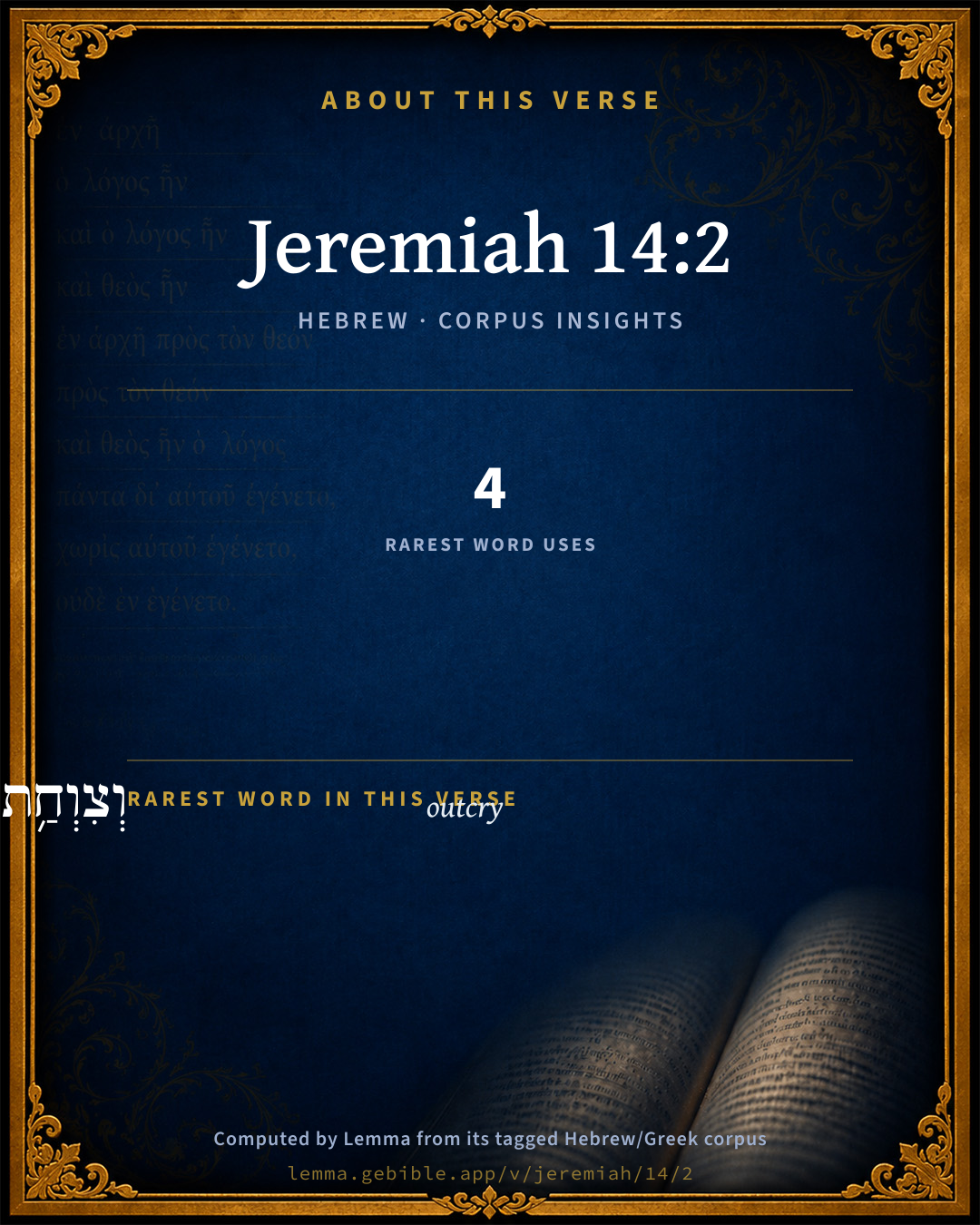
The rarest word here is וְצִוְחַ֥ת outcry H6682 — appearing just 4 times in the whole Hebrew Bible.

Shared distinctive vocabulary

וְצִוְחַ֥ת outcry H6682 occurs in 4 verses of the Hebrew Bible. Also found in:

Grammatical profile

  • 4 verbs
  • 5 nouns

Verb forms

  • אָבְלָ֣ה Qal · Perfect
  • אֻמְלְל֖וּ Pulal · Perfect
  • קָדְר֣וּ Qal · Perfect
  • עָלָֽתָה Qal · Perfect

Cross-references

22

Topical passages linked to Jeremiah 14:2 in the Treasury of Scripture Knowledge — connected by theme and wording, ordered by reader-vote popularity; previews shown in the World English Bible.

  • Isaiah 3:26 Her gates shall lament and mourn; And she shall be desolate and sit on the ground.
  • Jeremiah 8:21 For the hurt of the daughter of my people am I hurt: I mourn; dismay has taken hold on me.
  • 1 Samuel 5:12 The men who didn't die were struck with the tumors; and the cry of the city went up to heaven.
  • Lamentations 4:8–9 Their visage is blacker than a coal; they are not known in the streets: Their skin cleaves to their bones; it is withered, it is become like a stick.
  • Zechariah 7:13 It has come to pass that, as he called, and they refused to listen, so they will call, and I will not listen," said Yahweh of Hosts;
  • Jeremiah 11:11 Therefore thus says Yahweh, Behold, I will bring evil on them, which they shall not be able to escape; and they shall cry to me, but I will not listen to them.
  • Exodus 2:24 God heard their groaning, and God remembered his covenant with Abraham, with Isaac, and with Jacob.
  • 1 Samuel 9:16 Tomorrow about this time I will send you a man out of the land of Benjamin, and you shall anoint him to be prince over my people Israel; and he shall save my people out of the hand of the Philistines: for I have looked on my people, because their cry is come to me.
  • Job 34:28 So that they caused the cry of the poor to come to him, He heard the cry of the afflicted.
  • Isaiah 5:7 For the vineyard of Yahweh of Hosts is the house of Israel, And the men of Judah his pleasant plant: And he looked for justice, but, behold, oppression; For righteousness, but, behold, a cry of distress.
  • Isaiah 15:5 My heart cries out for Moab; her nobles [flee] to Zoar, to Eglath Shelishiyah: for by the ascent of Luhith with weeping they go up; for in the way of Horonaim they raise up a cry of destruction.
  • Isaiah 24:4 The earth mourns and fades away, the world languishes and fades away, the lofty people of the earth do languish.
  • Isaiah 24:7 The new wine mourns, the vine languishes, all the merry-hearted do sigh.
  • Isaiah 33:9 The land mourns and languishes; Lebanon is confounded and withers away; Sharon is like a desert; and Bashan and Carmel shake off [their leaves].
  • Jeremiah 4:28 For this shall the earth mourn, and the heavens above be black; because I have spoken it, I have purposed it, and I have not repented, neither will I turn back from it.
  • Jeremiah 12:4 How long shall the land mourn, and the herbs of the whole country wither? for the wickedness of those who dwell therein, the animals are consumed, and the birds; because they said, He shall not see our latter end.
  • Jeremiah 18:22 Let a cry be heard from their houses, when you shall bring a troop suddenly on them; for they have dug a pit to take me, and hid snares for my feet.
  • Lamentations 2:9 Her gates are sunk into the ground; he has destroyed and broken her bars: Her king and her princes are among the nations where the law is not; Yes, her prophets find no vision from Yahweh.
  • Lamentations 5:10 Our skin is black like an oven, Because of the burning heat of famine.
  • Hosea 4:3 Therefore the land will mourn, And everyone who dwells therein will waste away. All living things in her, Even the animals of the field and the birds of the sky; Yes, the fish of the sea also die.
  • Joel 1:10 The field is laid waste. The land mourns, for the grain is destroyed, The new wine has dried up, And the oil languishes.
  • Joel 2:6 At their presence the peoples are in anguish. All faces have grown pale.

Cross-references courtesy of OpenBible.info (CC BY 4.0).

Hebrew and Greek witnesses Masoretic Hebrew ↔ Greek Septuagint

The same verse in the two great witnesses to the Old Testament, shown verse-for-verse.

These are two independent witnesses, not word-aligned to each other, and the Septuagint is shown in lemma (dictionary) form.

Hebrew Jeremiah 14:2 Masoretic · Westminster Leningrad Codex

אָבְלָ֣ה יְהוּדָ֔ה וּשְׁעָרֶ֥יהָ אֻמְלְל֖וּ קָדְר֣וּ לָאָ֑רֶץ וְצִוְחַ֥ת יְרוּשָׁלִַ֖ם עָלָֽתָה

Judah mourns, and the gates of it languish, they sit in black on the ground; and the cry of Jerusalem is gone up.

World English Bible · Public Domain

Greek LXX Structure differs

In the Septuagint, Jeremiah is about an eighth shorter than the Hebrew and arranges its material differently — the Oracles Against the Nations (Hebrew chapters 46–51) appear in the middle of the Greek book, after 25:13. Because the chapter and verse boundaries do not line up, a verse-for-verse comparison with the Hebrew is not shown.

A verse-for-verse comparison isn’t shown here because the chapters and verses don’t line up. Switch to the LXX edition with the MT / LXX toggle above to read the Greek directly.

Hebrew: Westminster Leningrad Codex (CC BY 4.0). Greek: Septuagint (public domain); English from a public-domain English Septuagint. How the Septuagint differs from the Hebrew →

Targum (Aramaic paraphrase)

1

The Targum is the ancient Jewish Aramaic paraphrase of the Hebrew Scriptures — an interpretive translation, not the Hebrew text itself. Onkelos (literal) and Pseudo-Jonathan (expansive) render the Torah, and Jonathan the Prophets. Coverage is partial: where no permissively-licensed English translation exists for a verse, only the Aramaic is shown. This is verse-level text, not a word-by-word alignment to the Hebrew.

  1. Targum Jonathan Prophets (Joshua–Malachi)
    אִתְאַבָּלוּ דְבֵית יְהוּדָה וְקִרְוֵיהוֹן חֲרוֹבָא אִתְחַפִיאוּ אֲפֵּיהוֹן אֶכְרוֹם אוּכְמִין כְּקִדְרָא אִתְרְטִישׁוּ לְאַרְעָא וְצִוְחַת יַתְבֵי יְרוּשְׁלֵם סְלֵיקַת:

    (no public-domain English translation for this verse)

    Targum Jonathan — Aramaic: “Mikraot Gedolot” (public domain). English: “Sefaria Community Translation” (CC0 1.0 (public-domain dedication)); “London "Chaldee Paraphrase," 1871” (public domain). Text via Sefaria.

Commentary

Notes on Jeremiah 14:2 from classic Christian and Jewish commentators (each source and its license shown beneath its notes). The classic Christian expositions comment on the surrounding passage and are grouped to its opening verse, so a note may address several verses; the Jewish commentaries on the Tanakh (Rashi and others) are per-verse, so they appear only where the commentator wrote on this verse.

Lemma curates 59 commentaries, every one of them public domain or Creative Commons licensed, each selected and text-cleaned for this edition rather than reprinted as found. About our sources →

Trapp's Complete Commentary

John Trapp

Jer 14:2 Judah mourneth, and the gates thereof languish; they are black unto the ground; and the cry of Jerusalem is gone up.

Ver. 2. Judah mourneth.] The prophet’s pitiful complaint, bitterly bewailing the common calamity, and labouring thereby to bring them to a sense of the true cause of it, their sins. See 2Sa 21:1. {See Trapp on "2Sa 21:1"}

And the cry of Jerusalem is gone up,] sc., To heaven, for removal of this judgment. Compare Jer 36:9; Jer 14:12.

John Trapp, A Commentary or Exposition upon All the Books of the Old and New Testament (1647–1656) — public domain. Text from a community e-Sword module.

Joseph Benson's Commentary

Jer 14:2. Judah mourneth — The people of Judah and Jerusalem, here considered collectively, and represented as a mother oppressed with grief for the miseries which have come upon her children. And the gates languish, they are black — “They are in deep mourning:” so Blaney, who observes, “The gates of cities, being places of public resort, where the courts of justice were held, and other common business transacted, seem here to be put for the persons wont to meet there; in like manner as when we say, ‘The court is in mourning,’ we mean the persons that attend the court. So that by this passage we are to understand, that all the persons who appeared in public were dejected, and put on black, or mourning, on account of the national distress.” And the cry of Jerusalem is gone up — Namely, to heaven: That is, the cry of the inhabitants of Jerusalem; of their sin and trouble, but not, as it seems, of their confessions, prayers, and supplications.

Joseph Benson's Commentary on the Old and New Testaments (1811–1818) — public domain. Text from a community e-Sword module.

Keil & Delitzsch

C. F. Keil & F. Delitzsch

Description of the distress arising from the drought. - Jer 14:2. Judah mourneth, and the gates thereof languish, like mourning on the ground, and the cry of Jerusalem goeth up. Jer 14:3. Their nobles send their mean ones for water: they come to the wells, find no water, return with empty pitchers, are ashamed and confounded and cover their head. Jer 14:4. For the ground, which is confounded, because no rain is fallen upon the earth, the husbandmen are ashamed, cover their head. Jer 14:5. Yea, the hind also in the field, she beareth and forsaketh it, because there is no grass. Jer 14:6. And the wild asses stand on the bare-topped heights, gasp for air like the jackals; their eyes fail because there is no herb."

The country and the city, the distinguished and the mean, the field and the husbandmen, are thrown into deep mourning, and the beasts of the field pine away because neither grass nor herb grows. This description gives a touching picture of the distress into which the land and its inhabitants have fallen for lack of rain. Judah is the kingdom or the country with its inhabitants; the gates as used poetically for the cities with the citizens. Not mankind only, but the land itself mourns and pines away, with all the creatures that live on it; cf. Jer 14:4, where the ground is said to be dismayed along with the tillers of it. The gates of the cities are mentioned as being the places where the citizens congregate. אמלל, fade away, pine, is strengthened by: are black, i.e., mourn, down to the earth; pregnant for: set themselves mourning on the ground. As frequently, Jerusalem is mentioned alongside of Judah as being its capital. Their cry of anguish rises up to heaven. This universal mourning is specialized from Jer 14:3 on. Their nobles, i.e., the distinguished men of Judah and Jerusalem, send their mean ones, i.e., their retainers or servants and maids, for water to the wells (גּבים, pits, Kg2 3:16, here cisterns). The Chet. צעור, here and in Jer 48:4, is an unusual form for צעיר, Keri. Finding no water, they return, their vessels empty, i.e., with empty pitchers, ashamed of their disappointed hope. בּשׁוּ is strengthened by the synonym הכלמוּ. Covering the head is a token of deep grief turned inwards upon itself; cf. Sa2 15:30; Sa2 19:5. האדמה is the ground generally. חתּה is a relative clause: quae consternata est. "Because no rain," etc., literally as in Kg1 17:7. - Even the beasts droop and perish. כּי is intensive: yea, even. The hind brings forth and forsakes, sc. the new-born offspring, because for want of grass she cannot sustain herself and her young. עזוב, infin. abs. set with emphasis for the temp. fin., as Gen 41:43; Exo 8:11, and often; cf. Gesen. 131, 4, a, Ew. 351, c. The hind was regarded by the ancients as tenderly caring for her young, cf. Boch. Hieroz. i. lib. 3, c. 17 (ii. p. 254, ed. Ros.) The wild asses upon the bleak mountain-tops, where these animals choose to dwell, gasp for air, because, by reason of the dreadful drought, it is not possible to get a breath of air even on the hills. Like the תּנּים, jackals, cf. Jer 9:10; Jer 10:22, etc. Vulg. has dracones, with the Aram. versions; and Hitz. and Graf are of opinion that the mention of jackals is not here in point, and that, since תּנּים does not mean dracones, the word stands here, as in Exo 29:3; Exo 32:2, for תּנּין, the monster inhabiting the water, a crocodile or some kind of whale that stretches its head out of the water to draw breath with gaping jaws. On this Ng. has well remarked: he cannot see why the gaping, panting jaws of the jackal should not serve as a figure in such a case as the present. Their eyes fail away - from exhaustion due to want of wear. עשׂב, bushes and under-shrubs, as distinguished from דּשׁא, green grass.

Keil & Delitzsch — Biblical Commentary on the Old Testament (1861–1891) — public domain (CC PDM 1.0). Text via the HelloAO Bible API. (Old Testament only.)

Tyndale Open Study Notes

Tyndale Open Resources

14:2-3 During a drought, no crops were sold in the markets at the Jerusalem gates. Previous harvests could not be stored long, so starvation threatened the people. Cisterns constructed to collect water dried up, and with no rain, no water was available for drinking or for cooking meals. As a result, a great cry went up from Jerusalem.

Tyndale Open Study Notes — © Tyndale Open Resources, licensed CC BY-SA 4.0. Text via the HelloAO Bible API.

Geneva Bible (1599)

Geneva Bible translators

The word signifieth to be made black, and so is here taken for extreme sorrow.

Geneva Bible (1599) marginal notes — public domain. Text via Bolls.life.

Jamieson, Fausset & Brown

Robert Jamieson, A. R. Fausset & David Brown

gates--The place of public concourse in each city looks sad, as being no longer frequented (Isa 3:26; Isa 24:4).

black--that is, they mourn (blackness being indicative of sorrow), (Jer 8:21).

unto the ground--bowing towards it.

cry--of distress (Sa1 5:12; Isa 24:11).

Jamieson, Fausset & Brown — Commentary Critical and Explanatory on the Whole Bible (1871) — public domain (CC PDM 1.0). Text via the HelloAO Bible API.

Adam Clarke's Commentary

Verse 2. The gates thereof languish] The gates being the places of public resort, they are put here for the people.

They are black unto the ground] Covered from head to foot with a black garment, the emblem of sorrow and calamity.

Adam Clarke's Commentary on the Bible (1810–1826) — public domain. Text from a community e-Sword/MySword module.

John Calvin's Commentaries

The Prophet intimates in these words, that so great would be the scarcity as to appear to be a manifest and remarkable evidence of God’s vengeance; for when God punishes us in a common way, we for the most part refer the event to some fortuitous circumstances, and the devil also ever retains our minds in the consideration of secondary causes. Hence the Prophet declares here that an event so unusual could not be ascribed to natural causes, as that the earth should become so sterile, but that; it was the extraordinary judgment of God. This is the reason wily he employs so many figurative expressions. He might indeed have said, in one sentence, that there would be in the land a most grievous famine; but hardly one in a hundred would have been moved by words so simply expressed. Therefore the Prophet, in order to arouse their stupor, uses terms the most forcible.

Hence he says, Mourned has Judah Though he speaks of what was future, yet, according to his own usual manner and that of others, he uses the past time in order to shew the certainty of what he said. He then declares that there would be mourning in Judah. He afterwards says, His gates have been weakened, or scattered. In mentioning gates, he takes a part for the whole, for he means the cities: but as judgments were wont to be administered at the gates, and as men often assembled there, he says that the gates would be reduced to solitude, so that hardly any one would appear there. He in the third place adds, They have become darkened to the ground, or, in plainer words, they became overwhelmed with grief; but the proper meaning of the word is to become darkened: and he says, to the ground, as though he said that they would be so cast down as to he in the dust, and would not dare to raise up their heads, nor would be able to do so, being worn down by want and famine. We hence see what he means, even this, — that the scarcity would be so great that men would be down on the ground, and in a manner seek darkness for themselves, as it is the case with us when we flee as it were from the light and he on the ground; for we then shew that we cannot enjoy the light, it being disagreeable to us: and hence we see more clearly what I have stated, — that the Prophet uses very strong terms to produce an impression on the Jews, that they might know that the earth was so sterile, not through any natural or common cause, but through the judgment of God.

He afterwards adds, The cry of Jerusalem has ascended Here he sets forth their despair: for in doubtful matters we are wont to deliberate and to devise remedies; but when we are destitute of any counsel or advice, and when no hope appears, we then break out into crying. We hence see that it was an evidence of despair when the cry of Jerusalem ascended; for they would not be able to complain and to disburden their cares and griefs by pouring them into the bosoms of one another, but all of them would cry and howl.

John Calvin's Commentaries (1540-1563) — public domain. Text from the Calvin Translation Society English edition (1840s-50s) via the Christian Classics Ethereal Library (ccel.org). Calvin's coverage is partial (roughly two-thirds of the Bible); uncommented books and verses are honest gaps, never fabricated. The 19th-century editor's footnotes and remarks are omitted so the notes are faithfully Calvin's own voice.

Ellicott's Commentary for English Readers

(2) The gates thereof languish.—The “gates” of the cities, as the chief places of concourse, like the agora of Greek cities, are taken figuratively for the inhabitants, who in the “black” garments of sorrow and with the pallor of the famine, in which all faces gather blackness, are crouching upon the ground in their despair.

A Bible Commentary for English Readers, edited by Charles John Ellicott (1878–1897) — public domain. Text from a community e-Sword module.

The Cambridge Bible for Schools and Colleges

gen. ed. J. J. S. Perowne

2. the gates] put, as often in Hebrew, for cities, i.e. for the inhabitants, as being the place of general resort.

they sit in black upon the ground] Cp. Jer_8:21, Jer_13:18; also Psa_137:1; and Isa_47:1.

The Cambridge Bible for Schools and Colleges (gen. ed. J. J. S. Perowne; Cambridge University Press, 1878–1918) — public domain. Text from a community e-Sword module.

John Gill's Exposition

Judah mourneth,.... That is, the inhabitants of Judah; those of the house of Judah, as the Targum; these mourned because of the drought and famine that were upon the land:

and the gates thereof languish; the cities of Judah, as the Targum; the inhabitants of them, which used to be supplied from the field, and out of the country; gates may be mentioned, because through the gates the provisions were brought into the city; but now none; and therefore are said to languish; or else those that sat in the gates are meant, the elders of the people, the senators, the judges, and civil magistrates; these shared in the common calamity:

they are black unto the ground; that is, the inhabitants of the cities, and those that sit in the gates, their faces are black through famine; see Lam 4:8, so the Targum,

"their faces are covered with blackness, they are black as a pot;''

and which they turned to the ground, and looked downwards, not being able to lift them up through the sorrow and distress they were in, and through faintness of spirit for want of food:

and the cry of Jerusalem is gone up: meaning the cry and lamentation of the inhabitants of Jerusalem because of the famine, for that city was not exempted from it, it having its supply from the country; or the prayer of them, and of the people from all parts got together there, which went up to heaven for rain: it being usual, in times of common distress, for the people in the country to come up to Jerusalem to the temple to pray to God, and particularly for rain, when there was a want of it.

John Gill's Exposition of the Whole Bible (1746–1763) — public domain (CC PDM 1.0). Text via the HelloAO Bible API.

Albert Barnes' Notes on the Bible

They are black unto the ground - The people assembled at the gates, the usual places of concourse, are in deep mourning and sit humbly on the ground.

Albert Barnes' Notes on the Bible (1834–1885) — public domain. Text from a community e-Sword/MySword module.

Matthew Poole's English Annotations

By

Judah is meant the men and women in the whole country of Judah. The

gates is put for their cities; or the men of their cities languished, for want of moisture for themselves or their beasts. They are all in the habits of mourners, or their faces looked swarthy and starvedly, for want of due and wholesome nourishment,

and the cry of Jerusalem is gone up; either their cry unto God by their prayers in his temple, or their cry by the reason of, their misery and grief, is gone up to heaven.

Matthew Poole's English Annotations on the Holy Bible (1683–1685) — public domain. Text from a community e-Sword/MySword module.

Whedon's Commentary on the Bible

Daniel D. Whedon

2. Judah mourneth — The whole description is vigorous and graphic, and shows the unsurpassed power of Jeremiah in this respect. Country and city, the noble and the peasant, the husbandman and his parched fields, the burnt-up pastures, the waterless wells, and the starving flocks, all have a place in this vivid picture.

The gates — By metonomy for cities. They are the places where the people meet, and so the places where any popular feeling manifests itself.

They are black — That is, the people, who are in dark mourning attire, are seated on the ground in gloom and despair.

Daniel D. Whedon (gen. ed.), Commentary on the Old and New Testaments (1874–1909) — public domain. Text from a community e-Sword module.

The Pulpit Commentary

The tenses in the following description should be perfects and presents; the Authorized Version, by its inconsistency, destroys the unity of the picture. The gates thereof; i.e. the people assembled there. They are black unto the ground. "To be black," in Hebrew, is "to be dressed in mourning". (so e.g. Psa_35:14, "I bowed down in black Here we must understand the same verb which is expressed in the psalm, "They bowed down in mourning attire to the ground." "Black," however, is not to be taken literally; it means rather "squalid, unwashed" (of garments).

The Pulpit Commentary (1880–1919), ed. H.D.M. Spence-Jones & Joseph S. Exell — public domain. Text from a community e-Sword module.

Rashi

Rabbi Shlomo Yitzchaki (Rashi)

and her cities Heb. וּשְעָרֶיהָ, lit., her gates.

and the cry of Jerusalem Heb. צִוְחַת, the cry of Jerusalem. Comp. (Isaiah 42:11) “from the mountain peaks they shall shout (יִִִִִצְוָחוּ).

Rashi on the Tanakh — English translations: “The Judaica Press complete Tanach with Rashi, translated by A. J. Rosenberg” (CC BY 4.0); “Pentateuch with Rashi's commentary by M. Rosenbaum and A.M. Silbermann, 1929-1934” (public domain); “The Metsudah Tanach series, Lakewood, N.J” (CC BY 4.0); and “The Book of Joshua, Metsudah Publications, 1997” (CC BY 4.0). Text via Sefaria.

Lesson kit

Teaching starters — assembled from the data on this page, not authored interpretation. Every prompt links to the verse data it draws on. Edit before teaching.

Jeremiah, in the Prophets, opens this verse with 9 words (9 distinct Hebrew lemmas). Its most distinctive word is tsᵉvâchâh (“outcry”). A historical commentator’s framing appears above. Read the whole chapter for the surrounding context.

Discussion questions

  1. What does “outcry” (tsᵉvâchâh) contribute to the verse as a whole?
  2. Psalms 144:14 shares the word «outcry» with this verse. How do the two illuminate each other?
  3. The translations on this page render this verse differently — a whole-verse word diff, not a word-by-word alignment. What might account for the different wordings?
  4. The verb «אָבְלָ֣ה» is Qal Perfect. How does its form color the action?
  5. Reading how Trapp's Complete Commentary and Joseph Benson's Commentary read this verse, where do the two commentators agree and where do they part?

Things to notice

Reading settings

Reading text

Shown beneath each verse's original-language words.

Old Testament
Old Testament edition

Read the OT as the Masoretic Hebrew (MT) or the Greek Septuagint (LXX).

English shown for the Greek Septuagint (in the Hebrew ↔ Greek comparison).

Comparing translations? Open the Compare panel on any verse page to stack up to four side by side.