
Deuteronomy 12:17

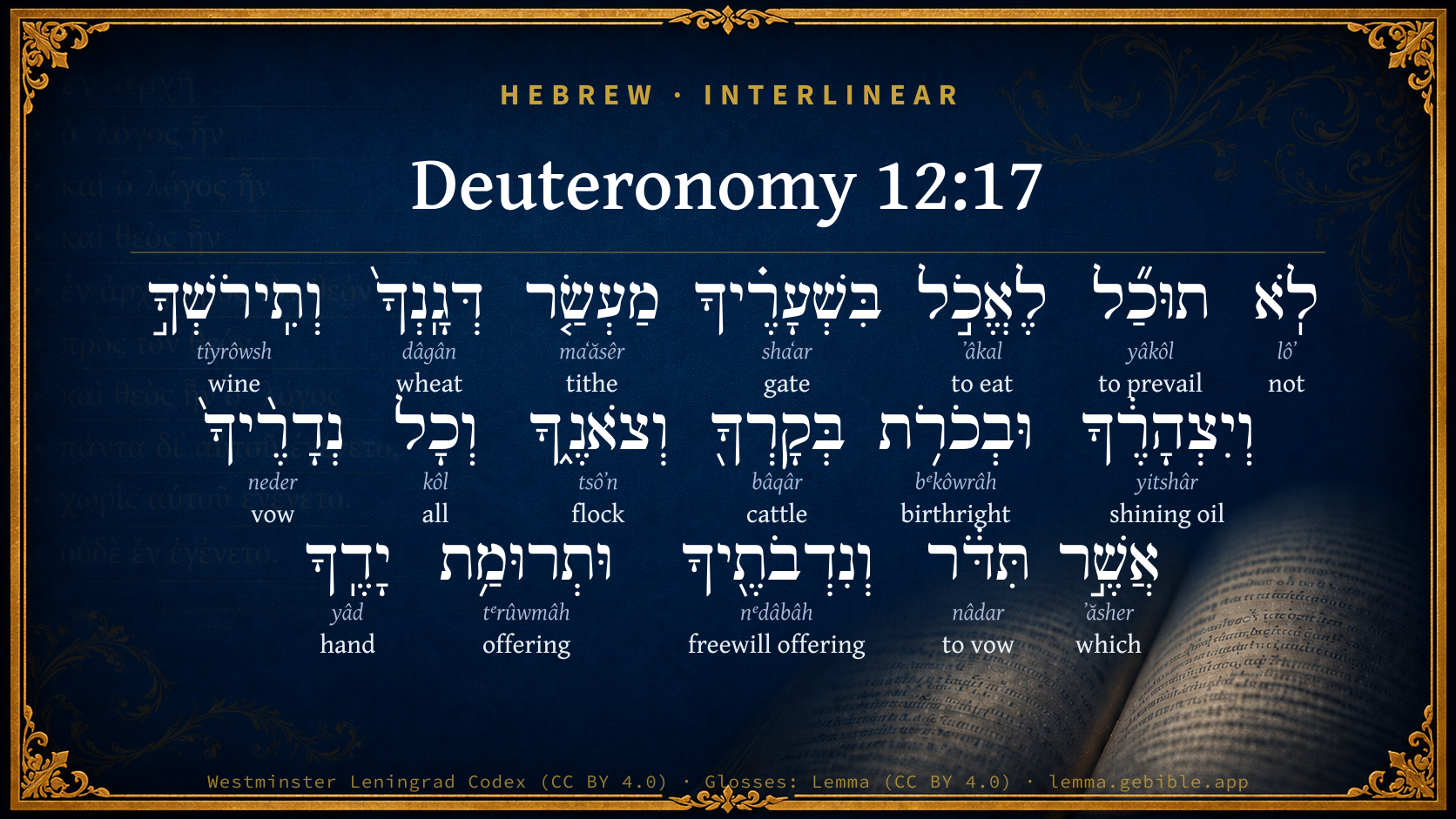
Hebrew (Westminster Leningrad Codex) Deuteronomy 12:17 appears in the Hebrew Old Testament. The text above is from the Westminster Leningrad Codex. Each word links to its Strong’s number, a concise gloss, and parsing drawn from the Open Scriptures Hebrew Bible morphology. Click any word for its full Brown-Driver-Briggs (BDB) entry.
Download image
Cite this verse

Deuteronomy 12:17 (World English Bible). Public Domain. Lemma interlinear Bible study tool, https://lemma.gebible.app/v/deuteronomy/12/17.

Show BibTeX & RIS
BibTeX
RIS
English Translation
You may not eat within your gates the tithe of your grain, or of your new wine, or of your oil, or the firstborn of your herd or of your flock, nor any of your vows which you vow, nor your freewill-offerings, nor the heave-offering of your hand;
World English Bible · Public Domain
Download a study sheet

One document with this verse’s original text, its word-by-word gloss line, the meaning frame, cross-references with their text, attributed commentary, and full source and license credits — printable, and it pastes into notes with its structure intact.

This verse Autodidact and up

Study sheet (.html) Plain text (.txt)

A passage Seminary Student

Up to 50 verses in one chapter. A passage sheet keeps up to 6 commentary sources and 12 cross-references per verse, in the order this page ranks them, and says so on the sheet whenever that leaves anything out. Ask for a single verse and you get the Autodidact verse sheet above.

Everything on this page stays free to read, with no account — the sheet is a download of what is already on screen, not access to it.

Want to remove ads? Support Godless Engineer
Compare translations 3

The same verse in 3 English versions, stacked beneath the original-language interlinear above. Click any original word for its lexicon entry.

Each is an independent rendering of the whole verse — the interlinear is not word-aligned to these translations.

Highlighted words mark where these versions differ — a whole-verse word diff, not a word-by-word alignment.

  • World English Bible Public Domain
    You may not eat within your gates the tithe of your grain, or of your new wine, or of your oil, or the firstborn of your herd or of your flock, nor any of your vows which you vow, nor your freewill-offerings, nor the heave-offering of your hand;
  • King James Version Public Domain
    Thou mayest not eat within thy gates the tithe of thy corn, or of thy wine, or of thy oil, or the firstlings of thy herds or of thy flock, nor any of thy vows which thou vowest, nor thy freewill offerings, or heave offering of thine hand:
  • unfoldingWord Literal Text CC BY-SA 4.0
    You are not allowed to eat within your gates from the tithe of your grain and your new wine and your oil and the firstborn of your herd or flock, and any of your vows that you vow and your freewill offerings and the contribution of your hand.

unfoldingWord Literal Text — © unfoldingWord, licensed CC BY-SA 4.0. Word-aligned USFM3 via Door43 (git.door43.org/unfoldingWord/en_ult).

Versions to compare (up to 4)

3 of 4 selected

Show all 18 translations

Every available English version of this verse, each an independent rendering of the whole verse.

  • World English Bible Public Domain
    You may not eat within your gates the tithe of your grain, or of your new wine, or of your oil, or the firstborn of your herd or of your flock, nor any of your vows which you vow, nor your freewill-offerings, nor the heave-offering of your hand;
  • Berean Standard Bible Public Domain
    Within your gates you must not eat the tithe of your grain or new wine or oil, the firstborn of your herds or flocks, any of the offerings that you have vowed to give, or your freewill offerings or special gifts.
  • Majority Standard Bible Public Domain
    Within your gates you must not eat the tithe of your grain or new wine or oil, the firstborn of your herds or flocks, any of the offerings that you have vowed to give, or your freewill offerings or special gifts.
  • King James Version Public Domain
    Thou mayest not eat within thy gates the tithe of thy corn, or of thy wine, or of thy oil, or the firstlings of thy herds or of thy flock, nor any of thy vows which thou vowest, nor thy freewill offerings, or heave offering of thine hand:
  • American Standard Version (1901) Public Domain
    Thou mayest not eat within thy gates the tithe of thy grain, or of thy new wine, or of thine oil, or the firstlings of thy herd or of thy flock, nor any of thy vows which thou vowest, nor thy freewill-offerings, nor the heave-offering of thy hand;
  • Revised Version (1885) Public Domain
    Thou mayest not eat within thy gates the tithe of thy corn, or of thy wine, or of thine oil, or the firstlings of thy herd or of thy flock, nor any of thy vows which thou vowest, nor thy freewill offerings, nor the heave offering of thine hand:
  • Geneva Bible (1599) Public Domain
    Thou maist nor eat within thy gates the tithe of thy corne, nor of thy wine, nor of thine oyle, nor the first borne of thy kine, nor of thy sheep, neither any of thy vowes which thou vowest, nor thy free offerings, nor the offering of thine hands,
  • Douay-Rheims (1899) Public Domain
    Thou mayst not eat in thy towns the tithes of thy corn, and thy wine, and thy oil, the firstborn of thy herds and thy cattle, nor any thing that thou vowest, and that thou wilt offer voluntarily, and the firstfruits of thy hands:
  • Young's Literal Translation Public Domain
    thou art not able to eat within thy gates the tithe of thy corn, and of thy new wine, and thine oil, and the firstlings of thy herd and of thy flock, and any of thy vows which thou vowest, and thy free-will offerings, and heave-offering of thy hand;
  • Literal Standard Version CC BY-SA 4.0
    you are not able to eat within your gates the tithe of your grain, and of your new wine, and your oil, and the firstlings of your herd and of your flock, and any of your vows which you vow, and your free-will offerings, and a raised-offering of your hand;
  • Unlocked Literal Bible CC BY-SA 4.0
    You may not eat within your gates from the tithe of your grain, your new wine, your oil, or the firstborn of your herd or flock; and you may not eat any of the meat you sacrifice along with any of your vows that you make, nor that of your freewill offerings, nor that of the offering you present with your hand.
  • unfoldingWord Literal Text CC BY-SA 4.0
    You are not allowed to eat within your gates from the tithe of your grain and your new wine and your oil and the firstborn of your herd or flock, and any of your vows that you vow and your freewill offerings and the contribution of your hand.
  • Darby Bible Public Domain
    Thou mayest not eat within thy gates the tithe of thy corn, or of thy new wine, or of thine oil, or the firstlings of thy kine or of thy sheep, nor any of thy vows which thou vowest, nor thy voluntary-offerings, nor the heave-offering of thy hand;
  • World Messianic Bible Public Domain
    You may not eat within your gates the tithe of your grain, or of your new wine, or of your oil, or the firstborn of your herd or of your flock, nor any of your vows which you vow, nor your free will offerings, nor the wave offering of your hand;
  • Webster's Bible Public Domain
    Thou mayest not eat within thy gates the tithe of thy corn, or of thy wine, or of thy oil, or the firstlings of thy herds or of thy flock, nor any of thy vows which thou vowest, nor thy free-will-offerings, or heave-offering of thy hand:
  • Free Bible Version CC BY-SA 4.0
    In your towns you must not eat the tithe of your grain or new wine or olive oil, the firstborn of your herds or flocks, any of the offerings that you give to fulfill a promise, your freewill offerings, or your special gifts.
  • Bible in Basic English Public Domain
    In your towns you are not to take as food the tenth part of your grain, or of your wine or your oil, or the first births of your herds or of your flocks, or anything offered under an oath, or freely offered to the Lord, or given as a lifted offering;
  • JPS Tanakh (1917) Public Domain
    Thou mayest not eat within thy gates the tithe of thy corn, or of thy wine, or of thine oil, or the firstlings of thy herd or of thy flock, nor any of thy vows which thou vowest, nor thy freewill-offerings, nor the offering of thy hand;

Literal Standard Version (2020), Covenant Press — licensed CC BY-SA 4.0. Text via the HelloAO Bible API (eBible.org). Unlocked Literal Bible (unfoldingWord) — licensed CC BY-SA 4.0. Text via the HelloAO Bible API (eBible.org). unfoldingWord Literal Text — © unfoldingWord, licensed CC BY-SA 4.0. Word-aligned USFM3 via Door43 (git.door43.org/unfoldingWord/en_ult). Free Bible Version, Dr. Jonathan Gallagher — licensed CC BY-SA 4.0. Text via the HelloAO Bible API (eBible.org).

Word by word

More ways to search: Search by grammar → Find every occurrence → Compare this word →

Practice this passage: Drill this verse → Learn its vocabulary →

וּבְכֹרֹ֥ת
bᵉkôwrâh
H1062
“and · birthrights of”
Conjunction + Noun, Common, Both, Plural, Construct
Part of Speech
Conjunction + Noun
Type
Common
Gender
Both
Number
Plural
State
Construct
Full BDB Definition

Origin: from H1060

TWOT: 244c

birthright, primogeniture, right of the first-born
  1. לֹֽא lôʼ H3808 “not” Particle, Negative
  2. תוּכַ֞ל yâkôl H3201 “to prevail” Verb, Qal, Imperfect, 2nd Person, Masculine, Singular
  3. לֶאֱכֹ֣ל ʼâkal H398 “to eat” Preposition + Verb, Qal, Infinitive Construct
  4. בִּשְׁעָרֶ֗יךָ shaʻar H8179 “in/at · gates · your” Preposition + Noun, Common, Masculine, Plural, Construct + Suffix, Personal, 2nd Person, Masculine, Singular
  5. מַעְשַׂ֤ר maʻăsêr H4643 “tithe of” Noun, Common, Masculine, Singular, Construct
  6. דְּגָֽנְךָ֙ dâgân H1715 “wheat · your” Noun, Common, Masculine, Singular, Construct + Suffix, Personal, 2nd Person, Masculine, Singular
  7. וְתִֽירֹשְׁךָ֣ tîyrôwsh H8492 “and · wine · your” Conjunction + Noun, Common, Masculine, Singular, Construct + Suffix, Personal, 2nd Person, Masculine, Singular
  8. וְיִצְהָרֶ֔ךָ yitshâr H3323 “and · shining oil · your” Conjunction + Noun, Common, Masculine, Singular, Construct + Suffix, Personal, 2nd Person, Masculine, Singular
  9. בְּקָרְךָ֖ bâqâr H1241 “cattle · your” Noun, Common, Both, Singular, Construct + Suffix, Personal, 2nd Person, Masculine, Singular
  10. וְצֹאנֶ֑ךָ tsôʼn H6629 “and · flock · your” Conjunction + Noun, Common, Both, Singular, Construct + Suffix, Personal, 2nd Person, Masculine, Singular
  11. וְכָל kôl H3605 “and · all of” Conjunction + Noun, Common, Masculine, Singular, Construct
  12. נְדָרֶ֨יךָ֙ neder H5088 “vows · your” Noun, Common, Masculine, Plural, Construct + Suffix, Personal, 2nd Person, Masculine, Singular
  13. אֲשֶׁ֣ר ʼăsher H834 “which” Particle, Relative
  14. תִּדֹּ֔ר nâdar H5087 “to vow” Verb, Qal, Imperfect, 2nd Person, Masculine, Singular
  15. וְנִדְבֹתֶ֖יךָ nᵉdâbâh H5071 “and · freewill offerings · your” Conjunction + Noun, Common, Feminine, Plural, Construct + Suffix, Personal, 2nd Person, Masculine, Singular
  16. וּתְרוּמַ֥ת tᵉrûwmâh H8641 “and · offering of” Conjunction + Noun, Common, Feminine, Singular, Construct
  17. יָדֶֽךָ yâd H3027 “hand · your” Noun, Common, Both, Singular, Construct + Suffix, Personal, 2nd Person, Masculine, Singular

About this verse

These counts appear in no published source. They are computed here, from the morphology-tagged text and Lemma’s own curated glosses. What Lemma adds →

18
words
18
distinct lemmas
Pentateuch
section

Notable vocabulary

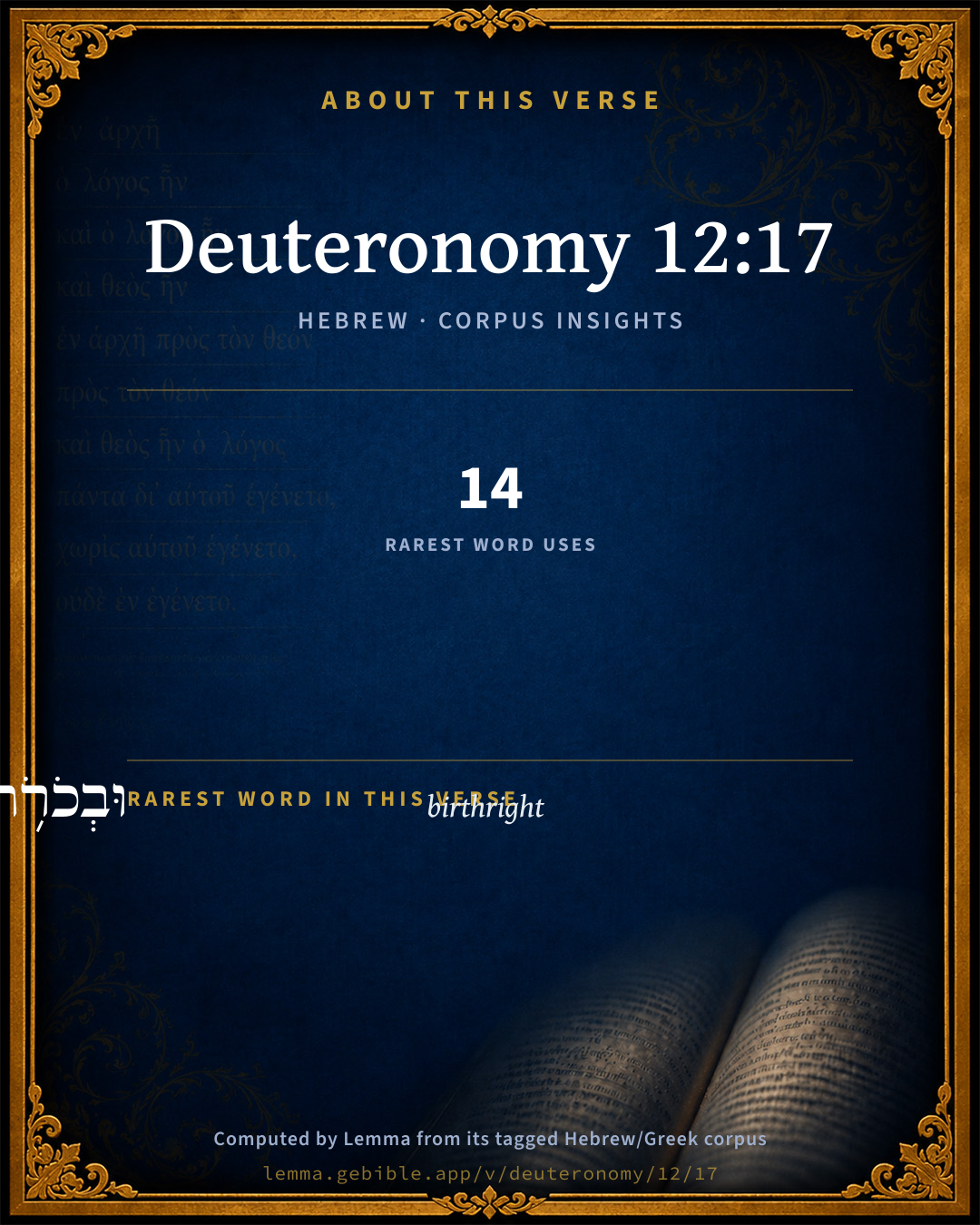
The rarest word here is וּבְכֹרֹ֥ת birthright H1062 — appearing just 14 times in the whole Hebrew Bible.

Shared distinctive vocabulary

וּבְכֹרֹ֥ת birthright H1062 occurs in 13 verses of the Hebrew Bible. Also found in:

Grammatical profile

  • 3 verbs
  • 13 nouns
  • 2 particles

Verb forms

  • תוּכַ֞ל Qal · Imperfect
  • לֶאֱכֹ֣ל Qal · Infinitive Construct
  • תִּדֹּ֔ר Qal · Imperfect

Hebrew & Septuagint length

In English translation the verse runs 48 words from the Hebrew and 53 from the Septuagint (LXX English) — closely comparable.

A rough comparison of the two English renderings, which tokenize alike — not a word-level alignment.

Word counts can differ between the Hebrew and the Greek without any difference in meaning — e.g. the Hebrew direct-object marker אֵת has no separate Greek word, and Greek often adds the article ὁ.

Cross-references

8

Topical passages linked to Deuteronomy 12:17 in the Treasury of Scripture Knowledge — connected by theme and wording, ordered by reader-vote popularity; previews shown in the World English Bible.

  • Deuteronomy 26:14 I have not eaten of it in my mourning, neither have I put away of it, being unclean, nor given of it for the dead: I have listened to the voice of Yahweh my God; I have done according to all that you have commanded me.
  • Deuteronomy 12:6 and there you shall bring your burnt offerings, and your sacrifices, and your tithes, and the heave-offering of your hand, and your vows, and your freewill-offerings, and the firstborn of your herd and of your flock:
  • Deuteronomy 14:22–29 You shall surely tithe all the increase of your seed, that which comes forth from the field year by year.
  • Leviticus 27:30–32 "'All the tithe of the land, whether of the seed of the land or of the fruit of the trees, is Yahweh's. It is holy to Yahweh.
  • Numbers 18:21–24 To the children of Levi, behold, I have given all the tithe in Israel for an inheritance, in return for their service which they serve, even the service of the tent of meeting.
  • Deuteronomy 12:11 then it shall happen that to the place which Yahweh your God shall choose, to cause his name to dwell there, there shall you bring all that I command you: your burnt offerings, and your sacrifices, your tithes, and the heave-offering of your hand, and all your choice vows which you vow to Yahweh.
  • Deuteronomy 12:26 Only your holy things which you have, and your vows, you shall take, and go to the place which Yahweh shall choose:
  • Deuteronomy 26:12 When you have made an end of tithing all the tithe of your increase in the third year, which is the year of tithing, then you shall give it to the Levite, to the foreigner, to the fatherless, and to the widow, that they may eat within your gates, and be filled.

Cross-references courtesy of OpenBible.info (CC BY 4.0).

Hebrew and Greek witnesses Masoretic Hebrew ↔ Greek Septuagint

The same verse in the two great witnesses to the Old Testament, shown verse-for-verse.

These are two independent witnesses, not word-aligned to each other, and the Septuagint is shown in lemma (dictionary) form.

Hebrew Deuteronomy 12:17 Masoretic · Westminster Leningrad Codex

לֹֽא תוּכַ֞ל לֶאֱכֹ֣ל בִּשְׁעָרֶ֗יךָ מַעְשַׂ֤ר דְּגָֽנְךָ֙ וְתִֽירֹשְׁךָ֣ וְיִצְהָרֶ֔ךָ וּבְכֹרֹ֥ת בְּקָרְךָ֖ וְצֹאנֶ֑ךָ וְכָל נְדָרֶ֨יךָ֙ אֲשֶׁ֣ר תִּדֹּ֔ר וְנִדְבֹתֶ֖יךָ וּתְרוּמַ֥ת יָדֶֽךָ

You may not eat within your gates the tithe of your grain, or of your new wine, or of your oil, or the firstborn of your herd or of your flock, nor any of your vows which you vow, nor your freewill-offerings, nor the heave-offering of your hand;

World English Bible · Public Domain

Greek LXX Deuteronomy 12:17 Septuagint · lemma form

οὐ δύναμαι ἐσθίω ἐν ὁ πόλις σύ ὁ ἐπιδέκατος ὁ σῖτος σύ καί ὁ οἶνος σύ καί ὁ ἔλαιον σύ ὁ πρωτότοκος ὁ βοῦς σύ καί ὁ πρόβατον σύ καί πᾶς εὐχή ὅσος ἄν εὔχομαι καί ὁ ὁμολογία σύ καί ὁ ἀπαρχή ὁ χείρ σύ

You shall not be able to eat in your cities the tithe of your corn, and of your wine, and of your oil, the firstborn of your herd and of your flock, and all your vows as many as you⌃ shall have vowed, and your thank-offerings, and the first fruits of your hands.

LXX2012 (modern English Septuagint) · Public Domain

Hebrew: Westminster Leningrad Codex (CC BY 4.0). Greek: Septuagint (public domain); English from LXX2012 (modern English Septuagint) (Public Domain). How the Septuagint differs from the Hebrew →

Targum (Aramaic paraphrase)

2

The Targum is the ancient Jewish Aramaic paraphrase of the Hebrew Scriptures — an interpretive translation, not the Hebrew text itself. Onkelos (literal) and Pseudo-Jonathan (expansive) render the Torah, and Jonathan the Prophets. Coverage is partial: where no permissively-licensed English translation exists for a verse, only the Aramaic is shown. This is verse-level text, not a word-by-word alignment to the Hebrew.

  1. Targum Onkelos Torah (Genesis–Deuteronomy)
    לֵית לָךְ רְשׁוּ לְמֵיכַל בְּקִרְוָיךְ מַעְשַׂר עִבוּרָךְ חַמְרָךְ וּמִשְׁחָךְ וּבְכוֹרֵי תוֹרָךְ וְעָנָךְ וְכָל נִדְרָךְ דִי תִדַר וְנִדְבָתָיךְ וְאַפְרָשׁוּת יְדָךְ

    (no public-domain English translation for this verse)

    Targum Onkelos — Aramaic: “Onkelos Genesis” (public domain); “Onkelos Exodus” (public domain); “Onkelos Leviticus” (public domain); “Onkelos Numbers” (public domain); “Onkelos Deuteronomy” (public domain). English: “Sefaria Community Translation” (CC0 1.0 (public-domain dedication)); “J.W. Etheridge. The Targums of Onkelos and Jonathan Ben Uzziel on the Pentateuch. London: Longmans, Green, 1862” (public domain). Text via Sefaria.

  2. Targum Pseudo-Jonathan Torah (Genesis–Deuteronomy)
    לֵיתֵיכוֹן רַשָּׁאִין לְמֵיכוּל בְּקִירְוֵיכוֹן מַעַשְרֵי עִיבּוּרֵיכוֹן חַמְרֵיכוֹן וּמִשְׁחֵיכוֹן וּבִיכּוּרֵי תּוֹרֵיכוֹן וְעַנְכוֹן וְכָל נִדְרֵיכוֹן דְּתִדְרוּן וְנִסְבָתֵיכוֹן וְאַפְרָשׁוּת יְדֵיכוֹן

    It will not be lawful for you to eat the tenths of your corn, or wine, or oil, or the firstlings of your herd or flock, nor any of the vows that you have vowed, or freewill offerings, or the separation of your hands in your cities;

    Targum Pseudo-Jonathan — Aramaic: “Targum Jonathan on Genesis” (public domain); “Targum Jonathan on Exodus” (public domain); “Targum Jonathan on Leviticus” (public domain); “Targum Jonathan on Numbers” (public domain); “Targum Jonathan on Deuteronomy” (public domain). English: “The Targum of Jonathan ben Uzziel, trans. J. W. Etheridge, London, 1862” (public domain). Text via Sefaria.

Commentary

Notes on Deuteronomy 12:17 from classic Christian and Jewish commentators (each source and its license shown beneath its notes). The classic Christian expositions comment on the surrounding passage and are grouped to its opening verse, so a note may address several verses; the Jewish commentaries on the Tanakh (Rashi and others) are per-verse, so they appear only where the commentator wrote on this verse.

Lemma curates 59 commentaries, every one of them public domain or Creative Commons licensed, each selected and text-cleaned for this edition rather than reprinted as found. About our sources →

Joseph Benson's Commentary

Deu 12:17. Within thy gates — That is, in your private habitations, here opposed to the place of God’s worship.

Joseph Benson's Commentary on the Old and New Testaments (1811–1818) — public domain. Text from a community e-Sword module.

Geneva Bible (1599)

Geneva Bible translators

Meaning, whatsoever was offered to the Lord, might not be eaten, but where he had appointed.

Geneva Bible (1599) marginal notes — public domain. Text via Bolls.life.

Ellicott's Commentary for English Readers

(17) The tithe.—This is understood by Jewish commentators of what is called “the second tithe.” The disposal of it is more particularly specified in Deu_14:22-29. (See also on Deu_26:12, &c.)

A Bible Commentary for English Readers, edited by Charles John Ellicott (1878–1897) — public domain. Text from a community e-Sword module.

John Gill's Exposition

Thou mayest not eat within thy gates the tithe of thy corn, or of thy wine, or of thy oil,.... This cannot be understood of the tithe given to the Levites, or of that which the Levites out of theirs gave to the priests, for that was only eaten by them; but of the tithe which every three years they were to lay up within their gates, and which they were to eat with their families and others; but the other two years they were to carry it to the place the Lord chose, or turn it into money, and when they came thither purchase with it what they pleased, and eat it, they and their household, and others with them, before the Lord; see Deu 14:22,

the firstlings of thy herds or of thy flocks; these also the firstborn males belonged to the Lord, and so to the priests, and could not be eaten by the people any where; and must be understood either of the next firstlings, which were the people's, or of the female firstlings, which they might devote to the Lord, and so not allowed to eat at home, but in the chosen place:

nor any of thy vows which thou vowest, nor thy freewill offerings; which were species of peace offerings, and so to be eaten not in their own cities, but in the place appointed:

or heave offerings of thine hand; the firstfruits; see Deu 26:1 these were such they were not bound to bring, but brought them freely.

John Gill's Exposition of the Whole Bible (1746–1763) — public domain (CC PDM 1.0). Text via the HelloAO Bible API.

Haydock's Catholic Bible Commentary

Tithes. These were of an extraordinary nature, destined for feasts, chap. xiv. 22., and Leviticus xxvii. 30. The usual tithes belonged entirely to the Levitical tribe. (Calmet) --- First-born, or the most excellent, ver. 11., and Exodus xii. 11, 12. The first-born, if it proved to be without defect, and a male, was given to the priests, Numbers xviii. 15. --- Voluntarily. If the thing was vowed to the Lord without restriction, it fell to the share of the priests alone: but if the person specified that he intended it for a peace-offering, &c., the priest could only claim what was allotted to him by the law. (Calmet) --- Hands. The fruits of trees, in the fourth year, may be insinuated. (Josephus, [Antiquities?] iv. 8.) (Menochius)

George Leo Haydock (1774–1849), Haydock's Catholic Family Bible and Commentary, 1859 edition — public domain. Excludes Psalms (Douay-Rheims chapter numbering differs from Protestant) and Deuterocanonical books (Catholic canon only).

Matthew Poole's English Annotations

Thou; either,

1. Thou, O Levite; or rather,

2. Thou, O Israelite, whom he distinguisheth from the Levite, Deu 12:18, accordingly as the following particulars agree to the one or to the other of you. Within thy gates, i.e. in your private habitations, here opposed to the place of God’s worship, Deu 12:18.

The tithe of thy corn, or of thy wine, or of thy oil. Here seems to be a great difficulty, not yet sufficiently observed nor cleared by interpreters. There were divers kinds of tithes:

1. The tithes given to the Levites out of all, of which Num 18:21,24; Deu 14:22; Neh 10:31.

2. The tithe of those tithes, which were to be given by the Levites to the priests, of which Num 18:21,24; Deu 14:29; Neh 10:37.

3. The third year’s tithe, of which Deu 14:28. To which some add another tithe, which they call the second tithe, which they say was taken after the Levites’ tithe was laid by. Now each of these hath its difficulty. It seems this place cannot be understood,

1. Of the Levites’ tithe; partly, because it might seem a great and wholly superfluous trouble to carry all their tithes up to Jerusalem, and to carry them back to their several habitations for their use; partly, because those were holy to the Lord, Lev 27:30, and not to be eaten by the people, Lev 27:31; whereas these belonged principally to the people, the Levites being only taken in as accessories to eat with them, as it is here, Deu 12:18; and partly, because those might be eaten in every place, as it is expressly affirmed, Num 18:31 Nor,

2. Of the tithe of the tithe, which was the priest’s; and neither Levites nor others might eat of it, except they were of or in the priest’s household. Nor,

3. Of the third year’s tithe, because that was to be eaten within their gates, Deu 14:28,29, as this was not.

I do therefore humbly conceive that this is meant of the second tithe, spoken of Deu 14:22; and that this was the very same tithe with that third year’s tithe, with this only difference, that in the third year they were to eat them together with the Levites within their gates, Deu 14:28,29, but in the two first years they were to eat them, together with the Levites also, in the place of God’s worship, as it is prescribed here and Deu 14:23. And that it is one land the same tithe which is spoken of Deu 14:22, and Deu 12:28, seems more than probable, both because they are called by the same name, all the tithe of their increase, and because that Deu 12:28 manifestly looks back to that Deu 12:22, and because otherwise every third year the Israelites were to pay three several tithes one after another, which Scripture no where affirms, and it seems to make the people’s burdens and the Levites’ provisions too great. For the objection taken from Deu 26:12,13, it shall be considered in its place. And the reason of that difference of place, and why the same tithes were eaten for two years together in Jerusalem, and the third in their own gates, seems to be this, that in the two first years there was a more special regard had to the Levites, who were very much conversant in Jerusalem, where those tithes were then eaten, and in the third year there is a respect had to the stranger, and the fatherless, and the widow, who are mentioned as joint sharers with the Levites in this third year’s tithe, whose occasions and obligations of coming to Jerusalem were not so many nor strong as those of the Levites, and therefore they were to be found generally within their gates, where these were to be eaten. And whereas the objection made before against the chargeable and useless carrying of the first tithes to Jerusalem might be applied here, it is answered there, and it is provided, that when they lived at a great distance from Jerusalem they might turn it into money and bestow it there, Deu 14-26, which both confirms the objection as to the first tithe, for which no such provision was made, and answers it as to this, where such a remedy is expressed. And whereas it may be pleaded on the behalf of the first, or the Levitical tithe, that those tithes were brought to Jerusalem, and that there were store-houses or chambers in the temple appointed for the receiving of the tithes, 2Ch 31:5,6,11,12; Ne 10:37,38; 12:44, it may be answered, that those chambers, being only thirty-eight in number, and each of them, except two, but six cubits broad and twelve cubits long, were altogether incapable of all those tithes, and seem principally, if not solely, appointed for the priests’ tithes, and not for all them neither, but only for so much of them as would serve for the use and necessity of those priests and Levites too that were in the actual ministration.

The firstlings of thy herds, or of thy flock. As the tithes now mentioned were not the Levitical, but second tithes, as hath been discoursed; so these firstlings do not seem to be the first firstlings, which being appropriated to the Levites were not to be eaten by any of the people, except those of or in the Levites’ families, but the second firstlings, which were the first which the owner could dispose of, and which, in conformity to the second tithes, he is required to set apart for this use.

Matthew Poole's English Annotations on the Holy Bible (1683–1685) — public domain. Text from a community e-Sword/MySword module.

Whedon's Commentary on the Bible

Daniel D. Whedon

17. Thou mayest not eat… the tithe of thy corn — The tithes mentioned differ from those in Lev_27:30-32. Those include all the products of the flock, the herd, and the field, and are spoken of as the Lord’s. The Deuteronomic tithes seem to be limited to the corn, wine, and oil. “They are nowhere characterized as the Lord’s, but are spoken of as belonging to the Israelites, to be eaten in sacrificial meals, or as a tithe to be set apart once in three years for the benefit of the poor.” — CURTISS, Levitical Priests, p. 38.

Firstlings — It is said that an unanswerable contradiction is found here to the regulations as to firstlings in Num_18:15-18. “There the Lord is represented as intimating to Aaron, in respect to the firstlings, that ‘the flesh of them shall be thine, as the wave breast and the heave shoulder, it shall be thine;’ but it is not said that the priests are to have all the flesh of the firstlings, nor is it said here that the people are to have all.” — CURTISS, Levitical Priests, p. 40.

Daniel D. Whedon (gen. ed.), Commentary on the Old and New Testaments (1874–1909) — public domain. Text from a community e-Sword module.

The Pulpit Commentary

Vers. 17-19. (Cf. vers. 6, 7, 12.) Thou mayest not eat; literally, thou art not able to eat; i.e. there is a legal inability to this. So the verb to be able (lkOy) is frequently used. (cf. Ge 43; Num_9:6; Deu_16:5 Deu_17:15, etc.)

The Pulpit Commentary (1880–1919), ed. H.D.M. Spence-Jones & Joseph S. Exell — public domain. Text from a community e-Sword module.

John Wesley's Explanatory Notes

Within thy gates - That is, in your private habitations, here opposed to the place of God's worship.

John Wesley, Explanatory Notes Upon the Whole Bible (1754–1765) — public domain. Text via the GEBible commentary corpus.

Kretzmann's Popular Commentary

Paul E. Kretzmann

Concerning the Care of the Levites, The Eating of Sacrificial Meat, and Idolatry

v. 17. Thou mayest not eat within thy gates the tithe of thy corn, or of thy wine, or of thy oil, or the firstlings of thy herds or of thy flock, nor any of thy vows which thou vowest, nor thy free-will offerings, or heave-offering of thine hand, whatever was taken from the possession of the Israelites as a gift to Jehovah; all these could not be consumed in the worshiper’s house or in his home town;

v. 18. but thou must eat them before the Lord, thy God, in the place which the Lord, thy God, shall choose, the central Sanctuary, thou, and thy son, and thy daughter, and thy man-servant, and thy maid-servant, and the Levite that is within thy gates; and thou shalt rejoice before the Lord, thy God, in all that thou puttest thine hands unto, in any offering that might be made.

v. 19. Take heed to thyself that thou forsake not the Levite as long as thou livest upon the earth, literally, "all thy days upon thy land," Deu 14:27; Neh 13:10.

v. 20. When the Lord, thy God, shall enlarge thy border, as He hath promised thee, Exo 34:24. and thou shalt say, I will eat flesh, because thy soul longeth to eat flesh, literally, "because the desire of thy soul is set upon eating flesh," indicating a very great, an overwhelming longing, thou mayest eat flesh, whatsoever thy soul lusteth after, or, wherever they would choose.

v. 21. If the place which the Lord, thy God, hath chosen to put His name there be too far from thee, then thou shalt kill of thy herd and of thy flock which the Lord hath given thee, as I have commanded thee; and thou shalt eat in thy gates whatsoever thy soul lusteth after.

v. 22. Even as the roebuck and the hart is eaten, namely, not in the form of sacrifices, so thou shalt eat them; the (Levitically) unclean and the clean shall eat of them alike.

v. 23. Only be sure that thou eat not the blood, they were to be strong enough to resist the temptation to use blood as food; for the blood is the life, and thou mayest not eat the life with the flesh, Lev 17:11-14.

v. 24. Thou shalt not eat it; thou shalt pour it upon the earth as water.

v. 25. Thou shalt not eat it, that it may go well with thee and with thy children after thee, when thou shalt do that which is right in the sight of the Lord, Exo 15:26.

v. 26. Only thy holy things which thou hast, those consecrated to the Lord, and thy vows, thou shalt take and go unto the place which the Lord shall choose;

v. 27. and thou shalt offer thy burnt offerings, the flesh and the blood, upon the altar of the Lord, thy God; and the blood of the sacrifices shall be poured out upon the altar of the Lord, thy God, as the Law provided, Lev 1:5, and thou shalt eat the flesh, Leviticus 7.

v. 28. Observe and hear all these words which I command thee, that it may go well with thee and with thy children after thee forever, when thou doest that which is good and right in the sight of the Lord, thy God.

v. 29. When the Lord, thy God, shall cut off, eradicate, the nations from before thee, whither thou goest to possess them, and thou succeedest them, by taking over their country, and dwellest in their land,

v. 30. take heed to thyself that thou be not snared by following them, fall into the same snare of idolatry which caused their downfall, after that they be destroyed from before thee, for that judgment of the Lord should deter them from a similar foolhardy course; and that thou enquire not after their gods, saying, How did these nations serve their gods? Even so will I do likewise. They should not even inquire about the form of worship used by the heathen, lest they be tempted to try it for themselves.

v. 31. Thou shalt not do so unto the Lord, thy God, not try to serve Him with a form of worship modeled after that of the heathen nations; for every abomination to the Lord which he hateth have they done unto their gods; for even their sons and their daughters they have burned in the fire to their gods, as the Moabites did in their service of Molech. It is a dangerous matter to Christianize heathen customs, for the superstition will cling to the rites after the Christian veneer is forgotten, as in many Christmas customs.

v. 32. What thing soever I command you, observe to do it; thou shalt not add thereto nor diminish from it, Jos 1:7. The Revelation of Scripture is sufficient for all purposes and teaches the way of salvation in a perfect manner. All books of modern antichristian sects which purport to be keys to the Bible are inventions of the Evil One.

Paul E. Kretzmann, Popular Commentary of the Bible (1921–1924) — public domain. Text from a community e-Sword module.

unfoldingWord translationNotes

Door43 World Missions Community

General Information:

Moses describes to the people all the special offerings and sacrifices that are to be made at the tabernacle.

within your gates

Here "gates" represents the whole city. AT: "inside your city" or "at your homes" (See: Synecdoche)

nor that of the offering you present with your hand

Here "hand" represents the whole person. AT: "nor that of any offering which you bring to Yahweh" (See: Synecdoche)

translationWords

tenth

grain

wine

oil

firstborn

flocks

sacrifice

vow

freewill offering

unfoldingWord translationNotes — © Distant Shores Media and the Door43 World Missions Community, licensed CC BY-SA 4.0. Source: git.door43.org/Door43/en_tn.

Rashi

Rabbi Shlomo Yitzchaki (Rashi)

לא תוכל THOU MAYEST NOT [EAT WITHIN THY GATES THE TITHE OF THY CORN etc.] — Scripture thereby intends to attach to this matter (the eating of מעשר בכור etc. outside the walls of Jerusalem) a negative command also (the positive command being contained in v. 11).

לא תוכל THOU MAYEST NOT (lit., thou canst not) [EAT etc.] — Rabbi Joshua the son of Korcha said: You can, but you are not allowed to (i.e. לא תוכל does not mean: you are unable for some reason or another to do so, but it expresses the inability to do it because of a legal restriction). A similar case we have in (Joshua 15:63) “As to the Jebusites, the inhabitants of Jerusalem, the children of Judah could not drive them out” — they could have done so, but they were not allowed to (Sifrei Devarim 72:1); because Abraham had made a covenant with them when he bought from them the cave of Machpelah that they would be spared at the conquest of the Land. — As a matter fact they were not Jebusites but Hittites (the people mentioned in Genesis 23 at the purchase of the cave), but they were called Jebusites after the city the name of which was Jebus. Thus is it explained in the Pirkei DeRabbi Eliezer 36. And this is the meaning of what is stated, that when David was about to drive out the Jebusites, they said to him (II Samuel 5:6) “Except thou take away the blind and the lame [thou shalt not come in hither]” — by “the blind and the lame” they meant the idols (that stood at the gates) upon which they had written the oath which Abraham had taken.

ובכרת בקרך [THOU MAYEST NOT EAT WITHIN THY GATES THE TITHE OF THY CORN …] AND THE FIRSTLINGS OF THY HERD — This, in contradistinction to מעשר דגנך וכו׳, is of course a prohibition addressed to the priests (since the Israelites were not at all permitted to eat firstlings; cf. Zevachim 5:1: הבכור נאכל לכהנים והמעשר לכל אדם).

‎ ותרומת ידך AND THE HEAVE-OFFERINGS OF THY HAND — This refers to the first-fruits (cf. Deuteronomy 26:4) (Sifrei Devarim 72:9; Makkot 17a).

Rashi on the Tanakh — English translations: “The Judaica Press complete Tanach with Rashi, translated by A. J. Rosenberg” (CC BY 4.0); “Pentateuch with Rashi's commentary by M. Rosenbaum and A.M. Silbermann, 1929-1934” (public domain); “The Metsudah Tanach series, Lakewood, N.J” (CC BY 4.0); and “The Book of Joshua, Metsudah Publications, 1997” (CC BY 4.0). Text via Sefaria.

Lesson kit

Teaching starters — assembled from the data on this page, not authored interpretation. Every prompt links to the verse data it draws on. Edit before teaching.

Deuteronomy, in the Pentateuch, opens this verse with 18 words (18 distinct Hebrew lemmas). Its most distinctive word is bᵉkôwrâh (“birthright”). A historical commentator’s framing appears above. Read the whole chapter for the surrounding context.

Discussion questions

  1. What does “birthright” (bᵉkôwrâh) contribute to the verse as a whole?
  2. Genesis 4:4 shares the word «birthright» with this verse. How do the two illuminate each other?
  3. The translations on this page render this verse differently — a whole-verse word diff, not a word-by-word alignment. What might account for the different wordings?
  4. The verb «תוּכַ֞ל» is Qal Imperfect. How does its form color the action?
  5. Reading how Joseph Benson's Commentary and Geneva Bible (1599) read this verse, where do the two commentators agree and where do they part?

Things to notice

Reading settings

Reading text

Shown beneath each verse's original-language words.

Old Testament
Old Testament edition

Read the OT as the Masoretic Hebrew (MT) or the Greek Septuagint (LXX).

English shown for the Greek Septuagint (in the Hebrew ↔ Greek comparison).

Comparing translations? Open the Compare panel on any verse page to stack up to four side by side.