Deuteronomy 23:16

Hebrew (Westminster Leningrad Codex) Deuteronomy 23:16 appears in the Hebrew Old Testament. The text above is from the Westminster Leningrad Codex. Each word links to its Strong’s number, a concise gloss, and parsing drawn from the Open Scriptures Hebrew Bible morphology. Click any word for its full Brown-Driver-Briggs (BDB) entry.
Download image
Cite this verse

Deuteronomy 23:16 (World English Bible). Public Domain. Lemma interlinear Bible study tool, https://lemma.gebible.app/v/deuteronomy/23/16.

Show BibTeX & RIS
BibTeX
RIS
English Translation
he shall dwell with you, in the midst of you, in the place which he shall choose within one of your gates, where it pleases him best: you shall not oppress him.
World English Bible · Public Domain
Download a study sheet

One document with this verse’s original text, its word-by-word gloss line, the meaning frame, cross-references with their text, attributed commentary, and full source and license credits — printable, and it pastes into notes with its structure intact.

This verse Autodidact and up

Study sheet (.html) Plain text (.txt)

A passage Seminary Student

Up to 50 verses in one chapter. A passage sheet keeps up to 6 commentary sources and 12 cross-references per verse, in the order this page ranks them, and says so on the sheet whenever that leaves anything out. Ask for a single verse and you get the Autodidact verse sheet above.

Everything on this page stays free to read, with no account — the sheet is a download of what is already on screen, not access to it.

Want to remove ads? Support Godless Engineer
Compare translations 3

The same verse in 3 English versions, stacked beneath the original-language interlinear above. Click any original word for its lexicon entry.

Each is an independent rendering of the whole verse — the interlinear is not word-aligned to these translations.

Highlighted words mark where these versions differ — a whole-verse word diff, not a word-by-word alignment.

  • World English Bible Public Domain
    he shall dwell with you, in the midst of you, in the place which he shall choose within one of your gates, where it pleases him best: you shall not oppress him.
  • King James Version Public Domain
    He shall dwell with thee, even among you, in that place which he shall choose in one of thy gates, where it liketh him best: thou shalt not oppress him.
  • unfoldingWord Literal Text CC BY-SA 4.0
    He shall live with you, in your midst, in the place that he chooses, in one of your gates as good to him. Do not oppress him.

unfoldingWord Literal Text — © unfoldingWord, licensed CC BY-SA 4.0. Word-aligned USFM3 via Door43 (git.door43.org/unfoldingWord/en_ult).

Versions to compare (up to 4)

3 of 4 selected

Show all 18 translations

Every available English version of this verse, each an independent rendering of the whole verse.

  • World English Bible Public Domain
    he shall dwell with you, in the midst of you, in the place which he shall choose within one of your gates, where it pleases him best: you shall not oppress him.
  • Berean Standard Bible Public Domain
    Let him live among you wherever he chooses, in the town of his pleasing. Do not oppress him.
  • Majority Standard Bible Public Domain
    Let him live among you wherever he chooses, in the town of his pleasing. Do not oppress him.
  • King James Version Public Domain
    He shall dwell with thee, even among you, in that place which he shall choose in one of thy gates, where it liketh him best: thou shalt not oppress him.
  • American Standard Version (1901) Public Domain
    he shall dwell with thee, in the midst of thee, in the place which he shall choose within one of thy gates, where it pleaseth him best: thou shalt not oppress him.
  • Revised Version (1885) Public Domain
    he shall dwell with thee, in the midst of thee, in the place which he shall choose within one of thy gates, where it liketh him best: thou shalt not oppress him.
  • Geneva Bible (1599) Public Domain
    He shall dwell with thee, euen among you, in what place he shall chuse, in one of thy cities where it liketh him best: thou shalt not vexe him.
  • Douay-Rheims (1899) Public Domain
    He shall dwell with thee ill the place that shall please him, and shall rest, in one of thy cities: give him no trouble.
  • Young's Literal Translation Public Domain
    with thee he doth dwell, in thy midst, in the place which he chooseth within one of thy gates, where it is pleasing to him; thou dost not oppress him.
  • Literal Standard Version CC BY-SA 4.0
    he dwells with you in your midst, in the place which he chooses within one of your gates, where it is pleasing to him; you do not oppress him.
  • Unlocked Literal Bible CC BY-SA 4.0
    Let him live with you, in whatever town he chooses. Do not oppress him.
  • unfoldingWord Literal Text CC BY-SA 4.0
    He shall live with you, in your midst, in the place that he chooses, in one of your gates as good to him. Do not oppress him.
  • Darby Bible Public Domain
    he shall dwell with thee, even in thy midst, in the place that he shall choose in one of thy gates, where it seemeth good to him; thou shalt not oppress him.
  • World Messianic Bible Public Domain
    He shall dwell with you, among you, in the place which he shall choose within one of your gates, where it pleases him best. You shall not oppress him.
  • Webster's Bible Public Domain
    He shall dwell with thee, even among you in that place which he shall choose in one of thy gates where it pleaseth him best: thou shalt not oppress him.
  • Free Bible Version CC BY-SA 4.0
    Let the slave live in your country wherever they want, in whatever town they want. Don't mistreat them.
  • Bible in Basic English Public Domain
    Let him go on living among you in whatever place is most pleasing to him: do not be hard on him.
  • JPS Tanakh (1917) Public Domain
    (23-17) he shall dwell with thee, in the midst of thee, in the place which he shall choose within one of thy gates, where it liketh him best; thou shalt not wrong him.

Literal Standard Version (2020), Covenant Press — licensed CC BY-SA 4.0. Text via the HelloAO Bible API (eBible.org). Unlocked Literal Bible (unfoldingWord) — licensed CC BY-SA 4.0. Text via the HelloAO Bible API (eBible.org). unfoldingWord Literal Text — © unfoldingWord, licensed CC BY-SA 4.0. Word-aligned USFM3 via Door43 (git.door43.org/unfoldingWord/en_ult). Free Bible Version, Dr. Jonathan Gallagher — licensed CC BY-SA 4.0. Text via the HelloAO Bible API (eBible.org).

Word by word

More ways to search: Search by grammar → Find every occurrence → Compare this word →

Practice this passage: Drill this verse → Learn its vocabulary →

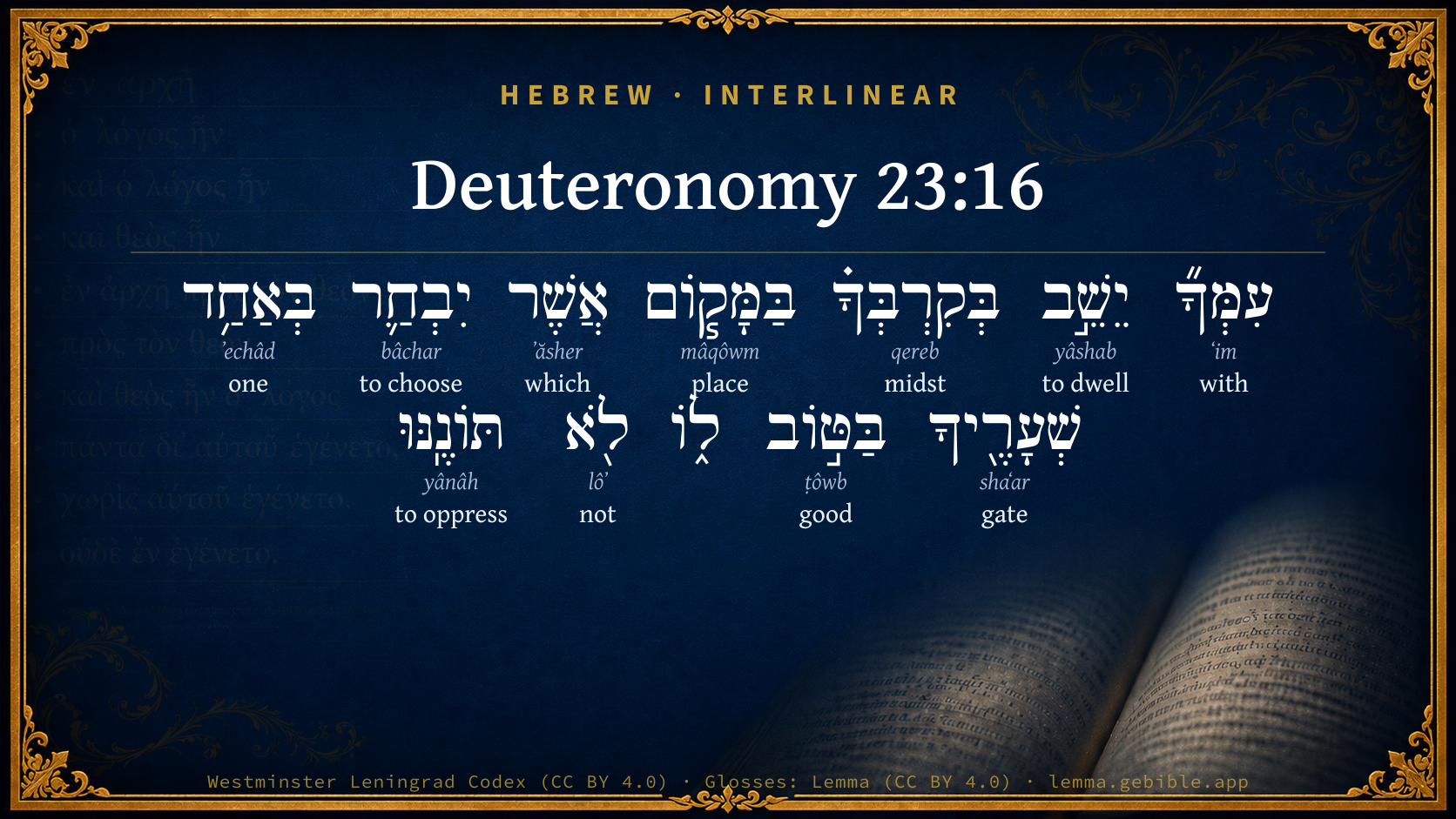
תּוֹנֶֽנּוּ
yânâh
H3238
“to oppress · him”
Verb, Hiphil, Imperfect, 2nd Person, Masculine, Singular + Suffix, Personal, 3rd Person, Masculine, Singular
Part of Speech
Verb
Stem
Hiphil
Form
Imperfect
Person
2nd Person
Gender
Masculine
Number
Singular
Full BDB Definition

Origin: a primitive root

TWOT: 873

to oppress, suppress, treat violently, maltreat, vex, do wrong - (Qal) to oppress, suppress - (Hiphil) to treat violently, maltreat
  1. עִמְּךָ֞ ʻim H5973 “with · you” Preposition + Suffix, Personal, 2nd Person, Masculine, Singular
  2. יֵשֵׁ֣ב yâshab H3427 “to dwell” Verb, Qal, Imperfect, 3rd Person, Masculine, Singular
  3. בְּקִרְבְּךָ֗ qereb H7130 “in/at · midst · your” Preposition + Noun, Common, Masculine, Singular, Construct + Suffix, Personal, 2nd Person, Masculine, Singular
  4. בַּמָּק֧וֹם mâqôwm H4725 “in/at the · place” Preposition, Determined + Noun, Common, Masculine, Singular, Absolute
  5. אֲשֶׁר ʼăsher H834 “which” Particle, Relative
  6. יִבְחַ֛ר bâchar H977 “to choose” Verb, Qal, Imperfect, 3rd Person, Masculine, Singular
  7. בְּאַחַ֥ד ʼechâd H259 “in/at · one” Preposition + Adjective, Cardinal number, Masculine, Singular, Construct
  8. שְׁעָרֶ֖יךָ shaʻar H8179 “gates · your” Noun, Common, Masculine, Plural, Construct + Suffix, Personal, 2nd Person, Masculine, Singular
  9. בַּטּ֣וֹב ṭôwb H2896 “in/at the · good” Preposition, Determined + Adjective, Adjective, Masculine, Singular, Absolute
  10. לֹ֖א lôʼ H3808 “not” Particle, Negative

About this verse

These counts appear in no published source. They are computed here, from the morphology-tagged text and Lemma’s own curated glosses. What Lemma adds →

12
words
11
distinct lemmas
Pentateuch
section

Notable vocabulary

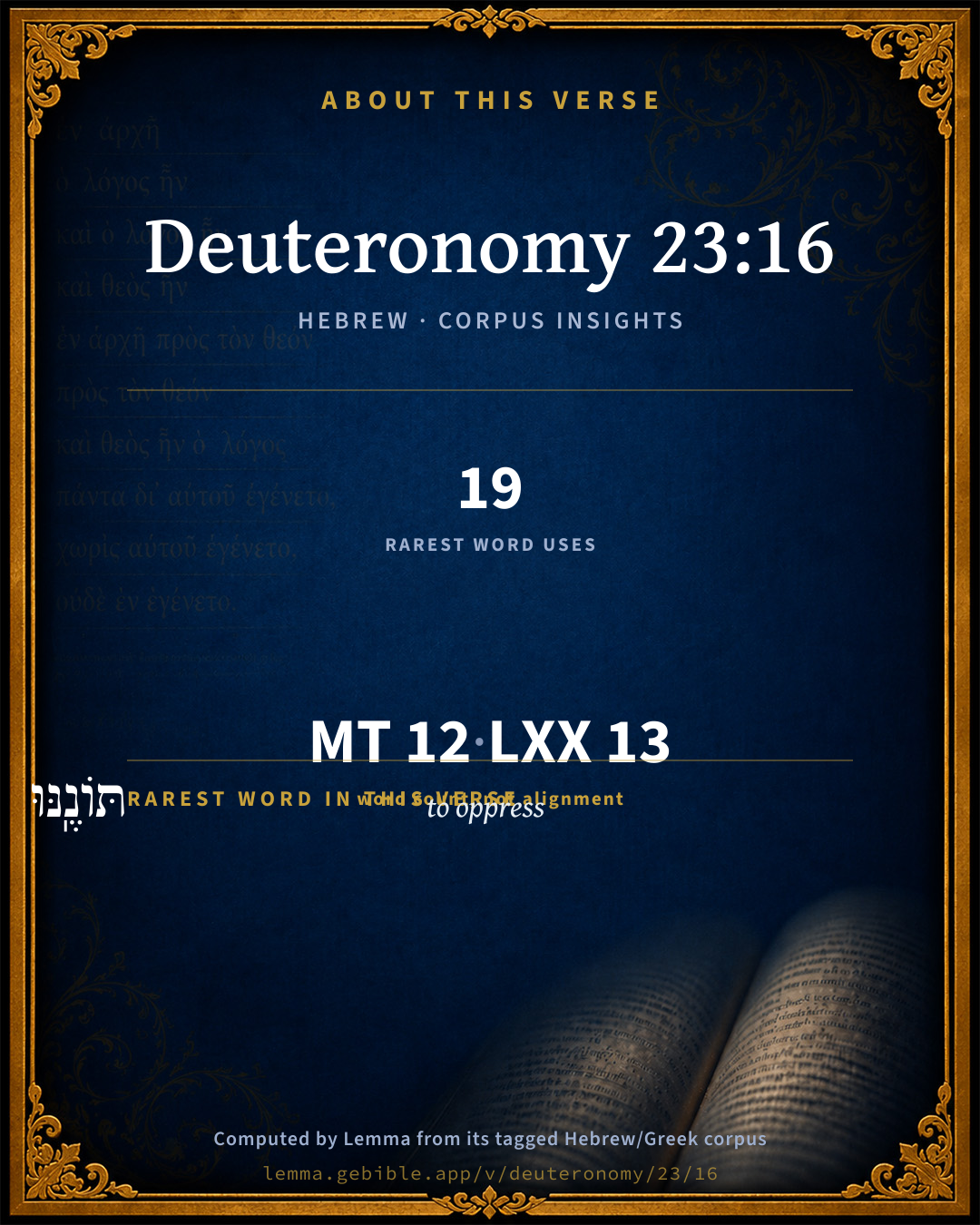
The rarest word here is תּוֹנֶֽנּוּ to oppress H3238 — appearing just 19 times in the whole Hebrew Bible.

Shared distinctive vocabulary

תּוֹנֶֽנּוּ to oppress H3238 occurs in 19 verses of the Hebrew Bible. Also found in:

Grammatical profile

  • 3 verbs
  • 3 nouns
  • 2 adjectives
  • 2 prepositions
  • 2 particles

Verb forms

  • יֵשֵׁ֣ב Qal · Imperfect
  • יִבְחַ֛ר Qal · Imperfect
  • תּוֹנֶֽנּוּ Hiphil · Imperfect

Hebrew & Septuagint length

In English translation the verse runs 32 words from the Hebrew and 19 from the Septuagint (LXX English) — the Septuagint runs noticeably shorter here. See the side-by-side →

A rough comparison of the two English renderings, which tokenize alike — not a word-level alignment.

Word counts can differ between the Hebrew and the Greek without any difference in meaning — e.g. the Hebrew direct-object marker אֵת has no separate Greek word, and Greek often adds the article ὁ.

In the original languages it is 12 Hebrew tokens and 13 Greek tokens — but the two are counted differently (Hebrew bundles its prefixes and suffixes into one token; the Greek is in lemma form), so that isn’t a like-for-like length.

Cross-references

9

Topical passages linked to Deuteronomy 23:16 in the Treasury of Scripture Knowledge — connected by theme and wording, ordered by reader-vote popularity; previews shown in the World English Bible.

  • Exodus 22:21 "You shall not wrong an alien, neither shall you oppress him, for you were aliens in the land of Egypt.
  • Exodus 23:9 "You shall not oppress an alien, for you know the heart of an alien, seeing you were aliens in the land of Egypt.
  • Isaiah 16:3–4 Give counsel, execute justice; make your shade as the night in the midst of the noonday; hide the outcasts; don't betray the fugitive.
  • Jeremiah 7:6 if you don't oppress the foreigner, the fatherless, and the widow, and don't shed innocent blood in this place, neither walk after other gods to your own hurt:
  • Zechariah 7:10 Don't oppress the widow, nor the fatherless, the foreigner, nor the poor; and let none of you devise evil against his brother in your heart.'
  • Malachi 3:5 I will come near to you to judgment; and I will be a swift witness against the sorcerers, and against the adulterers, and against the perjurers, and against those who oppress the hireling in his wages, the widow, and the fatherless, and who deprive the foreigner of justice, and don't fear me," says Yahweh of Hosts.
  • Titus 3:2–3 to speak evil of no one, not to be contentious, to be gentle, showing all humility toward all men.
  • James 2:6 But you have dishonored the poor man. Don't the rich oppress you, and personally drag you before the courts?
  • Luke 15:15–24 He went and joined himself to one of the citizens of that country, and he sent him into his fields to feed pigs.

Cross-references courtesy of OpenBible.info (CC BY 4.0).

Hebrew and Greek witnesses Masoretic Hebrew ↔ Greek Septuagint

The same verse in the two great witnesses to the Old Testament, shown verse-for-verse.

Here the Septuagint runs noticeably shorter than the Hebrew — LXX2012 (modern English Septuagint) 19 words vs World English Bible 32. A rough length comparison of the two English translations, not a word-level alignment — read both below.

These are two independent witnesses, not word-aligned to each other, and the Septuagint is shown in lemma (dictionary) form.

Hebrew Deuteronomy 23:16 Masoretic · Westminster Leningrad Codex

עִמְּךָ֞ יֵשֵׁ֣ב בְּקִרְבְּךָ֗ בַּמָּק֧וֹם אֲשֶׁר יִבְחַ֛ר בְּאַחַ֥ד שְׁעָרֶ֖יךָ בַּטּ֣וֹב ל֑וֹ לֹ֖א תּוֹנֶֽנּוּ

he shall dwell with you, in the midst of you, in the place which he shall choose within one of your gates, where it pleases him best: you shall not oppress him.

World English Bible · Public Domain

Greek LXX Deuteronomy 23:16 Septuagint · lemma form

οὐ παραδίδωμι παῖς ὁ κύριος αὐτός ὅς προςτίθημι σύ παρά ὁ κύριος αὐτός

He shall dwell with you, he shall dwell among you where he shall please; you shall not afflict him.

LXX2012 (modern English Septuagint) · Public Domain

Hebrew: Westminster Leningrad Codex (CC BY 4.0). Greek: Septuagint (public domain); English from LXX2012 (modern English Septuagint) (Public Domain). How the Septuagint differs from the Hebrew →

Targum (Aramaic paraphrase)

2

The Targum is the ancient Jewish Aramaic paraphrase of the Hebrew Scriptures — an interpretive translation, not the Hebrew text itself. Onkelos (literal) and Pseudo-Jonathan (expansive) render the Torah, and Jonathan the Prophets. Coverage is partial: where no permissively-licensed English translation exists for a verse, only the Aramaic is shown. This is verse-level text, not a word-by-word alignment to the Hebrew.

  1. Targum Onkelos Torah (Genesis–Deuteronomy)
    לָא תִמְסַר עֶבֶד עַמְמִין לְיַד רִבּוֹנֵהּ דְיִשְׁתֵּזֵב לְוָתָךְ מִלְוָת רִבּוֹנֵהּ

    (no public-domain English translation for this verse)

    Targum Onkelos — Aramaic: “Onkelos Genesis” (public domain); “Onkelos Exodus” (public domain); “Onkelos Leviticus” (public domain); “Onkelos Numbers” (public domain); “Onkelos Deuteronomy” (public domain). English: “Sefaria Community Translation” (CC0 1.0 (public-domain dedication)); “J.W. Etheridge. The Targums of Onkelos and Jonathan Ben Uzziel on the Pentateuch. London: Longmans, Green, 1862” (public domain). Text via Sefaria.

  2. Targum Pseudo-Jonathan Torah (Genesis–Deuteronomy)
    לָא תִימְסוֹר נוּכְרָאָה בִּידָא פַּלְחֵי טַעֲוָותֵי דְּאִישְׁתְּזִיב גַּבֵּיכוֹן לְמֶהֱוֵי תְּחוֹת טְלַל שְׁכִינְתִּי דְיִמְטוֹל הֵיכְנָא עֲרַק מִן פּוּלְחַן טָעוּתֵיהּ

    Thou shalt not deliver up a stranger into the hand of the worshipper of idols; (the sojourner) who hath escaped to be among you shall be under the protection of My Shekinah; for therefore he hath fled from his idolatry.

    Targum Pseudo-Jonathan — Aramaic: “Targum Jonathan on Genesis” (public domain); “Targum Jonathan on Exodus” (public domain); “Targum Jonathan on Leviticus” (public domain); “Targum Jonathan on Numbers” (public domain); “Targum Jonathan on Deuteronomy” (public domain). English: “The Targum of Jonathan ben Uzziel, trans. J. W. Etheridge, London, 1862” (public domain). Text via Sefaria.

Commentary

Notes on Deuteronomy 23:16 from classic Christian and Jewish commentators (each source and its license shown beneath its notes). The classic Christian expositions comment on the surrounding passage and are grouped to its opening verse, so a note may address several verses; the Jewish commentaries on the Tanakh (Rashi and others) are per-verse, so they appear only where the commentator wrote on this verse.

Lemma curates 59 commentaries, every one of them public domain or Creative Commons licensed, each selected and text-cleaned for this edition rather than reprinted as found. About our sources →

Geneva Bible (1599)

Geneva Bible translators

Hebrew, gates.

Geneva Bible (1599) marginal notes — public domain. Text via Bolls.life.

John Gill's Exposition

He shall dwell in thee, even among you,.... This seems to confirm the sense of it, being a stranger, a: proselyte servant that is here spoken of, since the law provides for his dwelling among the Israelites:

in that place he shall choose, in one of thy gates, where it liketh him best: he was not to be detained by the person that took him up in his own house, or be obliged to dwell in any certain place under, a restraint, but he might take up his abode in any of the cities of Israel, which would be most for his good, profit, and advantage:

thou shalt not oppress him; by words, as the Targum of Jonathan adds,"calling him a fugitive servant, or by any opprobrious name.''

John Gill's Exposition of the Whole Bible (1746–1763) — public domain (CC PDM 1.0). Text via the HelloAO Bible API.

Matthew Poole's English Annotations

Taking advantage from his low and afflicted condition to be unreasonable or injurious to him.

Matthew Poole's English Annotations on the Holy Bible (1683–1685) — public domain. Text from a community e-Sword/MySword module.

Rashi

Rabbi Shlomo Yitzchaki (Rashi)

לא תסגיר עבד THOU SHALT NOT DELIVER [UNTO HIS LORD] THE SERVANT [WHO IS ESCAPED FROM HIS LORD UNTO THEE] — Understand this as the Targum has it: עבד עממין the servant of the heathens. Another explanation is: that it implies even a Canaanite servant belonging to an Israelite who fled from outside the Land (from a foreign country) into the Land of Israel (Gittin 45a).

Rashi on the Tanakh — English translations: “The Judaica Press complete Tanach with Rashi, translated by A. J. Rosenberg” (CC BY 4.0); “Pentateuch with Rashi's commentary by M. Rosenbaum and A.M. Silbermann, 1929-1934” (public domain); “The Metsudah Tanach series, Lakewood, N.J” (CC BY 4.0); and “The Book of Joshua, Metsudah Publications, 1997” (CC BY 4.0). Text via Sefaria.

Ramban (Nachmanides)

Rabbi Moshe ben Nachman (Ramban / Nachmanides)

THOU SHALT NOT DELIVER UNTO HIS MASTER A BONDMAN THAT IS ESCAPED. This is connected with the section above that [when you go forth against the enemy] if a slave flees from his master against whom the host has gone forth and saves himself by fleeing to your camp you are not to deliver him to his master for money that he may give you. And since it states, he shall dwell with thee, in the midst of thee, in the place which he shall choose, it appears that it is a commandment that he become a free man and that we should not enslave him. The reason for this commandment is that with us he will worship G-d and it is not proper that we return him to his master to worship idols. Moreover, it is possible that he [the bondman] may show them the entrance into the city, for in that way they will capture many cities through slaves and captives fleeing from there. And our Rabbis have said [that this prohibition is applicable] even [to] a Canaanite bondman who belongs to an Israelite who fled from outside the Land into the Land of Israel, for this one too, should preferably work for those who dwell in the Land of G-d and be saved from working for those that dwell in an unclean land, and where not all commandments are binding.

Ramban (Nachmanides) on the Tanakh — English translation: “Commentary on the Torah by Ramban (Nachmanides). Translated and annotated by Charles B. Chavel. New York, Shilo Pub. House, 1971-1976” (CC BY 4.0). Text via Sefaria.

Lesson kit

Teaching starters — assembled from the data on this page, not authored interpretation. Every prompt links to the verse data it draws on. Edit before teaching.

Deuteronomy, in the Pentateuch, opens this verse with 12 words (11 distinct Hebrew lemmas). Its most distinctive word is yânâh (“to oppress”). The Greek Septuagint runs shorter here. A historical commentator’s framing appears above. Read the whole chapter for the surrounding context.

Discussion questions

  1. The word yânâh carries the sense “to oppress.” How does it shape the verse?
  2. How does Exodus 22:21, which shares the word «to oppress», read alongside this verse?
  3. The Septuagint runs shorter here than the Hebrew. What might account for the difference?
  4. These translations render this verse differently. What is at stake in choosing one wording over another?
  5. «יֵשֵׁ֣ב» is a Qal Imperfect verb. How does that grammatical form shape the action described?
  6. Compare how Geneva Bible (1599) and John Gill's Exposition read this verse. Where do they agree or differ?

Things to notice

Reading settings

Reading text

Shown beneath each verse's original-language words.

Old Testament
Old Testament edition

Read the OT as the Masoretic Hebrew (MT) or the Greek Septuagint (LXX).

English shown for the Greek Septuagint (in the Hebrew ↔ Greek comparison).

Comparing translations? Open the Compare panel on any verse page to stack up to four side by side.