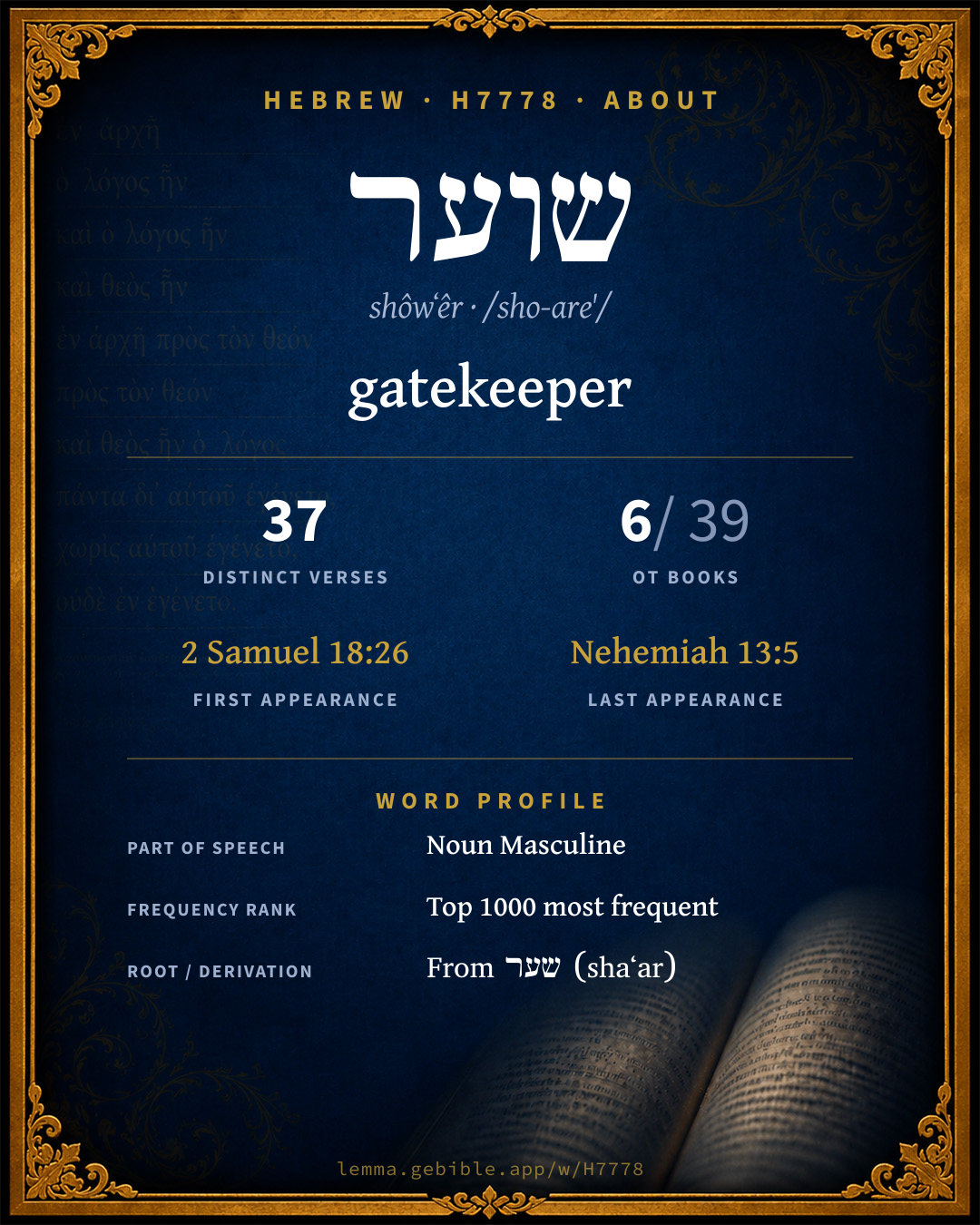
שֹׁעֵר
gatekeeper
Full lexicon entry — Brown-Driver-Briggs (BDB)
From Brown-Driver-Briggs (BDB)
Where this word appears
See every Absolute-state word in the Hebrew Bible →
Grammar key — what these labels mean
Part of speech
- Noun
- A naming word — a person, place, thing, or idea.
Noun type
- Common
- A common noun — a general class of person, place, or thing (“king,” “city,” “water”), not a specific name.
State
- Absolute
- The independent form of a noun, not bound to a following word.
- Construct
- A noun bound to a following noun in a possessive / “of” relationship (the construct chain).
Gender
- Masculine
- Grammatically masculine.
Number
- Plural
- More than one (in Hebrew, generally three or more).
- Singular
- One.
Grammatical forms
- Noun, Common, Masculine, Plural, Absolute 32 times (86%)
- Noun, Common, Masculine, Singular, Absolute 3 times (8%)
- Noun, Common, Masculine, Singular, Construct 1 time (3%)
- Noun, Common, Masculine, Plural, Construct 1 time (3%)
Parsed forms decoded from the imported morphology (morphhb / Westminster Leningrad Codex — WLC text public domain, morphhb tagging CC BY 4.0), counted across 37 parsed occurrences — not distinct verses.
Every verse where H7778 appears — 37 distinct verses across 6 books. Click any verse to open its interlinear word-by-word view. Verse text shown in the World English Bible for context — . Each verse’s Hebrew form is shown with its reference; the English is not keyword-highlighted, since the data carries no word-level English alignment. Use “Compare translations” on any verse to read it across multiple English versions. This concordance covers the Hebrew Bible; Septuagint (Greek Old Testament) occurrences are not indexed here.
2 Samuel 1 verse
2 Kings 2 verses
- 2 Kings 7:10 שֹׁעֵ֣ר n c ms cs So they came and called to the porter of the city; and they told them, saying, We came to the camp of the Syrians, and, behold, there was no man there, neither voice of man, but the horses tied, and the donkeys tied, and the tents as they were.
- 2 Kings 7:11 הַ/שֹּֽׁעֲרִ֑ים ptcl def.art + n c mp He called the porters; and they told it to the king's household within.
1 Chronicles 14 verses
- 1 Chronicles 9:17 וְ/הַ/שֹּׁעֲרִים֙ conj + ptcl def.art + n c mp The porters: Shallum, and Akkub, and Talmon, and Ahiman, and their brothers (Shallum was the chief),
- 1 Chronicles 9:18 הַ/שֹּׁ֣עֲרִ֔ים ptcl def.art + n c mp who hitherto [waited] in the king's gate eastward: they were the porters for the camp of the children of Levi.
- 1 Chronicles 9:21 שֹׁעֵ֥ר n c ms Zechariah the son of Meshelemiah was porter of the door of the tent of meeting.
- 1 Chronicles 9:22 לְ/שֹׁעֲרִ֣ים prep + n c mp All these who were chosen to be porters in the thresholds were two hundred and twelve. These were reckoned by genealogy in their villages, whom David and Samuel the seer did ordain in their office of trust.
- 1 Chronicles 9:24 הַ/שֹּׁעֲרִ֑ים ptcl def.art + n c mp On the four sides were the porters, toward the east, west, north, and south.
- 1 Chronicles 9:26 הַ/שֹּׁעֲרִ֔ים ptcl def.art + n c mp for the four chief porters, who were Levites, were in an office of trust, and were over the chambers and over the treasuries in the house of God.
- 1 Chronicles 15:18 הַ/שֹּׁעֲרִֽים ptcl def.art + n c mp and with them their brothers of the second degree, Zechariah, Ben, and Jaaziel, and Shemiramoth, and Jehiel, and Unni, Eliab, and Benaiah, and Maaseiah, and Mattithiah, and Eliphelehu, and Mikneiah, and Obed-edom, and Jeiel, the doorkeepers.
- 1 Chronicles 15:23 שֹׁעֲרִ֖ים n c mp Berechiah and Elkanah were doorkeepers for the ark.
- 1 Chronicles 15:24 שֹׁעֲרִ֖ים n c mp Shebaniah, and Joshaphat, and Nethanel, and Amasai, and Zechariah, and Benaiah, and Eliezer, the priests, did blow the trumpets before the ark of God: and Obed-edom and Jehiah were doorkeepers for the ark.
- 1 Chronicles 16:38 לְ/שֹׁעֲרִֽים prep + n c mp and Obed-edom with their brothers, sixty-eight; Obed-edom also the son of Jeduthun and Hosah to be doorkeepers;
- 1 Chronicles 23:5 שֹׁעֲרִ֑ים n c mp and four thousand were doorkeepers; and four thousand praised Yahweh with the instruments which I made, [said David], for giving praise.
- 1 Chronicles 26:1 לְ/שֹׁעֲרִ֑ים prep + n c mp For the divisions of the doorkeepers: of the Korahites, Meshelemiah the son of Kore, of the sons of Asaph.
- 1 Chronicles 26:12 הַ/שֹּֽׁעֲרִ֜ים ptcl def.art + n c mp Of these were the divisions of the doorkeepers, even of the chief men, having offices like their brothers, to minister in the house of Yahweh.
- 1 Chronicles 26:19 הַ/שֹּׁ֣עֲרִ֔ים ptcl def.art + n c mp These were the divisions of the doorkeepers; of the sons of the Korahites, and of the sons of Merari.
2 Chronicles 6 verses
- 2 Chronicles 8:14 וְ/הַ/שּׁוֹעֲרִ֥ים conj + ptcl def.art + n c mp He appointed, according to the ordinance of David his father, the divisions of the priests to their service, and the Levites to their offices, to praise, and to minister before the priests, as the duty of every day required; the doorkeepers also by their divisions at every gate: for so had David the man of God commanded.
- 2 Chronicles 23:4 לְ/שֹֽׁעֲרֵ֖י prep + n c mp cs This is the thing that you shall do: a third part of you, who come in on the Sabbath, of the priests and of the Levites, shall be porters of the thresholds;
- 2 Chronicles 23:19 הַ/שּׁ֣וֹעֲרִ֔ים ptcl def.art + n c mp He set the porters at the gates of the house of Yahweh, that no one who was unclean in anything should enter in.
- 2 Chronicles 31:14 הַ/שּׁוֹעֵ֣ר ptcl def.art + n c ms Kore the son of Imnah the Levite, the porter at the east [gate], was over the freewill-offerings of God, to distribute the offerings of Yahweh, and the most holy things.
- 2 Chronicles 34:13 וְ/שׁוֹעֲרִֽים conj + n c mp Also they were over the bearers of burdens, and set forward all who did the work in every manner of service: and of the Levites there were scribes, and officers, and porters.
- 2 Chronicles 35:15 וְ/הַ/שֹּׁעֲרִ֖ים conj + ptcl def.art + n c mp The singers the sons of Asaph were in their place, according to the commandment of David, and Asaph, and Heman, and Jeduthun the king's seer; and the porters were at every gate: they didn't need to depart from their service; for their brothers the Levites prepared for them.
Ezra 4 verses
- Ezra 2:42 הַ/שֹּֽׁעֲרִ֗ים ptcl def.art + n c mp The children of the porters: the children of Shallum, the children of Ater, the children of Talmon, the children of Akkub, the children of Hatita, the children of Shobai, in all one hundred thirty-nine.
- Ezra 2:70 וְ/הַ/שּׁוֹעֲרִ֛ים conj + ptcl def.art + n c mp So the priests, and the Levites, and some of the people, and the singers, and the porters, and the Nethinim, lived in their cities, and all Israel in their cities.
- Ezra 7:7 וְ/הַ/שֹּׁעֲרִ֛ים conj + ptcl def.art + n c mp There went up some of the children of Israel, and of the priests, and the Levites, and the singers, and the porters, and the Nethinim, to Jerusalem, in the seventh year of Artaxerxes the king.
- Ezra 10:24 הַ/שֹּׁ֣עֲרִ֔ים ptcl def.art + n c mp Of the singers: Eliashib. Of the porters: Shallum, and Telem, and Uri.
Nehemiah 10 verses
- Nehemiah 7:1 הַ/שּׁוֹעֲרִ֥ים ptcl def.art + n c mp Now it happened, when the wall was built, and I had set up the doors, and the porters and the singers and the Levites were appointed,
- Nehemiah 7:45 הַ/שֹּֽׁעֲרִ֗ים ptcl def.art + n c mp The porters: the children of Shallum, the children of Ater, the children of Talmon, the children of Akkub, the children of Hatita, the children of Shobai, one hundred thirty-eight.
- Nehemiah 7:73 וְ/הַ/שּׁוֹעֲרִים֩ conj + ptcl def.art + n c mp So the priests, and the Levites, and the porters, and the singers, and some of the people, and the Nethinim, and all Israel, lived in their cities. When the seventh month was come, the children of Israel were in their cities.
- Nehemiah 10:28 הַ/שּׁוֹעֲרִ֨ים ptcl def.art + n c mp The rest of the people, the priests, the Levites, the porters, the singers, the Nethinim, and all those who had separated themselves from the peoples of the lands to the law of God, their wives, their sons, and their daughters, everyone who had knowledge, and understanding;
- Nehemiah 10:39 וְ/הַ/שּׁוֹעֲרִ֖ים conj + ptcl def.art + n c mp For the children of Israel and the children of Levi shall bring the heave-offering of the grain, of the new wine, and of the oil, to the chambers, where are the vessels of the sanctuary, and the priests who minister, and the porters, and the singers: and we will not forsake the house of our God.
- Nehemiah 11:19 וְ/הַ/שּֽׁוֹעֲרִים֙ conj + ptcl def.art + n c mp Moreover the porters, Akkub, Talmon, and their brothers, who kept watch at the gates, were one hundred seventy-two.
- Nehemiah 12:25 שֽׁוֹעֲרִים֙ n c mp Mattaniah, and Bakbukiah, Obadiah, Meshullam, Talmon, Akkub, were porters keeping the watch at the store-houses of the gates.
- Nehemiah 12:45 וְ/הַ/שֹּׁעֲרִ֑ים conj + ptcl def.art + n c mp They kept the charge of their God, and the charge of the purification, and [so did] the singers and the porters, according to the commandment of David, and of Solomon his son.
- Nehemiah 12:47 וְ/הַ/שֹּׁעֲרִ֖ים conj + ptcl def.art + n c mp All Israel in the days of Zerubbabel, and in the days of Nehemiah, gave the portions of the singers and the porters, as every day required: and they set apart [that which was] for the Levites; and the Levites set apart [that which was] for the sons of Aaron.
- Nehemiah 13:5 וְ/הַ/שֹּׁעֲרִ֑ים conj + ptcl def.art + n c mp had prepared for him a great chamber, where before they laid the meal-offerings, the frankincense, and the vessels, and the tithes of the grain, the new wine, and the oil, which were given by commandment to the Levites, and the singers, and the porters; and the heave-offerings for the priests.
About this entry
At a glance — auto-summarized from this page’s data, not written by a person. Every figure links to its source below. This summary describes the numbers; it doesn’t interpret them.
At its core, שוער (shôwʻêr) means “gatekeeper.” Translators differ — “porters” in the King James Version, then “gatekeepers” (Berean Standard Bible), as the renderings breakdown shows. With 37 verses in 6 books, it is a moderately common word in the Hebrew Bible. Its uses concentrate in 1 Chronicles (38% of all occurrences). First canonically at 2 Samuel 18:26, it enters the text early. Dig into 37-verse concordance and the renderings breakdown below.
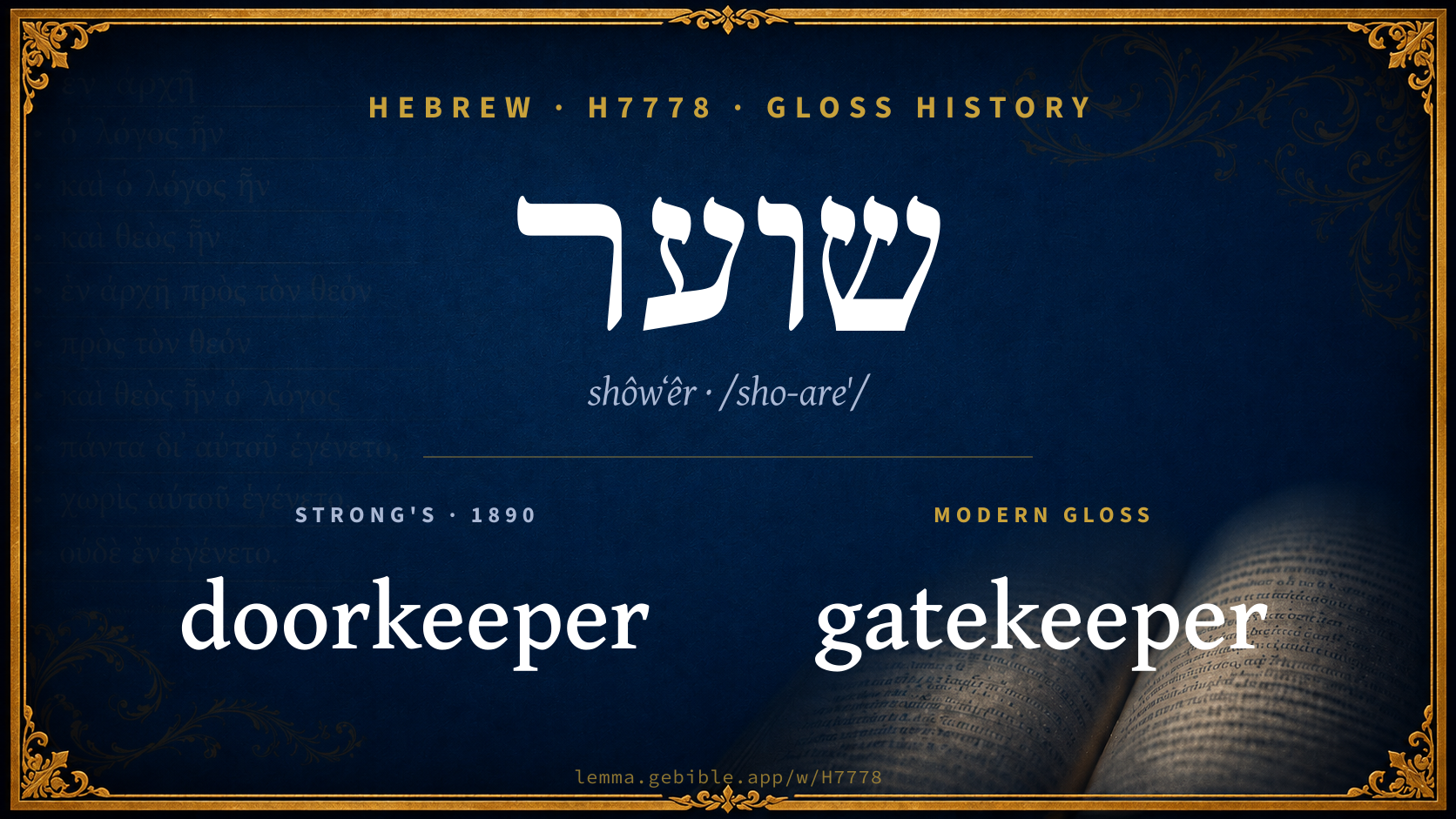
Gloss history
Strong's 1890 vs modern scholarship
About this word
Strong's H7778 catalogs a Hebrew word from the Hebrew Old Testament.
These counts are not copied from any lexicon or concordance. They are computed here, from the morphology-tagged Hebrew Old Testament. What Lemma adds →
- 37
- distinct verses
- The word appears in 37 distinct verses.
- 6 / 39
- OT books
- The word appears in 6 of 39 Old Testament books.
- #967
- by frequency
- Top 1000 most frequent Hebrew words (rank 967 of 8,640 Hebrew words by occurrence).
View all 37 occurrences in the concordance →
Most concentrated in
- 1 Chronicles 14 verses 38%
- Nehemiah 10 verses 27%
- 2 Chronicles 6 verses 16%
By section of the Old Testament
By traditional corpus
Conventional, traditional groupings — biblical authorship is debated, so this is a traditional corpus grouping, not an authorship claim. Each share is this word’s portion of its verses in that division of the Hebrew canon. Each figure is a share of the word’s 37 distinct verses.
- Writings (Ketuvim) 34 verses · 92%
- Prophets (Nevi'im) 3 verses · 8%
How translations render this word
Counts come from each version’s own published word-to-Strong’s tagging or interlinear alignment — an approximate guide to how each version renders this word, not a word-level alignment the data otherwise carries. Because each total is that version’s own tagged count, the per-version totals vary from one another and need not match the appearance or distinct-verse counts above. These counts may also differ from a printed concordance because Lemma counts each distinctly tagged rendering and does not collapse phrase taggings into a single head-word total. This is a fixed set of word-tagged versions (KJV, ASV, BSB, ULT) and does not change with the reading translation you choose elsewhere. Each version’s license is shown beside its name below (and on Sources).
- King James Version: Porters 23×, Porter 3×, Be porters 2×
- American Standard Version: Porters 18×, Doorkeepers 5×, Porter 3×
- Berean Standard Bible: Gatekeepers 27×
- unfoldingWord Literal Text: Gatekeepers 28×, Gatekeeper 2×, Were keepers 2×
King James Version Public Domain
Renders H7778 across 37 tagged occurrences — most commonly:
Plus 5 renderings that appear only once — usually multi-word phrases or single function words the recovered tagging swept in, not distinct renderings.
American Standard Version Public Domain
Renders H7778 across 37 tagged occurrences — most commonly:
Plus 8 renderings that appear only once — usually multi-word phrases or single function words the recovered tagging swept in, not distinct renderings.
Berean Standard Bible Public Domain
Renders H7778 across 37 tagged occurrences — most commonly:
Plus 10 renderings that appear only once — usually multi-word phrases or single function words the recovered tagging swept in, not distinct renderings.
unfoldingWord Literal Text CC BY-SA 4.0
Renders H7778 across 37 tagged occurrences — most commonly:
Plus 5 renderings that appear only once — usually multi-word phrases or single function words the recovered tagging swept in, not distinct renderings.
Senses in BDB
The 1 sense BDB distinguishes for this word, in lexicon order (not ranked by frequency or importance). The full entry — with sub-senses — is in the Lexicon Entry tab.
- gatekeeper, porter
Word origin
n.m. porter (denom. from 1. שַׁעַר);—abs. שׁוֹ׳ 2 Ch 31:14, cstr. שֹׁ׳ 2 K 7:10; 1 Ch 9:21, + f. שׁוֹעֶ֫רֶת 2 S 4:6 (for MT בֹּאוּ עַד תּ[וֹךְ]) We Dr HPS Bu Now after 𝔊 (Th פְּקִידַת דֶּלֶת); pl. שֹׁעֲרִים 2 K 7:11 + cstr. שֹׁעֲרֵי 2 Ch 23:4;—porter of city gate 2 K 7:10, 11 (2 S 18:26 read הַשַּׁעַר 𝔊 𝔖 𝔙 Th We Dr and most); portress of houses 2 S 4:6 (v. supr.); elsewhere (34 times Ch Ezr Ne) of gate-keepers in sanctuary 1 Ch 9:17, 18, 24 +; 4,000 in no., 23:5; שׁ׳ פֶּתַח לְאֹהֶל מוֹעֵד 9:21; שֹׁעֲרִים בַּסִּפִּים v 22; שׁ׳ לָאָרוֹן 15:23, 24; שֹׁעֲרֵי הַסִּפִּים 2 Ch 23:4; בְּנֵי הַשֹּׁעֲרִים Ezr 2:42.
— Brown-Driver-Briggs (Oxford 1906, public domain), digitized via Sefaria, supplemented by the OpenScriptures HebrewLexicon (CC BY 4.0). See Sources.
Derived from שער (shaʻar) (H8179) — gate.
Jastrow Dictionary
A second Hebrew/Aramaic lexicon for comparison, covering Aramaic and post-biblical (Talmudic, Targumic, Midrashic) usage that the biblical-Hebrew BDB does not. Matched by lemma rather than by Strong’s number, so a lemma may carry more than one Jastrow headword (shown separately below), and the entries cover usage well beyond the Bible.
שׁוֹעֵר
- gate-keeper. Deut. R. s. 23 היה מבקש מן הש׳ וכ׳ asked the gate-keeper to be allowed to enter the palace; a. e.—Pl. שׁוֹעֲרִים. Gen. R. s. 91 וכן הש׳ כל אחד שלו and so did the gate-keepers report, every one his own (the name of one of the sons of Jacob); a. e.
שׁוֹעֵר ²
- , Poel of שָׁעַר, part. מְשׁוֹעֵר, v. שָׁעַר I.
A Dictionary of the Targumim, the Talmud Babli and Yerushalmi, and the Midrashic Literature (Marcus Jastrow; London, Luzac, 1903) — Public Domain. Digitized via Sefaria. Digitized via Sefaria. Full attribution on Sources.
Forms in the corpus
The 31 distinct written forms H7778 takes in the Hebrew Bible, most frequent first — each parse links to that state’s occurrences in the concordance. Hebrew forms include their vowel points and cantillation, so a single lemma takes many written forms.
Same root — word family
Other BDB entries built from the same root as H7778, grouped by Strong’s listed origin. These share a root / origin per the lexicon — not necessarily a shared meaning. Each links to that word’s own entry.
Derives from
Shares the same root
Proper names from this root
People and places named from this root — a name, not an additional meaning of the word.
Compare all same-root words → 1 of the same-root words is a proper name (a person or place). They share a root, not necessarily a meaning.
Septuagint verse parallels
This word appears in 27 verses that also exist in the Greek Old Testament (Septuagint), out of the 37 Hebrew verses it occurs in. You can read those verses in Greek by switching the Old Testament edition to the Septuagint.
Read these verses in the Septuagint
This is a verse-level parallel only — the same verses exist in both the Hebrew and Greek Old Testaments. No word-level Hebrew↔Greek correspondence is claimed: the data carries no such alignment, so no Greek word is shown as this Hebrew word’s translation. Coverage is not total — the Septuagint omits the deuterocanon and renumbers the Psalms, so some Hebrew verses have no direct Greek parallel.