
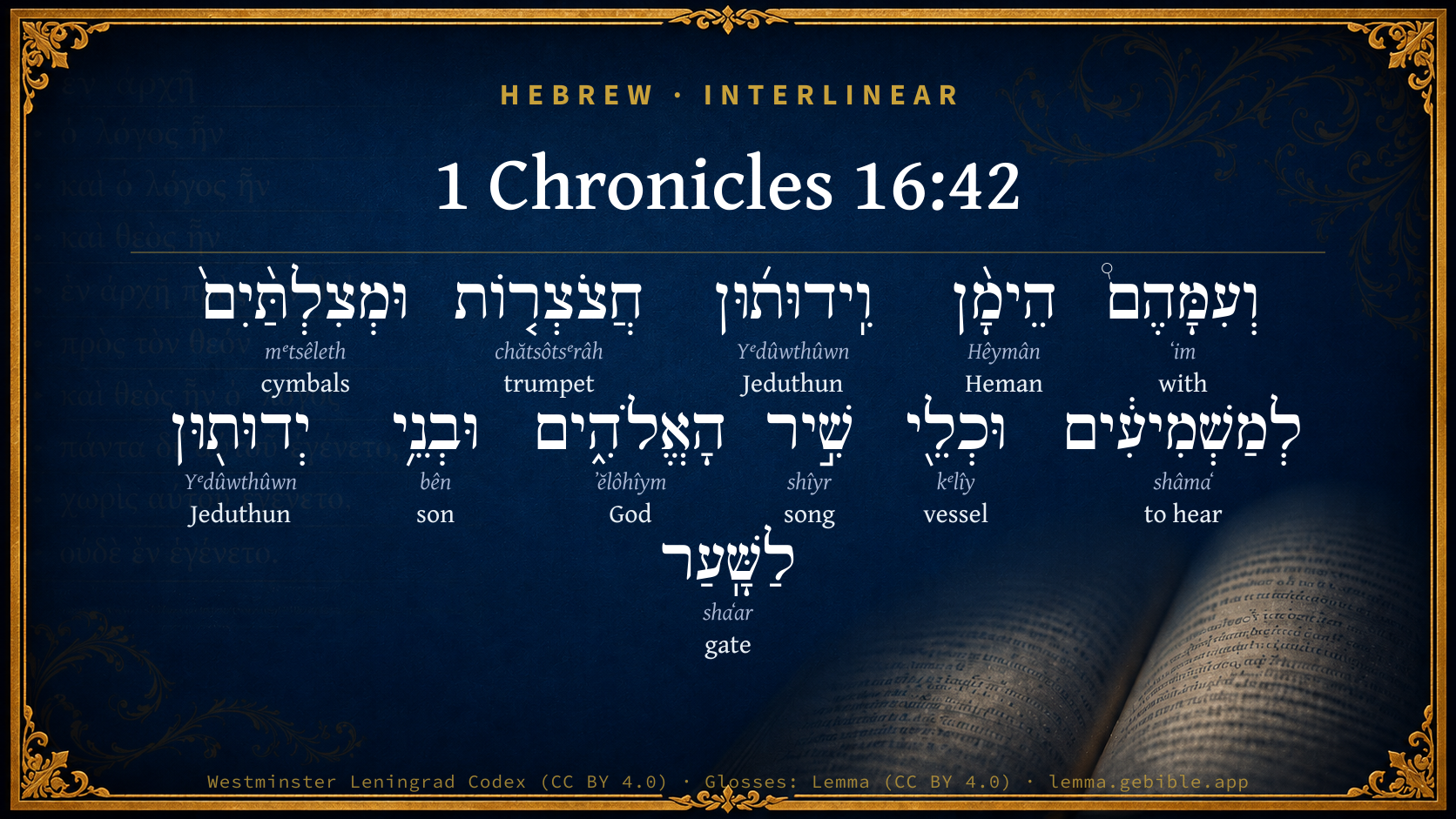
1 Chronicles 16:42

Hebrew (Westminster Leningrad Codex) 1 Chronicles 16:42 appears in the Hebrew Old Testament. The text above is from the Westminster Leningrad Codex. Each word links to its Strong’s number, a concise gloss, and parsing drawn from the Open Scriptures Hebrew Bible morphology. Click any word for its full Brown-Driver-Briggs (BDB) entry.
Download image
Cite this verse

1 Chronicles 16:42 (World English Bible). Public Domain. Lemma interlinear Bible study tool, https://lemma.gebible.app/v/1-chronicles/16/42.

Show BibTeX & RIS
BibTeX
RIS
English Translation
and with them Heman and Jeduthun [with] trumpets and cymbals for those that should sound aloud, and [with] instruments for the songs of God; and the sons of Jeduthun to be at the gate.
World English Bible · Public Domain
Download a study sheet

One document with this verse’s original text, its word-by-word gloss line, the meaning frame, cross-references with their text, attributed commentary, and full source and license credits — printable, and it pastes into notes with its structure intact.

This verse Autodidact and up

Study sheet (.html) Plain text (.txt)

A passage Seminary Student

Up to 50 verses in one chapter. A passage sheet keeps up to 6 commentary sources and 12 cross-references per verse, in the order this page ranks them, and says so on the sheet whenever that leaves anything out. Ask for a single verse and you get the Autodidact verse sheet above.

Everything on this page stays free to read, with no account — the sheet is a download of what is already on screen, not access to it.

Want to remove ads? Support Godless Engineer
Compare translations 3

The same verse in 3 English versions, stacked beneath the original-language interlinear above. Click any original word for its lexicon entry.

Each is an independent rendering of the whole verse — the interlinear is not word-aligned to these translations.

Highlighted words mark where these versions differ — a whole-verse word diff, not a word-by-word alignment.

  • World English Bible Public Domain
    and with them Heman and Jeduthun [with] trumpets and cymbals for those that should sound aloud, and [with] instruments for the songs of God; and the sons of Jeduthun to be at the gate.
  • King James Version Public Domain
    And with them Heman and Jeduthun with trumpets and cymbals for those that should make a sound, and with musical instruments of God. And the sons of Jeduthun were porters.
  • unfoldingWord Literal Text CC BY-SA 4.0
    And with them, Heman and Jeduthun to be making heard trumpets and cymbals and instruments of music of God, and the sons of Jeduthun for the gate.

unfoldingWord Literal Text — © unfoldingWord, licensed CC BY-SA 4.0. Word-aligned USFM3 via Door43 (git.door43.org/unfoldingWord/en_ult).

Versions to compare (up to 4)

3 of 4 selected

Show all 18 translations

Every available English version of this verse, each an independent rendering of the whole verse.

  • World English Bible Public Domain
    and with them Heman and Jeduthun [with] trumpets and cymbals for those that should sound aloud, and [with] instruments for the songs of God; and the sons of Jeduthun to be at the gate.
  • Berean Standard Bible Public Domain
    Heman and Jeduthun had with them trumpets and cymbals for the music and instruments for the songs of God. And the sons of Jeduthun were stationed at the gate.
  • Majority Standard Bible Public Domain
    Heman and Jeduthun had with them trumpets and cymbals for the music and instruments for the songs of God. And the sons of Jeduthun were stationed at the gate.
  • King James Version Public Domain
    And with them Heman and Jeduthun with trumpets and cymbals for those that should make a sound, and with musical instruments of God. And the sons of Jeduthun were porters.
  • American Standard Version (1901) Public Domain
    and with them Heman and Jeduthun `with' trumpets and cymbals for those that should sound aloud, and `with' instruments for the songs of God; and the sons of Jeduthun to be at the gate.
  • Revised Version (1885) Public Domain
    and with them Heman and Jeduthun with trumpets and cymbals for those that should sound aloud, and with instruments for the songs of God: and the sons of Jeduthun to be at the gate.
  • Geneva Bible (1599) Public Domain
    Euen with them were Heman and Ioduthun, to make a sound with the cornets and with the cymbales, with excellent instruments of musicke: and the sonnes of Ieduthun were at the gate.
  • Douay-Rheims (1899) Public Domain
    And Heman and Idithun sounded the trumpet, and played on the cymbals, and all kinds of musical instruments to sing praises to God: and the sons of Idithun he made porters.
  • Young's Literal Translation Public Domain
    and with them -- Heman and Jeduthun -- `are' trumpets and cymbals for those sounding, and instruments of the song of God, and the sons of Jeduthun `are' at the gate.
  • Literal Standard Version CC BY-SA 4.0
    and with them—Heman and Jeduthun—[are] trumpets and cymbals for those sounding, and instruments of the song of God, and the sons of Jeduthun [are] at the gate.
  • Unlocked Literal Bible CC BY-SA 4.0
    Heman and Jeduthun were in charge of those who played trumpets, cymbals, and the other instruments for the sacred music. The sons of Jeduthun guarded the gate.
  • unfoldingWord Literal Text CC BY-SA 4.0
    And with them, Heman and Jeduthun to be making heard trumpets and cymbals and instruments of music of God, and the sons of Jeduthun for the gate.
  • Darby Bible Public Domain
    and with them, [with] Heman and Jeduthun, trumpets and cymbals for those that should sound aloud; and the musical instruments of God. And the sons of Jeduthun were at the gate.
  • World Messianic Bible Public Domain
    and with them Heman and Jeduthun with shofars and cymbals for those that should sound aloud, and with instruments for the songs of God, and the sons of Jeduthun to be at the gate.
  • Webster's Bible Public Domain
    And with them Heman and Jeduthun with trumpets and cymbals for those that should make a sound, and with musical instruments of God. And the sons of Jeduthun were porters.
  • Free Bible Version CC BY-SA 4.0
    Heman and Jeduthun used their trumpets and cymbals to make music to accompany the songs of God. The sons of Jeduthun guarded the gate.
  • Bible in Basic English Public Domain
    And Heman and Jeduthun had horns and brass instruments sounding loudly, and instruments of music for the songs of God; and the sons of Jeduthun were to be at the door.
  • JPS Tanakh (1917) Public Domain
    and with them Heman and Jeduthun, to sound aloud with trumpets and cymbals, and with instruments for the songs of God; and the sons of Jeduthun to be at the gate.

Literal Standard Version (2020), Covenant Press — licensed CC BY-SA 4.0. Text via the HelloAO Bible API (eBible.org). Unlocked Literal Bible (unfoldingWord) — licensed CC BY-SA 4.0. Text via the HelloAO Bible API (eBible.org). unfoldingWord Literal Text — © unfoldingWord, licensed CC BY-SA 4.0. Word-aligned USFM3 via Door43 (git.door43.org/unfoldingWord/en_ult). Free Bible Version, Dr. Jonathan Gallagher — licensed CC BY-SA 4.0. Text via the HelloAO Bible API (eBible.org).

Word by word

More ways to search: Search by grammar → Find every occurrence → Compare this word →

Practice this passage: Drill this verse → Learn its vocabulary →

וּמְצִלְתַּ֨יִם֙
mᵉtsêleth
H4700
“and · cymbals”
Conjunction + Noun, Common, Feminine, Dual, Absolute
Part of Speech
Conjunction + Noun
Type
Common
Gender
Feminine
Number
Dual
State
Absolute
Full BDB Definition

Origin: from H6750

TWOT: 1919f

cymbals
  1. וְעִמָּהֶם֩ ʻim H5973 “and · with · them” Conjunction + Preposition + Suffix, Personal, 3rd Person, Masculine, Plural
  2. הֵימָ֨ן Hêymân H1968 “Heman” Noun, Proper
  3. וִֽידוּת֜וּן Yᵉdûwthûwn H3038 “and · Jeduthun” Conjunction + Noun, Proper
  4. חֲצֹצְר֤וֹת chătsôtsᵉrâh H2689 “trumpets” Noun, Common, Feminine, Plural, Absolute
  5. לְמַשְׁמִיעִ֔ים shâmaʻ H8085 “to/for · hearing” Preposition + Verb, Hiphil, Participle Active, Masculine, Plural, Absolute
  6. וּכְלֵ֖י kᵉlîy H3627 “and · vessels of” Conjunction + Noun, Common, Masculine, Plural, Construct
  7. שִׁ֣יר shîyr H7892 “song of” Noun, Common, Both, Singular, Construct
  8. הָאֱלֹהִ֑ים ʼĕlôhîym H430 “the · God(s)” Particle, Definite Article + Noun, Common, Masculine, Plural, Absolute
  9. וּבְנֵ֥י bên H1121 “and · sons of” Conjunction + Noun, Common, Masculine, Plural, Construct
  10. יְדוּת֖וּן Yᵉdûwthûwn H3038 “Jeduthun” Noun, Proper
  11. לַשָּֽׁעַר shaʻar H8179 “to/for the · gate” Preposition, Determined + Noun, Common, Masculine, Singular, Absolute

About this verse

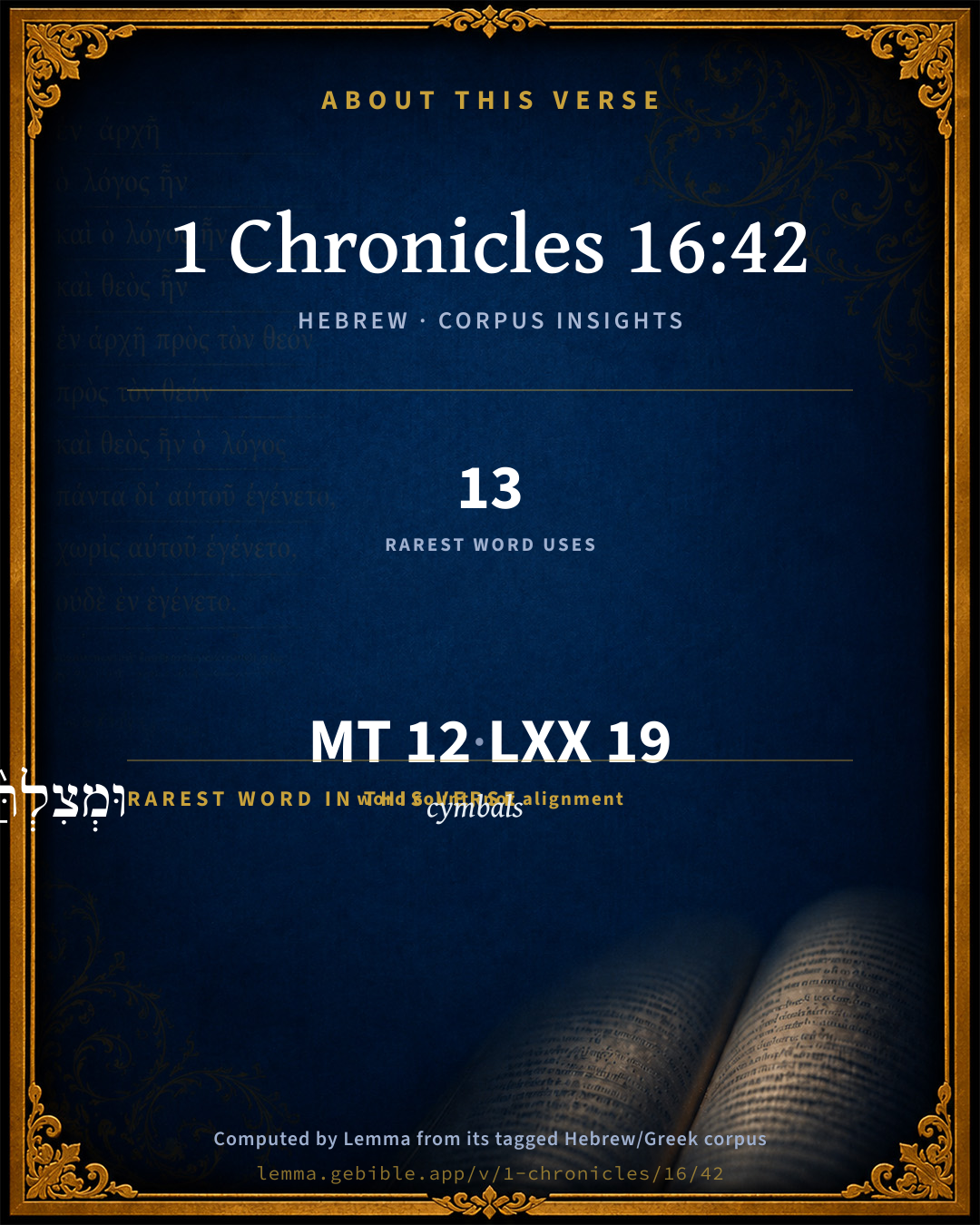
These counts appear in no published source. They are computed here, from the morphology-tagged text and Lemma’s own curated glosses. What Lemma adds →

12
words
11
distinct lemmas
Historical
section

Notable vocabulary

The rarest word here is וּמְצִלְתַּ֨יִם֙ cymbals H4700 — appearing just 13 times in the whole Hebrew Bible.

Shared distinctive vocabulary

וּמְצִלְתַּ֨יִם֙ cymbals H4700 occurs in 13 verses of the Hebrew Bible. Also found in:

Grammatical profile

  • 1 verb
  • 10 nouns
  • 1 preposition

Verb forms

  • לְמַשְׁמִיעִ֔ים Hiphil · Participle Active

Repetition

A word recurs within this verse — often emphatic in Hebrew:

  • וִֽידוּת֜וּן Jeduthun H3038 ×2

Hebrew & Septuagint length

In English translation the verse runs 34 words from the Hebrew and 28 from the Septuagint (LXX English) — closely comparable.

A rough comparison of the two English renderings, which tokenize alike — not a word-level alignment.

Word counts can differ between the Hebrew and the Greek without any difference in meaning — e.g. the Hebrew direct-object marker אֵת has no separate Greek word, and Greek often adds the article ὁ.

In the original languages it is 12 Hebrew tokens and 19 Greek tokens — but the two are counted differently (Hebrew bundles its prefixes and suffixes into one token; the Greek is in lemma form), so that isn’t a like-for-like length.

Cross-references

5

Topical passages linked to 1 Chronicles 16:42 in the Treasury of Scripture Knowledge — connected by theme and wording, ordered by reader-vote popularity; previews shown in the World English Bible.

  • Psalms 84:10 For a day in your courts is better than a thousand. I would rather be a doorkeeper in the house of my God, Than to dwell in the tents of wickedness.
  • Psalms 150:3–6 Praise him with the sounding of the trumpet! Praise him with harp and lyre!
  • 1 Chronicles 25:6–7 All these were under the hands of their father for song in the house of Yahweh, with cymbals, psalteries, and harps, for the service of the house of God; Asaph, Jeduthun, and Heman being under the order of the king.
  • 2 Chronicles 7:6 The priests stood, according to their offices; the Levites also with instruments of music of Yahweh, which David the king had made to give thanks to Yahweh, (for his loving kindness endures for ever), when David praised by their ministry: and the priests sounded trumpets before them; and all Israel stood.
  • 2 Chronicles 29:25–28 He set the Levites in the house of Yahweh with cymbals, with psalteries, and with harps, according to the commandment of David, and of Gad the king's seer, and Nathan the prophet; for the commandment was of Yahweh by his prophets.

Cross-references courtesy of OpenBible.info (CC BY 4.0).

Hebrew and Greek witnesses Masoretic Hebrew ↔ Greek Septuagint

The same verse in the two great witnesses to the Old Testament, shown verse-for-verse.

These are two independent witnesses, not word-aligned to each other, and the Septuagint is shown in lemma (dictionary) form.

Hebrew 1 Chronicles 16:42 Masoretic · Westminster Leningrad Codex

וְעִמָּהֶם֩ הֵימָ֨ן וִֽידוּת֜וּן חֲצֹצְר֤וֹת וּמְצִלְתַּ֨יִם֙ לְמַשְׁמִיעִ֔ים וּכְלֵ֖י שִׁ֣יר הָאֱלֹהִ֑ים וּבְנֵ֥י יְדוּת֖וּן לַשָּֽׁעַר

and with them Heman and Jeduthun [with] trumpets and cymbals for those that should sound aloud, and [with] instruments for the songs of God; and the sons of Jeduthun to be at the gate.

World English Bible · Public Domain

Greek LXX 1 Chronicles 16:42 Septuagint · lemma form

καί μετά αὐτός σάλπιγξ καί κύμβαλον ὁ ἀναφωνέω καί ὄργανον ὁ ᾠδή ὁ θεός υἱός ιδιθων εἰς ὁ πύλη

And with them there were trumpets and cymbals to sound aloud, and musical instruments for the songs of God: and the sons of Idithun were at the gate.

LXX2012 (modern English Septuagint) · Public Domain

On this verse, Adam Clarke's Commentary discusses the Septuagint’s reading. Read the note in Commentary ↓

Hebrew: Westminster Leningrad Codex (CC BY 4.0). Greek: Septuagint (public domain); English from LXX2012 (modern English Septuagint) (Public Domain). How the Septuagint differs from the Hebrew →

Commentary

Notes on 1 Chronicles 16:42 from classic Christian and Jewish commentators (each source and its license shown beneath its notes). The classic Christian expositions comment on the surrounding passage and are grouped to its opening verse, so a note may address several verses; the Jewish commentaries on the Tanakh (Rashi and others) are per-verse, so they appear only where the commentator wrote on this verse.

Lemma curates 59 commentaries, every one of them public domain or Creative Commons licensed, each selected and text-cleaned for this edition rather than reprinted as found. About our sources →

Joseph Benson's Commentary

1Ch 16:42. With musical instruments of God — Appropriated to the worship of God; not such as they used on other occasions. Between common mirth and holy joy, there is a vast difference; and the limits and distances between them must be carefully kept up.

Joseph Benson's Commentary on the Old and New Testaments (1811–1818) — public domain. Text from a community e-Sword module.

Adam Clarke's Commentary

Verse 42. Musical instruments of God.] Ad canendum Deo, "to sing to God." - Vulgate. Των ωδων του Θεου, "of the sons of God." - Septuagint. The Syriac is remarkable: "These were upright men who did not sing unto God with instruments of music, nor with drums, nor with listra, nor with straight nor crooked pipes, nor with cymbals; but they sang before the Lord Almighty with a joyous mouth, and with a pure and holy prayer, and with innocence and integrity." The Arabic is nearly the same. None of the versions understand the words כלי שיר האלהים keley shir haelohim as implying instruments of music of God, but instruments employed in the song of God, or to praise God; as also the Targum. Query, Did God ever ordain instruments of music to be used in his worship? Can they be used in Christian assemblies according to the spirit of Christianity? Has Jesus Christ, or his apostles, ever commanded or sanctioned the use of them? Were they ever used any where in the apostolic Church? Does the use of them at present, in Christian congregations, ever increase the spirit of devotion? Does it ever appear that bands of musicians, either in their collective or individual capacity, are more spiritual, or as spiritual, as the other parts of the Church of Christ? Is there less pride, self-will, stubbornness, insubordination, lightness, and frivolity, among such persons, than among the other professors of Christianity found in the same religious society? Is it ever remarked or known that musicians in the house of God have attained to any depth of piety, or superior soundness of understanding, in the things of God? Is it ever found that those Churches and Christian societies which have and use instruments of music in Divine worship are more holy, or as holy, as those societies which do not use them? And is it always found that the ministers which affect and recommend them to be used in the worship of Almighty God, are the most spiritual men, and the most spiritual and useful preachers? Can mere sounds, no matter how melodious, where no word nor sentiment is or can be uttered, be considered as giving praise to God? Is it possible that pipes or strings of any kind can give God praise? Can God be pleased with sounds which are emitted by no sentient being, and have in themselves no meaning? If these questions cannot be answered in the affirmative: then, query, Is not the introduction of such instruments into the worship of God antichristian, and calculated to debase and ultimately ruin the spirit and influence of the Gospel of Jesus Christ? And should not all who wish well to the spread and establishment of pure and undefiled religion, lift up their hand, their influence, and their voice against them? The argument from their use in the Jewish service is futile in the extreme when applied to Christianity.

Adam Clarke's Commentary on the Bible (1810–1826) — public domain. Text from a community e-Sword/MySword module.

The Cambridge Bible for Schools and Colleges

gen. ed. J. J. S. Perowne

42. and with them etc.] The words with them are probably repeated in error from 1Ch_16:41. Render, And Heman and Jeduthun had trumpets and cymbals. For trumpets cp. 1Ch_15:24 (note).

make a sound, and with musical instruments of God] R.V. sound aloud, and with instruments for the songs of God; 1Ch_23:5; 2Ch_7:6; 2Ch_29:27 (all R.V.).

sons of Jeduthun] Cp. 1Ch_16:38.

were porters] R.V. to be at the gate. David’s organisation of the doorkeepers is given in 1Ch_26:1-19.

The Cambridge Bible for Schools and Colleges (gen. ed. J. J. S. Perowne; Cambridge University Press, 1878–1918) — public domain. Text from a community e-Sword module.

Matthew Poole's English Annotations

Musical instruments of God, i.e. appointed and appropriated to the worship and honour of God.

Matthew Poole's English Annotations on the Holy Bible (1683–1685) — public domain. Text from a community e-Sword/MySword module.

John Wesley's Explanatory Notes

Of God - Appropriated to the worship of God; not such as they used on other occasions. Between common mirth and holy joy, there is a vast difference: and the limits and distances between them must be carefully kept up.

John Wesley, Explanatory Notes Upon the Whole Bible (1754–1765) — public domain. Text via the GEBible commentary corpus.

unfoldingWord translationNotes

Door43 World Missions Community

cymbals

These are two thin, round metal plates that are hit together to make a loud sound. See how you translated this in 1 Chronicles 13:8. (See: Translate Unknowns)

guarded the gate

The implied information is that they were to guard the entrance to the tabernacle. AT: "guarded the tabernacle gate" (See: Assumed Knowledge and Implicit Information)

translationWords

trumpet

holy

people group

bless

household

unfoldingWord translationNotes — © Distant Shores Media and the Door43 World Missions Community, licensed CC BY-SA 4.0. Source: git.door43.org/Door43/en_tn.

Rashi

Rabbi Shlomo Yitzchaki (Rashi)

were [appointed] over the gate like “for gate sentries”; and in the fortieth year of the kingdom of the house of David, they made them the heads of the singers, as it is written (below 25:3): “Of Jeduthun: the sons of Jeduthun, etc., six alongside, etc., who prophesied by the thanksgiving and praise to the Lord.”

Rashi on the Tanakh — English translations: “The Judaica Press complete Tanach with Rashi, translated by A. J. Rosenberg” (CC BY 4.0); “Pentateuch with Rashi's commentary by M. Rosenbaum and A.M. Silbermann, 1929-1934” (public domain); “The Metsudah Tanach series, Lakewood, N.J” (CC BY 4.0); and “The Book of Joshua, Metsudah Publications, 1997” (CC BY 4.0). Text via Sefaria.

Lesson kit

Teaching starters — assembled from the data on this page, not authored interpretation. Every prompt links to the verse data it draws on. Edit before teaching.

1 Chronicles, in the Historical, opens this verse with 12 words (11 distinct Hebrew lemmas). Its most distinctive word is mᵉtsêleth (“cymbals”). A historical commentator’s framing appears above. Read the whole chapter for the surrounding context.

Discussion questions

  1. How does “cymbals” (mᵉtsêleth) shape what this verse is saying?
  2. 1 Chronicles 13:8 shares the word «cymbals» with this verse. How do the two illuminate each other?
  3. “Jeduthun” occurs 2× in this one verse. What is the effect of the repetition?
  4. These translations render this verse differently. What is at stake in choosing one wording over another?
  5. The verb «לְמַשְׁמִיעִ֔ים» is Hiphil Participle Active. How does its form color the action?
  6. Reading how Joseph Benson's Commentary and Adam Clarke's Commentary read this verse, where do the two commentators agree and where do they part?

Things to notice

Reading settings

Reading text

Shown beneath each verse's original-language words.

Old Testament
Old Testament edition

Read the OT as the Masoretic Hebrew (MT) or the Greek Septuagint (LXX).

English shown for the Greek Septuagint (in the Hebrew ↔ Greek comparison).

Comparing translations? Open the Compare panel on any verse page to stack up to four side by side.