Isaiah 28:6

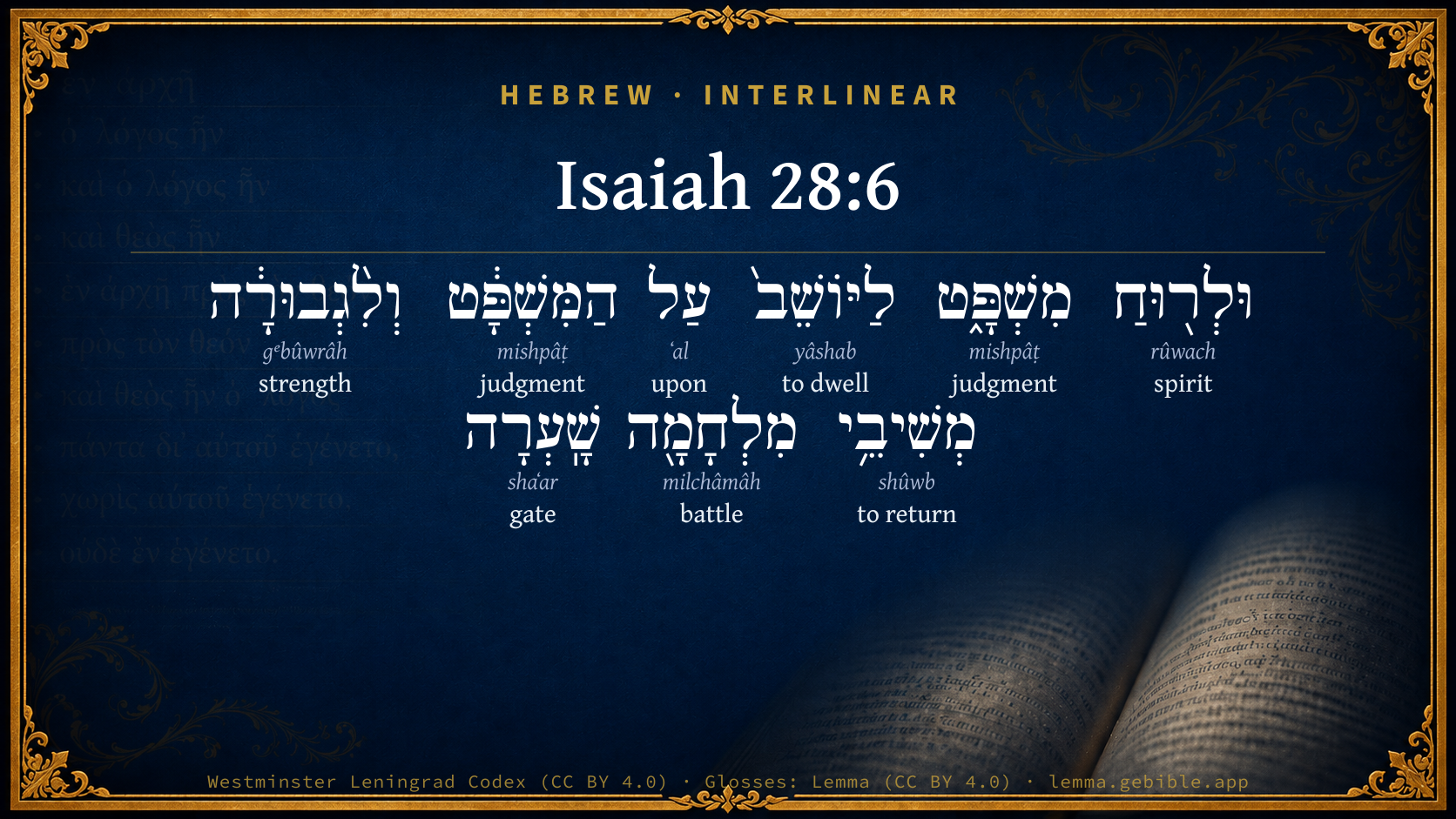
Hebrew (Westminster Leningrad Codex) Isaiah 28:6 appears in the Hebrew Old Testament. The text above is from the Westminster Leningrad Codex. Each word links to its Strong’s number, a concise gloss, and parsing drawn from the Open Scriptures Hebrew Bible morphology. Click any word for its full Brown-Driver-Briggs (BDB) entry.
Download image
Cite this verse

Isaiah 28:6 (World English Bible). Public Domain. Lemma interlinear Bible study tool, https://lemma.gebible.app/v/isaiah/28/6.

Show BibTeX & RIS
BibTeX
RIS
English Translation
and a spirit of justice to him who sits in judgment, and strength to those who turn back the battle at the gate.
World English Bible · Public Domain
Download a study sheet

One document with this verse’s original text, its word-by-word gloss line, the meaning frame, cross-references with their text, attributed commentary, and full source and license credits — printable, and it pastes into notes with its structure intact.

This verse Autodidact and up

Study sheet (.html) Plain text (.txt)

A passage Seminary Student

Up to 50 verses in one chapter. A passage sheet keeps up to 6 commentary sources and 12 cross-references per verse, in the order this page ranks them, and says so on the sheet whenever that leaves anything out. Ask for a single verse and you get the Autodidact verse sheet above.

Everything on this page stays free to read, with no account — the sheet is a download of what is already on screen, not access to it.

Want to remove ads? Support Godless Engineer
Compare translations 3

The same verse in 3 English versions, stacked beneath the original-language interlinear above. Click any original word for its lexicon entry.

Each is an independent rendering of the whole verse — the interlinear is not word-aligned to these translations.

Highlighted words mark where these versions differ — a whole-verse word diff, not a word-by-word alignment.

  • World English Bible Public Domain
    and a spirit of justice to him who sits in judgment, and strength to those who turn back the battle at the gate.
  • King James Version Public Domain
    And for a spirit of judgment to him that sitteth in judgment, and for strength to them that turn the battle to the gate.
  • unfoldingWord Literal Text CC BY-SA 4.0
    and a spirit of justice for the sitter in judgment, and strength the ones turning back the battle at the gate. q1

unfoldingWord Literal Text — © unfoldingWord, licensed CC BY-SA 4.0. Word-aligned USFM3 via Door43 (git.door43.org/unfoldingWord/en_ult).

Versions to compare (up to 4)

3 of 4 selected

Show all 18 translations

Every available English version of this verse, each an independent rendering of the whole verse.

  • World English Bible Public Domain
    and a spirit of justice to him who sits in judgment, and strength to those who turn back the battle at the gate.
  • Berean Standard Bible Public Domain
    a spirit of justice to him who sits in judgment, and a strength to those who repel the onslaught at the gate.
  • Majority Standard Bible Public Domain
    a spirit of justice to him who sits in judgment, and a strength to those who repel the onslaught at the gate.
  • King James Version Public Domain
    And for a spirit of judgment to him that sitteth in judgment, and for strength to them that turn the battle to the gate.
  • American Standard Version (1901) Public Domain
    and a spirit of justice to him that sitteth in judgment, and strength to them that turn back the battle at the gate.
  • Revised Version (1885) Public Domain
    and for a spirit of judgment to him that sitteth in judgment, and for strength to them that turn back the battle at the gate.
  • Geneva Bible (1599) Public Domain
    And for a spirite of iudgement to him that sitteth in iudgement, and for strength vnto them that turne away the battell to the gate.
  • Douay-Rheims (1899) Public Domain
    And a spirit of judgment to him that sitteth in judgment, and strength to them that return out of the battle to the gate.
  • Young's Literal Translation Public Domain
    And for a spirit of judgment To him who is sitting in the judgment, And for might `to' those turning back the battle to the gate.
  • Literal Standard Version CC BY-SA 4.0
    And for a spirit of judgment || To him who is sitting in the judgment, || And for might [to] those turning back the battle to the gate.
  • Unlocked Literal Bible CC BY-SA 4.0
    a spirit of justice for him who sits in judgment, and strength for those who turn back their enemies at their gates.
  • unfoldingWord Literal Text CC BY-SA 4.0
    and a spirit of justice for the sitter in judgment, and strength the ones turning back the battle at the gate. q1
  • Darby Bible Public Domain
    and for a spirit of judgment to him that sitteth in judgment, and for strength to them that turn the battle to the gate.
  • World Messianic Bible Public Domain
    and a spirit of justice to him who sits in judgment, and strength to those who turn back the battle at the gate.
  • Webster's Bible Public Domain
    And for a spirit of judgment to him that sitteth in judgment, and for strength to them that turn the battle to the gate.
  • Free Bible Version CC BY-SA 4.0
    He will be an inspiration to the judges to do what's right, and he will encourage those who fight off the attacks on the gate.
  • Bible in Basic English Public Domain
    And a spirit of wisdom to the judge, and strength to those who keep back the attackers at the door of the town.
  • JPS Tanakh (1917) Public Domain
    And for a spirit of judgment to him that sitteth in judgment, and for strength to them that turn back the battle at the gate.

Literal Standard Version (2020), Covenant Press — licensed CC BY-SA 4.0. Text via the HelloAO Bible API (eBible.org). Unlocked Literal Bible (unfoldingWord) — licensed CC BY-SA 4.0. Text via the HelloAO Bible API (eBible.org). unfoldingWord Literal Text — © unfoldingWord, licensed CC BY-SA 4.0. Word-aligned USFM3 via Door43 (git.door43.org/unfoldingWord/en_ult). Free Bible Version, Dr. Jonathan Gallagher — licensed CC BY-SA 4.0. Text via the HelloAO Bible API (eBible.org).

Word by word

More ways to search: Search by grammar → Find every occurrence → Compare this word →

Practice this passage: Drill this verse → Learn its vocabulary →

וְלִ֨גְבוּרָ֔ה
gᵉbûwrâh
H1369
“and · to/for · strength”
Conjunction + Preposition + Noun, Common, Feminine, Singular, Absolute
Part of Speech
Conjunction + Preposition + Noun
Type
Common
Gender
Feminine
Number
Singular
State
Absolute
Full BDB Definition

Origin: pass. participle from the same as H1368

TWOT: 310c

strength, might - strength - might, valour, bravery - might, mighty deeds (of God)
  1. וּלְר֖וּחַ rûwach H7307 “and · to/for · spirit of” Conjunction + Preposition + Noun, Common, Both, Singular, Construct
  2. מִשְׁפָּ֑ט mishpâṭ H4941 “judgment” Noun, Common, Masculine, Singular, Absolute
  3. לַיּוֹשֵׁב֙ yâshab H3427 “to/for the · dwelling” Preposition, Determined + Verb, Qal, Participle Active, Masculine, Singular, Absolute
  4. עַל ʻal H5921 “upon” Preposition
  5. הַמִּשְׁפָּ֔ט mishpâṭ H4941 “the · judgment” Particle, Definite Article + Noun, Common, Masculine, Singular, Absolute
  6. מְשִׁיבֵ֥י shûwb H7725 “returning” Verb, Hiphil, Participle Active, Masculine, Plural, Construct
  7. מִלְחָמָ֖ה milchâmâh H4421 “battle” Noun, Common, Feminine, Singular, Absolute
  8. שָֽׁעְרָה shaʻar H8179 “gate · toward” Noun, Common, Masculine, Singular, Absolute + Suffix, Demonstrative

About this verse

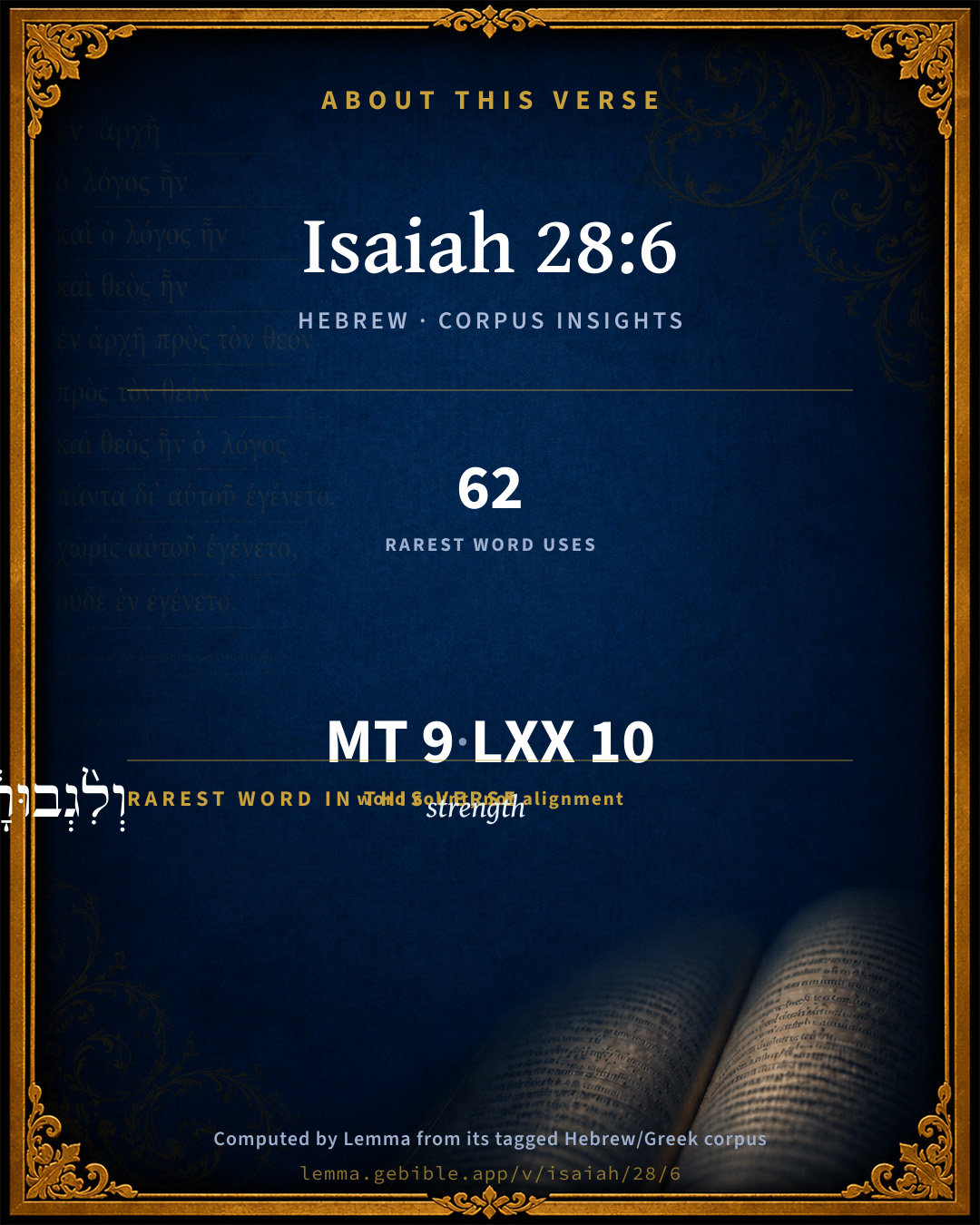
These counts appear in no published source. They are computed here, from the morphology-tagged text and Lemma’s own curated glosses. What Lemma adds →

9
words
8
distinct lemmas
Prophets
section

Grammatical profile

  • 2 verbs
  • 6 nouns
  • 1 preposition

Verb forms

  • לַיּוֹשֵׁב֙ Qal · Participle Active
  • מְשִׁיבֵ֥י Hiphil · Participle Active

Repetition

A word recurs within this verse — often emphatic in Hebrew:

  • מִשְׁפָּ֑ט judgment H4941 ×2

Hebrew & Septuagint length

In English translation the verse runs 23 words from the Hebrew and 20 from the Septuagint (LXX English) — closely comparable.

A rough comparison of the two English renderings, which tokenize alike — not a word-level alignment.

Word counts can differ between the Hebrew and the Greek without any difference in meaning — e.g. the Hebrew direct-object marker אֵת has no separate Greek word, and Greek often adds the article ὁ.

In the original languages it is 9 Hebrew tokens and 10 Greek tokens — but the two are counted differently (Hebrew bundles its prefixes and suffixes into one token; the Greek is in lemma form), so that isn’t a like-for-like length.

Cross-references

17

Topical passages linked to Isaiah 28:6 in the Treasury of Scripture Knowledge — connected by theme and wording, ordered by reader-vote popularity; previews shown in the World English Bible.

  • Psalms 18:32–34 The God who arms me with strength, and makes my way perfect?
  • John 5:30 I can of myself do nothing. As I hear, I judge, and my judgment is righteous; because I don't seek my own will, but the will of my Father who sent me.
  • Numbers 11:16–17 Yahweh said to Moses, Gather to me seventy men of the elders of Israel, whom you know to be the elders of the people, and officers over them; and bring them to the tent of meeting, that they may stand there with you.
  • Joshua 1:9 Haven't I commanded you? Be strong and of good courage; don't be afraid, neither be dismayed: for Yahweh your God is with you wherever you go.
  • Isaiah 11:2–4 The Spirit of Yahweh shall rest on him, the spirit of wisdom and understanding, the spirit of counsel and might, the spirit of knowledge and of the fear of Yahweh.
  • Isaiah 32:15–16 until the Spirit be poured on us from on high, and the wilderness become a fruitful field, and the fruitful field be esteemed as a forest.
  • John 3:34 For he whom God has sent speaks the words of God; for God gives the Spirit without measure.
  • Genesis 41:38–39 Pharaoh said to his servants, "Can we find such a one as this, a man in whom is the Spirit of God?"
  • Numbers 27:16–18 Let Yahweh, the God of the spirits of all flesh, appoint a man over the congregation,
  • Deuteronomy 20:4 for Yahweh your God is he who goes with you, to fight for you against your enemies, to save you.
  • 1 Kings 3:28 All Israel heard of the judgment which the king had judged; and they feared the king: for they saw that the wisdom of God was in him, to do justice.
  • 2 Chronicles 32:8 with him is an arm of flesh; but with us is Yahweh our God to help us, and to fight our battles. The people rested themselves on the words of Hezekiah king of Judah.
  • Psalms 46:1 God is our refuge and strength, A very present help in trouble.
  • Psalms 46:11 Yahweh of Hosts is with us. The God of Jacob is our refuge. Selah.
  • Psalms 72:1–4 God, give the king your justice; Your righteousness to the royal son.
  • Proverbs 20:8 A king who sits on the throne of judgment Scatters away all evil with his eyes.
  • 1 Corinthians 12:8 For to one is given through the Spirit the word of wisdom, and to another the word of knowledge, according to the same Spirit;

Cross-references courtesy of OpenBible.info (CC BY 4.0).

Hebrew and Greek witnesses Masoretic Hebrew ↔ Greek Septuagint

The same verse in the two great witnesses to the Old Testament, shown verse-for-verse.

These are two independent witnesses, not word-aligned to each other, and the Septuagint is shown in lemma (dictionary) form.

Hebrew Isaiah 28:6 Masoretic · Westminster Leningrad Codex

וּלְר֖וּחַ מִשְׁפָּ֑ט לַיּוֹשֵׁב֙ עַל הַמִּשְׁפָּ֔ט וְלִ֨גְבוּרָ֔ה מְשִׁיבֵ֥י מִלְחָמָ֖ה שָֽׁעְרָה

and a spirit of justice to him who sits in judgment, and strength to those who turn back the battle at the gate.

World English Bible · Public Domain

Greek LXX Isaiah 28:6 Septuagint · lemma form

καταλείπω ἐπί πνεῦμα κρίσις ἐπί κρίσις καί ἰσχύς κωλύω ἀνααἱρέω

They shall be left in the spirit of judgment for judgment, and for the strength of them that hinder slaying.

LXX2012 (modern English Septuagint) · Public Domain

Hebrew: Westminster Leningrad Codex (CC BY 4.0). Greek: Septuagint (public domain); English from LXX2012 (modern English Septuagint) (Public Domain). How the Septuagint differs from the Hebrew →

Targum (Aramaic paraphrase)

1

The Targum is the ancient Jewish Aramaic paraphrase of the Hebrew Scriptures — an interpretive translation, not the Hebrew text itself. Onkelos (literal) and Pseudo-Jonathan (expansive) render the Torah, and Jonathan the Prophets. Coverage is partial: where no permissively-licensed English translation exists for a verse, only the Aramaic is shown. This is verse-level text, not a word-by-word alignment to the Hebrew.

  1. Targum Jonathan Prophets (Joshua–Malachi)
    לְמֵימָר קְשׁוֹט דְדִין לִדְיָתְבִין בְּבֵית דִינָא לְמִדָן דִין דִקְשׁוֹט וּלְמִתַּן נִצְחָנָא לִדְנָפְקִין בִּקְרָבָא לַאֲתָבוּתְהוֹן בִּשְׁלָם לְבָתֵּיהוֹן:

    For a word of true judgments to them that sit in the house of justice, in order that they should judge according to truth; and to give victory to them that are going forth into battle, to bring them back in peace to their homes.

    Targum Jonathan — Aramaic: “Mikraot Gedolot” (public domain). English: “Sefaria Community Translation” (CC0 1.0 (public-domain dedication)); “London "Chaldee Paraphrase," 1871” (public domain). Text via Sefaria.

Commentary

Notes on Isaiah 28:6 from classic Christian and Jewish commentators (each source and its license shown beneath its notes). The classic Christian expositions comment on the surrounding passage and are grouped to its opening verse, so a note may address several verses; the Jewish commentaries on the Tanakh (Rashi and others) are per-verse, so they appear only where the commentator wrote on this verse.

Lemma curates 59 commentaries, every one of them public domain or Creative Commons licensed, each selected and text-cleaned for this edition rather than reprinted as found. About our sources →

Trapp's Complete Commentary

John Trapp

Isa 28:6 And for a spirit of judgment to him that sitteth in judgment, and for strength to them that turn the battle to the gate.

Ver. 6. And for a spirit of judgment.] A sagacity more than ordinary, in regard whereof Solomon calleth the king’s doom a divination, {Pro 16:10} as is well observed.

And for strength to them, &c.] In this verse we have the description of a happy state, governed justly at home, and able abroad to resist any endeavour of the enemy. {a}

{a} Diod.

John Trapp, A Commentary or Exposition upon All the Books of the Old and New Testament (1647–1656) — public domain. Text from a community e-Sword module.

The Biblical Illustrator

Joseph S. Exell

Isa_28:6

In that day shall the Lord of hosts be for a crown of glory.

The Christians crown

There is scarcely a more striking evidence to be found of the corrupt and perverted state of the human heart than that which is furnished in the views which commonly prevail of the distinctive features of the Christian religion. The pageantry and pomp of a false religion it will admire and approbate; but the spirit of the true it has ever contemned and repelled as a spirit of weakness, fanaticism, or bigotry. The spirit which it so characterises and so contemns is what God in our text styles a crown of glory and a diadem of beauty to His people. The crown and the diadem are, in the eyes of the world, objects of great beauty and value. They are usually set with diamonds, and with the most brilliant and costly gems, and are worn not only as ornaments, but as the insignia of royal authority and power, Hence they are properly employed as emblems to represent that which God regards as the most precious and beauteous ornament of His people. He says He will be to them for a crown of glory and a diadem of beauty. By which He means, that He will impart to them by His grace that which shall render them more glorious in His view, and which shall be infinitely more dear and valuable to them than the most costly crown that ever monarchs wore. It is, then, the lustre of a spiritual crown, the glory of a heavenly diadem, that is to be so comely upon the people of God. But in what deep obscurity, at present, are these heirs of heavenly royalty! Would you not like to contemplate some of the characteristics of this heavenly crown, by which it is distinguished from all earthly crowns?

1. It is unfading and imperishable in its nature. The apostle calls it an incorruptible crown, and a crown of glory that fadeth not away. In the verses which precede the text the prophet opposes this crown to the blasted and fading glory which appertains to the possessions of the wicked (Isa_28:1). Who is there that sees not the vanity and inconstancy of all worldly glory? But it is not so with the glory that has been given to the saints. This is substantial and immortal. The Lord shall be unto thee an everlasting light, and thy God thy glory.

2. This crown will be worn without care or peril. The crowns of earthly princes are set with thorns. But not only will it be worn without care or peril, it will have the power to satisfy every want of its possessor.

3. This is a crown of righteousness, rightfully obtained and right, ally possessed,--indicative, on the part of the Giver, of His own perfect righteousness, and expressive of His approbation of that righteousness in which our Lord Jesus Christ has arrayed His people. How different this from those crowns which earthly princes wear; often obtained by fraud and violence and saturated with blood,--emblems of injustice and tyranny, and frequently held by power, without right!

4. It is a crown of life (Rev_2:10). It is so called for two reasons. One is, that death has no power over it; it cannot deprive us of it, neither can it in any way impart it. The other is, that it is the sure pledge of a perfect and immortal life. Life will be life in heaven, not that weak, imperfect, suffering, half-developed existence which we have here.

Conclusion--

1. Have we not good reason to call upon all to strive to win this crown?

2. Can Christians understand the value of this crown, or its nature, or the mode of its procurement, and not feel that obligations the most solemn bind them to the love and service of their Redeemer? (J. W. Adams.)

The coronation of Christian character

I. THE SIGNIFICATION OF THE ROYAL PROMISE in the text, The Lord of hosts shall be as a crown, etc.

1. The salvation of those who have attained good characters is thus certified.

2. Their satisfaction is expressed by this figure of the royal promise.

3. Their sanctification is proclaimed. They are described as without fault as they stand before the throne of God.

II. THE RANKS IN THE POSSESSION OF THE ROYAL PROMISE. Christ did not deny to the mother of Zebedees children that there were places of distinctive honour, but said they should be given to those for whom they were prepared by the Father. The same truth is taught in the parable of the ten talents.

1. All in that land are joyful.

2. No one will have the same joy as another.

3. But each one will be joyful according to his capacity.

II. THE REVELATION OF THIS PERFECTION IS MADE FOR A PURPOSE.

1. It sustains the hope of the man of good character.

2. To think of this gracious promise stimulates growth.

3. It separates from all sin. He is drawn ever heavenward. (S. H.Tyng, D. D.)

A diadem of beauty

A diadem of beauty

1. A DIADEM is an ornament for the head--an ornament worn by kings and queens as a badge of royalty. It used to be made of linen or silk, set with pearls and precious stones. Now it is generally a fillet or band of gold on which the monarchs crown is built. It is a splendid headdress, the emblem of rank, power, sovereignty. Not any of us are likely ever to wear an earthly diadem of jewels and gold. But, wonderful to tell, the prophet Isaiah promises that the living God, the Lord of hosts, shall be to His people for a crown of glory, and for a diadem of beauty. We, the least of Gods children, may have Him for our diadem, our beauty, our glory, and our eternal joy.

2. BEAUTY is something we all love and prize. Even the ugliest people on the face of the earth have some notions of beauty, and try to make themselves beautiful. There are wild, savage tribes who have no churches, no schools, no altars, who never pray, and whose only heaven is their hunting ground, yet they have ideas of beauty and are vain of personal adornment. The red Indian sticks a few feathers in his hair, puts an iron ring through his nose, ties some strings of coloured glass beads around his waist, and a chain of shells upon his wrists and neck, and then thinks himself more beautiful than any dandy in the West End of London. This love of beauty is natural. God Himself loves beauty, and has made everything beautiful. Still, there is beauty and beauty. Not a little that is only fading, quickly dimmed, and almost worthless. Much that is lasting, precious, and noble. Socrates, one of the wisest men of his day, knew little concerning the Supreme Being whom we worship as God, and nothing at all of the Gospel--for he lived and died before Jesus Christ was born. And Socrates uttered this memorable petition: I pray Thee, O God, that I may be beautiful within. Keats says that Beauty is truth and truth is beauty. The Bible makes mention of the beauty of holiness. And the prophet Isaiah tells us that the Lord of hosts shall be to His people for a diadem of beauty. Beauty of soul is true beauty. Sin makes us ugly. Sin defaces and defiles our nature. Grace and truth came by Jesus Christ; and the Spirit of Christ will transform the heart and life of everyone who receives Him. Meekness, goodness, purity, truth, love indwelling in the soul will shine out in the face, and be a diadem of beauty. A flower is the diadem of a plant. You dont tie a flower on its stem. It grows out of it. And if the Spirit of Jesus Christ dwell in your heart, the beauty of His grace will blossom forth in your character and life. It will be not a mere outward decoration, to be put on and off on certain days, like a ladys feathers or a queens crown; it will be always there. No wonder the Psalmist prayed, Let the beauty of the Lord our God be upon us! This is a beauty brighter and better than the diadem of kings. (A. A. Ramsey.)

Isa_28:6

For a spirit of Judgment

The spirit of judgment

Next to the enactment of just and wholesome laws, the due administration of them is of the highest importance to a community.

If the distribution of justice in secular kingdoms, and in relation to the affairs of this life, is of so great moment, it must be of still greater importance in that society which is styled the kingdom of heaven, and in relation to things connected with the eternal interests of men.

I. THE WARRANTS AND NATURE OF ECCLESIASTICAL JUDICATURE. Religious society has its foundation in the very nature of man considered as a social being. Christ, as King of His Church, hath appointed a government in her, and committed to office bearers, under Him, a power to execute His laws, and pronounce judgment according to them, for the preservation of order and peace, and the promoting of the interests of truth and holiness to His glory. The overlooking of the important ends to be served by the Church as a visible society is a capital error, or at least has been the source of many hurtful mistakes in our own as well as in former times. To ecclesiastical judges belong the interpretation of the laws of Christ, by a judicial declaration of truth in opposition to prevailing error, and of duty in opposition to prevailing sins; and the application of these laws to such cases as occur.

1. Ecclesiastical judgment is spiritual, in distinction from that which is civil or secular.

2. Ecclesiastical judgment is ministerial and executive, not lordly or legislative. Christ is the sole lawgiver in His spiritual kingdom; and the proper business of the office bearers whom He hath appointed is to interpret and carry into execution those laws which He has given forth and enrolled in His statute book.

3. It is public and authoritative. There is a right of private judgment, called by divines the judgment of discretion, which belongs to all the members of the Church, and extends to every thing connected with religion, and among others to the decisions of ecclesiastical judicatories. But there must be also lodged, in every well-ordered society, a power of pronouncing by its proper organs, a public judgment for deciding disputes and controversies which may arise, and for determining the manner in which its affairs shall be conducted.

4. It is to be exercised by select persons set apart for this purpose, and not by the community of the faithful. In the multitude of counsellors is safety, in opposition to the danger incurred by him who relies on his own judgment, of the advice of one or two favourites; but counsellors consist of a select number taken from many.

5. It is to be exercised by them jointly, and in parity. The only monarchical power in the Church is exercised by Jesus Christ.

II. THE SPIRIT WHICH IS REQUISITE FOR THE EXERCISE OF ECCLESIASTICAL JUDGMENT, and which is promised in the text. Jesus Christ is not only the exemplar, but also the foundation of all qualifications for ruling in the Church (Isa_11:2-4).

1. I begin with the fear of the Lord, or a deep sense of religion. This is the ground into which all the other qualities must be wrought.

2. The spirit of wisdom and understanding. A good heart and upright intentions are not enough here. Knowledge, prudence, and discernment are peculiarly requisite for the management of public affairs. Those who are invested with office in the Church must be men full of wisdom, as well as of the Holy Ghost.

3. The spirit of disinterestedness and impartiality. This is the spirit of judgment--when the individual is sunk in the public functionary--when on crossing the threshold of the sanctuary and ascending the seat of judgment he forgets self and all worldly considerations.

4. A spirit of patience and meekness.

5. The spirit of holy resolution and courage.

6. The spirit of humility and dependence on God.

III. PRACTICAL LESSONS.

1. The great importance of ecclesiastical discipline, and of preserving it in its scriptural purity and primitive vigour. Evangelical and vital religion cannot flourish generally or permanently in any Church where this is neglected.

2. We may see one duty incumbent on those who have devoted themselves to the public service of the Church. To preach the gospel is a principal part of their employment, but it is not the whole of it. It is possible that a person may be able to make a sermon which shall be both acceptable and edifying, and, after all, be but poorly qualified for taking care of the Church of God.

3. We may learn what care ought to be exercised in choosing and setting apart those who are to bear office in the Church.

4. We may see the scriptural grounds of subjection to the authority, and obedience to the determinations of church rulers. These are, the Divine institutions of ecclesiastical government, the connection between it and the regal glory of Christ, and the salutary influence which it is calculated to exert upon all other Divine institutions, as well as upon the peace, unity, order, purity, and general prosperity of the Church as a visible and diffusive society.

5. Our subject suggests suitable exercise on occasion of the meeting of ecclesiastical judicatories. It was a custom in the better times of our Church to set apart a day for fasting and prayer before the meeting of a General Assembly, to entreat the Divine countenance to its deliberations. (T. MCrie, D. D.)

The Biblical Illustrator, edited by Joseph S. Exell (c. 1880s–1900s) — public domain. Text from a community e-Sword module.

MacLaren's Expositions of Holy Scripture

Alexander MacLaren

Isaiah

THE JUDGMENT OF DRUNKARDS AND MOCKERS

Isa 28:1 - Isa 28:13.

This prophecy probably falls in the first years of Hezekiah, when Samaria still stood, and the storm of war was gathering black in the north. The portion included in the text predicts the fall of Samaria {Isa 28:1 - Isa 28:6} and then turns to Judah, which is guilty of the same sins as the northern capital, and adds to them mockery of the prophet’s message. Isaiah speaks with fiery indignation and sharp sarcasm. His words are aflame with loathing of the moral corruption of both kingdoms, and he fastens on the one common vice of drunkenness-not as if it were the only sin, but because it shows in the grossest form the rottenness underlying the apparent beauty.

I. The woe on Samaria {Isa 28:1 - Isa 28:6}. Travellers are unanimous in their raptures over the fertility and beauty of the valley in which Samaria stood, perched on its sunny, fruitful hill, amid its vineyards. The situation of the city naturally suggests the figure which regards it as a sparkling coronet or flowery wreath, twined round the brows of the hill; and that poetical metaphor is the more natural, since revellers were wont to twist garlands in their hair, when they reclined at their orgies. The city is ‘the crown of pride’-that is, the object of boasting and foolish confidence-and is also ‘the fading flower of his sparkling ornament’; that is, the flower which is the ornament of Ephraim, but is destined to fade.

The picture of the city passes into that of the drunken debauch, where the chief men of Samaria sprawl, ‘smitten down’ by wine, and with the innocent flowers on their hot temples drooping in the fumes of the feast. But bright and sunny as the valley is, glittering in the light as the city sits on her hill, careless and confident as the revellers are, a black cloud lies on the horizon, and one of the terrible sudden storms which such lands know comes driving up the valley. ‘The Lord hath a mighty and strong one’-the conqueror from the north, who is God’s instrument, though he knows it not.

The swift, sudden, irresistible onslaught of the Assyrian is described, in harmony with the figure of the flowery coronal, as a tempest which beats down the flowers and flings the sodden crown to the ground. The word rendered ‘tempest’ is graphic, meaning literally a ‘downpour.’ First comes hail, which batters the flowers to shreds; then the effect of the storm is described as ‘destruction,’ and then the hurrying words turn back to paint the downpour of rain, ‘mighty’ from its force in falling, and ‘overflowing’ from its abundance, which soon sets all the fields swimming with flood water. What chance has a poor twist of flowers in such a storm? Its beauty will be marred, and all the petals beaten off, and nothing remains but that it should be trampled into mud. The rush of the prophet’s denunciation is swift and irresistible as the assault it describes, and it flashes from one metaphor to another without pause. The fertility of the valley of Samaria shapes the figures. As the picture of the flowery chaplet, so that which follows of the early fig, is full of local colour. A fig in June is a delicacy, which is sure to be plucked and eaten as soon as seen. Such a dainty, desirable morsel will Samaria be, as sweet and as little satisfying to the all-devouring hunger of the Assyrian.

But storms sweep the air clear, and everything will not go down before this one. The flower fadeth, but there is a chaplet of beauty which men may wreathe round their heads, which shall bloom for ever. All sensuous enjoyment has its limits in time, as well as in nobleness and exquisiteness; but when it is all done with, the beauty and festal ornament which truly crowns humanity shall smell sweet and blossom. The prophecy had regard simply to the issue of the historical disaster to which it pointed, and it meant that, after the storm of Assyrian conquest, there would still be, for the servants of God, the residue of the people, both in Israel and in Judah, a fuller possession of the blessings which descend on the men who make God their portion. But the principle involved is for ever true. The sweeping away of the perishable does draw true hearts nearer to God.

So the two halves of this prophecy give us eternal truths as to the certain destruction awaiting the joys of sense, and the permanence of the beauty and strength which belong to those who take God for their portion.

Drunkenness seems to have been a national sin in Israel; for Micah rebukes it as vehemently as Isaiah, and it is a clear bit of Christian duty in England to-day to ‘set the trumpet to thy mouth and show the people’ this sin. But the lessons of the prophecy are wider than the specific form of evil denounced. All setting of affection and seeking of satisfaction in that which, in all the pride of its beauty, is ‘a fading flower,’ is madness and sin. Into every life thus turned to the perishable will come the crash of the destroying storm, the mutterings of which might reach the ears of the feasters, if they were not drunk with the fumes of their deceiving delights. Only one kind of life has its roots in that which abides, and is safe from tempest and change. Amaranthine flowers bloom only in heaven, and must be brought thence, if they are to garland earthly foreheads. If we take God for ours, then whatever tempests may howl, and whatever fragile though fragrant joys may be swept away, we shall find in Him all that the world ‘fails to give to its votaries. He is ‘a crown of glory’ and ‘a diadem of beauty.’ Our humanity is never so fair as when it is made beautiful by the possession of Him. All that sense vainly seeks in earth, faith finds in God. Not only beauty, but ‘a spirit of judgment,’ in its narrower sense and in its widest, is breathed into those to whom God is ‘the master light of all their seeing’; and, yet more, He is strength to all who have to fight. Thus the close union of trustful souls with God, the actual inspiration of these, and the perfecting of their nature from communion with God, are taught us in the great words, which tell how beauty, justice, and strength are all given in the gift of Jehovah Himself to His people.

II. The prophet turns to Judah {Isa 28:7 - Isa 28:13}, and charges them with the same disgusting debauchery. His language is vehement in its loathing, and describes the filthy orgies of those who should have been the guides of the people with almost painful realism. Note how the words ‘reel’ and ‘stagger’ are repeated, and also the words ‘wine’ and ‘strong drink.’ We see the priests’ and prophets’ unsteady gait, and then they ‘stumble’ or fall. There they lie amid the filth, like hogs in a sty. It is very coarse language, but fine words are the Devil’s veils for coarse sins; and it is needful sometimes to call spades spades, and not to be ashamed to tell men plainly how ugly are the vices which they are not ashamed to commit. No doubt some of the drunken priests and false prophets in Jerusalem thought Isaiah extremely vulgar and indelicate, in talking about staggering teachers and tables swimming in ‘vomit.’ But he had to speak out. So deep was the corruption that the officials were tipsy even when engaged in their official duties, the prophets reeled while they were seeing visions; the judges could not sit upright even when pronouncing judgment.

Isa 28:9 - Isa 28:10 are generally taken as a sarcastic quotation of the drunkards’ scoffs at the prophet. They might be put in inverted commas. Their meaning is, ‘Does he take us grave and reverend seigniors, priests and prophets, to be babies just weaned, that he pesters us with these monotonous petty preachings, fit only for the nursery, which he calls his “message"?’ In Isa 28:10, the original for ‘precept upon precept,’ etc., is a series of short words, which may be taken as reproducing the ‘babbling tones of the drunken mockers.’

The loose livers of all generations talk in the same fashion about the stern morality which rebukes their vice. They call it weak, commonplace, fit for children, and they pretend that they despise it. They are much too enlightened for such antiquated teaching. Old women and children may take it in, but men of the world, who have seen life, and know what is what, are not to be fooled so. ‘What will this babbler say?’ was asked by the wise men of Athens, who were but repeating the scoffs of the prophets and priests of Jerusalem, and the same jeers are bitter in the mouth of many a profligate man to-day. It is the fate of all strict morality to be accounted childish by the people whom it inconveniently condemns.

In Isa 28:11 and onwards the prophet speaks. He catches up the mockers’ words, and retorts them. They have scoffed at his message as if it were stammering speech. They shall hear another kind of stammerers when the fierce invaders’ harsh and unintelligible language commands them. The reason why these foreign voices would have authority, was the national disregard of God’s voice. ‘Ye would not hear’ Him when, by His prophet, He spoke gracious invitations to rest, and to give the nation rest, in obedience and trust. Therefore they shall hear the battle-cry of the conqueror, and have to obey orders spoken in a barbarous tongue.

Of course, the language meant is the Assyrian, which, though cognate with Hebrew, is so unlike as to be unintelligible to the people. But is not the threat the statement of a great truth always being fulfilled towards the disobedient? If we will not listen to that loving Voice which calls us to rest, we shall be forced to listen to the harsh and strident tones of conquering enemies who command us to slavish toil. If we will not be guided by His eye and voice, we shall be governed by whip and bridle. Our choice is either to hearken to the divine call, which is loving and gentle, and invites to deep repose springing from faith, or to have to hear the voice of the taskmasters. The monotony of despised moral and religious teaching shall give place to a more terrible monotony, even that of continuous judgments.

‘The mills of God grind slowly.’ Bit by bit, with gradual steps, with dismal persistence, like the slow drops on the rock, the judgments of God trickle out on the mocking heart. It takes a long time for a child to learn a pageful when he gets his lesson a sentence at a time. So slowly do His chastisements fall on men who have despised the continuous messages of His love. The word of the Lord, which was laughed at when it clothed itself in a prophet’s speech, will be heard in more formidable shape, when it is wrapped in the long-drawn-out miseries of years of bondage. The warning is as needful for us as for these drunken priests and scornful rulers. The principle embodied is true in this day as it was then, and we too have to choose between serving God in gladness, hearkening to the voice of His word, and so finding rest to our souls, and serving the world, the flesh, and the devil, and so experiencing the perpetual dropping of the fiery rain of His judgments.

Alexander MacLaren, Expositions of Holy Scripture (1904–1910) — public domain. Text from a community e-Sword module.

Geneva Bible (1599)

Geneva Bible translators

He will give counsel to the governor, and strength to the captain, to drive the enemies in at their own gates.

Geneva Bible (1599) marginal notes — public domain. Text via Bolls.life.

Jamieson, Fausset & Brown

Robert Jamieson, A. R. Fausset & David Brown

Jehovah will inspire their magistrates with justice, and their soldiers with strength of spirit.

turn . . . battle to . . . gate--the defenders of their country who not only repel the foe from themselves, but drive him to the gates of his own cities (Sa2 11:23; Kg2 18:8).

Jamieson, Fausset & Brown — Commentary Critical and Explanatory on the Whole Bible (1871) — public domain (CC PDM 1.0). Text via the HelloAO Bible API.

Adam Clarke's Commentary

Verse 6. The battle to the gate - "The war to the gate of the enemy."] That is, who pursue the fleeing enemy even to the very gates of their own city. "But we were upon them even unto the entering of the gate," 2Sa 11:23; that is, we drove the enemy back to their own gates. See also 1Sa 17:52. The Targum says, The Messiah shall give the victory to those who go out to battle, that he may bring them back to their own houses in peace.

Adam Clarke's Commentary on the Bible (1810–1826) — public domain. Text from a community e-Sword/MySword module.

Ellicott's Commentary for English Readers

(6) And for a spirit of judgment . . .—The words remind us of the list of spiritual gifts in Isa_11:2. The injustice of corrupt judges was the crying evil of both Samaria and Jerusalem, and their place was to be taken by those who should be just and faithful. And brave warriors, able to drive back the enemy to the gate of the city from which they had issued forth (2Sa_11:23)—or, perhaps, to defeat them at the gate of that which they attacked—should be the companions of the upright judges.

A Bible Commentary for English Readers, edited by Charles John Ellicott (1878–1897) — public domain. Text from a community e-Sword module.

The Cambridge Bible for Schools and Colleges

gen. ed. J. J. S. Perowne

6. Jehovah is not only the beauty of the redeemed nation, but the source of all civic and martial virtues.

a spirit of judgment] The same phrase (but with a different meaning) occurs in ch. Isa_4:4. “Spirit” is used here as in ch. Isa_11:2. to him that sitteth in judgment] (or “over the judgment[-seat]”)—the king or the judge (cf. ch. Isa_32:1).

for strength (or, valour) to them that … gate] Better, at the gate, not the gate of the enemy, but of the city or land (Nah_3:13) into which the enemy have penetrated. The promise is somewhat remarkable for Isaiah (cf. Mic_5:5 ff.).

7, 8 form the literary introduction to the dramatic incident represented in Isa_28:9-13; they are not part of Isaiah’s spoken discourse on that occasion. The opening words But these also (R.V.) connect this section with the preceding, but the connexion is due to similarity of subject, and not to coincidence of date. There are obvious reasons why the prediction of the fall of Samaria should be republished in the time of Sennacherib. The magnates of Jerusalem were following the lead of Samaria, both in their dissolute habits and in their foolish trust in an Egyptian alliance; Samaria is a mirror in which they may read their own character and their own doom. On intemperance among the Judæan nobility see ch. Isa_5:11 f., 22.

The Cambridge Bible for Schools and Colleges (gen. ed. J. J. S. Perowne; Cambridge University Press, 1878–1918) — public domain. Text from a community e-Sword module.

John Gill's Exposition

But they also have erred through wine,.... Either they that sat in judgment, and turned the battle to the gate, as Jarchi interprets it: or rather, since the Lord was a spirit of judgment and strength to those, the two tribes of Judah and Benjamin in later times are meant, in the latter end of Hezekiah's reign, or in the times of Manasseh, or nearer the Babylonish captivity; these tribes, which professed the true religion, and who had the word, and worship, and ordinances of God among them, even these were guilty of the same sin of drunkenness, as the ten tribes that had apostatized; there were the drunkards of Judah, as well Ephraim, who "erred through wine"; they erred and strayed from the rule of the divine word by excessive drinking, and this led them on to other sins, as drunkenness commonly does; and they were not only through it guilty of errors in practice, but in principle also; they made sad mistakes, as in life and conversation, so in doctrine, their memories, understandings, and judgments, being sadly affected and beclouded through this sin:

and through strong drink are out the of way; of God and his word; out of the way of truth and godliness: it signifies the same as before, only expressed in different words. The Targum renders the word for "strong drink", which designs any liquor that makes men drunk, by "old wine", which is accounted the best:

the priest and the prophet have erred through strong drink; committed sin, by drinking to excess, and made themselves unfit for the duties of their office, and were guilty of sad mistakes in the performance of it; the priest sinned by so doing against an express command, and made himself incapable of distinguishing between the holy and unholy, the clean and the unclean, Lev 10:9 though this need not be restrained to the priest only, for the word "cohen" signifies a prince as well as priest; and it is not fitting for kings to drink wine, nor princes strong drink, to excess, Pro 31:4 civil as well as ecclesiastical rulers may be here designed, though chiefly the latter, men that should set the best of examples to others; and the "prophet", as Kimchi observes, intends not the true, but false prophets. The Targum renders it a "scribe"; these and the priests are frequently mentioned together in the New Testament, and were both erroneous; and their errors here, both as to doctrine and practice, are imputed to their drunkenness; a very scandalous sin, especially in persons of such a character:

they are swallowed up of wine; they not only greedily swallowed it down, and were filled with it, but were swallowed up by it, drowned in it, and lost the exercise of their sense and reason, and were ruined and destroyed by it, and made wholly unfit for such sacred offices in which they were:

they are out of the way through strong drink; out of the of their duty, by sinning in this manner; and out the way of the performance of their office, being rendered incapable of it:

they err in vision: these were the prophets, the seers, who pretended to the visions of God, and related them to the people as such; but they mistook the imaginations of their crazy heads, intoxicated with liquor, for the visions of God; they erred in prophesying, which may be meant by "vision", they delivered out false prophecies, false doctrines, and grievous errors, of fatal consequence to the people; or, as Kimchi further interprets it, they erred "in seeing"; they mistook in those things which were plain and obvious to the eye of everyone, in things clear and manifest; drunkenness affects the eyes both of the body and of the mind, that a man can see clearly with neither. The Targum is,

"they turned after, or declined unto, sweet meat;''

as if they were guilty of gluttony as well as drunkenness; but it is not usual for drunkards to crave sweet meat, but rather what is relishing:

they stumble in judgment; or "reel" (r) and stagger, as drunken men do: this refers to the priest, who, through drunkenness, made sad hobbling work in expounding the law, and giving the sense of it, and in pronouncing sentence of judgment in matters of controversy brought before him, to whom those things appertained, Mal 2:7, Deu 17:8.

(r) "titubant in judicatione", Junius & Tremellius, Piscator, Gataker.

John Gill's Exposition of the Whole Bible (1746–1763) — public domain (CC PDM 1.0). Text via the HelloAO Bible API.

Albert Barnes' Notes on the Bible

And for a spirit of judgment - (compare the note at Isa 1:26; Isa 11:2). The sense of this passage is, that Jehovah would enlighten the judges of the land, so that they should understand what was right, and be disposed to do it.

To him that sitteth in judgment - This is to be understood collectively, and means those who sat upon the bench of justice; that is, the magistracy in general.

And for strength to to them that turn the battle to the gate - That is, to the very gate of their enemies; who not only repel their foes from their own city, but who drive them even to the gates of their own cities, and besiege them there. Thus 2Sa 11:23 : ‘And we were upon them even unto the entering of the gate;’ that is, we drove them back unto their own gates.

Albert Barnes' Notes on the Bible (1834–1885) — public domain. Text from a community e-Sword/MySword module.

Haydock's Catholic Bible Commentary

Gate. Ezechias reunited the divided kingdoms, and inspired his troops with courage, bringing them back victorious, 2 Paralipomenon xxx. 1., and 4 Kings xviii. 7. (Calmet)

George Leo Haydock (1774–1849), Haydock's Catholic Family Bible and Commentary, 1859 edition — public domain. Excludes Psalms (Douay-Rheims chapter numbering differs from Protestant) and Deuterocanonical books (Catholic canon only).

Matthew Poole's English Annotations

He explains how, or wherein, God would glorify and beautify them, even by giving wisdom to their rulers, and courage to their soldiers; which two things contribute much to the strength, and safety, and glory of a nation.

To them that turn the battle to the gate; to their warriors; whom he describeth by this phrase, to intimate that their valour should be crowned with success, and that they should not only drive their enemies from their own gates and land, but should pursue them into their own lands, and besiege them in their own cities, which Hezekiah did; 2Ki 18:8.

Matthew Poole's English Annotations on the Holy Bible (1683–1685) — public domain. Text from a community e-Sword/MySword module.

The Pulpit Commentary

For a spirit of judgment. How far Judah had departed from the spirit of just judgment was made apparent in the very opening chapter of Isaiah"s prophecy (vers. 15-27). To him that sitteth in judgment; rather, that sitteth on the judgment-seat (Cheyne). For strength to them that turn the battle to the gate; i.e. "to those who repulse an enemy, and drive him back to his own city"s gate". (comp. 2Ki_18:8, "He smote the Philistines, even unto Gaza

The Pulpit Commentary (1880–1919), ed. H.D.M. Spence-Jones & Joseph S. Exell — public domain. Text from a community e-Sword module.

John Wesley's Explanatory Notes

To them - Who not only drive their enemies from their land, but pursue them into their own lands, and besiege them in their own cities.

John Wesley, Explanatory Notes Upon the Whole Bible (1754–1765) — public domain. Text via the GEBible commentary corpus.

J. A. Alexander on Isaiah

Joseph Addison Alexander

“And for a spirit of judgment to him that sitteth in judgment, and for strength to them that turn the battle to the gate.” This, which is the common English Version, coincides with that of the latest and best writers. ‘In judgment,’ (i.e., for the purpose of judging). The last words of the verse are applied by all the later writers to those who drive the war back to the enemy’s own gates, or as it were carry it into his own country. The two great requisites of civil government are here described as coming from Jehovah. The Spirit of this verse is not a mere influence, but God Himself.

Joseph Addison Alexander, The Prophecies of Isaiah (1846–1847; New York: Scribner, 1870–1878) — public domain. Text from a community e-Sword module.

Rashi

Rabbi Shlomo Yitzchaki (Rashi)

And for a spirit of justice will the Holy One, blessed be He, be, i.e., to teach justice, to him who sits in judgment.

and for might will He be for those who bring back the war, the war of Torah.

Rashi on the Tanakh — English translations: “The Judaica Press complete Tanach with Rashi, translated by A. J. Rosenberg” (CC BY 4.0); “Pentateuch with Rashi's commentary by M. Rosenbaum and A.M. Silbermann, 1929-1934” (public domain); “The Metsudah Tanach series, Lakewood, N.J” (CC BY 4.0); and “The Book of Joshua, Metsudah Publications, 1997” (CC BY 4.0). Text via Sefaria.

Ibn Ezra

Rabbi Abraham ibn Ezra

To him that sitteth in judgment. To the judges. God will strengthen them. אל השער ═ שערה.

To the gate. שערה משיבי מלחמה. Some explain: who turn the battle away from the gates. R. Moses Hakkohen renders the passage thus: (God will give strength to those) who have escaped, and this is the right explanation.

Ibn Ezra on the Tanakh — English translations: “Sefaria Community Translation” (CC0 1.0 (public-domain dedication)); “Yalkut, Sifsei Chachomim Chumash, Metsudah Publications, 2009” (CC BY 4.0); and “Commentary of Ibn Ezra on Isaiah - trans. by M. Friedlander, 1873” (public domain). Text via Sefaria.

Lesson kit

Teaching starters — assembled from the data on this page, not authored interpretation. Every prompt links to the verse data it draws on. Edit before teaching.

Isaiah, in the Prophets, opens this verse with 9 words (8 distinct Hebrew lemmas). Its most distinctive word is gᵉbûwrâh (“strength”). A historical commentator’s framing appears above. Read the whole chapter for the surrounding context.

Discussion questions

  1. The word gᵉbûwrâh carries the sense “strength.” How does it shape the verse?
  2. How does Psalms 18:32–34, which shares this passage’s theme, read alongside this verse?
  3. What does the repetition of “judgment” (2× in this one verse) do in this verse?
  4. These translations render this verse differently; the difference is in the English rendering, not the original. What questions does that raise?
  5. «לַיּוֹשֵׁב֙» is a Qal Participle Active verb. How does that grammatical form shape the action described?
  6. Compare how Trapp's Complete Commentary and The Biblical Illustrator read this verse. Where do they agree or differ?

Things to notice

Reading settings

Reading text

Shown beneath each verse's original-language words.

Old Testament
Old Testament edition

Read the OT as the Masoretic Hebrew (MT) or the Greek Septuagint (LXX).

English shown for the Greek Septuagint (in the Hebrew ↔ Greek comparison).

Comparing translations? Open the Compare panel on any verse page to stack up to four side by side.