
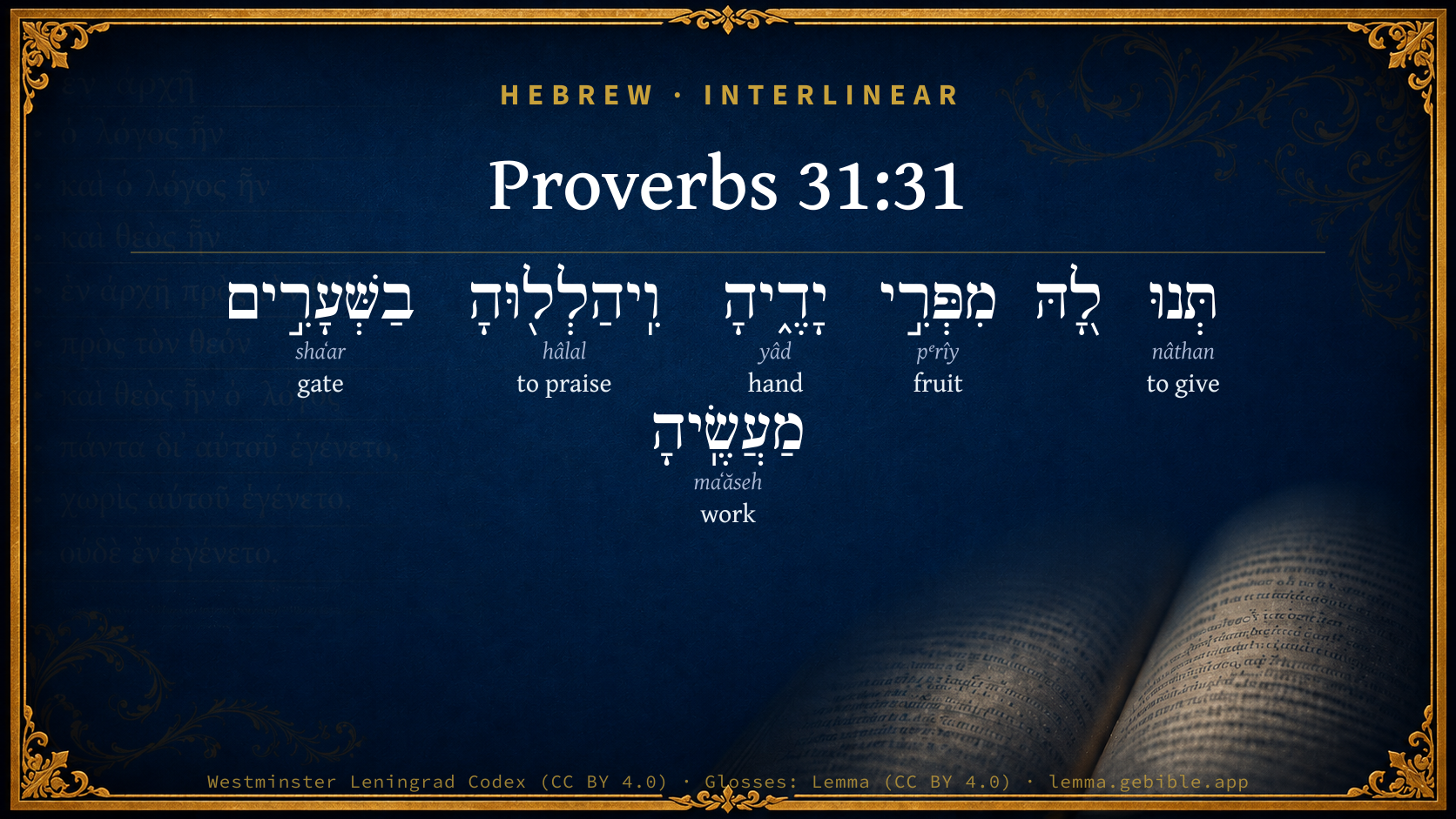
Proverbs 31:31

Hebrew (Westminster Leningrad Codex) Proverbs 31:31 appears in the Hebrew Old Testament. The text above is from the Westminster Leningrad Codex. Each word links to its Strong’s number, a concise gloss, and parsing drawn from the Open Scriptures Hebrew Bible morphology. Click any word for its full Brown-Driver-Briggs (BDB) entry.
Download image
Cite this verse

Proverbs 31:31 (World English Bible). Public Domain. Lemma interlinear Bible study tool, https://lemma.gebible.app/v/proverbs/31/31.

Show BibTeX & RIS
BibTeX
RIS
English Translation
Give her of the fruit of her hands! Let her works praise her in the gates!
World English Bible · Public Domain
Download a study sheet

One document with this verse’s original text, its word-by-word gloss line, the meaning frame, cross-references with their text, attributed commentary, and full source and license credits — printable, and it pastes into notes with its structure intact.

This verse Autodidact and up

Study sheet (.html) Plain text (.txt)

A passage Seminary Student

Up to 50 verses in one chapter. A passage sheet keeps up to 6 commentary sources and 12 cross-references per verse, in the order this page ranks them, and says so on the sheet whenever that leaves anything out. Ask for a single verse and you get the Autodidact verse sheet above.

Everything on this page stays free to read, with no account — the sheet is a download of what is already on screen, not access to it.

Want to remove ads? Support Godless Engineer
Compare translations 3

The same verse in 3 English versions, stacked beneath the original-language interlinear above. Click any original word for its lexicon entry.

Each is an independent rendering of the whole verse — the interlinear is not word-aligned to these translations.

Highlighted words mark where these versions differ — a whole-verse word diff, not a word-by-word alignment.

  • World English Bible Public Domain
    Give her of the fruit of her hands! Let her works praise her in the gates!
  • King James Version Public Domain
    Give her of the fruit of her hands; and let her own works praise her in the gates.
  • unfoldingWord Literal Text CC BY-SA 4.0
    Give to her from the fruit of her hands and let her works praise her at the gates.

unfoldingWord Literal Text — © unfoldingWord, licensed CC BY-SA 4.0. Word-aligned USFM3 via Door43 (git.door43.org/unfoldingWord/en_ult).

Versions to compare (up to 4)

3 of 4 selected

Show all 18 translations

Every available English version of this verse, each an independent rendering of the whole verse.

  • World English Bible Public Domain
    Give her of the fruit of her hands! Let her works praise her in the gates!
  • Berean Standard Bible Public Domain
    Give her the fruit of her hands, and let her works praise her at the gates.
  • Majority Standard Bible Public Domain
    Give her the fruit of her hands, and let her works praise her at the gates.
  • King James Version Public Domain
    Give her of the fruit of her hands; and let her own works praise her in the gates.
  • American Standard Version (1901) Public Domain
    Give her of the fruit of her hands; And let her works praise her in the gates.
  • Revised Version (1885) Public Domain
    Give her of the fruit of her hands; and let her works praise her in the gates.
  • Geneva Bible (1599) Public Domain
    Giue her of the fruite of her hands, and let her owne workes prayse her in the gates.
  • Douay-Rheims (1899) Public Domain
    Give her of the fruit of her hands: and let her works praise her in the gates.
  • Young's Literal Translation Public Domain
    Give ye to her of the fruit of her hands, And her works do praise her in the gates!
  • Literal Standard Version CC BY-SA 4.0
    Give to her of the fruit of her hands, || And her works praise her in the gates!
  • Unlocked Literal Bible CC BY-SA 4.0
    Give her the fruit of her hands and let her works praise her in the gates.
  • unfoldingWord Literal Text CC BY-SA 4.0
    Give to her from the fruit of her hands and let her works praise her at the gates.
  • Darby Bible Public Domain
    Give her of the fruit of her hands, and let her own works praise her in the gates.
  • World Messianic Bible Public Domain
    Give her of the fruit of her hands! Let her works praise her in the gates!
  • Webster's Bible Public Domain
    Give her of the fruit of her hands; and let her own works praise her in the gates.
  • Free Bible Version CC BY-SA 4.0
    Give her the recognition she deserves; praise her publicly for what she's done.
  • Bible in Basic English Public Domain
    Give her credit for what her hands have made: let her be praised by her works in the public place.
  • JPS Tanakh (1917) Public Domain
    Give her of the fruit of her hands; and let her works praise her in the gates.

Literal Standard Version (2020), Covenant Press — licensed CC BY-SA 4.0. Text via the HelloAO Bible API (eBible.org). Unlocked Literal Bible (unfoldingWord) — licensed CC BY-SA 4.0. Text via the HelloAO Bible API (eBible.org). unfoldingWord Literal Text — © unfoldingWord, licensed CC BY-SA 4.0. Word-aligned USFM3 via Door43 (git.door43.org/unfoldingWord/en_ult). Free Bible Version, Dr. Jonathan Gallagher — licensed CC BY-SA 4.0. Text via the HelloAO Bible API (eBible.org).

Word by word

More ways to search: Search by grammar → Find every occurrence → Compare this word →

Practice this passage: Drill this verse → Learn its vocabulary →

מִפְּרִ֣י
pᵉrîy
H6529
“from · fruit of”
Preposition + Noun, Common, Masculine, Singular, Construct
Part of Speech
Preposition + Noun
Type
Common
Gender
Masculine
Number
Singular
State
Construct
Full BDB Definition

Origin: from H6509

TWOT: 1809a

fruit - fruit, produce (of the ground) - fruit, offspring, children, progeny (of the womb) - fruit (of actions) (figuratively)
  1. תְּנוּ nâthan H5414 “give” Verb, Qal, Imperative, 2nd Person, Masculine, Plural
  2. יָדֶ֑יהָ yâd H3027 “hands · her” Noun, Common, Both, Dual, Construct + Suffix, Personal, 3rd Person, Feminine, Singular
  3. וִֽיהַלְל֖וּהָ hâlal H1984 “and · to praise · her” Conjunction + Verb, Piel, Imperfect, 3rd Person, Masculine, Plural + Suffix, Personal, 3rd Person, Feminine, Singular
  4. בַשְּׁעָרִ֣ים shaʻar H8179 “in/at the · gates” Preposition, Determined + Noun, Common, Masculine, Plural, Absolute
  5. מַעֲשֶֽׂיהָ maʻăseh H4639 “works · her” Noun, Common, Masculine, Plural, Construct + Suffix, Personal, 3rd Person, Feminine, Singular

About this verse

These counts appear in no published source. They are computed here, from the morphology-tagged text and Lemma’s own curated glosses. What Lemma adds →

7
words
6
distinct lemmas
Wisdom
section

Grammatical profile

  • 2 verbs
  • 4 nouns
  • 1 preposition

Verb forms

  • תְּנוּ Qal · Imperative
  • וִֽיהַלְל֖וּהָ Piel · Imperfect

Hebrew & Septuagint length

In English translation the verse runs 16 words from the Hebrew and 17 from the Septuagint (LXX English) — closely comparable.

A rough comparison of the two English renderings, which tokenize alike — not a word-level alignment.

Word counts can differ between the Hebrew and the Greek without any difference in meaning — e.g. the Hebrew direct-object marker אֵת has no separate Greek word, and Greek often adds the article ὁ.

In the original languages it is 7 Hebrew tokens and 13 Greek tokens — but the two are counted differently (Hebrew bundles its prefixes and suffixes into one token; the Greek is in lemma form), so that isn’t a like-for-like length.

Cross-references

15

Topical passages linked to Proverbs 31:31 in the Treasury of Scripture Knowledge — connected by theme and wording, ordered by reader-vote popularity; previews shown in the World English Bible.

  • Psalms 128:2 For you will eat the labor of your hands. You will be happy, and it will be well with you.
  • Hebrews 6:10 For God is not unrighteous, so as to forget your work and the labor of love which you showed toward his name, in that you served the saints, and still do serve them.
  • Matthew 7:16 By their fruits you will know them. Do you gather grapes from thorns, or figs from thistles?
  • Romans 16:1–4 I commend to you Phoebe, our sister, who is a servant of the assembly that is at Cenchreae,
  • Revelation 14:13 I heard the voice from heaven saying, "Write, 'Blessed are the dead who die in the Lord from now on.'" "Yes," says the Spirit, "that they may rest from their labors; for their works follow with them."
  • Proverbs 11:30 The fruit of the righteous is a tree of life. He who is wise wins souls.
  • Proverbs 31:16 She considers a field, and buys it. With the fruit of her hands, she plants a vineyard.
  • Philippians 4:17 Not that I seek for the gift, but I seek for the fruit that increases to your account.
  • Matthew 7:20 Therefore, by their fruits you will know them.
  • Mark 14:7–9 For you always have the poor with you, and whenever you want to, you can do them good; but you will not always have me.
  • Acts 9:39 Peter got up and went with them. When he had come, they brought him into the upper chamber. All the widows stood by him weeping, and showing the coats and garments which Dorcas had made while she was with them.
  • 1 Timothy 5:25 In the same way also there are good works that are obvious, and those that are otherwise can't be hidden.
  • Romans 16:6 Greet Mary, who labored much for us.
  • Romans 16:12 Greet Tryphaena and Tryphosa, who labor in the Lord. Greet Persis, the beloved, who labored much in the Lord.
  • Romans 6:21–22 What fruit then did you have at that time in the things of which you are now ashamed? For the end of those things is death.

Cross-references courtesy of OpenBible.info (CC BY 4.0).

Hebrew and Greek witnesses Masoretic Hebrew ↔ Greek Septuagint

The same verse in the two great witnesses to the Old Testament, shown verse-for-verse.

These are two independent witnesses, not word-aligned to each other, and the Septuagint is shown in lemma (dictionary) form.

Hebrew Proverbs 31:31 Masoretic · Westminster Leningrad Codex

תְּנוּ לָ֭הּ מִפְּרִ֣י יָדֶ֑יהָ וִֽיהַלְל֖וּהָ בַשְּׁעָרִ֣ים מַעֲשֶֽׂיהָ

Give her of the fruit of her hands! Let her works praise her in the gates!

World English Bible · Public Domain

Greek LXX Proverbs 31:31 Septuagint · lemma form

δίδωμι αὐτός ἀπό καρπός χείρ αὐτός καί αἰνέω ἐν πύλη ὁ ἀνήρ αὐτός

Give her of the fruit of her lips; and let her husband be praised in the gates.

LXX2012 (modern English Septuagint) · Public Domain

On this verse, John Gill's Exposition discusses the Septuagint’s reading. Read the note in Commentary ↓

Hebrew: Westminster Leningrad Codex (CC BY 4.0). Greek: Septuagint (public domain); English from LXX2012 (modern English Septuagint) (Public Domain). How the Septuagint differs from the Hebrew →

Commentary

Notes on Proverbs 31:31 from classic Christian and Jewish commentators (each source and its license shown beneath its notes). The classic Christian expositions comment on the surrounding passage and are grouped to its opening verse, so a note may address several verses; the Jewish commentaries on the Tanakh (Rashi and others) are per-verse, so they appear only where the commentator wrote on this verse.

Lemma curates 59 commentaries, every one of them public domain or Creative Commons licensed, each selected and text-cleaned for this edition rather than reprinted as found. About our sources →

Trapp's Complete Commentary

John Trapp

Pro 31:31 Give her of the fruit of her hands; and let her own works praise her in the gates.

Ver. 31. Give her of the fruit of her hands.] God would have desert dignified, good parts praised. Here he seals up his approbation and good liking of what her husband and children had said of her in the former verses. He takes it well when we speak good of his people, and holds himself honoured in their just praises. Give her her full due, saith God, both within doors and without. Let her eat of the vineyard that she hath planted, live of the land that she hath purchased, enjoy the fruit of her own labours, have both the comfort and the credit of her worthy parts and practices, she being - as she here stands described - not unlike that precious stone among the Troglodytes which is therefore called hexacontalithos, because within its own little compass it hath the radiant colours of sixty other stones of price. {a}

{a} Solin., Poly. Hist., cap. 44.

John Trapp, A Commentary or Exposition upon All the Books of the Old and New Testament (1647–1656) — public domain. Text from a community e-Sword module.

Joseph Benson's Commentary

Pro 31:31. Give her of the fruit of her hands — It is but just that she should enjoy those praises which her labours deserve. Let her works praise her — If men be silent, the lasting effects of her prudence and diligence will trumpet forth her praises. In the gates — In the most public and solemn assemblies.

Joseph Benson's Commentary on the Old and New Testaments (1811–1818) — public domain. Text from a community e-Sword module.

Geneva Bible (1599)

Geneva Bible translators

Confess her diligent labors, and commend her therefore.

Forasmuch as the most honorable are clad in the apparel that she made.

Geneva Bible (1599) marginal notes — public domain. Text via Bolls.life.

Jamieson, Fausset & Brown

Robert Jamieson, A. R. Fausset & David Brown

The result of her labor is her best eulogy. Nothing can add to the simple beauty of this admirable portrait. On the measure of its realization in the daughters of our own day rest untold results, in the domestic, and, therefore, the civil and religious, welfare of the people.

Next: Ecclesiastes Introduction

Jamieson, Fausset & Brown — Commentary Critical and Explanatory on the Whole Bible (1871) — public domain (CC PDM 1.0). Text via the HelloAO Bible API.

Adam Clarke's Commentary

Verse 31. Give her of the fruit of her hands] This may be a prayer. May she long enjoy the fruit of her labours! May she see her children's children, and peace upon Israel!

And let her own works praise her in the gates.] Let what she has done be spoken of for a memorial of her; let her bright example be held forth in the most public places. Let it be set before the eyes of every female, particularly of every wife, and especially of every mother; and let them learn from this exemplar, what men have a right to expect in their wives, the mistresses of their families, and the mothers of their children. Amen.

MASORETIC NOTES ON THIS BOOK

Number of verses in the book of Proverbs, 915.

Middle verse, Pr 16:18.

Sections, 8.

The Syriac reckons 1863 verses.

The Arabic concludes thus: - "The discipline of Solomon written out by the friends of Hezekiah, king of Judah, the interpretation or translation of which is extremely difficult, (but) is now completed by the assistance and influence of the Son of God."

IN the introduction to the book of Proverbs, among the several collections of a similar nature which are mentioned there, I have referred to M. Galand's Maximes des Orientaux. From this work, as contained in the supplement to the Bibliotheque Orientale, I have translated the following selection. They will serve to show the curious reader how many sayings similar to those of Solomon still abound in the East.

Adam Clarke's Commentary on the Bible (1810–1826) — public domain. Text from a community e-Sword/MySword module.

Ellicott's Commentary for English Readers

(31) Give her of the fruit of her hands—i.e., honour her for her noble life, “and let her own works praise her in the gates;” let them be recounted when men meet together; the mere mention of them will be sufficient, as no words could add anything to her praise.

A Bible Commentary for English Readers, edited by Charles John Ellicott (1878–1897) — public domain. Text from a community e-Sword module.

John Gill's Exposition

Give her of the fruit of her hands,.... According to Aben Ezra, these are the words of her husband to her children; exhorting them to give her the praise and glory that is due unto her. Jarchi interprets it of the world to come; at which time, it is certain, the graces of the church, and of all believers, which are the fruits of the Spirit in them, and of their hands, as exercised by them, such as faith, hope, love, humility, patience, and others, will be found to honour and praise; and every such person shall have praise of God, Pe1 1:7; and also of men and angels; to whom these words may be an exhortation to give it to them;

and let her own words praise her in the gates; where her husband is known, in public assemblies; before angels and men, in the great day; when her works will follow her, and speak for her, and she will be publicly praised by Christ, as all the faithful and righteous will, Rev 14:13. The Septuagint and Arabic versions render it, "let her husband be praised in the gate"; see Pro 31:23; so Ambrose, who interprets it of the happiness of the saints in heaven.

Next: Ecclesiastes Introduction

John Gill's Exposition of the Whole Bible (1746–1763) — public domain (CC PDM 1.0). Text via the HelloAO Bible API.

Haydock's Catholic Bible Commentary

Gates, before all the judges (Haydock) and people. (Menochius) --- Good works shall be rewarded at God’s tribunal, (Worthington) when the vain worldly beauty shall be covered with confusion. (Haydock) --- This idea of a perfect woman is best verified in the Catholic Church, (St. Augustine; Ven. Bede) though the blessed Virgin [Mary], &c., may also be designated. (Worthington) --- The use of the alphabet herein denotes, that we must begin with a moral good life, if we would penetrate the greater mysteries of the Scriptures. (St. Jerome) (Lam.[Lamentations?])

George Leo Haydock (1774–1849), Haydock's Catholic Family Bible and Commentary, 1859 edition — public domain. Excludes Psalms (Douay-Rheims chapter numbering differs from Protestant) and Deuterocanonical books (Catholic canon only).

Matthew Poole's English Annotations

Give her of the fruit of her hands; it is but just and fit that she should enjoy those benefits and praises which her excellent labours deserve.

Let her own works praise her; give her the praises which her own works may challenge. If men be silent, the lasting effects of her prudence and diligence will loudly trumpet forth her praises.

In the gates; in the most public and solemn assemblies.

Matthew Poole's English Annotations on the Holy Bible (1683–1685) — public domain. Text from a community e-Sword/MySword module.

Whedon's Commentary on the Bible

Daniel D. Whedon

31. The fruits of her hands — The product and results of her labours.

And let her own works — Of industry, of thrift, of economy, of kindness, of piety, of wise and careful household management, (the word means all these.)

Praise her in the gates — Let them be held up for imitation in the public assemblies, and for the incitement of others to like virtues. Here is a specimen of the “strong-minded” woman of the ancient Hebrew race. Let those of her sex who feel within them the stirrings of energy and the aspirations for distinction, take this “looking-glass for ladies,” as the old commentators call it, and dress themselves by it, and they will crown themselves with true womanly dignity and enduring fame.

Daniel D. Whedon (gen. ed.), Commentary on the Old and New Testaments (1874–1909) — public domain. Text from a community e-Sword module.

The Pulpit Commentary

TAV. Give her of the fruit of her hands. So may she enjoy the various blessings which her zeal, prudence, and economy have obtained. Psa_128:2, "Thou shalt eat the labour of thine hands; happy shalt thou be, and it shall be well with thee." Septuagint, "Give her of the fruit of her lips." And let her own works praise her in the gates. She needs no farfetched laudation; her life long actions speak for themselves. Where men most congregate, where the heads of the people meet in solemn assembly, there her praise is sung, and a unanimous verdict assigns to her the highest honour. Septuagint, "Let her husband be praised in the gates." This frequent introduction of the husband is cuprous. St. Gregory thus spiritualizes the passage: "As the entrance of a city is called the gate, so is the day of judgment the gate of the kingdom, since all the elect go in thereby to the glory of their heavenly country....Of these gates Solomon says, "Give her of the fruit of her hands, and her own works shall praise her in the gates." For holy Church then receives of "the fruit of her hands," when the recompensing of her labour raises her up to the possession of heavenly blessings; for her "works then praise her in the gates," when in the very entrance to his kingdom the words are spoken to his members, "I was a hungred, and ye gave me meat," etc." ("Moral.," 6:9).

Woman"s rights.

The strenuous advocacy of the rights of women by shrill oratory has injured the true cause of women by covering a serious subject with ridicule, and suggesting the unreality of the grievances urged. When extravagant demands are made, people assume that every just right has been conceded; and when the self-elected advocates of women put forth a programme which the great body of wives and daughters repudiate, it is supposed that there is no ground for considering any complaint as to the legal and social treatment of women. But this is unreasonable and unjust. There are women"s rights, and these fights are by no means universally conceded.

I WOMEN HAVE A RIGHT TO WORK. The Oriental notion, that women are but idle ornaments of the harem, finds no place in the Bible. Here they appear freely in the world, and, though their first duties are in the home, they are not idle, nor are they wanting in enterprise. The ideal woman in the Book of Proverbs is a manufacturer, a merchant, and a landowner. Woman"s work cannot be wholly the same as man"s, because nature has placed limitations upon her physical energies. But she has spheres for work, and it is cruel, unjust, and selfish to keep her out of any region of activity where she can do good service, by law or by social displeasure. Two wrongs in particular need to be swept away.

1. The motion that work is degrading to a woman. Surely idleness is more degrading. It is rightly said that woman"s sphere is the home. But it is not every woman who has a home. Surely it is a degrading and insulting idea that the main business of a young woman is to secure a husband, and so obtain a home. There are women who are manifestly cut out for other positions; many women never have an opportunity of obtaining a home of their own except by sacrificing themselves to men whom they do not love. In early life young girls are not the better for being kept in idleness, waiting for the chance that may turn up. Half the ailments of women of the comfortable classes come from want of occupation. It needs to be known and recognized that it is a right and honourable thing for a woman to be engaged in any ordinary occupation that is suitable to her powers.

2. The fear of rivalry with men. There have been professions the members of which have bitterly resented the invasion of their ranks by women. Such trade unionism is most ungenerous. It is a humiliation to have to confess that men could not hold their own unless under a system of protection against the competition of women. Certainly no Christian principle can justify such selfishness.

II WOMEN HAVE A RIGHT TO THE RESULTS OF THEIR WORK.

1. In payment. The wife who earns wages has a right to her purse as much as the husband to his. Where there is a true marriage, no thought of separate interests will rouse any jealousy as to the several possessions of the two. But true marriage is not always realized. We see brutal husbands living idly on the earnings of their wives. It is not enough that the poor women are supposed to be protected by a Married Woman"s Property Act, for the husband is still too often the tyrant of the home. We shall only see a more just arrangement when Christian principles are applied to domestic practices.

2. In honour. "Let her own works praise her in the gates." Women who contribute to the service of society are deserving of double honour, because they have had to work under exceptional disadvantages. Women who have proved themselves wise, industrious, and generous in the home life do not receive their meed of praise. Too much is taken for granted, and accepted without thanks, because the service is constant and the sacrifice habitual. In after years, when it is too late to give the due acknowledgment, many a man has had to feet sharp pangs of regret at his heedless treatment of a wife"s patient toil or a mother"s yearning love.

3. In position. Opportunity should be proportionate to capacity. If women can work, they should have scope for work. It is the duty of Christian society to give to woman her true position. If she be "the weaker vessel," she needs more consideration, not less justice. Christ gave high honours to women, accepted their devoted service, and laid the foundation of Christian justice in regard to them.

The Pulpit Commentary (1880–1919), ed. H.D.M. Spence-Jones & Joseph S. Exell — public domain. Text from a community e-Sword module.

John Wesley's Explanatory Notes

Give her - It is but just, that she should enjoy those praises which her labours deserve. Let her works - If men be silent, the lasting effects of her prudence and diligence will trumpet forth her praises. In the gates - In the most publick and solemn assemblies.

John Wesley, Explanatory Notes Upon the Whole Bible (1754–1765) — public domain. Text via the GEBible commentary corpus.

Keil & Delitzsch

C. F. Keil & F. Delitzsch

31 ת Give to her of the fruit of her hands;

And let her works praise her in the gates!

The fruit of her hands is the good which, by her conduct, she has brought to maturity - the blessing which she has secured for others, but, according to the promise (Isa 3:10), has also secured for her own enjoyment. The first line proceeds on the idea that, on account of this blessing, she herself shall rejoice. תּנוּ־להּ (with Gaja, after Metheg-Setzung, 37) is not equivalent to give to her honour because of...; for in that case, instead of the ambiguous מן, another preposition - such e.g., as על - would have been used; and so תּנוּ, of itself, cannot be equivalent to תּנּוּ (sing the praise of), as Ziegler would read, after Jdg 11:40. It must stand with כבוד, or instead of מפּרי an accus. obj. is to be thought of, as at Psa 68:35; Deu 32:3, which the necessity of the case brings with it - the giving, as a return in the echo of the song of praise. Immanuel is right in explaining תנו־לה by תגמלו לה חסד or עשׂו עתה חסד וכבוד, cf. Psa 28:4. The מן, as is not otherwise to be expected, after תנו is partitive: give to her something of the fruit of her hands, i.e., recompense it to her, render it thankfully, by which not exclusively a requital in the form of honourable recognition, but yet this specially, is to be thought of. Her best praise is her works themselves. In the gates, i.e., in the place where the representatives of the people come together, and where the people are assembled, her works praise her; and the poet desires that this may be right worthily done, full of certainty that she merits it, and that they honour themselves who seek to praise the works of such a woman, which carry in themselves their own commendation.

Keil & Delitzsch — Biblical Commentary on the Old Testament (1861–1891) — public domain (CC PDM 1.0). Text via the HelloAO Bible API. (Old Testament only.)

Rashi

Rabbi Shlomo Yitzchaki (Rashi)

her deeds The skill of her deeds testifies for her so that all passersby praise her in the gate of the city. This is the figure, as I explained it, but according to the allegory, the chapter is explained as referring to the Torah and those who study it.

[10] a woman of valor This is the Torah.

who can find Fortunate is he who merits to find it.

than pearls Heb. מפנינים, [also referred to as] מרגליות.

[11] and he lacks no gain He eats the fruit in this world and in the next

[13] She seeks wool and flax Since it [the Torah] is compared to a woman, Scripture speaks according to the figure concerning the requirements for the work of women, and the allegory is as follows: The Torah seeks Scripture, Mishnah and Midrash, and searches for them, as they are the requirements of the students.

[14] She is like the merchant ships The Torah brings those who study it blessing and sustenance.

[15] She rises when it is still night They rise early in the [morning] watch.

she gives food to her household The teacher teaches the pupils the lesson allotted to them.

[16] She contemplates a field Heb. זממה. The Torah muzzles Esau, the “man of the field,” with a muzzle and a bridle.

and purchases it lit. and takes him from the world to destroy him;

from the fruit of her deeds she plants a vineyard Israel, to keep them alive for the fire of the world to come.

[18] She advised Its speech.

her lamp does not go out at night It is written בליל, with the “hey” missing; on the night of watching (ליל שמורים), when the Egyptians were plagued, it shone for Israel and protected them.

[19] onto the distaff Heb. בכישור, through the skill of its deeds.

support the spindle Heb. פלך, a support, as in (II Sam. 3:29): “one who leans on a staff (מחזיק בפלך).”

[20]She spreads out her hand Whoever makes himself like a poor man on its account—in him it [the Torah] endures.

[21] She fears not for her household for snow with which they judge the wicked from fire to snow.

dressed in crimson The covenant of the blood of circumcision. Another explanation: They are dressed with the commandments expressed in double language. (Deut. 15:10): “You shall surely give (נתון תתן),” (ibid. verse 8): “you shall surely open (פתוח תפתח),” (ibid. verse 14): “you shall surely furnish him liberally (הענק תעניק).” All these save them from the snow of Gehinnom. So it is expounded in Tanhuma.

[24] She makes a cloak It grants a glorious [raiment] to the Sages.

and she gives a belt to the trafficker To the one who is girded with its merchandise, she gives a belt for their loins.

[25] to the last day They need not grieve over the day of judgment because they will be saved from it, and all the days of their life they will rejoice at the day of judgment. An expression of צחוק, laughter, applies to anyone who need not be concerned, as in (Job 41:21): “and he rejoices at the din of a spear.”

[27] She supervises the ways of her household The Torah teaches them the good way, to separate from sin.

[28] Her children The pupils.

her husband The Holy One, blessed be He.

[30] Charm is false [The charm] of the kings of the nations.

and...is futile Their greatness and their beauty.

[31] Give her in the future.

of the fruit of her hands Glory and greatness, strength, beauty and ruling power.

Rashi on the Tanakh — English translations: “The Judaica Press complete Tanach with Rashi, translated by A. J. Rosenberg” (CC BY 4.0); “Pentateuch with Rashi's commentary by M. Rosenbaum and A.M. Silbermann, 1929-1934” (public domain); “The Metsudah Tanach series, Lakewood, N.J” (CC BY 4.0); and “The Book of Joshua, Metsudah Publications, 1997” (CC BY 4.0). Text via Sefaria.

Lesson kit

Teaching starters — assembled from the data on this page, not authored interpretation. Every prompt links to the verse data it draws on. Edit before teaching.

Proverbs, in the Wisdom, opens this verse with 7 words (6 distinct Hebrew lemmas). Its most distinctive word is pᵉrîy (“fruit”). A historical commentator’s framing appears above. Read the whole chapter for the surrounding context.

Discussion questions

  1. What does “fruit” (pᵉrîy) contribute to the verse as a whole?
  2. How does Psalms 128:2, which shares this passage’s theme, read alongside this verse?
  3. The translations on this page render this verse differently — a whole-verse word diff, not a word-by-word alignment. What might account for the different wordings?
  4. «תְּנוּ» is a Qal Imperative verb. How does that grammatical form shape the action described?
  5. Compare how Trapp's Complete Commentary and Joseph Benson's Commentary read this verse. Where do they agree or differ?

Things to notice

Reading settings

Reading text

Shown beneath each verse's original-language words.

Old Testament
Old Testament edition

Read the OT as the Masoretic Hebrew (MT) or the Greek Septuagint (LXX).

English shown for the Greek Septuagint (in the Hebrew ↔ Greek comparison).

Comparing translations? Open the Compare panel on any verse page to stack up to four side by side.