
Deuteronomy 14:21

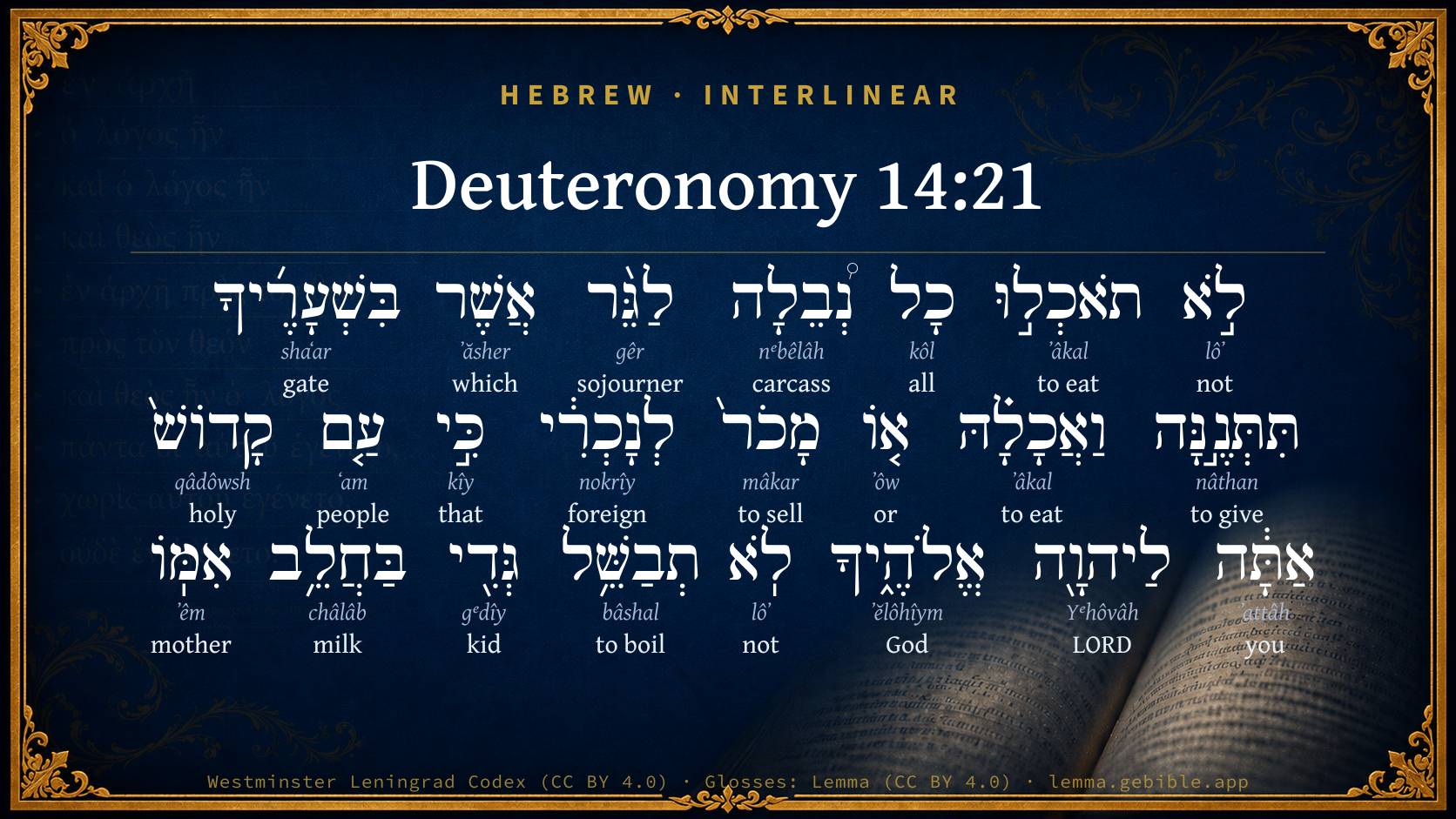
Hebrew (Westminster Leningrad Codex) Deuteronomy 14:21 appears in the Hebrew Old Testament. The text above is from the Westminster Leningrad Codex. Each word links to its Strong’s number, a concise gloss, and parsing drawn from the Open Scriptures Hebrew Bible morphology. Click any word for its full Brown-Driver-Briggs (BDB) entry.
Download image
Cite this verse

Deuteronomy 14:21 (World English Bible). Public Domain. Lemma interlinear Bible study tool, https://lemma.gebible.app/v/deuteronomy/14/21.

Show BibTeX & RIS
BibTeX
RIS
English Translation
You shall not eat of anything that dies of itself: you may give it to the foreigner living among you who is within your gates, that he may eat it; or you may sell it to a foreigner: for you are a holy people to Yahweh your God. You shall not boil a kid in its mother's milk.
World English Bible · Public Domain
Download a study sheet

One document with this verse’s original text, its word-by-word gloss line, the meaning frame, cross-references with their text, attributed commentary, and full source and license credits — printable, and it pastes into notes with its structure intact.

This verse Autodidact and up

Study sheet (.html) Plain text (.txt)

A passage Seminary Student

Up to 50 verses in one chapter. A passage sheet keeps up to 6 commentary sources and 12 cross-references per verse, in the order this page ranks them, and says so on the sheet whenever that leaves anything out. Ask for a single verse and you get the Autodidact verse sheet above.

Everything on this page stays free to read, with no account — the sheet is a download of what is already on screen, not access to it.

Want to remove ads? Support Godless Engineer
Compare translations 3

The same verse in 3 English versions, stacked beneath the original-language interlinear above. Click any original word for its lexicon entry.

Each is an independent rendering of the whole verse — the interlinear is not word-aligned to these translations.

Highlighted words mark where these versions differ — a whole-verse word diff, not a word-by-word alignment.

  • World English Bible Public Domain
    You shall not eat of anything that dies of itself: you may give it to the foreigner living among you who is within your gates, that he may eat it; or you may sell it to a foreigner: for you are a holy people to Yahweh your God. You shall not boil a kid in its mother's milk.
  • King James Version Public Domain
    Ye shall not eat of anything that dieth of itself: thou shalt give it unto the stranger that is in thy gates, that he may eat it; or thou mayest sell it unto an alien: for thou art an holy people unto the LORD thy God. Thou shalt not seethe a kid in his mother's milk.
  • unfoldingWord Literal Text CC BY-SA 4.0
    You must not eat anything dying; you may give it to the sojourner who within your gates, and he may eat it or sell to a foreigner. For you a nation sanctified to Yahweh your God. You must not boil a young goat in the milk of its mother.

unfoldingWord Literal Text — © unfoldingWord, licensed CC BY-SA 4.0. Word-aligned USFM3 via Door43 (git.door43.org/unfoldingWord/en_ult).

Versions to compare (up to 4)

3 of 4 selected

Show all 18 translations

Every available English version of this verse, each an independent rendering of the whole verse.

  • World English Bible Public Domain
    You shall not eat of anything that dies of itself: you may give it to the foreigner living among you who is within your gates, that he may eat it; or you may sell it to a foreigner: for you are a holy people to Yahweh your God. You shall not boil a kid in its mother's milk.
  • Berean Standard Bible Public Domain
    You are not to eat any carcass; you may give it to the foreigner residing within your gates, and he may eat it, or you may sell it to a foreigner. For you are a holy people belonging to the LORD your God. You must not cook a young goat in its mother’s milk.
  • Majority Standard Bible Public Domain
    You are not to eat any carcass; you may give it to the foreigner residing within your gates, and he may eat it, or you may sell it to a foreigner. For you are a holy people belonging to the LORD your God. You must not cook a young goat in its mother’s milk.
  • King James Version Public Domain
    Ye shall not eat of anything that dieth of itself: thou shalt give it unto the stranger that is in thy gates, that he may eat it; or thou mayest sell it unto an alien: for thou art an holy people unto the LORD thy God. Thou shalt not seethe a kid in his mother's milk.
  • American Standard Version (1901) Public Domain
    Ye shall not eat of anything that dieth of itself: thou mayest give it unto the sojourner that is within thy gates, that he may eat it; or thou mayest sell it unto a foreigner: for thou art a holy people unto Jehovah thy God. Thou shalt not boil a kid in its mother's milk.
  • Revised Version (1885) Public Domain
    Ye shall not eat of any thing that dieth of itself: thou mayest give it unto the stranger that is within thy gates, that he may eat it; or thou mayest sell it unto a foreigner: for thou art an holy people unto the LORD thy God. Thou shalt not seethe a kid in its mother’s milk.
  • Geneva Bible (1599) Public Domain
    Ye shall eate of nothing that dieth alone, but thou shalt giue it vnto the stranger that is within thy gates, that he may eate it: or thou maiest sell it vnto a stranger: for thou art an holy people vnto the Lord thy God. Thou shalt not seethe a kid in his mothers milke.
  • Douay-Rheims (1899) Public Domain
    But whatsoever is dead of itself, eat not thereof. Give it to the stranger, that is within thy gates, to eat, or sell it to him: because thou art the holy people of the Lord thy God. Thou shalt not boil a kid in the milk of his dam.
  • Young's Literal Translation Public Domain
    `Ye do not eat of any carcase; to the sojourner who `is' within thy gates thou dost give it, and he hath eaten it; or sell `it' to a stranger; for a holy people thou `art' to Jehovah thy God; thou dost not boil a kid in its mother's milk.
  • Literal Standard Version CC BY-SA 4.0
    You do not eat of any carcass; you give it to the sojourner who [is] within your gates, and he has eaten it; or sell [it] to a stranger; for you [are] a holy people to your God YHWH. You do not boil a kid in its mother’s milk.
  • Unlocked Literal Bible CC BY-SA 4.0
    You must not eat of anything that dies of itself; you may give it to the foreigner who is within your towns, that he may eat it; or you may sell it to a foreigner. For you are a nation that is set apart to Yahweh your God. You must not boil a young goat in its mother's milk.
  • unfoldingWord Literal Text CC BY-SA 4.0
    You must not eat anything dying; you may give it to the sojourner who within your gates, and he may eat it or sell to a foreigner. For you a nation sanctified to Yahweh your God. You must not boil a young goat in the milk of its mother.
  • Darby Bible Public Domain
    Ye shall eat of no carcase; thou shalt give it unto the stranger that is within thy gates, that he may eat it, or sell it unto a foreigner; for thou art a holy people to Jehovah thy God. Thou shalt not boil a kid in its mother's milk.
  • World Messianic Bible Public Domain
    You shall not eat of anything that dies of itself. You may give it to the foreigner living among you who is within your gates, that he may eat it; or you may sell it to a foreigner; for you are a holy people to the LORD your God. You shall not boil a young goat in its mother’s milk.
  • Webster's Bible Public Domain
    Ye shall not eat of any thing that dieth of itself: thou shalt give it to the stranger that is in thy gates, that he may eat it; or thou mayest sell it to an alien: for thou art a holy people to the LORD thy God. Thou shalt not seethe a kid in his mother's milk.
  • Free Bible Version CC BY-SA 4.0
    You must not eat any animal that dies. You can give it to a foreigner in your town, and they can eat it, or you can sell it to a foreigner. You, however, are a holy people who belong to the Lord your God. Don't cook a young goat in its mother's milk.
  • Bible in Basic English Public Domain
    You may not have as food anything which has come to a natural death; the man from another country who is living with you may take it for food, or you may get a price for it from one of another nation; for you are a holy people to the Lord your God. The young goat is not to be cooked in its mother's milk.
  • JPS Tanakh (1917) Public Domain
    Ye shall not eat of any thing that dieth of itself; thou mayest give it unto the stranger that is within thy gates, that he may eat it; or thou mayest sell it unto a foreigner; for thou art a holy people unto the LORD thy God. Thou shalt not seethe a kid in its mother's milk.

Literal Standard Version (2020), Covenant Press — licensed CC BY-SA 4.0. Text via the HelloAO Bible API (eBible.org). Unlocked Literal Bible (unfoldingWord) — licensed CC BY-SA 4.0. Text via the HelloAO Bible API (eBible.org). unfoldingWord Literal Text — © unfoldingWord, licensed CC BY-SA 4.0. Word-aligned USFM3 via Door43 (git.door43.org/unfoldingWord/en_ult). Free Bible Version, Dr. Jonathan Gallagher — licensed CC BY-SA 4.0. Text via the HelloAO Bible API (eBible.org).

Word by word

More ways to search: Search by grammar → Find every occurrence → Compare this word →

Practice this passage: Drill this verse → Learn its vocabulary →

גְּדִ֖י
gᵉdîy
H1423
“kid”
Noun, Common, Masculine, Singular, Absolute
Part of Speech
Noun
Type
Common
Gender
Masculine
Number
Singular
State
Absolute
Full BDB Definition

Origin: from the same as H1415

TWOT: 314b

kid, young male goat
  1. לֹ֣א lôʼ H3808 “not” Particle, Negative
  2. תֹאכְל֣וּ ʼâkal H398 “to eat” Verb, Qal, Imperfect, 2nd Person, Masculine, Plural
  3. כָל kôl H3605 “all of” Noun, Common, Masculine, Singular, Construct
  4. נְ֠בֵלָה nᵉbêlâh H5038 “carcass” Noun, Common, Feminine, Singular, Absolute
  5. לַגֵּ֨ר gêr H1616 “to/for the · sojourner” Preposition, Determined + Noun, Common, Masculine, Singular, Absolute
  6. אֲשֶׁר ʼăsher H834 “which” Particle, Relative
  7. בִּשְׁעָרֶ֜יךָ shaʻar H8179 “in/at · gates · your” Preposition + Noun, Common, Masculine, Plural, Construct + Suffix, Personal, 2nd Person, Masculine, Singular
  8. תִּתְּנֶ֣נָּה nâthan H5414 “to give · her” Verb, Qal, Imperfect, 2nd Person, Masculine, Singular + Suffix, Personal, 3rd Person, Feminine, Singular
  9. וַאֲכָלָ֗הּ ʼâkal H398 “and · to eat · her” Conjunction + Verb, Qal, Perfect, 3rd Person, Masculine, Singular + Suffix, Personal, 3rd Person, Feminine, Singular
  10. א֤וֹ ʼôw H176 “or” Conjunction
  11. מָכֹר֙ mâkar H4376 “to sell” Verb, Qal, Infinitive Absolute
  12. לְנָכְרִ֔י nokrîy H5237 “to/for · foreign” Preposition + Adjective, Adjective, Masculine, Singular, Absolute
  13. כִּ֣י kîy H3588 “that” Conjunction
  14. עַ֤ם ʻam H5971 “people” Noun, Common, Masculine, Singular, Absolute
  15. קָדוֹשׁ֙ qâdôwsh H6918 “holy” Adjective, Adjective, Masculine, Singular, Absolute
  16. אַתָּ֔ה ʼattâh H859 “you” Pronoun, Personal, 2nd Person, Masculine, Singular
  17. לַיהוָ֖ה Yᵉhôvâh H3068 “to/for · LORD” Preposition + Noun, Proper
  18. אֱלֹהֶ֑יךָ ʼĕlôhîym H430 “God(s) · your” Noun, Common, Masculine, Plural, Construct + Suffix, Personal, 2nd Person, Masculine, Singular
  19. לֹֽא lôʼ H3808 “not” Particle, Negative
  20. תְבַשֵּׁ֥ל bâshal H1310 “to boil” Verb, Piel, Imperfect, 2nd Person, Masculine, Singular
  21. בַּחֲלֵ֥ב châlâb H2461 “in/at · milk of” Preposition + Noun, Common, Masculine, Singular, Construct
  22. אִמּֽוֹ ʼêm H517 “mother · his” Noun, Common, Feminine, Singular, Construct + Suffix, Personal, 3rd Person, Masculine, Singular

About this verse

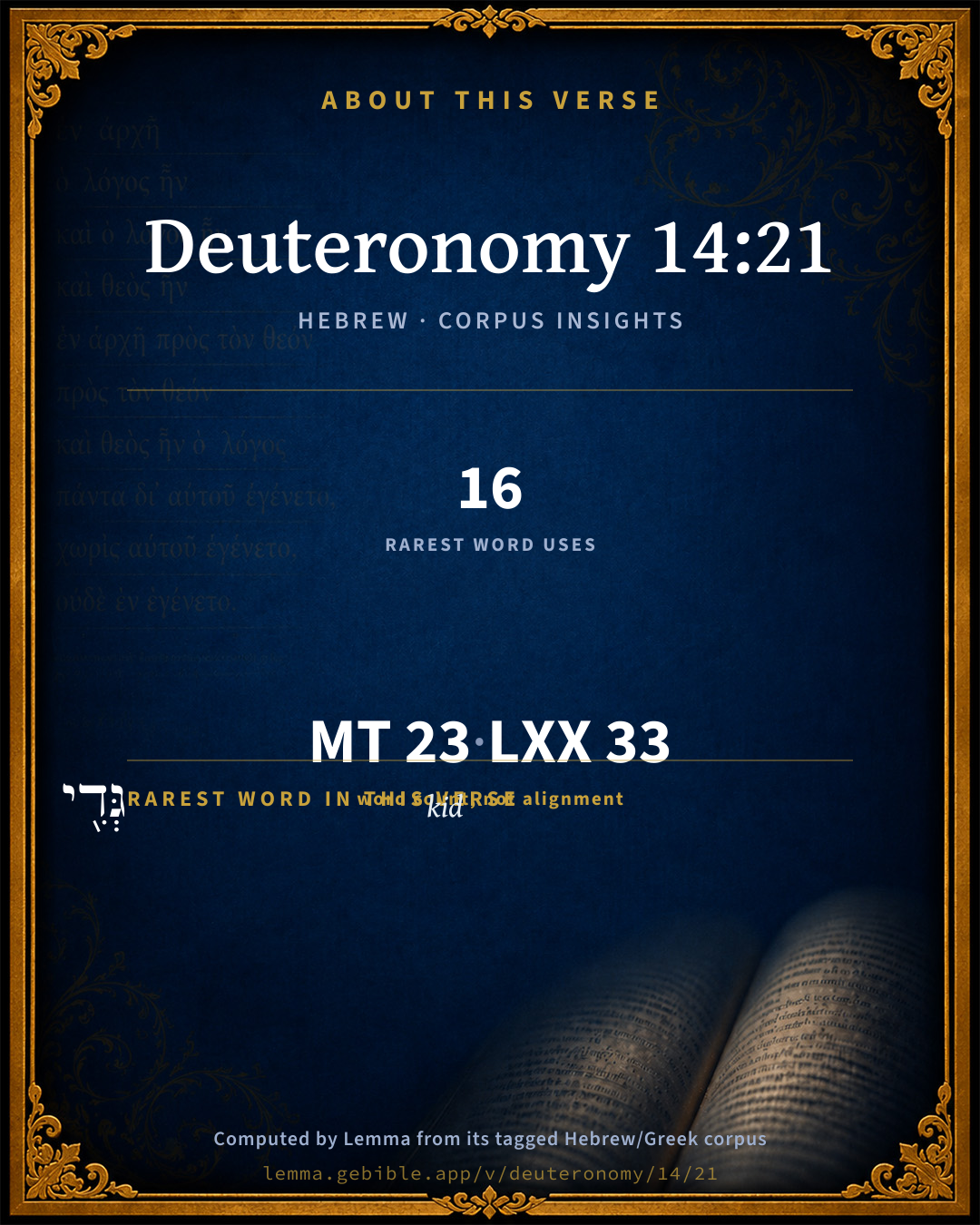
These counts appear in no published source. They are computed here, from the morphology-tagged text and Lemma’s own curated glosses. What Lemma adds →

23
words
21
distinct lemmas
Pentateuch
section

Notable vocabulary

The rarest word here is גְּדִ֖י kid H1423 — appearing just 16 times in the whole Hebrew Bible.

Shared distinctive vocabulary

גְּדִ֖י kid H1423 occurs in 16 verses of the Hebrew Bible. Also found in:

Grammatical profile

  • 5 verbs
  • 10 nouns
  • 2 adjectives
  • 1 pronoun
  • 2 conjunctions
  • 3 particles

Verb forms

  • תֹאכְל֣וּ Qal · Imperfect
  • תִּתְּנֶ֣נָּה Qal · Imperfect
  • וַאֲכָלָ֗הּ Qal · Perfect
  • מָכֹר֙ Qal · Infinitive Absolute
  • תְבַשֵּׁ֥ל Piel · Imperfect

Repetition

Words recur within this verse — often emphatic in Hebrew:

  • תֹאכְל֣וּ to eat H398 ×2
  • לֹ֣א not H3808 ×2

Hebrew & Septuagint length

In English translation the verse runs 58 words from the Hebrew and 52 from the Septuagint (LXX English) — closely comparable.

A rough comparison of the two English renderings, which tokenize alike — not a word-level alignment.

Word counts can differ between the Hebrew and the Greek without any difference in meaning — e.g. the Hebrew direct-object marker אֵת has no separate Greek word, and Greek often adds the article ὁ.

In the original languages it is 23 Hebrew tokens and 33 Greek tokens — but the two are counted differently (Hebrew bundles its prefixes and suffixes into one token; the Greek is in lemma form), so that isn’t a like-for-like length.

Cross-references

13

Topical passages linked to Deuteronomy 14:21 in the Treasury of Scripture Knowledge — connected by theme and wording, ordered by reader-vote popularity; previews shown in the World English Bible.

  • Exodus 23:19 The first of the first fruits of your ground you shall bring into the house of Yahweh your God. "You shall not boil a kid in its mother's milk.
  • Exodus 34:26 You shall bring the first of the first fruits of your ground to the house of Yahweh your God. You shall not boil a young goat in its mother's milk."
  • Leviticus 22:8 That which dies of itself, or is torn by animals, he shall not eat, defiling himself by it. I am Yahweh.
  • Deuteronomy 14:2 For you are a holy people to Yahweh your God, and Yahweh has chosen you to be a people for his own possession, above all peoples who are on the face of the earth.
  • Romans 12:2 Don't be conformed to this world, but be transformed by the renewing of your mind, so that you may prove what is the good, well-pleasing, and perfect will of God.
  • Leviticus 17:15 "'Every person that eats what dies of itself, or that which is torn by animals, whether he is native-born or a foreigner, he shall wash his clothes, and bathe himself in water, and be unclean until the evening: then he shall be clean.
  • Leviticus 19:33–34 "'If a stranger lives as a foreigner with you in your land, you shall not do him wrong.
  • Daniel 12:7 I heard the man clothed in linen, who was above the waters of the river, when he held up his right hand and his left hand to heaven, and swore by him who lives forever that it shall be for a time, times, and a half; and when they have made an end of breaking in pieces the power of the holy people, all these things shall be finished.
  • Acts 15:20 but that we write to them that they abstain from the pollution of idols, from sexual immorality, from what is strangled, and from blood.
  • Ezekiel 4:14 Then said I, Ah Lord Yahweh! behold, my soul has not been polluted; for from my youth up even until now have I not eaten of that which dies of itself, or is torn of animals; neither came there abominable flesh into my mouth.
  • Exodus 12:43–45 Yahweh said to Moses and Aaron, "This is the ordinance of the Passover. There shall no foreigner eat of it,
  • Daniel 8:24 His power shall be mighty, but not by his own power; and he shall destroy wonderfully, and shall prosper and do [his pleasure]; and he shall destroy the mighty ones and the holy people.
  • 1 Peter 1:16 because it is written, "You shall be holy; for I am holy."

Cross-references courtesy of OpenBible.info (CC BY 4.0).

Hebrew and Greek witnesses Masoretic Hebrew ↔ Greek Septuagint

The same verse in the two great witnesses to the Old Testament, shown verse-for-verse.

These are two independent witnesses, not word-aligned to each other, and the Septuagint is shown in lemma (dictionary) form.

Hebrew Deuteronomy 14:21 Masoretic · Westminster Leningrad Codex

לֹ֣א תֹאכְל֣וּ כָל נְ֠בֵלָה לַגֵּ֨ר אֲשֶׁר בִּשְׁעָרֶ֜יךָ תִּתְּנֶ֣נָּה וַאֲכָלָ֗הּ א֤וֹ מָכֹר֙ לְנָכְרִ֔י כִּ֣י עַ֤ם קָדוֹשׁ֙ אַתָּ֔ה לַיהוָ֖ה אֱלֹהֶ֑יךָ לֹֽא תְבַשֵּׁ֥ל גְּדִ֖י בַּחֲלֵ֥ב אִמּֽוֹ

You shall not eat of anything that dies of itself: you may give it to the foreigner living among you who is within your gates, that he may eat it; or you may sell it to a foreigner: for you are a holy people to Yahweh your God. You shall not boil a kid in its mother's milk.

World English Bible · Public Domain

Greek LXX Deuteronomy 14:21 Septuagint · lemma form

πᾶς θνησιμαῖος οὐ ἐσθίω ὁ πάροικος ὁ ἐν ὁ πόλις σύ δίδωμι καί ἐσθίω ἤ ἀποδίδωμι ὁ ἀλλότριος ὅτι λαός ἅγιος εἰμί κύριος ὁ θεός σύ οὐ ἕψω ἀρνός ἐν γάλα μήτηρ αὐτός

You⌃ shall eat nothing that dies of itself; it shall be given to the sojourner in your cities and he shall eat it, or you shall sell it to a stranger, because you are a holy people to the Lord your God. You shall not boil a lamb in his mother's milk.

LXX2012 (modern English Septuagint) · Public Domain

Hebrew: Westminster Leningrad Codex (CC BY 4.0). Greek: Septuagint (public domain); English from LXX2012 (modern English Septuagint) (Public Domain). How the Septuagint differs from the Hebrew →

Targum (Aramaic paraphrase)

2

The Targum is the ancient Jewish Aramaic paraphrase of the Hebrew Scriptures — an interpretive translation, not the Hebrew text itself. Onkelos (literal) and Pseudo-Jonathan (expansive) render the Torah, and Jonathan the Prophets. Coverage is partial: where no permissively-licensed English translation exists for a verse, only the Aramaic is shown. This is verse-level text, not a word-by-word alignment to the Hebrew.

  1. Targum Onkelos Torah (Genesis–Deuteronomy)
    לָא תֵיכְלוּן כָּל נְבִילָא לְתוֹתָב עָרֵל דִי בְקִרְוָיךְ תִּתְּנִנַהּ וְיֵיכְלִנַהּ אוֹ תְזַבְּנִנַהּ לְבַר עַמְמִין אֲרֵי עַם קַדִישׁ אַתְּ קֳדָם יְיָ אֱלָהָךְ לָא תֵיכוּל בְּשַׂר בַּחֲלָב

    (no public-domain English translation for this verse)

    Targum Onkelos — Aramaic: “Onkelos Genesis” (public domain); “Onkelos Exodus” (public domain); “Onkelos Leviticus” (public domain); “Onkelos Numbers” (public domain); “Onkelos Deuteronomy” (public domain). English: “Sefaria Community Translation” (CC0 1.0 (public-domain dedication)); “J.W. Etheridge. The Targums of Onkelos and Jonathan Ben Uzziel on the Pentateuch. London: Longmans, Green, 1862” (public domain). Text via Sefaria.

  2. Targum Pseudo-Jonathan Torah (Genesis–Deuteronomy)
    לָא תֵיכְלוּן כָּל דְּמִיקַלְקְלָא בְּנִכְסָא לְגִיוּר עָרֵל דִּבְקִירְוֵיכוֹן תִּיתְּנוּנָהּ וְיֵכְלוּנָהּ אוֹ תַּזְבִּין לְבַר עַמְמִין אֲרוּם עַם קַדִּישׁ אַתּוּן קֳדָם יְיָ אֱלָהָכוֹן לֵית אַתּוּן רַשָּׁאִין לְמִיבַשְׁלָא כָּל דְּכֵן לְמֵיכוֹל בְּשַר בַּחֲלָב תַּרְוֵיהוֹן מְעַרְבִין בְּחָדָא

    You shall not eat of anything that is unclean through the manner of its death; you may give it to the uncircumcised stranger who is in your cities to eat it, or sell it to a son of the Gentiles; for you are a holy people before the Lord your God. It shall not be lawful for you to boil, much less to eat, flesh with milk when both are mixed together.

    Targum Pseudo-Jonathan — Aramaic: “Targum Jonathan on Genesis” (public domain); “Targum Jonathan on Exodus” (public domain); “Targum Jonathan on Leviticus” (public domain); “Targum Jonathan on Numbers” (public domain); “Targum Jonathan on Deuteronomy” (public domain). English: “The Targum of Jonathan ben Uzziel, trans. J. W. Etheridge, London, 1862” (public domain). Text via Sefaria.

Commentary

Notes on Deuteronomy 14:21 from classic Christian and Jewish commentators (each source and its license shown beneath its notes). The classic Christian expositions comment on the surrounding passage and are grouped to its opening verse, so a note may address several verses; the Jewish commentaries on the Tanakh (Rashi and others) are per-verse, so they appear only where the commentator wrote on this verse.

Lemma curates 59 commentaries, every one of them public domain or Creative Commons licensed, each selected and text-cleaned for this edition rather than reprinted as found. About our sources →

Trapp's Complete Commentary

John Trapp

Deu 14:21 Ye shall not eat [of] any thing that dieth of itself: thou shalt give it unto the stranger that [is] in thy gates, that he may eat it; or thou mayest sell it unto an alien: for thou [art] an holy people unto the LORD thy God. Thou shalt not seethe a kid in his mother’s milk.

Ver. 21. Thou shalt not seethe,] {See Trapp on "Exo 23:19"}

John Trapp, A Commentary or Exposition upon All the Books of the Old and New Testament (1647–1656) — public domain. Text from a community e-Sword module.

The Biblical Illustrator

Joseph S. Exell

Deu_14:21

Thou shalt not seethe a kid in its mothers milk.

Cultivation of the feelings a Christian duty

I. That which commentators upon Scripture have found intricate and uncertain, writers of a more secular character have seized upon and read rightly. Some of you may remember the use made of it in one of those classical works of fiction of which Englishmen are so justly proud; where the intended victim of a deep-laid plot is lured to her destruction by an imitation of her husbands signal, and one of the conspirators says to his more guilty accomplice, Thou hast destroyed her by means of her best affections. It is a seething of the kid in the mothers milk! A just and thrilling application of the inspired charge; of which the simplest meaning is the true one. Thou shalt not blunt thy natural feelings, or those of others, by disregarding the inward dictate of a Divine humanity: human nature shrinks from the idea of using that which ought to be the food of a newborn animal, to prepare that animal to be mans food; of applying the mothers milk to a purpose so opposite to that for which God destined it: harden not thy heart against this instinct of tenderness on the plea that it matters not to the slain animal in what particular way it is dressed, or that the living parent, void of reason, has no consciousness of the inhumanity: for thine own sake refrain from that which is hardhearted; from that which, though it inflicts not pain, springs out of selfishness, indicates a spirit unworthy of man and forgetful of God, and tends still further to blunt those moral sensibilities which once lost are commonly lost forever, and with them all that is most beautiful and most attractive in the human character.

II. The text seems to teach us most of all the wickedness of using for selfish or wrong purposes the sacred feelings of another; of availing ourselves of the knowledge of anothers affections to make him miserable or to make him sinful; of trifling, in this sense, with the most delicate workings of the human mechanism, and turning to evil account that insight into character with which God has endowed us all, in different degrees, for purposes wholly beneficent, pure, and good.

III. In proportion as you learn and practise early that regard for others feelings which is almost synonymous with Christian charity, in that same degree will you become, not effeminate, but in the best of all senses manly; having put away childish things, and anticipated the noblest qualities of a Christian maturity. We pray in the Litany, From hardness of heart, good Lord, deliver us. Hardness of heart has two aspects; towards man, and towards God. Towards God it is brought about by acts of neglect, leading to habits of neglect; by a disregard of His word and commandments, issuing in what is called in the same petition, a contempt of both. Towards man, it is produced in us in a similar way; by repeated acts of disregard, leading to a habit of disregard; by blinding ourselves to others feelings, and saying and doing every day things which wound them, till at last we become unconscious of their very existence, and think nothing real which is not, in some manner, our own. That is hardness of heart in its full growth; selfishness unrestrained and unlimited. Many people are walking about in that state; with a heart hardened utterly both towards man and towards God. And they pass for respectable men too: in them religion and charity, worship and almsgiving, have become alike workings of selfishness regulated by calculations of self-interest, and never looking beyond earth for their reward. That you may not become thus seared, you must watch and pray, while you can, against hardness of heart. You must practise its opposite. Try to think more than you do of others, and less than you do of yourselves. Enter into the feelings one of another. Think not only what is your right, or what you can get, or what you are used to, in such and such a matter; but also what others would like, what would give pleasure, what would make their life happy, in small things or great; and sometimes do that; form the habit of doing that. (Dean Vaughan.)

The Biblical Illustrator, edited by Joseph S. Exell (c. 1880s–1900s) — public domain. Text from a community e-Sword module.

Joseph Benson's Commentary

Deu 14:21. Ye shall not eat of any thing that dieth of itself — The blood being in it, rendered it unlawful to be eaten. Proselytes of the gate, not being obliged to observe these laws, or mere Gentiles, who might happen to be in their country, might eat such meat. But those who were termed proselytes of righteousness, that is, circumcised Gentiles, who had embraced the Jewish religion, were bound to abstain from such food as much as the native Jews.

Joseph Benson's Commentary on the Old and New Testaments (1811–1818) — public domain. Text from a community e-Sword module.

Tyndale Open Study Notes

Tyndale Open Resources

14:21 Animals that had died a natural death were considered unclean (even if considered clean while living) because they had not been slaughtered according to ritual protocol and their blood had not been properly drained and disposed of (see 12:23-25). • You must not cook a young goat in its mother’s milk: A common explanation for why this pagan practice was improper is that it displayed insensitivity to the natural feelings of affection and trust between mothers and their offspring (see 28:56-57).

Tyndale Open Study Notes — © Tyndale Open Resources, licensed CC BY-SA 4.0. Text via the HelloAO Bible API.

Geneva Bible (1599)

Geneva Bible translators

Which is not of thy religion.

Because their blood was not shed, but remaineth in them.

Geneva Bible (1599) marginal notes — public domain. Text via Bolls.life.

Jamieson, Fausset & Brown

Robert Jamieson, A. R. Fausset & David Brown

Ye shall not eat of any thing that dieth of itself--(See on Lev 17:15; Lev 22:8).

thou shalt give it unto the stranger that is in thy gates--not a proselyte, for he, as well as an Israelite, was subject to this law; but a heathen traveller or sojourner.

Thou shalt not seethe a kid in his mother's milk--This is the third place in which the prohibition is repeated [Exo 23:19; Exo 34:26]. It was pointed against an annual pagan ceremony (see on Exo 23:19; Exo 34:26).

[Deu 14:22-29. LAW OF THE TITHE].

Jamieson, Fausset & Brown — Commentary Critical and Explanatory on the Whole Bible (1871) — public domain (CC PDM 1.0). Text via the HelloAO Bible API.

Adam Clarke's Commentary

Verse 21. Thou shalt not seethe a kid in his mother's milk.] Mr. Calmet thinks that this precept refers to the paschal lamb only, which was not to be offered to God till it was weaned from its mother; but See Clarke on Ex 23:19.

Adam Clarke's Commentary on the Bible (1810–1826) — public domain. Text from a community e-Sword/MySword module.

Ellicott's Commentary for English Readers

(21) That he may eat it.—Literally, and he will eat it. The common practice, and not the intention of the writer, may be indicated. It should be remembered that these rules and restrictions were intended to raise the Israelites above the common level; not to degrade the other nations in comparison of them. Strangers were not compelled to eat what Israel refused; they were left free to please themselves.

Thou shalt not seethe a kid in his mother’s milk.—This is the last appearance of a command repeated twice in Exodus (Exo_23:19; Exo_34:26). See Notes there.

A Bible Commentary for English Readers, edited by Charles John Ellicott (1878–1897) — public domain. Text from a community e-Sword module.

The Cambridge Bible for Schools and Colleges

gen. ed. J. J. S. Perowne

21. Ye shall not eat of any thing which dieth of itself] Lit. any carcase, anything found dead, without being slain by the finder. There is a possible case in Doughty, ii. 129; but usually when an Arab sees his camel must die, in consequence of an accident, he slays it forthwith.

thou mayest give it unto the stranger] The gçr or foreigner settled in Israel (see on Deu_1:16), distinct from the following foreigner, not settled, but trading, with Israel.

E, Exo_22:30 (31) enjoins that flesh torn of beasts shall be given to dogs; but H, Lev_17:15, enjoins that neither that which dies of itself nor what is torn of beasts shall be eaten either by Israelite or by gêr: obviously a later law, when the position of the gêr was more established in Israel and he was brought further into religious communion.

for thou art an holy people] As in Deu_14:2.

See further on Unclean and Clean Foods, Appendix I.

Thou shalt not seethe a kid in its mother’s milk] So E, Exo_23:19, and J, Exo_34:26. The prohibition has a natural seemliness like those laws in H, Lev_22:27 f., which forbid the sacrifice of a calf, lamb, or kid till it has been seven days under the dam, and the sacrifice of the dam and young together[134]. But there must be other motives behind the law. That it occurs among laws on ritual implies that the practice it vetoes had a sacramental meaning (as Calvin on Exo_33:19 points out); that both in E and J it immediately follows the offering of first-fruits suggests that this meaning was connected with the security of the harvest or of the fertility of the soil: ‘a superstitious usage of some of the Gentiles, who, ’tis said, at the end of their harvest seethed a kid in its dam’s milk, and sprinkled that milk pottage in a magical way upon their gardens and fields to make them the more fruitful the next year[135].’

[134] Some have even supposed that it was meant to exclude kids from use as food till they were weaned, which is neither ‘agreeable to reason’ (Calvin) nor to H’s law quoted above.

[135] M. Henry on Exo_23:19. He may have got this from Maimonides through Bochart, or through Spencer whose Leges Hebraeorum was published some years before his own commentary. W. R. Smith (Ret. Sem. 204 n.) suggests that as certain primitive peoples appear to regard milk as equivalent to blood, the seething of a kid in its mother’s milk would involve the partakers of the flesh in the guilt of ‘eating with the blood.’ Calvin had made the same suggestion with a more apposite emphasis: ‘God would not admit a monstrous thing in His sacrifice, that a kid’s flesh should be cooked in its dam’s milk, and thus, as it were, in its own blood.’—From its wording this law cannot mean the prohibition of any milk in sacrifice (to-day in Arabia sheep and goats are said to taste better when boiled in milk, Musil, Ethn. Ber. 149, and are frequently so cooked), yet it is significant that milk nowhere appears among the festal offerings of Israel, probably because of its ready fermentation (W. R. Smith).

The Cambridge Bible for Schools and Colleges (gen. ed. J. J. S. Perowne; Cambridge University Press, 1878–1918) — public domain. Text from a community e-Sword module.

John Gill's Exposition

And if the way be too long for thee,.... The way from the place where any Israelite might live:

to carry it; the tithe and the firstlings, it would be too expensive or too troublesome in any way that could be devised:

or if the place shall be too far from thee, which the Lord thy God shall choose to set his name there; which by the event appeared to be the city of Jerusalem, and this from some parts of the land of Canaan was very distant:

when the Lord thy God hath blessed thee; with a large increase of the fruits of the earth, and of flocks and herds.

John Gill's Exposition of the Whole Bible (1746–1763) — public domain (CC PDM 1.0). Text via the HelloAO Bible API.

Haydock's Catholic Bible Commentary

Of itself, or by suffocation. --- Stranger, who has not embraced your religion. (Menochius) --- Hence it is inferred, that the Jews might keep unclean animals, and sell them; as they did not defile till they were dead. (Jansenius) --- If they had been unclean by nature, they could not have been sold, which shews that this ceremonial law regarded only the Jewish religion. --- Dam. All appearance of cruelty must be avoided. Christ, who is signified by the kid, on account of his assuming our sinful nature, shall not be slain in his infancy. (St. Thomas Aquinas, [Summa Theologiae] 2. q. 102. a. 6.) (Worthington). --- Some take this prohibition literally, and extend it to calves and lambs. The Arabs use milk in almost all their ragouts. (Roger. ii. 2.) --- Others think that kids must not be eaten while they are as yet too tender, Qui plus lactis habet quam sanguinis. (Juvenal, Sat. xi.) --- But we believe that God forbids the paschal lamb or kid to be offered while it sucks. It must be of a competent age, of one year, Exodus xii. 5., and xxiii. 19. Other victims would do if they were only eight days old, Leviticus xxii. 27. (Calmet)

George Leo Haydock (1774–1849), Haydock's Catholic Family Bible and Commentary, 1859 edition — public domain. Excludes Psalms (Douay-Rheims chapter numbering differs from Protestant) and Deuterocanonical books (Catholic canon only).

Matthew Poole's English Annotations

Unto the stranger; not to the proselyte, for such were obliged by this law, Lev 17:15, but to such as were strangers in religion as well as in nation.

Matthew Poole's English Annotations on the Holy Bible (1683–1685) — public domain. Text from a community e-Sword/MySword module.

Whedon's Commentary on the Bible

Daniel D. Whedon

21. Not eat… that dieth of itself — See Exo_22:31, and Lev_22:8.

Thou shalt not seethe a kid in his mother’s milk — See Exo_23:19.

Daniel D. Whedon (gen. ed.), Commentary on the Old and New Testaments (1874–1909) — public domain. Text from a community e-Sword module.

The Pulpit Commentary

cf. Lev_17:15 Exo_23:19 Exo_34:26. The stranger that is in thy gates. "The uncircumcised stranger that is in thy cities" (Targum), i.e. "a heathen who takes upon him that he will serve no idol, with the residue of the commandments which were commanded to the sons of Noah, but is not circumcised nor baptized (Maimonides, "Issure Biah," Deuteronomy 14. (Ainsworth). Alien; a foreigner, one not resident in the land of Israel.

Seething a kid in its mother"s milk.

This precept, several times repeated in the Law, (Exo_23:16 Exo_34:25) may be connected with magical superstitions, but it is equally probable that the act was condemned as an outrage on the connection naturally subsisting between parent and offspring. It is thus related to the commands forbidding the killing of a cow and a calf on the same day, (Lev_22:28) or the taking a bird with its young, (Deu_22:6) and to the precepts enjoining a scrupulous regard for natural distinctions not sowing a field with mingled seed, etc.. (Lev_19:19) It suggests

I THE DUTY OF CHERISHING THE FINER INSTINCTS OF OUR NATURE. The act here forbidden could hardly be called cruelty, the kid being dead, but it was unnatural. It argued a blunted state of the sympathies. A finer instinct, alive to the tenderness of the relation between parent and offspring, would have disallowed it. It is beautiful to see the ancient Law inculcating this rare and delicate fineness of feeling this considerateness and sympathy even for dead animals. The lesson is that everything is to be avoided which would tend to blunt our moral sensibilities. The act has its analogue in higher relations. Not infrequently has the affection of a parent been used by the ingenuity of cruelty to inflict keener tortures on a child; or, conversely, a child has been betrayed into disclosures afterwards used to injure the parent.

II THE DUTY OF CONSIDERATION IN DEALING WITH IRRATIONAL CREATURES.

1. It is right that irrational creatures should be treated kindly. And if the Law required that this delicate consideration should be shown towards dead animals, how much more does it require of us kindly treatment of them while living!

2. Our behavior towards irrational creatures, as seen above, reacts upon ourselves. In certain cases, this is readily perceived. Most people would shrink from the wanton mutilation of a dead animal, even in sport, and would admit the reactive effect of such an action in deadening humane instincts in him who did it. But it is the same with all cruelty and unfeelingness. Any action which, in human relationships, would be condemned as unsympathetic, will be found, if performed to animals, to have a blunting effect on the sensibilities of the agent. A man"s dog is more to him than a brute. He is a friend. We can carry into our behavior towards the irrational creatures many of the feelings which actuate us in our personal relations, and the more we do it, the better for ourselves. J.O.

The Pulpit Commentary (1880–1919), ed. H.D.M. Spence-Jones & Joseph S. Exell — public domain. Text from a community e-Sword module.

unfoldingWord translationNotes

Door43 World Missions Community

General Information:

Moses continues speaking to the people of Israel.

anything that dies of itself

This means an animal that dies a natural death.

For you are a nation that is set apart to Yahweh your God

Yahweh choosing the people of Israel to belong to him in a special way is spoken of as if Yahweh set them apart from all other nations. This can be stated in active form. AT: "For Yahweh your God has set you apart from other nations" (See: Metaphor and Active or Passive)

translationWords

die

alien

gate

set apart

Yahweh

God

goat

unfoldingWord translationNotes — © Distant Shores Media and the Door43 World Missions Community, licensed CC BY-SA 4.0. Source: git.door43.org/Door43/en_tn.

Rashi

Rabbi Shlomo Yitzchaki (Rashi)

לגר אשר בשעריך [YE SHALL NOT EAT ANY CARRION: THOU SHALT GIVE IT] UNTO THE STRANGER THAT IS IN THY GATES — i.e. unto a stranger that is a sojourner (גר תושב) — one who has undertaken not to worship idols (i.e. one who has been converted to the fundamental tenet of Judaism) but who eats carrion (does not obey the other teachings of the Torah) (Sifrei Devarim 104:2; cf. Rashi on Leviticus 25:35).

כי עם קדוש אתה לה׳ FOR THOU ART AN HOLY PEOPLE UNTO THE LORD — This implies: show yourself holy (abstinent) in respect to things which are permitted to you — i.e. things that are actually permitted but which some treat as forbidden you should not treat as permissible in their presence (Sifrei Devarim 104:7).

לא תבשל גדי THOU SHALT NOT SEETHE A KID [IN ITS MOTHER’S MILK] — Three times the prohibition of seething meat in milk is mentioned in the Torah (here, and in Exodus 23:19 and Exodus 34:26) and each time in the form: “thou shalt not seethe a kid” thus excluding three species: a wild beast, fowls and unclean beasts from the prohibition (Sifrei Devarim 104:8; Chullin 113a).

Rashi on the Tanakh — English translations: “The Judaica Press complete Tanach with Rashi, translated by A. J. Rosenberg” (CC BY 4.0); “Pentateuch with Rashi's commentary by M. Rosenbaum and A.M. Silbermann, 1929-1934” (public domain); “The Metsudah Tanach series, Lakewood, N.J” (CC BY 4.0); and “The Book of Joshua, Metsudah Publications, 1997” (CC BY 4.0). Text via Sefaria.

Ramban (Nachmanides)

Rabbi Moshe ben Nachman (Ramban / Nachmanides)

FOR THOU ART A HOLY PEOPLE UNTO THE ETERNAL THY G-D. The purport thereof is connected with [the following prohibition], Thou shalt not seethe a kid in its mother’s milk. Although it is not an abhorrent food [for both meat and milk are permitted separately] He prohibited it because we are to be holy in [choice of] foods — or because we [ourselves] are holy — that we not become a cruel people that is not compassionate by milking the mother and extracting its milk to seethe therein its kid. And although any meat [cooked] in milk is included in this prohibition [even though it is not its own mother’s milk, a situation without apparent cruelty, nevertheless it is forbidden] because any nursing animal is called “mother” and any suckling offspring is called “kid,” and if they are together in the process of cooking there is [an element of] cruelty in all [cases whether a kid in its own mother’s milk or not].Now, Rashi wrote: “Thou shalt not seethe a kid in its mother’s milk. This is stated three times in order to exclude a wild beast, fowls, (clean wild beast) or fowl with milk is forbidden though by the Rabbis (Yoreh Deiah 57:3). and unclean animals” [from this prohibition]. This interpretation is derived from the Scriptural use of the term kid [an expression that does not apply to any of the excluded categories]. However, the thrice repeated] prohibition itself [teaches the following:] one forbids eating [meat cooked with milk], one forbids deriving benefit from it, and one forbids cooking it. And so did the Rabbi [Rashi] write in the section of And these are the ordinances.

Ramban (Nachmanides) on the Tanakh — English translation: “Commentary on the Torah by Ramban (Nachmanides). Translated and annotated by Charles B. Chavel. New York, Shilo Pub. House, 1971-1976” (CC BY 4.0). Text via Sefaria.

Lesson kit

Teaching starters — assembled from the data on this page, not authored interpretation. Every prompt links to the verse data it draws on. Edit before teaching.

Deuteronomy, in the Pentateuch, opens this verse with 23 words (21 distinct Hebrew lemmas). Its most distinctive word is gᵉdîy (“kid”). A historical commentator’s framing appears above. Read the whole chapter for the surrounding context.

Discussion questions

  1. How does “kid” (gᵉdîy) shape what this verse is saying?
  2. How does Genesis 27:9, which shares the word «kid», read alongside this verse?
  3. What does the repetition of “to eat” (2× in this one verse) do in this verse?
  4. The translations on this page render this verse differently — a whole-verse word diff, not a word-by-word alignment. What might account for the different wordings?
  5. «תֹאכְל֣וּ» is a Qal Imperfect verb. How does that grammatical form shape the action described?
  6. Compare how Trapp's Complete Commentary and The Biblical Illustrator read this verse. Where do they agree or differ?

Things to notice

Reading settings

Reading text

Shown beneath each verse's original-language words.

Old Testament
Old Testament edition

Read the OT as the Masoretic Hebrew (MT) or the Greek Septuagint (LXX).

English shown for the Greek Septuagint (in the Hebrew ↔ Greek comparison).

Comparing translations? Open the Compare panel on any verse page to stack up to four side by side.