2 Chronicles 32:6

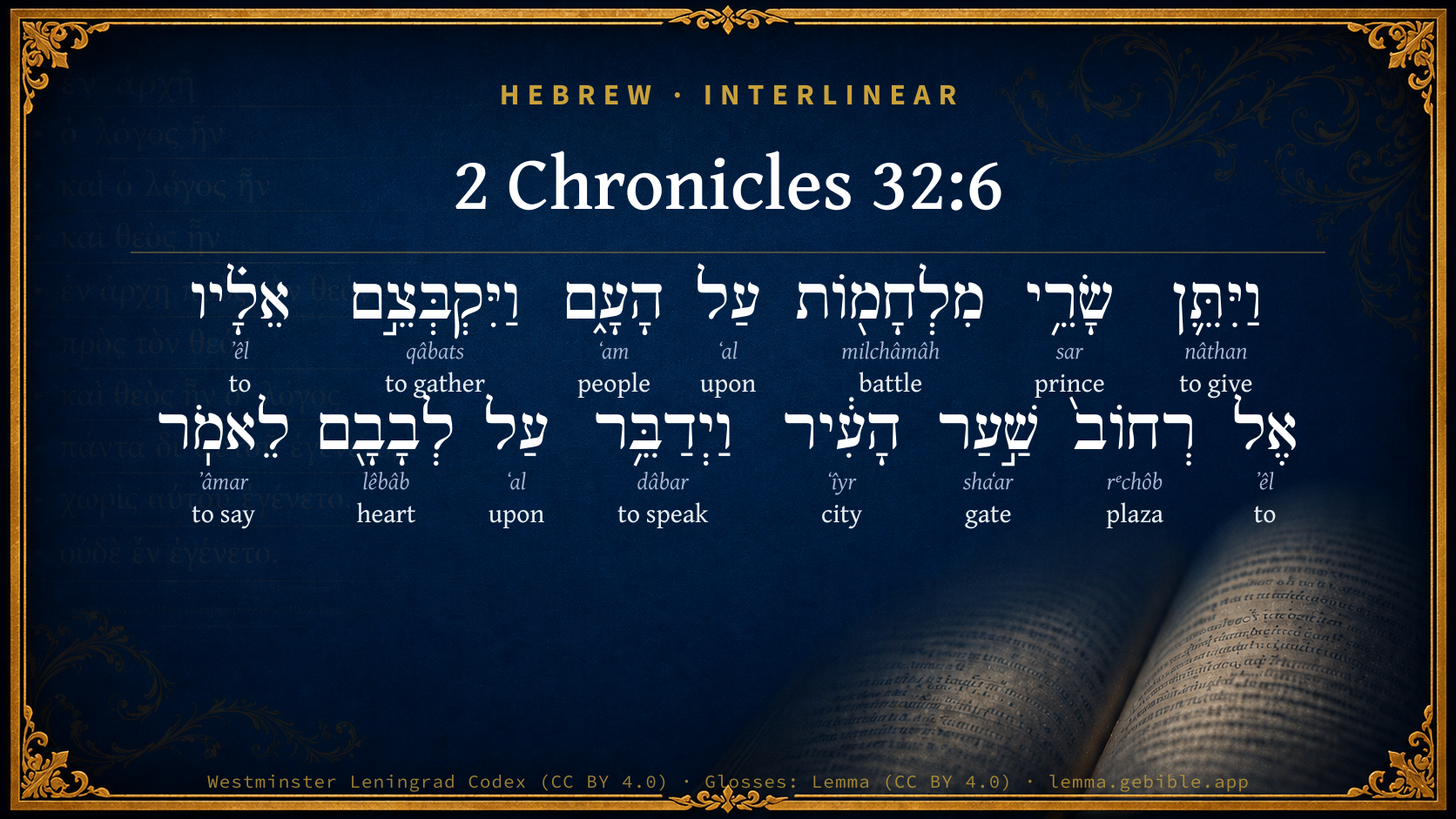
Hebrew (Westminster Leningrad Codex) 2 Chronicles 32:6 appears in the Hebrew Old Testament. The text above is from the Westminster Leningrad Codex. Each word links to its Strong’s number, a concise gloss, and parsing drawn from the Open Scriptures Hebrew Bible morphology. Click any word for its full Brown-Driver-Briggs (BDB) entry.
Download image
Cite this verse

2 Chronicles 32:6 (World English Bible). Public Domain. Lemma interlinear Bible study tool, https://lemma.gebible.app/v/2-chronicles/32/6.

Show BibTeX & RIS
BibTeX
RIS
English Translation
He set captains of war over the people, and gathered them together to him in the broad place at the gate of the city, and spoke comfortably to them, saying,
World English Bible · Public Domain
Download a study sheet

One document with this verse’s original text, its word-by-word gloss line, the meaning frame, cross-references with their text, attributed commentary, and full source and license credits — printable, and it pastes into notes with its structure intact.

This verse Autodidact and up

Study sheet (.html) Plain text (.txt)

A passage Seminary Student

Up to 50 verses in one chapter. A passage sheet keeps up to 6 commentary sources and 12 cross-references per verse, in the order this page ranks them, and says so on the sheet whenever that leaves anything out. Ask for a single verse and you get the Autodidact verse sheet above.

Everything on this page stays free to read, with no account — the sheet is a download of what is already on screen, not access to it.

Want to remove ads? Support Godless Engineer
Compare translations 3

The same verse in 3 English versions, stacked beneath the original-language interlinear above. Click any original word for its lexicon entry.

Each is an independent rendering of the whole verse — the interlinear is not word-aligned to these translations.

Highlighted words mark where these versions differ — a whole-verse word diff, not a word-by-word alignment.

  • World English Bible Public Domain
    He set captains of war over the people, and gathered them together to him in the broad place at the gate of the city, and spoke comfortably to them, saying,
  • King James Version Public Domain
    And he set captains of war over the people, and gathered them together to him in the street of the gate of the city, and spake comfortably to them, saying,
  • unfoldingWord Literal Text CC BY-SA 4.0
    And he placed chiefs of battle over the people. And he gathered them to himself to the plaza at the city gate. And he spoke to their heart, saying,

unfoldingWord Literal Text — © unfoldingWord, licensed CC BY-SA 4.0. Word-aligned USFM3 via Door43 (git.door43.org/unfoldingWord/en_ult).

Versions to compare (up to 4)

3 of 4 selected

Show all 18 translations

Every available English version of this verse, each an independent rendering of the whole verse.

  • World English Bible Public Domain
    He set captains of war over the people, and gathered them together to him in the broad place at the gate of the city, and spoke comfortably to them, saying,
  • Berean Standard Bible Public Domain
    Hezekiah appointed military commanders over the people and gathered the people in the square of the city gate. Then he encouraged them, saying,
  • Majority Standard Bible Public Domain
    Hezekiah appointed military commanders over the people and gathered the people in the square of the city gate. Then he encouraged them, saying,
  • King James Version Public Domain
    And he set captains of war over the people, and gathered them together to him in the street of the gate of the city, and spake comfortably to them, saying,
  • American Standard Version (1901) Public Domain
    And he set captains of war over the people, and gathered them together to him in the broad place at the gate of the city, and spake comfortably to them, saying,
  • Revised Version (1885) Public Domain
    And he set captains of war over the people, and gathered them together to him in the broad place at the gate of the city, and spake comfortably to them, saying,
  • Geneva Bible (1599) Public Domain
    And he set captaines of warre ouer the people, and assembled them to him in the broade place of the gate of the citie, and spake comfortably vnto them, saying,
  • Douay-Rheims (1899) Public Domain
    And he appointed captains of the soldiers of the army: and he called them all together in the street of the gate of the city, and spoke to their heart, saying:
  • Young's Literal Translation Public Domain
    And he putteth heads of war over the people, and gathereth them unto him, unto the broad place of a gate of the city, and speaketh unto their heart, saying,
  • Literal Standard Version CC BY-SA 4.0
    And he puts heads of war over the people, and gathers them to him, to the broad place of a gate of the city, and speaks to their heart, saying,
  • Unlocked Literal Bible CC BY-SA 4.0
    He placed military commanders over the people. He gathered them together to him in the broad place at the city gate and spoke encouragingly to them. He said,
  • unfoldingWord Literal Text CC BY-SA 4.0
    And he placed chiefs of battle over the people. And he gathered them to himself to the plaza at the city gate. And he spoke to their heart, saying,
  • Darby Bible Public Domain
    And he set captains of war over the people, and assembled them to him on the open place at the gate of the city, and spoke consolingly to them saying,
  • World Messianic Bible Public Domain
    He set captains of war over the people, gathered them together to him in the wide place at the gate of the city, and spoke encouragingly to them, saying,
  • Webster's Bible Public Domain
    And he set captains of war over the people, and assembled them to him in the street of the gate of the city, and encouraged them, saying,
  • Free Bible Version CC BY-SA 4.0
    Hezekiah put army commanders in charge of the people. Then he summoned the people to gather in the square at the city gate. He spoke to them confidently, telling them,
  • Bible in Basic English Public Domain
    And he put war chiefs over the people, and sent for them all to come together to him in the wide place at the doorway into the town, and to give them heart he said to them,
  • JPS Tanakh (1917) Public Domain
    And he set captains of war over the people, and gathered them together to him in the broad place at the gate of the city, and spoke encouragingly to them, saying:

Literal Standard Version (2020), Covenant Press — licensed CC BY-SA 4.0. Text via the HelloAO Bible API (eBible.org). Unlocked Literal Bible (unfoldingWord) — licensed CC BY-SA 4.0. Text via the HelloAO Bible API (eBible.org). unfoldingWord Literal Text — © unfoldingWord, licensed CC BY-SA 4.0. Word-aligned USFM3 via Door43 (git.door43.org/unfoldingWord/en_ult). Free Bible Version, Dr. Jonathan Gallagher — licensed CC BY-SA 4.0. Text via the HelloAO Bible API (eBible.org).

Word by word

More ways to search: Search by grammar → Find every occurrence → Compare this word →

Practice this passage: Drill this verse → Learn its vocabulary →

רְחוֹב֙
rᵉchôb
H7339
“plaza of”
Noun, Common, Feminine, Singular, Construct
Part of Speech
Noun
Type
Common
Gender
Feminine
Number
Singular
State
Construct
Full BDB Definition

Origin: from H7337

TWOT: 2143d

broad or open place or plaza
  1. וַיִּתֵּ֛ן nâthan H5414 “and · to give” Conjunction + Verb, Qal, Sequential Imperfect, 3rd Person, Masculine, Singular
  2. שָׂרֵ֥י sar H8269 “princes of” Noun, Common, Masculine, Plural, Construct
  3. מִלְחָמ֖וֹת milchâmâh H4421 “battles” Noun, Common, Feminine, Plural, Absolute
  4. עַל ʻal H5921 “upon” Preposition
  5. הָעָ֑ם ʻam H5971 “the · people” Particle, Definite Article + Noun, Common, Masculine, Singular, Absolute
  6. וַיִּקְבְּצֵ֣ם qâbats H6908 “and · to gather · them” Conjunction + Verb, Qal, Sequential Imperfect, 3rd Person, Masculine, Singular + Suffix, Personal, 3rd Person, Masculine, Plural
  7. אֵלָ֗יו ʼêl H413 “to · him” Preposition + Suffix, Personal, 3rd Person, Masculine, Singular
  8. אֶל ʼêl H413 “to” Preposition
  9. שַׁ֣עַר shaʻar H8179 “gate of” Noun, Common, Masculine, Singular, Construct
  10. הָעִ֔יר ʻîyr H5892 “the · city” Particle, Definite Article + Noun, Common, Feminine, Singular, Absolute
  11. וַיְדַבֵּ֥ר dâbar H1696 “and · to speak” Conjunction + Verb, Piel, Sequential Imperfect, 3rd Person, Masculine, Singular
  12. עַל ʻal H5921 “upon” Preposition
  13. לְבָבָ֖ם lêbâb H3824 “heart · their” Noun, Common, Masculine, Singular, Construct + Suffix, Personal, 3rd Person, Masculine, Plural
  14. לֵאמֹֽר ʼâmar H559 “to say” Preposition + Verb, Qal, Infinitive Construct

About this verse

These counts appear in no published source. They are computed here, from the morphology-tagged text and Lemma’s own curated glosses. What Lemma adds →

15
words
13
distinct lemmas
Historical
section

Shared distinctive vocabulary

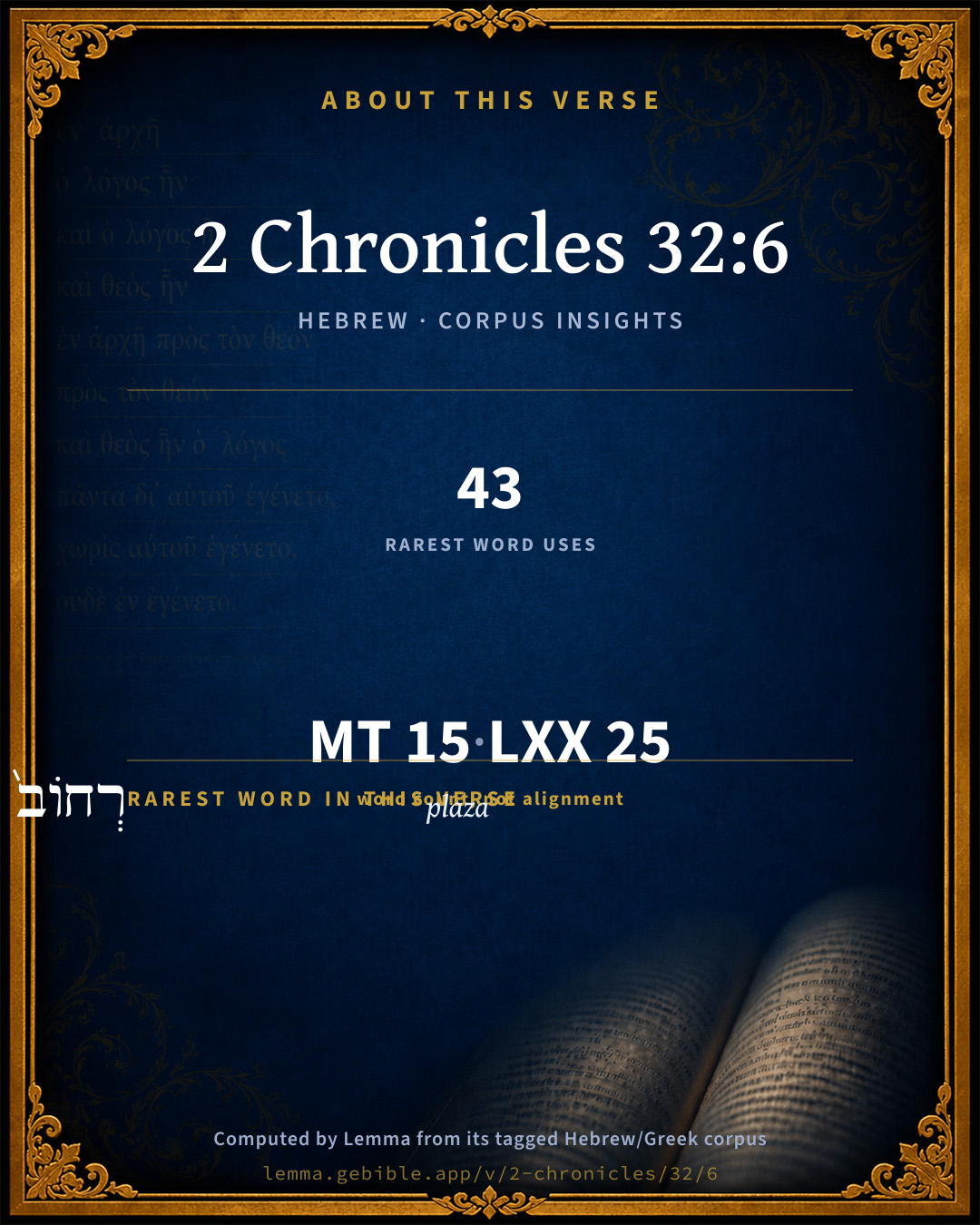
רְחוֹב֙ plaza H7339 occurs in 41 verses of the Hebrew Bible. Also found in:

Grammatical profile

  • 4 verbs
  • 7 nouns
  • 4 prepositions

Verb forms

  • וַיִּתֵּ֛ן Qal · Sequential Imperfect
  • וַיִּקְבְּצֵ֣ם Qal · Sequential Imperfect
  • וַיְדַבֵּ֥ר Piel · Sequential Imperfect
  • לֵאמֹֽר Qal · Infinitive Construct

Repetition

Words recur within this verse — often emphatic in Hebrew:

  • עַל upon H5921 ×2
  • אֵלָ֗יו to H413 ×2

Hebrew & Septuagint length

In English translation the verse runs 30 words from the Hebrew and 31 from the Septuagint (LXX English) — closely comparable.

A rough comparison of the two English renderings, which tokenize alike — not a word-level alignment.

Word counts can differ between the Hebrew and the Greek without any difference in meaning — e.g. the Hebrew direct-object marker אֵת has no separate Greek word, and Greek often adds the article ὁ.

In the original languages it is 15 Hebrew tokens and 25 Greek tokens — but the two are counted differently (Hebrew bundles its prefixes and suffixes into one token; the Greek is in lemma form), so that isn’t a like-for-like length.

Cross-references

8

Topical passages linked to 2 Chronicles 32:6 in the Treasury of Scripture Knowledge — connected by theme and wording, ordered by reader-vote popularity; previews shown in the World English Bible.

  • 2 Chronicles 30:22 Hezekiah spoke comfortably to all the Levites who had good understanding [in the service] of Yahweh. So they ate throughout the feast for the seven days, offering sacrifices of peace-offerings, and making confession to Yahweh, the God of their fathers.
  • Isaiah 40:2 Speak comfortably to Jerusalem; and cry to her, that her warfare is accomplished, that her iniquity is pardoned, that she has received of Yahweh's hand double for all her sins.
  • Genesis 34:3 His soul joined to Dinah, the daughter of Jacob, and he loved the young lady, and spoke kindly to the young lady.
  • 2 Chronicles 17:14–19 This was the numbering of them according to their fathers' houses: Of Judah, the captains of thousands: Adnah the captain, and with him mighty men of valor three hundred thousand;
  • Ezra 10:9 Then all the men of Judah and Benjamin gathered themselves together to Jerusalem within the three days; it was the ninth month, on the twentieth [day] of the month: and all the people sat in the broad place before the house of God, trembling because of this matter, and for the great rain.
  • Nehemiah 8:16 So the people went forth, and brought them, and made themselves booths, everyone on the roof of his house, and in their courts, and in the courts of the house of God, and in the broad place of the water gate, and in the broad place of the gate of Ephraim.
  • 1 Chronicles 27:3–34 [He was] of the children of Perez, the chief of all the captains of the host for the first month.
  • Nehemiah 8:1–3 All the people gathered themselves together as one man into the broad place that was before the water gate; and they spoke to Ezra the scribe to bring the book of the law of Moses, which Yahweh had commanded to Israel.

Cross-references courtesy of OpenBible.info (CC BY 4.0).

Hebrew and Greek witnesses Masoretic Hebrew ↔ Greek Septuagint

The same verse in the two great witnesses to the Old Testament, shown verse-for-verse.

These are two independent witnesses, not word-aligned to each other, and the Septuagint is shown in lemma (dictionary) form.

Hebrew 2 Chronicles 32:6 Masoretic · Westminster Leningrad Codex

וַיִּתֵּ֛ן שָׂרֵ֥י מִלְחָמ֖וֹת עַל הָעָ֑ם וַיִּקְבְּצֵ֣ם אֵלָ֗יו אֶל רְחוֹב֙ שַׁ֣עַר הָעִ֔יר וַיְדַבֵּ֥ר עַל לְבָבָ֖ם לֵאמֹֽר

He set captains of war over the people, and gathered them together to him in the broad place at the gate of the city, and spoke comfortably to them, saying,

World English Bible · Public Domain

Greek LXX 2 Chronicles 32:6 Septuagint · lemma form

καί τίθημι ἄρχων ὁ πόλεμος ἐπί ὁ λαός καί συνἄγω πρός αὐτός εἰς ὁ πλατύς ὁ πύλη ὁ φάραγξ καί λαλέω ἐπί καρδία αὐτός λέγω

And he appointed captains of war over the people, and they were gathered to meet him to the open place of the gate of the valley, and he encouraged them, saying,

LXX2012 (modern English Septuagint) · Public Domain

On this verse, Ellicott's Commentary for English Readers discusses the Septuagint’s reading. Read the note in Commentary ↓

Hebrew: Westminster Leningrad Codex (CC BY 4.0). Greek: Septuagint (public domain); English from LXX2012 (modern English Septuagint) (Public Domain). How the Septuagint differs from the Hebrew →

Commentary

Notes on 2 Chronicles 32:6 from classic Christian and Jewish commentators (each source and its license shown beneath its notes). The classic Christian expositions comment on the surrounding passage and are grouped to its opening verse, so a note may address several verses; the Jewish commentaries on the Tanakh (Rashi and others) are per-verse, so they appear only where the commentator wrote on this verse.

Lemma curates 59 commentaries, every one of them public domain or Creative Commons licensed, each selected and text-cleaned for this edition rather than reprinted as found. About our sources →

Trapp's Complete Commentary

John Trapp

2Ch 32:6 And he set captains of war over the people, and gathered them together to him in the street of the gate of the city, and spake comfortably to them, saying,

Ver. 6. He set captains of war.] He did all that could be done: for he knew that the Assyrian came with a mighty force, as a river that "cometh up over all his channels, and goeth over all his banks." {Isa 8:7}

John Trapp, A Commentary or Exposition upon All the Books of the Old and New Testament (1647–1656) — public domain. Text from a community e-Sword module.

Geneva Bible (1599)

Geneva Bible translators

Hebrew, he spake to their heart.

Geneva Bible (1599) marginal notes — public domain. Text via Bolls.life.

Jamieson, Fausset & Brown

Robert Jamieson, A. R. Fausset & David Brown

he . . . gathered them together . . . in the street--that is, the large open space at the gate of Eastern cities. Having equipped his soldiers with a full suit of military accoutrements, he addressed them in an animated strain, dwelling on the motives they had to inspire courage and confidence of success, especially on their consciousness of the favor and helping power of God.

Jamieson, Fausset & Brown — Commentary Critical and Explanatory on the Whole Bible (1871) — public domain (CC PDM 1.0). Text via the HelloAO Bible API.

Adam Clarke's Commentary

Verse 6. Set captains of war over the people - in the street of the gate of the city] That is, the open places at the gate of the city, whither the people came for judgment, &c.

Adam Clarke's Commentary on the Bible (1810–1826) — public domain. Text from a community e-Sword/MySword module.

Ellicott's Commentary for English Readers

(6) Captains of war.—Literally, captains of battles: a phrase found here only.

In the street.—Into the open space. In like manner, “the open space that was before the water gate” is mentioned in Neh_8:1; Neh_8:16.

The gate.—Which gate we are not told; but the

LXX. reads, τὴν πλατεῖαν τῆς πύλης τῆς φάραγγος, “the broad place of the gate of the ravine.”

Spake comfortably to them.—Encouraged them. 2Ch_30:22. (See margin.)

A Bible Commentary for English Readers, edited by Charles John Ellicott (1878–1897) — public domain. Text from a community e-Sword module.

The Cambridge Bible for Schools and Colleges

gen. ed. J. J. S. Perowne

6. in the street of the gate] R.V. in the broad place at the gate; cp. 2Ch_29:4; Neh_8:16. There is nothing here to shew which of the two broad places mentioned in Nehemiah is meant, or whether some third place is intended.

The Cambridge Bible for Schools and Colleges (gen. ed. J. J. S. Perowne; Cambridge University Press, 1878–1918) — public domain. Text from a community e-Sword module.

John Gill's Exposition

Be strong and courageous,.... Be of good heart and spirit, and quit yourselves like men:

be not afraid nor dismayed for the king of Assyria, nor for all the multitude that is with him; which was very large; for no less than 185,000 were slain of them by an angel in one night, Kg2 19:35.

for there be more with us than with him; though not in number, yet in power and might; and if angels are meant, they are more in number; but it seems, by what follows, that Hezekiah had only the Lord his God in his thoughts and view.

John Gill's Exposition of the Whole Bible (1746–1763) — public domain (CC PDM 1.0). Text via the HelloAO Bible API.

Albert Barnes' Notes on the Bible

The street of the gate ... - Or, “the square at the gate” (compare 2Ch 29:4 note). The gate intended is probably that of Ephraim 2Ch 25:23 - the great northern gate, opposite the “Camp of the Assyrians “ - represented by the modern Damascus gate.

Albert Barnes' Notes on the Bible (1834–1885) — public domain. Text from a community e-Sword/MySword module.

Haydock's Catholic Bible Commentary

Gate, where there was a room for assemblies, 2 K. xviii. 24. C. --- Heart, in the most affectionate and pathetic manner. H.

George Leo Haydock (1774–1849), Haydock's Catholic Family Bible and Commentary, 1859 edition — public domain. Excludes Psalms (Douay-Rheims chapter numbering differs from Protestant) and Deuterocanonical books (Catholic canon only).

Whedon's Commentary on the Bible

Daniel D. Whedon

6. The street of the gate of the city — This is indefinite, but may most naturally be understood of a broad open space in front of the principal gate of the city, perhaps the northern gate, or “gate of Ephraim.” 2Ki_14:13; Neh_8:16.

Spake comfortably — Encouragingly. Compare chap. 2Ch_30:22, note. Hezekiah’s words of faith and encouragement, as here given, do not well accord with his submission and payment of treasure to the invader, as recorded in 2Ki_18:14-16. But the records are by no means contradictory. Together they furnish a lesson of human weakness. The people for awhile were encouraged by Hezekiah’s words, (2Ch_32:8,) but when Sennacherib had captured “all the fenced cities of Judah,” (2Ki_18:13,) they probably became disheartened, and Hezekiah himself trembled for the safety of his capital, and was glad to hire the invader to depart.

2Ch_32:9-23 are a brief summary of the events of Sennacherib’s second invasion. This is much more fully detailed in 2Ki_18:17-19; 2Ki_18:37, where see notes. The rest of the chapter (2Ch_32:24-33) is also an abbreviation of what is more fully recorded in 2 Kings 20.

Daniel D. Whedon (gen. ed.), Commentary on the Old and New Testaments (1874–1909) — public domain. Text from a community e-Sword module.

The Pulpit Commentary

The street of the gate; translate, the wide area at the gate, etc.; what gate is not specified, but presumably either "the gate of Ephraim," which would be the one opposed to the camp of the besiegers, or possibly "the comer gate". (2Ch_25:23; and Courier"s "Handbook," pp. 343-345)

The Pulpit Commentary (1880–1919), ed. H.D.M. Spence-Jones & Joseph S. Exell — public domain. Text from a community e-Sword module.

unfoldingWord translationNotes

Door43 World Missions Community

He placed military commanders over the people

The idiom "place over" means to put in charge of. "He put military commanders in charge of the people" (See: Idiom)

for someone is with us who is greater than those with him

"for our God is with us and is more powerful than those with the king of Assyria"

is only an arm of flesh

Here "arm" represents strength, and "flesh" represents humanity. AT: "are only those with human power" (See: Metonymy)

translationWords

commander

people group

fear

flesh

Yahweh

word

unfoldingWord translationNotes — © Distant Shores Media and the Door43 World Missions Community, licensed CC BY-SA 4.0. Source: git.door43.org/Door43/en_tn.

Lesson kit

Teaching starters — assembled from the data on this page, not authored interpretation. Every prompt links to the verse data it draws on. Edit before teaching.

2 Chronicles, in the Historical, opens this verse with 15 words (13 distinct Hebrew lemmas). Its most distinctive word is rᵉchôb (“plaza”). A historical commentator’s framing appears above. Read the whole chapter for the surrounding context.

Discussion questions

  1. The word rᵉchôb carries the sense “plaza.” How does it shape the verse?
  2. How does Genesis 19:2, which shares the word «plaza», read alongside this verse?
  3. What does the repetition of “upon” (2× in this one verse) do in this verse?
  4. These translations render this verse differently; the difference is in the English rendering, not the original. What questions does that raise?
  5. «וַיִּתֵּ֛ן» is a Qal Sequential Imperfect verb. How does that grammatical form shape the action described?
  6. Compare how Trapp's Complete Commentary and Geneva Bible (1599) read this verse. Where do they agree or differ?

Things to notice

Reading settings

Reading text

Shown beneath each verse's original-language words.

Old Testament
Old Testament edition

Read the OT as the Masoretic Hebrew (MT) or the Greek Septuagint (LXX).

English shown for the Greek Septuagint (in the Hebrew ↔ Greek comparison).

Comparing translations? Open the Compare panel on any verse page to stack up to four side by side.