
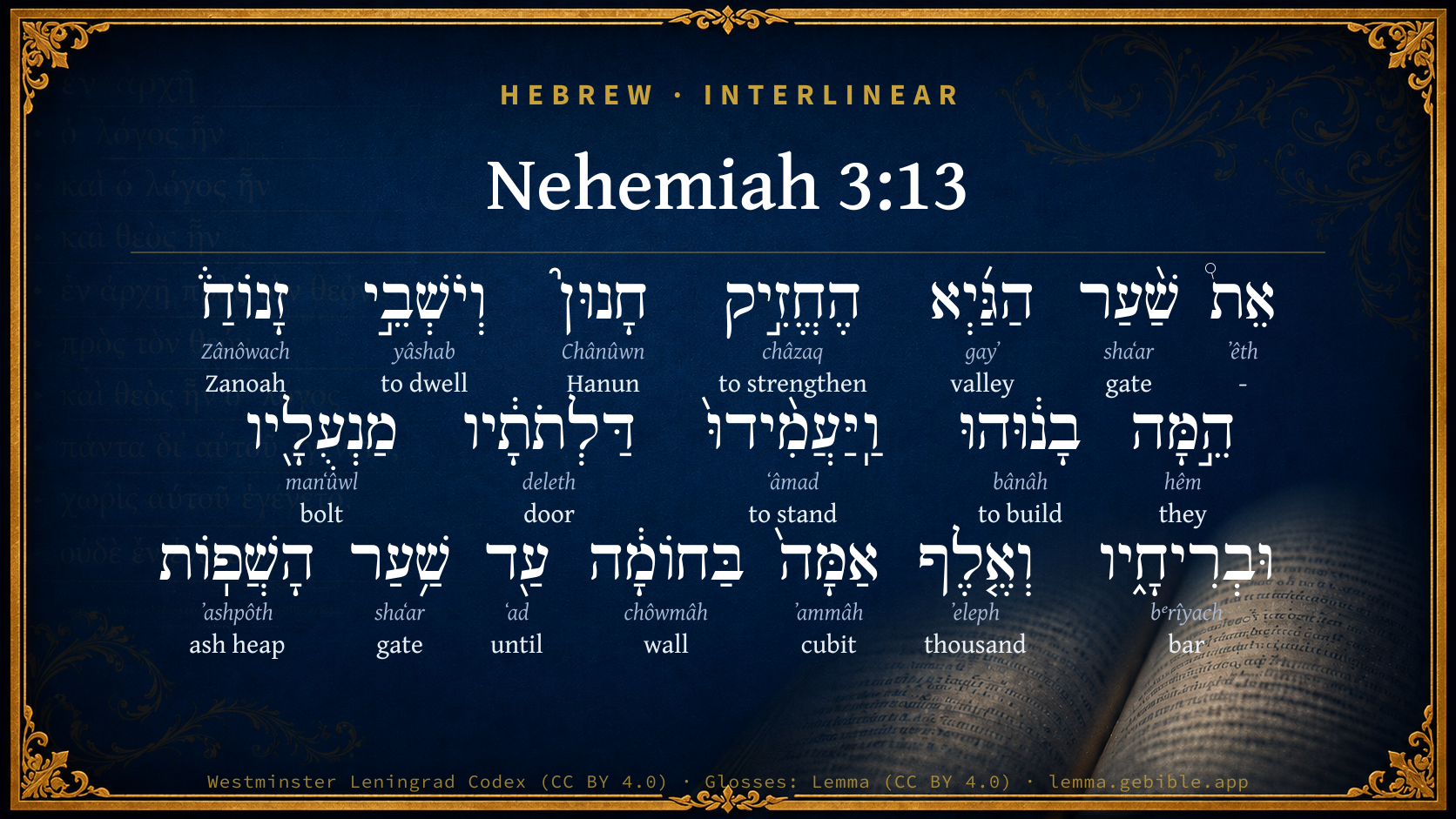
Nehemiah 3:13

Hebrew (Westminster Leningrad Codex) Nehemiah 3:13 appears in the Hebrew Old Testament. The text above is from the Westminster Leningrad Codex. Each word links to its Strong’s number, a concise gloss, and parsing drawn from the Open Scriptures Hebrew Bible morphology. Click any word for its full Brown-Driver-Briggs (BDB) entry.
Download image
Cite this verse

Nehemiah 3:13 (World English Bible). Public Domain. Lemma interlinear Bible study tool, https://lemma.gebible.app/v/nehemiah/3/13.

Show BibTeX & RIS
BibTeX
RIS
English Translation
The valley gate repaired Hanun, and the inhabitants of Zanoah; they built it, and set up the doors of it, the bolts of it, and the bars of it, and one thousand cubits of the wall to the dung gate.
World English Bible · Public Domain
Download a study sheet

One document with this verse’s original text, its word-by-word gloss line, the meaning frame, cross-references with their text, attributed commentary, and full source and license credits — printable, and it pastes into notes with its structure intact.

This verse Autodidact and up

Study sheet (.html) Plain text (.txt)

A passage Seminary Student

Up to 50 verses in one chapter. A passage sheet keeps up to 6 commentary sources and 12 cross-references per verse, in the order this page ranks them, and says so on the sheet whenever that leaves anything out. Ask for a single verse and you get the Autodidact verse sheet above.

Everything on this page stays free to read, with no account — the sheet is a download of what is already on screen, not access to it.

Want to remove ads? Support Godless Engineer
Compare translations 3

The same verse in 3 English versions, stacked beneath the original-language interlinear above. Click any original word for its lexicon entry.

Each is an independent rendering of the whole verse — the interlinear is not word-aligned to these translations.

Highlighted words mark where these versions differ — a whole-verse word diff, not a word-by-word alignment.

  • World English Bible Public Domain
    The valley gate repaired Hanun, and the inhabitants of Zanoah; they built it, and set up the doors of it, the bolts of it, and the bars of it, and one thousand cubits of the wall to the dung gate.
  • King James Version Public Domain
    The valley gate repaired Hanun, and the inhabitants of Zanoah; they built it, and set up the doors thereof, the locks thereof, and the bars thereof, and a thousand cubits on the wall unto the dung gate.
  • unfoldingWord Literal Text CC BY-SA 4.0
    Hanun and the inhabitants of Zanoah strengthened the gate of the valley. They themselves built it and erected its doors, its bolts, and its bars, and a thousand cubits of the wall as far as the gate of dung.

unfoldingWord Literal Text — © unfoldingWord, licensed CC BY-SA 4.0. Word-aligned USFM3 via Door43 (git.door43.org/unfoldingWord/en_ult).

Versions to compare (up to 4)

3 of 4 selected

Show all 18 translations

Every available English version of this verse, each an independent rendering of the whole verse.

  • World English Bible Public Domain
    The valley gate repaired Hanun, and the inhabitants of Zanoah; they built it, and set up the doors of it, the bolts of it, and the bars of it, and one thousand cubits of the wall to the dung gate.
  • Berean Standard Bible Public Domain
    The Valley Gate was repaired by Hanun and the residents of Zanoah. They rebuilt it, installed its doors, bolts, and bars, and repaired a thousand cubits of the wall as far as the Dung Gate.
  • Majority Standard Bible Public Domain
    The Valley Gate was repaired by Hanun and the residents of Zanoah. They rebuilt it, installed its doors, bolts, and bars, and repaired a thousand cubits of the wall as far as the Dung Gate.
  • King James Version Public Domain
    The valley gate repaired Hanun, and the inhabitants of Zanoah; they built it, and set up the doors thereof, the locks thereof, and the bars thereof, and a thousand cubits on the wall unto the dung gate.
  • American Standard Version (1901) Public Domain
    The valley gate repaired Hanun, and the inhabitants of Zanoah; they built it, and set up the doors thereof, the bolts thereof, and the bars thereof, and a thousand cubits of the wall unto the dung gate.
  • Revised Version (1885) Public Domain
    The valley gate repaired Hanun, and the inhabitants of Zanoah; they built it, and set up the doors thereof, the bolts thereof, and the bars thereof, and a thousand cubits of the wall unto the dung gate.
  • Geneva Bible (1599) Public Domain
    The valley gate fortified Hanum, and the inhabitants of Zanuah: they buylt it, and set on the doores thereof, the lockes thereof, and the barres thereof, euen a thousand cubites on the wall vnto the dung porte.
  • Douay-Rheims (1899) Public Domain
    And the gate of the valley Hanun built, and the inhabitants of Zanoe: they built it, and set up the doors thereof, and the locks, and the bars, and a thousand cubits in the wall unto the gate of the dunghill.
  • Young's Literal Translation Public Domain
    The gate of the valley hath Hanun strengthened, and the inhabitants of Zanoah; they have built it, and set up its doors, its locks, and its bars, and a thousand cubits in the wall unto the dung-gate.
  • Literal Standard Version CC BY-SA 4.0
    Hanun has strengthened the Valley Gate, and the inhabitants of Zanoah; they have built it, and set up its doors, its locks, and its bars, and one thousand cubits in the wall to the Refuse Gate.
  • Unlocked Literal Bible CC BY-SA 4.0
    Hanun and the inhabitants of Zanoah repaired the Valley Gate. They rebuilt it and set its doors, its bolts, and its bars. They repaired a thousand cubits as far as the Dung Gate.
  • unfoldingWord Literal Text CC BY-SA 4.0
    Hanun and the inhabitants of Zanoah strengthened the gate of the valley. They themselves built it and erected its doors, its bolts, and its bars, and a thousand cubits of the wall as far as the gate of dung.
  • Darby Bible Public Domain
    The valley-gate repaired Hanun, and the inhabitants of Zanoah; they built it, and set up its doors, its locks and its bars, and a thousand cubits of the wall as far as the dung-gate.
  • World Messianic Bible Public Domain
    Hanun and the inhabitants of Zanoah repaired the valley gate. They built it, and set up its doors, its bolts, and its bars, and one thousand cubits of the wall to the dung gate.
  • Webster's Bible Public Domain
    The valley-gate repaired Hanun, and the inhabitants of Zanoah; they built it, and set up its doors, its locks, and its bars, and a thousand cubits on the wall to the dung-gate.
  • Free Bible Version CC BY-SA 4.0
    The Valley Gate was repaired by Hanun and the people who lived in Zanoah. They rebuilt it, set up its doors, together with its bolts and bars, and repaired a thousand cubits of the wall up to the Refuse Gate.
  • Bible in Basic English Public Domain
    Hanun and the people of Zanoah were working on the doorway of the valley; they put it up and put up its doors, with their locks and rods, and a thousand cubits of wall as far as the doorway where the waste material was placed.
  • JPS Tanakh (1917) Public Domain
    The valley gate repaired Hanun, and the inhabitants of Zanoah; they built it, and set up the doors thereof, the bolts thereof, and the bars thereof, and a thousand cubits of the wall unto the dung gate.

Literal Standard Version (2020), Covenant Press — licensed CC BY-SA 4.0. Text via the HelloAO Bible API (eBible.org). Unlocked Literal Bible (unfoldingWord) — licensed CC BY-SA 4.0. Text via the HelloAO Bible API (eBible.org). unfoldingWord Literal Text — © unfoldingWord, licensed CC BY-SA 4.0. Word-aligned USFM3 via Door43 (git.door43.org/unfoldingWord/en_ult). Free Bible Version, Dr. Jonathan Gallagher — licensed CC BY-SA 4.0. Text via the HelloAO Bible API (eBible.org).

Word by word

More ways to search: Search by grammar → Find every occurrence → Compare this word →

Practice this passage: Drill this verse → Learn its vocabulary →

זָנוֹחַ֒
Zânôwach
H2182
“Zanoah”
Noun, Proper
Part of Speech
Noun
Type
Proper
Full BDB Definition

Origin: from H2186

TWOT: None

Zanoah = "cast off" - a city in the low country of Judah - a city in the mountains of Judah, perhaps southwest of Hebron
  1. אֵת֩ ʼêth H853 “-” Particle, Direct Object
  2. שַׁ֨עַר shaʻar H8179 “gate of” Noun, Common, Masculine, Singular, Construct
  3. הַגַּ֜יְא gayʼ H1516 “the · valley” Particle, Definite Article + Noun, Common, Both, Singular, Absolute
  4. הֶחֱזִ֣יק châzaq H2388 “to strengthen” Verb, Hiphil, Perfect, 3rd Person, Masculine, Singular
  5. חָנוּן֮ Chânûwn H2586 “Hanun” Noun, Proper
  6. וְיֹשְׁבֵ֣י yâshab H3427 “and · dwelling” Conjunction + Verb, Qal, Participle Active, Masculine, Plural, Construct
  7. הֵ֣מָּה hêm H1992 “they” Pronoun, Personal, 3rd Person, Masculine, Plural
  8. בָנ֔וּהוּ bânâh H1129 “to build · him” Verb, Qal, Perfect, 3rd Person, Common, Plural + Suffix, Personal, 3rd Person, Masculine, Singular
  9. וַֽיַּעֲמִ֨ידוּ֙ ʻâmad H5975 “and · to stand” Conjunction + Verb, Hiphil, Sequential Imperfect, 3rd Person, Masculine, Plural
  10. דַּלְתֹתָ֔יו deleth H1817 “doors · his” Noun, Common, Feminine, Plural, Construct + Suffix, Personal, 3rd Person, Masculine, Singular
  11. מַנְעֻלָ֖יו manʻûwl H4514 “bolts · his” Noun, Common, Masculine, Plural, Construct + Suffix, Personal, 3rd Person, Masculine, Singular
  12. וּבְרִיחָ֑יו bᵉrîyach H1280 “and · bars · his” Conjunction + Noun, Common, Masculine, Plural, Construct + Suffix, Personal, 3rd Person, Masculine, Singular
  13. וְאֶ֤לֶף ʼeleph H505 “and · thousand” Conjunction + Adjective, Cardinal number, Both, Singular, Absolute
  14. אַמָּה֙ ʼammâh H520 “cubit” Noun, Common, Feminine, Singular, Absolute
  15. בַּחוֹמָ֔ה chôwmâh H2346 “in/at the · wall” Preposition, Determined + Noun, Common, Feminine, Singular, Absolute
  16. עַ֖ד ʻad H5704 “until” Preposition
  17. שַׁ֥עַר shaʻar H8179 “gate of” Noun, Common, Masculine, Singular, Construct
  18. הָשֲׁפֽוֹת ʼashpôth H830 “the · ash heaps” Particle, Definite Article + Noun, Common, Masculine, Plural, Absolute

About this verse

These counts appear in no published source. They are computed here, from the morphology-tagged text and Lemma’s own curated glosses. What Lemma adds →

19
words
18
distinct lemmas
Historical
section

Notable vocabulary

The rarest word here is זָנוֹחַ֒ Zanoah H2182 — appearing just 5 times in the whole Hebrew Bible.

Shared distinctive vocabulary

זָנוֹחַ֒ Zanoah H2182 occurs in 5 verses of the Hebrew Bible. Also found in:

Grammatical profile

  • 4 verbs
  • 11 nouns
  • 1 adjective
  • 1 pronoun
  • 1 preposition
  • 1 particle

Verb forms

  • הֶחֱזִ֣יק Hiphil · Perfect
  • וְיֹשְׁבֵ֣י Qal · Participle Active
  • בָנ֔וּהוּ Qal · Perfect
  • וַֽיַּעֲמִ֨ידוּ֙ Hiphil · Sequential Imperfect

Repetition

A word recurs within this verse — often emphatic in Hebrew:

  • שַׁ֨עַר gate H8179 ×2

Cross-references

6

Topical passages linked to Nehemiah 3:13 in the Treasury of Scripture Knowledge — connected by theme and wording, ordered by reader-vote popularity; previews shown in the World English Bible.

  • Nehemiah 2:13 I went out by night by the valley gate, even toward the jackal's well, and to the dung gate, and viewed the walls of Jerusalem, which were broken down, and the gates of it were consumed with fire.
  • Joshua 15:34 and Zanoah, and En Gannim, Tappuah, and Enam,
  • Joshua 15:56 and Jezreel, and Jokdeam, and Zanoah,
  • 1 Chronicles 4:18 His wife the Jewess bore Jered the father of Gedor, and Heber the father of Soco, and Jekuthiel the father of Zanoah. These are the sons of Bithiah the daughter of Pharaoh, whom Mered took.
  • 2 Chronicles 26:9 Moreover Uzziah built towers in Jerusalem at the corner gate, and at the valley gate, and at the turning [of the wall], and fortified them.
  • Nehemiah 11:30 Zanoah, Adullam, and their villages, Lachish and the fields of it, Azekah and the towns of it. So they encamped from Beersheba to the valley of Hinnom.

Cross-references courtesy of OpenBible.info (CC BY 4.0).

Hebrew and Greek witnesses Masoretic Hebrew ↔ Greek Septuagint

The same verse in the two great witnesses to the Old Testament, shown verse-for-verse.

These are two independent witnesses, not word-aligned to each other, and the Septuagint is shown in lemma (dictionary) form.

Hebrew Nehemiah 3:13 Masoretic · Westminster Leningrad Codex

אֵת֩ שַׁ֨עַר הַגַּ֜יְא הֶחֱזִ֣יק חָנוּן֮ וְיֹשְׁבֵ֣י זָנוֹחַ֒ הֵ֣מָּה בָנ֔וּהוּ וַֽיַּעֲמִ֨ידוּ֙ דַּלְתֹתָ֔יו מַנְעֻלָ֖יו וּבְרִיחָ֑יו וְאֶ֤לֶף אַמָּה֙ בַּחוֹמָ֔ה עַ֖ד שַׁ֥עַר הָשֲׁפֽוֹת

The valley gate repaired Hanun, and the inhabitants of Zanoah; they built it, and set up the doors of it, the bolts of it, and the bars of it, and one thousand cubits of the wall to the dung gate.

World English Bible · Public Domain

Greek LXX Structure differs

The Septuagint has no separate book of Nehemiah. Its Greek text is the second half of Esdras B (2 Esdras), chapters 11–23; Ezra is the first half (1–10).

A verse-for-verse comparison isn’t shown here because the chapters and verses don’t line up. Switch to the LXX edition with the MT / LXX toggle above to read the Greek directly.

Hebrew: Westminster Leningrad Codex (CC BY 4.0). Greek: Septuagint (public domain); English from a public-domain English Septuagint. How the Septuagint differs from the Hebrew →

Commentary

Notes on Nehemiah 3:13 from classic Christian and Jewish commentators (each source and its license shown beneath its notes). The classic Christian expositions comment on the surrounding passage and are grouped to its opening verse, so a note may address several verses; the Jewish commentaries on the Tanakh (Rashi and others) are per-verse, so they appear only where the commentator wrote on this verse.

Lemma curates 59 commentaries, every one of them public domain or Creative Commons licensed, each selected and text-cleaned for this edition rather than reprinted as found. About our sources →

Trapp's Complete Commentary

John Trapp

Neh 3:13 The valley gate repaired Hanun, and the inhabitants of Zanoah; they built it, and set up the doors thereof, the locks thereof, and the bars thereof, and a thousand cubits on the wall unto the dung gate.

Ver. 13. The valley gate] See Neh 2:13.

And the inhabitants of Zanoah] Together with Hanun, their governor. Not priests and Levites only, but the great men in every country, yea, and the country people too, must work at God’s building. Every one must be active in his own sphere; not live to himself, but help to bear the burdens of Church and commonwealth, toti natum se credere mundo, as Cato did (Lucan).

John Trapp, A Commentary or Exposition upon All the Books of the Old and New Testament (1647–1656) — public domain. Text from a community e-Sword module.

Tyndale Open Study Notes

Tyndale Open Resources

3:13 Zanoah was a village about thirteen miles (21 kilometers) southwest of Jerusalem.

Tyndale Open Study Notes — © Tyndale Open Resources, licensed CC BY-SA 4.0. Text via the HelloAO Bible API.

Jamieson, Fausset & Brown

Robert Jamieson, A. R. Fausset & David Brown

the inhabitants of Zanoah--There were two towns so called in the territory of Judah (Jos 15:34, Jos 15:56).

Jamieson, Fausset & Brown — Commentary Critical and Explanatory on the Whole Bible (1871) — public domain (CC PDM 1.0). Text via the HelloAO Bible API.

Adam Clarke's Commentary

Verse 13. The inhabitants of Zanoah] This was a town in the tribe of Judah. Jos 15:34.

Adam Clarke's Commentary on the Bible (1810–1826) — public domain. Text from a community e-Sword/MySword module.

Ellicott's Commentary for English Readers

(13) A thousand cubits.—Not so much “built” as “strengthened.” This comparatively large space—mentioned in round numbers—had probably suffered less damage, and therefore needed less repairing.

A Bible Commentary for English Readers, edited by Charles John Ellicott (1878–1897) — public domain. Text from a community e-Sword module.

The Cambridge Bible for Schools and Colleges

gen. ed. J. J. S. Perowne

13. The valley gate] See note on Neh_2:13; Neh_2:15. This was the main entrance on the western side.

Zanoah] This town, mentioned in Neh_11:30; Jos_15:34, is probably the modern Zanuah, some 13 miles W. of Jerusalem.

the doors thereof, &c.] See note on Neh_3:3.

and a thousand cubits on the wall unto the dung gate] R.V. of the wall. Some who have thought that this would be too great a distance of wall to be restored by a single section of the community regard the clause as a topographical parenthesis, = ‘There were a thousand cubits between the two gates.’ But if we may suppose little restoration was here needed, no further details would be recorded of this section of the wall. This very reason, however, would enable us to accept the repairing of ‘the thousand cubits’ as the work of ‘Hanun and the inhabitants of Zanoah.’ Comparatively little work was here needed, and a small party could undertake a long stretch.

The ‘dung gate’ was probably at the S.W. angle of the wall. The wall having passed due S. from the ‘valley gate’ to the ‘dung gate,’ turned thence in an easterly direction.

The Cambridge Bible for Schools and Colleges (gen. ed. J. J. S. Perowne; Cambridge University Press, 1878–1918) — public domain. Text from a community e-Sword module.

John Gill's Exposition

But the dung gate repaired Malchiah the son of Rechab,.... If this was one of the Rechabites, they were forbid to build houses, Jer 35:7 but, perhaps, though they might not build private houses for themselves to dwell in, they might be employed in building walls and fortresses for public security; though it is more probable that this man was not of that family:

the ruler of part of Bethhaccerem; or of the tract of Bethhaccerem, a place between Tekoah and Jerusalem; see Jer 6:1,

he built it, and set up the doors thereof; &c. as in Neh 3:3.

John Gill's Exposition of the Whole Bible (1746–1763) — public domain (CC PDM 1.0). Text via the HelloAO Bible API.

Albert Barnes' Notes on the Bible

Zanoah lay west of Jerusalem, at the distance of about 10 miles (Jos 15:34 note).

Albert Barnes' Notes on the Bible (1834–1885) — public domain. Text from a community e-Sword/MySword module.

Whedon's Commentary on the Bible

Daniel D. Whedon

13. The valley gate — On the west side of the city, opening into the valley of Gihon. See note on Neh_2:13.

A thousand cubits — About 1,820 feet, which is the distance from the present tower of Hippicus to the southwestern corner of Zion. The dung gate, so called, no doubt, from being the place where the filth of the city was carried out, must have stood somewhere near the southwestern corner of Zion, and was probably the same as that which Josephus (v, 4, 2) calls the gate of the Essenes.

Daniel D. Whedon (gen. ed.), Commentary on the Old and New Testaments (1874–1909) — public domain. Text from a community e-Sword module.

The Pulpit Commentary

The valley gate. A gate in the western wall (See the comment on Neh_2:13) Zanoah was situated to the west of Jerusalem at the distance of some nine or ten miles. It is mentioned in Jos_15:34 as a city of Judah, but was not a place of much importance. We can scarcely suppose that the inhabitants had as much as a thousand cubits of the wall assigned to them, since that is more than a quarter of a mile, and the entire circuit was under four miles. Bertheau suggests that Nehemiah merely means to note that the distance between the two gates, the Valley and the Dung gate, was a thousand cubits, and that he says nothing of the repairs because no repairs were needed.

The Pulpit Commentary (1880–1919), ed. H.D.M. Spence-Jones & Joseph S. Exell — public domain. Text from a community e-Sword module.

Keil & Delitzsch

C. F. Keil & F. Delitzsch

From the valley-gate to the dung-gate. The valley-gate lay in the west, in the neighbourhood of the present Jaffa gate (see rem. on Neh 2:13), "where," as Tobler, Topogr. i. p. 163, expresses it, "we may conclude there must almost always have been, on the ridge near the present citadel, the site in the time of Titus of the water-gate also (Joseph. bell. Jud. v. 7. 3), an entrance provided with gates." Hanun and the inhabitants of Zanoah are here connected, probably because Hanun was the chief or ruler of the inhabitants of this place. Zanoah, now Zanna, is in the Wady Ismail, west of Jerusalem; see rem. on Jos 15:34. They built and set up its doors, etc.; comp. Neh 3:6. The further statement, "and a thousand cubits on the wall unto the dung-gate," still depends on החזיק, the principal verb of the verse. It is incomprehensible how Bertheau can say that this statement does not refer to the repairing of the wall, but only declares that the distance from the valley-gate to the dung-gate amounted to one thousand cubits. For the remark, that a section of such a length is, in comparison with the other sections, far too extensive, naturally proves nothing more than that the wall in this part had suffered less damage, and therefore needed less repair. The number one thousand cubits is certainly stated in round numbers. The length from the present Jaffa gate to the supposed site of the dung-gate, on the south-western edge of Zion, is above two thousand five hundred feet. The dung-gate may, however, have been placed at a greater distance from the road leading to Baher. השׁפות is only another form for האשׁפּות (without א prosthetic). Malchiah ben Rechab, perhaps a Rechabite, built and fortified the dung-gate; for though the Rechabites were forbidden to build themselves houses (Jer 35:7), they might, without transgressing this paternal injunction, take part in building the fortifications of Jerusalem (Berth.). This conjecture is, however, devoid of probability, for a Rechabite would hardly be a prince or ruler of the district of Beth-haccerem. The name Rechab occurs as early as the days of David, Sa2 4:5. בּית־הכּרם, i.e., the garden or vineyard-house, where, according to Jer 6:1, the children of Benjamin were wont to set up a banner, and to blow the trumpet in Tekoa, is placed by Jerome (Comm. Jer 6) upon a hill between Jerusalem and Tekoa; on which account Pococke (Reise, ii. p. 63) thinks Beth-Cherem must be sought for on the eminence now known as the Frank mountain, the Dshebel Fureidis, upon which was the Herodium of Josephus. This opinion is embraced with some hesitation by Robinson (Pal. ii. p. 397), and unreservedly by Wilson (The Holy City, i. p. 396) and v. de Velde, because "when we consider that this hill is the highest point in the whole district, and is by reason of its isolated position and conical shape very conspicuous, we shall find that no other locality better corresponds with the passage cited.

Keil & Delitzsch — Biblical Commentary on the Old Testament (1861–1891) — public domain (CC PDM 1.0). Text via the HelloAO Bible API. (Old Testament only.)

unfoldingWord translationNotes

Door43 World Missions Community

Hanun

This is the name of a man. (See: How to Translate Names)

the inhabitants of Zanoah

"the people from Zanoah"

Zanoah

This is the name of a place. (See: How to Translate Names)

the Valley Gate

"the Gate of the Valley" or "the Gate that Leads to the Valley." Try to translate this expression as a name, not just as a description.

set its doors

"installed its doors" or "put its doors in place"

its bolts, and its bars

"its locks and bars." These locked the gates securely.

They repaired a thousand cubits as far as the Dung Gate

They repaired the portion of the wall between the Valley Gate and the Dung Gate. AT: "They repaired a thousand cubits of the wall, from the Valley Gate to the Dung Gate" (See: Assumed Knowledge and Implicit Information)

They repaired a thousand cubits

It is understood that they were repaing the wall of Jerusalem. AT: "They repaired a thousand cubits of the wall" or "They repaired another thousand cubits of the wall beyond the Valley Gate" (See: Assumed Knowledge and Implicit Information)

a thousand cubits

"1,000 cubits." This may be written in modern measurements. AT: "460 meters" (See: Biblical Distance and Numbers)

the Dung Gate

Presumably, refuse was removed from the city through this gate. Try to translate this expression as a name, not just as a description.

translationWords

gate

dung

unfoldingWord translationNotes — © Distant Shores Media and the Door43 World Missions Community, licensed CC BY-SA 4.0. Source: git.door43.org/Door43/en_tn.

Rashi

Rabbi Shlomo Yitzchaki (Rashi)

until the Dung Gate but the Dung Gate was not included.

Rashi on the Tanakh — English translations: “The Judaica Press complete Tanach with Rashi, translated by A. J. Rosenberg” (CC BY 4.0); “Pentateuch with Rashi's commentary by M. Rosenbaum and A.M. Silbermann, 1929-1934” (public domain); “The Metsudah Tanach series, Lakewood, N.J” (CC BY 4.0); and “The Book of Joshua, Metsudah Publications, 1997” (CC BY 4.0). Text via Sefaria.

Lesson kit

Teaching starters — assembled from the data on this page, not authored interpretation. Every prompt links to the verse data it draws on. Edit before teaching.

Nehemiah, in the Historical, opens this verse with 19 words (18 distinct Hebrew lemmas). Its most distinctive word is Zânôwach (“Zanoah”). A historical commentator’s framing appears above. Read the whole chapter for the surrounding context.

Discussion questions

  1. What does “Zanoah” (Zânôwach) contribute to the verse as a whole?
  2. Joshua 15:34 shares the word «Zanoah» with this verse. How do the two illuminate each other?
  3. “gate” occurs 2× in this one verse. What is the effect of the repetition?
  4. These translations render this verse differently. What is at stake in choosing one wording over another?
  5. The verb «הֶחֱזִ֣יק» is Hiphil Perfect. How does its form color the action?
  6. Reading how Trapp's Complete Commentary and Tyndale Open Study Notes read this verse, where do the two commentators agree and where do they part?

Things to notice

Reading settings

Reading text

Shown beneath each verse's original-language words.

Old Testament
Old Testament edition

Read the OT as the Masoretic Hebrew (MT) or the Greek Septuagint (LXX).

English shown for the Greek Septuagint (in the Hebrew ↔ Greek comparison).

Comparing translations? Open the Compare panel on any verse page to stack up to four side by side.