Esther 6:12

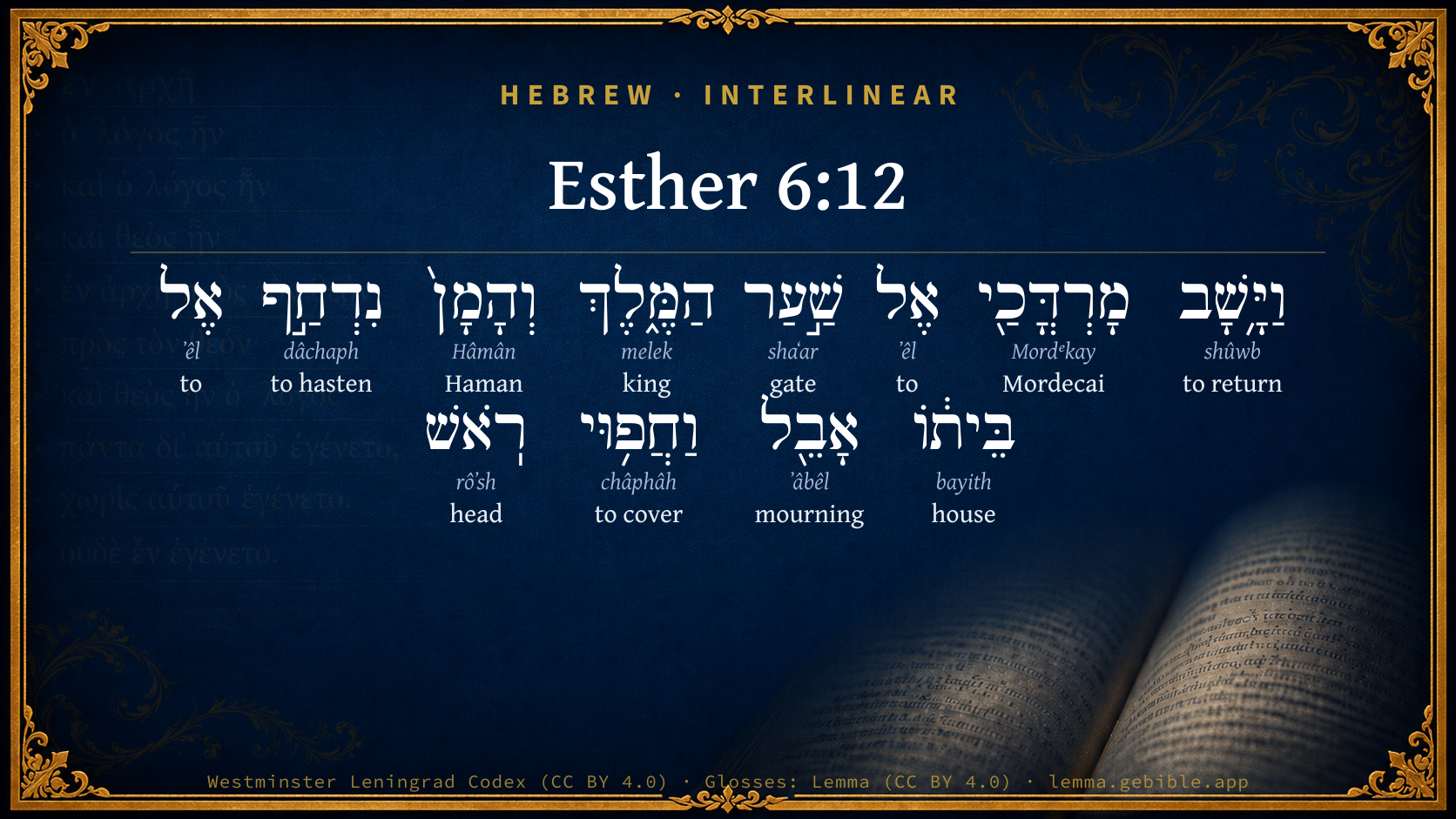
Hebrew (Westminster Leningrad Codex) Esther 6:12 appears in the Hebrew Old Testament. The text above is from the Westminster Leningrad Codex. Each word links to its Strong’s number, a concise gloss, and parsing drawn from the Open Scriptures Hebrew Bible morphology. Click any word for its full Brown-Driver-Briggs (BDB) entry.
Download image
Cite this verse

Esther 6:12 (World English Bible). Public Domain. Lemma interlinear Bible study tool, https://lemma.gebible.app/v/esther/6/12.

Show BibTeX & RIS
BibTeX
RIS
English Translation
Mordecai came again to the king's gate. But Haman hurried to his house, mourning and having his head covered.
World English Bible · Public Domain
Download a study sheet

One document with this verse’s original text, its word-by-word gloss line, the meaning frame, cross-references with their text, attributed commentary, and full source and license credits — printable, and it pastes into notes with its structure intact.

This verse Autodidact and up

Study sheet (.html) Plain text (.txt)

A passage Seminary Student

Up to 50 verses in one chapter. A passage sheet keeps up to 6 commentary sources and 12 cross-references per verse, in the order this page ranks them, and says so on the sheet whenever that leaves anything out. Ask for a single verse and you get the Autodidact verse sheet above.

Everything on this page stays free to read, with no account — the sheet is a download of what is already on screen, not access to it.

Want to remove ads? Support Godless Engineer
Compare translations 3

The same verse in 3 English versions, stacked beneath the original-language interlinear above. Click any original word for its lexicon entry.

Each is an independent rendering of the whole verse — the interlinear is not word-aligned to these translations.

Highlighted words mark where these versions differ — a whole-verse word diff, not a word-by-word alignment.

  • World English Bible Public Domain
    Mordecai came again to the king's gate. But Haman hurried to his house, mourning and having his head covered.
  • King James Version Public Domain
    And Mordecai came again to the king's gate. But Haman hasted to his house mourning, and having his head covered.
  • unfoldingWord Literal Text CC BY-SA 4.0
    And Mordecai returned to the gate of the king, but Haman hurried to his house, mourning with a covering of head.

unfoldingWord Literal Text — © unfoldingWord, licensed CC BY-SA 4.0. Word-aligned USFM3 via Door43 (git.door43.org/unfoldingWord/en_ult).

Versions to compare (up to 4)

3 of 4 selected

Show all 18 translations

Every available English version of this verse, each an independent rendering of the whole verse.

  • World English Bible Public Domain
    Mordecai came again to the king's gate. But Haman hurried to his house, mourning and having his head covered.
  • Berean Standard Bible Public Domain
    Then Mordecai returned to the king’s gate. But Haman rushed home, with his head covered in grief.
  • Majority Standard Bible Public Domain
    Then Mordecai returned to the king’s gate. But Haman rushed home, with his head covered in grief.
  • King James Version Public Domain
    And Mordecai came again to the king's gate. But Haman hasted to his house mourning, and having his head covered.
  • American Standard Version (1901) Public Domain
    And Mordecai came again to the king's gate. But Haman hasted to his house, mourning and having his head covered.
  • Revised Version (1885) Public Domain
    And Mordecai came again to the king’s gate. But Haman hasted to his house, mourning and having his head covered.
  • Geneva Bible (1599) Public Domain
    And Mordecai came againe to the Kings gate, but Haman hasted home mourning and his head couered.
  • Douay-Rheims (1899) Public Domain
    But Mardochai returned to the palace gate: and Aman made haste to go to his house, mourning and having his head covered:
  • Young's Literal Translation Public Domain
    And Mordecai turneth back unto the gate of the king, and Haman hath been hastened unto his house mourning, and with covered head,
  • Literal Standard Version CC BY-SA 4.0
    And Mordecai turns back to the gate of the king, and Haman has been hurried to his house mourning, and with covered head,
  • Unlocked Literal Bible CC BY-SA 4.0
    Mordecai returned to the king's gate. But Haman hurried to his house, mourning, with his head covered.
  • unfoldingWord Literal Text CC BY-SA 4.0
    And Mordecai returned to the gate of the king, but Haman hurried to his house, mourning with a covering of head.
  • Darby Bible Public Domain
    And Mordecai came again to the king's gate. But Haman hasted to his house, mourning and having his head covered.
  • World Messianic Bible Public Domain
    Mordecai came back to the king’s gate, but Haman hurried to his house, mourning and having his head covered.
  • Webster's Bible Public Domain
    And Mordecai came again to the king's gate. But Haman hasted to his house mourning, and having his head covered.
  • Free Bible Version CC BY-SA 4.0
    Mordecai went back to the palace gate, but Haman rushed home, crying and covering his head in shame.
  • Bible in Basic English Public Domain
    And Mordecai came back to the king's doorway. But Haman went quickly back to his house, sad and with his head covered.
  • JPS Tanakh (1917) Public Domain
    And Mordecai returned to the king's gate. But Haman hasted to his house, mourning and having his head covered.

Literal Standard Version (2020), Covenant Press — licensed CC BY-SA 4.0. Text via the HelloAO Bible API (eBible.org). Unlocked Literal Bible (unfoldingWord) — licensed CC BY-SA 4.0. Text via the HelloAO Bible API (eBible.org). unfoldingWord Literal Text — © unfoldingWord, licensed CC BY-SA 4.0. Word-aligned USFM3 via Door43 (git.door43.org/unfoldingWord/en_ult). Free Bible Version, Dr. Jonathan Gallagher — licensed CC BY-SA 4.0. Text via the HelloAO Bible API (eBible.org).

Word by word

More ways to search: Search by grammar → Find every occurrence → Compare this word →

Practice this passage: Drill this verse → Learn its vocabulary →

נִדְחַ֣ף
dâchaph
H1765
“to hasten”
Verb, Niphal, Perfect, 3rd Person, Masculine, Singular
Part of Speech
Verb
Stem
Niphal
Form
Perfect
Person
3rd Person
Gender
Masculine
Number
Singular
Full BDB Definition

Origin: a primitive root

TWOT: 423

to drive on, hurry, hasten - (Qal) to hasten - (Niphal) to hasten oneself, hurry
  1. וַיָּ֥שָׁב shûwb H7725 “and · to return” Conjunction + Verb, Qal, Sequential Imperfect, 3rd Person, Masculine, Singular
  2. מָרְדֳּכַ֖י Mordᵉkay H4782 “Mordecai” Noun, Proper
  3. אֶל ʼêl H413 “to” Preposition
  4. שַׁ֣עַר shaʻar H8179 “gate of” Noun, Common, Masculine, Singular, Construct
  5. הַמֶּ֑לֶךְ melek H4428 “the · king” Particle, Definite Article + Noun, Common, Masculine, Singular, Absolute
  6. וְהָמָן֙ Hâmân H2001 “and · Haman” Conjunction + Noun, Proper
  7. אֶל ʼêl H413 “to” Preposition
  8. בֵּית֔וֹ bayith H1004 “house · his” Noun, Common, Masculine, Singular, Construct + Suffix, Personal, 3rd Person, Masculine, Singular
  9. אָבֵ֖ל ʼâbêl H57 “mourning” Adjective, Adjective, Masculine, Singular, Absolute
  10. וַחֲפ֥וּי châphâh H2645 “and · covered” Conjunction + Verb, Qal, Participle Passive, Masculine, Singular, Construct
  11. רֹֽאשׁ rôʼsh H7218 “head” Noun, Common, Masculine, Singular, Absolute

About this verse

These counts appear in no published source. They are computed here, from the morphology-tagged text and Lemma’s own curated glosses. What Lemma adds →

12
words
11
distinct lemmas
Historical
section

Notable vocabulary

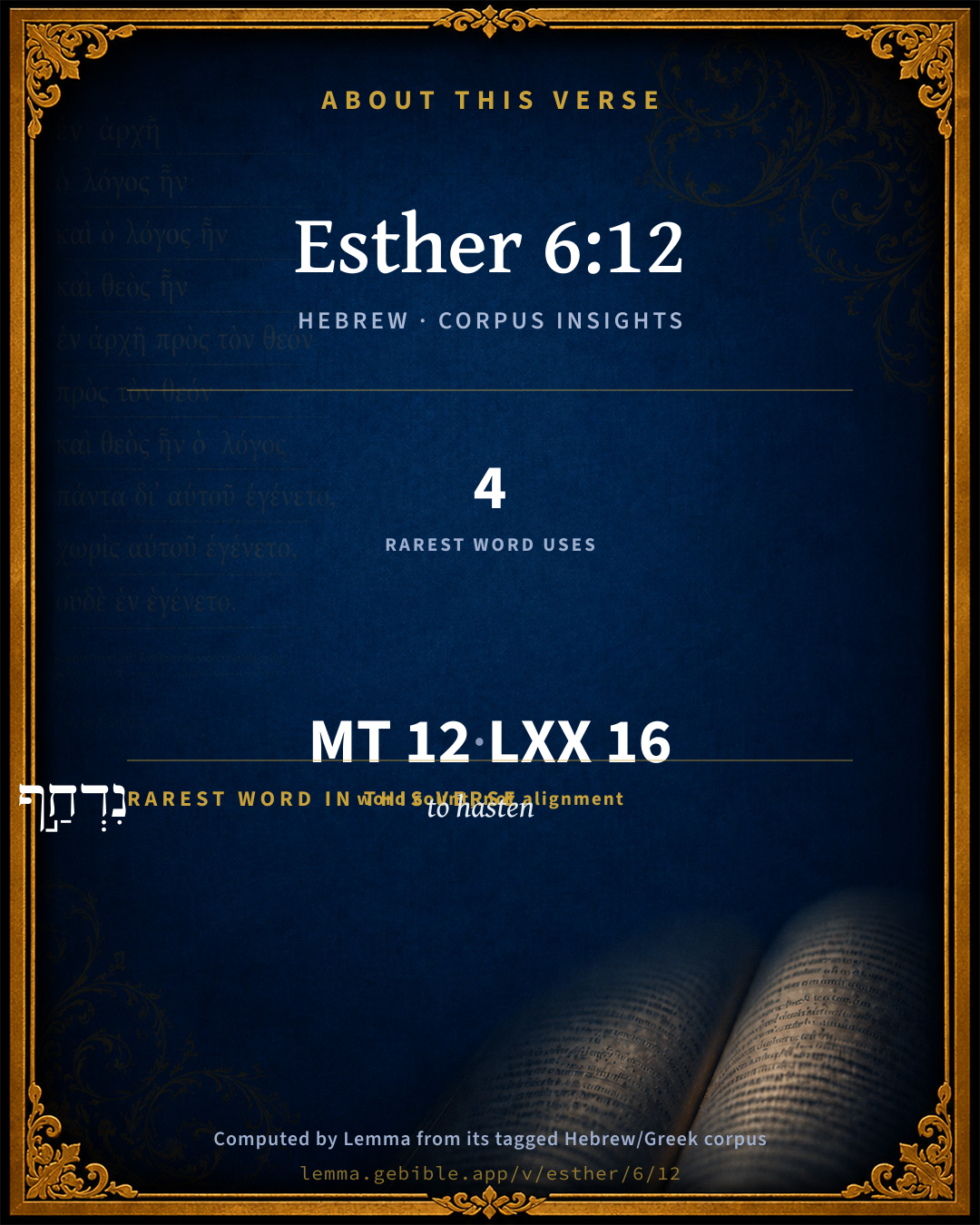
The rarest word here is נִדְחַ֣ף to hasten H1765 — appearing just 4 times in the whole Hebrew Bible.

Shared distinctive vocabulary

נִדְחַ֣ף to hasten H1765 occurs in 4 verses of the Hebrew Bible. Also found in:

Grammatical profile

  • 3 verbs
  • 6 nouns
  • 1 adjective
  • 2 prepositions

Verb forms

  • וַיָּ֥שָׁב Qal · Sequential Imperfect
  • נִדְחַ֣ף Niphal · Perfect
  • וַחֲפ֥וּי Qal · Participle Passive

Repetition

A word recurs within this verse — often emphatic in Hebrew:

  • אֶל to H413 ×2

Hebrew & Septuagint length

In English translation the verse runs 19 words from the Hebrew and 16 from the Septuagint (LXX English) — closely comparable.

A rough comparison of the two English renderings, which tokenize alike — not a word-level alignment.

Word counts can differ between the Hebrew and the Greek without any difference in meaning — e.g. the Hebrew direct-object marker אֵת has no separate Greek word, and Greek often adds the article ὁ.

In the original languages it is 12 Hebrew tokens and 16 Greek tokens — but the two are counted differently (Hebrew bundles its prefixes and suffixes into one token; the Greek is in lemma form), so that isn’t a like-for-like length.

Cross-references

12

Topical passages linked to Esther 6:12 in the Treasury of Scripture Knowledge — connected by theme and wording, ordered by reader-vote popularity; previews shown in the World English Bible.

  • 2 Samuel 15:30 David went up by the ascent of the [Mount of] Olives, and wept as he went up; and he had his head covered, and went barefoot: and all the people who were with him covered every man his head, and they went up, weeping as they went up.
  • Jeremiah 14:3–4 Their nobles send their little ones to the waters: they come to the cisterns, and find no water; they return with their vessels empty; they are disappointed and confounded, and cover their heads.
  • 1 Kings 21:4 Ahab came into his house sullen and angry because of the word which Naboth the Jezreelite had spoken to him; for he had said, I will not give you the inheritance of my fathers. He laid him down on his bed, and turned away his face, and would eat no bread.
  • Job 20:5 That the triumphing of the wicked is short, The joy of the godless but for a moment?
  • 1 Samuel 3:15 Samuel lay until the morning, and opened the doors of the house of Yahweh. Samuel feared to show Eli the vision.
  • 2 Samuel 17:23 When Ahithophel saw that his counsel was not followed, he saddled his donkey, and arose, and got him home, to his city, and set his house in order, and hanged himself; and he died, and was buried in the tomb of his father.
  • 1 Kings 20:43 The king of Israel went to his house sullen and angry, and came to Samaria.
  • 2 Chronicles 26:20 Azariah the chief priest, and all the priests, looked on him, and, behold, he was leprous in his forehead, and they thrust him out quickly from there; yes, himself hurried also to go out, because Yahweh had struck him.
  • Esther 2:19 When the virgins were gathered together the second time, then Mordecai was sitting in the king's gate.
  • Esther 7:8 Then the king returned out of the palace garden into the place of the banquet of wine; and Haman was fallen on the couch whereon Esther was. Then said the king, Will he even force the queen before me in the house? As the word went out of the king's mouth, they covered Haman's face.
  • Job 9:24 The earth is given into the hand of the wicked. He covers the faces of the judges of it. If not he, then who is it?
  • Psalms 131:1–2 Yahweh, my heart isn't haughty, nor my eyes lofty; Nor do I concern myself with great matters, Or things too wonderful for me.

Cross-references courtesy of OpenBible.info (CC BY 4.0).

Hebrew and Greek witnesses Masoretic Hebrew ↔ Greek Septuagint

The same verse in the two great witnesses to the Old Testament, shown verse-for-verse.

These are two independent witnesses, not word-aligned to each other, and the Septuagint is shown in lemma (dictionary) form.

Hebrew Esther 6:12 Masoretic · Westminster Leningrad Codex

וַיָּ֥שָׁב מָרְדֳּכַ֖י אֶל שַׁ֣עַר הַמֶּ֑לֶךְ וְהָמָן֙ נִדְחַ֣ף אֶל בֵּית֔וֹ אָבֵ֖ל וַחֲפ֥וּי רֹֽאשׁ

Mordecai came again to the king's gate. But Haman hurried to his house, mourning and having his head covered.

World English Bible · Public Domain

Greek LXX Esther 6:12 Septuagint · lemma form

ἐπιστρέφω δέ ὁ μαρδοχαῖος εἰς ὁ αὐλή αμαν δέ ὑποστρέφω εἰς ὁ ἴδιος λυπέω κατά κεφαλή

And Mardochaeus returned to the palace: but Aman went home mourning, and having his head covered.

LXX2012 (modern English Septuagint) · Public Domain

Hebrew: Westminster Leningrad Codex (CC BY 4.0). Greek: Septuagint (public domain); English from LXX2012 (modern English Septuagint) (Public Domain). How the Septuagint differs from the Hebrew →

Commentary

Notes on Esther 6:12 from classic Christian and Jewish commentators (each source and its license shown beneath its notes). The classic Christian expositions comment on the surrounding passage and are grouped to its opening verse, so a note may address several verses; the Jewish commentaries on the Tanakh (Rashi and others) are per-verse, so they appear only where the commentator wrote on this verse.

Lemma curates 59 commentaries, every one of them public domain or Creative Commons licensed, each selected and text-cleaned for this edition rather than reprinted as found. About our sources →

Matthew Henry's Commentary

We may here observe,

I. How little Mordecai was puffed up with his advancement. he came again to the king's gate (Est 6:12); he returned to his place and the duty of it immediately, and minded his business as closely as he had done before. Honour is well bestowed on those that are not made proud and idle by it, and will not think themselves above their business.

II. How much Haman was cast down with his disappointment. he could not bear it. To wait upon any man, especially Mordecai, and at this time, when he hoped to have seen him hanged, was enough to break such a proud heart as he had. He hasted to his house mourning, and having his head covered, as one that looked upon himself as sunk and in a manner condemned. What harm had it done him to stoop thus to Mordecai? Was he ever the worse for it? Was it not what he himself proposed to be done by one of the king's most noble princes? Why then should he grudge to do it himself? But that will break a proud man's heart which would not break a humble man's sleep.

III. How his doom was, out of this event, read to him by his wife and his friends: "If Mordecai be, as they say he is, of the seed of the Jews, before whom thou hast begun to fall, though but in a point of honour, never expect to prevail against him; for thou shalt surely fall before him," Est 6:13. Miserable comforters were they all; they did not advise him to repent, and ask Mordecai's pardon for his bad design against him, but foretold his destiny as fatal and unavoidable. Two things they foresaw: - 1. That Haman would be disappointed in his enterprise against the Jews: "Thou shalt not prevail to root out that people. Heaven plainly fights against thee." 2. That he himself would be destroyed: Thou shalt surely fall before him. The contest between Michael and the dragon will not be a drawn battle; no, Haman must fall before Mordecai. Two things they grounded their prognostications upon: - (1.) This Mordecai was of the seed of the Jews; feeble Jews their enemies sometimes called them, but formidable Jews they sometimes found them. They are a holy seed, a praying seed, in covenant with God, and a seed that the Lord hath all along blessed, and therefore let not their enemies expect to triumph over them. (2.) Haman had begun to fall, and therefore he was certainly a gone man. It has been observed of great court-favourites that when once they have been frowned upon they have fallen utterly, as fast as they rose; it is true of the church's enemies that when God begins with them he will make an end. As for God his work is perfect.

IV. How seasonably he was now sent for to the banquet that Esther had prepared, Est 6:14. He thought it seasonable, in hopes it would revive his drooping spirits and save his sinking honour. But really it was seasonable because, his spirits being broken by this sore disappointment, he might the more easily be run down by Esther's complaint against him. The wisdom of God is seen in timing the means of his church's deliverance so as to manifest his own glory.

Matthew Henry's Commentary on the Whole Bible (1708–1710) — public domain (CC PDM 1.0). Text via the HelloAO Bible API.

The Cambridge Bible for Schools and Colleges

gen. ed. J. J. S. Perowne

Chaps. Est_6:12 to Est_8:2. Haman’s overthrow

12. having his head covered] in token of grief. Cp. Est_7:8; 2Sa_15:30; 2Sa_19:4; Jer_14:4; Eze_24:17.

The Cambridge Bible for Schools and Colleges (gen. ed. J. J. S. Perowne; Cambridge University Press, 1878–1918) — public domain. Text from a community e-Sword module.

Trapp's Complete Commentary

John Trapp

Est 6:12 And Mordecai came again to the king’s gate. But Haman hasted to his house mourning, and having his head covered.

Ver. 12. And Mordecai came again to the king’s gate] No whit overjoyed by his new honour, or thereby (as many would have been - a small wind bloweth up a bubble), only he conceiveth hope thereby for a better condition, and taketh every former mercy for a pledge of a future: this experience breedeth confidence. He doth not rush into the court at his return, and reach after a higher room, but came again to the king’s gate, where his office was and his business lay; he took up also, as some think, his old habit again (the king’s apparel and horse being restored to the right owner, he had as little delight in it as David once had of Saul’s armour); but it is rather probable, saith an expositor, that he now left that off, being full of hope, that as God had heard his prayers, to bring him out of danger and to high honour; so he should now be able to help his brethren the Jews out of theirs also. Meanwhile, he doth not envy his superiors, insult over his inferiors, trouble his equals, threaten his enemies, &c., but committeth himself and all his affairs to God’s good pleasure and providence; and this is the guise of a godly man, Psa 131:1-2.

But Haman hasted to his house mourning] Or, vexed at heart, fretting within himself, that he was so very much disappointed. Merrily he made account to have gone to the queen’s feast, when he had first trussed up Mordecai. Of which not only missing, but made to do him public honour in that sort, and that by his own direction, this galled him and grieved him above measure; so bladder-like is the soul of an unregenerate man, that filled with earthly vanities, though but wind, it grows great, and swells in pride; but if pricked with the least pin of piercing grief it shriveleth to nothing.

And having his head covered] With his cap pulled over his eyes, as ashamed to look any one in the face. See 2Sa 15:30 Jer 14:4.

John Trapp, A Commentary or Exposition upon All the Books of the Old and New Testament (1647–1656) — public domain. Text from a community e-Sword module.

The Biblical Illustrator

Joseph S. Exell

Est_6:12

And Mordecai came again to the kings gate

Humility

A proud, ambitious man would have said to himself, No more of the kings gate for me! I shall direct my steps now to the kings palace, and hold myself ready for honour, office, emolument, which surely must now be at hand.

Mordecai seems to have said within himself, If these things are designed for me in Gods good providence, they will find me. But they must seek me, for I shall not seek them. Those who confer them know my address. Mordecai, at the kings gate, will still find me. (A. Raleigh, D. D.)

Honours modestly borne

Few can bear honours and dignities with equanimity, even when they come upon them gradually; but such sudden and high advancement was enough to make any ordinary person giddy, to cause him to forget himself, and behave unseemly. What fatal effects upon the head and heart do we often witness in persons who have all at once been raised from poverty to riches and rank. Even good men are not always proof against the intoxicating influence of such transitions. But Mordecai kept his place; like a gallant ship, firmly moored in a bay, which during a flood-tide heaves and seems for a time borne along with the lighter craft, but, obeying its anchor, comes round and resumes its former position. The pageantry of an hour could not unsettle his mind; he regarded it in its true light--a vain show. (T. McCrie, D. D.)

The Biblical Illustrator, edited by Joseph S. Exell (c. 1880s–1900s) — public domain. Text from a community e-Sword module.

The Pulpit Commentary

HAMAN RETURNS HOME. DESPONDENCY OF HIMSELF AND HIS FRIENDS. (Est_6:12-14) There was as yet no real reason for Haman to feel depressed, or to regard himself as having lost favour with the king. He had been made an instrument in another man"s honour, and had suffered a disappointment; but otherwise he was situated as on the day preceding, when he "went forth" from the palace "joyful and with a glad heart". (Est_5:9) But he seems to have had a presentiment of impending calamity. All had as yet gone so well with him that the first vexation seemed like a turn in the tide, ominous of coming evil. And the fear of his own heart found an echo in the hearts of his wife and friends. Among the last were some who had the reputation of being "wise men perhaps Magians, acquainted with arts from which it was supposed they could divine the future. These persons ventured on a prediction. "If Mordecai, before whom thou hast begun to fall, be of the seed of the Jews, thou shalt not prevail against him, but shalt surely (or utterly) fall before him." With this evil presage ringing in his ears, Haman quitted his house, and accompanied the palace eunuchs who had been sent to conduct him to Esther"s second banquet.

And Mordecai came again to the king"s gate. Returned, i.e., to his former condition and employment. The high honour done him was regarded as sufficient reward. Having his head covered. Like David when he fled from Absalom (2Sa_15:30; comp. Psa_44:15)

The Pulpit Commentary (1880–1919), ed. H.D.M. Spence-Jones & Joseph S. Exell — public domain. Text from a community e-Sword module.

The Preacher's Complete Homiletical Commentary

Joseph S. Exell (gen. ed.)

CRITICAL NOTES.]

Est_6:12-14.] It is quite consonant with Oriental notions that Mordecai, after receiving the extraordinary honours assigned him, should return to the palace and resume his former humble employment, Ahasuerus regarding him as sufficiently rewarded, and not yet intending to do anything more for him.—Rawlinson. Haman, with covered head and sorrowful heart, hastens home to his friends and wife only to hear the discouraging prophecy that the unfortunate occurrence will be the beginning of his end. To cover the head was a sign of deep shame and distress. His friends are now called wise men] at least some of them, because they undertook to forecast his future.—Lange. His diviners now hesitate not to predict his fall. If his enemy is of the seed of the Jews] a new and startling fact that seems suddenly to have impressed these wise men; then it is certain that the providence which has ever been such a wondrous power in the Jewish nation, and which has now so strangely elevated Mordecai at the very moment when Haman thought to have slain him, will cause the Jew to triumph. Hasted to bring Haman] The avenging Fates seem to hurry him to his doom.—Whedon’s Com.

MAIN HOMILETICS OF THE PARAGRAPH. Est_6:12-14

A SMALL MAN IN ADVERSITY

MEN are to be judged so as to form an estimate of their greatness or their littleness, not by their surroundings, but by the manner in which they conduct themselves in the trying changes, in the ups and downs, of life. We must consider their conduct. “By their fruits shall ye know them.” Does a man carry himself with calmness in prosperity and with fortitude in adversity, then we may pronounce him great. Is a man unduly elated by prosperity and brokenhearted by adversity, then we pronounce him a small man. Tried thus the despised Mordecai is the truly great man, and the haughty Haman is the little man. In one sense we are the creatures of circumstances. We cannot help being more or less affected by them. In another sense we ought to be the masters of circumstances. They must not be permitted to unman our natures. In the day of prosperity be joyful, but in the day of adversity consider. Adversity so acts upon some people that all power of consideration is removed. Oh, to be masters of ourselves! This can only be done by the help of Divine grace. “I can do all things through Christ strengthening me.”

I. A great man in prosperity. Are there no great men that meet with no prosperity, as the world accounts prosperity? Has God no hidden heroes in quiet walks? We may believe that he has. Up to this time Mordecai had been a great man in obscurity. Really Mordecai was no greater when riding on the king’s horse in triumphal procession through the city than when sitting at the king’s gate. We are slow to learn and believe the truth, that not circumstances, but character makes a man great. Mordecai’s mind was so great that he rose above the state of things and men. He dwelt in a higher sphere than that formed by the pomp of circumstances, by the parade of royalty. We can imagine Mordecai with calm majesty riding through the city Susa. He took the thing naturally; he penetrated to the heart of things. When the little show was over he went calmly to his obscure place at the city gate. In some degree he is a type of him who rode forth amid the hosannas of the multitude, and then listened, as one not astonished, to the cry, Crucify him, crucify him. A great soul had Mordecai. He had food to eat of which Haman had no conception. Seek high conceptions of duty. Sit at thy post, even at the city gate, and wait only for the opening of heaven’s gate.

II. A small man in adversity. Oh, when adversity really comes are we not all small men? The Bechuanas sit and talk as if they felt nothing when under going a painful surgical operation. But most men wince beneath the sharp knife of adversity. Most are but bruised reeds when the blasts of sorrow blow keenly and sharply, and they give forth dismal wailings. Therefore we must temper our judgment with much mercy as we consider Haman in adversity. “Our grief is but our grandeur in disguise;” but our grief also tells of our littleness. Most are brothers to Haman in the time of their adversity. The dreaded blow of trouble sends them to their houses mourning. Adversity makes us acquainted with strange bed-fellows. How many despise the guilty Haman, and yet are by trouble reduced to his miserable level. Haman was a small man. He was fretting like a little child because the coveted toy had been grasped out of his hand. For we do not suppose that Haman as yet knew that this honour rendered to Mordecai was but the beginning of his own awful end. So far Haman’s troubles were in great measure of an ideal character. A great many of our troubles are of this character. But ideal troubles cause us real misery. If we could only act out the lesson, man wants but little here below, nor wants that little long, we should not have many troubles. Small are most men in the nature of their desires and their disappointments. They strive and fight for childish toys, and when they get them they are not satisfied, and ask for more. When these toys are wrested from them they haste to their houses mourning, and have their heads covered for grief.

III. A small man in adversity seeks for counsellors. He went to his wife and his friends. Where should a man go in the time of trouble if not to his wife and his friends? A good wife should be a help-meet. Like the ivy plant, she should cling the faster the greater the ruin, and be a helping support and a graceful ornament even to that ruin. Where can a man in sorrow go if not to his friends? where Haman little thought of going. Friends are not always glad to see humiliated Hamans. Even the wife may turn round upon the husband and say, Curse God and die. There is a friend that sticketh closer than a brother. When my father and my mother forsake me, then the Lord will take me up.

IV. A man in adversity obtains poor consolation. One thing is certain, Haman’s wife and his friends told him the truth now, but they had not told him the truth before. They had not warned him of his danger, nor showed him the way out of his difficulty. Even now they have nothing in the way of really helpful advice to offer. They simply predict his further downfall. Friends too often have the fatal capacity of plunging a drowning man deeper into the water. Very sad sometimes is the errand on which the man goes when he consults his friends as to the best thing to be done in his trial. He comes back a sadder, but not always a wiser, man from the visit. They glibly show him his faults; they tell him where he has made a slip; they too often appear as if they were taking pleasure in making him look contemptible. We compassionate Haman from the bottom of our hearts. He has sown the wind, and is now reaping the whirlwind. He is now deserted by all, left to his own bitter fate. Heaven’s consolations even then might have been obtained. Rich are the consolations that Jesus brings. He never upbraids on account of our faults. If he does not deliver us from our distresses, he gives us strength that we may bear them manfully.

V. A man in adversity receives an ominous summons. And while they were yet talking with him came the king’s chamberlains. Trouble upon trouble; but Haman did not understand the worst. He did not foresee the future. He little dreamt that Esther’s banquet was but the way to the gallows. We sometimes say, If I had only known! Well, we all know, or might know, that wrong-doing will lead to trouble, and yet we go on doing wrong things. Had Haman known, perhaps, like too many, he would simply have done another wrong thing to prevent the mischief likely to come from past wrong-doing. No need for prophetic sight. We know that sin worketh death; let us then forsake all evil. From all blindness of heart; from pride, vainglory, and hypocrisy; from envy, hatred, and malice, and all uncharitableness, Good Lord, deliver us.

SUGGESTIVE COMMENTS ON Est_6:12-14

In prosperity he is highly insolent and cruel, but in adversity he is so broken and dejected that he knows not which way to turn. But his counsellors are no better off than himself. His friends do not console him, nor show him any plan for escaping his danger, which nevertheless was then the most needful help for Haman; but they throw him, just hesitating between hope and fear, into despair. “Thou wilt surely fall in his sight,” say they. Had they admonished him indeed of his many and heinous sins toward God and his servants, of his duty of recognizing the inevitable judgment of God, of repentance, of reconciliation, then perchance it may have turned out better with him. The power and efficacy of truth is so great that even its enemies and all the ungodly bear testimony to it. So the magicians of Pharaoh are compelled to explain, This is the finger of God; and the Egyptians’ cry, Let us flee before Israel, for the Lord fighteth for them.—Feuardent.

Men find no difference in themselves. The face of a Jew looks so like other men’s that Esther and Mordecai were not, for long, taken for what they were. He that made them makes the distinction betwixt them; so as a Jew may fall before a Persian and get up and prevail; but if a Persian, or whosoever of the Gentiles, begin to fall before a Jew he can neither stay nor rise. There is an invisible hand of omnipotency that strikes in from his own and confounds their opposites. O God, neither is thy hand shortened, nor thy bowels straitened in thee: thou art still and ever thyself. If we be thy true spiritual Israel, neither earth nor hell shall prevail against us; we shall either stand sure or surely rise, while our enemies shall lick the dust.—Bishop Hall.

The chief reason why the enemies of the Church gnash their teeth at the sight of God’s gracious dealings is, that they take the rising of the Church to be a presage of their ruin: a lesson which Haman’s wife had learned.

Haman’s wife had learned this, that if her husband began once to fall before the Jews he should surely fall. Wicked men have an hour, and they will be sure to take it; and God hath his hour too, and will be as sure to take that. The judgments of the wicked are mercies to the Church. So saith David, “He slew mighty kings, Og, king of Bashan, for his mercy endureth for ever.”—Sibbes.

In the narrative which follows we have an example of that decency and propriety with respect to circumstances which is always observed in Scripture, and which may be traced in what is omitted as well as what is introduced. Nothing is said of what passed between Mordecai and Haman, either at the beginning or close of the ceremony. The inspired writer gives us no account of the acclamations of the multitude whom the spectacle drew together. They would no doubt act, poor souls, as they are always accustomed to do, hail the favourite of the day, and echo back the voice of the herald. Let them alone—they would have done the same for Haman. We are even left to conjecture what were the thoughts of the judicious few, both Jews and natives, who might be led by this strange event to augur the approaching fall of the arrogant prime minister, and the rising fortunes of the object of his hatred. The sacred narrative passes over these things, and hastens to the crisis.

The pageant is now over, and we see, issuing from the dispersing crowd, the two principal persons, moving in different directions, and in opposite moods of mind.

Mordecai came again to the king’s gate. But Haman hasted to his house mourning, and having his head covered. There is a double portrait drawn with one stroke, but it is by the hand of a master! “We see the hearts of the two men depicted in their looks and gait;—the composure and humility of the one, and the confusion and bitter mortification of the other. These two lines give us a deeper insight into the characters of the men than a would-be painter could have conveyed by the most elaborate representation.

Mordecai came again to the king’s gate. He did not remain to prolong his triumph, and to drink in the incense offered by the crowd. He did not go to his own house, and gather together his friends and countrymen to tell them of his high honours, and to receive their congratulations. He did not hurry back to the palace in expectation of receiving some more substantial mark of the royal favour. He did not seek an audience of the king to bring an accusation against his mortal enemy. But he came again to the king’s gate from which he had been taken, and resumed his former place as a servant. He was not elated—he was not even discomposed by his honours. “He stood not up, nor moved,” for all that Haman had done to him.

“If the spirit of the ruler rise up against thee” (saith the wise man), “leave not thy place.” But it is still more difficult to keep our place when we are visited with the favour of the ruler. Few can bear honours and dignities with equanimity, even when they come upon them gradually; but such sudden and high advancement was enough to make any ordinary person giddy, to cause him to forget himself, and behave unseemly. What fatal effects upon the head and heart do we often witness in persons who have all at once been raised from poverty to riches and rank. Even good men are not always proof against the intoxicating influence of such transitions. How incoherently did the disciples talk on the Mount of Transfiguration! That vessel needs to be well ballasted, which, after being long becalmed, has all its sails at once filled with a favourable gust of wind.

But Mordecai kept his place; like a gallant ship, firmly moored in a bay, which during a flood-tide heaves, and seems for a time borne along with the lighter craft, but, obeying its anchor, comes round and resumes its former position. The pageantry of an hour could not unsettle his mind; he regarded it in its true light—a vain show. Had he had a choice, he would have declined it; as it was, he suffered rather than enjoyed it. It may be difficult to determine which of the two felt most awkward and constrained—Haman in conferring or Mordecai in receiving the extravagant honours. Not that the latter was insensible or a stranger to feeling on the occasion. But then he viewed it, not as a prelude to his own aggrandizement, but as an earnest of the deliverance of his people; and as his confidence of this event rested on surer grounds than his own advancement or the influence of his daughter, his heart was filled with astonishment and with gratitude at the prospect; he possessed his soul in patience—he stood still, and waited for the salvation of God.

But let us now turn to Haman. He had not confidence to return to the palace to present the request for which he had visited it in the morning. Nor could he endure the sight of the people, before whom he felt himself dishonoured. But he “hasted to his house mourning, and with his head covered.” Had Haman been a man of virtue and true dignity of mind, this occurrence could not have disturbed his peace, far less broken his heart. “Why? what harm has it done to me? I have been selected as ‘one of the king’s most noble princes,’ to do this temporary honour to a man who saved the royal life.” At most he would have regarded it as one of those freaks which fortune delights to play in arbitrary courts, and which break the dull monotony of a palace. He would have said, “I have seen servants riding upon horses, and princes, like servants, walking on the earth.” But the man who could complain that all his wealth and honours “availed him nothing, so long as he saw Mordecai the Jew sitting at the king’s gate,” could not fail to be stung to the quick by the recent transaction. Hatred, and disappointment, and mortified pride, rankled in his breast, and, to torment him still more, awakened remorse for the past, and fearful forebodings of the future. Surely such a sight is sufficient to cure those who have been smitten with pride or with envy at worldly greatness.—McCrie.

Then said his wise men and Zeresh his wife unto him, If Mordecai be of the seed of the Jews, before whom thou hast begun to fall, thou shalt not prevail against him, but shalt surely fall before him. Who were these wise men? Either sages whom Haman patronized, and from whom he expected wise counsel when he required it, or diviners, who were believed to know more than men could know, without some communication with superior beings. Many of the heathens put much confidence in diviners, but we have learned better things from the word of God. By making it our counsellor at all times of perplexity we shall find peace to our souls.*

“If Mordecai be of the seed of the Jews, before whom thou hast begun to fall, thou shalt not prevail against him, but shalt surely fall.”—If Mordecai be of the seed of the Jews. Why do they lay so much stress upon the stock from which Mordecai sprung? If Mordecai had been a native Persian, or a Babylonian, or an Egyptian, would they not have prognosticated equal success to him against Haman? No; it plainly appears that the dispensations of Divine Providence in favour of the Jews were so far known to them as to assure them that Providence watched over their interests in a manner peculiar to their nation. Although most men are disposed to think that their own country is happy above others in the Divine favour, and although the Persians at this time seemed to have good reason to flatter themselves with a special interest in the favour of Heaven, yet these wise Persians plainly confessed, that the Jews scattered through the nations were the special objects of the Divine care. The wonders done in Babylon were known to all the world, and could not fail to impress all confederate princes with high sentiments concerning the God of Israel. Haman’s wise men might have read the sacred books of the Jews, in which they would find that their God had wrought as great wonders for them in times past as in the period of the Babylonian captivity. They learned instruction from the works of God. They saw that the same God who had preserved Daniel and his companions watched over the safety and fortune of Mordecai, and they concluded that Haman, his irreconcileable enemy, would fall under the weight of his vengeance.

But it is strange that these wise men, and even the wife of Haman, whatever they thought, expressed to him their mind so fully. If they did not choose to flatter him, might they not at least have concealed their dismal conjectures, especially as he was led by their counsels to that public disgrace in which he had involved himself, by building a gallows for the man who was appointed to be the king’s favourite? for although it was built in the court of his own house, yet the news of its erection was soon to spread. It appears from the freedom they used with Haman, that they already considered him as a lost man, whom it was useless to flatter. They were his friends, as long as his friendship could profit them, and now they seem to have cared little whether he accounted them as his friends or his enemies. Their prophecy must have been as unpleasant as the howling of a dog, or even a sentence of death, to his ears. The rich hath many friends; but when poverty is seen coming like an armed man, they vanish away like snow in the days of sunshine.

We may, however, learn useful instruction from a prophecy dictated by reflection on the works of the Lord. Blind heathens have been forced to see that God takes care of his people, that he often interposes wonderfully for their deliverance, and that he leaves not his gracious works in their behalf unfinished. Why do not God’s own people, in the day of their distress, call to remembrance his judgments for their consolation and the support of their faith? When he begins to deliver them, why do they indulge distrusting fears about the accomplishment of that work which he hath taken into his own hand? Why are they not thankful for the day of small things, as the beginnings of months of joy? After Jesus undertook to heal the daughter of Jairus strong temptations met the mourning parent, when Jesus was on the road to complete his work, and fears began to overwhelm his soul. But what said Jesus? “Fear not, only believe.” He believed, and received his daughter back from death.—Lawson.

Still, although we may despise the wife and the friends, we cannot say that by their counsel now they do Haman any injustice. They do not render him the highest service. The highest service would be to tell him the truth, and help him to conform to it by confession, repentance, and amendment. (If they had been even worldly wise they would have told him at once to take down the gallows.) But they do him no injustice. The poor man (for now pity begins to rise) has been sowing diligently, and he is now to reap as he has sown. Black harvest comes in a day. It begins to come in his own house. There—where he had plotted the mischief, begins to fall the shadow of doom.

Yet, let us not overdraw the picture; possibly, if we knew all, there are softer lines to put into it, and some lights of human kindness. There is always much untold and unknown in these histories. Did they follow up their confident prediction that he could not succeed against Mordecai and the Jews, by earnest friendly counsel to Haman to conceal himself, or at once to take flight out of the empire, or away to some distant part of it? We know not. We know only that they were still talking with him—talking over the whole matter—the gathering dangers, the possible methods of relief—when the conference is interrupted by the entrance of the king’s chamberlains, who have come, in haste, to bring Haman to the banquet that Esther had again prepared.—Dr. Raleigh.

When Haman’s wife heard her husband say that Mordecai was against him, because he was an Israelite, she said that her husband should take the foil, and Mordecai should prevail. What if she had heard her husband say that the Lord of Mordecai was against him? If the servant be so terrible, who dare encounter with his master?—H. Smith’s Sermons.

And Mordecai came again to the king’s gate. Was there ever a nobler man than this? You will find ten Christians who bear well the trial of adversity for one who can bear well the sharper trial of prosperity. Mordecai, returned to his place, was wearing fairer robes than the king’s—that vesture of humility wherein the Son of God walked on earth, and which he has ordained as the livery of his redeemed. Go tell him that he has now a splendid opportunity to rise in the world, that his foot is on the ladder, and he needs but to climb; and he will tell of another ladder he is climbing, with angels for his helpers, and that the show this morning had almost cast him down. His duty is at the king’s gate, and there he will wait upon God to show him the end of this strange thing.

“The dew that never wets the flinty mountain

Falls on the valley free;

Bright verdure fringes the small desert fountain,

But barren sand the sea.

The white-robed saints the throne-steps singing under,

Their state all meekly wear,

Their pauseless praise wells up from hearts that wonder

That ever they came there.”

But Haman hastened to his house mourning, and having his head covered. The change was swift and ominous since morning, when he had seen to the gallows being ready, and gone forth hopeful. Not a man in all the city knew that two hours hence others would cover his face and lead him out to death; but Haman felt that God was fighting against him, and anticipated his doom. Is it wrong to mock him now? Why not report yourself to the king as having done his bidding, and ask what you purposed to ask this morning? On the showing of your own words, the king has treated you as “one of his most noble princes.” Zeresh and your friends are expecting you to bring back your victim with you for the gallows. Why so downcast? But, despicable as Haman is, pity is fitter for us than scorn—pity, with a prayer for ourselves that we may escape the fatal madness of making self our god. Haman’s friends had helped him last night, and roused him to hope; but they failed him now. These were summer friends, and thought it not worth while even to lie to him any longer. Besides, they were superstitious. “If Mordecai be of the seed of the Jews.” Why this emphasis on Mordecai’s race? The case would not have been so bad if he had been an Ethiopian; but there were strange features about these Jews. They sometimes stood out on ground of high principle, and when they did so they prospered against all probability. The friends of Haman were Amalekites, in all likelihood, and familiar, therefore, with a history of warning. “Before whom thou hast begun to fall.” His friends see no hope for Haman now that he is started on the swift incline of ruin. When great men of this sort begin to go down their course is quick in proportion to their greatness; and it is a serious aggravation of their misery that the friends of their prosperity hasten their unpitied fall. The tempters, in this world or the next, prove the tormentors.—Symington.

ILLUSTRATIONS TO CHAPTER 6

Est_6:12. Fortitude of the Bechuanas. They are excellent patients. There is no wincing; everything prescribed is done instanter. Their only failing is that they become tired of a long course. But in any operation even the women sit unmoved. I have been quite astonished again and again at their calmness. In cutting out a tumour, an inch in diameter, they sit and talk as if they felt nothing. “A man like me never cries,” they say; “they are children that cry.” And it is a fact that the men never cry. They stand in striking contrast to Haman, who hasted to his house mourning for what was an imaginary evil in great measure; yea, they reprove a great many who profess to be sustained by higher motives. It may be a want of sensitiveness on the part of the Bechuanas, but with increased sensitiveness there should be an increased power of self-control. It is wonderful what power of self-control is possessed and manifested by the members of the Society of Friends.—Dr. Blaikie’s Personal Life of David Livingstone, LL.D.

Satan, a hard task-master. There was a man in the town where I was born who used to steal all his firewood. He would get up on cold nights, and go and take it from his neighbours’ wood-piles. A computation was made, and it was ascertained that he had spent more time, and worked harder, to get his fuel than he would have been obliged to do if he had earned it in an honest way, and at ordinary wages. And this thief was a type of thousands of men who work a great deal harder to please the devil than they would have to work to please God.—Beecher.

So Haman worked hard to please the devil of an evil nature, and it ended in mourning. He would have found more satisfaction in the long-run if he could have set himself to serve a good nature.

Circumstances. He is happy whose circumstances suit his temper; but he is more excellent who can suit his temper to his circumstances.—Hume.

If you can’t turn the wind you must turn the mill-sails. Joseph was a beautiful example. See him, in his changed positions, still the upright saint; and Jesus, his conduct at the marriage and in the temple. William Pitt used to be called the minister of existing circumstances. A Christian shepherd, when a gentleman said, to try him, “Suppose your master were to change, or your flock to die; what then?” replied, “Sir, I look upon it that I do not depend upon circumstances, but upon the great God that directs them.” The Rev. H. W. Fox, when dying, had constantly upon his lips the words of Baxter:—“Lord, when thou wilt; where thou wilt; as thou wilt.” Mordecai, riding in the procession, and then returning to sit at the gate, shows his superiority to mere externals.—Bowes.

The Preacher's Complete Homiletical Commentary (gen. ed. Joseph S. Exell; Funk & Wagnalls, c. 1892) — public domain (pre-1929). A full-Bible homiletical/sermon-outline anthology covering 65 of 66 books (2 John is absent from the source module). Text from a community e-Sword module.

Adam Clarke's Commentary

Verse 12. Mordecai came again to the king's gate] He resumed his former humble state; while Haman, ashamed to look up, covered his face, and ran home to hide himself in his own house. Covering the head and face was a sign of shame and confusion, as well as of grief, among most people of the earth.

Adam Clarke's Commentary on the Bible (1810–1826) — public domain. Text from a community e-Sword/MySword module.

Ellicott's Commentary for English Readers

(12) Mordecai came again to the king’s gate.—He had received his reward, and to the Eastern, who sees continually the Vizier and the poor man exchange places, there would be nothing startling in this resumption of the former humble post.

His head covered.—In token of mourning.

A Bible Commentary for English Readers, edited by Charles John Ellicott (1878–1897) — public domain. Text from a community e-Sword module.

John Gill's Exposition

And Haman told Zeresh his wife, and all his friends, every thing that had befallen him,.... How he was prevented speaking to the king on this errand he went; instead of which, he had the mortification of being obliged to do the honour to Mordecai which he thought would never have been given to any but himself, and so related the whole affair as above:

then said his wise men; before called his friends; perhaps they were magicians and soothsayers he kept in his house, to advise with about the proper methods and times of advancing himself, and destroying his enemies:

and Zeresh his wife unto him; who joined with the wise men in giving her opinion, and who set up for a knowing woman, and of whom Haman thought highly:

if Mordecai be of the seed of the Jews; as it was said he was; and therefore Haman had vowed and plotted revenge on the people of the Jews for his sake:

before whom thou hast begun to fall; as he did, by being obliged to execute the king's will in doing him so much honour:

thou shall not prevail against him; to get him hanged, or his people destroyed, though he had prepared a gallows for the one, and had got an edict for the other:

but shall surely fall before him: which might be concluded from his being set above him, who would not fail of using his power and interest to crush him, who had showed himself to be such an implacable enemy to him; or they might have some knowledge of the history of the Jews, and of what wonderful things God often did for them, in defeating the designs of their enemies, and in raising them up from a low to an high estate.

John Gill's Exposition of the Whole Bible (1746–1763) — public domain (CC PDM 1.0). Text via the HelloAO Bible API.

Albert Barnes' Notes on the Bible

It is quite consonant with Oriental notions that Mordecai, after receiving the extraordinary honors assigned him, should return to the palace and resume his former humble employment.

Albert Barnes' Notes on the Bible (1834–1885) — public domain. Text from a community e-Sword/MySword module.

Haydock's Catholic Bible Commentary

Covered. To hide his shame, (Tirinus) as Demosthenes did, when the people kissed him. (Plutarch) See 2 Kings xv., and Ezechiel xii. 6.

George Leo Haydock (1774–1849), Haydock's Catholic Family Bible and Commentary, 1859 edition — public domain. Excludes Psalms (Douay-Rheims chapter numbering differs from Protestant) and Deuterocanonical books (Catholic canon only).

Matthew Poole's English Annotations

To the king’s gate; to his former place and office; showing that as he was not overwhelmed by Haman’s threats and malicious design, as appears by Est 5:9; so now he was not puffed up with all this honour. Besides, he came thither to attend the issue of the main business, and to be at hand to assist or encourage the queen, if need were; which now he was more capable of doing than hitherto he had been.

Having his head covered, in token of his shame and grief for his unexpected and great disappointment of his hope and desire, and for the great honour done to his most despised and abhorred adversary, and this by his own hands, and with his own public disgrace; and for such further inconveniences as this unlucky omen seemed to presage to him.

Matthew Poole's English Annotations on the Holy Bible (1683–1685) — public domain. Text from a community e-Sword/MySword module.

Whedon's Commentary on the Bible

Daniel D. Whedon

12. Mordecai came again to the king’s gate — That is, resumed his position as one of the royal porters. His honour did not so puff him up that he could not cheerfully return again to his humble office. But the mortified Haman covered his head with a vail to hide, as he thought, his shame, and ran home crying, to tell his wife and friends his sorrow.

Daniel D. Whedon (gen. ed.), Commentary on the Old and New Testaments (1874–1909) — public domain. Text from a community e-Sword module.

John Wesley's Explanatory Notes

Gate - To his former place; shewing that as he was not overwhelmed by Haman's threats, so he was not puffed up with this honour. Cover'd - In token of his shame and grief for his unexpected disappointment, and for the great honour done to his abhorred adversary, by his own hands, and with his own public disgrace.

John Wesley, Explanatory Notes Upon the Whole Bible (1754–1765) — public domain. Text via the GEBible commentary corpus.

Keil & Delitzsch

C. F. Keil & F. Delitzsch

After this honour had been paid him, Mordochai returned to the king's gate; but Haman hasted to his house, "sad and with his head covered," to relate to his wife and friends all that had befallen him. A deeper mortification he could not have experienced than that of being obliged, by the king's command, publicly to show the highest honour to the very individual whose execution he was just about to propose to him. The covering of the head is a token of deep confusion and mourning; comp. Jer 14:4; Sa2 15:30. Then his wise men, and Zeresh his wife, said to him: "If Mordochai, before whom thou hast begun to fall, be of the seed of the Jews, thou wilt not prevail against him, but wholly fall before him." לו תוּכל לא, non praevalebis ei, comp. Gen 32:26. תּפּול נפול with an emphatic infin. absol.: wholly fall. Instead of the חכמיו אהביו are here named, or to speak more correctly the friends of Haman are here called his wise men (magi). Even in Est 5:14 Haman's friends figure as those with whom he takes counsel concerning Mordochai, i.e., as his counsellors or advisers; hence it is very probable that there were magi among their number, who now "come forward as a genus sapientum et doctorum (Cicero, divin. i. 23)" (Berth.), and predict his overthrow in his contest with Mordochai. The ground of this prediction is stated: "If Mordochai is of the seed of the Jews," i.e., of Jewish descent, then after this preliminary fall a total fall is inevitable. Previously (Est 5:14) they had not hesitated to advise him to hang the insignificant Jew; but now that the insignificant Jew has become, as by a miracle, a man highly honoured by the king, the fact that the Jews are under the special protection of Providence is pressed upon them. Ex fato populorum, remarks Grotius, de singulorum fatis judicabant. Judaei gravissime oppressi a Cyri temporibus contra spem omnem resurgere caeperant. We cannot, however, regard as well founded the further remark: de Amalecitis audierant oraculum esse, eos Judaeorum manu perituros, which Grotius, with most older expositors, derives from the Amalekite origin of Haman. The revival of the Jewish people since the times of Cyrus was sufficient to induce, in the minds of heathen who were attentive to the signs of the times, the persuasion that this nation enjoyed divine protection.

Keil & Delitzsch — Biblical Commentary on the Old Testament (1861–1891) — public domain (CC PDM 1.0). Text via the HelloAO Bible API. (Old Testament only.)

unfoldingWord translationNotes

Door43 World Missions Community

with his head covered

People often covered their head to show that they were either extremely sad or ashamed. (See: Symbolic Action)

Zeresh

See how you translated this woman's name in Esther 6:13. (See: How to Translate Names)

before whom you have begun to fall ... you will certainly fall before him

They spoke as if Haman and Mordecai were in a battle, and Haman was beginning to lose the battle. Here "to fall" represents being dishonored and defeated. AT: "who has already humiliated you ... he will certainly defeat you" (See: Metaphor)

you will not overcome him

"you will not win against him." They spoke as if Haman and Mordecai were in a battle. Here overcoming a person represents having greater honor than that person. AT: "you will not have greater honor than he has" (See: Metaphor)

translationWords

mourn

wise

feast

Esther

unfoldingWord translationNotes — © Distant Shores Media and the Door43 World Missions Community, licensed CC BY-SA 4.0. Source: git.door43.org/Door43/en_tn.

Rashi

Rabbi Shlomo Yitzchaki (Rashi)

And Mordecai returned to his sackcloth and to his fasting.

mourning and with his head covered Our Sages explained the matter in Tractate Megillah (ad loc.).

Rashi on the Tanakh — English translations: “The Judaica Press complete Tanach with Rashi, translated by A. J. Rosenberg” (CC BY 4.0); “Pentateuch with Rashi's commentary by M. Rosenbaum and A.M. Silbermann, 1929-1934” (public domain); “The Metsudah Tanach series, Lakewood, N.J” (CC BY 4.0); and “The Book of Joshua, Metsudah Publications, 1997” (CC BY 4.0). Text via Sefaria.

Lesson kit

Teaching starters — assembled from the data on this page, not authored interpretation. Every prompt links to the verse data it draws on. Edit before teaching.

Esther, in the Historical, opens this verse with 12 words (11 distinct Hebrew lemmas). Its most distinctive word is dâchaph (“to hasten”). A historical commentator’s framing appears above. Read the whole chapter for the surrounding context.

Discussion questions

  1. What does “to hasten” (dâchaph) contribute to the verse as a whole?
  2. 2 Chronicles 26:20 shares the word «to hasten» with this verse. How do the two illuminate each other?
  3. “to” occurs 2× in this one verse. What is the effect of the repetition?
  4. The translations on this page render this verse differently — a whole-verse word diff, not a word-by-word alignment. What might account for the different wordings?
  5. The verb «וַיָּ֥שָׁב» is Qal Sequential Imperfect. How does its form color the action?
  6. Reading how Matthew Henry's Commentary and The Cambridge Bible for Schools and Colleges read this verse, where do the two commentators agree and where do they part?

Things to notice

Reading settings

Reading text

Shown beneath each verse's original-language words.

Old Testament
Old Testament edition

Read the OT as the Masoretic Hebrew (MT) or the Greek Septuagint (LXX).

English shown for the Greek Septuagint (in the Hebrew ↔ Greek comparison).

Comparing translations? Open the Compare panel on any verse page to stack up to four side by side.