
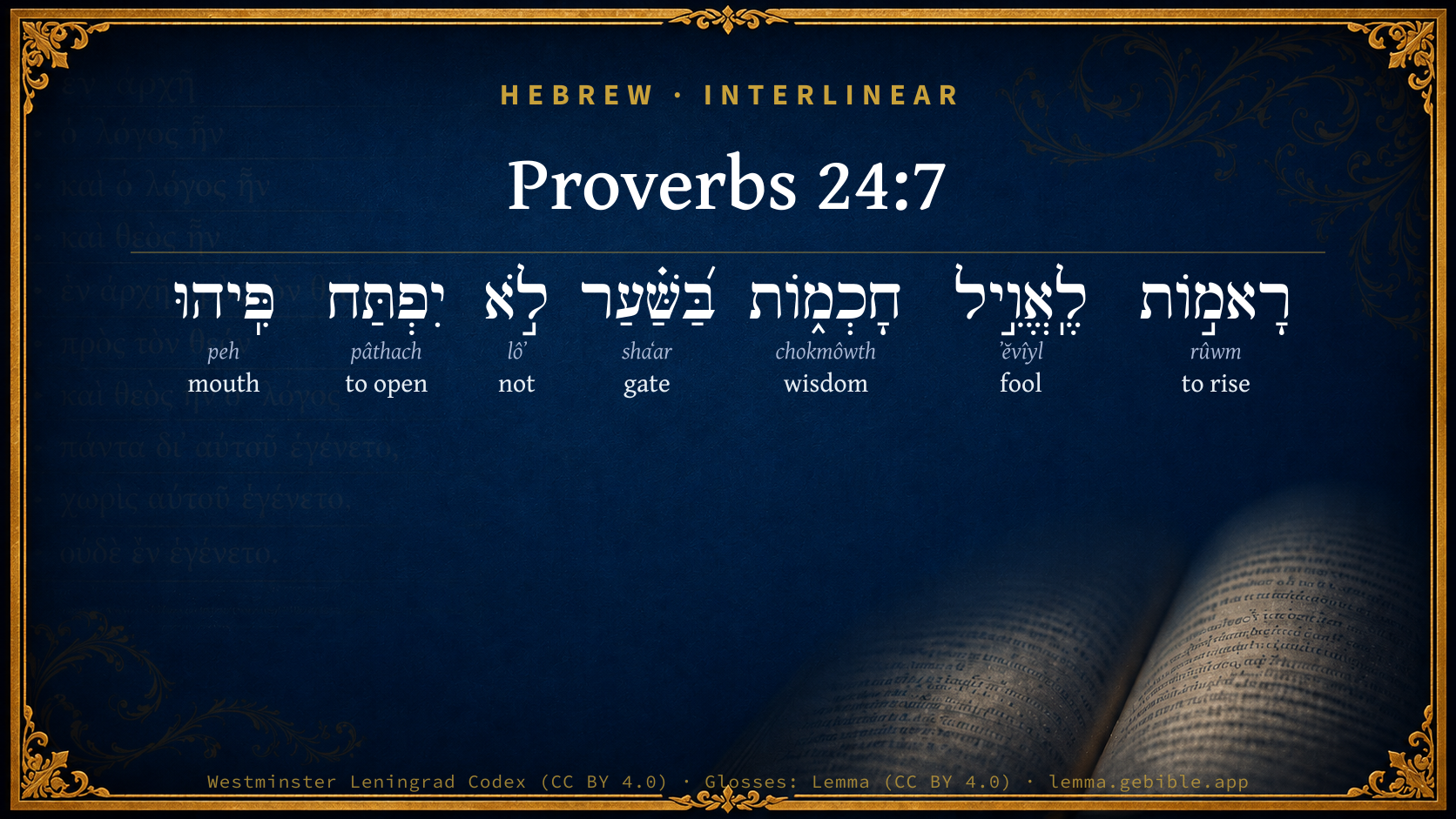
Proverbs 24:7

Hebrew (Westminster Leningrad Codex) Proverbs 24:7 appears in the Hebrew Old Testament. The text above is from the Westminster Leningrad Codex. Each word links to its Strong’s number, a concise gloss, and parsing drawn from the Open Scriptures Hebrew Bible morphology. Click any word for its full Brown-Driver-Briggs (BDB) entry.
Download image
Cite this verse

Proverbs 24:7 (World English Bible). Public Domain. Lemma interlinear Bible study tool, https://lemma.gebible.app/v/proverbs/24/7.

Show BibTeX & RIS
BibTeX
RIS
English Translation
Wisdom is too high for a fool: He doesn't open his mouth in the gate.
World English Bible · Public Domain
Download a study sheet

One document with this verse’s original text, its word-by-word gloss line, the meaning frame, cross-references with their text, attributed commentary, and full source and license credits — printable, and it pastes into notes with its structure intact.

This verse Autodidact and up

Study sheet (.html) Plain text (.txt)

A passage Seminary Student

Up to 50 verses in one chapter. A passage sheet keeps up to 6 commentary sources and 12 cross-references per verse, in the order this page ranks them, and says so on the sheet whenever that leaves anything out. Ask for a single verse and you get the Autodidact verse sheet above.

Everything on this page stays free to read, with no account — the sheet is a download of what is already on screen, not access to it.

Want to remove ads? Support Godless Engineer
Compare translations 3

The same verse in 3 English versions, stacked beneath the original-language interlinear above. Click any original word for its lexicon entry.

Each is an independent rendering of the whole verse — the interlinear is not word-aligned to these translations.

Highlighted words mark where these versions differ — a whole-verse word diff, not a word-by-word alignment.

  • World English Bible Public Domain
    Wisdom is too high for a fool: He doesn't open his mouth in the gate.
  • King James Version Public Domain
    Wisdom is too high for a fool: he openeth not his mouth in the gate.
  • unfoldingWord Literal Text CC BY-SA 4.0
    Wise things high for a fool; at the gate he will not open his mouth.

unfoldingWord Literal Text — © unfoldingWord, licensed CC BY-SA 4.0. Word-aligned USFM3 via Door43 (git.door43.org/unfoldingWord/en_ult).

Versions to compare (up to 4)

3 of 4 selected

Show all 18 translations

Every available English version of this verse, each an independent rendering of the whole verse.

  • World English Bible Public Domain
    Wisdom is too high for a fool: He doesn't open his mouth in the gate.
  • Berean Standard Bible Public Domain
    Wisdom is too high for a fool; he does not open his mouth in the meeting place.
  • Majority Standard Bible Public Domain
    Wisdom is too high for a fool; he does not open his mouth in the meeting place.
  • King James Version Public Domain
    Wisdom is too high for a fool: he openeth not his mouth in the gate.
  • American Standard Version (1901) Public Domain
    Wisdom is too high for a fool: He openeth not his mouth in the gate.
  • Revised Version (1885) Public Domain
    Wisdom is too high for a fool: he openeth not his mouth in the gate.
  • Geneva Bible (1599) Public Domain
    Wisdome is hie to a foole: therefore he can not open his mouth in the gate.
  • Douay-Rheims (1899) Public Domain
    Wisdom is too high for a fool, in the gate he shall not open his mouth.
  • Young's Literal Translation Public Domain
    Wisdom `is' high for a fool, In the gate he openeth not his mouth.
  • Literal Standard Version CC BY-SA 4.0
    Wisdom [is] high for a fool, he does not open his mouth in the gate.
  • Unlocked Literal Bible CC BY-SA 4.0
    Wisdom is too high for a fool; in the gate he does not open his mouth.
  • unfoldingWord Literal Text CC BY-SA 4.0
    Wise things high for a fool; at the gate he will not open his mouth.
  • Darby Bible Public Domain
    Wisdom is too high for a fool: he will not open his mouth in the gate.
  • World Messianic Bible Public Domain
    Wisdom is too high for a fool. He doesn’t open his mouth in the gate.
  • Webster's Bible Public Domain
    Wisdom is too high for a fool: he openeth not his mouth in the gate.
  • Free Bible Version CC BY-SA 4.0
    Wisdom goes over the heads of stupid people; they have nothing to contribute when important matters are discussed.
  • Bible in Basic English Public Domain
    Wisdom is outside the power of the foolish: he keeps his mouth shut in the public place.
  • JPS Tanakh (1917) Public Domain
    Wisdom is as unattainable to a fool as corals; he openeth not his mouth in the gate.

Literal Standard Version (2020), Covenant Press — licensed CC BY-SA 4.0. Text via the HelloAO Bible API (eBible.org). Unlocked Literal Bible (unfoldingWord) — licensed CC BY-SA 4.0. Text via the HelloAO Bible API (eBible.org). unfoldingWord Literal Text — © unfoldingWord, licensed CC BY-SA 4.0. Word-aligned USFM3 via Door43 (git.door43.org/unfoldingWord/en_ult). Free Bible Version, Dr. Jonathan Gallagher — licensed CC BY-SA 4.0. Text via the HelloAO Bible API (eBible.org).

Word by word

More ways to search: Search by grammar → Find every occurrence → Compare this word →

Practice this passage: Drill this verse → Learn its vocabulary →

About this verse

These counts appear in no published source. They are computed here, from the morphology-tagged text and Lemma’s own curated glosses. What Lemma adds →

7
words
7
distinct lemmas
Wisdom
section

Notable vocabulary

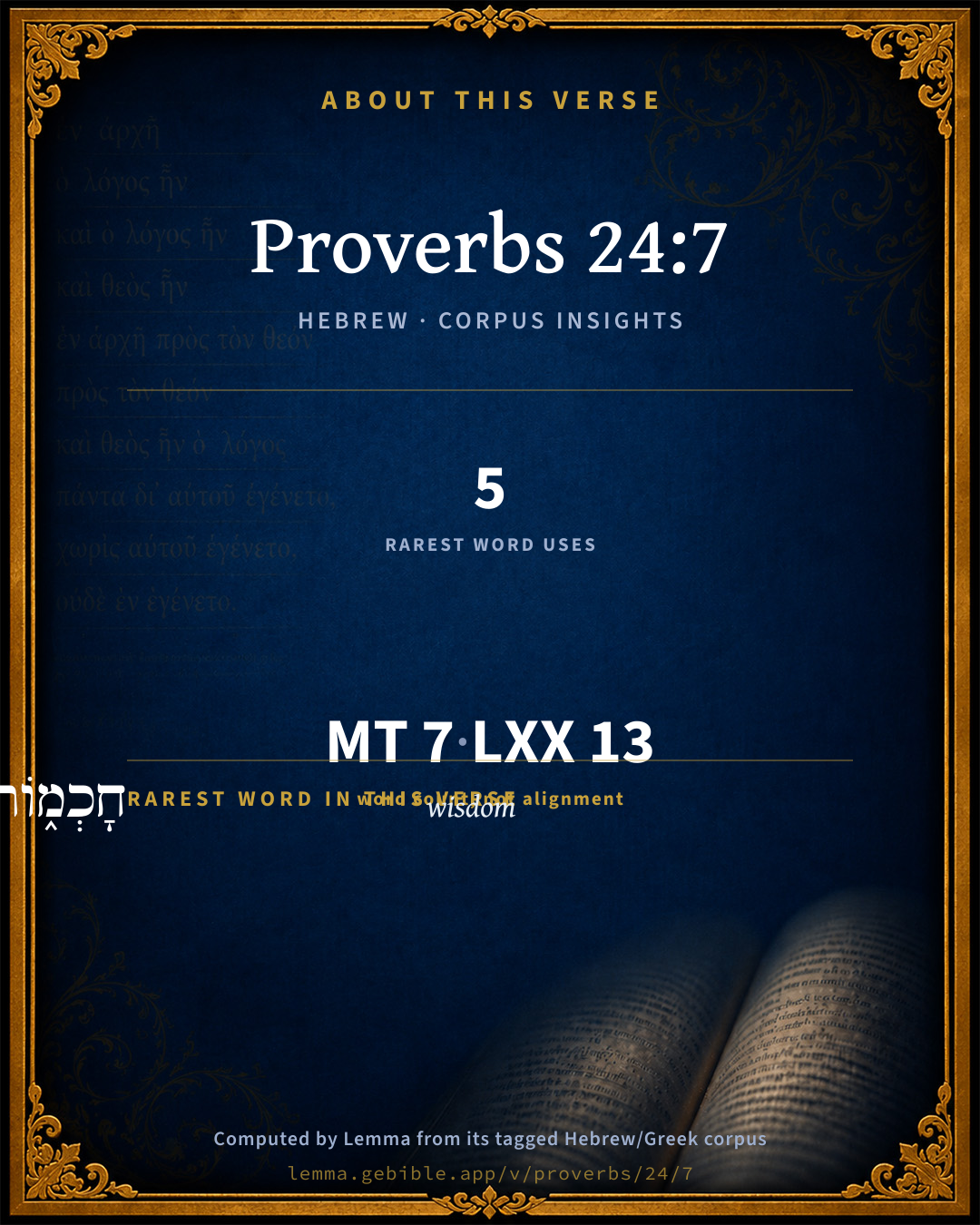
The rarest word here is חָכְמ֑וֹת wisdom H2454 — appearing just 5 times in the whole Hebrew Bible.

Shared distinctive vocabulary

חָכְמ֑וֹת wisdom H2454 occurs in 5 verses of the Hebrew Bible. Also found in:

Grammatical profile

  • 2 verbs
  • 3 nouns
  • 1 adjective
  • 1 particle

Verb forms

  • רָאמ֣וֹת Qal · Participle Active
  • יִפְתַּח Qal · Imperfect

Hebrew & Septuagint length

In English translation the verse runs 15 words from the Hebrew and 22 from the Septuagint (LXX English) — the Septuagint runs noticeably longer here. See the side-by-side →

A rough comparison of the two English renderings, which tokenize alike — not a word-level alignment.

Word counts can differ between the Hebrew and the Greek without any difference in meaning — e.g. the Hebrew direct-object marker אֵת has no separate Greek word, and Greek often adds the article ὁ.

In the original languages it is 7 Hebrew tokens and 13 Greek tokens — but the two are counted differently (Hebrew bundles its prefixes and suffixes into one token; the Greek is in lemma form), so that isn’t a like-for-like length.

Cross-references

15

Topical passages linked to Proverbs 24:7 in the Treasury of Scripture Knowledge — connected by theme and wording, ordered by reader-vote popularity; previews shown in the World English Bible.

  • Proverbs 14:6 A scoffer seeks wisdom, and doesn't find it, But knowledge comes easily to a discerning person.
  • Psalms 10:5 His ways are prosperous at all times; He is haughty, and your laws are far from his sight: As for all his adversaries, he sneers at them.
  • 1 Corinthians 2:14 Now the natural man doesn't receive the things of God's Spirit, for they are foolishness to him, and he can't know them, because they are spiritually discerned.
  • Job 5:4 His children are far from safety, They are crushed in the gate. Neither is there any to deliver them,
  • Job 29:7–25 When I went forth to the city gate, When I prepared my seat in the street,
  • Job 31:21 If I have lifted up my hand against the fatherless, Because I saw my help in the gate:
  • Psalms 92:5–6 How great are your works, Yahweh! Your thoughts are very deep.
  • Proverbs 15:24 The path of life leads upward for the wise, To keep him from going downward to Sheol.
  • Proverbs 17:24 Wisdom is before the face of one who has understanding, But the eyes of a fool wander to the ends of the earth.
  • Proverbs 22:22 Don't exploit the poor, because he is poor; And don't crush the needy in court;
  • Proverbs 31:8–9 Open your mouth for the mute, In the cause of all who are left desolate.
  • Isaiah 29:21 that make a man an offender in [his] cause, and lay a snare for him who reproves in the gate, and turn aside the just with a thing of nothing.
  • Amos 5:10 They hate him who reproves in the gate, And they abhor him who speaks blamelessly.
  • Amos 5:12 For I know how many your offenses, And how great are your sins-- You who afflict the just, Who take a bribe, And who turn aside the needy in the courts.
  • Amos 5:15 Hate evil, love good, And establish justice in the courts. It may be that Yahweh, the God of hosts, will be gracious to the remnant of Joseph."

Cross-references courtesy of OpenBible.info (CC BY 4.0).

Hebrew and Greek witnesses Masoretic Hebrew ↔ Greek Septuagint

The same verse in the two great witnesses to the Old Testament, shown verse-for-verse.

Here the Septuagint runs noticeably longer than the Hebrew — LXX2012 (modern English Septuagint) 22 words vs World English Bible 15. A rough length comparison of the two English translations, not a word-level alignment — read both below.

These are two independent witnesses, not word-aligned to each other, and the Septuagint is shown in lemma (dictionary) form.

Hebrew Proverbs 24:7 Masoretic · Westminster Leningrad Codex

רָאמ֣וֹת לֶֽאֱוִ֣יל חָכְמ֑וֹת בַּ֝שַּׁ֗עַר לֹ֣א יִפְתַּח פִּֽיהוּ

Wisdom is too high for a fool: He doesn't open his mouth in the gate.

World English Bible · Public Domain

Greek LXX Proverbs 24:7 Septuagint · lemma form

σοφία καί ἔννοια ἀγαθός ἐν πύλη σοφός σοφός οὐ ἐκκλίνω ἐκ στόμα κύριος

Wisdom and good understanding are in the gates of the wise: the wise turn not aside from the mouth of the Lord,

LXX2012 (modern English Septuagint) · Public Domain

On this verse, Matthew Henry's Commentary discusses the Septuagint’s reading. Read the note in Commentary ↓

Hebrew: Westminster Leningrad Codex (CC BY 4.0). Greek: Septuagint (public domain); English from LXX2012 (modern English Septuagint) (Public Domain). How the Septuagint differs from the Hebrew →

Commentary

Notes on Proverbs 24:7 from classic Christian and Jewish commentators (each source and its license shown beneath its notes). The classic Christian expositions comment on the surrounding passage and are grouped to its opening verse, so a note may address several verses; the Jewish commentaries on the Tanakh (Rashi and others) are per-verse, so they appear only where the commentator wrote on this verse.

Lemma curates 59 commentaries, every one of them public domain or Creative Commons licensed, each selected and text-cleaned for this edition rather than reprinted as found. About our sources →

Trapp's Complete Commentary

John Trapp

Pro 24:7 Wisdom [is] too high for a fool: he openeth not his mouth in the gate.

Ver. 7. Wisdom is too hard for a fool.] Heb., Too high; his pericranium comprehends it not, "neither indeed can" do. {1Co 2:14} He puts off the study of it, pretending the impossibility of reaching to it.

He openeth not his mouth in the gate.] He were two fools if he should, for while he holds his tongue he is held wise.

John Trapp, A Commentary or Exposition upon All the Books of the Old and New Testament (1647–1656) — public domain. Text from a community e-Sword module.

Joseph Benson's Commentary

Pro 24:7. Wisdom is too high for a fool — For a wicked man, whose sins enfeeble his mind, and make it incapable of wisdom. Or, he judges it too difficult for him to understand: he despairs of attaining it, because he will not put away his sins, and be at the trouble of using the means necessary in order to that end: as, on the contrary, wisdom is said to be easy to him that understandeth, Pro 14:6, because he seriously gives his mind to it, and therefore easily and certainly attains it. He openeth not his mouth in the gate — He knows not how to speak acceptably in the public assembly.

Joseph Benson's Commentary on the Old and New Testaments (1811–1818) — public domain. Text from a community e-Sword module.

The Preacher's Complete Homiletical Commentary

Joseph S. Exell (gen. ed.)

CRITICAL NOTES.—

Pro_24:7. Wisdom is too high, etc. Delitzsch here reads, Wisdom seems to the fool to be an ornamental commodity, and thinks “the comparison lies in the rarity, costliness, and unattainableness of wisdom.” “The word,” says Miller, “occurs but three times in the Bible; once in Job_28:18, translated coral; once in Eze_27:16, translated coral and agate; and once in this passage, where it ought to be translated coral again.” Some, from this rendering, understand the verse to signify that the fool uses wisdom like a precious stone, only for ornament.

Pro_24:8. Mischievous person, literally a master or lord of mischief.

Pro_24:9. The thought, etc., rather, “the device or undertaking.”

MAIN HOMILETICS OF Pro_24:7

A FALSE ESTIMATE AND A TRUE ONE

I. The fool’s estimate of wisdom. Solomon here gives the fool’s own reason for remaining in his folly, viz., that wisdom is difficult to acquire—that neither intellectual or spiritual knowledge can be gained without pains and self-denial. This is of course saying in effect that they are worthless, and this false estimate lies at the root of all ignorance, whether it be mental or moral. For if we can make a man feel that a thing is good and will bring him good, he will not be unwilling to seek to possess it, and his search and his pursuit will be diligent, and eager, and continuous, in proportion to the good which he believes the possession will bring to him. The idle schoolboy complains of the difficulty of his tasks, and of the severity of his teacher, because he does not rightly estimate the value of knowledge, and the moral fool finds fault with the methods of becoming spiritually wise, because he has no sense of the worth of such wisdom. But it must not be forgotten that the longer the fool makes the excuse of the text, the more true it becomes. The powers of the intellect, like those of the body, are less capable of use the longer they remain idle. If a healthy man is so indolent as to refuse to walk, his legs by long disuse may become unable to perform their office, and if the mental powers are left unexercised in youth, it is more difficult to use them to purpose in middle life. And it is so, too, with the spiritual perceptions and capabilities. Although it is never too late to acquire the highest wisdom, it certainly seems more out of the reach of the man who has neglected to seek it throughout a long life, than of him who gives to its pursuit the vigour and freshness of his youth.

II. The consequent estimate which wise men form of the fool. If men undervalue wisdom, they themselves are little valued, and their words and opinions have no weight with wise men. As it is a mark of folly generally to “open the mouth,” although nothing comes therefrom that is worth anything, the declaration that a fool “openeth not his mouth in the gate” must point, not to his own modesty or conscious inability to speak wisely, but to the estimation in which he is held by others.

OUTLINES AND SUGGESTIVE COMMENTS

In bodily things, the more weighty they are, the lower they fall; the lighter they are, the higher they go. Contrariwise is it in the things of the soul, and the more weighty they are, the higher they are; the lighter they are, the lower they lie. It is therefore the lightness of a fool’s brain that makes wisdom too high for him: the giddiness of his head is not able to look up unto the height of it.… Therefore St. Gregory saith, If thou wilt find wisdom, tread upon the waves of this world, and walk upon the waters of this life, as St. Peter did, and she will reach forth her right hand to thee, as she did to Peter.—Jermin.

Pro_24:8-9 treat of subjects which have occurred more than once before. See on chap. Pro_6:12-19, page 81.

The Preacher's Complete Homiletical Commentary (gen. ed. Joseph S. Exell; Funk & Wagnalls, c. 1892) — public domain (pre-1929). A full-Bible homiletical/sermon-outline anthology covering 65 of 66 books (2 John is absent from the source module). Text from a community e-Sword module.

Tyndale Open Study Notes

Tyndale Open Resources

24:7 Saying 22: Rulers should be wise (see 8:5-6).

Tyndale Open Study Notes — © Tyndale Open Resources, licensed CC BY-SA 4.0. Text via the HelloAO Bible API.

Geneva Bible (1599)

Geneva Bible translators

In the place where wisdom should be showed.

Geneva Bible (1599) marginal notes — public domain. Text via Bolls.life.

Matthew Henry's Commentary

Here is the description, 1. Of a weak man: Wisdom is too high for him; he thinks it so, and therefore, despairing to attain it, he will take no pains in the pursuit of it, but sit down content without it. And really it is so; he has not capacity for it, and therefore the advantages he has for getting it are all in vain to him. It is no easy thing to get wisdom; those that have natural parts good enough, yet if they be foolish, that is, if they be slothful and will not take pains, if they be playful and trifling, and given to their pleasures, if they be viciously inclined and keep bad company, it is too high for them; they are not likely to reach it. And, for want of it, they are unfit for the service of their country: They open not their mouth in the gate; they are not admitted into the council or magistracy, or, if they are, they are dumb statues, and stand for cyphers; they say nothing, because they have nothing to say, and they know that if they should offer any thing it would not be heeded, nay, it would be hissed at. Let young men take pains to get wisdom, that they may be qualified for public business, and do it with reputation. 2. Of a wicked man, who is not only despised as a fool is, but detested. Two sorts of wicked men are so: - (1.) Such as are secretly malicious. Though they speak courteously and conduct themselves plausibly, they devise to do evil, are contriving to do an ill turn to those they bear a grudge to, or have an envious eye at. He that does so shall be called a mischievous person, or a master of mischief, which perhaps was then a common name of reproach; he shall be branded as an inventor of evil things (Rom 1:30), or if any mischief be done, he shall be suspected as the author of it, or at least accessory to it. This devising evil is the thought of foolishness, Pro 24:9. It is made light of, and turned off with a jest, as only a foolish thing, but really it is sin, it is exceedingly sinful; you cannot call it by a worse name than to call it sin. It is bad to do evil, but it is worse to devise it; for that has in it the subtlety and poison of the old serpent. But it may be taken more generally. We contract guilt, not only by the act of foolishness, but by the thought of it, though it go no further; the first risings of sin in the heart are sin, offensive to God, and must be repented of or we are undone. Not only malicious, unclean, proud thoughts, but even foolish thoughts, are sinful thoughts. If vain thoughts lodge in the heart, they defile it (Jer 4:14), which is a reason why we should keep our hearts with all diligence, and harbour no thoughts there which cannot give a good account of themselves, Gen 6:5. (2.) Such as are openly abusive: The scorner, who gives ill-language to every body, takes a pleasure in affronting people and reflecting upon them, is an abomination to men; none that have any sense of honour and virtue will care to keep company with him. The seat of the scornful is the pestilential chair (as the Septuagint calls it, Psa 1:1), which no wise man will come near, for fear of taking the infection. Those that strive to make others odious do but make themselves so.

Matthew Henry's Commentary on the Whole Bible (1708–1710) — public domain (CC PDM 1.0). Text via the HelloAO Bible API.

Jamieson, Fausset & Brown

Robert Jamieson, A. R. Fausset & David Brown

(Compare Pro 14:16).

in the gate--(Compare Pro 22:22).

Jamieson, Fausset & Brown — Commentary Critical and Explanatory on the Whole Bible (1871) — public domain (CC PDM 1.0). Text via the HelloAO Bible API.

Adam Clarke's Commentary

Verse 7. A fool - openeth not his mouth in the gate.] Is not put into public offices of trust and responsibility.

Adam Clarke's Commentary on the Bible (1810–1826) — public domain. Text from a community e-Sword/MySword module.

Ellicott's Commentary for English Readers

(7) Wisdom is too high for a fool.—For “wisdom” (literally, wisdoms), comp. note on Pro_1:20. He has been too self-willed to learn; so while others express their opinions when the business or justice of his city is being transacted (see above on Pro_22:22) he has to remain sheepishly silent.

A Bible Commentary for English Readers, edited by Charles John Ellicott (1878–1897) — public domain. Text from a community e-Sword module.

The Cambridge Bible for Schools and Colleges

gen. ed. J. J. S. Perowne

7. too high] Lit. (unattainable) heights. The same Heb. word is rendered coral, Job_28:18; Eze_27:16; so that we might render here an unattainable treasure, or a gem beyond his reach.

openeth not his mouth, &c.] Contrast Job_29:7-10; Job_29:21-25.

The Cambridge Bible for Schools and Colleges (gen. ed. J. J. S. Perowne; Cambridge University Press, 1878–1918) — public domain. Text from a community e-Sword module.

John Gill's Exposition

He that deviseth to do evil shall be called a mischievous person To do evil is natural to men, all are prone to it; being conceived and born in sin, and, from the womb, more or less commit it: but for a man to sit down and contrive evil, as some men are inventors of evil things; contrive new sins, or at least new methods of sinning, such as new oaths, new games, new ways of tricking and deceiving men; and are always studying and devising ways and means of committing sin, and doing that which is evil in the sight of God and men. Such a man, with great propriety, may be called, and will be called by those that know him, a mischievous man, a very pernicious one, and to be shunned and avoided as such; men will reckon him and call him a "master" or "author (d) of evil devices", as it may be rendered; a name agreeable to his character.

(d) "patronum malarum cogitationum", Montanus; "dominum", Mercerus, Gejerus; "auctorem", Michaelis.

John Gill's Exposition of the Whole Bible (1746–1763) — public domain (CC PDM 1.0). Text via the HelloAO Bible API.

Albert Barnes' Notes on the Bible

In the gate - Compare the Pro 22:22 note.

Albert Barnes' Notes on the Bible (1834–1885) — public domain. Text from a community e-Sword/MySword module.

Haydock's Catholic Bible Commentary

High. Thus the fool excuses himself. But wisdom condescends to our weakness, if we be truly in earnest, Deuteronomy xxxii. 12. Mouth. To defend himself, or to give advice. (Calmet)

George Leo Haydock (1774–1849), Haydock's Catholic Family Bible and Commentary, 1859 edition — public domain. Excludes Psalms (Douay-Rheims chapter numbering differs from Protestant) and Deuterocanonical books (Catholic canon only).

Matthew Poole's English Annotations

Wisdom is too high for a fool; either,

1. Really, it is above his reach or capacity. Or,

2. In his opinion; he judgeth it too hard for him, he despairs of attaining it, he pretends the impossibility of it, because he will not put himself to the charge or trouble of getting it; as, on the contrary, wisdom is said to be easy to him that understandeth, Pro 14:6, because he seriously giveth his mind to it, and therefore easily and certainly attains to it.

For a fool; for a wilful fool, or a wicked man, whose lusts enfeeble and darken his mind, and make it incapable of wisdom.

He openeth not his mouth in the gate; either,

1. He can say nothing for himself when he is accused before the magistrate, for which he gives frequent occasion. Or,

2. He knows not how to speak acceptably and profitably in the public assembly among wise men.

Matthew Poole's English Annotations on the Holy Bible (1683–1685) — public domain. Text from a community e-Sword/MySword module.

Whedon's Commentary on the Bible

Daniel D. Whedon

7. Wisdom is too high for a fool — Is inaccessible to him; he cannot reach unto it.

Openeth not his mouth in the gate — Is not capable of pleading a cause in court, or of addressing a public assembly; is not intrusted with responsibility either as a judge or counseller. The “gates” of cities were the places of concourse and of the courts of justice. Compare Pro_22:22.

Daniel D. Whedon (gen. ed.), Commentary on the Old and New Testaments (1874–1909) — public domain. Text from a community e-Sword module.

The Pulpit Commentary

Vers. 7-10. Some distiches now follow, concerned with wisdom and its opposite.

Wisdom is too high for a fool. It is beyond his reach, he cannot follow its lead, and has nothing to say when his counsel is asked, and no ability to judge of any question presented to him. "Wisdom" (chochmoth) is in the plural number, intimating the various attributes connoted by it, or the different aspects in which it may be regarded. (see note on Pro_1:20) "Too high" (twOmar, ramoth) is also plural; and Delitzsch and Nowack take it to mean, not so much "high things" as "precious things," such as pearls or precious stones, in accordance with Job_28:18, "No mention shall be made of coral or of crystal; yea,. the price of wisdom is above rubies." In this sense Delitzsch translates, "Wisdom seems to the fool to be an ornamental commodity," a costly and unnecessary appendage, which is not worth the sacrifices entailed by its pursuit. Whichever way we take it, the point is the rarity and inaccessibility of wisdom, and the repugnance of fools to make any exertion in order to obtain it. St. Augustine thus sums up the steps by which wisdom is reached: fear of God, piety, knowledge, fortitude, mercifulness, sincerity ("De Doctr. Christ.," 2:7). He openeth not him month in the gate. When men gather in the usual place of assembly, (Pro_8:3 Pro_22:2) to take counsel on public matters, he has nothing to say; he listens fatuously, and is silent. Septuagint, "Wisdom and good thought are in the gates of the wise; the wise turn not aside from the mouth of the Lord, but reason in assemblies.

Vers. 7-10. Some traits of folly and sin.

I THE GROVELLING MIND. (Ver. 7) Wisdom is too high for the indolent to climb to, for the sensual and earthly to admire and love. They are like Muck-rake, in Bunyan"s parable. From such no good counsel ever comes. They are dumb "in the gate," on every important occasion, when help, light, sympathy, are needed. The base prudence which inspires many popular proverbs the prudence "which adores the rule of three, which never subscribes, never gives, seldom lends, and asks but one question of any project, "Will it bake bread? is indeed folly. "Self"s the man," says a Dutch proverb. But those who would gain all for self end by losing self and all.

II THE MALICIOUS TEMPER. (Ver. 8) There are degrees in vice as in virtue. It is a short step from grovelling egotism to active malice. Extract the root of self-seeking out of any dispute, private or public, in Church or state, and the other differences may soon be adjusted. To make mischief is a diabolic instinct, and it certainly springs up in the mind void of healthy occupation and of interest for the true, beautiful, and good; for the mind"s principle is motion, and it cannot cease to act.

III SIN IN THE THOUGHT AND THE MOOD. (Ver. 9) When busy invention and meditation are at work in the mind of the wicked and the fool, nothing good is produced. Still more is it the case with the scoffer. In him the ripened and practised powers of the mind are brought into alliance with evil desire. Such a habit of mind, once detected, excites the utmost odium and abhorrence. The man who can sneer at goodness, or hold what is by common consent good and beautiful in contempt, is already an outcast from his kind, and need not complain if he is treated as such.

IV COWARDLY FAINT HEARTEDNESS. (Ver. 10) The pressure of circumstances should rouse in us the God-given strength. The man who makes duty his polar star, and trusts in God, can actually do more when things seem to be against him than widen all is in his favour. Moral cowardice is closely connected with the root sin of unbelief. Indulgence in it impoverishes and weakens the soul, so that the man ends by being actually unable to do what once he only fancied himself unable to do. Here is an illustration of Christ"s saying, "To him that hath shall be given, and from him that hath not shall be taken that which he hath. J.

The Pulpit Commentary (1880–1919), ed. H.D.M. Spence-Jones & Joseph S. Exell — public domain. Text from a community e-Sword module.

John Wesley's Explanatory Notes

A fool - For a wicked man, whose sins enfeeble his mind, and make it incapable of wisdom. Openeth not - He knows not how to speak acceptably, and profitably in the publick assembly.

John Wesley, Explanatory Notes Upon the Whole Bible (1754–1765) — public domain. Text via the GEBible commentary corpus.

Keil & Delitzsch

C. F. Keil & F. Delitzsch

Till now in this appendix we have found only two distichs (vid., vol. i. p. 17); now several of them follow. From this, that wisdom is a power which accomplishes great things, it follows that it is of high value, though to the fool it appears all too costly.

7 Wisdom seems to the fool to be an ornamental commodity;

He openeth not his mouth in the gate.

Most interpreters take ראמות for רמות (written as at Ch1 6:58; cf. Zac 14:10; ראשׁ, Pro 10:4; קאם, Hos 10:14), and translate, as Jerome and Luther: "Wisdom is to the fool too high;" the way to wisdom is to him too long and too steep, the price too costly, and not to be afforded. Certainly this thought does not lie far distant from what the poet would say; but why does he say חכמות, and not חכמה? This חכמות is not a numerical plur., so as to be translated with the Venet.: μετέωροι τῷ ἄφρονι αἱ ἐπιστῆμαι; it is a plur., as Psa 49:4 shows; but, as is evident from the personification and the construction, Pro 1:20, one inwardly multiplying and heightening, which is related to חכמה as science or the contents of knowledge is to knowledge. That this plur. comes here into view as in chap. 1-9 (vid., vol. i. p. 34), is definitely accounted for in these chapters by the circumstance that wisdom was to be designated, which is the mediatrix of all wisdom; here, to be designated in intentional symphony with ראמות, whose plur. ending th shall be for that very reason, however, inalienable. Thus ראמות will be the name of a costly foreign bijouterie, which is mentioned in the Book of Job, where the unfathomableness and inestimableness of wisdom is celebrated; vid., Job 27:18, where we have recorded what we had to say at the time regarding this word. But what is now the meaning of the saying that wisdom is to the fool a pearl or precious coral? Jol Bril explains: "The fool uses the sciences like a precious stone, only for ornament, but he knows not how to utter a word publicly," This is to be rejected, because ראמות is not so usual a trinket or ornament as to serve as an expression of this thought. The third of the comparison lies in the rarity, costliness, unattainableness; the fool despises wisdom, because the expenditure of strength and the sacrifices of all kinds which are necessary to put one into the possession of wisdom deter him from it (Rashi). This is also the sense which the expression has when ראמות = רמות; and probably for the sake of this double meaning the poet chose just this word, and not פנינים, גבישׁ, or any other name, for articles of ornament (Hitzig). The Syr. has incorrectly interpreted this play upon words: sapientia abjecta stulto; and the Targumist: the fool grumbles (מתרעם) against wisdom.

(Note: This explanation is more correct than Levy's: he lifts himself up (boasts) with wisdom.)

He may also find the grapes to be sour because they hang too high for him; here it is only said that wisdom remains at a distance from him because he cannot soar up to its attainment; for that very reason he does not open his mouth in the gate, where the council and the representatives of the people have their seats: he has not the knowledge necessary for being associated in counselling, and thus must keep silent; and this is indeed the most prudent thing he can do.

Keil & Delitzsch — Biblical Commentary on the Old Testament (1861–1891) — public domain (CC PDM 1.0). Text via the HelloAO Bible API. (Old Testament only.)

Bridges on Proverbs

Charles Bridges

7 Wisdom†a is too high for a fool: he openeth not his mouth in the gate.

The commendation of wisdom is here continued. The man richly endowed with it comes forth with authority, and speaks at the gate among the wise. The fool, destitute of wisdom, is debarred from this honor. The simple†1 and diligent†2 prove, that the treasure is not really out of reach. But it is too high for the fool. His groveling mind can never rise to so lofty a matter. He has no apprehension of it;†3 no heart to desire it;†4 no energy to lay hold of it.†5 And therefore, though in the Gospel "it is nigh him, even in his mouth, and in his heart,"†6 it is inaccessible. Its holy spirituality is too high for his reach. He commands therefore no respect in his own station of society.†7 His counsel is not sought. His opinion, if given, is of no account. Though he may have a babbling tongue in the street, yet he openeth not his mouth in the gate; utterly unfit to give judgment in the presence of wise and judicious men. Nor is this from natural defect, but from willful perverseness. His Lord had committed at least one talent to his trust. But he had frittered it away, not traded with it. (Mat 25:24-30 .) Oh! let wisdom be sought, while it is within reach; while it is so freely promised. (Jas 1:5 .) When found, let it be diligently improved for the great end of life. What! if we should die without it, under the fearful responsibility of having done nothing for our God or fellow-creatures, of having neglected the way of life: and "in the greatness of our folly gone astray" to everlasting ruin? (Pro 5:23 .)

Footnotes:

†a Wisdoms. Heb. Psa 49:4 . Schultens, &c.

†1 Pro 8:9; Pro 14:6 . Mat 11:25 .

†2 Pro 2:1-6. Joh 7:17 .

†3 Psa 10:5; Psa 92:5-6 . 1Co 2:14 .

†4 Pro 17:16, Pro 17:24 .

†5 Pro 13:4; Pro 21:25 .

†6 Rom 10:6-8.

†7 Contrast Job 29:7-10 .

Charles Bridges, An Exposition of the Book of Proverbs (1846) — public domain. Text from a community e-Sword module.

Kretzmann's Popular Commentary

Paul E. Kretzmann

v. 7. Wisdom is too high, altogether unattainable, for a fool; he openeth not his mouth in the gate, he cannot be consulted by the leading men of the city as they deliberate upon the welfare of the community, their place of assembly being in the gate of the city or immediately inside the gate, where the open space was set aside for public meetings.

Paul E. Kretzmann, Popular Commentary of the Bible (1921–1924) — public domain. Text from a community e-Sword module.

unfoldingWord translationNotes

Door43 World Missions Community

General Information:

These verses continue the "thirty sayings" (Proverbs 22:20).

too high for a fool

This is an idiom. "too difficult for a fool to understand" (See: Idiom)

open his mouth

The mouth is a metonym for the words that come from the mouth. AT: "speak" (See: Metonymy)

translationWords

wise

fool

gate

unfoldingWord translationNotes — © Distant Shores Media and the Door43 World Missions Community, licensed CC BY-SA 4.0. Source: git.door43.org/Door43/en_tn.

Rashi

Rabbi Shlomo Yitzchaki (Rashi)

Wisdom is as pearls to the fool Heb. ראמות, a type of rare precious stone, as it is stated (Job 28: 18): “Pearls (ראמות) and beryls.” All wisdom appears to the fool as unattainable, [as difficult] to purchase as precious stones and pearls, saying, ‘’How will I learn Torah? When will I attain it?” But the wise man studies a little today and a little tomorrow.

Rashi on the Tanakh — English translations: “The Judaica Press complete Tanach with Rashi, translated by A. J. Rosenberg” (CC BY 4.0); “Pentateuch with Rashi's commentary by M. Rosenbaum and A.M. Silbermann, 1929-1934” (public domain); “The Metsudah Tanach series, Lakewood, N.J” (CC BY 4.0); and “The Book of Joshua, Metsudah Publications, 1997” (CC BY 4.0). Text via Sefaria.

Lesson kit

Teaching starters — assembled from the data on this page, not authored interpretation. Every prompt links to the verse data it draws on. Edit before teaching.

Proverbs, in the Wisdom, opens this verse with 7 words (7 distinct Hebrew lemmas). Its most distinctive word is chokmôwth (“wisdom”). The Greek Septuagint runs longer here. A historical commentator’s framing appears above. Read the whole chapter for the surrounding context.

Discussion questions

  1. The word chokmôwth carries the sense “wisdom.” How does it shape the verse?
  2. Psalms 49:3 shares the word «wisdom» with this verse. How do the two illuminate each other?
  3. Compared with the Hebrew, the Septuagint runs longer here. What questions does that raise?
  4. These translations render this verse differently; the difference is in the English rendering, not the original. What questions does that raise?
  5. The verb «רָאמ֣וֹת» is Qal Participle Active. How does its form color the action?
  6. Reading how Trapp's Complete Commentary and Joseph Benson's Commentary read this verse, where do the two commentators agree and where do they part?

Things to notice

Reading settings

Reading text

Shown beneath each verse's original-language words.

Old Testament
Old Testament edition

Read the OT as the Masoretic Hebrew (MT) or the Greek Septuagint (LXX).

English shown for the Greek Septuagint (in the Hebrew ↔ Greek comparison).

Comparing translations? Open the Compare panel on any verse page to stack up to four side by side.