Isaiah 38:10

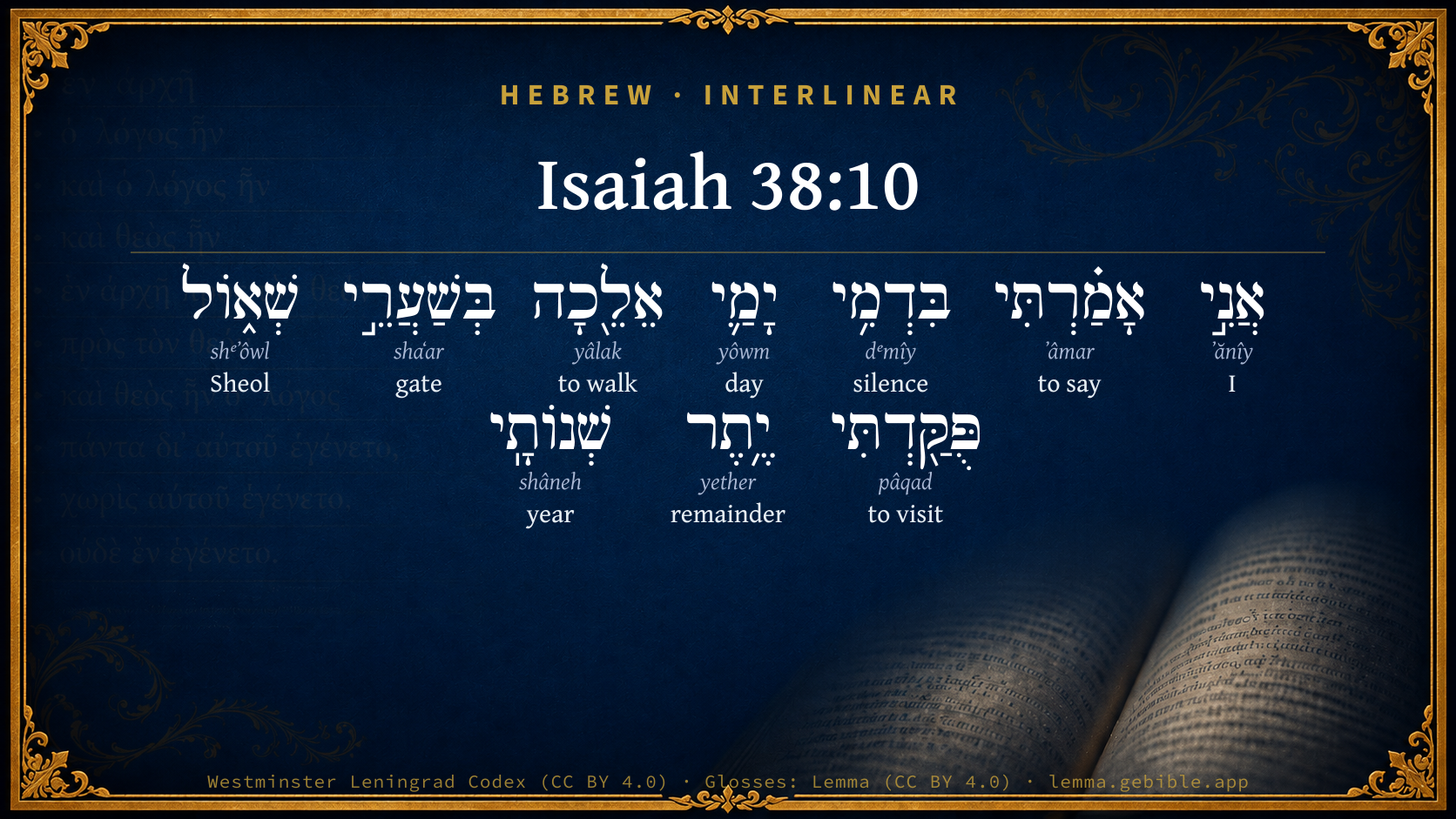
Hebrew (Westminster Leningrad Codex) Isaiah 38:10 appears in the Hebrew Old Testament. The text above is from the Westminster Leningrad Codex. Each word links to its Strong’s number, a concise gloss, and parsing drawn from the Open Scriptures Hebrew Bible morphology. Click any word for its full Brown-Driver-Briggs (BDB) entry.
Download image
Cite this verse

Isaiah 38:10 (World English Bible). Public Domain. Lemma interlinear Bible study tool, https://lemma.gebible.app/v/isaiah/38/10.

Show BibTeX & RIS
BibTeX
RIS
English Translation
I said, In the noontide of my days I shall go into the gates of Sheol: I am deprived of the residue of my years.
World English Bible · Public Domain
Download a study sheet

One document with this verse’s original text, its word-by-word gloss line, the meaning frame, cross-references with their text, attributed commentary, and full source and license credits — printable, and it pastes into notes with its structure intact.

This verse Autodidact and up

Study sheet (.html) Plain text (.txt)

A passage Seminary Student

Up to 50 verses in one chapter. A passage sheet keeps up to 6 commentary sources and 12 cross-references per verse, in the order this page ranks them, and says so on the sheet whenever that leaves anything out. Ask for a single verse and you get the Autodidact verse sheet above.

Everything on this page stays free to read, with no account — the sheet is a download of what is already on screen, not access to it.

Want to remove ads? Support Godless Engineer
Compare translations 3

The same verse in 3 English versions, stacked beneath the original-language interlinear above. Click any original word for its lexicon entry.

Each is an independent rendering of the whole verse — the interlinear is not word-aligned to these translations.

Highlighted words mark where these versions differ — a whole-verse word diff, not a word-by-word alignment.

  • World English Bible Public Domain
    I said, In the noontide of my days I shall go into the gates of Sheol: I am deprived of the residue of my years.
  • King James Version Public Domain
    I said in the cutting off of my days, I shall go to the gates of the grave: I am deprived of the residue of my years.
  • unfoldingWord Literal Text CC BY-SA 4.0
    I, I said, “In the quiet of my days I will go into the gates of Sheol; I am visited the remainder of my years.”

unfoldingWord Literal Text — © unfoldingWord, licensed CC BY-SA 4.0. Word-aligned USFM3 via Door43 (git.door43.org/unfoldingWord/en_ult).

Versions to compare (up to 4)

3 of 4 selected

Show all 18 translations

Every available English version of this verse, each an independent rendering of the whole verse.

  • World English Bible Public Domain
    I said, In the noontide of my days I shall go into the gates of Sheol: I am deprived of the residue of my years.
  • Berean Standard Bible Public Domain
    I said, “In the prime of my life I must go through the gates of Sheol and be deprived of the remainder of my years.”
  • Majority Standard Bible Public Domain
    I said, “In the prime of my life I must go through the gates of Sheol and be deprived of the remainder of my years.”
  • King James Version Public Domain
    I said in the cutting off of my days, I shall go to the gates of the grave: I am deprived of the residue of my years.
  • American Standard Version (1901) Public Domain
    I said, In the noontide of my days I shall go into the gates of Sheol: I am deprived of the residue of my years.
  • Revised Version (1885) Public Domain
    I said, In the noontide of my days I shall go into the gates of the grave: I am deprived of the residue of my years.
  • Geneva Bible (1599) Public Domain
    I saide in the cutting off of my dayes, I shall goe to the gates of the graue: I am depriued of the residue of my yeeres.
  • Douay-Rheims (1899) Public Domain
    I said: In the midst of my days I shall go to the gates of hell: I sought for the residue of my years.
  • Young's Literal Translation Public Domain
    `I -- I said in the cutting off of my days, I go in to the gates of Sheol, I have numbered the remnant of mine years.
  • Literal Standard Version CC BY-SA 4.0
    “I said in the cutting off of my days, || I go to the gates of Sheol, || I have numbered the remnant of my years.
  • Unlocked Literal Bible CC BY-SA 4.0
    “I said that halfway through my life I will go through the gates of Sheol; I am sent there for the rest of my years.
  • unfoldingWord Literal Text CC BY-SA 4.0
    I, I said, “In the quiet of my days I will go into the gates of Sheol; I am visited the remainder of my years.”
  • Darby Bible Public Domain
    I said, In the meridian of my days I shall go to the gates of Sheol: I am deprived of the rest of my years.
  • World Messianic Bible Public Domain
    I said, “In the middle of my life I go into the gates of Sheol. I am deprived of the residue of my years.”
  • Webster's Bible Public Domain
    I said in the cutting off of my days, I shall go to the gates of the grave: I am deprived of the residue of my years.
  • Free Bible Version CC BY-SA 4.0
    I said to myself, “Do I have to go to my death just as my life is going well? Why can't I count on the rest of my years?”
  • Bible in Basic English Public Domain
    I said, In the quiet of my days I am going down into the underworld: the rest of my years are being taken away from me.
  • JPS Tanakh (1917) Public Domain
    I said: In the noontide of my days I shall go, even to the gates of the nether-world; I am deprived of the residue of my years.

Literal Standard Version (2020), Covenant Press — licensed CC BY-SA 4.0. Text via the HelloAO Bible API (eBible.org). Unlocked Literal Bible (unfoldingWord) — licensed CC BY-SA 4.0. Text via the HelloAO Bible API (eBible.org). unfoldingWord Literal Text — © unfoldingWord, licensed CC BY-SA 4.0. Word-aligned USFM3 via Door43 (git.door43.org/unfoldingWord/en_ult). Free Bible Version, Dr. Jonathan Gallagher — licensed CC BY-SA 4.0. Text via the HelloAO Bible API (eBible.org).

Word by word

More ways to search: Search by grammar → Find every occurrence → Compare this word →

Practice this passage: Drill this verse → Learn its vocabulary →

בִּדְמִ֥י
dᵉmîy
H1824
“in/at · silence of”
Preposition + Noun, Common, Masculine, Singular, Construct
Part of Speech
Preposition + Noun
Type
Common
Gender
Masculine
Number
Singular
State
Construct
Full BDB Definition

Origin: from H1820

TWOT: 438a

cessation, quiet, rest, silence, pause, peacefulness
  1. אֲנִ֣י ʼănîy H589 “I” Pronoun, Personal, 1st Person, Common, Singular
  2. אָמַ֗רְתִּי ʼâmar H559 “to say” Verb, Qal, Perfect, 1st Person, Common, Singular
  3. יָמַ֛י yôwm H3117 “days · my” Noun, Common, Masculine, Plural, Construct + Suffix, Personal, 1st Person, Common, Singular
  4. אֵלֵ֖כָה yâlak H3212 “to walk” Verb, Qal, Imperfect, 1st Person, Common, Singular
  5. בְּשַׁעֲרֵ֣י shaʻar H8179 “in/at · gates of” Preposition + Noun, Common, Masculine, Plural, Construct
  6. שְׁא֑וֹל shᵉʼôwl H7585 “Sheol” Noun, Proper
  7. פֻּקַּ֖דְתִּי pâqad H6485 “to visit” Verb, Pual, Perfect, 1st Person, Common, Singular
  8. יֶ֥תֶר yether H3499 “remainder of” Noun, Common, Masculine, Singular, Construct
  9. שְׁנוֹתָֽי shâneh H8141 “years · my” Noun, Common, Feminine, Plural, Construct + Suffix, Personal, 1st Person, Common, Singular

About this verse

These counts appear in no published source. They are computed here, from the morphology-tagged text and Lemma’s own curated glosses. What Lemma adds →

10
words
10
distinct lemmas
Prophets
section

Notable vocabulary

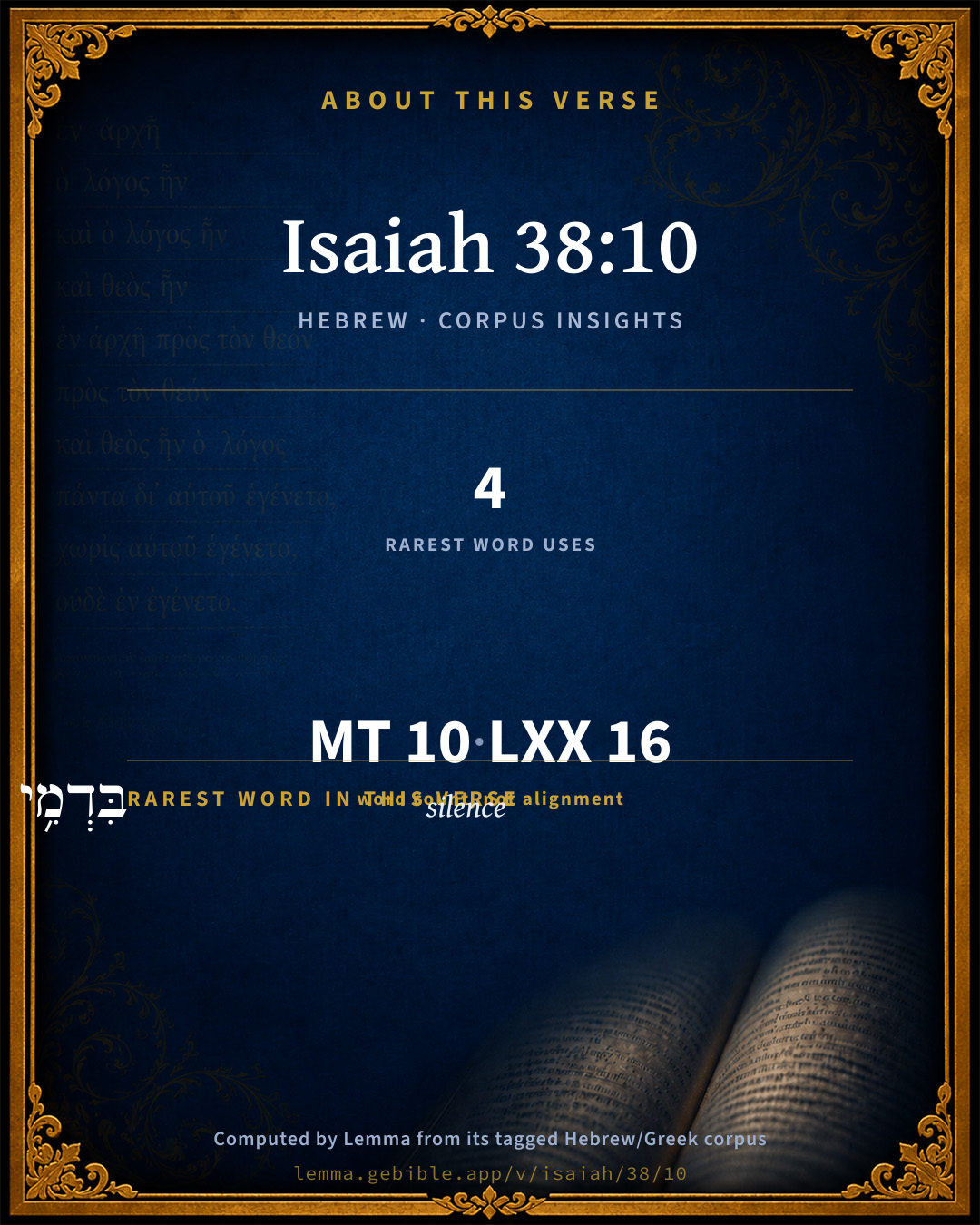
The rarest word here is בִּדְמִ֥י silence H1824 — appearing just 4 times in the whole Hebrew Bible.

Shared distinctive vocabulary

בִּדְמִ֥י silence H1824 occurs in 4 verses of the Hebrew Bible. Also found in:

Grammatical profile

  • 3 verbs
  • 6 nouns
  • 1 pronoun

Verb forms

  • אָמַ֗רְתִּי Qal · Perfect
  • אֵלֵ֖כָה Qal · Imperfect
  • פֻּקַּ֖דְתִּי Pual · Perfect

Hebrew & Septuagint length

In English translation the verse runs 25 words from the Hebrew and 26 from the Septuagint (LXX English) — closely comparable.

A rough comparison of the two English renderings, which tokenize alike — not a word-level alignment.

Word counts can differ between the Hebrew and the Greek without any difference in meaning — e.g. the Hebrew direct-object marker אֵת has no separate Greek word, and Greek often adds the article ὁ.

In the original languages it is 10 Hebrew tokens and 16 Greek tokens — but the two are counted differently (Hebrew bundles its prefixes and suffixes into one token; the Greek is in lemma form), so that isn’t a like-for-like length.

Cross-references

7

Topical passages linked to Isaiah 38:10 in the Treasury of Scripture Knowledge — connected by theme and wording, ordered by reader-vote popularity; previews shown in the World English Bible.

  • Psalms 102:24 I said, "My God, don't take me away in the midst of my days. Your years are throughout all generations.
  • 2 Corinthians 1:9 Yes, we ourselves have had the sentence of death within ourselves, that we should not trust in ourselves, but in God who raises the dead,
  • Job 7:7 Oh remember that my life is a breath. My eye shall no more see good.
  • Psalms 107:18 Their soul abhors all kinds of food. They draw near to the gates of death.
  • Job 6:11 What is my strength, that I should wait? What is my end, that I should be patient?
  • Job 17:11–16 My days are past, my plans are broken off, As are the thoughts of my heart.
  • Isaiah 38:1 In those days was Hezekiah sick to death. Isaiah the prophet the son of Amoz came to him, and said to him, Thus says Yahweh, Set your house in order; for you shall die, and not live.

Cross-references courtesy of OpenBible.info (CC BY 4.0).

Hebrew and Greek witnesses Masoretic Hebrew ↔ Greek Septuagint

The same verse in the two great witnesses to the Old Testament, shown verse-for-verse.

These are two independent witnesses, not word-aligned to each other, and the Septuagint is shown in lemma (dictionary) form.

Hebrew Isaiah 38:10 Masoretic · Westminster Leningrad Codex

אֲנִ֣י אָמַ֗רְתִּי בִּדְמִ֥י יָמַ֛י אֵלֵ֖כָה בְּשַׁעֲרֵ֣י שְׁא֑וֹל פֻּקַּ֖דְתִּי יֶ֥תֶר שְׁנוֹתָֽי

I said, In the noontide of my days I shall go into the gates of Sheol: I am deprived of the residue of my years.

World English Bible · Public Domain

Greek LXX Isaiah 38:10 Septuagint · lemma form

ἐγώ εἶπον ἐν ὁ ὕψος ὁ ἡμέρα ἐγώ ἐν πύλη ᾅδης καταλείπω ὁ ἔτος ὁ ἐπίλοιπος

I said in the end of my days, I shall go to the gates of the grave: I shall part with the remainder of my years.

LXX2012 (modern English Septuagint) · Public Domain

On this verse, Albert Barnes' Notes on the Bible discusses the Septuagint’s reading. Read the note in Commentary ↓

Hebrew: Westminster Leningrad Codex (CC BY 4.0). Greek: Septuagint (public domain); English from LXX2012 (modern English Septuagint) (Public Domain). How the Septuagint differs from the Hebrew →

Targum (Aramaic paraphrase)

1

The Targum is the ancient Jewish Aramaic paraphrase of the Hebrew Scriptures — an interpretive translation, not the Hebrew text itself. Onkelos (literal) and Pseudo-Jonathan (expansive) render the Torah, and Jonathan the Prophets. Coverage is partial: where no permissively-licensed English translation exists for a verse, only the Aramaic is shown. This is verse-level text, not a word-by-word alignment to the Hebrew.

  1. Targum Jonathan Prophets (Joshua–Malachi)
    אֲנָא אֲמָרֵית בִּדְוָן יוֹמֵי אֱהַךְ בְּתַרְעֵי שְׁאוֹל עַל דָכְרָנִי לְטַב אִתּוֹסַף עַל שְׁנָי:

    I said in the sorrow of my days, I shall go into the gates of the grave; but because He remembered me for good, an addition hath been made to my years.

    Targum Jonathan — Aramaic: “Mikraot Gedolot” (public domain). English: “Sefaria Community Translation” (CC0 1.0 (public-domain dedication)); “London "Chaldee Paraphrase," 1871” (public domain). Text via Sefaria.

Commentary

Notes on Isaiah 38:10 from classic Christian and Jewish commentators (each source and its license shown beneath its notes). The classic Christian expositions comment on the surrounding passage and are grouped to its opening verse, so a note may address several verses; the Jewish commentaries on the Tanakh (Rashi and others) are per-verse, so they appear only where the commentator wrote on this verse.

Lemma curates 59 commentaries, every one of them public domain or Creative Commons licensed, each selected and text-cleaned for this edition rather than reprinted as found. About our sources →

Trapp's Complete Commentary

John Trapp

Isa 38:10 I said in the cutting off of my days, I shall go to the gates of the grave: I am deprived of the residue of my years.

Ver. 10. I said in the cutting off of my days.] When I looked upon myself as a dead man. Here he telleth us what passed between God and him while he lay desperately sick. The utmost of a danger escaped is to be recognised and recorded. This will both instruct the judgment, enlarge the heart, and open the mouth.

I shall go to the gates of the grave.] He maketh the grave to have gates, either by a poetic fiction, or else by a proverbial expression. So "the gates of death." {Psa 9:13; Psa 107:18 1Sa 2:6}

I am deprived of the residue of my years,] sc., That I might have lived in a natural course. Vox haec queritantis quidem est: Quis enim vult mori? prorsus nemo. Nature shunneth death as its slaughter man.

John Trapp, A Commentary or Exposition upon All the Books of the Old and New Testament (1647–1656) — public domain. Text from a community e-Sword module.

The Biblical Illustrator

Joseph S. Exell

Isa_38:10

I shall go to the gates of the grave

Views of the grave

1.

It was doubtless from veneration for the dead, that the practice first arose of depositing their ashes around the temple where the living worship. That dust, which once was tenanted by an immortal spirit,--that dust, through which once the intelligence and the feelings of an immortal spirit shone,--becomes in itself hallowed to the fancy. Collecting it around the place which most we honour, we trust that we remove it beyond the reach of profane intrusion.

2. To the Christian there appears a peculiar propriety in this simple and affecting arrangement. The dust of the departed is doubly valuable in the Christians regard, who knows that this mortal is destined to put on immortality. In placing it near the temple of our God, we seem to express our humble confidence in the promise which He hath given; we seem to leave it under His own especial protection.

3. The practice which arose from reverence for the dead, is powerfully enforced by its usefulness to the living. If we would listen to the thought, there is in it eloquence irresistible, that around the place where we assemble to worship our God, the ashes of our fathers and of our brethren sleep. We act the part of fools when we banish from our minds any theme, uninviting though its aspect be, by which our spiritual welfare might he so essentially advanced. (A. Brunton, D. D.)

Appeals of the grave

1. Come hither, ye proud! Look around you on this scene of universal stillness, and show us the trace of those distinctions in which you glory. Tell us which is noble and which is vulgar dust l

2. Come hither, ye who value yourselves upon the graces of your outward form. Have you courage to meet the aspect here of that which late was lovely?

3. Come hither, ye votaries of wealth; and show us in this receptacle of human dust, what advantages have gone down to the grave with him who preceded you in your anxious labours. The riches of this world descend not into the grave. But there are treasures of which the value outlives the tomb.

4. Children of intemperance and folly, those who once were your associates in riot, are laid in the grave. Silent is now the wit that was to charm for ever; and quenched the smile that was never to fade! Are you prepared for a change like this?

5. Son of wisdom, and holiness, and piety, thine associates also are sleeping here.

6. Come hither, and stand by this new-formed grave. It is the grave of thine enemy. He cannot harm thee now. Thou mournest to think that the remembrance of injuries which he had done or suffered may have agonised his deathbed. Thou shudderest at the thought, either that he died execrating and abhorring thee, or suing for reconciliation and peace in vain; that the departing spirit may have gone hence, unforgiving or unforgiven. Is there, then, one to whom, at this moment, thou bearest enmity? Go, while yet the lesson is warm upon thy heart, leave thy gift before the altar, &c.

7. Reverence and attachment lead thee onward to the spot where the instructor of thy youth, the guide of thy childhood, lies. All the lessons of his wisdom rush upon thy remembrance, as thou standest by his grave. Improve the moment,--it is rich in usefulness.

8. The scene around may well rouse thee to self-examination. For, see, here is laid thine equal in age. He began with thee the career of life, gay and careless as thyself. The same with thine own were his pursuits. The same with thine own were his hopes. Seest thou that vacant space by his side? God only knows, how soon thou mayest be called to fill it. In this land of shadows one thing is certain,--it is death; one thing is needful,--it is an interest in Him who hath vanquished death and the grave. (A. Brunton, D. D.)

The gates of the grave

The region of the grave is bounded. God keeps the gates.

I. ALL MENS DREAD. Through--

1. Sin.

2. Natural fear of the unknown.

3. Want of faith.

II. ALL MENS DESTINY.

1. Certain.

2. Men may approach these gates and return, but once passed they are passed for ever.

3. They are the portals of endless joy or woe. (W. O. Lilley.)

I am deprived of the residue of my years

The shortening of human life

The words of the text naturally suggest this general observation: that God deprives many of the human race of the residue of their years.

I. CONSIDER WHEN GOD DOES THIS.

1. God deprives all those of the residue of their years whom He calls out of the world before they have reached the limits of life which are to be found in Scripture.

2. Whom He calls out of the world before they have reached the bounds of life fixed by Providence. Though the Scriptures limit life to seventy or eighty years, yet Providence oftens extends it to a longer period.

3. Who die before they have reached the bounds of life which are imposed by the laws of nature. Nature sets bounds to every kind of life in this world. All, therefore, who die by sickness, or accident, or violence, or any other cause than the course of nature, are really deprived of the residue of their days.

II. Inquire WHY GOD THUS SHORTENS THE LIVES OF MEN.

1. To teach the living that He is not dependent upon them in the least degree.

2. To teach mankind their constant and absolute dependence upon Himself.

3. To teach the living the necessity of being continually prepared for another life.

4. To teach the living the importance of faithfully improving life as long as they enjoy it.

5. God may sometimes cut short the days of the wicked to prevent their doing evil in time to come.

6. God may sometimes shorten the lives of His faithful servants to prevent their seeing and suffering public calamities.

III. IMPROVEMENT.

1. If God does not always deprive men of the residue of their years, but allows some to reach the bounds of nature, then there is propriety in praying for the lives of the aged as well as of the young.

2. If God so often deprives men of the residue of their years, then it is extremely unreasonable and dangerous to flatter ourselves with the hopes of living a great while in the world.

3. We ought to beware of placing too much dependence upon the lives of others, as well as upon our own.

4. Long life is a great as well as distinguishing favour.

5. If God always has wise and good reasons for depriving men of the residue of their years, then it is as reasonable to submit to His providence in one instance of mortality as another. (N. Emmons, D. D.)

The residue of years

Life has crises. Men often feel as if life were re-given. Wisdom is born in such hours. The residue of life is regarded with reverence. The residue of year

I. ARE, WITH US, UNCERTAIN.

II. SHOULD BE GUIDED BY THE EXPERIENCES OF PAST YEARS.

III. SHOULD BE MOST SERENE AND HAPPY.

IV. SHOULD BE MOST PIOUS AND FRUITFUL IN GOOD TO OTHERS. (W. O.Lilley.)

The Biblical Illustrator, edited by Joseph S. Exell (c. 1880s–1900s) — public domain. Text from a community e-Sword module.

Joseph Benson's Commentary

Isa 38:10-11. I said — Within myself; I concluded, in the cutting off of my days — When my days were cut off by the sentence of God, related Isa 38:1; I shall go to the gates of the grave — I perceive that I must die without any hopes of prevention. The grave is called man’s long home, Ecc 12:5; and the house appointed for all living, Job 30:23; and death opens the gates of this house. I am deprived of the residue of my years — Which I might have lived according to the common course of nature, and of God’s dispensations; and which I hoped to live for the service of God and of my generation. I shall not see the Lord — I shall not behold his beauty and glory as he manifests them in his temple, in his oracles and ordinances; I shall not enjoy him: for seeing is frequently put for enjoying; even the Lord in the land of the living — In this world, which is often so called; which limitation is prudently added, to intimate that he expected to see God in another place and manner, on the other side death; but he despairs of seeing him any more on this side death, as he had seen him in the sanctuary, Psa 63:2. I shall behold man no more. &c. — I shall have no more society with men upon earth. Many good men, under the law, had but imperfect notions of a future state, and thought it a great unhappiness to be deprived, by death, of the communion of saints here upon earth. But by not seeing the Lord in the land of the living, Hezekiah might probably mean that he should not see the effects of God’s grace and goodness in the deliverance of his people.

Joseph Benson's Commentary on the Old and New Testaments (1811–1818) — public domain. Text from a community e-Sword module.

The Preacher's Complete Homiletical Commentary

Joseph S. Exell (gen. ed.)

THE SHORTENING OF HUMAN LIFE

(A Funeral Sermon.)

Isa_38:10. I am deprived of the residue of my years.

Briefly narrate the facts of Hezekiah’s illness. The words of the text naturally suggest this general observation, that God deprives many of the human race of the residue of their years.

I. WHEN GOD DEPRIVES ANT OF MANKIND OF THE RESIDUE OF THEIR YEARS.

1. When He calls them out of the world before they have reached the limits of life which are to be found in Scripture (Psa_90:10). Hezekiah undoubtedly numbered his years according to this standard when he spoke (at forty years of age) of being deprived of the residue of his years.

2. When He calls them out of the world before they have reached the bounds of life fixed by Providence. Though the Scriptures limit life to seventy or eighty years, yet Providence often extends it to a longer period, even to a century. Many aged persons enjoy a large measure of health, strength, and activity; should any of these be suddenly cut down by disease or accident, they would be deprived of the residue of their years which they had anticipated, according to the course of Divine providence in fixing the limits of life to the aged.

3. Even those who die before they have reached the bounds of life which are imposed by the laws of Nature, may be said to be deprived of the residue of their days. Nature sets bounds to every kind of life in this world, not excepting human life. What the natural limit of human life is we cannot tell, but from the fact that some have survived for over a century and a half, we may infer that God has deprived the vast majority of the human race of the residue of their years, and has not allowed even one in a million to reach the bounds of life which Nature has set.

II. WHY GOD THUS SHORTENS THE LIVES OF MEN AND CUTS OFF THEIR EXPECTED YEARS.

1. Sometimes it is to teach the living that He is not dependent upon them in the least degree. Though He can and does employ them in His service, yet He can lay them aside whenever He pleases, and carry on His designs without their assistance. Let eminent and useful men like Hezekiah remember this, that they may not yield to the temptation of pride (H. E. I. 2218–2219).

2. In order to teach mankind their constant and absolute dependence upon Himself. This they are extremely inclined to forget, and their forgetfulness arises in a great measure from the consideration of the general bounds of life which Scripture, Providence, and Nature have set. To these well-known periods they naturally extend their views, desires, and expectations. But to make them sensible that they still live, move, and have their being in Himself, God continually deprives one and another, and much the largest portion of mankind, of the residue of their years.

3. To teach the living the necessity of being continually prepared for another life (H. E. I. 1543–1546).

4. To teach the living the importance of faithfully improving life as long as they enjoy it. All men are naturally slothful and strongly inclined to postpone present duties to a more convenient season. The best and most industrious of men need the sharp spur of the possibility of sudden death, and of being called away before their work is complete. When God cuts down the active and useful in the midst of their days, He warns us most solemnly (Ecc_9:10; H. E. I. 1562–1566).

5. God sometimes cuts short the days of the wicked to prevent their doing evil in time to come (Psa_55:23; Pro_10:27; Ecc_7:17).

6. God sometimes shortens the lives of His faithful servants to prevent their seeing and suffering public calamities. It seems to have been in mercy to Hezekiah that God added only fifteen years to his life; had fifty years been added (and then at death he would only have been ninety), he would have been involved in the dreadful evils which were coming upon both his family and his kingdom (Isa_57:1).

APPLICATION.—

1. If God does not always deprive men of the residue of their years, there is a propriety in praying for the lives of the aged as well as for the lives of the young. Even the oldest persons living, though labouring under pains, infirmities, and diseases which seem to indicate the near approach of death, may yet pray for the removal or mitigation of their disorders, and for a longer space of life. Life is a blessing, and to pray for its continuance is a duty.

2. If God so often deprives men of the residue of their years, it is extremely unreasonable and dangerous to flatter ourselves with the hope of living a great while in the world. What ground have we to expect that our days will be greatly prolonged; that we shall escape all the dangers and diseases which have proved so fatal to others, and live as long as man can live according to the course of nature? This expectation is as dangerous as it is absurd. It encourages the wicked to continue in sin. It is the strangest and most fatal error that mankind ever embraced (Jas_4:14; Mat_22:44).

3. Since God deprives so many of the residue of their years, we ought to beware of placing too much dependence upon the lives of others, as well as of our own. Others are as liable to leave us as we are to leave them (Psa_146:3-5).

4. If God so often deprives men of the residue of their years, then long life is a great as well as a distinguishing favour. It is a talent capable of being improved to the highest public and private advantage. We should desire it for the sake of having greater opportunity of getting good, and still more of doing good. Had Hezekiah, Joseph, Joshua, Caleb, and David died in early manhood, how little comparatively they could have done for Israel! Since good men are to be rewarded according to their works, the longer they are permitted to live, the greater opportunity they enjoy of promoting their own future blessedness.

5. If God always has wise and good reasons for depriving men of the residue of their years, then it is as reasonable to submit to His providence in one instance of mortality as another. He knows all the disappointment which a strong man feels in being cut down in the midst of his days, all acute sorrow that is caused by an untimely death, and He sympathises with it all. He never afflicts willingly, nor grieves the children of men; He takes no pleasure in giving anxiety and distress to the dying, nor in desolating the hearts of the living; and when He does either, it is for a reason that is infinitely wise and infinitely kind. It behoves us then to say with Job: (Isa_13:15, or Isa_1:21).—Dr. Emmons: Works, vol. iii. pp. 79–92.

The Preacher's Complete Homiletical Commentary (gen. ed. Joseph S. Exell; Funk & Wagnalls, c. 1892) — public domain (pre-1929). A full-Bible homiletical/sermon-outline anthology covering 65 of 66 books (2 John is absent from the source module). Text from a community e-Sword module.

Tyndale Open Study Notes

Tyndale Open Resources

38:10 enter the place of the dead? (literally enter the gates of Sheol?): This image comes from an ancient idea that people enter death through gates (see 14:9). Old Testament believers did not understand the afterlife as the New Testament reveals it. It was a shadowy place where all the dead were together and where no praise of God existed (see 38:18; Pss 88:10; 115:17).

Tyndale Open Study Notes — © Tyndale Open Resources, licensed CC BY-SA 4.0. Text via the HelloAO Bible API.

Geneva Bible (1599)

Geneva Bible translators

At what time it was told me, that I should die.

Geneva Bible (1599) marginal notes — public domain. Text via Bolls.life.

Jamieson, Fausset & Brown

Robert Jamieson, A. R. Fausset & David Brown

cutting off--ROSENMULLER translates, "the meridian"; when the sun stands in the zenith: so "the perfect day" (Pro 4:18). Rather, "in the tranquillity of my days," that is, that period of life when I might now look forward to a tranquil reign [MAURER]. The Hebrew is so translated (Isa 62:6-7).

go to--rather, "go into," as in Isa 46:2 [MAURER].

residue of my years--those which I had calculated on. God sends sickness to teach man not to calculate on the morrow, but to live more wholly to God, as if each day were the last.

Jamieson, Fausset & Brown — Commentary Critical and Explanatory on the Whole Bible (1871) — public domain (CC PDM 1.0). Text via the HelloAO Bible API.

Ellicott's Commentary for English Readers

(10) I said in the cutting off of my days . . .—The words have been very differently interpreted—(1) “in the quietness,” and so in the even tenor of a healthy life. As a fact, however, the complaint did not, and could not, come in the “quiet” of his life, but after it had passed away; (2) “in the dividing point,” scil., the “half-way house of life.” Hezekiah was thirty-nine, but the word might rightly be used of the years between thirty-five and forty, which were the moieties of the seventy and eighty years of the psalmist (Psa_90:10). We are reminded of Dante’s “Nel mezza del cammin di nostra vita” (Inf. i. 1).

The gates of the grave.—The image is what we should call Dantesque. Sheol, the Hades of the Hebrews, is, as in the Assyrian representations of the unseen world, and as in the Inferno of Dante (iii. 11, vii. 2, x. 22), a great city, and, therefore, it has its gates, which again become, as with other cities, the symbol of its power. So we have “gates of death” in Job_38:17; Psa_9:18; Psa_107:18.

The residue . . .—The words assume a normal duration, say of seventy years, on which the sufferer, who had, as he thought, done nothing to deserve punishment, might have legitimately counted.

A Bible Commentary for English Readers, edited by Charles John Ellicott (1878–1897) — public domain. Text from a community e-Sword module.

The Cambridge Bible for Schools and Colleges

gen. ed. J. J. S. Perowne

10. in the cutting off of my days] R.V. In the noontide of my days (lit. “in the stillness of my days”). The phrase has been variously interpreted; but the best sense is that given by the R.V., whether the noon be conceived as the time of rest, or (as in an Arabic idiom) the time when the sun seems to stand still in the heavens. Hezekiah was at the time in his thirty-ninth year. (Cf. “in the midst of my days,” Psa_102:24.)

the gates of the grave (lit. of Sheol)] Cf. Job_38:17; Psa_9:13; Psa_107:18.

I am deprived (lit. “punished”) of the residue of my years] The verb for “be punished” does not elsewhere bear the sense of “be mulcted” as it must do in this translation. Duhm, with a different division of the verse, renders as follows:—

“I said, In the noon-tide of my days I must depart;

I am consigned (cf. Jer_37:21) to the gates of Sheol for the rest of my years.”

The Cambridge Bible for Schools and Colleges (gen. ed. J. J. S. Perowne; Cambridge University Press, 1878–1918) — public domain. Text from a community e-Sword module.

John Gill's Exposition

I said, I shall not see the Lord, even the Lord in the land of the living,.... Not any more, in this world, though in the other, and that more clearly, even face to face: his meaning is, that he should no more see him in the glass of the word; no more praise him in his house; worship him in his temple; enjoy him in his ordinances; and see his beauty, power, and glory, in the sanctuary; and confess unto him, and praise his name (g). The Targum is,

"I shall no more appear before the face of the Lord in the land of the house of his Shechinah, in which is length of life; and I shall no more serve him in the house of the sanctuary.''

In the Hebrew text it is, "I shall not see Jah, Jah"; a word, the same with Jehovah; and is repeated, to show the vehemency of his affection for the Lord, and his ardent desire of communion with him: unless it should be rendered, "I shall not see the Lord's Lord in the land of the living (h)"; or the Lord's Christ in the flesh:

I shall behold man no more with the inhabitants of the world; or "time" (i); of this fading transitory world, which will quickly cease, as the word for it signifies: next to God, his concern was, that he should no more enjoy the company of men, of his subjects, of his courtiers, of his relations, companions, and acquaintance; particularly of the saints, the excellent in the earth.

(g) Ben Melech observes, that seeing or appearing before the Creator signifies confession and praise before him, and consideration of his ways; and this sense of the words, he says, R. Sandiah gives. (h) , Sept. "non videbo Jah Jah", Montanus, Vatablus. (i) "cum habitoribus temporis", Montanus. So Ben Melech explains it; and which will quickly cease. "mundus, tempus cito desinens"----ldx, "prodit mundi cessabilitatem, quatenus est colectio rerum pereuntium", Gusset. Ebr. Comment. p. 242. "cum habitatoribus terrae cessationis", Vitringa.

John Gill's Exposition of the Whole Bible (1746–1763) — public domain (CC PDM 1.0). Text via the HelloAO Bible API.

Albert Barnes' Notes on the Bible

I said - Probably the words ‘I said’ do not imply that he said or spoke this openly or audibly; but this was the language of his heart, or the substance of his reflections.

In the cutting off of my days - There has been considerable diversity of interpretation in regard to this phrase. Vitringa renders it as our translators have done. Rosenmuller renders it, ‘In the meridian of my days.’ The Septuagint, Ἐν τῷ ὕψει τῶν ἡμερῶν μου En tō hupsei tōn hēmerōn mou - ‘In the height of my days,’ where they evidently read ברמי instead of בדמי, by the change of a single letter. Aquila, and the Greek interpreters generally, rendered it, ‘In the silence of my days.’ The word used here in Hebrew (דמי demı̂y) denotes properly stillness, quiet, rest; and Gesenius renders it, ‘in the quiet of my days.’ According to him the idea is, ‘now when I might have rest; when I am delivered from my foes; when I am in the midst of my life, of my reign, and of my plans of usefulness, I must die.’ The sense is, doubtless, that he was about to be cut off in middle life, and when he had every prospect of usefulness, and of happiness in his reign.

I shall go to the gates of the grave - Hebrew, ‘Gates of sheol.’ On the meaning of the word sheol, and the Hebrew idea of the descent to it through gates, see the notes at Isa 5:14; Isa 14:9. The idea is, that he must go down to the regions of the dead, and dwell with departed shades (see the note at Isa 38:11).

The residue of my years - Those which I had hoped to enjoy; of which I had a reasonable prospect in the ordinary course of events. It is evident that Hezekiah had looked forward to a long life, and to a prosperous and peaceful reign. This was the means which God adopted to show him the impropriety of his desire, and to turn him more entirely to his service, and to a preparation for death. Sickness often has this effect on the minds of good people.

Albert Barnes' Notes on the Bible (1834–1885) — public domain. Text from a community e-Sword/MySword module.

Haydock's Catholic Bible Commentary

Hell. Sheol, or Hades, the region of the dead. (Challoner) --- He was afraid to die without issue. (St. Jerome; ver. 12.) --- Manasses was born three years later. (Calmet) --- The king would naturally have died. (St. Augustine, de Gen. ad lit. vi. 17.) (Worthington)

George Leo Haydock (1774–1849), Haydock's Catholic Family Bible and Commentary, 1859 edition — public domain. Excludes Psalms (Douay-Rheims chapter numbering differs from Protestant) and Deuterocanonical books (Catholic canon only).

Matthew Poole's English Annotations

I said, to and within myself, I concluded it.

In the cutting off of my days; when my days were cut off by the sentence of God, related here, Isa 38:1.

I shall go to the gates of the grave; I perceive that I must die without any hopes of prevention. The grave is called a man’s long home, Ecc 12:5, and the house appointed for all living men, Job 30:23, and death opens the gates of this house. We read also of the gates of death, Psa 9:13; 107:18.

I am deprived of the residue of my years; which I might have lived, according to the common course of nature, and of God’s dispensations; and which I expected and hoped to live, for the service of God and of my generation.

Matthew Poole's English Annotations on the Holy Bible (1683–1685) — public domain. Text from a community e-Sword/MySword module.

Whedon's Commentary on the Bible

Daniel D. Whedon

10, 11. I said — In my heart, my thought.

In the cutting off of my days — Of all the opinions on these very perplexing words, that seems the best which renders them, In the meridians, in the high noon, of life, just as I had attained the summit of my best years.

I shall go to the gates of the grave — Of sheol, the under world. No more of life here remaining to me.

Shall not see the Lord — Or, Jah, namely, in his working and providence on earth. Shall no more have demonstrations of his power and goodness in this state of being, but shall die and go away among the dead.

With the inhabitants of the world — The “world” here, (in the Hebrew חדל, chedel, the land of stillness, of cessation from activity,) is a state sometimes dreaded even by the good. The import of the whole phrase, then, is, “I, with those in the land of stillness, shall no more see man.”

Daniel D. Whedon (gen. ed.), Commentary on the Old and New Testaments (1874–1909) — public domain. Text from a community e-Sword module.

The Pulpit Commentary

In the cutting off of my days; literally, in the pausing of my days which is taken by some to mean "the noon-tide of my life when my sun had reached its zenith, and might have been expected to begin to decline; by others to signify "the still tranquillity of my life," when it was gliding quietly and peacefully along without anything to disturb it. Ver. 6 is against this latter view. I shall go to the gates of the grave; rather, I shall enter in at the gates of hell (or, Hades) the place of departed spirits. (see the comment on Isa_14:9) Hezekiah bewails his fate somewhat as Antigone: All em o pagkoitav Aidhv zwsan agei tarontov aktan (Soph., "Ant.," 11. 810-813).

Vers. 10-12. Figures of life and death.

Some of the Scripture figures of death are full of the sweetest poetry for sensitive souls. Illustrating Hezekiah"s figure, an Eastern traveller says, "It was in the bleak season of a cold autumn, by the side of a large moor, that I one day saw a shepherd"s tent. It was composed of straw and fern, and secured under the warmer side of a hedge, with a few briars and stakes. Thither for about a week, he took shelter, until the herbage failed his flock, and he removed I knew not whither. His tent was, however, left behind. A few days after I rode that way, and looked for the shepherd"s tent, but it was all gone. The stormy winds had scattered its frail materials, and only a few fragments strewed the ground, to mark out that once, for a brief day, the tent had its residence, and the shepherd his solace, there. And such is this life, and such are all the airy expectations, and imaginary felicities, and hoped-for ports and places beneath the sun. Time scatters them, as the storm did the fern and straw of the shepherd"s tent" "What is your life? It is even a vapour, that appeareth for a little time, and then vanisheth away; ... My days are swifter than the post;" "They are passed away as the swift ships, as the eagle hasting to the prey;" "My days are swifter than a weaver"s shuttle;" "Oh, remember, that my life is wind." With what exquisite pathos it is said of wrestling, crafty, managing Jacob, "He gathered up his feet into the bed, and yielded up the ghost, and was gathered unto his people"! In view of his long and passionate affection for Rachel the beautiful, how tender is that last expression! Death for us is but passing from the fellowship of one company of beloved ones to join the other company that has gone on before. David speaks of the dead as "going down into silence." Is not that also most expressive? The man who has been so full of anxious cares and worldly troubles just steps aside to rest passes from the bustle of life to the stillness, the silence, of death. The Apostle Paul says, "If our earthly house of this tabernacle were dissolved," broken up, the pins removed, the ropes loosened, the canvas folded, "we have a building of God," no mere tent, a substantial building," a house not made with hands, eternal in the heavens." So the decay of our body is only our removal to a new house, built for us, fitted for us, and, as we pass into it, the old tent-body is taken down, folded up, and put away. Dr. A. Raleigh dwells very beautifully on one of the most familiar figures of the grave, "There the wicked cease from troubling, and there the weary are at rest." "This is man"s long home. Other homes are but calling-places, in which a wayfaring man tarries for a few days and nights in pursuing a great journey; but in this long home "man lieth down and riseth not, till the heavens be no more." There is no earth quite so profound as that of a quiet country churchyard. The hills stand in silence watching. The river, as it flows by, seems to hush its waters in passing; and the trees make soft and melancholy music with the evening wind, or stand in calm, voiceless grief, lest they should disturb the sleepers. Quiet is the dust below quiet the scarcely moving grass of the graves quiet the shadows of the tombstones quiet the overarching sky. It is, indeed, a quiet resting-place, where we may lie in stillness for a while, until Christ shall bring us to another home, the last, the best of all in heaven, the quietest resting place of all." And Jesus our Lord said," Our friend Lazarus sleepeth." That is all. Death is only the sleep of God"s beloved ones; over it he watches with more than motherly care, and, one wondrous day, the sweet morning light of the great glory shall stream in at the windows, and wake the sleeping children. After showing thus the mingling of sadness with hope in the Bible figures of hurrying life and masterful death, illustrate the things which help to make dying and death seem to us a foe so greatly to be dreaded. It is a foe

I BECAUSE OF THE BREAKING DOWN AND CORRUPTION OF THE BODY WHICH IT INVOLVES. There is something humiliating and revolting even in the change through which our bodies must pass. We turn away from the sight of the dead, and cannot bear to think that we must be even as they.

II BECAUSE IT INVOLVES THE ENDING OF ALL OUR EARTHLY PLEASURES. And there are pleasures and friendships and scenes which make life very dear to us all rightly dear. It is no way of honouring God to call this earth and life that he has given us a "desert land, which yields us no supplies." But death takes the cup right away from our lips, and bids us leave all the playthings on the board, and come away.

III BECAUSE OF THE CIRCUMSTANCES ATTENDING IT. As Bacon long ago reminded us, it is the suffering body, the darkened chamber, the weeping friends, the pangs of separation, the trappings of woe, that make so much of the bitterness of death.

IV BECAUSE OF THE UNTIMELINESS OF ITS COMING. And it is almost always untimely; oftentimes painfully so. He plucks young buds. He takes opening flowers. tie cuts down bearded grain. He delays until the grain is shed, and the straw is trembling to its winter fall. Always coming; almost never wanted. Yet, for true and trustful hearts, changed into an angel of light, the Father"s messenger calling his children home. They are quiet even from the fear of death who can pray with McCheyne"In whatsoever form death comes to me In midnight storm, whelming my bark, or in my nest Gently dismissing me to rest; Oh, give me in thy Word to see A risen Saviour beckoning me. My Lamp and Light In the dark night. R.T.

The Pulpit Commentary (1880–1919), ed. H.D.M. Spence-Jones & Joseph S. Exell — public domain. Text from a community e-Sword module.

Keil & Delitzsch

C. F. Keil & F. Delitzsch

Strophe 1 consists indisputably of seven lines:

"I said, In quiet of my days shall I depart into the gates of Hades:

I am mulcted of the rest of my years.

I said, I shall not see Jah, Jah, in the land of the living:

I shall behold man no more, with the inhabitants of the regions of the dead.

My home is broken up, and is carried off from me like a shepherd's tent:

I rolled up my life like a weaver; He would have cut me loose from the roll:

From day to night Thou makest an end of me."

"In quiet of my days" is equivalent to, in the midst of the quiet course of a healthy life, and is spoken without reference to the Assyrian troubles, which still continued. דּמי, from דּמה, to be quiet, lit., to be even, for the radical form דם has the primary idea of a flat covering, of something stroked smooth, of that which is level and equal, so that it could easily branch out into the different ideas of aequabilitas, equality of measure, aequitas, equanimity, aequitas, equality, and also of destruction = complanatio, levelling. On the cohortative, in the sense of that which is to be, see Ewald, 228, a; אלכה, according to its verbal idea, has the same meaning as in Ps. 39:14 and Ch2 21:20; and the construction with בּ (= ואבואה אלכה) is constructio praegnans (Luzzatto). The pual פּקּדתּי does not mean, "I am made to want" (Rashi, Knobel, and others), which, as the passive of the causative, would rather be הפקשׂדתּי, like הנסהלתּי, I am made to inherit (Job 7:3); but, I am visited with punishment as to the remnant, mulcted of the remainder, deprived, as a punishment, of the rest of my years. The clause, "Jah in the land of the living," i.e., the God of salvation, who reveals Himself in the land of the living, is followed by the corresponding clause, הדל עם־יושׁבי, "I dwelling with the inhabitants of the region of the dead;" for whilst הלד signifies temporal life (from châlad, to glide imperceptibly away, Job 11:17), הלד signifies the end of this life, the negation of all conscious activity of being, the region of the dead. The body is called a dwelling (dōr, Arab. dâr), as the home of a man who possesses the capacity to distinguish himself from everything belonging to him (Psychol. p. 227). It is compared to a nomadic tent. רעי (a different word from that in Zac 11:17, where it is the chirek compaginis) is not a genitive (= רעה, Ewald, 151, b), but an adjective in i, like אוילי רעה in Zac 11:15. With niglâh (in connection with נסּע, as in Job 4:21), which does not mean to be laid bare (Luzz.), nor to be wrapt up (Ewald), but to be obliged to depart, compare the New Testament ἐκδημεῖν ἐκ τοῦ σώματος (Co2 5:8). The ἁπ γεγρ קפד might mean to cut off, or shorten (related to qâphach); it is safer, however, and more appropriate, to take it in the sense of rolling up, as in the name of the badger (Isa 14:23; Isa 34:11), since otherwise what Hezekiah says of himself and of God would be tautological. I rolled or wound up my life, as the weaver rolls up the finished piece of cloth: i.e., I was sure of my death, namely, because God was about to give me up to death; He was about to cut me off from the thrum (the future is here significantly interchanged with the perfect). Dallâh is the thrum, licium, the threads of the warp upon a loom, which becomes shorter and shorter the further the weft proceeds, until at length the piece is finished, and the weaver cuts through the short threads, and so sets it free (בצּע, cf., Job 6:9; Job 27:8). The strophe closes with the deep lamentation which the sufferer poured out at that time: he could not help feeling that God would put an end to him (shâlam, syn. kâlâh, tâmam, gâmar) from day to night, i.e., in the shortest time possible (compare Job 4:20).

Keil & Delitzsch — Biblical Commentary on the Old Testament (1861–1891) — public domain (CC PDM 1.0). Text via the HelloAO Bible API. (Old Testament only.)

J. A. Alexander on Isaiah

Joseph Addison Alexander

“I said in the pause of my days I shall go into the gates of the grave, I am deprived of the rest of my years.” The words ‘in the pause of my days’ may naturally qualify either the foregoing or the following verb, ‘I said in the pause of my days,’ or, ‘in the pause of my days I shall go’; but the latter construction is the best. The general idea is the same as in Psa 102:24, ‘I said, O my God, take me not away in the midst of my days.’ The preposition before ‘gates’ may mean either to, through, or into; but the last is its usual sense after verbs of motion. As parallel expressions may be mentioned the gates of death (Psa 9:13) and the gates of hell (Mat 16:18). The last verb expresses not mere loss or privation, but penal infliction. It was because Hezekiah regarded the threatened abbreviation of his life as a token of God’s wrath, that he so importunately deprecated it.

Joseph Addison Alexander, The Prophecies of Isaiah (1846–1847; New York: Scribner, 1870–1878) — public domain. Text from a community e-Sword module.

Scofield Reference Notes

C. I. Scofield

grave

Heb. "Sheol," (See Scofield "Hab 2:5")

The Scofield Reference Bible (1917 edition), notes by C. I. Scofield — public domain. Text from a community e-Sword module.

Rashi

Rabbi Shlomo Yitzchaki (Rashi)

I said, In the desolation of my days (בִּדְמִי) When I saw my days בִּדְמִי, in desolation and in silence. Comp. (Zeph. 1:11) “For the entire people of Canaan has been silenced (נִדְמָה).” That is to say that when I became ill, I said, “I will go into the gates of the grave.” Now I will die, since, until that day, no sick person had recovered.

I am deprived of the rest of my years (פֻּקַּדְתִּי) Comp. “(Num. 31:49) No man was missing (נִפְקַד) of us.” I am missing the rest of my years. Jonathan, however, renders: My remembrance has entered for good; years have been added to my years. I have been visited (נִפְקַדְתִּי) for good, and my years have been increased.

Rashi on the Tanakh — English translations: “The Judaica Press complete Tanach with Rashi, translated by A. J. Rosenberg” (CC BY 4.0); “Pentateuch with Rashi's commentary by M. Rosenbaum and A.M. Silbermann, 1929-1934” (public domain); “The Metsudah Tanach series, Lakewood, N.J” (CC BY 4.0); and “The Book of Joshua, Metsudah Publications, 1997” (CC BY 4.0). Text via Sefaria.

Ibn Ezra

Rabbi Abraham ibn Ezra

בדמי. Some derive it from דָּם blood, and explain it, In the vigour; but the correct explanation is: In the cutting off. Comp. נדמה נדמה shall utterly be cut off (Hos. 10:15).

שאל The grave, which is deep in the earth; the opposite of heaven, which is always above; comp. Ps. 139:8: it does not mean hell.

פקדתי I am deprived. Comp. ולא נפקד and there lacketh not (Num. 31:49); it is a poetical expression, as also used in Arabic. Some say that פקדתי is the same as ממני פקד was taken from me, and compare it with יצאוני are gone forth from me (Jer. 10:20); according to others it means I was remembered, in the same sense as and the Lord remembered (Gen. 21:1).

The residue of my years. Comp. the number of thy days I will complete (Ex. 23:26). In my commentary on that verse I have explained it.

Ibn Ezra on the Tanakh — English translations: “Sefaria Community Translation” (CC0 1.0 (public-domain dedication)); “Yalkut, Sifsei Chachomim Chumash, Metsudah Publications, 2009” (CC BY 4.0); and “Commentary of Ibn Ezra on Isaiah - trans. by M. Friedlander, 1873” (public domain). Text via Sefaria.

Lesson kit

Teaching starters — assembled from the data on this page, not authored interpretation. Every prompt links to the verse data it draws on. Edit before teaching.

Isaiah, in the Prophets, opens this verse with 10 words (10 distinct Hebrew lemmas). Its most distinctive word is dᵉmîy (“silence”). A historical commentator’s framing appears above. Read the whole chapter for the surrounding context.

Discussion questions

  1. The word dᵉmîy carries the sense “silence.” How does it shape the verse?
  2. How does Psalms 83:1, which shares the word «silence», read alongside this verse?
  3. The translations on this page render this verse differently — a whole-verse word diff, not a word-by-word alignment. What might account for the different wordings?
  4. «אָמַ֗רְתִּי» is a Qal Perfect verb. How does that grammatical form shape the action described?
  5. Compare how Trapp's Complete Commentary and The Biblical Illustrator read this verse. Where do they agree or differ?

Things to notice

Reading settings

Reading text

Shown beneath each verse's original-language words.

Old Testament
Old Testament edition

Read the OT as the Masoretic Hebrew (MT) or the Greek Septuagint (LXX).

English shown for the Greek Septuagint (in the Hebrew ↔ Greek comparison).

Comparing translations? Open the Compare panel on any verse page to stack up to four side by side.