
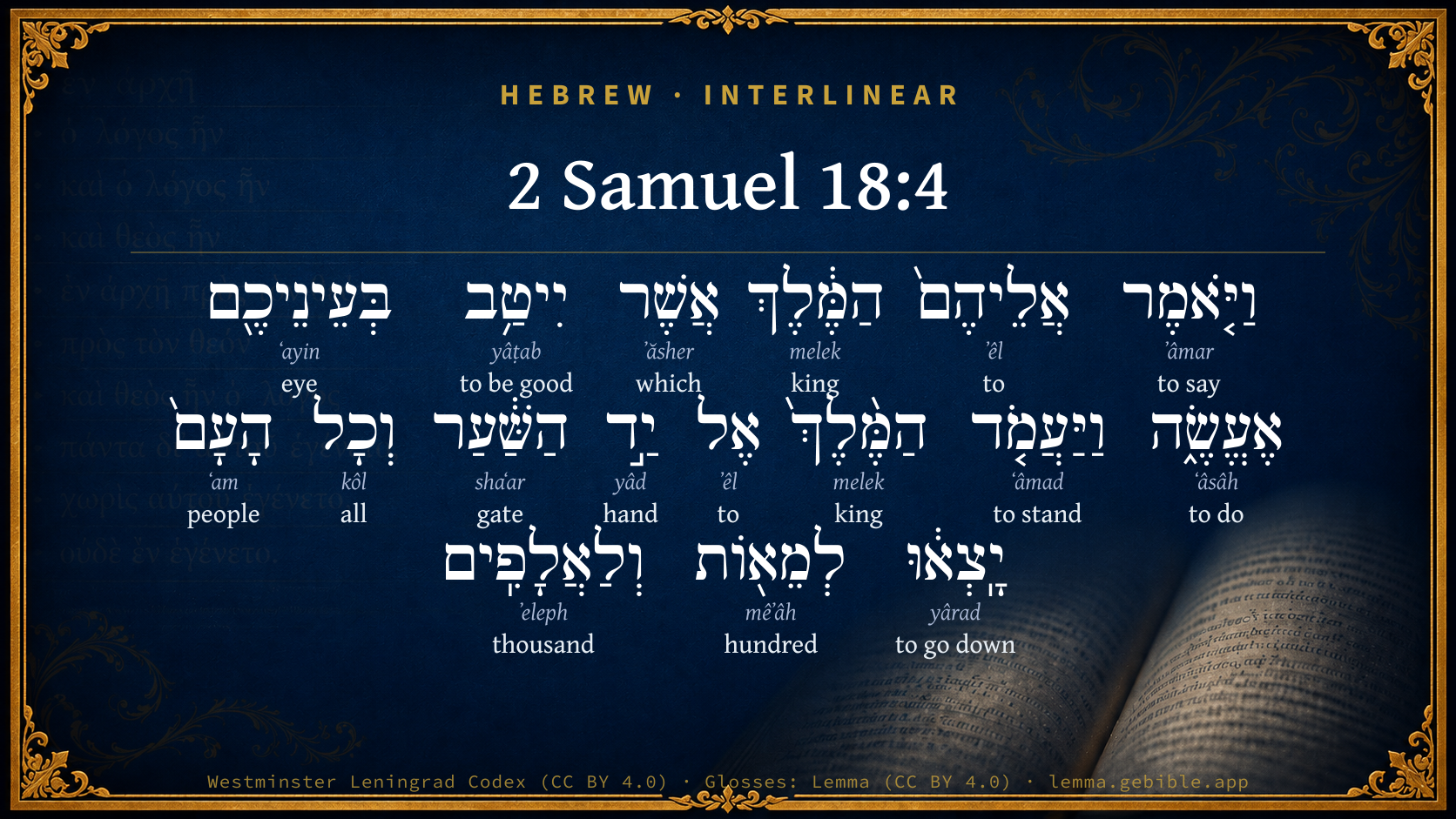
2 Samuel 18:4

Hebrew (Westminster Leningrad Codex) 2 Samuel 18:4 appears in the Hebrew Old Testament. The text above is from the Westminster Leningrad Codex. Each word links to its Strong’s number, a concise gloss, and parsing drawn from the Open Scriptures Hebrew Bible morphology. Click any word for its full Brown-Driver-Briggs (BDB) entry.
Download image
Cite this verse

2 Samuel 18:4 (World English Bible). Public Domain. Lemma interlinear Bible study tool, https://lemma.gebible.app/v/2-samuel/18/4.

Show BibTeX & RIS
BibTeX
RIS
English Translation
The king said to them, What seems you best I will do. The king stood by the gate-side, and all the people went out by hundreds and by thousands.
World English Bible · Public Domain
Download a study sheet

One document with this verse’s original text, its word-by-word gloss line, the meaning frame, cross-references with their text, attributed commentary, and full source and license credits — printable, and it pastes into notes with its structure intact.

This verse Autodidact and up

Study sheet (.html) Plain text (.txt)

A passage Seminary Student

Up to 50 verses in one chapter. A passage sheet keeps up to 6 commentary sources and 12 cross-references per verse, in the order this page ranks them, and says so on the sheet whenever that leaves anything out. Ask for a single verse and you get the Autodidact verse sheet above.

Everything on this page stays free to read, with no account — the sheet is a download of what is already on screen, not access to it.

Want to remove ads? Support Godless Engineer
Compare translations 3

The same verse in 3 English versions, stacked beneath the original-language interlinear above. Click any original word for its lexicon entry.

Each is an independent rendering of the whole verse — the interlinear is not word-aligned to these translations.

Highlighted words mark where these versions differ — a whole-verse word diff, not a word-by-word alignment.

  • World English Bible Public Domain
    The king said to them, What seems you best I will do. The king stood by the gate-side, and all the people went out by hundreds and by thousands.
  • King James Version Public Domain
    And the king said unto them, What seemeth you best I will do. And the king stood by the gate side, and all the people came out by hundreds and by thousands.
  • unfoldingWord Literal Text CC BY-SA 4.0
    And the king said to them, “What is good in your eyes, I will do.” And the king stood at the hand of the gate, and all of the people went out by hundreds and by thousands.

unfoldingWord Literal Text — © unfoldingWord, licensed CC BY-SA 4.0. Word-aligned USFM3 via Door43 (git.door43.org/unfoldingWord/en_ult).

Versions to compare (up to 4)

3 of 4 selected

Show all 18 translations

Every available English version of this verse, each an independent rendering of the whole verse.

  • World English Bible Public Domain
    The king said to them, What seems you best I will do. The king stood by the gate-side, and all the people went out by hundreds and by thousands.
  • Berean Standard Bible Public Domain
    “I will do whatever seems best to you,” the king replied. So he stood beside the gate, while all the troops marched out by hundreds and by thousands.
  • Majority Standard Bible Public Domain
    “I will do whatever seems best to you,” the king replied. So he stood beside the gate, while all the troops marched out by hundreds and by thousands.
  • King James Version Public Domain
    And the king said unto them, What seemeth you best I will do. And the king stood by the gate side, and all the people came out by hundreds and by thousands.
  • American Standard Version (1901) Public Domain
    And the king said unto them, What seemeth you best I will do. And the king stood by the gate-side, and all the people went out by hundreds and by thousands.
  • Revised Version (1885) Public Domain
    And the king said unto them, What seemeth you best I will do. And the king stood by the gate side, and all the people went out by hundreds and by thousands.
  • Geneva Bible (1599) Public Domain
    Then the King said vnto them, What seemeth you best, that I will doe. So the King stood by the gate side, and all the people came out by hundreths and by thousands.
  • Douay-Rheims (1899) Public Domain
    And the king said to them: What seemeth good to you, that will I do. And the king stood by the gate: and all the people went forth by their troops, by hundreds and by thousands.
  • Young's Literal Translation Public Domain
    And the king saith unto them, `That which is good in your eyes I do;' and the king standeth at the side of the gate, and all the people have gone out by hundreds and by thousands,
  • Literal Standard Version CC BY-SA 4.0
    And the king says to them, “That which is good in your eyes I do”; and the king stands at the side of the gate, and all the people have gone out by hundreds and by thousands,
  • Unlocked Literal Bible CC BY-SA 4.0
    So the king answered them, “I will do whatever seems best to you.” The king stood by the city gate while all the army went out by hundreds and by thousands.
  • unfoldingWord Literal Text CC BY-SA 4.0
    And the king said to them, “What is good in your eyes, I will do.” And the king stood at the hand of the gate, and all of the people went out by hundreds and by thousands.
  • Darby Bible Public Domain
    And the king said to them, I will do what is good in your sight. And the king stood by the gate-side, and all the people came out by hundreds and by thousands.
  • World Messianic Bible Public Domain
    The king said to them, “I will do what seems best to you.” The king stood beside the gate, and all the people went out by hundreds and by thousands.
  • Webster's Bible Public Domain
    And the king said to them, What seemeth to you best I will do. And the king stood by the gate side, and all the people came out by hundreds and by thousands.
  • Free Bible Version CC BY-SA 4.0
    “I will do whatever you think best,” the king replied. The king stood beside the gate while all his men marched out by hundreds and by thousands.
  • Bible in Basic English Public Domain
    And the king said to them, I will do whatever seems best to you. So the king took his place by the door of the town, and all the people went out by hundreds and by thousands.
  • JPS Tanakh (1917) Public Domain
    And the king said unto them: 'What seemeth you best I will do.' And the king stood by the gate-side, and all the people went out by hundreds and by thousands.

Literal Standard Version (2020), Covenant Press — licensed CC BY-SA 4.0. Text via the HelloAO Bible API (eBible.org). Unlocked Literal Bible (unfoldingWord) — licensed CC BY-SA 4.0. Text via the HelloAO Bible API (eBible.org). unfoldingWord Literal Text — © unfoldingWord, licensed CC BY-SA 4.0. Word-aligned USFM3 via Door43 (git.door43.org/unfoldingWord/en_ult). Free Bible Version, Dr. Jonathan Gallagher — licensed CC BY-SA 4.0. Text via the HelloAO Bible API (eBible.org).

Word by word

More ways to search: Search by grammar → Find every occurrence → Compare this word →

Practice this passage: Drill this verse → Learn its vocabulary →

יִיטַ֥ב
yâṭab
H3190
“to be good”
Verb, Qal, Imperfect, 3rd Person, Masculine, Singular
Part of Speech
Verb
Stem
Qal
Form
Imperfect
Person
3rd Person
Gender
Masculine
Number
Singular
Full BDB Definition

Origin: a primitive root

TWOT: 863

to be good, be pleasing, be well, be glad - (Qal) - to be glad, be joyful - to be well placed - to be well for, be well with, go well with - to be pleasing, be pleasing to - (Hiphil) - to make glad, rejoice - to do good to, deal well with - to do well, do thoroughly - to make a thing good or right or beautiful - to do well, do right
  1. וַיֹּ֤אמֶר ʼâmar H559 “and · to say” Conjunction + Verb, Qal, Sequential Imperfect, 3rd Person, Masculine, Singular
  2. אֲלֵיהֶם֙ ʼêl H413 “to · them” Preposition + Suffix, Personal, 3rd Person, Masculine, Plural
  3. הַמֶּ֔לֶךְ melek H4428 “the · king” Particle, Definite Article + Noun, Common, Masculine, Singular, Absolute
  4. אֲשֶׁר ʼăsher H834 “which” Particle, Relative
  5. בְּעֵינֵיכֶ֖ם ʻayin H5869 “in/at · eyes · your” Preposition + Noun, Common, Both, Dual, Construct + Suffix, Personal, 2nd Person, Masculine, Plural
  6. אֶעֱשֶׂ֑ה ʻâsâh H6213 “to do” Verb, Qal, Imperfect, 1st Person, Common, Singular
  7. וַיַּעֲמֹ֤ד ʻâmad H5975 “and · to stand” Conjunction + Verb, Qal, Sequential Imperfect, 3rd Person, Masculine, Singular
  8. הַמֶּ֨לֶךְ֙ melek H4428 “the · king” Particle, Definite Article + Noun, Common, Masculine, Singular, Absolute
  9. אֶל ʼêl H413 “to” Preposition
  10. יַ֣ד yâd H3027 “hand of” Noun, Common, Both, Singular, Construct
  11. הַשַּׁ֔עַר shaʻar H8179 “the · gate” Particle, Definite Article + Noun, Common, Masculine, Singular, Absolute
  12. וְכָל kôl H3605 “and · all of” Conjunction + Noun, Common, Masculine, Singular, Construct
  13. הָעָם֙ ʻam H5971 “the · people” Particle, Definite Article + Noun, Common, Masculine, Singular, Absolute
  14. יָֽצְא֔וּ yârad H3381 “to go down” Verb, Qal, Perfect, 3rd Person, Common, Plural
  15. לְמֵא֖וֹת mêʼâh H3967 “to/for · hundred” Preposition + Adjective, Cardinal number, Both, Plural, Absolute
  16. וְלַאֲלָפִֽים ʼeleph H505 “and · to/for · thousand” Conjunction + Preposition + Adjective, Cardinal number, Both, Plural, Absolute

About this verse

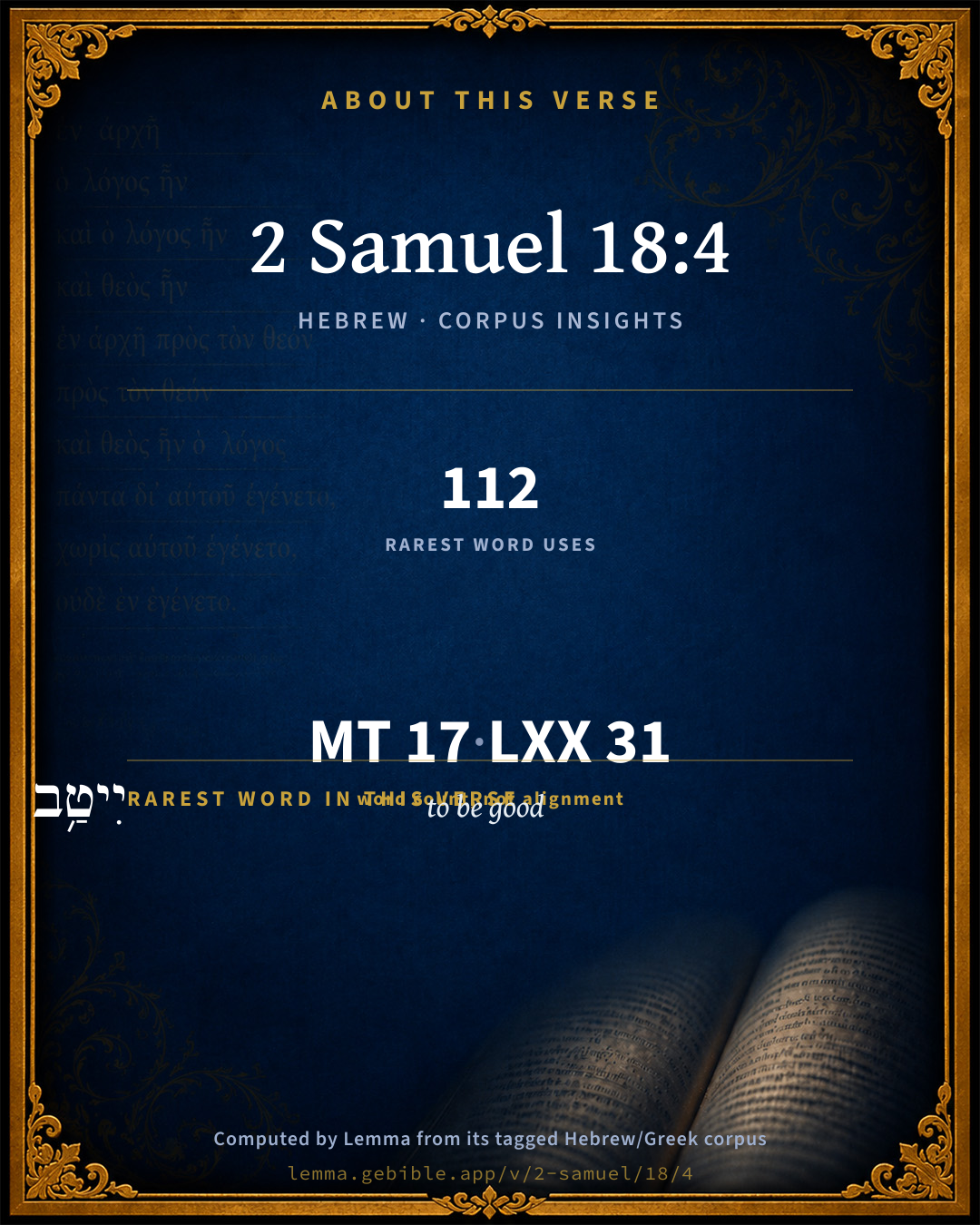
These counts appear in no published source. They are computed here, from the morphology-tagged text and Lemma’s own curated glosses. What Lemma adds →

17
words
15
distinct lemmas
Historical
section

Grammatical profile

  • 5 verbs
  • 7 nouns
  • 2 adjectives
  • 2 prepositions
  • 1 particle

Verb forms

  • וַיֹּ֤אמֶר Qal · Sequential Imperfect
  • יִיטַ֥ב Qal · Imperfect
  • אֶעֱשֶׂ֑ה Qal · Imperfect
  • וַיַּעֲמֹ֤ד Qal · Sequential Imperfect
  • יָֽצְא֔וּ Qal · Perfect

Repetition

Words recur within this verse — often emphatic in Hebrew:

  • הַמֶּ֔לֶךְ king H4428 ×2
  • אֲלֵיהֶם֙ to H413 ×2

Hebrew & Septuagint length

In English translation the verse runs 29 words from the Hebrew and 37 from the Septuagint (LXX English) — closely comparable.

A rough comparison of the two English renderings, which tokenize alike — not a word-level alignment.

Word counts can differ between the Hebrew and the Greek without any difference in meaning — e.g. the Hebrew direct-object marker אֵת has no separate Greek word, and Greek often adds the article ὁ.

In the original languages it is 17 Hebrew tokens and 31 Greek tokens — but the two are counted differently (Hebrew bundles its prefixes and suffixes into one token; the Greek is in lemma form), so that isn’t a like-for-like length.

Cross-references

4

Topical passages linked to 2 Samuel 18:4 in the Treasury of Scripture Knowledge — connected by theme and wording, ordered by reader-vote popularity; previews shown in the World English Bible.

  • 2 Samuel 18:24 Now David was sitting between the two gates: and the watchman went up to the roof of the gate to the wall, and lifted up his eyes, and looked, and, behold, a man running alone.
  • 1 Samuel 29:2 The lords of the Philistines passed on by hundreds, and by thousands; and David and his men passed on in the rearward with Achish.
  • 2 Samuel 18:1 David numbered the people who were with him, and set captains of thousands and captains of hundreds over them.
  • Isaiah 28:6 and a spirit of justice to him who sits in judgment, and strength to those who turn back the battle at the gate.

Cross-references courtesy of OpenBible.info (CC BY 4.0).

Hebrew and Greek witnesses Masoretic Hebrew ↔ Greek Septuagint

The same verse in the two great witnesses to the Old Testament, shown verse-for-verse.

These are two independent witnesses, not word-aligned to each other, and the Septuagint is shown in lemma (dictionary) form.

Hebrew 2 Samuel 18:4 Masoretic · Westminster Leningrad Codex

וַיֹּ֤אמֶר אֲלֵיהֶם֙ הַמֶּ֔לֶךְ אֲשֶׁר יִיטַ֥ב בְּעֵינֵיכֶ֖ם אֶעֱשֶׂ֑ה וַיַּעֲמֹ֤ד הַמֶּ֨לֶךְ֙ אֶל יַ֣ד הַשַּׁ֔עַר וְכָל הָעָם֙ יָֽצְא֔וּ לְמֵא֖וֹת וְלַאֲלָפִֽים

The king said to them, What seems you best I will do. The king stood by the gate-side, and all the people went out by hundreds and by thousands.

World English Bible · Public Domain

Greek LXX 2 Samuel 18:4 Septuagint · lemma form

καί εἶπον πρός αὐτός ὁ βασιλεύς ὅς ἐάν ἀρέσκω ἐν ὀφθαλμός σύ ποιέω καί ἵστημι ὁ βασιλεύς ἀνά χείρ ὁ πύλη καί πᾶς ὁ λαός ἐκπορεύομαι εἰς ἑκατοντάς καί εἰς χιλίας

And the king said to them, Whatsoever shall seem good in your eyes I will do. And the king stood by the side of the gate, and all the people went out by hundreds and by thousands.

LXX2012 (modern English Septuagint) · Public Domain

Hebrew: Westminster Leningrad Codex (CC BY 4.0). Greek: Septuagint (public domain); English from LXX2012 (modern English Septuagint) (Public Domain). How the Septuagint differs from the Hebrew →

Targum (Aramaic paraphrase)

1

The Targum is the ancient Jewish Aramaic paraphrase of the Hebrew Scriptures — an interpretive translation, not the Hebrew text itself. Onkelos (literal) and Pseudo-Jonathan (expansive) render the Torah, and Jonathan the Prophets. Coverage is partial: where no permissively-licensed English translation exists for a verse, only the Aramaic is shown. This is verse-level text, not a word-by-word alignment to the Hebrew.

  1. Targum Jonathan Prophets (Joshua–Malachi)
    וַאֲמַר לְהוֹן מַלְכָּא דְתַקִין בְּעֵינֵיכוֹן אַעְבֵּיד וְקָם מַלְכָּא עַל כֵּיבַשׁ אוֹרַח תַּרְעָא וְכָל עַמָא נְפָקוּ לְמָאתָן וּלְאַלְפִין:

    (no public-domain English translation for this verse)

    Targum Jonathan — Aramaic: “Mikraot Gedolot” (public domain). English: “Sefaria Community Translation” (CC0 1.0 (public-domain dedication)); “London "Chaldee Paraphrase," 1871” (public domain). Text via Sefaria.

Commentary

Notes on 2 Samuel 18:4 from classic Christian and Jewish commentators (each source and its license shown beneath its notes). The classic Christian expositions comment on the surrounding passage and are grouped to its opening verse, so a note may address several verses; the Jewish commentaries on the Tanakh (Rashi and others) are per-verse, so they appear only where the commentator wrote on this verse.

Lemma curates 59 commentaries, every one of them public domain or Creative Commons licensed, each selected and text-cleaned for this edition rather than reprinted as found. About our sources →

Trapp's Complete Commentary

John Trapp

2Sa 18:4 And the king said unto them, What seemeth you best I will do. And the king stood by the gate side, and all the people came out by hundreds and by thousands.

Ver. 4. What seemeth you best I will do.] So meekly doth David submit himself to the will of his men. Affliction and meekness grow both on the same root in the holy tongue. "A man of understanding is of an excellent" - or, of a cool - "spirit." {Pro 17:27}

John Trapp, A Commentary or Exposition upon All the Books of the Old and New Testament (1647–1656) — public domain. Text from a community e-Sword module.

Ellicott's Commentary for English Readers

(4) What seemeth you best.—David was nothing loth to avoid the personal encounter with his son, and readily yielded, He, however, encouraged the troops by reviewing them as they passed out, and improved the opportunity to give his generals special and public charge concerning Absalom. He speaks of him tenderly as “the young man” (2Sa_18:5; comp. 2Sa_18:29; 2Sa_18:32), to imply that his sin was a youthful indiscretion.

A Bible Commentary for English Readers, edited by Charles John Ellicott (1878–1897) — public domain. Text from a community e-Sword module.

John Gill's Exposition

And the king said unto them, what seemeth you best I will do,.... Which was an instance of great condescension in him; and it was his wisdom and prudence to yield to them at such a time as this, and especially as their sentiments were founded on affection and loyalty to him:

and the king stood by the gate side; of the city of Mahanaim:

and all the people came out by hundreds, and by thousands; and passed by him, to whom no doubt he gave his blessing and best wishes; and, as Abarbinel thinks, now it was he composed and said the twentieth psalm, "The Lord hear thee in the day of trouble", &c. Psa 20:1.

John Gill's Exposition of the Whole Bible (1746–1763) — public domain (CC PDM 1.0). Text via the HelloAO Bible API.

Matthew Poole's English Annotations

By the gate side, i.e. between the two gates of the city, as it is expressed below, 2Sa 18:24.

Matthew Poole's English Annotations on the Holy Bible (1683–1685) — public domain. Text from a community e-Sword/MySword module.

Keil & Delitzsch

C. F. Keil & F. Delitzsch

The king gave his consent to these proposals, and went to the side of the gate, whilst the people went out by hundreds and thousands; but in the hearing of all he commanded the principal generals, "Mildly for me (i.e., deal gently for my sake) with the boy Absalom." לאט is not the imperative of לאט, to cover over, which would not suit the connection, and could not be construed with ל, but an adverb from אט, as in Isa 8:6; Kg1 21:27; Job 15:11.

Keil & Delitzsch — Biblical Commentary on the Old Testament (1861–1891) — public domain (CC PDM 1.0). Text via the HelloAO Bible API. (Old Testament only.)

Lesson kit

Teaching starters — assembled from the data on this page, not authored interpretation. Every prompt links to the verse data it draws on. Edit before teaching.

2 Samuel, in the Historical, opens this verse with 17 words (15 distinct Hebrew lemmas). Its most distinctive word is yâṭab (“to be good”). A historical commentator’s framing appears above. Read the whole chapter for the surrounding context.

Discussion questions

  1. What does “to be good” (yâṭab) contribute to the verse as a whole?
  2. 2 Samuel 18:24 shares this passage’s theme. How do the two illuminate each other?
  3. “king” occurs 2× in this one verse. What is the effect of the repetition?
  4. These translations render this verse differently; the difference is in the English rendering, not the original. What questions does that raise?
  5. The verb «וַיֹּ֤אמֶר» is Qal Sequential Imperfect. How does its form color the action?
  6. Reading how Trapp's Complete Commentary and Ellicott's Commentary for English Readers read this verse, where do the two commentators agree and where do they part?

Things to notice

Reading settings

Reading text

Shown beneath each verse's original-language words.

Old Testament
Old Testament edition

Read the OT as the Masoretic Hebrew (MT) or the Greek Septuagint (LXX).

English shown for the Greek Septuagint (in the Hebrew ↔ Greek comparison).

Comparing translations? Open the Compare panel on any verse page to stack up to four side by side.