Deuteronomy 24:14

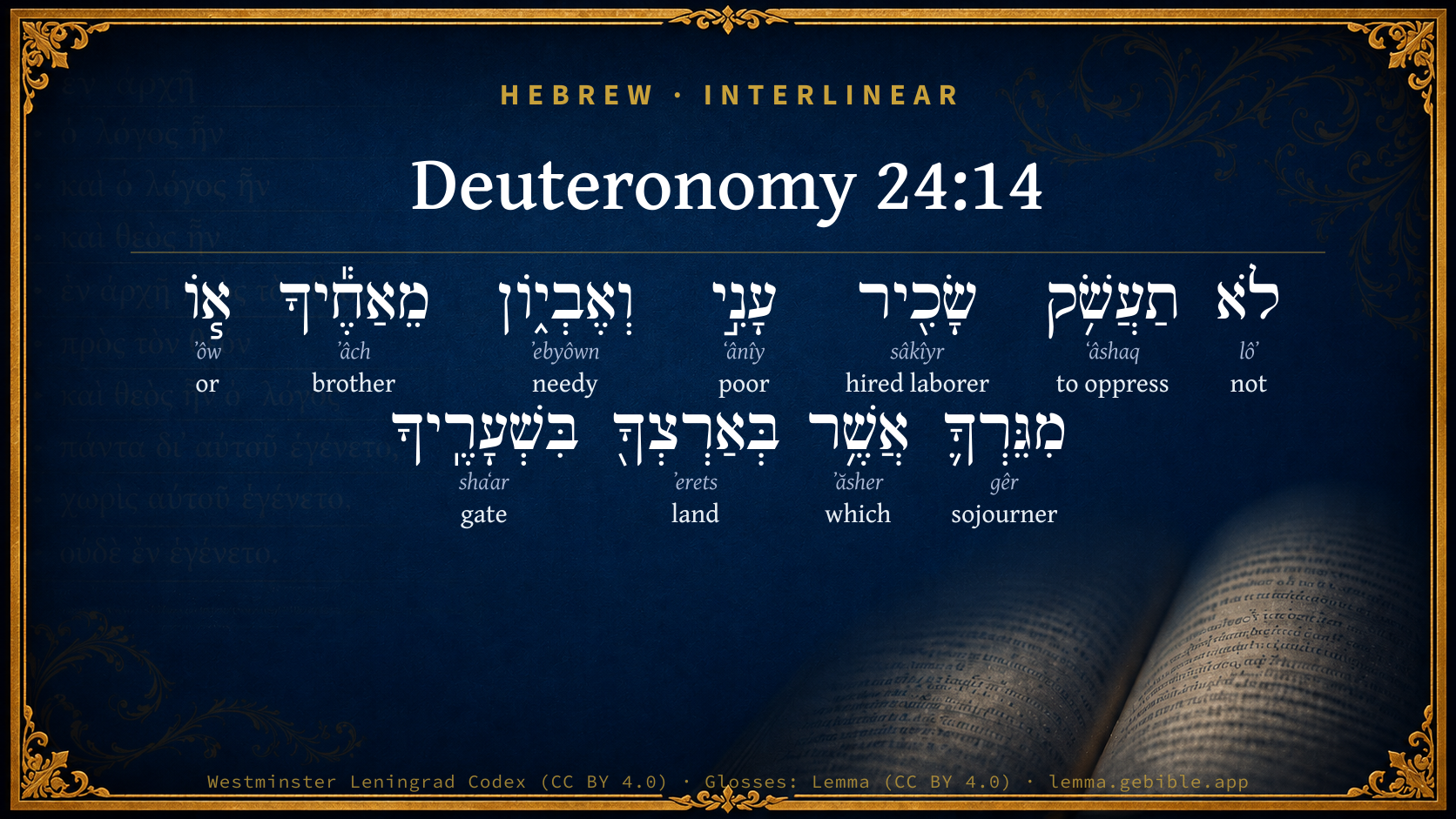
Hebrew (Westminster Leningrad Codex) Deuteronomy 24:14 appears in the Hebrew Old Testament. The text above is from the Westminster Leningrad Codex. Each word links to its Strong’s number, a concise gloss, and parsing drawn from the Open Scriptures Hebrew Bible morphology. Click any word for its full Brown-Driver-Briggs (BDB) entry.
Download image
Cite this verse

Deuteronomy 24:14 (World English Bible). Public Domain. Lemma interlinear Bible study tool, https://lemma.gebible.app/v/deuteronomy/24/14.

Show BibTeX & RIS
BibTeX
RIS
English Translation
You shall not oppress a hired servant who is poor and needy, whether he be of your brothers, or of your foreigners who are in your land within your gates:
World English Bible · Public Domain
Download a study sheet

One document with this verse’s original text, its word-by-word gloss line, the meaning frame, cross-references with their text, attributed commentary, and full source and license credits — printable, and it pastes into notes with its structure intact.

This verse Autodidact and up

Study sheet (.html) Plain text (.txt)

A passage Seminary Student

Up to 50 verses in one chapter. A passage sheet keeps up to 6 commentary sources and 12 cross-references per verse, in the order this page ranks them, and says so on the sheet whenever that leaves anything out. Ask for a single verse and you get the Autodidact verse sheet above.

Everything on this page stays free to read, with no account — the sheet is a download of what is already on screen, not access to it.

Want to remove ads? Support Godless Engineer
Compare translations 3

The same verse in 3 English versions, stacked beneath the original-language interlinear above. Click any original word for its lexicon entry.

Each is an independent rendering of the whole verse — the interlinear is not word-aligned to these translations.

Highlighted words mark where these versions differ — a whole-verse word diff, not a word-by-word alignment.

  • World English Bible Public Domain
    You shall not oppress a hired servant who is poor and needy, whether he be of your brothers, or of your foreigners who are in your land within your gates:
  • King James Version Public Domain
    Thou shalt not oppress an hired servant that is poor and needy, whether he be of thy brethren, or of thy strangers that are in thy land within thy gates:
  • unfoldingWord Literal Text CC BY-SA 4.0
    You shall not oppress a poor and needy hired man from your brothers or from the foreigners who in your land, within your gates.

unfoldingWord Literal Text — © unfoldingWord, licensed CC BY-SA 4.0. Word-aligned USFM3 via Door43 (git.door43.org/unfoldingWord/en_ult).

Versions to compare (up to 4)

3 of 4 selected

Show all 18 translations

Every available English version of this verse, each an independent rendering of the whole verse.

  • World English Bible Public Domain
    You shall not oppress a hired servant who is poor and needy, whether he be of your brothers, or of your foreigners who are in your land within your gates:
  • Berean Standard Bible Public Domain
    Do not oppress a hired hand who is poor and needy, whether he is a brother or a foreigner residing in one of your towns.
  • Majority Standard Bible Public Domain
    Do not oppress a hired hand who is poor and needy, whether he is a brother or a foreigner residing in one of your towns.
  • King James Version Public Domain
    Thou shalt not oppress an hired servant that is poor and needy, whether he be of thy brethren, or of thy strangers that are in thy land within thy gates:
  • American Standard Version (1901) Public Domain
    Thou shalt not oppress a hired servant that is poor and needy, whether he be of thy brethren, or of thy sojourners that are in thy land within thy gates:
  • Revised Version (1885) Public Domain
    Thou shalt not oppress an hired servant that is poor and needy, whether he be of thy brethren, or of thy strangers that are in thy land within thy gates:
  • Geneva Bible (1599) Public Domain
    Thou shalt not oppresse an hyred seruant that is needie and poore, neyther of thy brethren, nor of the stranger that is in thy land within thy gates.
  • Douay-Rheims (1899) Public Domain
    Thou shalt not refuse the hire of the needy, and the poor, whether he be thy brother, or a stranger that dwelleth with thee in the land, and is within thy gates:
  • Young's Literal Translation Public Domain
    `Thou dost not oppress a hireling, poor and needy, of thy brethren or of thy sojourner who is in thy land within thy gates;
  • Literal Standard Version CC BY-SA 4.0
    You do not oppress a hired worker, poor and needy, of your brothers or of your sojourner who is in your land within your gates;
  • Unlocked Literal Bible CC BY-SA 4.0
    You must not oppress a hired servant who is poor and needy, whether he is of your fellow Israelites, or of the foreigners who are in your land within your city gates;
  • unfoldingWord Literal Text CC BY-SA 4.0
    You shall not oppress a poor and needy hired man from your brothers or from the foreigners who in your land, within your gates.
  • Darby Bible Public Domain
    Thou shalt not oppress a hired servant [who is] poor and needy of thy brethren, or of thy sojourners who are in thy land within thy gates:
  • World Messianic Bible Public Domain
    You shall not oppress a hired servant who is poor and needy, whether he is one of your brothers or one of the foreigners who are in your land within your gates.
  • Webster's Bible Public Domain
    Thou shalt not oppress a hired servant that is poor and needy, whether he is of thy brethren, or of thy strangers that are in thy land within thy gates:
  • Free Bible Version CC BY-SA 4.0
    Don't mistreat a paid servant who is poor and needy, whether he's an Israelite or a foreigner living in one of your towns.
  • Bible in Basic English Public Domain
    Do not be hard on a servant who is poor and in need, if he is one of your countrymen or a man from another nation living with you in your land.
  • JPS Tanakh (1917) Public Domain
    Thou shalt not oppress a hired servant that is poor and needy, whether he be of thy brethren, or of thy strangers that are in thy land within thy gates.

Literal Standard Version (2020), Covenant Press — licensed CC BY-SA 4.0. Text via the HelloAO Bible API (eBible.org). Unlocked Literal Bible (unfoldingWord) — licensed CC BY-SA 4.0. Text via the HelloAO Bible API (eBible.org). unfoldingWord Literal Text — © unfoldingWord, licensed CC BY-SA 4.0. Word-aligned USFM3 via Door43 (git.door43.org/unfoldingWord/en_ult). Free Bible Version, Dr. Jonathan Gallagher — licensed CC BY-SA 4.0. Text via the HelloAO Bible API (eBible.org).

Word by word

More ways to search: Search by grammar → Find every occurrence → Compare this word →

Practice this passage: Drill this verse → Learn its vocabulary →

שָׂכִ֖יר
sâkîyr
H7916
“hired laborer”
Adjective, Adjective, Masculine, Singular, Absolute
Part of Speech
Adjective
Type
Adjective
Gender
Masculine
Number
Singular
State
Absolute
Full BDB Definition

Origin: from H7936

TWOT: 2264 . 1c

hired - hired (of animal) - hireling, hired labourer (substantive) - mercenary
  1. לֹא lôʼ H3808 “not” Particle, Negative
  2. תַעֲשֹׁ֥ק ʻâshaq H6231 “to oppress” Verb, Qal, Imperfect, 2nd Person, Masculine, Singular
  3. עָנִ֣י ʻânîy H6041 “poor” Adjective, Adjective, Masculine, Singular, Absolute
  4. וְאֶבְי֑וֹן ʼebyôwn H34 “and · needy” Conjunction + Adjective, Adjective, Masculine, Singular, Absolute
  5. מֵאַחֶ֕יךָ ʼâch H251 “from · brothers · your” Preposition + Noun, Common, Masculine, Plural, Construct + Suffix, Personal, 2nd Person, Masculine, Singular
  6. א֧וֹ ʼôw H176 “or” Conjunction
  7. מִגֵּרְךָ֛ gêr H1616 “from · sojourner · your” Preposition + Noun, Common, Masculine, Singular, Construct + Suffix, Personal, 2nd Person, Masculine, Singular
  8. אֲשֶׁ֥ר ʼăsher H834 “which” Particle, Relative
  9. בְּאַרְצְךָ֖ ʼerets H776 “in/at · land · your” Preposition + Noun, Common, Both, Singular, Construct + Suffix, Personal, 2nd Person, Masculine, Singular
  10. בִּשְׁעָרֶֽיךָ shaʻar H8179 “in/at · gates · your” Preposition + Noun, Common, Masculine, Plural, Construct + Suffix, Personal, 2nd Person, Masculine, Singular

About this verse

These counts appear in no published source. They are computed here, from the morphology-tagged text and Lemma’s own curated glosses. What Lemma adds →

11
words
11
distinct lemmas
Pentateuch
section

Notable vocabulary

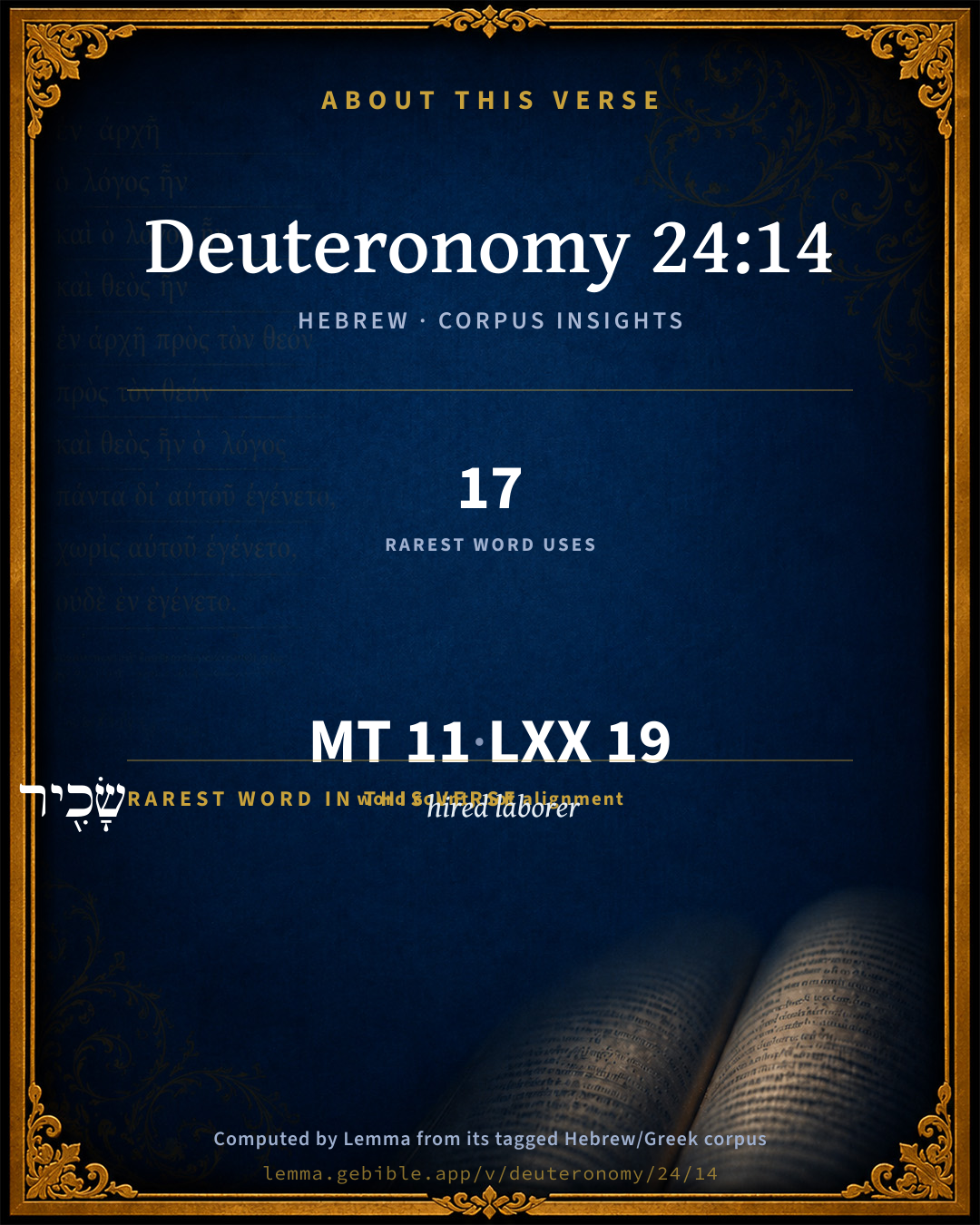
The rarest word here is שָׂכִ֖יר hired laborer H7916 — appearing just 17 times in the whole Hebrew Bible.

Shared distinctive vocabulary

שָׂכִ֖יר hired laborer H7916 occurs in 17 verses of the Hebrew Bible. Also found in:

Grammatical profile

  • 1 verb
  • 4 nouns
  • 3 adjectives
  • 1 conjunction
  • 2 particles

Verb forms

  • תַעֲשֹׁ֥ק Qal · Imperfect

Hebrew & Septuagint length

In English translation the verse runs 30 words from the Hebrew and 13 from the Septuagint (LXX English) — the Septuagint runs noticeably shorter here. See the side-by-side →

A rough comparison of the two English renderings, which tokenize alike — not a word-level alignment.

Word counts can differ between the Hebrew and the Greek without any difference in meaning — e.g. the Hebrew direct-object marker אֵת has no separate Greek word, and Greek often adds the article ὁ.

In the original languages it is 11 Hebrew tokens and 19 Greek tokens — but the two are counted differently (Hebrew bundles its prefixes and suffixes into one token; the Greek is in lemma form), so that isn’t a like-for-like length.

Cross-references

12

Topical passages linked to Deuteronomy 24:14 in the Treasury of Scripture Knowledge — connected by theme and wording, ordered by reader-vote popularity; previews shown in the World English Bible.

  • Malachi 3:5 I will come near to you to judgment; and I will be a swift witness against the sorcerers, and against the adulterers, and against the perjurers, and against those who oppress the hireling in his wages, the widow, and the fatherless, and who deprive the foreigner of justice, and don't fear me," says Yahweh of Hosts.
  • Proverbs 14:31 He who oppresses the poor shows contempt for his Maker, But he who is kind to the needy honors him.
  • Proverbs 22:16 Whoever oppresses the poor for his own increase and whoever gives to the rich, Both come to poverty.
  • Job 24:10–11 So that they go around naked without clothing. Being hungry, they carry the sheaves.
  • Amos 4:1 Listen to this word, you cows of Bashan, who are on the mountain of Samaria, who oppress the poor, who crush the needy, who tell their lords, "Bring, and let us drink."
  • Leviticus 25:35–43 "'If your brother has become poor, and his hand can't support him among you; then you shall uphold him. As a stranger and a sojourner he shall live with you.
  • Deuteronomy 15:12–18 If your brother, a Hebrew man, or a Hebrew woman, be sold to you, and serve you six years; then in the seventh year you shall let him go free from you.
  • Job 31:13–15 "If I have despised the cause of my man-servant Or of my maid-servant, When they contended with me;
  • Amos 2:7 They trample on the dust of the earth on the head of the poor, And deny justice to the oppressed; And a man and his father use the same maiden, to profane my holy name;
  • Luke 10:7 Remain in that same house, eating and drinking the things they give, for the laborer is worthy of his wages. Don't go from house to house.
  • Ezekiel 22:7 In you have they set light by father and mother; in the midst of you have they dealt by oppression with the foreigner; in you have they wronged the fatherless and the widow.
  • Amos 8:4 Hear this, you who desire to swallow up the needy, And cause the poor of the land to fail,

Cross-references courtesy of OpenBible.info (CC BY 4.0).

Hebrew and Greek witnesses Masoretic Hebrew ↔ Greek Septuagint

The same verse in the two great witnesses to the Old Testament, shown verse-for-verse.

Here the Septuagint runs noticeably shorter than the Hebrew — LXX2012 (modern English Septuagint) 13 words vs World English Bible 30. A rough length comparison of the two English translations, not a word-level alignment — read both below.

These are two independent witnesses, not word-aligned to each other, and the Septuagint is shown in lemma (dictionary) form.

Hebrew Deuteronomy 24:14 Masoretic · Westminster Leningrad Codex

לֹא תַעֲשֹׁ֥ק שָׂכִ֖יר עָנִ֣י וְאֶבְי֑וֹן מֵאַחֶ֕יךָ א֧וֹ מִגֵּרְךָ֛ אֲשֶׁ֥ר בְּאַרְצְךָ֖ בִּשְׁעָרֶֽיךָ

You shall not oppress a hired servant who is poor and needy, whether he be of your brothers, or of your foreigners who are in your land within your gates:

World English Bible · Public Domain

Greek LXX Deuteronomy 24:14 Septuagint · lemma form

οὐ ἀποἀδικέω μισθός πένης καί ἐνδεής ἐκ ὁ ἀδελφός σύ ἤ ἐκ ὁ προσήλυτος ὁ ἐν ὁ πόλις σύ

And if the man be poor, you shall not sleep with his pledge.

LXX2012 (modern English Septuagint) · Public Domain

On this verse, The Cambridge Bible for Schools and Colleges discusses the Septuagint’s reading. Read the note in Commentary ↓

Hebrew: Westminster Leningrad Codex (CC BY 4.0). Greek: Septuagint (public domain); English from LXX2012 (modern English Septuagint) (Public Domain). How the Septuagint differs from the Hebrew →

Targum (Aramaic paraphrase)

2

The Targum is the ancient Jewish Aramaic paraphrase of the Hebrew Scriptures — an interpretive translation, not the Hebrew text itself. Onkelos (literal) and Pseudo-Jonathan (expansive) render the Torah, and Jonathan the Prophets. Coverage is partial: where no permissively-licensed English translation exists for a verse, only the Aramaic is shown. This is verse-level text, not a word-by-word alignment to the Hebrew.

  1. Targum Onkelos Torah (Genesis–Deuteronomy)
    לָא תַעֲשׁוֹק אֲגִירָא עַנְיָא וּמִסְכֵּנָא מֵאַחָיךְ אוֹ מִגִיוֹרָךְ דִי בְאַרְעָךְ בְּקִרְוָיךְ

    (no public-domain English translation for this verse)

    Targum Onkelos — Aramaic: “Onkelos Genesis” (public domain); “Onkelos Exodus” (public domain); “Onkelos Leviticus” (public domain); “Onkelos Numbers” (public domain); “Onkelos Deuteronomy” (public domain). English: “Sefaria Community Translation” (CC0 1.0 (public-domain dedication)); “J.W. Etheridge. The Targums of Onkelos and Jonathan Ben Uzziel on the Pentateuch. London: Longmans, Green, 1862” (public domain). Text via Sefaria.

  2. Targum Pseudo-Jonathan Torah (Genesis–Deuteronomy)
    לָא תִטְלוֹמוּן חַבְרֵיכוֹן וְלָא תְשַׁנּוּן סוֹטְרֵיהּ דְּאַגְרָא עַנְיָא וּמִסְכְּנָא מִן אֲחֵיכוֹן אוֹ מִן גִּיּוֹרֵיכוֹן דְּמִתְגַּיְירִין בְּאַרְעֲכוֹן בְּקִירְוֵיכוֹן

    You shall not be hard upon your neighbours, or shift (or decrease) the wages of the needy and poor hireling of thy brethren, or of the strangers who sojourn in your land, in your cities.

    Targum Pseudo-Jonathan — Aramaic: “Targum Jonathan on Genesis” (public domain); “Targum Jonathan on Exodus” (public domain); “Targum Jonathan on Leviticus” (public domain); “Targum Jonathan on Numbers” (public domain); “Targum Jonathan on Deuteronomy” (public domain). English: “The Targum of Jonathan ben Uzziel, trans. J. W. Etheridge, London, 1862” (public domain). Text via Sefaria.

Commentary

Notes on Deuteronomy 24:14 from classic Christian and Jewish commentators (each source and its license shown beneath its notes). The classic Christian expositions comment on the surrounding passage and are grouped to its opening verse, so a note may address several verses; the Jewish commentaries on the Tanakh (Rashi and others) are per-verse, so they appear only where the commentator wrote on this verse.

Lemma curates 59 commentaries, every one of them public domain or Creative Commons licensed, each selected and text-cleaned for this edition rather than reprinted as found. About our sources →

Matthew Henry's Commentary

Here, I. Masters are commanded to be just to their poor servants, Deu 24:14, Deu 24:15. 1. They must not oppress them, by overloading them with work, by giving them undue and unreasonable rebukes, or by withholding from them proper maintenance. A servant, though a stranger to the commonwealth of Israel, must not be abused: "For thou wast a bondman in the land where thou wast a stranger (Deu 24:18), and thou knowest what a grievous thing it is to be oppressed by a task-master, and therefore, in tenderness to those that are servants and strangers, and in gratitude to that God who set thee at liberty and settled thee in a country of thy own, thou shalt not oppress a servant." Let not masters be tyrants to their servants, for their Master is in heaven. See Job 31:13. 2. They must be faithful and punctual in paying them their wages: "At his day thou shalt give him his hire, not only pay it in time, without further delay. As soon as he had done his day's work, if he desire it, let him have his day's wages," as those labourers (Mat 20:8) when evening had come. he that works by day-wages is supposed to live from hand to mouth, and cannot have tomorrow's bread for his family till be is paid for this day's labour. If the wages be withheld, (1.) It will be grief to the servant, for, poor man, he sets his heart upon it,. or, as the word is, he lifts up his soul to it, he is earnestly desirous of it, as the reward of his work (Job 7:2), and depends upon it as the gift of God's providence for the maintenance of his family. A compassionate master, though it should be somewhat inconvenient to himself, would not disappoint the expectation of a poor servant that was so fond to think of receiving his wages. But that is not the worst. (2.) It will be guilt to the master. "The injured servant will cry against thee to the Lord; since he has no one else to appeal to, he will lodge his appeal in the court of heaven, and it will be sin to thee." Or, if he do not complain, the cause will speak for itself, the "hire of the labourers which is kept back by fraud will itself cry," Jam 5:4. It is a greater sin than most people think it is, and will be found so in the great day, to put hardships upon poor servants, labourers, and workmen, that we employ. God will do them right if men do not.

II. Magistrates and judges are commanded to be just in their administrations. 1. In those which we call pleas of the crown a standing rule is here given, that the fathers shall not be put to death for the children, nor the children for the fathers, Deu 24:16. If the children make themselves obnoxious to the law, let them suffer for it, but let not the parents suffer either for them or with them; it is grief enough to them to see their children suffer: if the parents be guilty, let them die for their own sin; but though God, the sovereign Lord of life, sometimes visits the iniquity of the fathers upon the children, especially the sin of idolatry, and when he deals with nations in their national capacity, yet he does not allow men to do so. Accordingly, we find Amaziah sparing the children, even when the fathers were put to death for killing the king, Kg2 14:6. It was in an extraordinary case, and no doubt by special direction from heaven, that Saul's sons were put to death for his offence, and they died rather as sacrifices than as malefactors, Sa2 21:9, Sa2 21:14. 2. In common pleas between party and party, great care must be taken that none whose cause was just should fare the worse for their weakness, nor for their being destitute of friends, as strangers, fatherless, and widows (Deu 24:17): "Thou shalt not pervert their judgment, nor force them to give their very raiment for a pledge, by defrauding them of their right." Judges must be advocates for those that cannot speak for themselves and have no friends to speak for them.

III. The rich are commanded to be kind and charitable to the poor. Many ways they are ordered to be so by the law of Moses. The particular instance of charity here prescribed is that they should not be greedy in gathering in their corn, and grapes, and olives, so as to be afraid of leaving any behind them, but be willing to overlook some, and let the poor have the gleanings, v. 19-22. 1. "Say not, 'It is all my own, and why should not I have it?' But learn a generous contempt of property in small matters. One sheaf or two forgotten will make thee never the poorer at the year's end, and it will do somebody good, if thou have it not." 2. "Say not, 'What I give I will give, and know whom I give it to, why should I leave it to be gathered by I know not whom, that will never thank me.' But trust God's providence with the disposal of thy charity, perhaps that will direct it to the most necessitous." Or, "Thou mayest reasonably think it will come to the hands of the most industrious, that are forward to seek and gather that which this law provides for them." 3. "Say not, 'What should the poor do with grapes and olives? It is enough for them to have bread and water;' for, since they have the same senses that the rich have, why should not they have some little share of the delights of sense?" Boaz ordered handfuls of corn to be left on purpose for Ruth, and God blessed him. All that is left is not lost.

Matthew Henry's Commentary on the Whole Bible (1708–1710) — public domain (CC PDM 1.0). Text via the HelloAO Bible API.

Joseph Benson's Commentary

Deu 24:14-15. Not oppress a hired servant — By detaining his wages from him when due, which is the meaning of oppression here, as appears from the next verse. At his day thou shalt give him his hire — That is, at the time appointed, weekly or daily. He speaks of a hireling who was so poor as not to be able to provide himself and family with necessaries without his wages, and who therefore eagerly expected them as the support of their lives.

Joseph Benson's Commentary on the Old and New Testaments (1811–1818) — public domain. Text from a community e-Sword module.

Jamieson, Fausset & Brown

Robert Jamieson, A. R. Fausset & David Brown

Thou shalt not oppress an hired servant that is poor and needy--Hired servants in the East are paid at the close of the day; and for a master to defraud the laborer of his hire, or to withhold it wrongfully for a night, might have subjected a poor man with his family to suffering and was therefore an injustice to be avoided (Lev 19:13).

Jamieson, Fausset & Brown — Commentary Critical and Explanatory on the Whole Bible (1871) — public domain (CC PDM 1.0). Text via the HelloAO Bible API.

Ellicott's Commentary for English Readers

(14, 15) Thou shalt not oppress an hired servant.—So Lev_19:13. “The wages of him that is hired shall not abide with thee all night until the morning.” (Comp. also Jer_22:13; Mal_3:5; Jas_5:4.)

A Bible Commentary for English Readers, edited by Charles John Ellicott (1878–1897) — public domain. Text from a community e-Sword module.

The Cambridge Bible for Schools and Colleges

gen. ed. J. J. S. Perowne

14. poor and needy] See on Deu_15:11.

within thy gates] See on Deu_12:17. The preceding in thy land, omitted by Sam., LXX, is a gloss.

14, 15. Payment of the Wage-earner. Whether Israelite or gçr, if he be poor, his wage is to be paid the day he earns it; if he has to appeal to God it will be sin to thee.—Sg. with brother (not neighbour) and other deuteronomic phrases. Parallel to H, Lev_19:13 : thou shalt not oppress thy neighbour … the wage of a hireling shall not stay overnight with thee till morning. Cp. Mal_3:5, Tob_4:14, Jas_5:4. Ḫammurabi fixes the daily money wages of labourers and artisans (273 f.), in other cases wages in kind are paid yearly (257 f., 261).

The Cambridge Bible for Schools and Colleges (gen. ed. J. J. S. Perowne; Cambridge University Press, 1878–1918) — public domain. Text from a community e-Sword module.

John Gill's Exposition

Thou shall not oppress an hired servant,.... That is hired by the day, as appears by Deu 24:15; though the law may include such as are hired by the week, or month, or year; neither of whom are to be oppressed by any means, and chiefly by detaining their wages; so the Jerusalem Targum explains the phrase,"ye shall not detain by force the hire of the hired servant;''nor by fraud, as in Jam 5:4,

that is poor and needy; and so cannot bear the lest oppression of this kind, nor to have his wages detained from him any time, and much less wholly to be defrauded of them:

whether he be of thy brethren; an Israelite, and so a brother both by nation and religion:

or of thy strangers that are in thy land, within thy gates; Jarchi interprets this, both of proselytes of righteousness, and of proselytes of the gate; which latter are plainly described by this clause, and the former must be included; for, if proselytes of the gate are not to be oppressed, much less proselytes of righteousness, who were in all respects as Israelites, the same law was to them both. Jarchi says, the phrase "in thy land" is intended to comprehend the hire of beasts, and of vessels; and these in the Misnah (o) are said to be comprehended in this precept, as well as the hire of man.

(o) Bava Metzia, c. 9. sect. 12.

John Gill's Exposition of the Whole Bible (1746–1763) — public domain (CC PDM 1.0). Text via the HelloAO Bible API.

Haydock's Catholic Bible Commentary

Hire. Hebrew, "Commit no violence (or fraud) towards an hired servant," Leviticus xix. 13. (Haydock)

George Leo Haydock (1774–1849), Haydock's Catholic Family Bible and Commentary, 1859 edition — public domain. Excludes Psalms (Douay-Rheims chapter numbering differs from Protestant) and Deuterocanonical books (Catholic canon only).

Matthew Poole's English Annotations

Either by laying too grievous burdens of work upon him, or by withholding his wages from him, as it follows.

Matthew Poole's English Annotations on the Holy Bible (1683–1685) — public domain. Text from a community e-Sword/MySword module.

Whedon's Commentary on the Bible

Daniel D. Whedon

14, 15. Thou shalt not oppress a hired servant — These merciful provisions for the poor are in the main from Lev_19:13.

Daniel D. Whedon (gen. ed.), Commentary on the Old and New Testaments (1874–1909) — public domain. Text from a community e-Sword module.

The Pulpit Commentary

Vers. 14, 15. The wage of the laborer was to be punctually paid, whether he were an Israelite or a foreigner (cf. Lev_19:13; the law there is repeated here, with a special reference to the distress which the withholding of the hire from a poor man even for a day might occasion)

Vers. 14, 15. Omitted duty ripens into curse.

Thoughtlessness is a flimsy excuse for neglected duty. It is a sin to be thoughtless. One talent is buried in the earth. In proportion to the mischief produced is the punishment thereof.

I WE HAVE HERE A CASE OF OBLIGATION FULLY MATURED.

1. The rich is debtor to the poor. Obligation between the several ranks of society is equal. The rich rely for many services upon the poor. The king depends upon the cook. The laborer gives his strength, the employer contributes his money. There is as much obligation on the one side as on the other.

2. At a fixed point of time the obligation is matured. Henceforth the neglect of the obligation becomes sin. My obligations today differ from those of yesterday. The element of time plays an important part. Obligations grow.

3. Obligations are implied as well as expressed. Custom is unwritten law. Riches carry with them no warrant for arrogance. Riches have cursed the man if they have made him churlish.

II NEGLECTED OBLIGATION ENTAILS UNKNOWN MISERY. We cannot follow the effects of thoughtlessness into all their intricate ramifications and to their utmost issues. What would be regarded as a trivial disappointment on the part of one man may be an agony of pain to another. Wages expected and deferred may mean to a needy laborer pinching hunger, not only to himself, but to feeble wife and to helpless babes. A gloomy and sleepless night may follow. Bitter and angry feelings may be engendered. Faith in human integrity may be lost. Self-restraint may vanish. For want of a nail a shoe was lost, a battle was lost, ay, an empire fell!

III NEGLECTED OBLIGATION MAY BRING HEAVY CURSE UPON THE CULPRIT. It is not safe to treat any human being with contempt, especially the poor. God is the avowed Champion of such. The command, "Honor all men," is as binding as "Thou shalt not steal." The cry of the injured man in his distress is sure to pierce the skies. The ear of God is specially attent to his children"s suffering cry, even as a mother catches the plaintive wail of her firstborn infant. Swiftly God attaches himself to the side of the oppressed, and takes upon himself the burden. The injustice done to the man becomes an insult done to God. The deed alters in its character, intensifies in its immorality, becomes heinous sin. Vials of wrath are preparing for the head of the unthinking transgressor. It will be as the sin of blasphemy or of murder unto them. D.

The Pulpit Commentary (1880–1919), ed. H.D.M. Spence-Jones & Joseph S. Exell — public domain. Text from a community e-Sword module.

Keil & Delitzsch

C. F. Keil & F. Delitzsch

They were not to oppress a poor and distressed labourer, by withholding his wages. This command is repeated here from Lev 19:13, with special reference to the distress of the poor man. "And to it (his wages) he lifts up his soul:" i.e., he feels a longing for it. "Lifts up his soul:" as in Psa 24:4; Hos 4:8; Jer 22:27. On Deu 24:15, see Deu 15:9 and Jam 5:4.

Keil & Delitzsch — Biblical Commentary on the Old Testament (1861–1891) — public domain (CC PDM 1.0). Text via the HelloAO Bible API. (Old Testament only.)

unfoldingWord translationNotes

Door43 World Missions Community

General Information:

Moses speaks to the Israelites as if they were one man, so the words "you" and "your" here are singular. (See: Forms of You)

You must not oppress a hired servant

"You must not treat a hired servant poorly"

hired servant

a person who gets paid daily for his work

poor and needy

These two words have similar meanings and emphasize that this is a person who cannot help himself. (See: Doublet)

within your city gates

Here "city gates" mean towns or cities. AT: "in one of your cities" (See: Synecdoche)

Each day you must give him his wage

"You should give the man the money he earns every single day"

the sun must not go down on this unsettled matter

This is an idiom. The Israelites considered the new day as starting when the sun went down. AT: "you should pay the man on the same day he does the work" (See: Idiom)

for he is poor and is counting on it

The full meaning of this statement can be made explicit. AT: "because he is poor and depends on his wages to buy his food for the next day" (See: Assumed Knowledge and Implicit Information)

he does not cry out against you to Yahweh

"he does not call out to Yahweh and ask him to punish you"

translationWords

oppress

servant

Israel

alien

gate

cry

sin

unfoldingWord translationNotes — © Distant Shores Media and the Door43 World Missions Community, licensed CC BY-SA 4.0. Source: git.door43.org/Door43/en_tn.

Rashi

Rabbi Shlomo Yitzchaki (Rashi)

לא תעשק שכיר THOU SHALT NOT WRONG ANY HIRED SERVANT — But has not this already been stated in Leviticus 19:13? But it is repeated here to make one transgress in respect of the hired, servant who is poor (i.e., if he wrongs such a person) two negative commands, for the meaning of the text here is: thou shalt not suppress the wages of an hired servant who is poor and needy. (The meaning is not: thou shalt not wrong a hired servant, the poor and the needy). As to the well-to-do hired servant one has already been prohibited to wrong him (Leviticus 19:13): “thou shalt not wrong thy neighbour” (Bava Metzia 61a).

אביון is one who longs for everything, (lacks all the necessities of life; cf. Rashi on Deuteronomy 15:4).

מגרך [WHETHER HE BE OF THY BRETHREN, OR] OF ANY STRANGERS — this refers to a “proselyte of righteousness” (who embraces the entire Jewish Faith out of conviction) (Sifrei Devarim 278:4),

בשערך [STRANGERS THAT ARE] WITHIN THY GATES — this refers to a stranger [who has undertaken not to worship idols] but eats carrion (who may reside in the land of Israel) (Sifrei Devarim 278:5),

אשר בארצך [OF ANY STRANGERS] THAT ARE IN THY LAND — this is intended to include in the prohibition of withholding what is due to one’s neighbor the payment for using his animals or utensils (Sifrei Devarim 278:5; Bava Metzia 111b).

Rashi on the Tanakh — English translations: “The Judaica Press complete Tanach with Rashi, translated by A. J. Rosenberg” (CC BY 4.0); “Pentateuch with Rashi's commentary by M. Rosenbaum and A.M. Silbermann, 1929-1934” (public domain); “The Metsudah Tanach series, Lakewood, N.J” (CC BY 4.0); and “The Book of Joshua, Metsudah Publications, 1997” (CC BY 4.0). Text via Sefaria.

Ramban (Nachmanides)

Rabbi Moshe ben Nachman (Ramban / Nachmanides)

THOU SHALT NOT WRONG A HIRED SERVANT THAT IS POOR AND NEEDY. Scripture is speaking of the common occurrence, for the poor, the needy, and strangers hire themselves out [for wages, but the law applies to all workers]. Similarly, If thou lend money to any of My people that is poor by thee and so also, it shall be for the stranger, for the fatherless, and for the widow, because they are generally poor. Likewise in many places Scripture speaks of common occurrence, such as, Thou shalt not muzzle the ox when he treadeth out the corn, 25:4. [which applies equally to all domestic and wild animals as well as birds]; Thou shalt not plow with an ox and an ass together [which also applies to any two different species]. And in the Sifre the Rabbis have said: 278. “If so, why is it stated here poor and needy [when the law applies to all workers]? It is because I hasten to punish when the poor and needy are involved more than any other people.” They also interpreted: “Whether he be of thy strangers [in Verse 14 before us] — this refers to a righteous proselyte, so that he who wrongs him [in his hire] transgresses two prohibitions” [since he is also of thy brethren].

Ramban (Nachmanides) on the Tanakh — English translation: “Commentary on the Torah by Ramban (Nachmanides). Translated and annotated by Charles B. Chavel. New York, Shilo Pub. House, 1971-1976” (CC BY 4.0). Text via Sefaria.

Lesson kit

Teaching starters — assembled from the data on this page, not authored interpretation. Every prompt links to the verse data it draws on. Edit before teaching.

Deuteronomy, in the Pentateuch, opens this verse with 11 words (11 distinct Hebrew lemmas). Its most distinctive word is sâkîyr (“hired laborer”). The Greek Septuagint runs shorter here. A historical commentator’s framing appears above. Read the whole chapter for the surrounding context.

Discussion questions

  1. The word sâkîyr carries the sense “hired laborer.” How does it shape the verse?
  2. Exodus 12:45 shares the word «hired laborer» with this verse. How do the two illuminate each other?
  3. Compared with the Hebrew, the Septuagint runs shorter here. What questions does that raise?
  4. The translations on this page render this verse differently — a whole-verse word diff, not a word-by-word alignment. What might account for the different wordings?
  5. The verb «תַעֲשֹׁ֥ק» is Qal Imperfect. How does its form color the action?
  6. Reading how Matthew Henry's Commentary and Joseph Benson's Commentary read this verse, where do the two commentators agree and where do they part?

Things to notice

Reading settings

Reading text

Shown beneath each verse's original-language words.

Old Testament
Old Testament edition

Read the OT as the Masoretic Hebrew (MT) or the Greek Septuagint (LXX).

English shown for the Greek Septuagint (in the Hebrew ↔ Greek comparison).

Comparing translations? Open the Compare panel on any verse page to stack up to four side by side.