
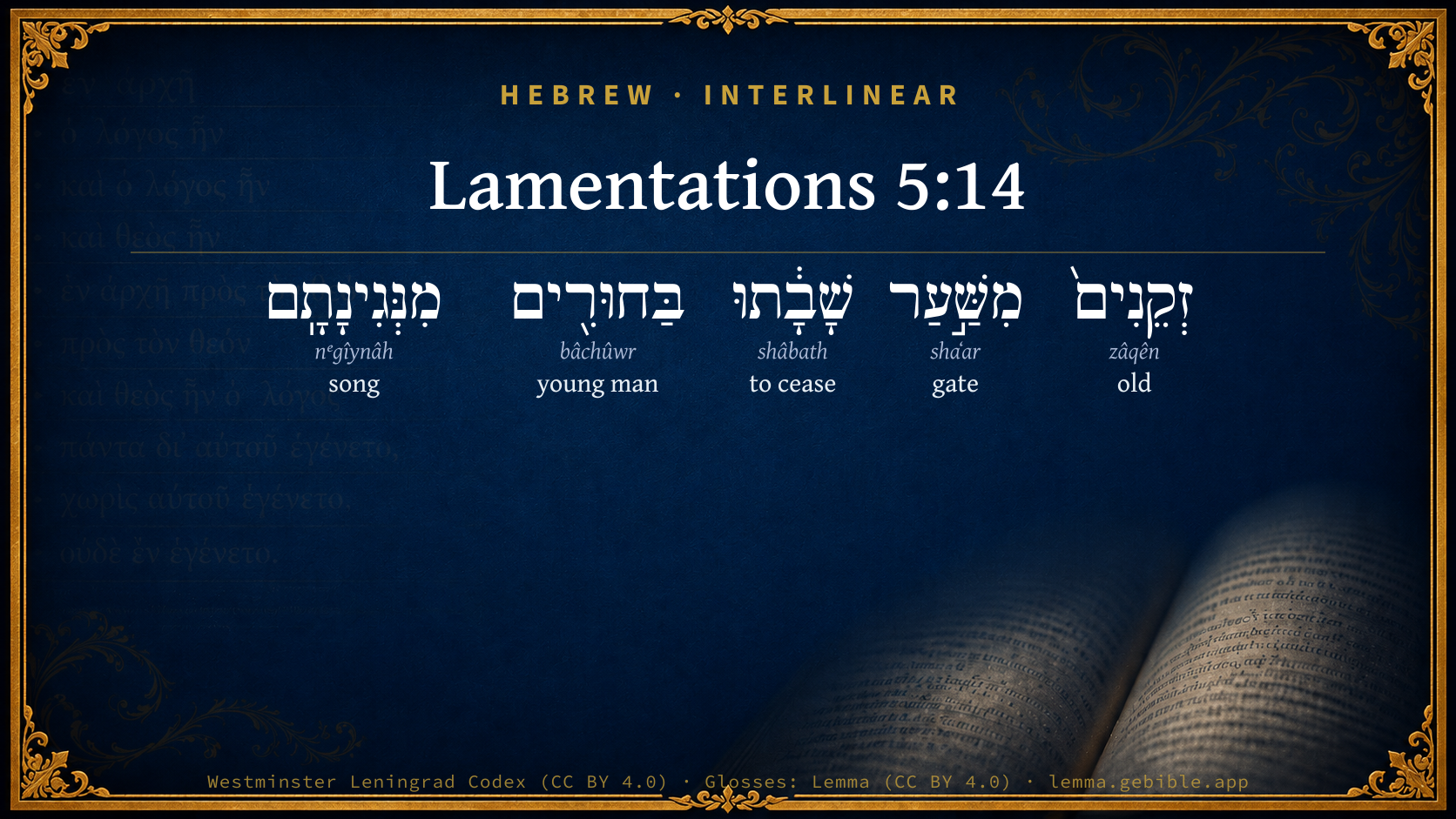
Lamentations 5:14

Hebrew (Westminster Leningrad Codex) Lamentations 5:14 appears in the Hebrew Old Testament. The text above is from the Westminster Leningrad Codex. Each word links to its Strong’s number, a concise gloss, and parsing drawn from the Open Scriptures Hebrew Bible morphology. Click any word for its full Brown-Driver-Briggs (BDB) entry.
Download image
Cite this verse

Lamentations 5:14 (World English Bible). Public Domain. Lemma interlinear Bible study tool, https://lemma.gebible.app/v/lamentations/5/14.

Show BibTeX & RIS
BibTeX
RIS
English Translation
The elders have ceased from the gate, The young men from their music.
World English Bible · Public Domain
Download a study sheet

One document with this verse’s original text, its word-by-word gloss line, the meaning frame, cross-references with their text, attributed commentary, and full source and license credits — printable, and it pastes into notes with its structure intact.

This verse Autodidact and up

Study sheet (.html) Plain text (.txt)

A passage Seminary Student

Up to 50 verses in one chapter. A passage sheet keeps up to 6 commentary sources and 12 cross-references per verse, in the order this page ranks them, and says so on the sheet whenever that leaves anything out. Ask for a single verse and you get the Autodidact verse sheet above.

Everything on this page stays free to read, with no account — the sheet is a download of what is already on screen, not access to it.

Want to remove ads? Support Godless Engineer
Compare translations 3

The same verse in 3 English versions, stacked beneath the original-language interlinear above. Click any original word for its lexicon entry.

Each is an independent rendering of the whole verse — the interlinear is not word-aligned to these translations.

Highlighted words mark where these versions differ — a whole-verse word diff, not a word-by-word alignment.

  • World English Bible Public Domain
    The elders have ceased from the gate, The young men from their music.
  • King James Version Public Domain
    The elders have ceased from the gate, the young men from their musick.
  • unfoldingWord Literal Text CC BY-SA 4.0
    Elders have ceased from the gate, young men from their music.

unfoldingWord Literal Text — © unfoldingWord, licensed CC BY-SA 4.0. Word-aligned USFM3 via Door43 (git.door43.org/unfoldingWord/en_ult).

Versions to compare (up to 4)

3 of 4 selected

Show all 18 translations

Every available English version of this verse, each an independent rendering of the whole verse.

  • World English Bible Public Domain
    The elders have ceased from the gate, The young men from their music.
  • Berean Standard Bible Public Domain
    The elders have left the city gate; the young men have stopped their music.
  • Majority Standard Bible Public Domain
    The elders have left the city gate; the young men have stopped their music.
  • King James Version Public Domain
    The elders have ceased from the gate, the young men from their musick.
  • American Standard Version (1901) Public Domain
    The elders have ceased from the gate, The young men from their music.
  • Revised Version (1885) Public Domain
    The elders have ceased from the gate, the young men from their music.
  • Geneva Bible (1599) Public Domain
    The Elders haue ceased from the gate and the yong men from their songs.
  • Douay-Rheims (1899) Public Domain
    The ancients have ceased from the gates: the young men from the choir of the singers.
  • Young's Literal Translation Public Domain
    The aged from the gate have ceased, Young men from their song.
  • Literal Standard Version CC BY-SA 4.0
    Elderly have ceased from the gate, || Young men from their song.
  • Unlocked Literal Bible CC BY-SA 4.0
    The elders have left the city gate, and the young men have left their music.
  • unfoldingWord Literal Text CC BY-SA 4.0
    Elders have ceased from the gate, young men from their music.
  • Darby Bible Public Domain
    The elders have ceased from the gate, the young men from their music.
  • World Messianic Bible Public Domain
    The elders have ceased from the gate, and the young men from their music.
  • Webster's Bible Public Domain
    The elders have ceased from the gate, the young men from their music.
  • Free Bible Version CC BY-SA 4.0
    The elders have abandoned their places at the city gate; the young men have given up playing their music.
  • Bible in Basic English Public Domain
    The old men are no longer seated in the doorway, and the music of the young men has come to an end.
  • JPS Tanakh (1917) Public Domain
    The elders have ceased from the gate, the young men from their music.

Literal Standard Version (2020), Covenant Press — licensed CC BY-SA 4.0. Text via the HelloAO Bible API (eBible.org). Unlocked Literal Bible (unfoldingWord) — licensed CC BY-SA 4.0. Text via the HelloAO Bible API (eBible.org). unfoldingWord Literal Text — © unfoldingWord, licensed CC BY-SA 4.0. Word-aligned USFM3 via Door43 (git.door43.org/unfoldingWord/en_ult). Free Bible Version, Dr. Jonathan Gallagher — licensed CC BY-SA 4.0. Text via the HelloAO Bible API (eBible.org).

Word by word

More ways to search: Search by grammar → Find every occurrence → Compare this word →

Practice this passage: Drill this verse → Learn its vocabulary →

About this verse

These counts appear in no published source. They are computed here, from the morphology-tagged text and Lemma’s own curated glosses. What Lemma adds →

5
words
5
distinct lemmas
Prophets
section

Notable vocabulary

The rarest word here is מִנְּגִינָתָֽם song H5058 — appearing just 13 times in the whole Hebrew Bible.

Shared distinctive vocabulary

מִנְּגִינָתָֽם song H5058 occurs in 13 verses of the Hebrew Bible. Also found in:

Grammatical profile

  • 1 verb
  • 3 nouns
  • 1 adjective

Verb forms

  • שָׁבָ֔תוּ Qal · Perfect

Hebrew & Septuagint length

In English translation the verse runs 13 words from the Hebrew and 14 from the Septuagint (LXX English) — closely comparable.

A rough comparison of the two English renderings, which tokenize alike — not a word-level alignment.

Word counts can differ between the Hebrew and the Greek without any difference in meaning — e.g. the Hebrew direct-object marker אֵת has no separate Greek word, and Greek often adds the article ὁ.

Cross-references

14

Topical passages linked to Lamentations 5:14 in the Treasury of Scripture Knowledge — connected by theme and wording, ordered by reader-vote popularity; previews shown in the World English Bible.

  • Jeremiah 7:34 Then will I cause to cease from the cities of Judah, and from the streets of Jerusalem, the voice of mirth and the voice of gladness, the voice of the bridegroom and the voice of the bride; for the land shall become a waste.
  • Isaiah 24:7–11 The new wine mourns, the vine languishes, all the merry-hearted do sigh.
  • Ezekiel 26:13 I will cause the noise of your songs to cease; and the sound of your harps shall be no more heard.
  • Revelation 18:22 The voice of harpists, minstrels, flute players, and trumpeters will be heard no more at all in you. No craftsman, of whatever craft, will be found any more at all in you. The sound of a mill will be heard no more at all in you.
  • Deuteronomy 16:18 Judges and officers shall you make you in all your gates, which Yahweh your God gives you, according to your tribes; and they shall judge the people with righteous judgment.
  • Job 29:7–17 When I went forth to the city gate, When I prepared my seat in the street,
  • Job 30:1 "But now those who are younger than I, have me in derision, Whose fathers I would have disdained to put with my sheep dogs.
  • Job 30:31 Therefore is my harp turned to mourning, And my pipe into the voice of those who weep.
  • Isaiah 3:2–3 The mighty man, The man of war, The judge, The prophet, The diviner, The elder,
  • Jeremiah 16:9 For thus says Yahweh of Hosts, the God of Israel: Behold, I will cause to cease out of this place, before your eyes and in your days, the voice of mirth and the voice of gladness, the voice of the bridegroom and the voice of the bride.
  • Jeremiah 25:10 Moreover I will take from them the voice of mirth and the voice of gladness, the voice of the bridegroom and the voice of the bride, the sound of the millstones, and the light of the lamp.
  • Lamentations 1:4 The ways of Zion do mourn, because none come to the solemn assembly; All her gates are desolate, her priests do sigh: Her virgins are afflicted, and she herself is in bitterness.
  • Lamentations 1:19 I called for my lovers, [but] they deceived me: My priests and my elders gave up the spirit in the city, While they sought them food to refresh their souls.
  • Lamentations 2:10 The elders of the daughter of Zion sit on the ground, they keep silence; They have cast up dust on their heads; they have girded themselves with sackcloth: The virgins of Jerusalem hang down their heads to the ground.

Cross-references courtesy of OpenBible.info (CC BY 4.0).

Hebrew and Greek witnesses Masoretic Hebrew ↔ Greek Septuagint

The same verse in the two great witnesses to the Old Testament, shown verse-for-verse.

These are two independent witnesses, not word-aligned to each other, and the Septuagint is shown in lemma (dictionary) form.

Hebrew Lamentations 5:14 Masoretic · Westminster Leningrad Codex

זְקֵנִים֙ מִשַּׁ֣עַר שָׁבָ֔תוּ בַּחוּרִ֖ים מִנְּגִינָתָֽם

The elders have ceased from the gate, The young men from their music.

World English Bible · Public Domain

Greek LXX Lamentations 5:14 Septuagint · lemma form

καί πρεσβύτης ἀπό πύλη καταπαύω ἐκλεκτός ἐκ ψαλμός αὐτός καταπαύω

And the elders ceased from the gate, the chosen men ceased from their music.

LXX2012 (modern English Septuagint) · Public Domain

Hebrew: Westminster Leningrad Codex (CC BY 4.0). Greek: Septuagint (public domain); English from LXX2012 (modern English Septuagint) (Public Domain). How the Septuagint differs from the Hebrew →

Commentary

Notes on Lamentations 5:14 from classic Christian and Jewish commentators (each source and its license shown beneath its notes). The classic Christian expositions comment on the surrounding passage and are grouped to its opening verse, so a note may address several verses; the Jewish commentaries on the Tanakh (Rashi and others) are per-verse, so they appear only where the commentator wrote on this verse.

Lemma curates 59 commentaries, every one of them public domain or Creative Commons licensed, each selected and text-cleaned for this edition rather than reprinted as found. About our sources →

Trapp's Complete Commentary

John Trapp

Lam 5:14 The elders have ceased from the gate, the young men from their musick.

Ver. 14. The elders have ceased from the gate.] Where they were wont to sit, {Gen 34:20} to judge between party and party.

The young men from their music.] From their ordinary and honest recreations and disports.

John Trapp, A Commentary or Exposition upon All the Books of the Old and New Testament (1647–1656) — public domain. Text from a community e-Sword module.

The Preacher's Complete Homiletical Commentary

Joseph S. Exell (gen. ed.)

EXEGETICAL NOTES.—

Lam_5:14. Entire collapse of interest in the common ways of life was shown by the abandonment of public meetings and social pastimes. The elders ceased from [frequenting] the gate. They had gone thither as to the usual gathering-place; they adjudicated, advised, had general intercourse, and received the marks of respect suggested by the law—Thou shalt rise up before the hoary head and honour the face of the old man (Lev_19:32); but that resort was no longer theirs. Moreover, the buoyancy of youthful spirits was crushed down. Young men ceased from their music, accompanied by instruments.

Lam_5:15. The iron had entered the soul. Ceased is the joy of our heart, and past pleasures had become a pain; turned into mourning our dance.

HOMILETICS

BUSINESS AND RECREATION

(Lam_5:14-15)

I. Are necessary in all organised communities. Commercial activity and prosperity lead to a more highly organised condition of social life. To prevent the clashing and confusion of the multiplicity of interests generated by an increasing commerce, certain rules are laid down for general observance. It is only thus that law and order can be maintained. It is soon recognised that business and pleasure must be judiciously combined in order to develop a healthy and vigorous people. Incessant labour would grind down and destroy the force of the national character, and an uninterrupted round of pleasure would weaken and dissipate its enterprise and energy. The happy medium in promoting what is best in both individual and national life is found in the wise alternation of work and recreation.

“Run if you will, but try to keep your breath;

Work like a man, but don’t be worked to death.”

II. Are evidences of a happy and contented people. The gate of an Eastern city is the common rendezvous of the citizens for both business and recreation. There the venerable counsellors sit in repose and dignity to discuss and settle disputes. There the traders vend their wares. There the young life of the city expresses its exuberant joy in song and dance. Here we have a picture of prosperity, peace, and happiness. No people will be long content where there is not a thriving commerce, a reverence for law and age, ample employment and food, and the opportunity for innocent recreation.

III. Their absence a pathetic sign of general desolation. “The elders have ceased from the gate, the young men from their music. The joy of our heart is ceased; our dance is turned into mourning” (Lam_5:14-15). The aged magistrates no longer frequent the gate, the bazaars of the merchants are deserted, the busy murmur of buying and selling is hushed, the instruments of music are laid aside unstrung, the voice of singing is no longer heard, and the spirits of the youthful dancers are crushed. Business and pleasure alike are abandoned. The joy of happier times is turned into mourning. The prophet could give no more graphic a picture of the desolation and ruin that had settled down upon the land.

LESSONS.—

1. The character and condition of a nation may be read in its commerce and recreations.

2. Work and play are alike necessary in the development of national life.

3. When the spring of enterprise is broken, a nation sinks into decay.

GERM NOTES ON THE VERSES

Lam_5:14-15. The extinction of national life:

1. When the wise and aged are no longer interested in public affairs.

2. When the voice of mirth is hushed.

3. When youth has lost its elasticity and hope.

ILLUSTRATIONS.—The dignity of labour. It is time that the opprobrium of toil were done away. Ashamed of toil, art thou? Ashamed of thy dingy workshop or dusty labour-field, of thy hard hand, scarred with service more honourable than that of war, of thy soiled and weather-stained garments, on which Mother Nature has embroidered, amidst sun and rain, amidst smoke and steam, her own heraldic honours? Ashamed of these tokens and titles, and envious of the flaunting robes of imbecile idleness and vanity? It is treason to Nature, it is impiety to Heaven. Toil—toil either of the brain, of the heart, or of the hand—is true nobility.

Business not to absorb all our time. Who gave thee leave, Christian, to overlade thyself with the encumbrances of life? Is not God the Lord of thy time, as of everything else? He does indeed allow thee a fair portion for the lower employments of the body, but did He ever intend to turn Himself out of all? This is as if the sailors, who are allowed by the merchant some small adventure for themselves, should fill the ship, and leave no stowage for his goods; or as if a servant should excuse himself to his master, when reproved for neglecting his duty, by saying he could not do it because he was drunk.—Gurnall.

Business and religion. Piety does not retreat from business, but it seizes business, sanctifies it, and makes it sacred. If I understand religion, it is to open a shop, it is to freight ships, it is to keep accounts, it is to write up your ledgers, it is to wear an apron till it be as holy as a bishop’s sleeve, and to wield a spade as responsibly and devoutly as a monarch sways a sceptre. The true characteristic of religion is to go down into everything, rise up to the highest, till, like the atmosphere, it embraces all in its beneficent and beautiful folds.—Cumming.

Recreation. Lute-strings sound all the sweeter for being sometimes let down; and fields sowed every year become barren. So it is with body and mind.

—A primitive Christian playing with birds vindicated his conduct by comparison with the bow, which, if constantly bent, becomes useless. Recreation is a second creation.

Pleasure itself unsatisfying. George Moore, when a wealthy man, wrote in his diary—“After this we kept a great deal of company. The house was looked upon as a work of art. All our friends expected to be invited to see it and partake of our hospitality. We accordingly gave a large dinner weekly, until we had exhausted our numerous friends and acquaintances. But happiness does not flow in such a channel. Promiscuous company takes one’s mind away from God and His dealings with men; and there is no lasting pleasure in the excitement.”

The Preacher's Complete Homiletical Commentary (gen. ed. Joseph S. Exell; Funk & Wagnalls, c. 1892) — public domain (pre-1929). A full-Bible homiletical/sermon-outline anthology covering 65 of 66 books (2 John is absent from the source module). Text from a community e-Sword module.

Geneva Bible (1599)

Geneva Bible translators

There were no more laws nor form of commonwealth.

Geneva Bible (1599) marginal notes — public domain. Text via Bolls.life.

Jamieson, Fausset & Brown

Robert Jamieson, A. R. Fausset & David Brown

Aged men in the East meet in the open space round the gate to decide judicial trials and to hold social converse (Job 29:7-8).

Jamieson, Fausset & Brown — Commentary Critical and Explanatory on the Whole Bible (1871) — public domain (CC PDM 1.0). Text via the HelloAO Bible API.

Adam Clarke's Commentary

Verse 14. The elders have ceased from the gate] There is now no more justice administered to the people; they are under military law, or disposed of in every sense according to the caprice of their masters.

Adam Clarke's Commentary on the Bible (1810–1826) — public domain. Text from a community e-Sword/MySword module.

John Calvin's Commentaries

Here the Prophet briefly shews that the city was reduced to ruins, so that nothing but desolation could be seen there. For when cities are inhabited, judges sit at the gate and young men exercise themselves in lawful pursuits; but he says that there were no judgments; for at that time, as it is well known, they were wont to administer justice and to hold assemblies at the gates of cities. It was then the same as though all civil order had been abolished.

Then he adds, the young men had ceased from their own beating or musical songs. The meaning is, that there was so great a desolation in the city, that, it was no more a city. For men cannot dwell together without laws and without courts of justice. Where courts of justice are closed up, where laws are mute, where no equity is administered, there barbarity prevails, which is worse than solitude; and where there are no assemblies for legitimate amusements, life becomes brutal, for we know that man is a sociable being. By these words, then, the Prophet shews that a dreadful desolation appeared in the city after the people had gone into exile. And among the Chaldeans, and in Assyria, they had not their own judges nor any form of government, for they were dispersed and scattered, and that designedly, that they might not unite together any more; for it was the purpose of the Chaldeans to obliterate by degrees the very name of the people; and hence they were not there formed into a community. So justly does the Prophet deplore their desolation even in exile. It follows, —

John Calvin's Commentaries (1540-1563) — public domain. Text from the Calvin Translation Society English edition (1840s-50s) via the Christian Classics Ethereal Library (ccel.org). Calvin's coverage is partial (roughly two-thirds of the Bible); uncommented books and verses are honest gaps, never fabricated. The 19th-century editor's footnotes and remarks are omitted so the notes are faithfully Calvin's own voice.

Ellicott's Commentary for English Readers

(14) Have ceased from the gate.—The gate in an Eastern city was the natural place of meeting for the elder citizens as for counsel and judgment (Rth_4:1; Jos_20:4), and also for social converse (Job_29:7; Pro_31:23). The “music” of this verse and the “dancing” of the next point to a like interruption of the social joys of the young.

A Bible Commentary for English Readers, edited by Charles John Ellicott (1878–1897) — public domain. Text from a community e-Sword module.

The Cambridge Bible for Schools and Colleges

gen. ed. J. J. S. Perowne

14. from the gate] the place of social enjoyment and conversation, answering to our clubs and other places of entertainment. See on Jer_14:2.

The Cambridge Bible for Schools and Colleges (gen. ed. J. J. S. Perowne; Cambridge University Press, 1878–1918) — public domain. Text from a community e-Sword module.

John Gill's Exposition

The elders have ceased from the gate,.... Of the sanhedrim, or court of judicature, as the Targum; from the gate of the city, where they used to sit and try causes; but now there was nothing of this kind done:

the young men from their music; vocal and instrumental; the latter is more particularly specified, though both may be intended; neither were any more heard; their harps were hung upon the willows on the banks of Euphrates, which ran through the city of Babylon, Psa 137:1.

John Gill's Exposition of the Whole Bible (1746–1763) — public domain (CC PDM 1.0). Text via the HelloAO Bible API.

Albert Barnes' Notes on the Bible

The gate - The gate was the place for public gatherings, for conversation, and the music of stringed instruments.

Albert Barnes' Notes on the Bible (1834–1885) — public domain. Text from a community e-Sword/MySword module.

Haydock's Catholic Bible Commentary

Gates, where sentence was usually passed. (Haydock) --- The Jews had judges at Babylon, (Daniel xiii. 5.) but not at first, nor everywhere.

George Leo Haydock (1774–1849), Haydock's Catholic Family Bible and Commentary, 1859 edition — public domain. Excludes Psalms (Douay-Rheims chapter numbering differs from Protestant) and Deuterocanonical books (Catholic canon only).

Matthew Poole's English Annotations

Our grave men were wont to sit and execute judgment in the gates, but now there is no such thing. Our young men were wont to play on music, and to have their merry meetings, but they are also ceased.

Matthew Poole's English Annotations on the Holy Bible (1683–1685) — public domain. Text from a community e-Sword/MySword module.

Whedon's Commentary on the Bible

Daniel D. Whedon

14. From the gate — The place for rest and recreation, for business and social converse. In a land in which there were no public houses or public baths the gates were ordinarily the only available places of common resort.

Daniel D. Whedon (gen. ed.), Commentary on the Old and New Testaments (1874–1909) — public domain. Text from a community e-Sword module.

The Pulpit Commentary

From the gate. The place where the elders, technically so called, assembled for legal proceedings, and where the citizens in general met together for social concourse. (comp. Jer_7:34 Jer_16:9)

The occupation of the elders gone.

I THE PLACE OF OLD MEN IN A COMMUNITY. As men grow old they may get past certain kinds of work, but they need not cease to be useful, nor need age become, unless from bodily frailty, a burden and a weariness. There is much for an old man to tell from the stores of his experience and observation. He may show what ought to be avoided, even if he cannot always tell what ought to be done. The elders sat in the gate, where the throng passed in and out, and where they could see more people probably than anywhere else. An old man should endeavour to be useful and to mingle with the life of the world as long as he can. It is right that he should be in the way of all the respect and veneration he can receive, not because these things are necessary to his happiness, but because those who give them are the better for their giving. A society without its troops of children at one end, full of life and eagerness, and its sprinkling of hoary heads crowned with glory at the other, would soon feel that very important elements were lacking. Elders sitting in the gate bore testimony to a certain stability and continuity in the social life of Jerusalem.

II THE PECULIAR ASPECT OF THE CALAMITY FURNISHED BY THE FACT THAT THE OLD MEN HAVE FORSAKEN THE GATE. There is no longer anything to take them to the gate. Where of old they had many pleasures, now they will have nothing but pain. The place of honour would only become a place of insult, and in all likelihood only too many of these elders had been advisers of the wrong sort, men with a serene and firmly rooted confidence in their own opinion. To the warnings of a prophet old men can often reply that such things have been said over and over again without coming true; and then, when all at once the threatening takes effect, what can they do but retire into as much obscurity as possible? These same old men, many of them, must have had much to do with the state of affairs that made all these calamities a Divine necessity. Y.

The Pulpit Commentary (1880–1919), ed. H.D.M. Spence-Jones & Joseph S. Exell — public domain. Text from a community e-Sword module.

Lesson kit

Teaching starters — assembled from the data on this page, not authored interpretation. Every prompt links to the verse data it draws on. Edit before teaching.

Lamentations, in the Prophets, opens this verse with 5 words (5 distinct Hebrew lemmas). Its most distinctive word is nᵉgîynâh (“song”). A historical commentator’s framing appears above. Read the whole chapter for the surrounding context.

Discussion questions

  1. How does “song” (nᵉgîynâh) shape what this verse is saying?
  2. How does Job 30:9, which shares the word «song», read alongside this verse?
  3. These translations render this verse differently. What is at stake in choosing one wording over another?
  4. «שָׁבָ֔תוּ» is a Qal Perfect verb. How does that grammatical form shape the action described?
  5. Compare how Trapp's Complete Commentary and The Preacher's Complete Homiletical Commentary read this verse. Where do they agree or differ?

Things to notice

Reading settings

Reading text

Shown beneath each verse's original-language words.

Old Testament
Old Testament edition

Read the OT as the Masoretic Hebrew (MT) or the Greek Septuagint (LXX).

English shown for the Greek Septuagint (in the Hebrew ↔ Greek comparison).

Comparing translations? Open the Compare panel on any verse page to stack up to four side by side.