Jeremiah 17:21

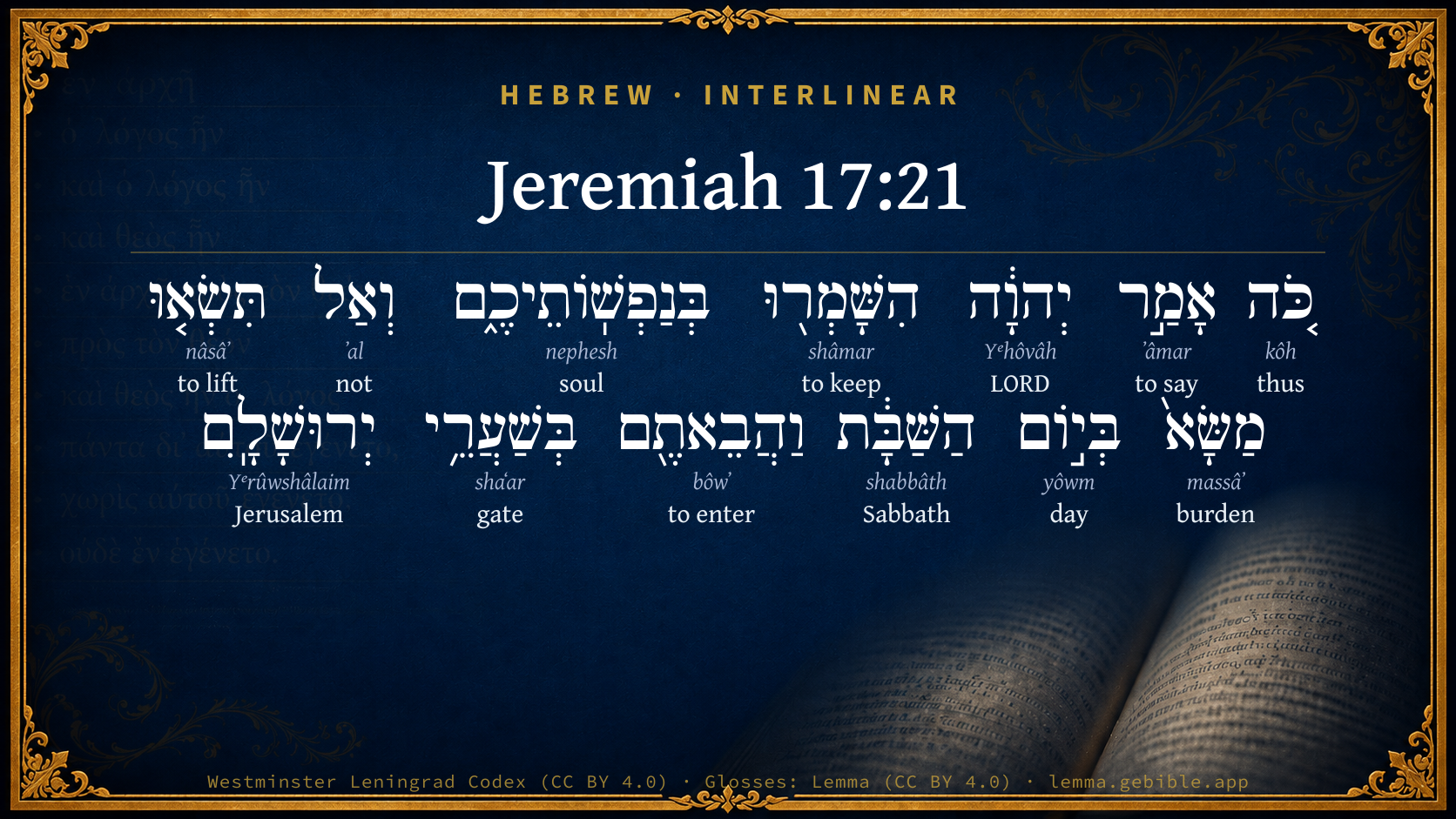
Hebrew (Westminster Leningrad Codex) Jeremiah 17:21 appears in the Hebrew Old Testament. The text above is from the Westminster Leningrad Codex. Each word links to its Strong’s number, a concise gloss, and parsing drawn from the Open Scriptures Hebrew Bible morphology. Click any word for its full Brown-Driver-Briggs (BDB) entry.
Download image
Cite this verse

Jeremiah 17:21 (World English Bible). Public Domain. Lemma interlinear Bible study tool, https://lemma.gebible.app/v/jeremiah/17/21.

Show BibTeX & RIS
BibTeX
RIS
English Translation
Thus says Yahweh, Take heed to yourselves, and bear no burden on the Sabbath day, nor bring it in by the gates of Jerusalem;
World English Bible · Public Domain
Download a study sheet

One document with this verse’s original text, its word-by-word gloss line, the meaning frame, cross-references with their text, attributed commentary, and full source and license credits — printable, and it pastes into notes with its structure intact.

This verse Autodidact and up

Study sheet (.html) Plain text (.txt)

A passage Seminary Student

Up to 50 verses in one chapter. A passage sheet keeps up to 6 commentary sources and 12 cross-references per verse, in the order this page ranks them, and says so on the sheet whenever that leaves anything out. Ask for a single verse and you get the Autodidact verse sheet above.

Everything on this page stays free to read, with no account — the sheet is a download of what is already on screen, not access to it.

Want to remove ads? Support Godless Engineer
Compare translations 3

The same verse in 3 English versions, stacked beneath the original-language interlinear above. Click any original word for its lexicon entry.

Each is an independent rendering of the whole verse — the interlinear is not word-aligned to these translations.

Highlighted words mark where these versions differ — a whole-verse word diff, not a word-by-word alignment.

  • World English Bible Public Domain
    Thus says Yahweh, Take heed to yourselves, and bear no burden on the Sabbath day, nor bring it in by the gates of Jerusalem;
  • King James Version Public Domain
    Thus saith the LORD; Take heed to yourselves, and bear no burden on the sabbath day, nor bring it in by the gates of Jerusalem;
  • unfoldingWord Literal Text CC BY-SA 4.0
    Thus says Yahweh: “Take heed to yourselves and do not bear a burden on the day of the Sabbath, nor bring it in by the gates of Jerusalem.

unfoldingWord Literal Text — © unfoldingWord, licensed CC BY-SA 4.0. Word-aligned USFM3 via Door43 (git.door43.org/unfoldingWord/en_ult).

Versions to compare (up to 4)

3 of 4 selected

Show all 18 translations

Every available English version of this verse, each an independent rendering of the whole verse.

  • World English Bible Public Domain
    Thus says Yahweh, Take heed to yourselves, and bear no burden on the Sabbath day, nor bring it in by the gates of Jerusalem;
  • Berean Standard Bible Public Domain
    This is what the LORD says: Take heed for yourselves; do not carry a load or bring it through the gates of Jerusalem on the Sabbath day.
  • Majority Standard Bible Public Domain
    This is what the LORD says: Take heed for yourselves; do not carry a load or bring it through the gates of Jerusalem on the Sabbath day.
  • King James Version Public Domain
    Thus saith the LORD; Take heed to yourselves, and bear no burden on the sabbath day, nor bring it in by the gates of Jerusalem;
  • American Standard Version (1901) Public Domain
    Thus saith Jehovah, Take heed to yourselves, and bear no burden on the sabbath day, nor bring it in by the gates of Jerusalem;
  • Revised Version (1885) Public Domain
    Thus saith the LORD: Take heed to yourselves, and bear no burden on the sabbath day, nor bring it in by the gates of Jerusalem;
  • Geneva Bible (1599) Public Domain
    Thus sayth the Lord, Take heede to your soules, and beare no burden in the Sabbath day, nor bring it in by the gates of Ierusalem.
  • Douay-Rheims (1899) Public Domain
    Thus saith the Lord: Take heed to your souls and carry no burdens on the Sabbath day: and bring them not in by the gates of Jerusalem.
  • Young's Literal Translation Public Domain
    Thus said Jehovah, Take ye heed to yourselves, And ye bear not a burden on the day of rest, Nor have ye brought `it' in by the gates of Jerusalem.
  • Literal Standard Version CC BY-SA 4.0
    Thus said YHWH: “Take heed to yourselves, || And you do not bear a burden on the day of rest, || Nor have you brought [it] in by the gates of Jerusalem.
  • Unlocked Literal Bible CC BY-SA 4.0
    Yahweh says this: “Be careful for the sake of your lives and do not carry a burden on the Sabbath day to bring it to the gates of Jerusalem.
  • unfoldingWord Literal Text CC BY-SA 4.0
    Thus says Yahweh: “Take heed to yourselves and do not bear a burden on the day of the Sabbath, nor bring it in by the gates of Jerusalem.
  • Darby Bible Public Domain
    thus saith Jehovah: Take heed to your souls, and bear no burden on the sabbath day, and bring nothing in through the gates of Jerusalem;
  • World Messianic Bible Public Domain
    The LORD says, “Be careful, and bear no burden on the Sabbath day, nor bring it in by the gates of Jerusalem.
  • Webster's Bible Public Domain
    Thus saith the LORD; Take heed to yourselves, and bear no burden on the sabbath day, nor bring it in by the gates of Jerusalem;
  • Free Bible Version CC BY-SA 4.0
    This is what the Lord says: Pay attention, if you value your lives! Don't carry a load on the Sabbath day, and don't bring it through the gates of Jerusalem.
  • Bible in Basic English Public Domain
    This is what the Lord has said: See to yourselves, that you take up no weight on the Sabbath day, or take it in through the doors of Jerusalem;
  • JPS Tanakh (1917) Public Domain
    thus saith the LORD: Take heed for the sake of your souls, and bear no burden on the sabbath day, nor bring it in by the gates of Jerusalem;

Literal Standard Version (2020), Covenant Press — licensed CC BY-SA 4.0. Text via the HelloAO Bible API (eBible.org). Unlocked Literal Bible (unfoldingWord) — licensed CC BY-SA 4.0. Text via the HelloAO Bible API (eBible.org). unfoldingWord Literal Text — © unfoldingWord, licensed CC BY-SA 4.0. Word-aligned USFM3 via Door43 (git.door43.org/unfoldingWord/en_ult). Free Bible Version, Dr. Jonathan Gallagher — licensed CC BY-SA 4.0. Text via the HelloAO Bible API (eBible.org).

Word by word

More ways to search: Search by grammar → Find every occurrence → Compare this word →

Practice this passage: Drill this verse → Learn its vocabulary →

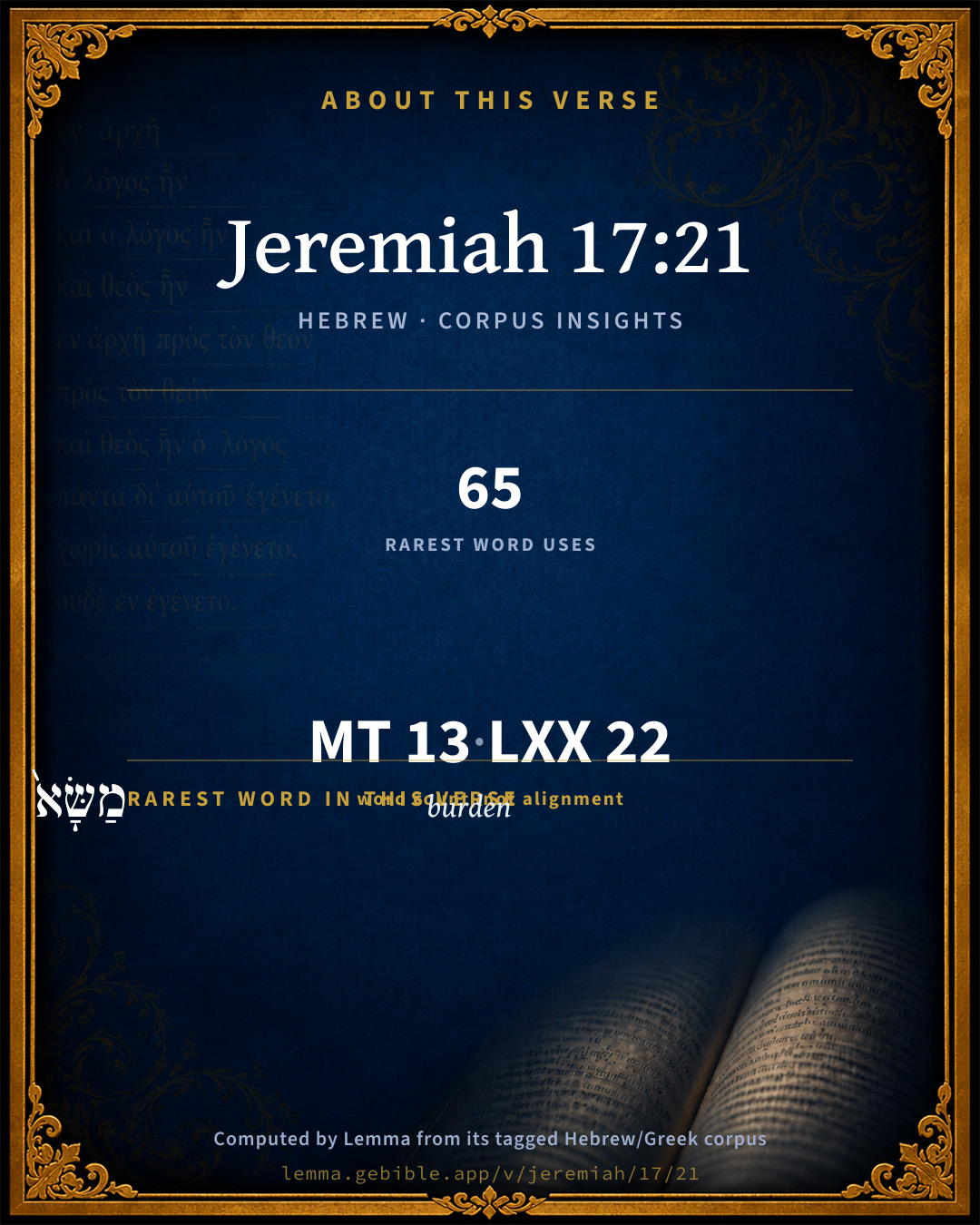
מַשָּׂא֙
massâʼ
H4853
“burden”
Noun, Common, Masculine, Singular, Absolute
Part of Speech
Noun
Type
Common
Gender
Masculine
Number
Singular
State
Absolute
Full BDB Definition

Origin: from H5375

TWOT: 1421d , 1421e

Massa = "burden" - load, bearing, tribute, burden, lifting (noun masculine) - load, burden - lifting, uplifting, that to which the soul lifts itself up - bearing, carrying - tribute, that which is carried or brought or borne - utterance, oracle, burden (noun masculine) - a son of Ishmael (noun proper masculine)
  1. כֹּ֚ה kôh H3541 “thus” Adverb
  2. אָמַ֣ר ʼâmar H559 “to say” Verb, Qal, Perfect, 3rd Person, Masculine, Singular
  3. יְהוָ֔ה Yᵉhôvâh H3068 “LORD” Noun, Proper
  4. הִשָּׁמְר֖וּ shâmar H8104 “keep” Verb, Niphal, Imperative, 2nd Person, Masculine, Plural
  5. בְּנַפְשֽׁוֹתֵיכֶ֑ם nephesh H5315 “in/at · souls · your” Preposition + Noun, Common, Both, Plural, Construct + Suffix, Personal, 2nd Person, Masculine, Plural
  6. וְאַל ʼal H408 “and · not” Conjunction + Particle, Negative
  7. תִּשְׂא֤וּ nâsâʼ H5375 “to lift” Verb, Qal, Jussive, 2nd Person, Masculine, Plural
  8. בְּי֣וֹם yôwm H3117 “in/at · day of” Preposition + Noun, Common, Masculine, Singular, Construct
  9. הַשַּׁבָּ֔ת shabbâth H7676 “the · Sabbath” Particle, Definite Article + Noun, Common, Both, Singular, Absolute
  10. וַהֲבֵאתֶ֖ם bôwʼ H935 “and · to enter” Conjunction + Verb, Hiphil, Sequential Perfect, 2nd Person, Masculine, Plural
  11. בְּשַׁעֲרֵ֥י shaʻar H8179 “in/at · gates of” Preposition + Noun, Common, Masculine, Plural, Construct
  12. יְרוּשָׁלִָֽם Yᵉrûwshâlaim H3389 “Jerusalem” Noun, Proper

About this verse

These counts appear in no published source. They are computed here, from the morphology-tagged text and Lemma’s own curated glosses. What Lemma adds →

13
words
13
distinct lemmas
Prophets
section

Grammatical profile

  • 4 verbs
  • 7 nouns
  • 1 adverb
  • 1 particle

Verb forms

  • אָמַ֣ר Qal · Perfect
  • הִשָּׁמְר֖וּ Niphal · Imperative
  • תִּשְׂא֤וּ Qal · Jussive
  • וַהֲבֵאתֶ֖ם Hiphil · Sequential Perfect

Hebrew & Septuagint length

In the original languages it is 13 Hebrew tokens and 22 Greek tokens — but the two are counted differently (Hebrew bundles its prefixes and suffixes into one token; the Greek is in lemma form), so that isn’t a like-for-like length.

Cross-references

15

Topical passages linked to Jeremiah 17:21 in the Treasury of Scripture Knowledge — connected by theme and wording, ordered by reader-vote popularity; previews shown in the World English Bible.

  • Nehemiah 13:15–21 In those days saw I in Judah some men treading wine-presses on the Sabbath, and bringing in sheaves, and lading donkeys [therewith]; as also wine, grapes, and figs, and all manner of burdens, which they brought into Jerusalem on the Sabbath day: and I testified [against them] in the day in which they sold food.
  • Numbers 15:32–36 While the children of Israel were in the wilderness, they found a man gathering sticks on the Sabbath day.
  • John 5:9–12 Immediately, the man was made well, and took up his mat and walked. Now it was the Sabbath on that day.
  • Deuteronomy 4:9 Only take heed to yourself, and keep your soul diligently, lest you forget the things which your eyes saw, and lest they depart from your heart all the days of your life; but make them known to your children and your children's children;
  • Deuteronomy 4:15 Take therefore good heed to yourselves; for you saw no manner of form on the day that Yahweh spoke to you in Horeb out of the midst of the fire.
  • Deuteronomy 4:23 Take heed to yourselves, lest you forget the covenant of Yahweh your God, which he made with you, and make you an engraved image in the form of anything which Yahweh your God has forbidden you.
  • Deuteronomy 11:16 Take heed to yourselves, lest your heart be deceived, and you turn aside, and serve other gods, and worship them;
  • Joshua 23:11 Take good heed therefore to yourselves, that you love Yahweh your God.
  • Proverbs 4:23 Keep your heart with all diligence, For out of it is the wellspring of life.
  • Jeremiah 17:22–27 neither carry forth a burden out of your houses on the Sabbath day holy, neither do any work: but make the Sabbath day, as I commanded your fathers.
  • Mark 4:24 He said to them, "Take heed what you hear. With whatever measure you measure, it will be measured to you, and more will be given to you who hear.
  • Luke 8:18 Be careful therefore how you hear. For whoever has, to him will be given; and whoever doesn't have, from him will be taken away even that which he thinks he has."
  • Hebrews 2:1–3 Therefore we ought to pay greater attention to the things that were heard, lest perhaps we drift away.
  • Hebrews 12:15–16 looking carefully lest there be any man who falls short of the grace of God; lest any root of bitterness springing up trouble you, and thereby the many be defiled;
  • Acts 20:28 Take heed, therefore, to yourselves, and to all the flock, in which the Holy Spirit has made you overseers, to shepherd the assembly of the Lord and God which he purchased with his own blood.

Cross-references courtesy of OpenBible.info (CC BY 4.0).

Hebrew and Greek witnesses Masoretic Hebrew ↔ Greek Septuagint

The same verse in the two great witnesses to the Old Testament, shown verse-for-verse.

These are two independent witnesses, not word-aligned to each other, and the Septuagint is shown in lemma (dictionary) form.

Hebrew Jeremiah 17:21 Masoretic · Westminster Leningrad Codex

כֹּ֚ה אָמַ֣ר יְהוָ֔ה הִשָּׁמְר֖וּ בְּנַפְשֽׁוֹתֵיכֶ֑ם וְאַל תִּשְׂא֤וּ מַשָּׂא֙ בְּי֣וֹם הַשַּׁבָּ֔ת וַהֲבֵאתֶ֖ם בְּשַׁעֲרֵ֥י יְרוּשָׁלִָֽם

Thus says Yahweh, Take heed to yourselves, and bear no burden on the Sabbath day, nor bring it in by the gates of Jerusalem;

World English Bible · Public Domain

Greek LXX Structure differs

In the Septuagint, Jeremiah is about an eighth shorter than the Hebrew and arranges its material differently — the Oracles Against the Nations (Hebrew chapters 46–51) appear in the middle of the Greek book, after 25:13. Because the chapter and verse boundaries do not line up, a verse-for-verse comparison with the Hebrew is not shown.

A verse-for-verse comparison isn’t shown here because the chapters and verses don’t line up. Switch to the LXX edition with the MT / LXX toggle above to read the Greek directly.

Hebrew: Westminster Leningrad Codex (CC BY 4.0). Greek: Septuagint (public domain); English from a public-domain English Septuagint. How the Septuagint differs from the Hebrew →

Targum (Aramaic paraphrase)

1

The Targum is the ancient Jewish Aramaic paraphrase of the Hebrew Scriptures — an interpretive translation, not the Hebrew text itself. Onkelos (literal) and Pseudo-Jonathan (expansive) render the Torah, and Jonathan the Prophets. Coverage is partial: where no permissively-licensed English translation exists for a verse, only the Aramaic is shown. This is verse-level text, not a word-by-word alignment to the Hebrew.

  1. Targum Jonathan Prophets (Joshua–Malachi)
    כִּדְנַן אֲמַר יְיָ אִסְתַּמָרוּ בְּנַפְשָׁתְכוֹן וְלָא תִטְלוּן מַטוּל בְּיוֹמָא דְשַׁבְּתָא וְתֵיעַלוּן בְּתַרְעֵי יְרוּשְׁלֵם:

    (no public-domain English translation for this verse)

    Targum Jonathan — Aramaic: “Mikraot Gedolot” (public domain). English: “Sefaria Community Translation” (CC0 1.0 (public-domain dedication)); “London "Chaldee Paraphrase," 1871” (public domain). Text via Sefaria.

Commentary

Notes on Jeremiah 17:21 from classic Christian and Jewish commentators (each source and its license shown beneath its notes). The classic Christian expositions comment on the surrounding passage and are grouped to its opening verse, so a note may address several verses; the Jewish commentaries on the Tanakh (Rashi and others) are per-verse, so they appear only where the commentator wrote on this verse.

Lemma curates 59 commentaries, every one of them public domain or Creative Commons licensed, each selected and text-cleaned for this edition rather than reprinted as found. About our sources →

Trapp's Complete Commentary

John Trapp

Jer 17:21 Thus saith the LORD; Take heed to yourselves, and bear no burden on the sabbath day, nor bring [it] in by the gates of Jerusalem;

Ver. 21. Take heed to yourselves.] Break not the Sabbath, that ye fall not under the fierce wrath of God, who paid him home with stones who but only gathered sticks on that day. Cavete, Beware, it concerns you much.

And bear no burden.] See Neh 13:15-16; Neh 13:19. {See Trapp on "Neh 13:15"} {See Trapp on "Neh 13:16"} {See Trapp on "Neh 13:19"}

John Trapp, A Commentary or Exposition upon All the Books of the Old and New Testament (1647–1656) — public domain. Text from a community e-Sword module.

Tyndale Open Study Notes

Tyndale Open Resources

17:21-22 Trading on the Sabbath was wrong and had to be stopped. The Sabbath was not a time to buy and sell, but was established in the Sinai covenant as a holy day (Exod 29:8-11; 31:12-17) when the people of Israel were to rest and honor the Lord.

Tyndale Open Study Notes — © Tyndale Open Resources, licensed CC BY-SA 4.0. Text via the HelloAO Bible API.

Geneva Bible (1599)

Geneva Bible translators

By naming the Sabbath day, he comprehendeth the thing that is thereby signified: for if they transgressed in the ceremony, they must needs be culpable of the rest, read Exod. 20:8, and by the breaking of this one commandment, he maketh them transgressors of the whole law, forasmuch as the first and second table are contained herein.

Geneva Bible (1599) marginal notes — public domain. Text via Bolls.life.

Jamieson, Fausset & Brown

Robert Jamieson, A. R. Fausset & David Brown

Take heed to yourselves--literally, "to your souls." MAURER explains, "as ye love your lives"; a phrase used here to give the greater weight to the command.

sabbath--The non-observance of it was a chief cause of the captivity, the number of years of the latter, seventy, being exactly made to agree with the number of Sabbaths which elapsed during the four hundred ninety years of their possession of Canaan from Saul to their removal (Lev 26:34-35; Ch2 36:21). On the restoration, therefore, stress was especially laid on Sabbath observance (Neh 13:19).

Jerusalem--It would have been scandalous anywhere; but in the capital, Jerusalem, it was an open insult to God. Sabbath-hallowing is intended as a symbol of holiness in general (Eze 20:12); therefore much stress is laid on it; the Jews' gross impiety is manifested in their setting God's will at naught, in the case of such an easy and positive command.

Jamieson, Fausset & Brown — Commentary Critical and Explanatory on the Whole Bible (1871) — public domain (CC PDM 1.0). Text via the HelloAO Bible API.

Adam Clarke's Commentary

Verse 21. Take heed to yourselves and bear no burden] From this and the following verses we find the ruin of the Jews attributed to the breach of the Sabbath; as this led to a neglect of sacrifice, the ordinances of religion, and all public worship, so it necessarily brought with it all immorality. This breach of the Sabbath was that which let in upon them all the waters of God's wrath.

Adam Clarke's Commentary on the Bible (1810–1826) — public domain. Text from a community e-Sword/MySword module.

John Calvin's Commentaries

He bids them to attend, or to beware in their souls. Some render the words, “As your souls are precious to you.” But I take souls, not for their lives, but for the affections of their hearts; as though he had said, “Take heed carefully of yourselves, that this may be laid up in your inmost heart.” The word נפש nuphesh, means often the heart, the seat of the affections. It is said in Deuteronomy 4:15,

“Take heed to yourselves, לנפשותיכם lanupheshuticam, to your souls.”

here it is, בנפשותיכם, benupheshuticam, “in your souls;” but there, “to” or “for your souls,” as also in Joshua 23:11. But the same thing is meant, and that is, that they were to take great heed, to take every care, to exert every effort, and, in short, every faculty of their souls. Take heed then carefully, he says, take heed with every thought and faculty of your soul, that ye carry no burden on the Sabbath-day, and that ye bring it not through the gates of Jerusalem. It was a thing not difficult to be observed; and further, it was a most shameless transgression of the law; for, as I have said, by this slight matter they shewed that they despised the law of God, while yet the observance of the Sabbath was a thing of great importance: it was important in itself, but to observe it was easy. Hence appeared the twofold impiety of the people, — because they despised God’s singular favor, of which the seventh day was an evidence; and, because they were unwilling to take rest on that day, and in so easy a matter, they hesitated not, as it were, to insult God, as it has been before said.

Hence we ought to notice also what he says in these words, Carry no burden, and bring it not through the gatesof Jerusalem: and this was emphatically added; for it was not lawful even in the fields or in desert places to do anything on the Sabbath; but it was extremely shameful to carry a burden through the gates of Jerusalem; it was as though they wished publicly to reproach and despise God. Jerusalem was a public place; and it was as though one was not content privately to do dishonor to his neighbor or his brother, but must shew his ill-nature openly and in the light of day. Thus the Jews were not only reproachful towards God, but also dared to shew their impiety in his own renowned city, and, in short, in his very sanctuary. The rest we must defer.

John Calvin's Commentaries (1540-1563) — public domain. Text from the Calvin Translation Society English edition (1840s-50s) via the Christian Classics Ethereal Library (ccel.org). Calvin's coverage is partial (roughly two-thirds of the Bible); uncommented books and verses are honest gaps, never fabricated. The 19th-century editor's footnotes and remarks are omitted so the notes are faithfully Calvin's own voice.

The Cambridge Bible for Schools and Colleges

gen. ed. J. J. S. Perowne

21. to yourselves] rather as mg. for your life’s sake, Heb. in your souls; we should say, As you value your lives.

The Cambridge Bible for Schools and Colleges (gen. ed. J. J. S. Perowne; Cambridge University Press, 1878–1918) — public domain. Text from a community e-Sword module.

John Gill's Exposition

Thus saith the Lord, take heed to yourselves,.... That ye sin not against the Lord, by breaking the sabbath, and so bring wrath and ruin upon yourselves: or "to your souls" (a); to the inward frame of them, that they be in disposition for the work of that day; and that they be wholly engaged therein, even all the powers and faculties of them; and that they be not taken up in thoughts and cares about other things:

and bear no burden on the sabbath day; as no worldly thoughts and cares should, cumber the mind, and lie heavy thereon, to the interruption of spiritual exercises of religion; so neither should any weight or burden be borne by the body, or carried from place to place; as not by themselves, so neither by their servants, nor by their cattle, nor in carts and wagons, nor by any instrument whatever; in short, all servile work was forbidden:

nor bring it in by the gates of Jerusalem; to be unloaded and sold there, as wine, grapes, figs, and fish, were, in the times of Nehemiah, Neh 13:15.

(a) "in animabus vestris", Calvin, Montanus, Schmidt.

John Gill's Exposition of the Whole Bible (1746–1763) — public domain (CC PDM 1.0). Text via the HelloAO Bible API.

Haydock's Catholic Bible Commentary

CHAPTER XVII.

Souls. Those who broke the sabbath were to die, Exodus xxx. 15., and Numbers xv. 32. --- Burdens, or servile work. (Calmet) --- The Jews trifle in deciding what is a burden. (Origen, prin. iv. 2.) --- Sabbath often denotes the observance of the whole law. (Worthington)

George Leo Haydock (1774–1849), Haydock's Catholic Family Bible and Commentary, 1859 edition — public domain. Excludes Psalms (Douay-Rheims chapter numbering differs from Protestant) and Deuterocanonical books (Catholic canon only).

Matthew Poole's English Annotations

Take heed to yourselves; the Hebrew is, Take heed to your souls, intimating to us that the sanctification of the sabbath is a great thing, wherein the welfare of our souls is concerned.

Matthew Poole's English Annotations on the Holy Bible (1683–1685) — public domain. Text from a community e-Sword/MySword module.

Whedon's Commentary on the Bible

Daniel D. Whedon

21, 22. Take heed to yourselves — Literally, to your souls.

Bear no burden… neither do ye any work — These are specifications as to the law of the sabbath, suggested, probably, by violations which were common. The bearing of burdens probably refers to market trade and business. It is not unlikely that the country people, as they came to temple-service, were accustomed to “mingle traffic with their devotions;”

and, as has been suggested, the fact that the people of Jerusalem were forbidden to carry burdens out of their houses seems to point to a practice on their part of carrying their wares to the gates for the purpose of traffic with the inhabitants on their holy day.

Daniel D. Whedon (gen. ed.), Commentary on the Old and New Testaments (1874–1909) — public domain. Text from a community e-Sword module.

The Pulpit Commentary

Take heed to yourselves; rather, Take heed heartily, conscientiously; literally, in your souls. So in Malachi, (Mal_2:15, Mal_2:16) "Take heed in your spirit" (not, "to your spirit," as Authorized Version).

The Pulpit Commentary (1880–1919), ed. H.D.M. Spence-Jones & Joseph S. Exell — public domain. Text from a community e-Sword module.

unfoldingWord translationNotes

Door43 World Missions Community

for the sake of your lives

"to protect your lives"

They did not listen or pay attention

These two phrases mean basically the same thing and emphasize that the people refused to listen. AT: "They refused to listen" or "They refused to obey" (See: Doublet)

stiffened their neck

Jeremiah speaks of the people being stubborn as if they had made their necks stiff and unmovable. AT: "became stubborn" (See: Metaphor)

translationWords

life

burden

Sabbath

works

set apart

command

stiff-necked

discipline

unfoldingWord translationNotes — © Distant Shores Media and the Door43 World Missions Community, licensed CC BY-SA 4.0. Source: git.door43.org/Door43/en_tn.

Lesson kit

Teaching starters — assembled from the data on this page, not authored interpretation. Every prompt links to the verse data it draws on. Edit before teaching.

Jeremiah, in the Prophets, opens this verse with 13 words (13 distinct Hebrew lemmas). Its most distinctive word is massâʼ (“burden”). A historical commentator’s framing appears above. Read the whole chapter for the surrounding context.

Discussion questions

  1. How does “burden” (massâʼ) shape what this verse is saying?
  2. Nehemiah 13:15–21 shares this passage’s theme. How do the two illuminate each other?
  3. These translations render this verse differently; the difference is in the English rendering, not the original. What questions does that raise?
  4. The verb «אָמַ֣ר» is Qal Perfect. How does its form color the action?
  5. Reading how Trapp's Complete Commentary and Tyndale Open Study Notes read this verse, where do the two commentators agree and where do they part?

Things to notice

Reading settings

Reading text

Shown beneath each verse's original-language words.

Old Testament
Old Testament edition

Read the OT as the Masoretic Hebrew (MT) or the Greek Septuagint (LXX).

English shown for the Greek Septuagint (in the Hebrew ↔ Greek comparison).

Comparing translations? Open the Compare panel on any verse page to stack up to four side by side.