
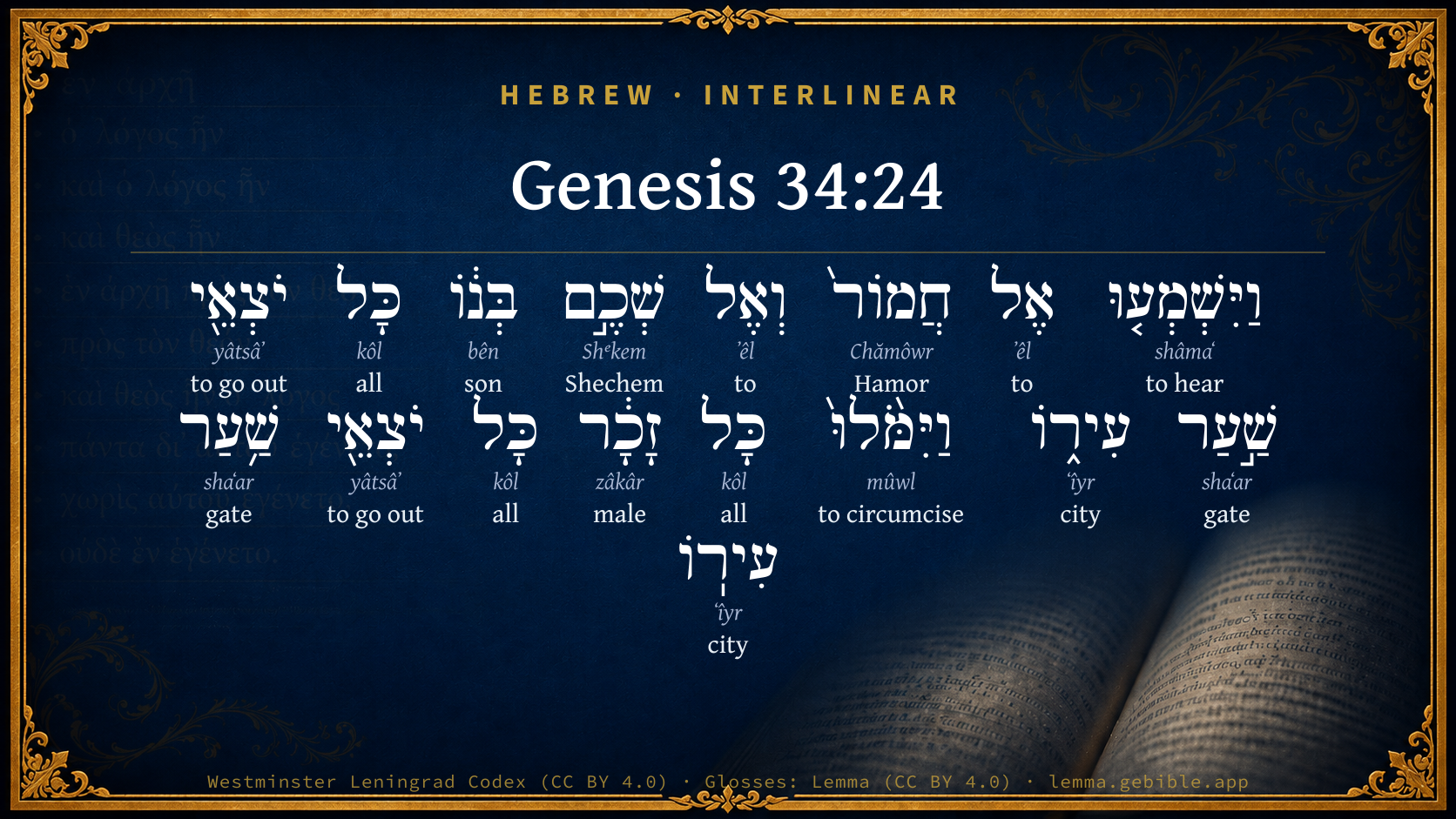
Genesis 34:24

Hebrew (Westminster Leningrad Codex) Genesis 34:24 appears in the Hebrew Old Testament. The text above is from the Westminster Leningrad Codex. Each word links to its Strong’s number, a concise gloss, and parsing drawn from the Open Scriptures Hebrew Bible morphology. Click any word for its full Brown-Driver-Briggs (BDB) entry.
Download image
Cite this verse

Genesis 34:24 (World English Bible). Public Domain. Lemma interlinear Bible study tool, https://lemma.gebible.app/v/genesis/34/24.

Show BibTeX & RIS
BibTeX
RIS
English Translation
All who went out of the gate of his city listened to Hamor, and to Shechem his son; and every male was circumcised, all who went out of the gate of his city.
World English Bible · Public Domain
Download a study sheet

One document with this verse’s original text, its word-by-word gloss line, the meaning frame, cross-references with their text, attributed commentary, and full source and license credits — printable, and it pastes into notes with its structure intact.

This verse Autodidact and up

Study sheet (.html) Plain text (.txt)

A passage Seminary Student

Up to 50 verses in one chapter. A passage sheet keeps up to 6 commentary sources and 12 cross-references per verse, in the order this page ranks them, and says so on the sheet whenever that leaves anything out. Ask for a single verse and you get the Autodidact verse sheet above.

Everything on this page stays free to read, with no account — the sheet is a download of what is already on screen, not access to it.

Want to remove ads? Support Godless Engineer
Compare translations 3

The same verse in 3 English versions, stacked beneath the original-language interlinear above. Click any original word for its lexicon entry.

Each is an independent rendering of the whole verse — the interlinear is not word-aligned to these translations.

Highlighted words mark where these versions differ — a whole-verse word diff, not a word-by-word alignment.

  • World English Bible Public Domain
    All who went out of the gate of his city listened to Hamor, and to Shechem his son; and every male was circumcised, all who went out of the gate of his city.
  • King James Version Public Domain
    And unto Hamor and unto Shechem his son hearkened all that went out of the gate of his city; and every male was circumcised, all that went out of the gate of his city.
  • unfoldingWord Literal Text CC BY-SA 4.0
    And all who went out of the gate of his city listened to Hamor and to Shechem his son, and every male was circumcised, all who went out of the gate of his city.

unfoldingWord Literal Text — © unfoldingWord, licensed CC BY-SA 4.0. Word-aligned USFM3 via Door43 (git.door43.org/unfoldingWord/en_ult).

Versions to compare (up to 4)

3 of 4 selected

Show all 18 translations

Every available English version of this verse, each an independent rendering of the whole verse.

  • World English Bible Public Domain
    All who went out of the gate of his city listened to Hamor, and to Shechem his son; and every male was circumcised, all who went out of the gate of his city.
  • Berean Standard Bible Public Domain
    All the men who went out of the city gate listened to Hamor and his son Shechem, and every male of the city was circumcised.
  • Majority Standard Bible Public Domain
    All the men who went out of the city gate listened to Hamor and his son Shechem, and every male of the city was circumcised.
  • King James Version Public Domain
    And unto Hamor and unto Shechem his son hearkened all that went out of the gate of his city; and every male was circumcised, all that went out of the gate of his city.
  • American Standard Version (1901) Public Domain
    And unto Hamor and unto Shechem his son hearkened all that went out of the gate of his city; and every male was circumcised, all that went out of the gate of his city.
  • Revised Version (1885) Public Domain
    And unto Hamor and unto Shechem his son hearkened all that went out of the gate of his city; and every male was circumcised, all that went out of the gate of his city.
  • Geneva Bible (1599) Public Domain
    And vnto Hamor, and Shechem his sonne hearkened all that went out of the gate of his citie: and all the men children were circumcised, euen all that went out of the gate of his citie.
  • Douay-Rheims (1899) Public Domain
    And they all agreed, and circumcised all the males.
  • Young's Literal Translation Public Domain
    And unto Hamor, and unto Shechem his son, hearken do all those going out of the gate of his city, and every male is circumcised, all those going out of the gate of his city.
  • Literal Standard Version CC BY-SA 4.0
    And to Hamor, and to his son Shechem, do all those going out of the gate of his city listen, and every male is circumcised, all those going out of the gate of his city.
  • Unlocked Literal Bible CC BY-SA 4.0
    All the men of the city listened to Hamor and Shechem, his son. Every male was circumcised.
  • unfoldingWord Literal Text CC BY-SA 4.0
    And all who went out of the gate of his city listened to Hamor and to Shechem his son, and every male was circumcised, all who went out of the gate of his city.
  • Darby Bible Public Domain
    And all that went out at the gate of his city hearkened to Hamor and to Shechem his son; and every male was circumcised -- all that went out at the gate of his city.
  • World Messianic Bible Public Domain
    All who went out of the gate of his city listened to Hamor, and to Shechem his son; and every male was circumcised, all who went out of the gate of his city.
  • Webster's Bible Public Domain
    And to Hamor and to Shechem his son hearkened all that went out of the gate of his city: and every male was circumcised, all that went out of the gate of his city.
  • Free Bible Version CC BY-SA 4.0
    Everyone there at the town gate agreed with Hamor and Shechem so every male in the town was circumcised.
  • Bible in Basic English Public Domain
    Then all the men of the town gave ear to the words of Hamor and Shechem his son; and every male in the town underwent circumcision.
  • JPS Tanakh (1917) Public Domain
    And unto Hamor and unto Shechem his son hearkened all that went out of the gate of his city; and every male was circumcised, all that went out of the gate of his city.

Literal Standard Version (2020), Covenant Press — licensed CC BY-SA 4.0. Text via the HelloAO Bible API (eBible.org). Unlocked Literal Bible (unfoldingWord) — licensed CC BY-SA 4.0. Text via the HelloAO Bible API (eBible.org). unfoldingWord Literal Text — © unfoldingWord, licensed CC BY-SA 4.0. Word-aligned USFM3 via Door43 (git.door43.org/unfoldingWord/en_ult). Free Bible Version, Dr. Jonathan Gallagher — licensed CC BY-SA 4.0. Text via the HelloAO Bible API (eBible.org).

Word by word

More ways to search: Search by grammar → Find every occurrence → Compare this word →

Practice this passage: Drill this verse → Learn its vocabulary →

חֲמוֹר֙
Chămôwr
H2544
“Hamor”
Noun, Proper
Part of Speech
Noun
Type
Proper
Full BDB Definition

Origin: the same as H2543

TWOT: None

Hamor = "he-ass" - the Hivite prince of the city of Shechem when Jacob entered Palestine
  1. וַיִּשְׁמְע֤וּ shâmaʻ H8085 “and · to hear” Conjunction + Verb, Qal, Sequential Imperfect, 3rd Person, Masculine, Plural
  2. אֶל ʼêl H413 “to” Preposition
  3. וְאֶל ʼêl H413 “and · to” Conjunction + Preposition
  4. שְׁכֶ֣ם Shᵉkem H7927 “Shechem” Noun, Proper
  5. בְּנ֔וֹ bên H1121 “son · his” Noun, Common, Masculine, Singular, Construct + Suffix, Personal, 3rd Person, Masculine, Singular
  6. כָּל kôl H3605 “all of” Noun, Common, Masculine, Singular, Construct
  7. יֹצְאֵ֖י yâtsâʼ H3318 “going out” Verb, Qal, Participle Active, Masculine, Plural, Construct
  8. שַׁ֣עַר shaʻar H8179 “gate of” Noun, Common, Masculine, Singular, Construct
  9. עִיר֑וֹ ʻîyr H5892 “city · his” Noun, Common, Feminine, Singular, Construct + Suffix, Personal, 3rd Person, Masculine, Singular
  10. וַיִּמֹּ֨לוּ֙ mûwl H4135 “and · to circumcise” Conjunction + Verb, Niphal, Sequential Imperfect, 3rd Person, Masculine, Plural
  11. כָּל kôl H3605 “all of” Noun, Common, Masculine, Singular, Construct
  12. זָכָ֔ר zâkâr H2145 “male” Adjective, Adjective, Masculine, Singular, Absolute
  13. כָּל kôl H3605 “all of” Noun, Common, Masculine, Singular, Construct
  14. יֹצְאֵ֖י yâtsâʼ H3318 “going out” Verb, Qal, Participle Active, Masculine, Plural, Construct
  15. שַׁ֥עַר shaʻar H8179 “gate of” Noun, Common, Masculine, Singular, Construct
  16. עִירֽוֹ ʻîyr H5892 “city · his” Noun, Common, Feminine, Singular, Construct + Suffix, Personal, 3rd Person, Masculine, Singular

About this verse

These counts appear in no published source. They are computed here, from the morphology-tagged text and Lemma’s own curated glosses. What Lemma adds →

17
words
11
distinct lemmas
Pentateuch
section

Notable vocabulary

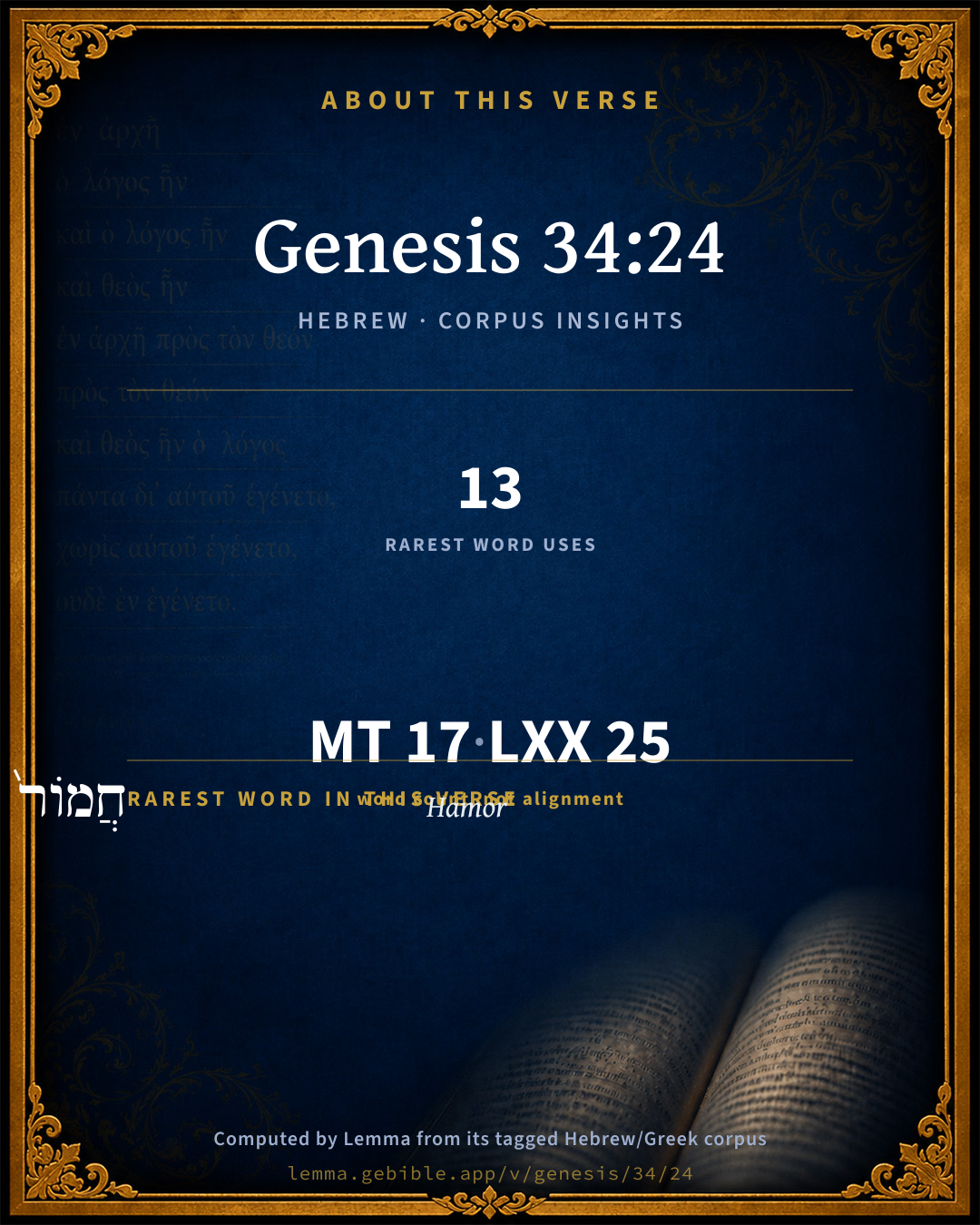
The rarest word here is חֲמוֹר֙ Hamor H2544 — appearing just 13 times in the whole Hebrew Bible.

Shared distinctive vocabulary

חֲמוֹר֙ Hamor H2544 occurs in 12 verses of the Hebrew Bible. Also found in:

Grammatical profile

  • 4 verbs
  • 10 nouns
  • 1 adjective
  • 2 prepositions

Verb forms

  • וַיִּשְׁמְע֤וּ Qal · Sequential Imperfect
  • יֹצְאֵ֖י Qal · Participle Active
  • וַיִּמֹּ֨לוּ֙ Niphal · Sequential Imperfect
  • יֹצְאֵ֖י Qal · Participle Active

Repetition

Words recur within this verse — often emphatic in Hebrew:

  • כָּל all H3605 ×3
  • יֹצְאֵ֖י to go out H3318 ×2
  • שַׁ֣עַר gate H8179 ×2
  • עִיר֑וֹ city H5892 ×2
  • אֶל to H413 ×2

Hebrew & Septuagint length

In English translation the verse runs 33 words from the Hebrew and 30 from the Septuagint (LXX English) — closely comparable.

A rough comparison of the two English renderings, which tokenize alike — not a word-level alignment.

Word counts can differ between the Hebrew and the Greek without any difference in meaning — e.g. the Hebrew direct-object marker אֵת has no separate Greek word, and Greek often adds the article ὁ.

In the original languages it is 17 Hebrew tokens and 25 Greek tokens — but the two are counted differently (Hebrew bundles its prefixes and suffixes into one token; the Greek is in lemma form), so that isn’t a like-for-like length.

Cross-references

7

Topical passages linked to Genesis 34:24 in the Treasury of Scripture Knowledge — connected by theme and wording, ordered by reader-vote popularity; previews shown in the World English Bible.

  • Genesis 23:10 Now Ephron was sitting in the midst of the children of Heth. Ephron the Hittite answered Abraham in the hearing of the children of Heth, even of all who went in at the gate of his city, saying,
  • 1 Corinthians 7:19 Circumcision is nothing, and uncircumcision is nothing, but the keeping of the commandments of God.
  • Genesis 17:23 Abraham took Ishmael his son, all who were born in his house, and all who were bought with his money; every male among the men of Abraham's house, and circumcised the flesh of their foreskin in the same day, as God had said to him.
  • Genesis 23:18 to Abraham for a possession in the presence of the children of Heth, before all who went in at the gate of his city.
  • Isaiah 1:10–16 Hear the word of Yahweh, you rulers of Sodom! Listen to the law of our God, you people of Gomorrah!
  • Matthew 7:6 "Don't give that which is holy to the dogs, neither throw your pearls before the pigs, lest perhaps they trample them under their feet, and turn and tear you to pieces.
  • Romans 2:28–29 For he is not a Jew who is one outwardly, neither is that circumcision which is outward in the flesh;

Cross-references courtesy of OpenBible.info (CC BY 4.0).

Hebrew and Greek witnesses Masoretic Hebrew ↔ Greek Septuagint

The same verse in the two great witnesses to the Old Testament, shown verse-for-verse.

These are two independent witnesses, not word-aligned to each other, and the Septuagint is shown in lemma (dictionary) form.

Hebrew Genesis 34:24 Masoretic · Westminster Leningrad Codex

וַיִּשְׁמְע֤וּ אֶל חֲמוֹר֙ וְאֶל שְׁכֶ֣ם בְּנ֔וֹ כָּל יֹצְאֵ֖י שַׁ֣עַר עִיר֑וֹ וַיִּמֹּ֨לוּ֙ כָּל זָכָ֔ר כָּל יֹצְאֵ֖י שַׁ֥עַר עִירֽוֹ

All who went out of the gate of his city listened to Hamor, and to Shechem his son; and every male was circumcised, all who went out of the gate of his city.

World English Bible · Public Domain

Greek LXX Genesis 34:24 Septuagint · lemma form

καί εἰςἀκούω εμμωρ καί συχεμ ὁ υἱός αὐτός πᾶς ὁ ἐκπορεύομαι ὁ πύλη ὁ πόλις αὐτός καί περιτέμνω ὁ σάρξ ὁ ἀκροβυστία αὐτός πᾶς ἄρσην

And all that went in at the gate of their city listened to Emmor and Sychem his son, and they were circumcised in the flesh of their foreskin every male.

LXX2012 (modern English Septuagint) · Public Domain

Hebrew: Westminster Leningrad Codex (CC BY 4.0). Greek: Septuagint (public domain); English from LXX2012 (modern English Septuagint) (Public Domain). How the Septuagint differs from the Hebrew →

Targum (Aramaic paraphrase)

2

The Targum is the ancient Jewish Aramaic paraphrase of the Hebrew Scriptures — an interpretive translation, not the Hebrew text itself. Onkelos (literal) and Pseudo-Jonathan (expansive) render the Torah, and Jonathan the Prophets. Coverage is partial: where no permissively-licensed English translation exists for a verse, only the Aramaic is shown. This is verse-level text, not a word-by-word alignment to the Hebrew.

  1. Targum Onkelos Torah (Genesis–Deuteronomy)
    וְקַבִּילוּ מִן חֲמוֹר וּמִן שְׁכֶם בְּרֵהּ כָּל נָפְקֵי תְּרַע קַרְתֵּהּ וּגְזָרוּ כָּל דְּכוּרָא כָּל נָפְקֵי תְּרַע קַרְתֵּהּ

    (no public-domain English translation for this verse)

    Targum Onkelos — Aramaic: “Onkelos Genesis” (public domain); “Onkelos Exodus” (public domain); “Onkelos Leviticus” (public domain); “Onkelos Numbers” (public domain); “Onkelos Deuteronomy” (public domain). English: “Sefaria Community Translation” (CC0 1.0 (public-domain dedication)); “J.W. Etheridge. The Targums of Onkelos and Jonathan Ben Uzziel on the Pentateuch. London: Longmans, Green, 1862” (public domain). Text via Sefaria.

  2. Targum Pseudo-Jonathan Torah (Genesis–Deuteronomy)
    וְקַבִּילוּ מִן חֲמוֹר וּמִן שְׁכֶם בְּרֵיהּ כָּל נַפְקֵי תְּרַע קַרְתֵּיהּ וּגְזָרוּ כָּל דְכוּרָא כָּל נַפְקֵי תְּרַע קַרְתֵּיהּ

    And all they who came out of the gate of his city received from Hamor and from Shekem, his son; and they circumcised every male, all who came out of the gate of the city.

    Targum Pseudo-Jonathan — Aramaic: “Targum Jonathan on Genesis” (public domain); “Targum Jonathan on Exodus” (public domain); “Targum Jonathan on Leviticus” (public domain); “Targum Jonathan on Numbers” (public domain); “Targum Jonathan on Deuteronomy” (public domain). English: “The Targum of Jonathan ben Uzziel, trans. J. W. Etheridge, London, 1862” (public domain). Text via Sefaria.

Commentary

Notes on Genesis 34:24 from classic Christian and Jewish commentators (each source and its license shown beneath its notes). The classic Christian expositions comment on the surrounding passage and are grouped to its opening verse, so a note may address several verses; the Jewish commentaries on the Tanakh (Rashi and others) are per-verse, so they appear only where the commentator wrote on this verse.

Lemma curates 59 commentaries, every one of them public domain or Creative Commons licensed, each selected and text-cleaned for this edition rather than reprinted as found. About our sources →

Trapp's Complete Commentary

John Trapp

Gen 34:24 And unto Hamor and unto Shechem his son hearkened all that went out of the gate of his city; and every male was circumcised, all that went out of the gate of his city.

Ver. 24. And every male was circumcised.] Many have lost their blood, and suffered so much trouble for their lusts, as, had it been for religion, they had been martyrs. But the cause, and not the punishment, makes the martyr. Samson and the Philistines died together; sed diverse fine at fate. Multum interest, saith Augustine, et qualia quis, et qualis quisque patiatur.

John Trapp, A Commentary or Exposition upon All the Books of the Old and New Testament (1647–1656) — public domain. Text from a community e-Sword module.

Joseph Benson's Commentary

Gen 34:24. Unto Hamor and Shechem hearkened all, &c. — They consented to be circumcised, partly in compliance with their young prince, whom they either feared or loved; and partly in prospect of their own advantage; for which men are frequently willing to expose themselves to great pains and hazards.

Joseph Benson's Commentary on the Old and New Testaments (1811–1818) — public domain. Text from a community e-Sword module.

Adam Clarke's Commentary

Verse 24. Every male was circumcised] These simple people must have had very great affection for their chief and his son, or have been under the influence of the most passive obedience, to have come so readily into this measure, and to have submitted to this rite. But the petty princes in Asiatic countries have ever been absolute and despotic, their subjects paying them the most prompt and blind obedience. I shall give a few examples from Mr. Richardson's Dissertations. -

"Abu Thaher, chief of the Carmathians, about the year nine hundred and thirty, ravaged the territory of Mecca, defiled the temple, and destroyed nearly 40,000 people. With only 500 horse he went to lay siege to Bagdad: the caliph's general, at the head of 30,000 men, marched out to seize him, but before he attacked him he sent an officer to summon him to surrender. 'How many men has the caliph's general?' said Abu Thaher. 'Thirty thousand,' replied the officer. 'Among them all,' says the Carmathian chief, 'has he got three like mine?' Then, ordering his followers to approach, he commanded one to stab himself, another to throw himself from a precipice, and a third to plunge into the Tigris; all three instantly obeyed, and perished. Then turning to the officer, he said, 'He who has such troops needs not value the number of his enemies!'

"Hassan Sabat, one of those petty princes formerly known in Asia and Europe by the title Sheekh-ul-jibel, or old man of the mountain, being required by an ambassador to do homage to his master, the Sultan Malekshah Jelaleddin, without giving any answer, ordered one of his attendants to poniard himself, and another to leap from the battlements of the tower; and he was instantly obeyed! Then turning to the ambassador, he said, 'Seventy thousand are thus attentive to my commands. Let this be my answer. On a principle of this kind we may account for the prompt obedience of the people of Hamor.

Adam Clarke's Commentary on the Bible (1810–1826) — public domain. Text from a community e-Sword/MySword module.

John Calvin's Commentaries

24. And unto Hamor and unto Shechem his son hearkened, etc Apparently this consent may be ascribed to modesty and humanity; for, by readily obeying their princes, and kindly admitting the strangers to an equality of rights in the city, they show themselves, in both respects, modest and humane. But if we reflect on the true import of circumcision, it will easily appear that they were too much addicted to their own selfish interests. They knew that, by a new sacrament, they would be committed to a different worship of God. They had not yet been taught that the ablutions and sacrifices, to which they had been all their life accustomed, were unprofitable trifles. Therefore, to change their religion so carelessly betrays, on their part, a gross contempt of God; for never do they who seriously worship God, so suddenly cast aside their superstitions, unless they are convinced by sound doctrine and arguments. But the Shechemites, blinded by an evil conscience, and by the hope of gain, pass over, like men half brutalized, to an unknown God. Search the isles, (saith the Prophet,) is there any nation which deserts its, gods, who yet are not gods? Yet this was done at Shechem, when no defect had been shown to exist in the received superstitions; wherefore none ought to wonder that a sad result followed this levity of mind. nevertheless, Simian and Levi were not, on that account, excusable for the indulgence of their own cruelty: yea, their impiety appears the more detestable, because they not only rush impetuously upon men, but, in a sense, trample upon the sacred covenant of God, of which alone they make their boast. Certainly, if they had no feeling for the men themselves, yet reverence for God ought to have restrained their ferocity, when they reflected from what cause the weakness of the Shechemites proceeded.

John Calvin's Commentaries (1540-1563) — public domain. Text from the Calvin Translation Society English edition (1840s-50s) via the Christian Classics Ethereal Library (ccel.org). Calvin's coverage is partial (roughly two-thirds of the Bible); uncommented books and verses are honest gaps, never fabricated. The 19th-century editor's footnotes and remarks are omitted so the notes are faithfully Calvin's own voice.

The Cambridge Bible for Schools and Colleges

gen. ed. J. J. S. Perowne

24. all that went out of the gate] i.e. all the citizens: cf. “all that went in at the gate,” Gen_23:10; Gen_23:18.

The Cambridge Bible for Schools and Colleges (gen. ed. J. J. S. Perowne; Cambridge University Press, 1878–1918) — public domain. Text from a community e-Sword module.

John Gill's Exposition

And it came to pass on the third day, when they were sore,.... Or in "pain" (k), when their pains were strong upon them, as the Targum of Onkelos; or when they were weak through the pain of circumcision, as the Targum of Jonathan; for it seems that the pain of circumcision was more intense on the third day (l), and the part the more inflamed, and the person more feverish, and which is observed by physicians of other wounds; and therefore Hippocrates (m) advised not to meddle with wounds on the third or fourth days, or do anything that might irritate them, for on those days they were apt to rankle or be inflamed, and bring on fevers; and in this case, not only the wound was sore in itself and distressing, but being in such a part of the body, motion must give great uneasiness: nor could persons in such circumstances easily arise and walk, and go forth to defend themselves; and of this Jacob's sons availed themselves: so

that two of the sons of Jacob, Simeon and Levi, Dinah's brethren; by the mother's side as well as the father's, being Leah's children, and so most provoked at this indignity and abuse of their sister:

took each man his sword, and came upon the city boldly; not fearing the inhabitants of it, and their rising up against them to defend themselves, knowing in what circumstances they were: or "upon the city that dwelt securely"; as the Targums of Onkelos and Jonathan; for the men of the city had no suspicion of any such attempt that would be made upon them, and therefore were quite easy and secure, not expecting nor fearing anything of this kind:

and slew all the males; the males that were grown up, for the little ones are after said to be carried captive, Gen 34:29; Josephus (n) takes no notice of this circumstance of their being circumcised, but represents them as surprised in the night of their festival, overcharged with feasting, and their watch asleep, who were first killed. Though only two of Jacob's sons were mentioned, they might be assisted by the rest; at least, no doubt, they were attended with servants, who were aiding: in accomplishing this cruel and bloody attempt.

(k) "dolore affecti", Pagninus, Schmidt, "essent in dolore", Junius & Tremellius, Piscator, Drusius. (l) Pirke Eliezer, c. 29. (m) De fracturis, sect. 33. apud Scheuchzer. Physica Sacra, vol. 1. p. 93. (n) Antiqu. l. 1. c. 21. sect. 1.

John Gill's Exposition of the Whole Bible (1746–1763) — public domain (CC PDM 1.0). Text via the HelloAO Bible API.

Matthew Poole's English Annotations

They yielded to circumcision, partly in compliance with their young prince, whom they either loved or feared; and partly for the prospect of their own advantage, for which men are frequently willing to expose themselves to great pains and hazards.

All that went out of the gate of his city; all the citizens that went out of the gate, & c., or came in at the gate, as they are described Gen 23:10; Jer 17:20. For when the chief persons had consented, they could easily persuade or overrule others to comply with them.

Matthew Poole's English Annotations on the Holy Bible (1683–1685) — public domain. Text from a community e-Sword/MySword module.

Whedon's Commentary on the Bible

Daniel D. Whedon

24. Every male was circumcised — “The readiness of the Shechemites to submit to circumcision may be accounted for if circumcision had by this time become a rite known to others besides the descendants of Abraham. Herod., 2:104. At all events, it was now practiced not only by the sons of Jacob and his household, but by the Ishmaelites and the family and household of Esau, all growing into important tribes in the neighbourhood of the Shechemites.” — Speaker’s Commentary.

Daniel D. Whedon (gen. ed.), Commentary on the Old and New Testaments (1874–1909) — public domain. Text from a community e-Sword module.

The Pulpit Commentary

And unto Hamor and unto Shechem his son hearkened all that went out of the gate of his city. The ready acquiescence of the Shechemites to the proposal of Jacob"s sons has not unreasonably been regarded as a proof that they were already acquainted with circumcision as a social, if not religious, rite (Kurtz, Keil, &c.). ;And every male was circumcised, all that went out of the gate of his city. Knobel notes it as remarkable that the Hivites were not circumcised, since, according to Herodotus, the rite was observed among the Phenicians, and probably also the Canaanites, who were of the same extraction, and thinks that either the rite was not universally observed in any of these ancient nations where it was known, or that the Hivites were originally a different race from the Canaanites, and had not conformed to the customs of the land (vide Lange in loco). Murphy thinks the present instance may point out one way in which the custom spread from tribe to tribe.

The Pulpit Commentary (1880–1919), ed. H.D.M. Spence-Jones & Joseph S. Exell — public domain. Text from a community e-Sword module.

unfoldingWord translationNotes

Door43 World Missions Community

Every male was circumcised

This can be stated in active form. AT: "So Hamor and Shechem had someone circumcise all the men" (See: Active or Passive)

On the third day

"third" is the ordinal number for three. It can be stated without the ordinal number. AT: "After two days" (See: Ordinal Numbers)

when they were still in pain

"when the men of the city were still in pain"

each took his sword

"took their swords"

they attacked the city

Here "city" stands for the people. AT: "they attacked the people of the city" (See: Metonymy)

security, and they killed all the males

This can be translated as a new sentence. "security. Simeon and Levi killed all the men of the city"

translationWords

Hamor

Shechem

circumcise

Jacob

Simeon

Levi

sword

house

unfoldingWord translationNotes — © Distant Shores Media and the Door43 World Missions Community, licensed CC BY-SA 4.0. Source: git.door43.org/Door43/en_tn.

Lesson kit

Teaching starters — assembled from the data on this page, not authored interpretation. Every prompt links to the verse data it draws on. Edit before teaching.

Genesis, in the Pentateuch, opens this verse with 17 words (11 distinct Hebrew lemmas). Its most distinctive word is Chămôwr (“Hamor”). A historical commentator’s framing appears above. Read the whole chapter for the surrounding context.

Discussion questions

  1. The word Chămôwr carries the sense “Hamor.” How does it shape the verse?
  2. How does Genesis 33:19, which shares the word «Hamor», read alongside this verse?
  3. What does the repetition of “all” (3× in this one verse) do in this verse?
  4. The translations on this page render this verse differently — a whole-verse word diff, not a word-by-word alignment. What might account for the different wordings?
  5. «וַיִּשְׁמְע֤וּ» is a Qal Sequential Imperfect verb. How does that grammatical form shape the action described?
  6. Compare how Trapp's Complete Commentary and Joseph Benson's Commentary read this verse. Where do they agree or differ?

Things to notice

Reading settings

Reading text

Shown beneath each verse's original-language words.

Old Testament
Old Testament edition

Read the OT as the Masoretic Hebrew (MT) or the Greek Septuagint (LXX).

English shown for the Greek Septuagint (in the Hebrew ↔ Greek comparison).

Comparing translations? Open the Compare panel on any verse page to stack up to four side by side.