
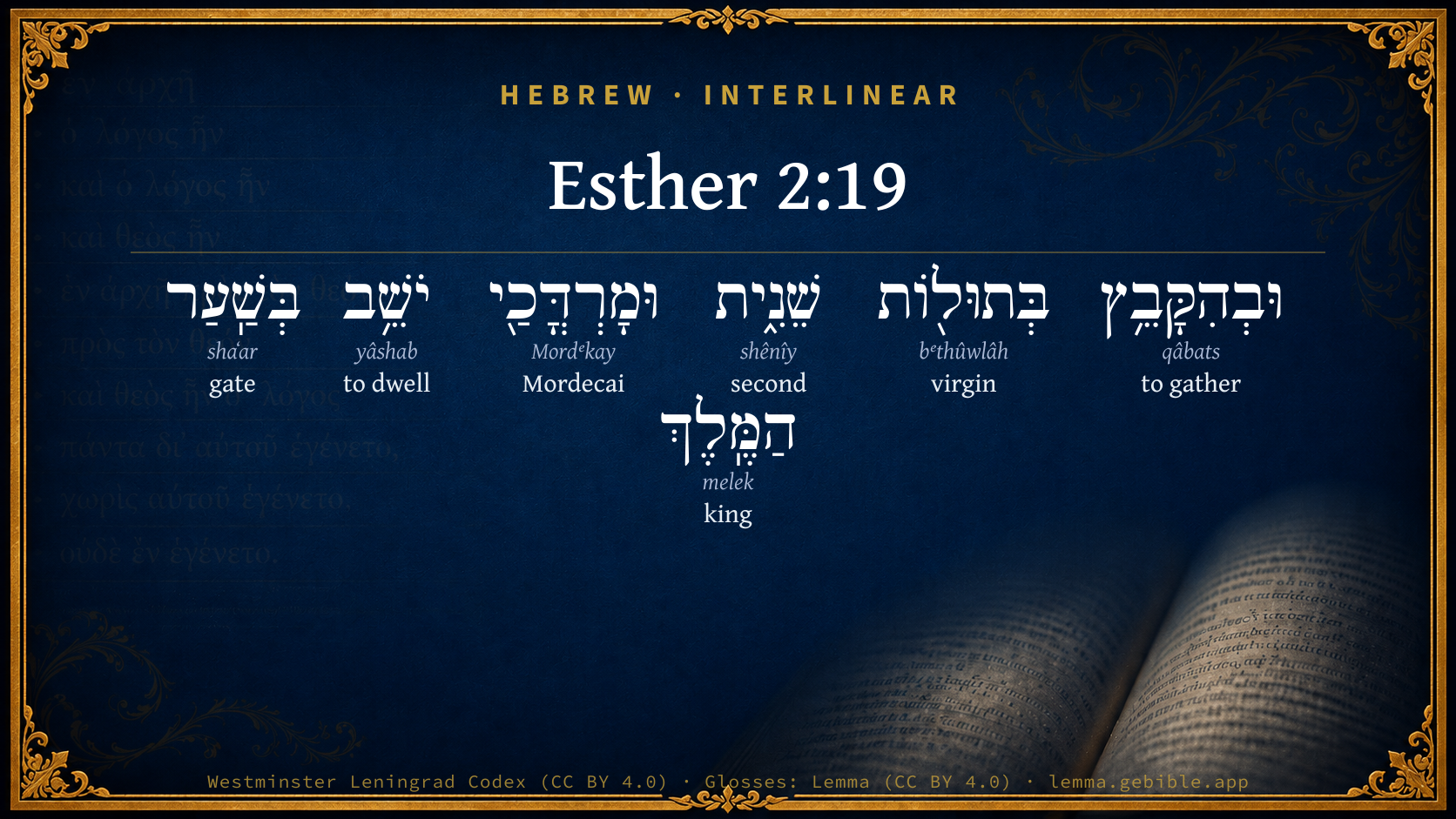
Esther 2:19

Hebrew (Westminster Leningrad Codex) Esther 2:19 appears in the Hebrew Old Testament. The text above is from the Westminster Leningrad Codex. Each word links to its Strong’s number, a concise gloss, and parsing drawn from the Open Scriptures Hebrew Bible morphology. Click any word for its full Brown-Driver-Briggs (BDB) entry.
Download image
Cite this verse

Esther 2:19 (World English Bible). Public Domain. Lemma interlinear Bible study tool, https://lemma.gebible.app/v/esther/2/19.

Show BibTeX & RIS
BibTeX
RIS
English Translation
When the virgins were gathered together the second time, then Mordecai was sitting in the king's gate.
World English Bible · Public Domain
Download a study sheet

One document with this verse’s original text, its word-by-word gloss line, the meaning frame, cross-references with their text, attributed commentary, and full source and license credits — printable, and it pastes into notes with its structure intact.

This verse Autodidact and up

Study sheet (.html) Plain text (.txt)

A passage Seminary Student

Up to 50 verses in one chapter. A passage sheet keeps up to 6 commentary sources and 12 cross-references per verse, in the order this page ranks them, and says so on the sheet whenever that leaves anything out. Ask for a single verse and you get the Autodidact verse sheet above.

Everything on this page stays free to read, with no account — the sheet is a download of what is already on screen, not access to it.

Want to remove ads? Support Godless Engineer
Compare translations 3

The same verse in 3 English versions, stacked beneath the original-language interlinear above. Click any original word for its lexicon entry.

Each is an independent rendering of the whole verse — the interlinear is not word-aligned to these translations.

Highlighted words mark where these versions differ — a whole-verse word diff, not a word-by-word alignment.

  • World English Bible Public Domain
    When the virgins were gathered together the second time, then Mordecai was sitting in the king's gate.
  • King James Version Public Domain
    And when the virgins were gathered together the second time, then Mordecai sat in the king's gate.
  • unfoldingWord Literal Text CC BY-SA 4.0
    Now when virgins were being gathered a second time, Mordecai was then sitting at the gate of the king.

unfoldingWord Literal Text — © unfoldingWord, licensed CC BY-SA 4.0. Word-aligned USFM3 via Door43 (git.door43.org/unfoldingWord/en_ult).

Versions to compare (up to 4)

3 of 4 selected

Show all 18 translations

Every available English version of this verse, each an independent rendering of the whole verse.

  • World English Bible Public Domain
    When the virgins were gathered together the second time, then Mordecai was sitting in the king's gate.
  • Berean Standard Bible Public Domain
    When the virgins were assembled a second time, Mordecai was sitting at the king’s gate.
  • Majority Standard Bible Public Domain
    When the virgins were assembled a second time, Mordecai was sitting at the king’s gate.
  • King James Version Public Domain
    And when the virgins were gathered together the second time, then Mordecai sat in the king's gate.
  • American Standard Version (1901) Public Domain
    And when the virgins were gathered together the second time, then Mordecai was sitting in the king's gate.
  • Revised Version (1885) Public Domain
    And when the virgins were gathered together the second time, then Mordecai sat in the king’s gate.
  • Geneva Bible (1599) Public Domain
    And whe the virgins were gathered ye second time, then Mordecai sate in the Kings gate.
  • Douay-Rheims (1899) Public Domain
    And when the virgins were sought the second time, and gathered together, Mardochai stayed at the king's gate,
  • Young's Literal Translation Public Domain
    And in the virgins being gathered a second time, then Mordecai is sitting in the gate of the king;
  • Literal Standard Version CC BY-SA 4.0
    And in the virgins being gathered a second time, then Mordecai is sitting in the gate of the king;
  • Unlocked Literal Bible CC BY-SA 4.0
    Now when the virgins had been gathered together a second time, Mordecai was sitting at the king's gate.
  • unfoldingWord Literal Text CC BY-SA 4.0
    Now when virgins were being gathered a second time, Mordecai was then sitting at the gate of the king.
  • Darby Bible Public Domain
    And when the virgins were gathered together the second time, Mordecai sat in the king's gate.
  • World Messianic Bible Public Domain
    When the virgins were gathered together the second time, Mordecai was sitting in the king’s gate.
  • Webster's Bible Public Domain
    And when the virgins were assembled the second time, then Mordecai sat in the king's gate.
  • Free Bible Version CC BY-SA 4.0
    Even though there had been a second gathering of virgins, and Mordecai had been given a position by the king,
  • Bible in Basic English Public Domain
    And when the virgins came together in the second house of the women, Mordecai took his seat in the doorway of the king's house.
  • JPS Tanakh (1917) Public Domain
    And when the virgins were gathered together the second time, and Mordecai sat in the king's gate —

Literal Standard Version (2020), Covenant Press — licensed CC BY-SA 4.0. Text via the HelloAO Bible API (eBible.org). Unlocked Literal Bible (unfoldingWord) — licensed CC BY-SA 4.0. Text via the HelloAO Bible API (eBible.org). unfoldingWord Literal Text — © unfoldingWord, licensed CC BY-SA 4.0. Word-aligned USFM3 via Door43 (git.door43.org/unfoldingWord/en_ult). Free Bible Version, Dr. Jonathan Gallagher — licensed CC BY-SA 4.0. Text via the HelloAO Bible API (eBible.org).

Word by word

More ways to search: Search by grammar → Find every occurrence → Compare this word →

Practice this passage: Drill this verse → Learn its vocabulary →

About this verse

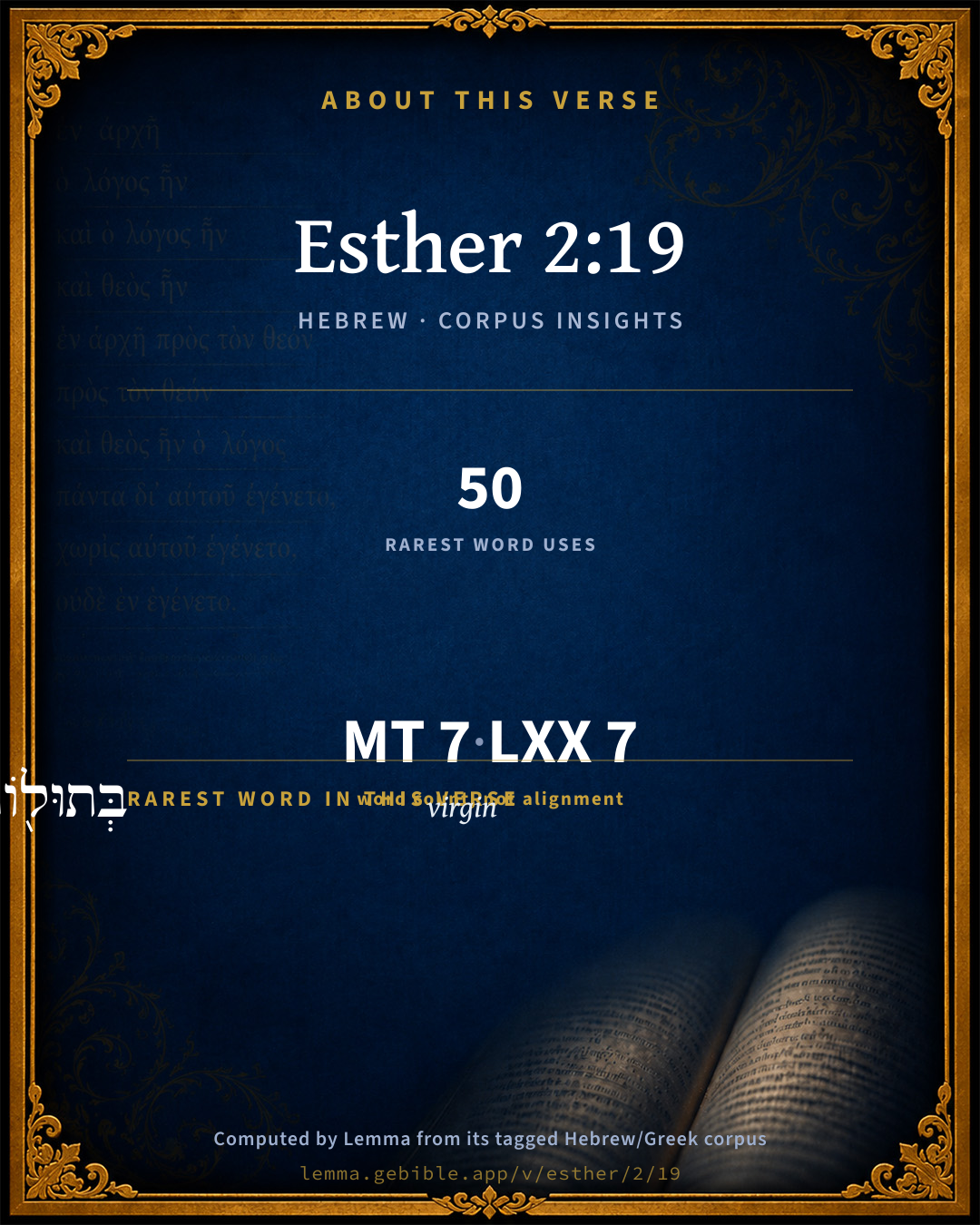
These counts appear in no published source. They are computed here, from the morphology-tagged text and Lemma’s own curated glosses. What Lemma adds →

7
words
7
distinct lemmas
Historical
section

Shared distinctive vocabulary

בְּתוּל֖וֹת virgin H1330 occurs in 50 verses of the Hebrew Bible. Also found in:

Grammatical profile

  • 2 verbs
  • 4 nouns
  • 1 adjective

Verb forms

  • וּבְהִקָּבֵ֥ץ Niphal · Infinitive Construct
  • יֹשֵׁ֥ב Qal · Participle Active

Hebrew & Septuagint length

In English translation the verse runs 17 words from the Hebrew and 6 from the Septuagint (LXX English) — the Septuagint runs noticeably shorter here. See the side-by-side →

A rough comparison of the two English renderings, which tokenize alike — not a word-level alignment.

Word counts can differ between the Hebrew and the Greek without any difference in meaning — e.g. the Hebrew direct-object marker אֵת has no separate Greek word, and Greek often adds the article ὁ.

In the original languages it is 7 Hebrew tokens and 7 Greek tokens — but the two are counted differently (Hebrew bundles its prefixes and suffixes into one token; the Greek is in lemma form), so that isn’t a like-for-like length.

Cross-references

4

Topical passages linked to Esther 2:19 in the Treasury of Scripture Knowledge — connected by theme and wording, ordered by reader-vote popularity; previews shown in the World English Bible.

  • Esther 2:21 In those days, while Mordecai was sitting in the king's gate, two of the king's chamberlains, Bigthan and Teresh, of those who kept the threshold, were angry, and sought to lay hands on the king Ahasuerus.
  • Esther 2:3–4 and let the king appoint officers in all the provinces of his kingdom, that they may gather together all the beautiful young virgins to Shushan the palace, to the house of the women, to the custody of Hegai the king's chamberlain, keeper of the women; and let their things for purification be given them;
  • Esther 3:2–3 All the king's servants, who were in the king's gate, bowed down, and did reverence to Haman; for the king had so commanded concerning him. But Mordecai didn't bow down, nor did him reverence.
  • Esther 5:13 Yet all this avails me nothing, so long as I see Mordecai the Jew sitting at the king's gate.

Cross-references courtesy of OpenBible.info (CC BY 4.0).

Hebrew and Greek witnesses Masoretic Hebrew ↔ Greek Septuagint

The same verse in the two great witnesses to the Old Testament, shown verse-for-verse.

Here the Septuagint runs noticeably shorter than the Hebrew — LXX2012 (modern English Septuagint) 6 words vs World English Bible 17. A rough length comparison of the two English translations, not a word-level alignment — read both below.

These are two independent witnesses, not word-aligned to each other, and the Septuagint is shown in lemma (dictionary) form.

Hebrew Esther 2:19 Masoretic · Westminster Leningrad Codex

וּבְהִקָּבֵ֥ץ בְּתוּל֖וֹת שֵׁנִ֑ית וּמָרְדֳּכַ֖י יֹשֵׁ֥ב בְּשַֽׁעַר הַמֶּֽלֶךְ

When the virgins were gathered together the second time, then Mordecai was sitting in the king's gate.

World English Bible · Public Domain

Greek LXX Esther 2:19 Septuagint · lemma form

ὁ δέ μαρδοχαῖος θεραπεύω ἐν ὁ αὐλή

But Mardochaeus served in the palace.

LXX2012 (modern English Septuagint) · Public Domain

On this verse, Trapp's Complete Commentary discusses the Septuagint’s reading. Read the note in Commentary ↓

Hebrew: Westminster Leningrad Codex (CC BY 4.0). Greek: Septuagint (public domain); English from LXX2012 (modern English Septuagint) (Public Domain). How the Septuagint differs from the Hebrew →

Commentary

Notes on Esther 2:19 from classic Christian and Jewish commentators (each source and its license shown beneath its notes). The classic Christian expositions comment on the surrounding passage and are grouped to its opening verse, so a note may address several verses; the Jewish commentaries on the Tanakh (Rashi and others) are per-verse, so they appear only where the commentator wrote on this verse.

Lemma curates 59 commentaries, every one of them public domain or Creative Commons licensed, each selected and text-cleaned for this edition rather than reprinted as found. About our sources →

Ellicott's Commentary for English Readers

(19) And when the virgins . . .—Here begins a fresh incident in the history, whose date we cannot fix precisely, save that it falls between the marriage of Esther and the twelfth year of Ahasuerus (Est_3:7). The king “loved Esther above all the women,” but how the word “love “is degraded in this connection is seen by the fact that after she had been his wife certainly less (possibly much less) than five years, there takes place a second gathering of virgins (there is no article in the Hebrew), like the one previously mentioned (Est_2:2). We should treat Est_2:20 as parenthetical, and join Est_2:21 closely to Est_2:19.

Then Mordecai sat.—Translate, and Mordecai was sitting.

A Bible Commentary for English Readers, edited by Charles John Ellicott (1878–1897) — public domain. Text from a community e-Sword module.

Trapp's Complete Commentary

John Trapp

Est 2:19 And when the virgins were gathered together the second time, then Mordecai sat in the king’s gate.

Ver. 19. And when the virgins were gathered together, &c.] For a new supply of the king’s insatiable lust, say some, this affection soon growing cold to Esther. So unreasonable is lust, so inconstant carnal affection, so lawless are the wicked, so short is any happiness of perfection in this life. The Septuagint leave out this word [the second time], but the Hebrew version hath it. Others say, the second time, signifieth into the second house of the women. For they went not each to their own homes, because the king was now fully satisfied in his choice, as Tremellius and Junius conceive, but they remained in the custody of Shaazgar, keeper of the king’s concubines, not suffered to converse with any man ever after, as Aben Ezra observeth. Therefore they were twice gathered together. Once, when they were brought to Hegai the eunuch, and again, when, from the king’s house, they met all together in the second house of the women, under the government of Shaazgar.

Then Mordecai sat in the king’s gate] As porter or other officer, saith Severus; and he attended still upon his office, not fawning on Esther, nor prowling for preferment. His ambition was to be quiet, and to do his own business, intra pelliculam suam se continere, Negotiorum familiarium curator: 1Th 4:11, φιλοτιμεισθαι ησυχαζεν, high seats he knew were never but uneasy, and long robes cannot but contract much soil. In the place he now holdeth he can hear how it goeth with his Esther, and do the king good service, as Est 2:21.

John Trapp, A Commentary or Exposition upon All the Books of the Old and New Testament (1647–1656) — public domain. Text from a community e-Sword module.

Joseph Benson's Commentary

Est 2:19. When the virgins were gathered together the second time — They in all probability were gathered together first in the provinces, and afterward in Susa, before they were taken into the house of the king’s chamberlain. The writer now goes back to what happened before Esther’s marriage. Then Mordecai sat in the king’s gate — It was ordered by Cyrus, as Xenophon informs us, Cyropaæd., lib. 8, that all persons whatever, who had any employment at court, should attend at the palace gate, where there was doubtless a proper waiting-place for their reception, that they might be in readiness whenever they were wanted or called for; and that this custom was afterward continued, we may learn from Herodotus, lib. 3. cap. 120. See Le Clerc. Mordecai has been thought by some to have been one of the porters of the royal palace; but it is probable he was an officer of higher rank. Poole thinks he was one of the king’s guard, or ministers, and that he had been advanced to this place by Esther’s favour, though without any discovery of her relation to him.

Joseph Benson's Commentary on the Old and New Testaments (1811–1818) — public domain. Text from a community e-Sword module.

Whedon's Commentary on the Bible

Daniel D. Whedon

MORDECAI EXPOSES A COURT CONSPIRACY, Est_2:19-23.

19. When the virgins… the second time — Rather, at the gathering together of virgins a second time. Hence it appears there was a second collection of virgins at Shushan, made some years after the previous one, and with the design, no doubt, of enriching the royal harem with new beauties. After his unsuccessful war with Greece, the king abandoned all plans of conquest, and gave himself over to the pleasures of his harem. Accordingly, such a second gathering of virgins would be readily devised to gratify both his vanity and lust.

Mordecai sat in the king’s gate — He was one of the royal porters who guarded the doors of the great palace at Shushan.

Daniel D. Whedon (gen. ed.), Commentary on the Old and New Testaments (1874–1909) — public domain. Text from a community e-Sword module.

The Pulpit Commentary

CHAPTER 2:19-23

MORDECAI"S DISCOVERY OF A PLOT AGAINST AHASUERUS". (Est_2:19-23) Some time after Esther had been made queen, there was a second collection of virgins at Susa (ver. 19), under circumstances which are not related, and which were probably of small importance. At this time (ver. 21) Mordecai, still serving in his humble office at the palace gate, from which he had not been advanced, since Esther had told no one that he was her relation (ver. 20), happened to detect a conspiracy against the king"s life, which had been formed by two of the palace eunuchs, Bigthan and Tercsh, whom Ahasuerus had somehow offended (ver. 21). Being still in the habit of holding communication with Esther, Mordecai was able to make her acquainted with the facts, of which she then informed the king, telling him how she had obtained her knowledge (ver. 22). There was nothing surprising or suspicious in a eunuch of the palace having had speech with the queen, especially when he had intelligence of such importance to impart to her. On inquiry, the king found that Mordecai"s information was correct; the conspiracy was laid bare, and the conspirators put to death (ver. 23) the facts being, as was sure to be the case, entered in the court chronicle, a daily record of the life of the court, and of the circumstances that befell the king. It was to have been expected that Mordecai would have been rewarded for his zeal; but somehow or other it happened that his services were overlooked he was neither promoted from his humble office, nor did he receive any gift. (Est_6:3) This was quite contrary to ordinary Persian practice; but the court generally may.have disliked Mordecai because he was a Jew.

When the virgins were gathered together. Rather, "When virgins." There is no article. The fact seems to be mentioned simply as furnishing a date, and we must suppose both that there was a second gathering, and that the time when it happened was generally known to the Jews and Persians. Then Mordecai sat, etc. The three verses, 19, 20, 21, hang together, and form a single sentence: "When virgins were gathered together a second time, and Mordecai was sitting in the king"s gate now Esther had not showed her kindred or her people, as Mordecai had charged her; for Esther did the command of Mordecai like as when she was brought up with him in those days, while Mordecai sat in the king"s gate, Bigthan and Teresh, two of the king"s eunuchs, being of the number of them which kept the threshold, were wroth," etc.

The Pulpit Commentary (1880–1919), ed. H.D.M. Spence-Jones & Joseph S. Exell — public domain. Text from a community e-Sword module.

Keil & Delitzsch

C. F. Keil & F. Delitzsch

Est 2:19-23 relate the intervention of an incident of great importance in the subsequent development of the narrative. When virgins were for the second time gathered together, two courtiers were incensed with the king, and sought to lay hands upon him. This thing was known to Mordochai, who sat in the gate of the palace and kept up a constant communication with Esther even after she became queen, and by him communicated to her, that she might bring it to the knowledge of the king. The matter being investigated and found to have been truly reported, the offenders were punished, and an entry of the particulars made in the chronicles of the kingdom. The words "when virgins were assembled for the second time," which serve to define the time when the conspiracy of the two courtiers took place, as is obvious from the circumstance that ההם בּיּמים, Est 2:21, refers to בת בּהקּבץ, Est 2:19, are obscure. The obscurity lies in the fact that no reason for assembling virgins can be perceived, after the choice of Ahashverosh had fallen upon Esther. The sentence שׁנית בּתוּלות וּבהקּבץ unmistakeably corresponds with נערות וּבהקּבץ of v. 8. This was already rightly perceived by Grotius, who, however, wrongly infers: est ἐπάνοδος (retrogressio), referendum enim hoc ad illa quae supra, ii. 2. This is, however, not only incompatible with שׁנית, but also with the circumstance that, according to the correct understanding of the sentences in Est 2:21 and Est 2:22, Esther was then already queen, and Mordochai was sitting in the gate of the king's palace, and thence keeping up communication with her; while as long as Esther was in the women's house preparing for her interview with the king, under the guardianship of Hegai, he walked day by day before the court of the women's house (Est 2:11). Still less admissible is the view of Drusius, received by Bertheau, that the gathering of the virgins for the second time is to be understood from the circumstance, that after going in to the king, they had to go into the second house of the women, under the stricter guardianship of Shaashgaz (Est 2:14). For, being no longer בּתוּלות, but פּילגשׁים (Est 2:14), their reception into the house of the concubines could not be called a second gathering together, since as virgins they were formerly in a different house. The only explanation of the שׁנית left us is the view, that even after the choice of Esther to be queen, a second gathering together of virgins actually took place; for this, as C. a Lapide remarks, is what the words undoubtedly declare. The matter itself was in accordance with the prevailing custom of polygamy, which kings carried to such an extent, that, as C. a Lapide points out, Solomon, e.g., had 700 wives and 300 concubines, i.e., secondarias uxores. From וּמרדּכי, Est 2:19, onwards, explanatory circumstantial clauses follow: "The Mordochai sat in the king's gate" introduces the parenthetical sentence, "Esther had not yet showed her kindred and her people (comp. Est 2:10), as Mordochai had charged her; for Esther did the commandment of Mordochai as when she was under his care;" i.e., Esther obeyed, after her elevation to be queen, the command of Mordochai not to make her Jewish descent known, as she had formerly done while she was yet his foster-daughter. אמנה, care, education, is a substantive derived from אמן.

Keil & Delitzsch — Biblical Commentary on the Old Testament (1861–1891) — public domain (CC PDM 1.0). Text via the HelloAO Bible API. (Old Testament only.)

Tyndale Open Study Notes

Tyndale Open Resources

2:19 Even after all the young women had been transferred to the second harem: Since the queen had been chosen, those in waiting would join the other concubines. • Mordecai had become a palace official (literally Mordecai was sitting in the gate of the king): Court cases were decided and much official business was conducted at the gate. There Mordecai was able to hear about the plot against the king (2:21-23).

Tyndale Open Study Notes — © Tyndale Open Resources, licensed CC BY-SA 4.0. Text via the HelloAO Bible API.

Geneva Bible (1599)

Geneva Bible translators

That is, at the marriage of Esther, which was the second marriage of the king.

Geneva Bible (1599) marginal notes — public domain. Text via Bolls.life.

The Cambridge Bible for Schools and Colleges

gen. ed. J. J. S. Perowne

19–23. Mordecai’s discovery of the plot against the king’s life

19. And when the virgins were gathered together the second time] Render, Now when maidens were being gathered together a second time. There is no article attached to the word ‘virgins’ in the original, and we have no means of knowing what kind of occasion is referred to here. It is merely a conjecture that the reference is to an effort made by the officials to supplant Esther in the king’s affections by introducing to his notice such as would better support their influence. The clause is omitted in the LXX.

then Mordecai sat etc.] better, perhaps, and when Mordecai was sitting etc. In this way we have another circumstantial clause, which is added to the first, and resumed in Est_2:21. Mordecai occupied a place at the gate of the palace properly so called, or of that division of the women’s apartments which was assigned to the queen herself (see on Est_2:3), that he might utilise any opportunity which presented itself of communicating with his ward. His occupation of this subordinate position is accounted for in Est_2:20, which is of the nature of a parenthesis.

The Cambridge Bible for Schools and Colleges (gen. ed. J. J. S. Perowne; Cambridge University Press, 1878–1918) — public domain. Text from a community e-Sword module.

John Gill's Exposition

And when the virgins were gathered together the second time,.... Some think this second collection is that which was made when Esther was taken and brought to the keeper of the women, called the second, in reference to a former collection of them, made when Vashti was taken and made queen; but as there is no proof of any such collection then made, rather the case was this, such was the lust of the king, though he had a queen he loved, and a multitude of concubine's, yet a second collection of virgins was made for his gratification:

then Mordecai sat in the king's gate; or court, being an officer in it, promoted by the interest of Esther, though not as yet known to be a relation of her's: so in Xenophon (z) is used of the court of the king of Persia, as the Ottoman or Turkish court is now called the "Porte".

(z) Cyropaedia, l. 8. c. 2, 5, 11, 40.

John Gill's Exposition of the Whole Bible (1746–1763) — public domain (CC PDM 1.0). Text via the HelloAO Bible API.

Albert Barnes' Notes on the Bible

When the virgins ... - Rather, “when virgins” etc. The words begin a new paragraph. There was a second collection of virgins (after that of Est 2:8), and it was at the time of this second collection that Mordecai had the good fortune to save the king’s life.

Albert Barnes' Notes on the Bible (1834–1885) — public domain. Text from a community e-Sword/MySword module.

Haydock's Catholic Bible Commentary

And. Septuagint, "But Mardochai," &c. (Haydock) --- They say nothing of the gifts, ver. 18. --- Second. The same process had been observed before, when Vasthi was chosen. (Calmet) --- Mardochai was perhaps then one of the king’s guards. (Haydock) (Ver. 11.) (Tirinus) --- This second inquiry is here specified, to introduce the following account. (Menochius)

George Leo Haydock (1774–1849), Haydock's Catholic Family Bible and Commentary, 1859 edition — public domain. Excludes Psalms (Douay-Rheims chapter numbering differs from Protestant) and Deuterocanonical books (Catholic canon only).

Matthew Poole's English Annotations

The second time; either,

1. When Esther, with others, were brought to the king’s house, as it was decreed above, Est 2:2,3, which is called the second time, because they had taken this course once before, when Vashti was chosen queen. But there is no mention of any such former use; and by the manner of proposing it seems to have been a new project. Or,

2. Since Esther was declared queen; for though that point was determined, the king’s lust was not yet satisfied; and therefore being pleased with the former experiment, he desired another collection of virgins, whom he might make his concubines. And this seems best to agree with the following words. For it is not probable that Mordecai sat at the king’s gate till Esther was queen; for till then he only walked before the court of the women’s house, as is expressed, Est 2:11.

Mordecai sat in the king’s gate; either,

1. Voluntarily, to learn the progress of affairs. Or rather,

2. By office, as one of the king’s guard or ministers; being advanced to this place by Esther’s favour, though without any discovery of her relation to him.

Matthew Poole's English Annotations on the Holy Bible (1683–1685) — public domain. Text from a community e-Sword/MySword module.

John Wesley's Explanatory Notes

Sat - By office, as one of the king's guards or ministers; being advanced to this place by Esther's favour.

John Wesley, Explanatory Notes Upon the Whole Bible (1754–1765) — public domain. Text via the GEBible commentary corpus.

unfoldingWord translationNotes

Door43 World Missions Community

when the virgins had been gathered together a second time

It is unclear when this second gathering happened, and why. Therefore some versions have altered the text somewhat. It is probably best to translate it as it is written.

a second time

"one more time" or "an additional time" (See: Numbers)

Mordecai was sitting at the king's gate

Possible meanings are 1) Mordecai sat there so he could hear how Esther was doing from the many people who passed through the gate or 2) "sitting at the king's gate" is an idiom that means Mordecai was given a position of authority by the king.

the king's gate

"the gate to the king's palace"

as Mordecai had instructed her

Mordecai told her not to tell anyone about her family.

In those days

This introduces a new event in the story. (See: Introduction of a New Event)

Bigthana and Teresh

These are the names of men. (See: How to Translate Names)

translationWords

virgin

Mordecai

king

gate

Esther

people group

Ahasuerus

unfoldingWord translationNotes — © Distant Shores Media and the Door43 World Missions Community, licensed CC BY-SA 4.0. Source: git.door43.org/Door43/en_tn.

Lesson kit

Teaching starters — assembled from the data on this page, not authored interpretation. Every prompt links to the verse data it draws on. Edit before teaching.

Esther, in the Historical, opens this verse with 7 words (7 distinct Hebrew lemmas). Its most distinctive word is bᵉthûwlâh (“virgin”). The Greek Septuagint runs shorter here. A historical commentator’s framing appears above. Read the whole chapter for the surrounding context.

Discussion questions

  1. How does “virgin” (bᵉthûwlâh) shape what this verse is saying?
  2. How does Genesis 24:16, which shares the word «virgin», read alongside this verse?
  3. The Septuagint runs shorter here than the Hebrew. What might account for the difference?
  4. The translations on this page render this verse differently — a whole-verse word diff, not a word-by-word alignment. What might account for the different wordings?
  5. «וּבְהִקָּבֵ֥ץ» is a Niphal Infinitive Construct verb. How does that grammatical form shape the action described?
  6. Compare how Ellicott's Commentary for English Readers and Trapp's Complete Commentary read this verse. Where do they agree or differ?

Things to notice

Reading settings

Reading text

Shown beneath each verse's original-language words.

Old Testament
Old Testament edition

Read the OT as the Masoretic Hebrew (MT) or the Greek Septuagint (LXX).

English shown for the Greek Septuagint (in the Hebrew ↔ Greek comparison).

Comparing translations? Open the Compare panel on any verse page to stack up to four side by side.