
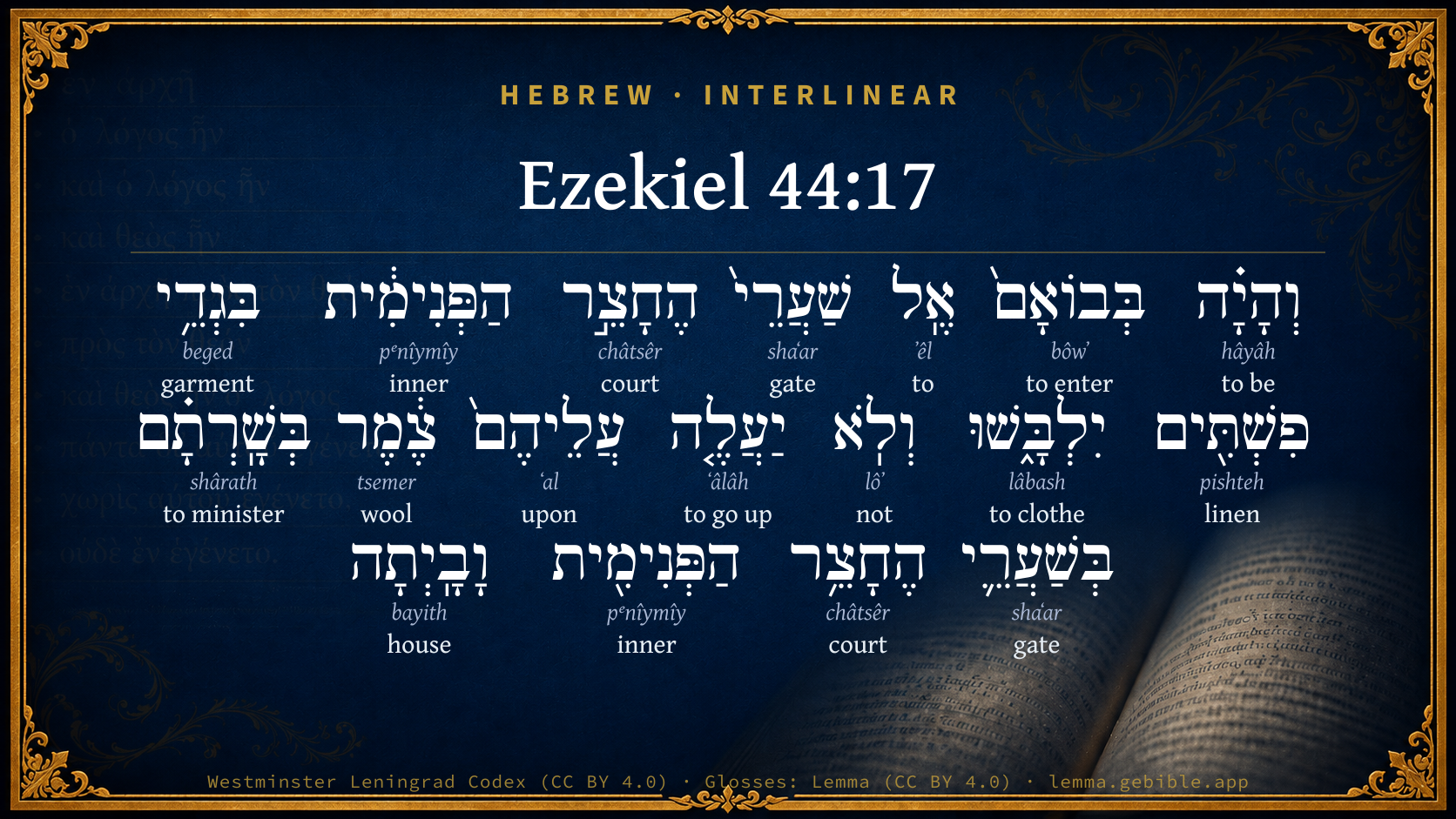
Ezekiel 44:17

Hebrew (Westminster Leningrad Codex) Ezekiel 44:17 appears in the Hebrew Old Testament. The text above is from the Westminster Leningrad Codex. Each word links to its Strong’s number, a concise gloss, and parsing drawn from the Open Scriptures Hebrew Bible morphology. Click any word for its full Brown-Driver-Briggs (BDB) entry.
Download image
Cite this verse

Ezekiel 44:17 (World English Bible). Public Domain. Lemma interlinear Bible study tool, https://lemma.gebible.app/v/ezekiel/44/17.

Show BibTeX & RIS
BibTeX
RIS
English Translation
It shall be that, when they enter in at the gates of the inner court, they shall be clothed with linen garments; and no wool shall come on them, while they minister in the gates of the inner court, and within.
World English Bible · Public Domain
Download a study sheet

One document with this verse’s original text, its word-by-word gloss line, the meaning frame, cross-references with their text, attributed commentary, and full source and license credits — printable, and it pastes into notes with its structure intact.

This verse Autodidact and up

Study sheet (.html) Plain text (.txt)

A passage Seminary Student

Up to 50 verses in one chapter. A passage sheet keeps up to 6 commentary sources and 12 cross-references per verse, in the order this page ranks them, and says so on the sheet whenever that leaves anything out. Ask for a single verse and you get the Autodidact verse sheet above.

Everything on this page stays free to read, with no account — the sheet is a download of what is already on screen, not access to it.

Want to remove ads? Support Godless Engineer
Compare translations 3

The same verse in 3 English versions, stacked beneath the original-language interlinear above. Click any original word for its lexicon entry.

Each is an independent rendering of the whole verse — the interlinear is not word-aligned to these translations.

Highlighted words mark where these versions differ — a whole-verse word diff, not a word-by-word alignment.

  • World English Bible Public Domain
    It shall be that, when they enter in at the gates of the inner court, they shall be clothed with linen garments; and no wool shall come on them, while they minister in the gates of the inner court, and within.
  • King James Version Public Domain
    And it shall come to pass, that when they enter in at the gates of the inner court, they shall be clothed with linen garments; and no wool shall come upon them, whiles they minister in the gates of the inner court, and within.
  • unfoldingWord Literal Text CC BY-SA 4.0
    So it will be that when they come to the gates of the inner courtyard, they will have to dress in linen clothes, for they must not come in wool inside the gates of the courtyard and its house.

unfoldingWord Literal Text — © unfoldingWord, licensed CC BY-SA 4.0. Word-aligned USFM3 via Door43 (git.door43.org/unfoldingWord/en_ult).

Versions to compare (up to 4)

3 of 4 selected

Show all 18 translations

Every available English version of this verse, each an independent rendering of the whole verse.

  • World English Bible Public Domain
    It shall be that, when they enter in at the gates of the inner court, they shall be clothed with linen garments; and no wool shall come on them, while they minister in the gates of the inner court, and within.
  • Berean Standard Bible Public Domain
    When they enter the gates of the inner court, they are to wear linen garments; they must not wear anything made of wool when they minister at the gates of the inner court or inside the temple.
  • Majority Standard Bible Public Domain
    When they enter the gates of the inner court, they are to wear linen garments; they must not wear anything made of wool when they minister at the gates of the inner court or inside the temple.
  • King James Version Public Domain
    And it shall come to pass, that when they enter in at the gates of the inner court, they shall be clothed with linen garments; and no wool shall come upon them, whiles they minister in the gates of the inner court, and within.
  • American Standard Version (1901) Public Domain
    And it shall be that, when they enter in at the gates of the inner court, they shall be clothed with linen garments; and no wool shall come upon them, while they minister in the gates of the inner court, and within.
  • Revised Version (1885) Public Domain
    And it shall be that when they enter in at the gates of the inner court, they shall be clothed with linen garments; and no wool shall come upon them, whiles they minister in the gates of the inner court, and within.
  • Geneva Bible (1599) Public Domain
    And whe they shall enter in at the gates of the inner court, they shall be clothed with linen garments, and no wool shall come vpon the while they serue in ye gates of the inner court, and within.
  • Douay-Rheims (1899) Public Domain
    And when they shall enter in at the gates of the inner court, they shall be clothed with linen garments: neither shall any woollen come upon them, when they minister in the gates of the inner court and within.
  • Young's Literal Translation Public Domain
    And it hath come to pass, in their going in unto the gates of the inner court, linen garments they put on; and no wool cometh up on them in their ministering in the gates of the inner court and within.
  • Literal Standard Version CC BY-SA 4.0
    And it has come to pass, in their going into the gates of the inner court, they put on linen garments; and no wool comes up on them in their ministering in the gates of the inner court and within.
  • Unlocked Literal Bible CC BY-SA 4.0
    So it will be that when they come to the gates of the inner courtyard, they will have to dress in linen clothes, for they must not come in wool inside the gates of the courtyard and its house.
  • unfoldingWord Literal Text CC BY-SA 4.0
    So it will be that when they come to the gates of the inner courtyard, they will have to dress in linen clothes, for they must not come in wool inside the gates of the courtyard and its house.
  • Darby Bible Public Domain
    And it shall come to pass when they enter in at the gates of the inner court, they shall be clothed with linen garments; and no wool shall come upon them, when they minister in the gates of the inner court, and towards the house.
  • World Messianic Bible Public Domain
    “‘“It will be that when they enter in at the gates of the inner court, they shall be clothed with linen garments. No wool shall come on them while they minister in the gates of the inner court, and within.
  • Webster's Bible Public Domain
    And it shall come to pass, that when they enter in at the gates of the inner court, they shall be clothed with linen garments; and no wool shall come upon them, while they minister in the gates of the inner court, and within.
  • Free Bible Version CC BY-SA 4.0
    When they come in through the entrances of the inner courtyard, they shall wear linen garments. They must not wear any woolen clothes when they serve at the entrances of the inner courtyard or inside the Temple.
  • Bible in Basic English Public Domain
    And when they come in by the doorways of the inner square, they are to be clothed in linen robes; there is to be no wool on them while they are doing my work in the doorway of the inner square and inside the house.
  • JPS Tanakh (1917) Public Domain
    And it shall be that when they enter in at the gates of the inner court, they shall be clothed with linen garments; and no wool shall come upon them, while they minister in the gates of the inner court, and within.

Literal Standard Version (2020), Covenant Press — licensed CC BY-SA 4.0. Text via the HelloAO Bible API (eBible.org). Unlocked Literal Bible (unfoldingWord) — licensed CC BY-SA 4.0. Text via the HelloAO Bible API (eBible.org). unfoldingWord Literal Text — © unfoldingWord, licensed CC BY-SA 4.0. Word-aligned USFM3 via Door43 (git.door43.org/unfoldingWord/en_ult). Free Bible Version, Dr. Jonathan Gallagher — licensed CC BY-SA 4.0. Text via the HelloAO Bible API (eBible.org).

Word by word

More ways to search: Search by grammar → Find every occurrence → Compare this word →

Practice this passage: Drill this verse → Learn its vocabulary →

פִשְׁתִּ֖ים
pishteh
H6593
“linen”
Noun, Common, Masculine, Plural, Absolute
Part of Speech
Noun
Type
Common
Gender
Masculine
Number
Plural
State
Absolute
Full BDB Definition

Origin: from the same as H6580 as in the sense of comminuting

TWOT: 1848

flax, linen - fibre used as material for garments
  1. וְהָיָ֗ה hâyâh H1961 “and · to be” Conjunction + Verb, Qal, Sequential Perfect, 3rd Person, Masculine, Singular
  2. בְּבוֹאָם֙ bôwʼ H935 “in/at · to enter · them” Preposition + Verb, Qal, Infinitive Construct + Suffix, Personal, 3rd Person, Masculine, Plural
  3. אֶֽל ʼêl H413 “to” Preposition
  4. שַׁעֲרֵי֙ shaʻar H8179 “gates of” Noun, Common, Masculine, Plural, Construct
  5. הֶחָצֵ֣ר châtsêr H2691 “the · court” Particle, Definite Article + Noun, Common, Both, Singular, Absolute
  6. הַפְּנִימִ֔ית pᵉnîymîy H6442 “the · inner” Particle, Definite Article + Adjective, Adjective, Feminine, Singular, Absolute
  7. בִּגְדֵ֥י beged H899 “garments of” Noun, Common, Masculine, Plural, Construct
  8. יִלְבָּ֑שׁוּ lâbash H3847 “to clothe” Verb, Qal, Imperfect, 3rd Person, Masculine, Plural
  9. וְלֹֽא lôʼ H3808 “and · not” Conjunction + Particle, Negative
  10. יַעֲלֶ֤ה ʻâlâh H5927 “to go up” Verb, Qal, Imperfect, 3rd Person, Masculine, Singular
  11. עֲלֵיהֶם֙ ʻal H5921 “upon · them” Preposition + Suffix, Personal, 3rd Person, Masculine, Plural
  12. צֶ֔מֶר tsemer H6785 “wool” Noun, Common, Masculine, Singular, Absolute
  13. בְּשָֽׁרְתָ֗ם shârath H8334 “in/at · to minister · them” Preposition + Verb, Piel, Infinitive Construct + Suffix, Personal, 3rd Person, Masculine, Plural
  14. בְּשַׁעֲרֵ֛י shaʻar H8179 “in/at · gates of” Preposition + Noun, Common, Masculine, Plural, Construct
  15. הֶחָצֵ֥ר châtsêr H2691 “the · court” Particle, Definite Article + Noun, Common, Both, Singular, Absolute
  16. הַפְּנִימִ֖ית pᵉnîymîy H6442 “the · inner” Particle, Definite Article + Adjective, Adjective, Feminine, Singular, Absolute
  17. וָבָֽיְתָה bayith H1004 “and · house · toward” Conjunction + Noun, Common, Masculine, Singular, Absolute + Suffix, Demonstrative

About this verse

These counts appear in no published source. They are computed here, from the morphology-tagged text and Lemma’s own curated glosses. What Lemma adds →

18
words
15
distinct lemmas
Prophets
section

Notable vocabulary

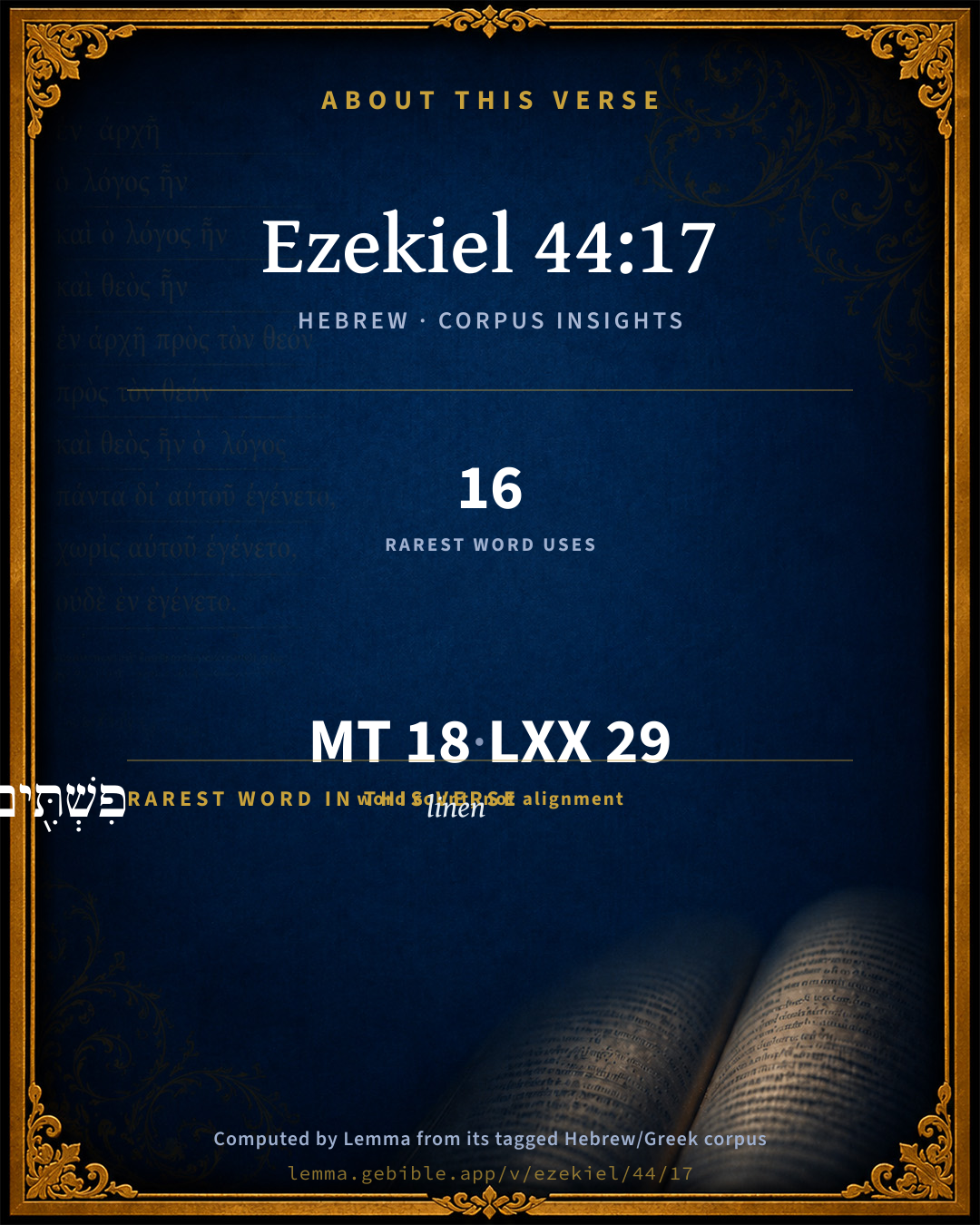
The rarest word here is פִשְׁתִּ֖ים linen H6593 — appearing just 16 times in the whole Hebrew Bible.

Shared distinctive vocabulary

פִשְׁתִּ֖ים linen H6593 occurs in 15 verses of the Hebrew Bible. Also found in:

Grammatical profile

  • 5 verbs
  • 8 nouns
  • 2 adjectives
  • 2 prepositions
  • 1 particle

Verb forms

  • וְהָיָ֗ה Qal · Sequential Perfect
  • בְּבוֹאָם֙ Qal · Infinitive Construct
  • יִלְבָּ֑שׁוּ Qal · Imperfect
  • יַעֲלֶ֤ה Qal · Imperfect
  • בְּשָֽׁרְתָ֗ם Piel · Infinitive Construct

Repetition

Words recur within this verse — often emphatic in Hebrew:

  • שַׁעֲרֵי֙ gate H8179 ×2
  • הֶחָצֵ֣ר court H2691 ×2
  • הַפְּנִימִ֔ית inner H6442 ×2

Hebrew & Septuagint length

In English translation the verse runs 41 words from the Hebrew and 40 from the Septuagint (LXX English) — closely comparable.

A rough comparison of the two English renderings, which tokenize alike — not a word-level alignment.

Word counts can differ between the Hebrew and the Greek without any difference in meaning — e.g. the Hebrew direct-object marker אֵת has no separate Greek word, and Greek often adds the article ὁ.

In the original languages it is 18 Hebrew tokens and 29 Greek tokens — but the two are counted differently (Hebrew bundles its prefixes and suffixes into one token; the Greek is in lemma form), so that isn’t a like-for-like length.

Cross-references

6

Topical passages linked to Ezekiel 44:17 in the Treasury of Scripture Knowledge — connected by theme and wording, ordered by reader-vote popularity; previews shown in the World English Bible.

  • Revelation 19:8 It was given to her that she would array herself in bright, pure, fine linen: for the fine linen is the righteous acts of the saints.
  • Exodus 28:43 They shall be on Aaron, and on his sons, when they go in to the tent of meeting, or when they come near to the altar to minister in the holy place; that they don't bear iniquity, and die: it shall be a statute forever to him and to his descendants after him.
  • Exodus 39:27–29 They made the coats of fine linen of woven work for Aaron, and for his sons,
  • Exodus 28:39–40 You shall weave the coat in checker work of fine linen, and you shall make a turban of fine linen, and you shall make a sash, the work of the embroiderer.
  • Leviticus 16:4 He shall put on the holy linen coat, and he shall have the linen breeches on his body, and shall put on the linen sash, and he shall be dressed with the linen turban. They are the holy garments. He shall bathe his body in water, and put them on.
  • Revelation 4:4 Around the throne were twenty-four thrones. On the thrones were twenty-four elders sitting, dressed in white garments, with crowns of gold on their heads.

Cross-references courtesy of OpenBible.info (CC BY 4.0).

Hebrew and Greek witnesses Masoretic Hebrew ↔ Greek Septuagint

The same verse in the two great witnesses to the Old Testament, shown verse-for-verse.

These are two independent witnesses, not word-aligned to each other, and the Septuagint is shown in lemma (dictionary) form.

Hebrew Ezekiel 44:17 Masoretic · Westminster Leningrad Codex

וְהָיָ֗ה בְּבוֹאָם֙ אֶֽל שַׁעֲרֵי֙ הֶחָצֵ֣ר הַפְּנִימִ֔ית בִּגְדֵ֥י פִשְׁתִּ֖ים יִלְבָּ֑שׁוּ וְלֹֽא יַעֲלֶ֤ה עֲלֵיהֶם֙ צֶ֔מֶר בְּשָֽׁרְתָ֗ם בְּשַׁעֲרֵ֛י הֶחָצֵ֥ר הַפְּנִימִ֖ית וָבָֽיְתָה

It shall be that, when they enter in at the gates of the inner court, they shall be clothed with linen garments; and no wool shall come on them, while they minister in the gates of the inner court, and within.

World English Bible · Public Domain

Greek LXX Ezekiel 44:17 Septuagint · lemma form

καί εἰμί ἐν ὁ εἰςπορεύομαι αὐτός ὁ πύλη ὁ αὐλή ὁ ἐσώτερος στολή λινοῦς ἐνδύω καί οὐ ἐνδύω ἐρέα ἐν ὁ λειτουργέω αὐτός ἀπό ὁ πύλη ὁ ἐσώτερος αὐλή

And it shall come to pass when they enter the gates of the inner court, that they shall put on linen robes; and they shall not put on woollen garments when they minister at the gate of the inner court.

LXX2012 (modern English Septuagint) · Public Domain

On this verse, Joseph Benson's Commentary discusses the Septuagint’s reading. Read the note in Commentary ↓

Hebrew: Westminster Leningrad Codex (CC BY 4.0). Greek: Septuagint (public domain); English from LXX2012 (modern English Septuagint) (Public Domain). How the Septuagint differs from the Hebrew →

Targum (Aramaic paraphrase)

1

The Targum is the ancient Jewish Aramaic paraphrase of the Hebrew Scriptures — an interpretive translation, not the Hebrew text itself. Onkelos (literal) and Pseudo-Jonathan (expansive) render the Torah, and Jonathan the Prophets. Coverage is partial: where no permissively-licensed English translation exists for a verse, only the Aramaic is shown. This is verse-level text, not a word-by-word alignment to the Hebrew.

  1. Targum Jonathan Prophets (Joshua–Malachi)
    וִיהֵי בְּמֵיעַלְהוֹן לְתַרְעֵי דַרְתָּא גַוַיְתָא לְבוּשֵׁי בוּצָא יִלְבְּשׁוּ וְלָא יְהֵי עֲלֵיהוֹן כְּסוּת עֲמַר בְּשַׁמָשׁוּתְהוֹן בְּתַרְעֵי דַרְתָּא גַוַיְתָא וּלְגָיו:

    (no public-domain English translation for this verse)

    Targum Jonathan — Aramaic: “Mikraot Gedolot” (public domain). English: “Sefaria Community Translation” (CC0 1.0 (public-domain dedication)); “London "Chaldee Paraphrase," 1871” (public domain). Text via Sefaria.

Commentary

Notes on Ezekiel 44:17 from classic Christian and Jewish commentators (each source and its license shown beneath its notes). The classic Christian expositions comment on the surrounding passage and are grouped to its opening verse, so a note may address several verses; the Jewish commentaries on the Tanakh (Rashi and others) are per-verse, so they appear only where the commentator wrote on this verse.

Lemma curates 59 commentaries, every one of them public domain or Creative Commons licensed, each selected and text-cleaned for this edition rather than reprinted as found. About our sources →

Matthew Henry's Commentary

God's priests must be regulars, not seculars; and therefore here are rules laid down for them to govern themselves by and due encouragement given them to live up to those rules. Directions are here given,

I. Concerning their clothes; they must wear linen garments when they went in to minister or do any service in the inner court, or in the sanctuary, and nothing that was woollen, because it would cause sweat, Eze 44:17, Eze 44:18. They must dress themselves cool, that they might go the more readily about their work; and they had the more need to do so because they were to attend the altars, which had constant fires upon them. And they must dress themselves clean and sweet, and avoid every thing that was sweaty and filthy, to signify the purity of mind with which the service of God is to be attended to. Sweat came in with sin and was part of the curse. In the sweat of thy face shalt thou eat bread. Clothes came in with sin, coats of skins did; and therefore the priests must use as little and as light clothing as possible, and not such as caused sweat. When they had finished their service they must change their clothes again, and lay up their linen garments in the chambers appointed for that purpose, Eze 44:19, as before, Eze 42:14. They must not go among the people with their holy garments on, lest they should imagine themselves sanctified by the touch of them; or, They shall sanctify the people, that is (as it is explained, Eze 42:14), they shall approach to those things which are for the people, in their ordinary garments.

II. Concerning their hair; in that they must avoid extremes on both hands (Eze 44:20): They must not shave their heads, in imitation of the Gentile priests, and as the priests of the Romish church do; nor, on the other hand, must they suffer their locks to grow long, as the beaux, or that they might be thought Nazarites, when really they were not; but they must be grave and modest, must poll their heads and keep their hair short. If a man, especially a minister, wear long hair, it is not becoming (Co1 11:14); it is effeminate.

III. Concerning their diet; they must be sure to drink no wine when they went in to minister, lest they should rink to excess, should drink and forget the law, Eze 44:21. It is not for kings to drink wine, more than will do them good, much less for priests. See Lev 10:9; Pro 31:4, Pro 31:5.

IV. Concerning their marriages, Eze 44:22. Here they must consult the credit of their office, and not marry one that had been divorced, that was at least under the suspicion of immodesty, nor a widow, unless she were a priest's widow, that had been accustomed to the usages of the priests' families. Others may do that which ministers may not do, but must deny themselves in, in honour of their character. Their wives as well as themselves must be of good report.

V. Concerning their preaching and church-government. 1. It was part of their business to teach the people; and herein they must approve themselves both skilful and faithful (Eze 44:23): They shall teach my people the difference between the holy and the profane, between good and evil, lawful and unlawful, that they may neither scruple what is lawful nor venture upon what is unlawful, that they may not pollute what is holy nor pollute themselves with what is profane. Ministers must take pains to cause people to discern between the clean and the unclean, that they may not confound the distinctions between right and wrong, nor mistake concerning them, so as to put darkness for light and light for darkness, but may have a good judgment of discretion concerning their own actions. 2. It was part of their business to judge upon appeals made to them (Deu 17:8, Deu 17:9); and in controversy they shall stand in judgment, Eze 44:24. They shall have the honesty to stand up for what is right, and, when they have passed a right judgment, shall have the courage to stand to it and stand by it. They must judge, not according to their own fancies, or inclinations, or secular interests, but according to my judgments; that must be their rule and standard. Note, Ministers must decide controversies according to the word of God, to the law and to the testimony. Sit liber judex - Let the judge be unbiased. Their business is to keep courts in God's name, to preside in the congregations of his people. And herein they must go to the statute-book: They shall keep my statutes in all my assemblies. God calls the assemblies of his people his assemblies, because they are held in his name, to his glory. Ministers are the masters of those assemblies, are to preside in them, and in all their acts must keep close to God's laws. Another part of their work, as church governors, is to hallow God's sabbaths, to do the public work of that day with a becoming care and reverence, as the work of a holy day should be done, and to see that God's people also sanctify that day and do nothing to pollute it.

VI. Concerning their mourning for dead relations; the rule here agrees with the law of Moses, Lev 21:1, Lev 21:11. A priest shall not come near any dead body (for they must be purified from dead works) except of his next relations, Eze 44:25. Decent expressions of a pious sorrow for dear relations, when they are removed by death, are not disagreeable to the character of a minister. Yet by this approach to the dead body of a relation they contracted a ceremonial pollution, from which they must be cleansed by a sin-offering before they went in again to minister, Eze 44:26, Eze 44:27. Note, Though sorrow for the dead is very allowable and commendable, yet there is danger of sinning in it, either by excess or dissimulation; and those tears have too often need to be wept over again.

VII. Concerning their maintenance; they must live upon the altar at which they served, and live comfortably (Eze 44:28): "You shall give them no possession in Israel, no lands or tenements, lest they should be entangled with the affairs of this life;" for God has said, I am their inheritance, and they need no other in reserve; I am their possession, and they need no other in hand. Some land was allowed them (Eze 48:10), but their principal subsistence was by their office. What God appropriated to himself they were the receivers of, for their own proper use and behoof; they lived upon the holy things, and so God himself was the portion both of their inheritance and of their cup. Note, Those who have God for their inheritance and their possession may be content with a little, and ought not to covet a great deal of the possessions and inheritances of this earth. If we have God, we have all; and therefore may well reckon that we have enough. Observe,

1. What the priests were to have from the people, for their maintenance and encouragement. (1.) They must have the flesh of many of the offerings, the sin-offering and trespass-offering, which would supply them and their families with flesh-meat, and the meat-offerings, which would supply them with bread. What we offer to God will redound to our own advantage. (2.) They must have every dedicated devoted thing in Israel, which was in many cases to be turned into money and given to the priest. This is explained, Eze 44:20. Every oblation or free-will offering (which in times of reformation and devotion would be many and considerable) of all, of every sort of your oblations, shall be the priest's. We have the law concerning them Lev. 27. (3.) They were to have the first of the dough when it was going to the oven, as well as the first of their fruits when they were going to the barn. God, who is the first, must have the first; and, if it belong to him, his priests must have it. We may then comfortably enjoy what we have, when a share of it has been first set apart for works of piety and charity. To this the apostle's rule bears some analogy, to begin the week with laying by for pious uses, Co1 16:2. The priests being so well provided for, it would be inexcusable in them if they (contrary to the law which every Israelite is bound by) should eat that which is torn or which died of itself, Eze 44:31. Those that were in want of necessary food might perhaps expect to be dispensed with in such a case. Poverty has its temptations, but the priests were so well provided for that they could have no pretence for it.

2. What the people might expect from the priest for their recompence. Those that are kind to a prophet, to a priest, shall have a prophet's, a priest's reward: That he may cause the blessing to rest in thy house (Eze 44:30), that God may cause it by commanding it, that the priest may cause it by praying for it; and it was part of the priest's work to bless the people in the name of the Lord, not only their congregations, but their families. Note, It is all in all to the comfort of any house to have the blessing of God upon it and to have the blessing to rest in it, to dwell where we dwell and to attend the entail of it upon those that shall come after us. And the way to have the blessing of God abide upon our estates is to honour God with them, and to give him and his ministers, him and his poor, their share out of them. God blesses, he surely blesses, the habitation of those who are thus just, Pro 3:33. And ministers, by instructing and praying for the families that are kind to them, should do their part towards causing the blessing to rest there. Peace be to this house.

Matthew Henry's Commentary on the Whole Bible (1708–1710) — public domain (CC PDM 1.0). Text via the HelloAO Bible API.

Ellicott's Commentary for English Readers

(17) Clothed with linen garments.—The rest of the chapter is occupied with directions for the clothing and conduct of the priests. The dress (Eze_44:17-19) is the same as that prescribed in Lev. 28, only a few special points being mentioned partly for emphasis, and partly as recalling to mind the whole.

A Bible Commentary for English Readers, edited by Charles John Ellicott (1878–1897) — public domain. Text from a community e-Sword module.

Trapp's Complete Commentary

John Trapp

Eze 44:17 And it shall come to pass, [that] when they enter in at the gates of the inner court, they shall be clothed with linen garments; and no wool shall come upon them, whiles they minister in the gates of the inner court, and within.

Ver. 17. They shall be clothed with linen garments.] As so many earthly angels, {Mat 28:3 Rev 4:4; Rev 7:13} for innocence and victory over their corruptions.

And no wool shall come upon them.] No brutish and sensual lusts and practices shall be found in them. Ex brutorum lana vestes contexuntur. {a}

{a} Lavat.

John Trapp, A Commentary or Exposition upon All the Books of the Old and New Testament (1647–1656) — public domain. Text from a community e-Sword module.

Joseph Benson's Commentary

Eze 44:17-20. When they shall enter in at the gates of the inner court — The court just before the temple, where the altar of the burnt-offering stood; they shall be clothed with linen garments — The ephod, breeches, mitre, and girdle, (the habit of the ordinary priests,) were all of fine linen, contrived for glory and beauty, (Exo 28:40,) fine linen being the habit of persons of the greatest quality; while they minister in the gates of the inner court — That is, in the court of the priests; and within — In the sanctuary itself. They shall not gird themselves with any thing that causeth sweat — Not with a woollen girdle, which may make them sweat during their laborious service about the altar, and make their garments smell offensively. When they go forth into the outer court, they shall put off their garments — See note on Eze 42:14. They shall not sanctify the people with their garments — According to the law, common things, touching holy things, became consecrated, and no more fit for common use. Neither shall they shave their heads — This prescription is implied in the words of the law, Lev 21:5; especially according to the translation of the LXX., who render the sentence, Thou shalt not shave thyself with baldness [to make thyself bald] upon the head for the dead. They indeed understand it as an expression of mourning for the dead, which agrees with the sense of the parallel texts, Lev 19:27-28; Deu 14:1. But the words in the original contain a general prohibition, and consequently include other seasons, as well as times of mourning. St. Jerome upon this place supposes, with great probability, that the Jewish priests were forbidden to shave their heads, that they might distinguish themselves from the heathen priests, particularly the Egyptian priests of Isis and Serapis, who had their heads shaved and uncovered. Learned men have observed, that many other Jewish laws were made in opposition to the rites observed in the heathen worship. Nor suffer their locks to grow long — Letting their hair grow long and neglected was a sign of mourning, as well as shaving it close to the head, and therefore was forbidden to be practised by the priests of God.

Joseph Benson's Commentary on the Old and New Testaments (1811–1818) — public domain. Text from a community e-Sword module.

Keil & Delitzsch

C. F. Keil & F. Delitzsch

Requisites for the Administration of the Priests' Office, and the Obligations and Privileges of that Office. - Eze 44:17. And it shall come to pass, when they go to the gates of the inner court, they shall put on linen clothes, and no wool shall lie upon them, when they serve in the gates of the inner court and serve toward the house. Eze 44:18. Linen turbans shall be upon their head, and linen drawers upon their hips; they shall not gird themselves in sweat. Eze 44:19. And when they go out into the outer court, into the outer court to the people, they shall take off their clothes in which they have ministered, and put them in the holy cells, and put on other clothes, that they may not sanctify the people with their clothes. Eze 44:20. And they shall not shave their head bald, nor let their hair grow freely; they shall cut the hair of their head. Eze 44:21. And they shall not drink wine, no priest, when they go into the inner court. Eze 44:22. And a window and a divorced woman they shall not take as wives, but virgins of the seed of the house of Israel, and the widow who has become the widow of a priest they may take. Eze 44:23. And they shall teach my people, make known to them the difference between holy and common, and between unclean and clean. Eze 44:24. And they shall stand to judge concerning disputes; and they shall observe my laws and my statutes at all my feasts, and sanctify my Sabbaths. Eze 44:25. And one shall not go to any corpse of a man to defile himself; only for father and mother, for son and daughter, for brother, for sister who had no husband, may they defile themselves. Eze 44:26. And after his purification shall they reckon seven days more to him; Eze 44:27. And on the day when he comes to the holy place, into the inner court, to serve in the holy place, he shall offer his sin-offering, is the saying of the Lord Jehovah. - Eze 44:28. And so shall it be with their inheritance, that I am their inheritance, ye shall not give them a possession in Israel: I am their possession. Eze 44:29. The meat-offering, and the sin-offering, and the trespass-offering, these shall they eat, and everything banned in Israel shall belong to them. Eze 44:30. And the firstlings of all the first-fruits of everything, and every heave-offering of everything, of all your heave-offerings, shall belong to the priests; and the firstlings of all your ground meal shall ye give to the priest, that a blessing may come down upon thy house. Eze 44:31. No carrion nor anything torn in pieces of fowl and of beast shall the priests eat. - To the directions, who are to perform the service in the new temple, there are appended corresponding instructions concerning the bodily condition in which this service is to be performed, as the bodily condition shadows forth the state of the soul, or the spiritual constitution of the servants of God. The dress prescribed in Ex 28 for the priests to wear during the holy service had this signification. The same rule is here presupposed as still in force; and it is simply renewed and partially emphasized by the enumeration of some of the leading points. At the service at the altar and in the holy place the priests are to wear linen clothes, and, after the performance of the service, they are to take them off again when they go into the outer court (Eze 44:17-19). In the Mosaic law, שׁשׁ, white byssus, or בּד, white linen, is mentioned as the material used for the priests' clothing (Exo 28:39, Exo 28:42); here the material is more distinctly designated as פּשׁתּים, flax linen; and צמר, animal wool, is expressly forbidden, the motive being assigned for this regulation, namely, that the priest is not to cause himself to sweat by wearing woollen clothing. Sweat produces uncleanness; and the priest, by keeping his body clean, is to show even outwardly that he is clean and blameless. With regard to the putting on and off of the official clothes, the new thorah accords with the Mosaic. For we cannot agree with Kliefoth, who detects a deviation in the fact that, according to Exo 28:43, the priests were to wear the official clothes only when they entered the tabernacle and when approaching the altar, and, according to Lev 6:4; Lev 16:23, were to take them off when the service was ended; whereas, according to Eze 44:17 of the chapter before us, they were to put them on as soon as they entered the inner court, and were never to come before the people in the official costume. If, according to the Mosaic law, the priests were to go before the altar of burnt-offering in the court in their holy official dress, and not otherwise, they must have put on this dress on entering the court; for they could not wait till they were in front of the altar before they changed their clothes. For the expression צאת אל העם does not imply that, according to Ezekiel, they were never to appear in the presence of the people in their official costume, as it does not mean "come before the people," but "go out to the people," or "walk among the people;" nor is this involved in the words 'ולא יקדּשׁוּ , they shall not sanctify the people in their clothes (by their clothes). The latter by no means affirms that they are to sanctify the people by intercourse with them, but are not to do this in official costume; the meaning is simply that they are not to move among the people in the outer court while wearing their official clothes, that they may not sanctify them by their holy clothes.

This sanctification cannot be understood in any other way than as analogous to the rule laid down in the law, that touching most holy sacrificial flesh would sanctify (Lev 6:11, Lev 6:20), which Ezekiel repeats in Eze 46:20, and which does not stand in anything like an isolated position in the law, but is also affirmed in Exo 29:37 and Exo 30:29 of the altar of burnt-offering and the vessels of the sanctuary. The same thing which applied to these vessels - namely, that their holiness passed from them to any one who touched them - is here predicated of the holy dresses of the priests; and the moving of the priests among the people in their holy clothes is forbidden, because such holiness, acquired by contact with holy objects, imposed upon the person to whom it had passed the obligation to guard against all defilement (Lev 21:1-8), which the people could not avoid in the ordinary relations of life, and thus a weakening or abolition of the distinction between things holy and common would inevitably have ensued. לשׁכות הקּדשׁ are the holy cell-buildings described in Eze 42:1-14. - To the clothing there is simply appended in Eze 44:20 the direction concerning the hair of the head, the natural covering of the head, in relation to which excess on either side is prohibited, either shaving the head bald or wearing the hair uncut. Both of these were forbidden to the priests in the law: shaving in Lev 21:5, and letting the hair grow freely in Lev 10:6; and the latter was simply imposed upon the Nazarites for the period of their vow (Num 6:5). כּסם only occurs here; but its meaning, to cut the hair, is obvious from the context. - Eze 44:21. The prohibition of the drinking of wine when performing service agrees with Lev 10:9; on the other hand, the instructions concerning the choice of wives are sharpened in Eze 44:22, as that which only applied to the high priest in the law is here extended to all the priests. In fact, Ezekiel throughout makes no distinction between the high priest and the common priests. In Lev 21:14, marrying a widow is only forbidden to the high priest, who was to marry a virgin of his own people, whereas no such restriction is laid down for the ordinary priests. Here, on the other hand, marrying a widow is forbidden to all the priests, marriage with the widow of a priest being the only one allowed. מכּהן belongs to תּהיה, who has become the widow of a priest.

(Note: The Rabbins (Targ. Talm. and Masor. according to their accentuation) have endeavoured to obliterate this distinction, by applying the first hemistich to the high priest alone, and explaining the second thus: "The widow, who is really a widow, the priest may take," interpreting מכּהן by quidam sacerdotum, or aliqui ex ordine sacerdotali, or ceteri sacerdotes. But this is contrary to the usage of the language, as מכּהן cannot possibly be understood in a partitive sense in this passage, where the priests generally are spoken of, and the plural יקּחוּ follows.)

In Eze 44:23 and Eze 44:24 the general official duties of the priests are mentioned, viz., to teach the people, and to instruct them concerning the difference between the holy and the unholy, the clean and the unclean, as in Lev 10:10 (cf. Deu 33:10 and Eze 22:26); also to administer justice in questions in dispute according to the rights of God-a duty which had already been committed to the priests in its highest form in Deu 17:8., Deu 19:17, and Deu 21:5. על ריב, concerning, in the case of, matters in dispute. עמד , to stand to judge, i.e., to appear or act as judge (compare העמיד שׁפטים, to appoint or institute judges, in Ch2 19:5). The Keri למשׁפּט is a needless emendation after Ch2 19:8. The Chetib ושׁפטהוּ, on the other hand, is a copyist's error for ישׁפטהוּ. Lastly, at all the feasts they are to observe the laws and statutes of Jehovah, that is to say, to perform all the priestly duties binding upon them at the feasts, and to sanctify the Sabbaths, not merely by offering the Sabbath sacrifices, but also by maintaining the Sabbath rest (cf. Lev 23:3). - In Eze 44:25-27 there follow regulations concerning defilement from the dead, and its removal. Eze 44:25 is a simple repetition of Lev 21:1-3. But the instructions concerning the purification from defilement from the dead are sharpened, inasmuch as not only is the purification prescribed by the law (Num 19:1.), and which lasted seven days, required (this is meant by טהרתו), but a further period of seven days is appointed after these, at the expiration of which the presentation of a sin-offering is demanded before the service in the sanctuary can be resumed. By this demand for a heightened purification, the approach to a corpse permitted to the priests, which was prohibited to the high priest in the Mosaic law, even in the case of father and mother (Lev 21:11), is tolerably equalized.

For these duties and obligations of service the priests are to receive corresponding emoluments. These are treated of in Eze 44:28-31. They are not, indeed, to receive any share of the land as their property in time to come any more than in former times; but in the place of this Jehovah will be their property and possession, and give them the necessary room for their dwellings from His own property in the land (Eze 45:4), and let them draw their maintenance from His altar (Eze 44:29 and Eze 44:30). The promise that Jehovah will be the נחלה and אחזּה of the priests is a simple repetition of the regulation in the law (Num 18:20; Deu 18:1; Deu 10:9). So far as the construction in Eze 44:28 is concerned, the words אני נחלתם are really the subject to 'והיתה להם לן, which we are obliged to render obliquely, "the inheritance for them shall be, I am their inheritance." For the proposal of Hitzig to take the words from אני נחלתם to the close of the verse as a parenthesis, and to regard 'המּנחה וגו in Eze 44:29 as the subject to 'והיתה, is untenable, not only on account of the great harshness which such a parenthesis would involve, but principally because these portions of the sacrifices and heave-offerings which belonged to the priest were not a נחלה, and are never designated as נחלה, inheritance, i.e., property in land. Eze 44:28 treats of the property in land, which God assigned to the Levites and priests under the Mosaic economy, by appointing them towns to dwell in, with meadows for the feeding of their cattle, within the territory of the other tribes, but would assign to them in future from the heave-offering set apart from the land for the sanctuary (Eze 45:4). It is not till Eze 44:29 and Eze 44:30 that the means of support for the priests are spoken of. They are to be supported from the sacrifices and the tithes and first-fruits which Israel has to pay to Jehovah as the lord of the land, and which He transfers to His servants the priests. For the priests' share of the meat-offering, sin-offering, and trespass-offering, see Lev 2:3; Lev 6:9, Lev 6:11, Lev 6:19; Lev 7:6-7; for that which is put under the ban, Lev 27:21; for the first-fruits, Exo 23:19; Exo 34:26; Deu 18:4; Num 18:13; for the תּרוּמות, Num 15:19; Num 18:19; for the ראשׁית עריסות, Num 15:20-21. In 'להניח, "to cause a blessing to rest upon thy house," the individual Israelite is addressed. For the fact itself, see Mal 3:10. - To the enumeration of the means of support there is appended in Eze 44:31 an emphatic repetition of the command in Lev 22:8, not to eat of any dead thing (i.e., anything that has died a natural death), or anything torn to pieces, either of birds or beasts, on account of its defiling (Lev 17:15).

Keil & Delitzsch — Biblical Commentary on the Old Testament (1861–1891) — public domain (CC PDM 1.0). Text via the HelloAO Bible API. (Old Testament only.)

Tyndale Open Study Notes

Tyndale Open Resources

44:17-19 The privileged access of the priests carried heightened responsibilities for holiness. Their behavior was far more restricted than that of the people in general. They had to wear linen rather than wool so that their bodies would not be defiled by sweat (see study note on 36:17), and they were to maintain a separate wardrobe of sacred garments. • endanger . . . by transmitting holiness to them: Holiness was a contagious quality that could be conveyed to anything with which it came into contact. The problem with this is that if a sacred object transmitted holiness to a profane object or person, there could be fatal consequences (cp. Lev 10:1-3; 1 Sam 6:19; 2 Sam 6:6-7).

Tyndale Open Study Notes — © Tyndale Open Resources, licensed CC BY-SA 4.0. Text via the HelloAO Bible API.

Jamieson, Fausset & Brown

Robert Jamieson, A. R. Fausset & David Brown

linen--symbolical of purity. Wool soon induces perspiration in the sultry East and so becomes uncleanly.

Jamieson, Fausset & Brown — Commentary Critical and Explanatory on the Whole Bible (1871) — public domain (CC PDM 1.0). Text via the HelloAO Bible API.

Adam Clarke's Commentary

Verse 17. No wool shall come upon them] The reason is plain; wool is more apt than linen to contract dirt and breed insects; linen breeds none; besides, this is a vegetable, and the other an animal substance. It was an ancient maxim, that whatever was taken from a dead body was impure in matters of religion, and should not be permitted to enter into the temple. The Egyptian priests always wore linen on their bodies, and shoes of matting or rushes on their feet. The Mohammedans never write the Koran upon vellum or skin of any kind, as they would consider that as a defilement.

Adam Clarke's Commentary on the Bible (1810–1826) — public domain. Text from a community e-Sword/MySword module.

John Gill's Exposition

And it shall come to pass, that when they enter in at the gates of the inner court,.... The priests before described; when they enter the right way into a true Gospel church, consisting of such who are internally renewed, and have an inward work of grace upon their hearts, and are inward court worshippers; either as private Christians, to pray together, to praise the Lord, to hear his word, and sit down at his table; or as public ministers, to preach the Gospel, and administer ordinances:

they shall be clothed with linen garments; meaning not the outward conversation garments of the Lord's people; nor their inward garment of sanctification; but the robe of Christ's righteousness, and garments of salvation; that fine linen, clean and white, which is the righteousness of the saints; and which, though but one, serves for many; and answers not only all the purposes of a garment, but even of many, of change of raiment: like a garment, it is on, and not in, the saints; it is put upon them by imputation; and, like a garment, it covers them, protects them from all injuries, keeps them warm and comfortable, and beautifies and adorns them; and is compared to linen for its whiteness and purity; see Rev 3:18 and in this all the people of God, ministers and private Christians, perform all their services in the house of God; making mention of this, and of this only, whereby they become acceptable unto God, Psa 71:16,

and no wool shall come upon them, while they minister in the gates of the inner court, and within; it is certain that the priests under the law had wool upon them in the time of their ministry; for the purple, blue, and scarlet, as the Jewish writers (k) observe, were all of them dyed wool; of which, with other things, the girdle common to all the priests, and the ephod and breast plate of the high priest, were made, Exo 28:5, and which they wore in their common service: to the Jews in general it was not lawful to wear a garment of linen and woollen, Lev 19:19 and therefore, as Josephus says (l), to the priests only it was allowed to wear such a garment; and it is common with the Jewish doctors (m) to observe, that

"the priests were not clothed to minister in the temple but with wool and linen;''

indeed, on the day of atonement, the high priest, when he went into the holiest of all, had only linen garments on him; and of the service of this day Jarchi interprets the text; but Kimchi rightly objects, that the holiest of all cannot be called a court; and besides, it is said in the plural number,

they shall be clothed, and minister; whereas only the high priest went into the most holy place; and therefore he truly observes, that this is a new thing to be done in future times: and this is true of the spiritual priesthood of saints and ministers of the Gospel, who are to have no wool upon them in their ministrations, whether in a more private or public way; who are, and should profess to be, justified by the righteousness of Christ only, without any works of their own to be joined with it; which to do is unnecessary, indecent, and dangerous: wool is observed to be the clothing of brute beasts, and therefore not a fit emblem of the clothing of saints; and likewise of such as are most slow, and sluggish, and inactive (n), and so an emblem of sloth; and which ought not to be in any of the people of God, and especially in ministers, who of all men should not be slothful in business, but fervent in spirit, serving the Lord. It may be further observed, that clothes made of wool are heavy, and render unfit for business, and cause sweat, which is offensive; and which seems to be a reason, Eze 44:18, why wool should not be upon them, only linen garments wore by them; that they might be more quick and expeditious in the dispatch of business, and avoid everything that gives offence, that the ministry may not be blamed: woollen clothes are also liable to moths, and worms, and to contract filth; and may signify that the priests of the Lord should be clear of carnal and sensual lusts; these should not be upon them, or they under the predominance of them, and particularly avarice; they should feed the flock, and not fleece it and clothe themselves with the wool of it, Eze 34:2. The phrase, "and within", or "in the house", seems to denote some place distinct from the inner court, even the more inmost place of the temple, the holy of holies; which signifies heaven itself, into which only the high priest entered once a year, typical of Christ's entering into heaven; and who has opened a way, and given all his people, who are priests unto God, boldness to enter there also by prayer, in the exercise of faith and hope; and which service they perform in the righteousness of Christ, and that only; see Heb 9:8.

(k) Jarchi and Aben Ezra in Exod. xxv. 4. (l) Antiqu. l. 4. c. 8. sect. 11. (m) Misna Kilaim, c. 9. sect. 1. Maimon. Hilchot Cele Hamikdash, c. 8. sect. 12. (n) "Lana segnissimi corporis excrementum est et prophanus vestitus, itaque lanea vestis videtur desidiam, et segnitiem indicare", Apuleius.

John Gill's Exposition of the Whole Bible (1746–1763) — public domain (CC PDM 1.0). Text via the HelloAO Bible API.

Albert Barnes' Notes on the Bible

Regulations as to the priests’ services. The garments of the priests are defined and various rules prescribed in the Law are repeated with some additions in order to denote additional care to avoid uncleanness.

Eze 44:18

The material of which the four vestments of the ordinary priest were made was “linen,” or, more accurately, “byssus,” the cotton stuff of Egypt. The two special qualities of the byssus - white and shining - are characteristic, and on them part of the symbolic meaning depended. Compare Rev 19:8.

Eze 44:19

They shall not sanctify the people - They shall not touch the people with their holy garments. The word “sanctify” is used because the effect of touching was to separate as holy the persons or things so touched (Exo 29:37; Exo 30:29; compare Lev 6:18). The priests wore the distinctive dress, only while performing in the temple strictly sacrificial services.

The holy chambers; see Eze 42:1 ff.

Eze 44:22

Restrictions and exceptions intended to mark the holiness of the office of a priest, imposing on him additional (compare the marginal reference) obligations to purity, and communicating it in some degree to his wife. In the Christian Church all the members are “priests” 1Pe 2:5; Rev 1:6; Rev 20:6. Hence, the directions for maintaining the holiness of the “priesthood” in the new order, represent the necessity for holiness in all Christians, and the exclusion of the “uncircumcised in heart and in flesh” is equivalent to the exclusion of “all that defileth” from the New Jerusalem Rev 21:27.

Eze 44:24

There was in Herod’s Temple a council of priests, whose special duty it was to regulate every thing connected with the sanctuary. They did not ordinarily busy themselves with criminal questions, although they took a leading part in the condemnation of Jesus Mar 15:1.

Eze 44:28

It shall be unto them - The remains of the sacrifices were a chief source of the priests’ support. The burnt-offerings being entirely consumed, the priests had the skins, which yielded a considerable revenue; meat-offerings and drink-offerings belonged entirely to them. sin-offerings and trepass-offerings, except in particular cases, also belonged to the priests and were partaken of in the temple. Of the peace-offerings a portion dedicated to the Lord by waving was left for the priests, and the rest eaten by the officers and their friends, either in the courts of the temple, or at least within Jerusalem. The kitchen-courts (K, Plan II Ezek. Eze 46:21-24), were provided in order to prepare these public meals.

Eze 44:30

Oblation - Offering, margin “heave-offering” (see Eze 45:1; Exo 25:2; Exo 29:27; Notes and Pref. to Leviticus).

Albert Barnes' Notes on the Bible (1834–1885) — public domain. Text from a community e-Sword/MySword module.

Haydock's Catholic Bible Commentary

Court; that is to do duty. --- Linen. Wool might have been taken from a dead sheep, which would render the person unclean. (Calmet)

George Leo Haydock (1774–1849), Haydock's Catholic Family Bible and Commentary, 1859 edition — public domain. Excludes Psalms (Douay-Rheims chapter numbering differs from Protestant) and Deuterocanonical books (Catholic canon only).

Matthew Poole's English Annotations

When they enter: they must put on their priestly garments in the chambers that are appointed for vestries to them, where they put off the garments when the service was done, and where they put them on when they approached to the altar, Eze 42:14.

At the gates of the inner court; where the altar of burnt-offering stood, and where the temple, which is included, stood.

@With linen garments; according to the law, Exo 28:42,43.

No wool; the reason hereof is given in the next verse.

In the gates of the inner court; about the altar of burnt-offering.

And within; in the temple itself, in every service of both.

Matthew Poole's English Annotations on the Holy Bible (1683–1685) — public domain. Text from a community e-Sword/MySword module.

Whedon's Commentary on the Bible

Daniel D. Whedon

17-19. Linen garments were worn by the Hebrew priests (Exo_28:39; Exo_28:42; Exo_39:27-28), as by the Egyptian (Herodotus, 2:37), because of its cleanliness and because of its symbolization of purity. Sweat was regarded, both by the Egyptians and Hebrews, as unclean. These holy garments were to be left in the inner sanctuary (Eze_42:14) lest they should touch the people who were working in the outer courts and therefore “sanctify” them — that is, separate them unto God, making them unfit for their ordinary duties. (Compare Eze_46:20; Exo_29:37; Exo_30:29; Lev_6:18; Lev_6:27.)

Daniel D. Whedon (gen. ed.), Commentary on the Old and New Testaments (1874–1909) — public domain. Text from a community e-Sword module.

The Pulpit Commentary

Vers. 17-31 The duties and emoluments of the priests.

Beginning with their attire when engaged in temple service, this verse states, in a general way, that the priests should be clothed with linen garments, as the priests were under the Law (Exo_28:40-43 Exo_39:27-29; Lev_6:10) with this difference, that whereas under the Law the terms employed were vve, the white byssus of Egypt, and dB, "fine white linen," here the word is hTvPi, or "flax a difference which assists newer critics to perceive in the so-called priest-code a refinement on Ezekiel, and therefore an evidence that the priest-cede arose later than Ezekiel But if the so-called priest-code had already indicated that the linen for priests" garments should be of the finest quality, Ezekiel may have felt there was no occasion for him to use other than the generic term for "linen," which hTvpi (pishteh) seems to have been. (comp. Lev_13:47, Lev_13:48, Lev_13:52, Lev_13:59; Deu_22:11; Jer_13:1) That this was so is suggested by the statement that no wool, rmx, "perhaps so called from its being shorn off" (Gesenius), should come upon them whiles they ministered in the gates of the inner court, or within the court itself, or the house the contrast being between what was of vegetable and what was of animal production. The reason for the prohibition of wool is hinted at in ver. 18 it was apt to cause sweat, and thus entail impurity; the clean white linen, on the other hand, was designed both for hygienic reasons and as an emblem of purity. (comp. Rev_19:8, Rev_19:14)

Vers. 17-31A good minister of Jesus Christ.

What the faithful priest was under the Law, that the "good minister" is under Christ. (1Ti_4:6) And while the form of service is altogether different, the spirit should be the same. The ideal priest, as here delineated, is, mutatis mutandis, the true bishop or pastor of the New Testament. The latter is

I STUDIOUS OF HIS MASTER"S WILL, EVEN IN SMALL PARTICULARS. The priest was to carry out very minute instructions (see vers. 17-20). The minister of Christ is freed from the observance of such particulars, but still he is to be regardful of the will of Christ in everything. He is to carry a Christian temper and bearing everywhere. If in the view of the Master there was a right and a wrong way of entering a room and taking a seat, (see Luk_14:7-10) so may there be a right and a wrong way of entering a pulpit, or reading a chapter, or visiting a cottage.

II CAREFUL TO BE AT HIS BEST IN PUBLIC MINISTRATIONS. The priest was to avoid the drinking of wine at or near the time of sacrifice (ver. 21). The true minister of Christ will

(1) shun everything in the way of bodily indulgence which unfits him, and

(2) study and practice every habit, whether physical or mental, which will qualify him, for the discharge of his sacred duties with the utmost efficiency.

III AN EXEMPLAR IN ALL MATTERS OF PURITY. (Vers. 22, 25, 26.) In all domestic relations, as husband and father. (see Tit_1:6) And in all his relations with either sex it becomes him to be a pattern of purity; not only shunning that which is positively wrong and guilty, that which is condemned in terms, but avoiding even the approaches to evil in this direction, knowing the great importance that he should encourage all, more especially the young, in that thorough purity (of heart, of word, and of deed) without which no character can be beautiful in the sight of God.

IV ONE THAT EXPOUNDS AND ENFORCES PRACTICAL RIGHTEOUSNESS. (Ver. 23.) What the people have a right to look for from their Christian teacher is:

1. A full, clear, forcible declaration of those truths which determine their relation to God, First of all, men want to be brought into a right relation with him; until that is done it may be said that nothing is done; estranged and separated from God, there is no rest or rightness for the human heart. Then comes:

2. A clear enunciation of Christian morals; such an exposition of duty that men shall know and feel the distinction between what is right and what is wrong in all their dealings with their fellow-men, in all their home relations, in all the varied spheres in which they, move.. The minister of Christ is to be, like Noah, a "preacher of righteousness, he is so to speak that those who hear him will be powerfully encouraged in every virtue, strongly dissuaded from every evil way and all unworthiness in temper and spirit.

V A MAN OF AN ESSENTIALLY DEVOUT LIFE. (Vers. 24, 27, 28.) One that delights in the worship of God, that does not fail to use well the privileges provided by the day and the house of the Lord, that finds his chief and best inheritance in God himself; to whom the Fatherhood of God and the friendship and service of Jesus Christ are (and not merely bring) an "exceeding great reward." He is to be a man who can say that "to him to live is Christ," and that, conversely, to know and love and serve Christ is life indeed. C.

The Pulpit Commentary (1880–1919), ed. H.D.M. Spence-Jones & Joseph S. Exell — public domain. Text from a community e-Sword module.

John Wesley's Explanatory Notes

And within - In the temple.

John Wesley, Explanatory Notes Upon the Whole Bible (1754–1765) — public domain. Text via the GEBible commentary corpus.

Kretzmann's Popular Commentary

Paul E. Kretzmann

Ordinances for the Priests in the Performance of their Duties

v. 17. And it shall come to pass that, when they enter in at the gates of the inner court, for the performance of the special functions pertaining to their office, they shall be clothed with linen garments, as were the priests of old, Exo 28:39; and no wool shall come upon them whiles they minister in the gates of the inner court and within, namely, in the Sanctuary proper. "Wool soon induces perspiration in the sultry East and so becomes uncleanly. "

v. 18. They shall have linen bonnets upon their heads, a special kind of turban, and shall have linen breeches upon their loins; they shall not gird themselves with anything that causeth sweat, literally, in sweat," so that their garments would carry the odor of perspiration.

v. 19. And when they go forth into the utter court, even into the utter court to the people, they shall put off their garments wherein they ministered and lay them in the holy chambers, in the vestry-cells provided for that purpose, and they shall put on other garments; and they shall not sanctify the people with their garments, by having on the peculiar priestly vestments in which they performed the service of the Sanctuary.

v. 20. Neither shall they shave their heads, which was a heathenish custom and therefore forbidden to priests of old, Lev 21:5, nor suffer their locks to grow long, Lev 10:6; they shall only poll their heads, keep their hair properly trimmed.

v. 21. Neither shall any priest drink wine when they enter into the inner court, as being typical of the sobriety of the soul, which could be expected from one who devoted his life to the Lord.

v. 22. Neither shall they take for their wives a widow, the ordinance of Lev 21:13-14 thus being extended to include not only the high priest, hut all the ordinary priests as well, nor her that is put away, namely, with the stain of guilt upon her, Lev 21:7; but they shall take maidens of the seed of the house of Israel, or a widow that had a priest before, this being the one exception to the prohibition in the first part of the verse.

v. 23. And they shall teach My people the difference between the holy and profane and cause them to discern between the unclean and the clean. Cf Lev 10:10; Deu 33:10.

v. 24. And in controversy they shall stand in judgment, perform the office of judge in deciding controversies pertaining to the Law of God, thus extending the duties enjoined Deu 17:8; Deu 19:17; Deu 21:5; and they shall judge it according to My judgments, in all matters of difference between people of the nation; and they shall keep My laws and My statutes in all Mine assemblies, in all the festivals of the Lord, namely, by performing the duties of their office with strict regard to every detail; and they shall hallow My Sabbaths, particularly by observing the injunctions concerning the Sabbath rest.

v. 25. And they shall come at no dead person to defile themselves, namely, by touching or handling a corpse; but for father, or for mother, or for son, or for daughter, for brother, or for sister that hath had no husband, they may defile themselves. Cf Lev 21:1-3.

v. 26. And after he is cleansed, namely, after coming into contact with the body of a dead person, they shall reckon unto him seven days, this period being demanded in addition to the time of cleansing, Numbers 19.

v. 27. And in the day that he goeth into the Sanctuary, to resume the functions of his office, unto the inner court, to minister in the Sanctuary, he shall offer his sin-offering, saith the Lord God. Cf Lev 4:3.

v. 28. And it shall be unto them for an inheritance: I am their Inheritance; and ye shall give them no possession in Israel: I am their Possession. Cf Num 18:20; Deu 18:1; Deu 10:9. They were not to concern themselves with the cares of life, but be devoted entirely to the service of the Lord, as all His servants at all times will be.

v. 29. They shall eat the meat-offering and the sin-offering and the trespass-offering, in agreement with the ancient provisions of the Law, Lev 2:3; Lev 6:9-19; Lev 7:6-7; and every dedicated thing in Israel shall be theirs. Cf Lev 27:21.

v. 30. And the first of all the first-fruits of all things, which had to be dedicated to the Lord, Exo 23:19; Exo 34:26; Num 18:13; Deu 28:4, and every oblation of all, gifts offered to the Lord by heaving and waving, of every sort of your oblations, shall be the priest’s, as part of his emoluments; ye shall also give unto the priests the first of your dough, of the grain-corn, that he may cause the blessing to rest in thine house, for the blessing of God rests upon him who, in simple faith, performs the duties laid upon him.

v. 31. The priest shall not eat of anything that is dead of itself, as a result of disease, or torn, whether it be fowl or beast, for to do so defiled every man, all the more therefore the priests of Jehovah. "Only what Jehovah gives to them and His Sanctuary in offerings and dues, which, however, must never be unclean, shall accrue to them; and this, at the same time, forms the best transition to the awards which follow. " (Ewald. )

Paul E. Kretzmann, Popular Commentary of the Bible (1921–1924) — public domain. Text from a community e-Sword module.

unfoldingWord translationNotes

Door43 World Missions Community

General Information:

Yahweh continues giving Ezekiel his message to the house of Israel about the descendants of Zadok who serve as priests.

So it will be that

"So"

the inner courtyard

See how you translated this in Ezekiel 8:16.

linen

See how you translated this in Ezekiel 9:2.

wool

cloth or clothing made of the soft hair of sheep

turbans

A turban is a head covering that is that is made of a long cloth wrapped around the head.

translationWords

gate

court

unfoldingWord translationNotes — © Distant Shores Media and the Door43 World Missions Community, licensed CC BY-SA 4.0. Source: git.door43.org/Door43/en_tn.

Rashi

Rabbi Shlomo Yitzchaki (Rashi)

when they enter the gates of the Inner Court the Inner Sanctum on the Day of Atonement.

and no wool shall be upon them They shall not wear the blue wool that was in the robe and girdle on the Day of Atonement during the service in the Inner Court.

Rashi on the Tanakh — English translations: “The Judaica Press complete Tanach with Rashi, translated by A. J. Rosenberg” (CC BY 4.0); “Pentateuch with Rashi's commentary by M. Rosenbaum and A.M. Silbermann, 1929-1934” (public domain); “The Metsudah Tanach series, Lakewood, N.J” (CC BY 4.0); and “The Book of Joshua, Metsudah Publications, 1997” (CC BY 4.0). Text via Sefaria.

Lesson kit

Teaching starters — assembled from the data on this page, not authored interpretation. Every prompt links to the verse data it draws on. Edit before teaching.

Ezekiel, in the Prophets, opens this verse with 18 words (15 distinct Hebrew lemmas). Its most distinctive word is pishteh (“linen”). A historical commentator’s framing appears above. Read the whole chapter for the surrounding context.

Discussion questions

  1. What does “linen” (pishteh) contribute to the verse as a whole?
  2. How does Leviticus 13:47, which shares the word «linen», read alongside this verse?
  3. What does the repetition of “gate” (2× in this one verse) do in this verse?
  4. These translations render this verse differently; the difference is in the English rendering, not the original. What questions does that raise?
  5. «וְהָיָ֗ה» is a Qal Sequential Perfect verb. How does that grammatical form shape the action described?
  6. Compare how Matthew Henry's Commentary and Ellicott's Commentary for English Readers read this verse. Where do they agree or differ?

Things to notice

Reading settings

Reading text

Shown beneath each verse's original-language words.

Old Testament
Old Testament edition

Read the OT as the Masoretic Hebrew (MT) or the Greek Septuagint (LXX).

English shown for the Greek Septuagint (in the Hebrew ↔ Greek comparison).

Comparing translations? Open the Compare panel on any verse page to stack up to four side by side.