
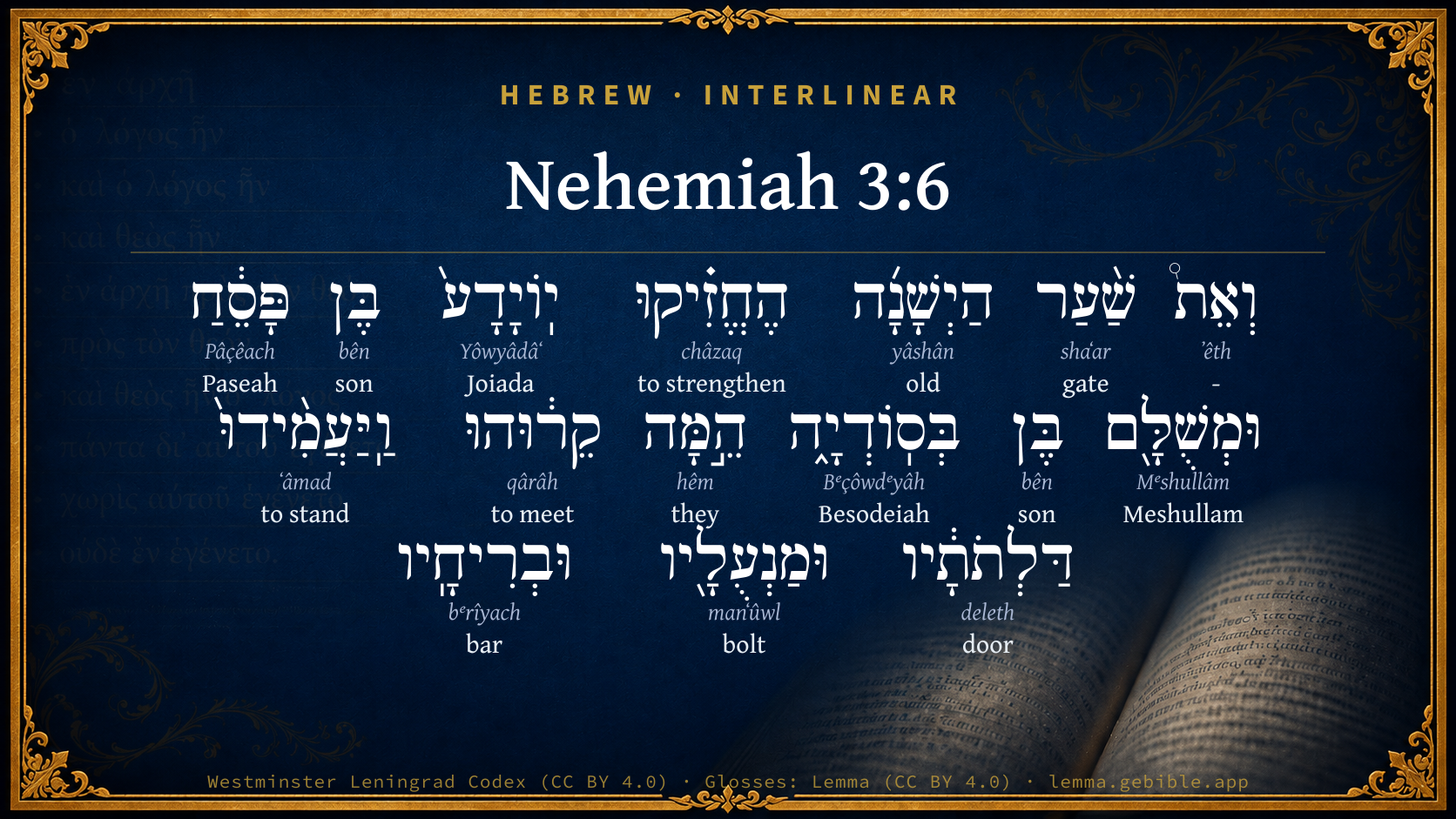
Nehemiah 3:6

Hebrew (Westminster Leningrad Codex) Nehemiah 3:6 appears in the Hebrew Old Testament. The text above is from the Westminster Leningrad Codex. Each word links to its Strong’s number, a concise gloss, and parsing drawn from the Open Scriptures Hebrew Bible morphology. Click any word for its full Brown-Driver-Briggs (BDB) entry.
Download image
Cite this verse

Nehemiah 3:6 (World English Bible). Public Domain. Lemma interlinear Bible study tool, https://lemma.gebible.app/v/nehemiah/3/6.

Show BibTeX & RIS
BibTeX
RIS
English Translation
The old gate repaired Joiada the son of Paseah and Meshullam the son of Besodeiah; they laid the beams of it, and set up the doors of it, and the bolts of it, and the bars of it.
World English Bible · Public Domain
Highlights
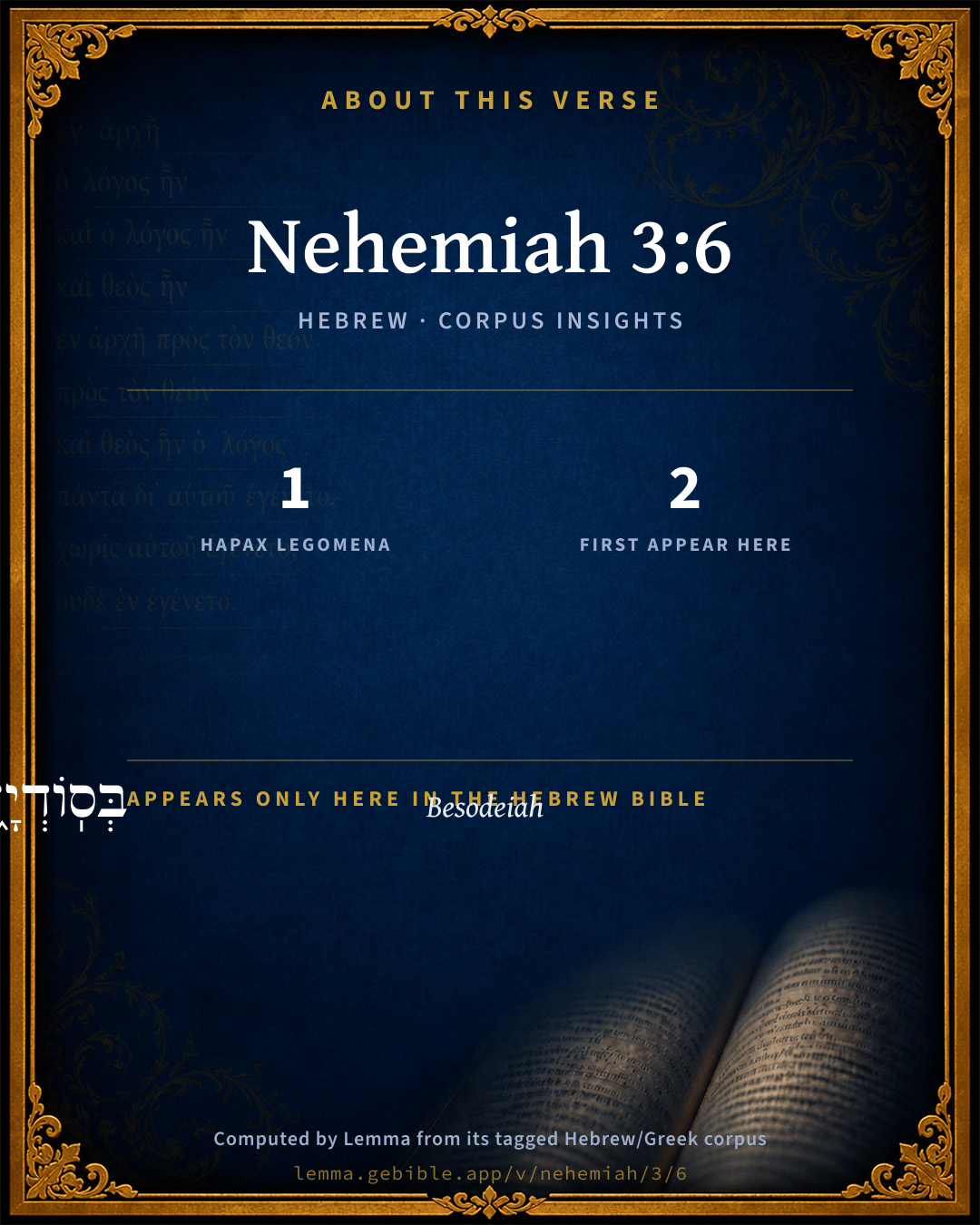
  • 1 hapax legomenon — only here in the Hebrew Bible
  • 2 first appearances in the Hebrew Bible
Full analysis ↓
Download a study sheet

One document with this verse’s original text, its word-by-word gloss line, the meaning frame, cross-references with their text, attributed commentary, and full source and license credits — printable, and it pastes into notes with its structure intact.

This verse Autodidact and up

Study sheet (.html) Plain text (.txt)

A passage Seminary Student

Up to 50 verses in one chapter. A passage sheet keeps up to 6 commentary sources and 12 cross-references per verse, in the order this page ranks them, and says so on the sheet whenever that leaves anything out. Ask for a single verse and you get the Autodidact verse sheet above.

Everything on this page stays free to read, with no account — the sheet is a download of what is already on screen, not access to it.

Want to remove ads? Support Godless Engineer
Compare translations 3

The same verse in 3 English versions, stacked beneath the original-language interlinear above. Click any original word for its lexicon entry.

Each is an independent rendering of the whole verse — the interlinear is not word-aligned to these translations.

Highlighted words mark where these versions differ — a whole-verse word diff, not a word-by-word alignment.

  • World English Bible Public Domain
    The old gate repaired Joiada the son of Paseah and Meshullam the son of Besodeiah; they laid the beams of it, and set up the doors of it, and the bolts of it, and the bars of it.
  • King James Version Public Domain
    Moreover the old gate repaired Jehoiada the son of Paseah, and Meshullam the son of Besodeiah; they laid the beams thereof, and set up the doors thereof, and the locks thereof, and the bars thereof.
  • unfoldingWord Literal Text CC BY-SA 4.0
    And Joiada the son of Paseah, and Meshullam the son of Besodeiah, strengthened the gate of old. They themselves laid its beams and erected its doors, its bolts, and its bars.

unfoldingWord Literal Text — © unfoldingWord, licensed CC BY-SA 4.0. Word-aligned USFM3 via Door43 (git.door43.org/unfoldingWord/en_ult).

Versions to compare (up to 4)

3 of 4 selected

Show all 18 translations

Every available English version of this verse, each an independent rendering of the whole verse.

  • World English Bible Public Domain
    The old gate repaired Joiada the son of Paseah and Meshullam the son of Besodeiah; they laid the beams of it, and set up the doors of it, and the bolts of it, and the bars of it.
  • Berean Standard Bible Public Domain
    The Jeshanah Gate was repaired by Joiada son of Paseah and Meshullam son of Besodeiah. They laid its beams and installed its doors, bolts, and bars.
  • Majority Standard Bible Public Domain
    The Jeshanah Gate was repaired by Joiada son of Paseah and Meshullam son of Besodeiah. They laid its beams and installed its doors, bolts, and bars.
  • King James Version Public Domain
    Moreover the old gate repaired Jehoiada the son of Paseah, and Meshullam the son of Besodeiah; they laid the beams thereof, and set up the doors thereof, and the locks thereof, and the bars thereof.
  • American Standard Version (1901) Public Domain
    And the old gate repaired Joiada the son of Paseah and Meshullam the son of Besodeiah; they laid the beams thereof, and set up the doors thereof, and the bolts thereof, and the bars thereof.
  • Revised Version (1885) Public Domain
    And the old gate repaired Joiada the son of Paseah and Meshullam the son of Besodeiah; they laid the beams thereof, and set up the doors thereof, and the bolts thereof, and the bars thereof.
  • Geneva Bible (1599) Public Domain
    And the gate of the olde fishpoole fortified Iehoiada the sonne of Paseah, and Meshullam the sonne of Besodaiah: they laid the beames thereof, and set on the doores thereof, and the lockes thereof, and the barres thereof.
  • Douay-Rheims (1899) Public Domain
    And Joiada the son of Phasea, and Mosollam the son of Besodia built the old gate: they covered it and set up the doors thereof, and the locks, and the bars.
  • Young's Literal Translation Public Domain
    And the old gate have Jehoiada son of Paseah, and Meshullam son of Besodeiah, strengthened; they have walled it, and set up its doors, and its locks, and its bars.
  • Literal Standard Version CC BY-SA 4.0
    And Jehoiada son of Paseah and Meshullam son of Besodeiah have strengthened the Old Gate; they have walled it, and set up its doors, and its locks, and its bars.
  • Unlocked Literal Bible CC BY-SA 4.0
    Joiada son of Paseah and Meshullam son of Besodeiah repaired the Old Gate. They made beams for it, and set its doors, its bolts, and its bars.
  • unfoldingWord Literal Text CC BY-SA 4.0
    And Joiada the son of Paseah, and Meshullam the son of Besodeiah, strengthened the gate of old. They themselves laid its beams and erected its doors, its bolts, and its bars.
  • Darby Bible Public Domain
    And the gate of the old [wall] repaired Jehoiada the son of Paseah, and Meshullam the son of Besodiah; they laid its beams, and set up its doors, and its locks, and its bars.
  • World Messianic Bible Public Domain
    Joiada the son of Paseah and Meshullam the son of Besodeiah repaired the old gate. They laid its beams and set up its doors, its bolts, and its bars.
  • Webster's Bible Public Domain
    Moreover, the old gate repaired Jehoiada the son of Paseah, and Meshullam the son of Besodeiah; they laid its beams, and set up its doors, and its locks, and its bars.
  • Free Bible Version CC BY-SA 4.0
    The Old Gate was repaired by Joiada, son of Paseah and Meshullam, son of Besodeiah. They laid its beams and set up its doors, together with its bolts and bars.
  • Bible in Basic English Public Domain
    Joiada, the son of Paseah, and Meshullam, the son of Besodeiah, made good the old doorway; they put its boards in place and put up its doors, with their locks and rods.
  • JPS Tanakh (1917) Public Domain
    And the gate of the old city repaired Joiada the son of Paseah and Meshullam the son of Besodeiah; they laid the beams thereof, and set up the doors thereof, and the bolts thereof, and the bars thereof.

Literal Standard Version (2020), Covenant Press — licensed CC BY-SA 4.0. Text via the HelloAO Bible API (eBible.org). Unlocked Literal Bible (unfoldingWord) — licensed CC BY-SA 4.0. Text via the HelloAO Bible API (eBible.org). unfoldingWord Literal Text — © unfoldingWord, licensed CC BY-SA 4.0. Word-aligned USFM3 via Door43 (git.door43.org/unfoldingWord/en_ult). Free Bible Version, Dr. Jonathan Gallagher — licensed CC BY-SA 4.0. Text via the HelloAO Bible API (eBible.org).

Word by word

More ways to search: Search by grammar → Find every occurrence → Compare this word →

Practice this passage: Drill this verse → Learn its vocabulary →

בְּסֽוֹדְיָ֑ה
Bᵉçôwdᵉyâh
H1152
“Besodeiah”
Noun, Proper
Part of Speech
Noun
Type
Proper
Full BDB Definition

Origin: from H5475 and H3050 with prepositional prefix

TWOT: None

Besodeiah = "with the counsel of Jehovah" or " in the secret of the Lord" - father of one of the repairers of the wall of Jerusalem in the time of Nehemiah
  1. וְאֵת֩ ʼêth H853 “and · -” Conjunction + Particle, Direct Object
  2. שַׁ֨עַר shaʻar H8179 “gate of” Noun, Common, Masculine, Singular, Construct
  3. הַיְשָׁנָ֜ה yâshân H3465 “old” Noun, Proper
  4. הֶחֱזִ֗יקוּ châzaq H2388 “to strengthen” Verb, Hiphil, Perfect, 3rd Person, Common, Plural
  5. יֽוֹיָדָע֙ Yôwyâdâʻ H3111 “Joiada” Noun, Proper
  6. בֶּן bên H1121 “son of” Noun, Common, Masculine, Singular, Construct
  7. פָּסֵ֔חַ Pâçêach H6454 “Paseah” Noun, Proper
  8. וּמְשֻׁלָּ֖ם Mᵉshullâm H4918 “and · Meshullam” Conjunction + Noun, Proper
  9. בֶּן bên H1121 “son of” Noun, Common, Masculine, Singular, Construct
  10. הֵ֣מָּה hêm H1992 “they” Pronoun, Personal, 3rd Person, Masculine, Plural
  11. קֵר֔וּהוּ qârâh H7136 “to meet · him” Verb, Piel, Perfect, 3rd Person, Common, Plural + Suffix, Personal, 3rd Person, Masculine, Singular
  12. וַֽיַּעֲמִ֨ידוּ֙ ʻâmad H5975 “and · to stand” Conjunction + Verb, Hiphil, Sequential Imperfect, 3rd Person, Masculine, Plural
  13. דַּלְתֹתָ֔יו deleth H1817 “doors · his” Noun, Common, Feminine, Plural, Construct + Suffix, Personal, 3rd Person, Masculine, Singular
  14. וּמַנְעֻלָ֖יו manʻûwl H4514 “and · bolts · his” Conjunction + Noun, Common, Masculine, Plural, Construct + Suffix, Personal, 3rd Person, Masculine, Singular
  15. וּבְרִיחָֽיו bᵉrîyach H1280 “and · bars · his” Conjunction + Noun, Common, Masculine, Plural, Construct + Suffix, Personal, 3rd Person, Masculine, Singular

About this verse

These counts appear in no published source. They are computed here, from the morphology-tagged text and Lemma’s own curated glosses. What Lemma adds →

16
words
15
distinct lemmas
Historical
section

Notable vocabulary

1 hapax legomenon — a word that appears only here in the entire Hebrew Bible:

  • בְּסֽוֹדְיָ֑ה Besodeiah H1152

First appearance in Scripture

These words make their first canonical appearance in the Hebrew Bible here:

  • יֽוֹיָדָע֙ Joiada H3111
  • בְּסֽוֹדְיָ֑ה Besodeiah H1152

Shared distinctive vocabulary

פָּסֵ֔חַ Paseah H6454 occurs in 4 verses of the Hebrew Bible. Also found in:

Grammatical profile

  • 3 verbs
  • 11 nouns
  • 1 pronoun
  • 1 particle

Verb forms

  • הֶחֱזִ֗יקוּ Hiphil · Perfect
  • קֵר֔וּהוּ Piel · Perfect
  • וַֽיַּעֲמִ֨ידוּ֙ Hiphil · Sequential Imperfect

Repetition

A word recurs within this verse — often emphatic in Hebrew:

Cross-references

1

Topical passages linked to Nehemiah 3:6 in the Treasury of Scripture Knowledge — connected by theme and wording, ordered by reader-vote popularity; previews shown in the World English Bible.

  • Nehemiah 12:39 and above the gate of Ephraim, and by the old gate, and by the fish gate, and the tower of Hananel, and the tower of Hammeah, even to the sheep gate: and they stood still in the gate of the guard.

Cross-references courtesy of OpenBible.info (CC BY 4.0).

Hebrew and Greek witnesses Masoretic Hebrew ↔ Greek Septuagint

The same verse in the two great witnesses to the Old Testament, shown verse-for-verse.

These are two independent witnesses, not word-aligned to each other, and the Septuagint is shown in lemma (dictionary) form.

Hebrew Nehemiah 3:6 Masoretic · Westminster Leningrad Codex

וְאֵת֩ שַׁ֨עַר הַיְשָׁנָ֜ה הֶחֱזִ֗יקוּ יֽוֹיָדָע֙ בֶּן פָּסֵ֔חַ וּמְשֻׁלָּ֖ם בֶּן בְּסֽוֹדְיָ֑ה הֵ֣מָּה קֵר֔וּהוּ וַֽיַּעֲמִ֨ידוּ֙ דַּלְתֹתָ֔יו וּמַנְעֻלָ֖יו וּבְרִיחָֽיו

The old gate repaired Joiada the son of Paseah and Meshullam the son of Besodeiah; they laid the beams of it, and set up the doors of it, and the bolts of it, and the bars of it.

World English Bible · Public Domain

Greek LXX Structure differs

The Septuagint has no separate book of Nehemiah. Its Greek text is the second half of Esdras B (2 Esdras), chapters 11–23; Ezra is the first half (1–10).

A verse-for-verse comparison isn’t shown here because the chapters and verses don’t line up. Switch to the LXX edition with the MT / LXX toggle above to read the Greek directly.

Hebrew: Westminster Leningrad Codex (CC BY 4.0). Greek: Septuagint (public domain); English from a public-domain English Septuagint. How the Septuagint differs from the Hebrew →

Commentary

Notes on Nehemiah 3:6 from classic Christian and Jewish commentators (each source and its license shown beneath its notes). The classic Christian expositions comment on the surrounding passage and are grouped to its opening verse, so a note may address several verses; the Jewish commentaries on the Tanakh (Rashi and others) are per-verse, so they appear only where the commentator wrote on this verse.

Lemma curates 59 commentaries, every one of them public domain or Creative Commons licensed, each selected and text-cleaned for this edition rather than reprinted as found. About our sources →

Trapp's Complete Commentary

John Trapp

Neh 3:6 Moreover the old gate repaired Jehoiada the son of Paseah, and Meshullam the son of Besodeiah; they laid the beams thereof, and set up the doors thereof, and the locks thereof, and the bars thereof.

Ver. 6. Moreover the old gate] Famous only for its antiquity; like as many old books are monumenta adorandae robiginis, of more antiquity than authority; and as that image at Ephesus, that was said, but falsely, to have fallen down from Jupiter (Dιοπετες), so the covetous priests persuaded the credulous people, Act 19:35. The Rabbis say, that this was a gate ever since the time that David took Zion from the Jebusites, Quis hoc credat, nisi sit pro teste vetustas? Who would believe this unless he winessed it?

John Trapp, A Commentary or Exposition upon All the Books of the Old and New Testament (1647–1656) — public domain. Text from a community e-Sword module.

Keil & Delitzsch

C. F. Keil & F. Delitzsch

From the gate of the old wall to the valley gate. - Neh 3:6 הישׁנה שׁער does not mean the old gate, for הישׁנה is genitive. Schultz (Jerus. p. 90), Thenius, and Bertheau supply העיר, gate of the old town, and explain the name from the fact that Bezetha, the new town, already existed as a suburb or village in front of the gate, which was named after the contrast. To this Arnold rightly objects (in Herzog's Realencycl. xviii. p. 628) that it is by no means proved that there was at that time any contrast between the old and new towns, and as well as Hupfeld (die topograph. Streitfragen ber Jerus., in the morgenl. Zeitschrift, xv. p. 231) supplies חומה: gate of the old wall. He does not, however, derive this designation from the remark (vv. Neh 3:8), "They fortified Jerusalem unto the broad wall," as though this old wall received its name from having been left undestroyed by the Chaldeans, which is irreconcilable with the fact (4-8) that both the gate of the old wall and the portions of wall adjoining it on each side were now built, but understands the term "old wall" as used in contrast to the "broad wall," which had indeed been rebuilt after the destruction by Joash (Kg2 14:13). This view we esteem to be correct. The individuals specified as the builders of this gate are not further known. That two principes were employed in the rebuilding of this gate is explained by Ramb. as arising vel quod penitus disturbata a Chaldaeis, vel quod magnis sumtibus reparanda fuit, quos unus princeps ferre non potuit.

Neh 3:7

Next unto them repaired Melatiah the Gibeonite, and Jadon the Meronothite, the men of Gibeon and of Mizpah. If Melatiah is to be regarded as the superintendent of the men of Gibeon, Jadon the Meronothite must be equally esteemed that of the men of Mizpah. Meronoth, mentioned only here and Ch1 27:30, must have been some small place near Mizpah. Mizpah (המּצפּה, the watch-tower) is probably the modern Nebi Samwil, two leagues to the north-east of Jerusalem; see rem. on Jos 19:26. The meaning of the words next following, וגו פּחת לכּסּא, is questionable. Bertheau, together with Osiander, Cler., de Wette, and others, understands them as more precisely defining the men before named, as men of Gibeon and Mizpah, of the throne or belonging to the throne of the Pechah of Eber hannahar. This addition brings to light the fact that Jews who were not under the jurisdiction of Nehemiah, nevertheless took part in the restoration of the wall. It also distinguishes these men of Mizpah from those mentioned Neh 3:15 and Neh 3:19, who were certainly not under the Pechah of Eber hannahar. Finally, the boundary of the little territory of the returned Jewish community must have been at about Mizpah and Gibeon; and a statement that certain inhabitants of this district were not under the Pechah of Jerusalem, but under the Pechah of the province west of Euphrates, would agree with the position of Gibeon and Mizpah. None, however, of these reasons are of much force. For if, according to Neh 3:5 and Neh 3:27, the Tekoites repaired two different lengths of wall, without this fact implying any distinction between these two parties of Tekoite builders, the same may be the case with the men of Gibeon and Mizpah. Besides, neither in this verse nor in Neh 3:15 and Neh 3:19 are the men of Mizpah in general spoken of, so as to make a distinction necessary; for in this verse two chiefs, Melatiah and Jadon, are designated as men of Gibeon and Mizpah, and in Neh 3:15 and Neh 3:19 two rulers of the district of Mizpah are specified by name. Hence the view that part of the inhabitants of Mizpah were under the jurisdiction of the Pechah of the province west of Euphrates, and part under that of the Pechah of Jerusalem, is devoid of probability. Finally, there is no adequate analogy for the metonomy set up in support of this view, viz., that כּסּא, a seat, a throne, stands for jurisdiction. The words in question can have only a local signification. כּסּא may indeed by metonomy be used for the official residence, but not for the official or judicial district, or jurisdiction of the Pechah. לכּסּא does not state the point to which, but the direction or locality in which, these persons repaired the wall: "towards the seat of the Pechah," i.e., at the place where the court or tribunal of the governor placed over the province on this side Euphrates was held when he came to Jerusalem to administer justice, or to perform any other official duties required of him. This being so, it appears from this verse that this court was within the northern wall, and undoubtedly near a gate.

Neh 3:8

Next to him repaired Uzziel the son of Harhaiah of the goldsmiths, and next to him repaired Hananiah, a son of the apothecaries. צורפים is in explanatory apposition to the name Uzziel, and the plural is used to denote that his fellow-artisans worked with him under his direction. Hananiah is called בּן־הרקּחים, son of the apothecaries, i.e., belonging to the guild of apothecaries. The obscure words, וגו ויּעזבוּ, "and they left Jerusalem unto the broad wall," have been variously interpreted. From Neh 12:38, where the broad wall is also mentioned, it appears that a length of wall between the tower of the furnaces and the gate of Ephraim was thus named, and not merely a place in the wall distinguished for its breadth, either because it stood out or formed a corner, as Bertheau supposes; for the reason adduced for this opinion, viz., that it is not said that the procession went along the broad wall, depends upon a mistaken interpretation of the passage cited. The expression "the broad wall" denotes a further length of wall; and as this lay, according to Neh 12:38, west of the gate of Ephraim, the conjecture forces itself upon us, that the broad wall was that 400 cubits of the wall of Jerusalem, broken down by the Israelite king Joash, from the gate of Ephraim unto the corner gate (Kg2 14:13), and afterwards rebuilt by Uzziel of a greater breadth, and consequently of increased strength (Joseph. Antiq. ix. 10. 3). Now the gate of Ephraim not being mentioned among the rebuilt gates, and this gate nevertheless existing (according to Neh 8:16) in the days of Nehemiah, the reason of this omission must be the circumstance that it was left standing when the wall of Jerusalem was destroyed. The remark, then, in this verse seems to say the same concerning the broad wall, whether we understand it to mean: the builders left Jerusalem untouched as far as the broad wall, because this place as well as the adjoining gate of Ephraim needed no restoration; or: the Chaldeans had here left Jerusalem, i.e., either the town or town-wall, standing. So Hupfeld in his above-cited work, p. 231; Arnold; and even older expositors.

(Note: Bertheau's interpretation of this statement, viz., that at the rebuilding and re-fortification of the town after the captivity, the part of the town extending to the broad wall was left, i.e., was not rebuilt, but delayed for the present, answers neither to the verbal sense of the passage nor to the particular mentioned Neh 12:38, that at the dedication of the wall the second company of them that gave thanks went upon the wall from beyond the tower of the furnaces even unto the broad wall, and over from beyond the gate of Ephraim, etc. Haneberg (in Reusch's theol. Literaturbl. 1869, No. 12) supports this view, but understands by "the broad wall" the wall which had a broad circuit, i.e., the wall previous to the captivity, and hence infers that the Jerusalem now rebuilt was not equal in extent to the old city. But if a portion of the former city had here been left outside the new wall, the gate of Ephraim would have been displaced, and must have been rebuilt elsewhere in a position to the south of the old gate. Still less can the attempt of the elder Buxtorf (Lexic. talm. rabb. s. v. עזב), now revived by Ewald (Gesch. iv. p. 174), to force upon the word עזב the meaning restaurare, or fortify, be justified.)

Neh 3:9-10

Further lengths of wall were built by Rephaiah ben Hur, the ruler of the half district of Jerusalem, i.e., of the district of country belonging to Jerusalem (comp. Neh 3:19 with Neh 3:15, where Mizpah and the district of Mizpah are distinguished); by Jedaiah ben Harumaph, בּיתו ונגד, and indeed before (opposite) his house, i.e., the portion of wall which lay opposite his own dwelling; and by Hattush the son of Hashabniah. Whether Hattush is to be identified with the priest of this name (Neh 10:5), or with the similarly named descendant of David (Ezr 8:2), or with neither, cannot be determined.

Neh 3:11

A second section of wall was repaired by Malchijah the son of Harim, and Hashshub ben Pahath-Moab, two families who came up with Zerubbabel, Ezr 2:6 and Ezr 2:32. Bertheau understands שׁנית מדּה of a second section of wall added to a first already repaired by the same builders. So, too, he says, did Meremoth ben Urijah build one portion, Neh 3:4, and a second, Neh 3:21; comp. Neh 3:5 and Neh 3:27, Neh 3:15 and Neh 3:19, Neh 3:8 and Neh 3:30. This first portion, however, which this mention of a second presupposes, not being named, he infers that our present text has not preserved its original completeness, and thinks it probable, from Neh 12:38 and Neh 12:39, that certain statements, in this description, relating to the gate of Ephraim and its neighbourhood, which once stood before Neh 3:8, have been omitted. This inference is unfounded. The non-mention of the gate of Ephraim is to be ascribed, as we have already remarked on Neh 3:8, to other reasons than the incompleteness of the text; and the assertion that שׁנית מדּה assumes that a former portion was repaired by the same builders, receives no support from a comparison of Neh 3:5 with Neh 3:27, Neh 3:15 with Neh 3:19, and Neh 3:8 with Neh 3:30. Hananiah the son of Shelemiah, and Hanun the sixth son of Zalaph, who, according to Neh 3:30, built שׁני מדּה, are not identical with Hananiah the son of the apothecaries, Neh 3:8. The same remark applies to Ezer the son of Jeshua, the ruler of Mizpah (Neh 3:19), and Shallum the ruler of the district of Mizpah (Neh 3:15). Only in Neh 3:5 and Neh 3:27, and Neh 3:4 and Neh 3:21, are the names of the builders the same. Moreover, besides Neh 3:21 and Neh 3:27, שׁנית מדּה occurs five times more (Neh 3:11, Neh 3:19, Neh 3:20, Neh 3:24, and Neh 3:30) with respect to builders not previously (nor subsequently) mentioned in this list. Hence, in five different places, the names of the building parties, and the notices of the portions of wall built by them respectively, must have been lost, - a circumstance priori incredible. When, however, we consider the verses, in which שׁנית מדּה occurs, more closely, the second length is, in Neh 3:19, Neh 3:20, Neh 3:21, Neh 3:24, and Neh 3:27, more nearly defined by a statement of locality: thus, in Neh 3:19, we have a second piece over against the ascent to the arsenal at the angle; in Neh 3:20, a second piece from the angle to the door of the house of Eliashib; in Neh 3:21, a second piece from the door of the house of Eliashib to ... ; in Neh 3:24, a second piece from the house of Azariah to ... , who, according to Neh 3:23, built near his own house; in Neh 3:27, a second piece over against the great projecting tower ... , as far as which, according to Neh 3:26, the Nethinim dwelt in Ophel. From all this, it is evident that שׁנית מדּה in these verses, always denotes a second portion of that length of wall previously spoken of, or a portion next to that of which the building was previously mentioned. And so must שׁנית מדּה be understood in the present Neh 3:11, where it is used because Malchiah and Hashshub repaired or built the tower of the furnaces, besides the portion of wall. שׁנית מדּה may be rendered, "another or a further piece." the word שׁנית is chosen, because that previously mentioned is regarded as a first. The tower of the furnaces lay, according to this verse and Neh 12:38, where alone it is again mentioned, between the broad wall and the valley-gate. Now, since there was between the gate of Ephraim and the corner-gate a portion of wall four hundred cubits long (see Kg2 14:13), which, as has been above remarked, went by the name of the broad wall, it is plain that the tower of the furnaces must be sought for in the neighbourhood of the corner-gate, or perhaps even identified with it. This is the simplest way of accounting for the omission of any notice in the present description of this gate, which is mentioned not merely before (Ch2 26:9; Jer 31:38; and Kg2 14:13), but also after, the captivity (Zac 14:10). It is probable that the tower of the furnaces served as a defence for the corner-gate at the north-western corner of the town, where now lie, upon an earlier building of large stones with morticed edges, probably a fragment of the old Jewish wall, the ruins of the ancient Kal'at el Dshalud (tower of Goliath), which might, at the time of the Crusades, have formed the corner bastion of the city: comp. Rob. Palestine, ii. p. 114; Biblical Researches, p. 252; and Tobler, Topogr. i. p. 67f.

Neh 3:12

Next repaired Shallum, ruler of the other (comp. Neh 3:9) half district of Jerusalem, he and his daughters. הוּא can only refer to Shallum, not to הוּא, which would make the daughters signify the daughters of the district, of the villages and places in the district.

Keil & Delitzsch — Biblical Commentary on the Old Testament (1861–1891) — public domain (CC PDM 1.0). Text via the HelloAO Bible API. (Old Testament only.)

Tyndale Open Study Notes

Tyndale Open Resources

3:6-8 These verses describe work done on the walls and gates on the western side of Jerusalem. Even people from outside the city and people having wealth or more delicate occupations participated.

3:6 The Old City Gate: The oldest part of Jerusalem sat on an eastern hill that ran north to the Temple Mount.

Tyndale Open Study Notes — © Tyndale Open Resources, licensed CC BY-SA 4.0. Text via the HelloAO Bible API.

Ellicott's Commentary for English Readers

(6) The old gate.—Not mentioned elsewhere: probably that of Damascus; but (by a conjectural addition to the text,) it has been translated the gate of the old wall, as if distinguished from “the broad wall.”

A Bible Commentary for English Readers, edited by Charles John Ellicott (1878–1897) — public domain. Text from a community e-Sword module.

The Cambridge Bible for Schools and Colleges

gen. ed. J. J. S. Perowne

6. Moreover the old gate] R.V. And the old gate. Marg. ‘Or, the gate of the old city or, of the old wall.’ Literally rendered the words are ‘And the gate of the old,’ so that there is some uncertainty which word we should supply. From the mention of the same gate elsewhere (Neh_12:39) we gather that it stood between the ‘fish gate’ and the ‘gate of Ephraim,’ and is possibly the same as the ‘corner gate’ (2Ki_14:13) which Zechariah calls ‘the first gate’ (Zec_14:10). On the N. side the ground being more level the city would naturally extend itself in this direction. The gate possibly derived its name from being the entrance to the old city. Prof. Robertson Smith (Art. Jerusalem, Enc. Brit.) says: ‘For obvious engineering reasons the eminence at the N.W. of the Haram area must always have been a principal point in the fortifications, and here the old gate may very well have been placed.’ The ‘gate of the old wall’ is a less likely appellation. In one sense every gate that was restored was a gate of the old wall. If ‘the old wall’ was a part of an ancient or disused rampart, it would not have been a portion included in this description. When the fortifications coincided with an earlier and thicker wall, it was called ‘the broad wall’ (Neh_3:8).

Jehoiada] R.V. Joiada.

they laid the beams, &c.] See on Neh_3:3.

The Cambridge Bible for Schools and Colleges (gen. ed. J. J. S. Perowne; Cambridge University Press, 1878–1918) — public domain. Text from a community e-Sword module.

John Gill's Exposition

Moreover, the old gate repaired Jehoiada, the son of Paseah, and Meshullam the son of Besodeiah,.... Which some think was so called because it led to the old city Salem. Dr. Lightfoot (a) thinks it is the same with the second or third gate, Zep 1:10. According to Vatablus, it was the gate of the old pool, Isa 22:11, or rather, perhaps, it was the gate of the old wall Josephus speaks of (b); it led to the north of the land:

they laid the beams thereof; as in Neh 3:3.

(a) Ut supra. (Chorograph. Cent. of the Land of Israel, c. 26. p. 27. vol. 2.) (b) De Bello Jud. l. 5. c. 4. sect. 2, 3.

John Gill's Exposition of the Whole Bible (1746–1763) — public domain (CC PDM 1.0). Text via the HelloAO Bible API.

Albert Barnes' Notes on the Bible

The old gate - Either the modern Damascus gate, the main entrance to the city on the north side; or a gate a little further eastward.

Albert Barnes' Notes on the Bible (1834–1885) — public domain. Text from a community e-Sword/MySword module.

Haydock's Catholic Bible Commentary

Old gate, or of the judges, who there assembled. (Lyranus)

George Leo Haydock (1774–1849), Haydock's Catholic Family Bible and Commentary, 1859 edition — public domain. Excludes Psalms (Douay-Rheims chapter numbering differs from Protestant) and Deuterocanonical books (Catholic canon only).

Whedon's Commentary on the Bible

Daniel D. Whedon

6. The old gate — Its location can now be fixed only by conjecture. It seems to have been in the northern wall, and probably near the northeastern corner of the city. See plan.

Daniel D. Whedon (gen. ed.), Commentary on the Old and New Testaments (1874–1909) — public domain. Text from a community e-Sword module.

The Pulpit Commentary

The old gate must either have corresponded to the modern "Damascus gate" or have been in its near neighbourhood. It is not mentioned elsewhere.

The Pulpit Commentary (1880–1919), ed. H.D.M. Spence-Jones & Joseph S. Exell — public domain. Text from a community e-Sword module.

unfoldingWord translationNotes

Door43 World Missions Community

Joiada ... Paseah and Meshullam ... Besodeiah ... Melatiah ... Jadon

These are all names of men. (See: How to Translate Names)

set its doors

"installed its doors" or "put its doors in place"

its bolts, and its bars

"its locks and bars." These locked the gates securely.

Gibeonite ... Meronothite

Gibeonites and Meronothites are people groups. (See: How to Translate Names)

Gibeon and Mizpah

These are names of places. (See: How to Translate Names)

the Province Beyond the River

This is the name of the province that was west of the Euphrates River. It was across the river from the city of Susa. See how you translated this in Nehemiah 2:7. (See: How to Translate Names)

translationWords

son

gate

Gibeon

govern

life

unfoldingWord translationNotes — © Distant Shores Media and the Door43 World Missions Community, licensed CC BY-SA 4.0. Source: git.door43.org/Door43/en_tn.

Rashi

Rabbi Shlomo Yitzchaki (Rashi)

And...the gate of the old [city] Heb. הַיְשָּׁנָה, the Gate Yeshana, such was its name.

Rashi on the Tanakh — English translations: “The Judaica Press complete Tanach with Rashi, translated by A. J. Rosenberg” (CC BY 4.0); “Pentateuch with Rashi's commentary by M. Rosenbaum and A.M. Silbermann, 1929-1934” (public domain); “The Metsudah Tanach series, Lakewood, N.J” (CC BY 4.0); and “The Book of Joshua, Metsudah Publications, 1997” (CC BY 4.0). Text via Sefaria.

Lesson kit

Teaching starters — assembled from the data on this page, not authored interpretation. Every prompt links to the verse data it draws on. Edit before teaching.

Nehemiah, in the Historical, opens this verse with 16 words (15 distinct Hebrew lemmas). Its most distinctive word is Bᵉçôwdᵉyâh (“Besodeiah”). A historical commentator’s framing appears above. Read the whole chapter for the surrounding context.

Discussion questions

  1. The word Bᵉçôwdᵉyâh carries the sense “Besodeiah.” How does it shape the verse?
  2. This verse holds 1 word here found nowhere else in the Hebrew Bible. What might the rare word draw attention to?
  3. 2 words here appear for the first time in Scripture. What is being introduced at this debut?
  4. 1 Chronicles 4:12 shares the word «Paseah» with this verse. How do the two illuminate each other?
  5. “son” occurs 2× in this one verse. What is the effect of the repetition?
  6. The translations on this page render this verse differently — a whole-verse word diff, not a word-by-word alignment. What might account for the different wordings?
  7. The verb «הֶחֱזִ֗יקוּ» is Hiphil Perfect. How does its form color the action?
  8. Reading how Trapp's Complete Commentary and Keil & Delitzsch read this verse, where do the two commentators agree and where do they part?

Things to notice

  • 1 word in this verse appears nowhere else in the Hebrew Bible.
  • 2 words make their first canonical appearance in Scripture here.
  • These translations choose different wording for 12 words in this verse.
  • “son” occurs 2× in this single verse.
  • 15 distinct Hebrew lemmas span 16 words in this verse.

Reading settings

Reading text

Shown beneath each verse's original-language words.

Old Testament
Old Testament edition

Read the OT as the Masoretic Hebrew (MT) or the Greek Septuagint (LXX).

English shown for the Greek Septuagint (in the Hebrew ↔ Greek comparison).

Comparing translations? Open the Compare panel on any verse page to stack up to four side by side.