
Isaiah 60:11

Hebrew (Westminster Leningrad Codex) Isaiah 60:11 appears in the Hebrew Old Testament. The text above is from the Westminster Leningrad Codex. Each word links to its Strong’s number, a concise gloss, and parsing drawn from the Open Scriptures Hebrew Bible morphology. Click any word for its full Brown-Driver-Briggs (BDB) entry.
Download image
Cite this verse

Isaiah 60:11 (World English Bible). Public Domain. Lemma interlinear Bible study tool, https://lemma.gebible.app/v/isaiah/60/11.

Show BibTeX & RIS
BibTeX
RIS
English Translation
Your gates also shall be open continually; they shall not be shut day nor night; that men may bring to you the wealth of the nations, and their kings led captive.
World English Bible · Public Domain
Download a study sheet

One document with this verse’s original text, its word-by-word gloss line, the meaning frame, cross-references with their text, attributed commentary, and full source and license credits — printable, and it pastes into notes with its structure intact.

This verse Autodidact and up

Study sheet (.html) Plain text (.txt)

A passage Seminary Student

Up to 50 verses in one chapter. A passage sheet keeps up to 6 commentary sources and 12 cross-references per verse, in the order this page ranks them, and says so on the sheet whenever that leaves anything out. Ask for a single verse and you get the Autodidact verse sheet above.

Everything on this page stays free to read, with no account — the sheet is a download of what is already on screen, not access to it.

Want to remove ads? Support Godless Engineer
Compare translations 3

The same verse in 3 English versions, stacked beneath the original-language interlinear above. Click any original word for its lexicon entry.

Each is an independent rendering of the whole verse — the interlinear is not word-aligned to these translations.

Highlighted words mark where these versions differ — a whole-verse word diff, not a word-by-word alignment.

  • World English Bible Public Domain
    Your gates also shall be open continually; they shall not be shut day nor night; that men may bring to you the wealth of the nations, and their kings led captive.
  • King James Version Public Domain
    Therefore thy gates shall be open continually; they shall not be shut day nor night; that men may bring unto thee the forces of the Gentiles, and that their kings may be brought.
  • unfoldingWord Literal Text CC BY-SA 4.0
    And your gates will be open continually; day and night they will not be shut, to bring to you the wealth of the nations and their kings, being led.

unfoldingWord Literal Text — © unfoldingWord, licensed CC BY-SA 4.0. Word-aligned USFM3 via Door43 (git.door43.org/unfoldingWord/en_ult).

Versions to compare (up to 4)

3 of 4 selected

Show all 18 translations

Every available English version of this verse, each an independent rendering of the whole verse.

  • World English Bible Public Domain
    Your gates also shall be open continually; they shall not be shut day nor night; that men may bring to you the wealth of the nations, and their kings led captive.
  • Berean Standard Bible Public Domain
    Your gates will always stand open; they will never be shut, day or night, so that the wealth of the nations may be brought into you, with their kings being led in procession.
  • Majority Standard Bible Public Domain
    Your gates will always stand open; they will never be shut, day or night, so that the wealth of the nations may be brought into you, with their kings being led in procession.
  • King James Version Public Domain
    Therefore thy gates shall be open continually; they shall not be shut day nor night; that men may bring unto thee the forces of the Gentiles, and that their kings may be brought.
  • American Standard Version (1901) Public Domain
    Thy gates also shall be open continually; they shall not be shut day nor night; that men may bring unto thee the wealth of the nations, and their kings led captive.
  • Revised Version (1885) Public Domain
    Thy gates also shall be open continually; they shall not be shut day nor night; that men may bring unto thee the wealth of the nations; and their kings led with them.
  • Geneva Bible (1599) Public Domain
    Therefore thy gates shalbe open continually: neither day nor night shall they be shutte, that men may bring vnto thee the riches of the Gentiles, and that their Kings may be brought.
  • Douay-Rheims (1899) Public Domain
    And thy gates shall be open continually: they shall not be shut day nor night, that the strength of the Gentiles may be brought to thee, and their kings may be brought.
  • Young's Literal Translation Public Domain
    And opened have thy gates continually, By day and by night they are not shut, To bring unto thee the force of nations, Even their kings are led.
  • Literal Standard Version CC BY-SA 4.0
    And your gates have continually opened, || They are not shut by day and by night, || To bring the force of nations to you, || Even their kings are led.
  • Unlocked Literal Bible CC BY-SA 4.0
    Your gates also will remain open continually; they will not be shut day or night, so that the wealth of the nations may be brought, with their kings being led.
  • unfoldingWord Literal Text CC BY-SA 4.0
    And your gates will be open continually; day and night they will not be shut, to bring to you the wealth of the nations and their kings, being led.
  • Darby Bible Public Domain
    And thy gates shall stand open continually: (they shall not be shut day nor night,) that the wealth of the nations may be brought unto thee, and that their kings may be led [to thee].
  • World Messianic Bible Public Domain
    Your gates also shall be open continually; they shall not be shut day nor night, that men may bring to you the wealth of the nations, and their kings led captive.
  • Webster's Bible Public Domain
    Therefore thy gates shall be open continually; they shall not be shut day nor night; that men may bring to thee the forces of the Gentiles, and that their kings may be brought.
  • Free Bible Version CC BY-SA 4.0
    Your gates will always be kept open. They won't ever be shut, day or night, so the wealth of the nations can be brought to you, with their kings being led along in a procession.
  • Bible in Basic English Public Domain
    Your doors will be open at all times; they will not be shut day or night; so that men may come into you with the wealth of the nations, with their kings at their head.
  • JPS Tanakh (1917) Public Domain
    Thy gates also shall be open continually, day and night, they shall not be shut; that men may bring unto thee the wealth of the nations, and their kings in procession.

Literal Standard Version (2020), Covenant Press — licensed CC BY-SA 4.0. Text via the HelloAO Bible API (eBible.org). Unlocked Literal Bible (unfoldingWord) — licensed CC BY-SA 4.0. Text via the HelloAO Bible API (eBible.org). unfoldingWord Literal Text — © unfoldingWord, licensed CC BY-SA 4.0. Word-aligned USFM3 via Door43 (git.door43.org/unfoldingWord/en_ult). Free Bible Version, Dr. Jonathan Gallagher — licensed CC BY-SA 4.0. Text via the HelloAO Bible API (eBible.org).

Word by word

More ways to search: Search by grammar → Find every occurrence → Compare this word →

Practice this passage: Drill this verse → Learn its vocabulary →

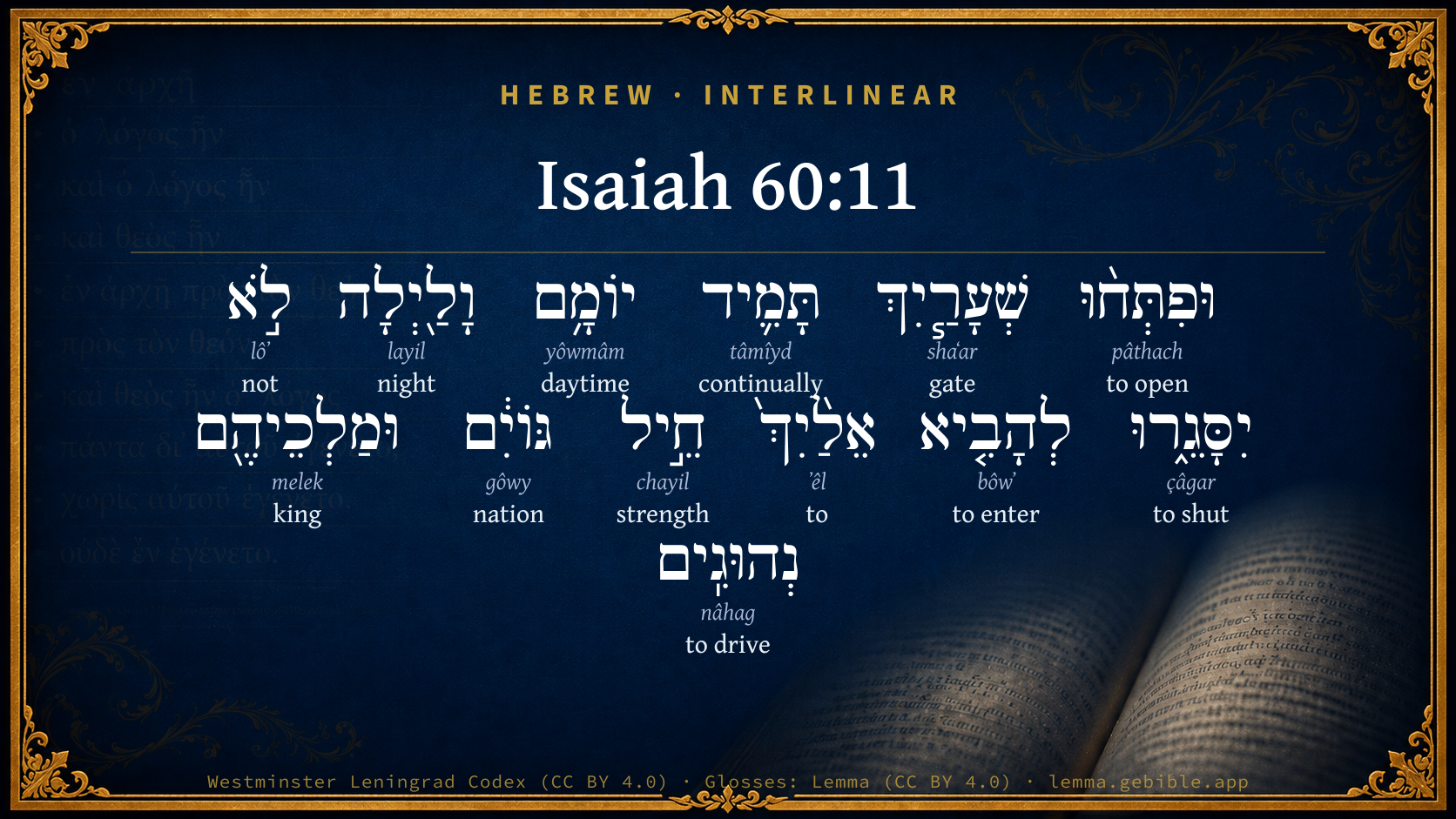
נְהוּגִֽים
nâhag
H5090
“driven”
Verb, Qal, Participle Passive, Masculine, Plural, Absolute
Part of Speech
Verb
Stem
Qal
Form
Participle Passive
Gender
Masculine
Number
Plural
State
Absolute
Full BDB Definition

Origin: a primitive root

TWOT: 1309 , 1310

to drive, lead, guide, conduct - (Qal) - to drive, lead on, drive away, drive off - to behave itself (figuratively) (of heart) - (Piel) - to drive away, lead off - to lead on, guide, guide on - to cause to drive - (Piel) to moan, lament
  1. וּפִתְּח֨וּ pâthach H6605 “and · to open” Conjunction + Verb, Piel, Sequential Perfect, 3rd Person, Common, Plural
  2. שְׁעָרַ֧יִךְ shaʻar H8179 “gates · your” Noun, Common, Masculine, Plural, Construct + Suffix, Personal, 2nd Person, Feminine, Singular
  3. תָּמִ֛יד tâmîyd H8548 “continually” Noun, Common, Masculine, Singular, Absolute
  4. יוֹמָ֥ם yôwmâm H3119 “daytime” Adverb
  5. וָלַ֖יְלָה layil H3915 “and · night” Conjunction + Noun, Common, Masculine, Singular, Absolute
  6. לֹ֣א lôʼ H3808 “not” Particle, Negative
  7. יִסָּגֵ֑רוּ çâgar H5462 “to shut” Verb, Niphal, Imperfect, 3rd Person, Masculine, Plural
  8. לְהָבִ֤יא bôwʼ H935 “to enter” Preposition + Verb, Hiphil, Infinitive Construct
  9. אֵלַ֨יִךְ֙ ʼêl H413 “to · you” Preposition + Suffix, Personal, 2nd Person, Feminine, Singular
  10. חֵ֣יל chayil H2428 “strength of” Noun, Common, Masculine, Singular, Construct
  11. גּוֹיִ֔ם gôwy H1471 “nations” Noun, Common, Masculine, Plural, Absolute
  12. וּמַלְכֵיהֶ֖ם melek H4428 “and · kings · their” Conjunction + Noun, Common, Masculine, Plural, Construct + Suffix, Personal, 3rd Person, Masculine, Plural

About this verse

These counts appear in no published source. They are computed here, from the morphology-tagged text and Lemma’s own curated glosses. What Lemma adds →

13
words
13
distinct lemmas
Prophets
section

Shared distinctive vocabulary

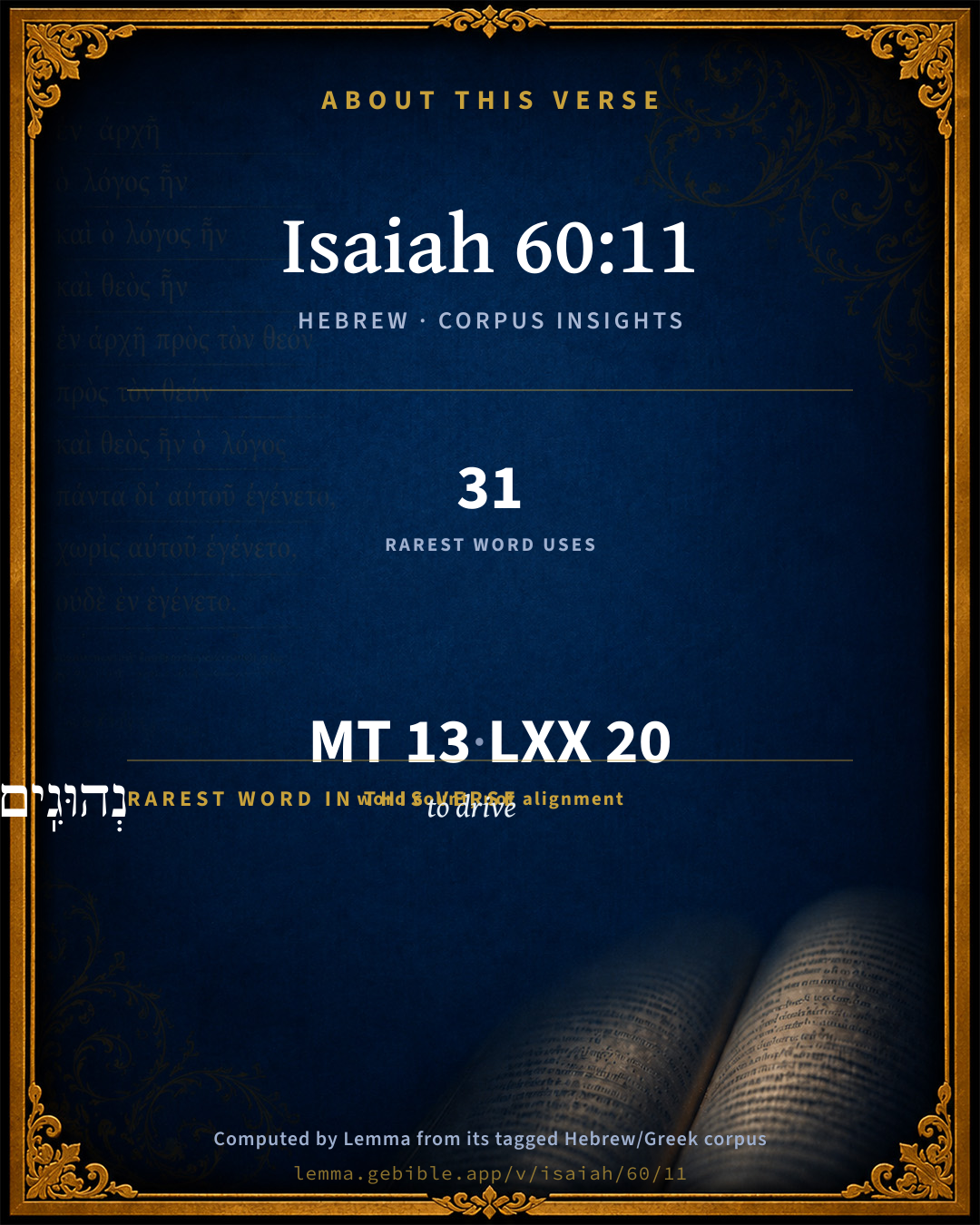
נְהוּגִֽים to drive H5090 occurs in 31 verses of the Hebrew Bible. Also found in:

Grammatical profile

  • 4 verbs
  • 6 nouns
  • 1 preposition
  • 1 adverb
  • 1 particle

Verb forms

  • וּפִתְּח֨וּ Piel · Sequential Perfect
  • יִסָּגֵ֑רוּ Niphal · Imperfect
  • לְהָבִ֤יא Hiphil · Infinitive Construct
  • נְהוּגִֽים Qal · Participle Passive

Hebrew & Septuagint length

In English translation the verse runs 31 words from the Hebrew and 30 from the Septuagint (LXX English) — closely comparable.

A rough comparison of the two English renderings, which tokenize alike — not a word-level alignment.

Word counts can differ between the Hebrew and the Greek without any difference in meaning — e.g. the Hebrew direct-object marker אֵת has no separate Greek word, and Greek often adds the article ὁ.

In the original languages it is 13 Hebrew tokens and 20 Greek tokens — but the two are counted differently (Hebrew bundles its prefixes and suffixes into one token; the Greek is in lemma form), so that isn’t a like-for-like length.

Cross-references

5

Topical passages linked to Isaiah 60:11 in the Treasury of Scripture Knowledge — connected by theme and wording, ordered by reader-vote popularity; previews shown in the World English Bible.

  • Revelation 21:25–26 Its gates will in no way be shut by day (for there will be no night there),
  • Isaiah 60:5 Then you shall see and be radiant, and your heart shall thrill and be enlarged; because the abundance of the sea shall be turned to you, the wealth of the nations shall come to you.
  • Isaiah 60:18 Violence shall no more be heard in your land, desolation nor destruction within your borders; but you shall call your walls Salvation, and your gates Praise.
  • Isaiah 62:10 Go through, go through the gates; prepare you the way of the people; cast up, cast up the highway; gather out the stones; lift up an ensign for the peoples.
  • Psalms 149:8 To bind their kings with chains, And their nobles with fetters of iron;

Cross-references courtesy of OpenBible.info (CC BY 4.0).

Hebrew and Greek witnesses Masoretic Hebrew ↔ Greek Septuagint

The same verse in the two great witnesses to the Old Testament, shown verse-for-verse.

These are two independent witnesses, not word-aligned to each other, and the Septuagint is shown in lemma (dictionary) form.

Hebrew Isaiah 60:11 Masoretic · Westminster Leningrad Codex

וּפִתְּח֨וּ שְׁעָרַ֧יִךְ תָּמִ֛יד יוֹמָ֥ם וָלַ֖יְלָה לֹ֣א יִסָּגֵ֑רוּ לְהָבִ֤יא אֵלַ֨יִךְ֙ חֵ֣יל גּוֹיִ֔ם וּמַלְכֵיהֶ֖ם נְהוּגִֽים

Your gates also shall be open continually; they shall not be shut day nor night; that men may bring to you the wealth of the nations, and their kings led captive.

World English Bible · Public Domain

Greek LXX Isaiah 60:11 Septuagint · lemma form

καί ἀναοἴγω ὁ πύλη σύ διά πᾶς ἡμέρα καί νύξ οὐ κλείω εἰςἄγω πρός σύ δύναμις ἔθνος καί βασιλεύς ἄγω

And your gates shall be opened continually; they shall not be shut day nor night; to bring in to you the power of the Gentiles, and their kings as captives.

LXX2012 (modern English Septuagint) · Public Domain

Hebrew: Westminster Leningrad Codex (CC BY 4.0). Greek: Septuagint (public domain); English from LXX2012 (modern English Septuagint) (Public Domain). How the Septuagint differs from the Hebrew →

Targum (Aramaic paraphrase)

1

The Targum is the ancient Jewish Aramaic paraphrase of the Hebrew Scriptures — an interpretive translation, not the Hebrew text itself. Onkelos (literal) and Pseudo-Jonathan (expansive) render the Torah, and Jonathan the Prophets. Coverage is partial: where no permissively-licensed English translation exists for a verse, only the Aramaic is shown. This is verse-level text, not a word-by-word alignment to the Hebrew.

  1. Targum Jonathan Prophets (Joshua–Malachi)
    וְיִתְפַּתְּחוּן תַּרְעָךְ תְּדִירָא יֵימָם וְלֵילֵי לָא יִתְאַחֲדוּן לַאֲעָלָא לְגַוִיךְ נִכְסֵי עַמְמַיָא וּמַלְכֵיהוֹן זְקִיקִין:

    Thy gates shall be open continually; they shall not be shut day nor night; that men may bring unto thee the treasures of the nations, and their kings in chains.

    Targum Jonathan — Aramaic: “Mikraot Gedolot” (public domain). English: “Sefaria Community Translation” (CC0 1.0 (public-domain dedication)); “London "Chaldee Paraphrase," 1871” (public domain). Text via Sefaria.

Commentary

Notes on Isaiah 60:11 from classic Christian and Jewish commentators (each source and its license shown beneath its notes). The classic Christian expositions comment on the surrounding passage and are grouped to its opening verse, so a note may address several verses; the Jewish commentaries on the Tanakh (Rashi and others) are per-verse, so they appear only where the commentator wrote on this verse.

Lemma curates 59 commentaries, every one of them public domain or Creative Commons licensed, each selected and text-cleaned for this edition rather than reprinted as found. About our sources →

Trapp's Complete Commentary

John Trapp

Isa 60:11 Therefore thy gates shall be open continually; they shall not be shut day nor night; that [men] may bring unto thee the forces of the Gentiles, and [that] their kings [may be] brought.

Ver. 11. Therefore shall thy gates be open continually.] Such shall be thy spiritual security, and so great the resort unto thee

And that their kings may be brought.] Led captive, saith the Chaldee, sc., to the obedience of faith, {as Psa 149:8} or, Led in state; so others.

John Trapp, A Commentary or Exposition upon All the Books of the Old and New Testament (1647–1656) — public domain. Text from a community e-Sword module.

Tyndale Open Study Notes

Tyndale Open Resources

60:11 There are two likely reasons for why the gates are not closed at night (see also Rev 21:25): (1) So much traffic will be coming into the city (Isa 60:8-10) that the gates will need to be open. (2) The citizens of Zion will no longer need to fear enemies because the Lord is their protector (60:18); the nations that remain will be serving the Lord and his people (60:9, 12).

Tyndale Open Study Notes — © Tyndale Open Resources, licensed CC BY-SA 4.0. Text via the HelloAO Bible API.

Jamieson, Fausset & Brown

Robert Jamieson, A. R. Fausset & David Brown

(Rev 21:25). The gates are ever open to receive new offerings and converts (Isa 26:2; Act 14:27; Rev 3:8). In time of peace the gates of a city are open: so, under the Prince of peace, there shall be no need of barring gates against invaders.

forces--riches.

be brought--as willing captives to the truth; or, if not willingly, be bought by judgments to submit to Israel (Isa 60:12, Isa 60:14). GESENIUS explains it, "may come escorted by a retinue."

Jamieson, Fausset & Brown — Commentary Critical and Explanatory on the Whole Bible (1871) — public domain (CC PDM 1.0). Text via the HelloAO Bible API.

Ellicott's Commentary for English Readers

(11) Thy gates shall be open continually.—The words imply (1) a state of peace in which there would be no danger of attack; and (2) the constant stream of caravans of pilgrims, With their offerings, entering by night as well as day. It is interesting to note St. John’s transfer of the thought to the heavenly Jerusalem (Rev_21:25-26).

The forces of the Gentiles.—Better, the riches, or the possessions.

That their kings may be brought . . .—The verb, as in Isa_20:4, 1Sa_30:2, implies that they are brought as captives, acknowledging, with or against their will, the sovereignty of Zion.

A Bible Commentary for English Readers, edited by Charles John Ellicott (1878–1897) — public domain. Text from a community e-Sword module.

The Cambridge Bible for Schools and Colleges

gen. ed. J. J. S. Perowne

11. For Therefore read And (R.V. “also”).

the riches of nations] as Isa_60:5.

and that their kings may be brought] R.V. and their kings led with them;—a circumstantial clause. Some commentators would change the passive participle into an active: “their kings being the leaders.” The alteration seems unnecessary.

The Cambridge Bible for Schools and Colleges (gen. ed. J. J. S. Perowne; Cambridge University Press, 1878–1918) — public domain. Text from a community e-Sword module.

John Gill's Exposition

Therefore thy gates shall be open continually,.... This is expressive both of the peaceable state of the church, that she shall be in no danger, nor fear of enemies; there being none to hurt and destroy in all the holy mountain; and therefore under no concern to keep her gates shut; see Eze 38:11 and of the vast concourse of people to it continually; converts from all parts shall be always coming in, and the gates of the church will stand open always to receive them; they will be welcome, come as many as will; there will be no objection to them, no hinderance of them; ministers and people will gladly embrace them; see Isa 26:2 and likewise of the capacity of the church to receive them; for though they will be continually coming in great numbers, yet still there will be room; the gates will not be shut upon them, as unable to receive more; place will be given for them to dwell in; her tents will be enlarged; the curtains of her habitation stretched out; her cords lengthened, and stakes strengthened; so that though she breaks forth on the right hand, and on the left, there will be room for them all, Isa 54:2,

they shall not be shut day nor night; this clause is referred to in Rev 21:25 but there differently expressed,

and the gates of it shall not be shut at all day, for there shall be no night there; the reason of which difference is, because the New Jerusalem state, or personal reign of Christ, will be a perfect state, and no night at all in it; but the spiritual reign of Christ, to which this prophecy relates, will be an imperfect one, though glorious; and therefore mention is made both of day and night:

that men may bring unto thee the forces of the Gentiles; the whole strength of them, their armies; See Gill on Isa 60:5. The Targum paraphrases it, the substance of the people, their wealth and riches:

and that their kings may be brought; or "led" (d), either in state, as kings on horseback sometimes are, or rather as captives in chains; see Isa 20:4, so the Targum renders it, "bound"; being conquered by mighty grace, and led in chains of love to Christ, and to his church, and become obedient. Kimchi has this note,

"they shall come before the King Messiah, as servants before their masters.''

(d) "ducti", Vatablus, Calvin; "ducantur", Tigurine version; "ductos", Cocceius.

John Gill's Exposition of the Whole Bible (1746–1763) — public domain (CC PDM 1.0). Text via the HelloAO Bible API.

Albert Barnes' Notes on the Bible

Therefore thy gates shall be open continually - The main idea here is, probably, that the accession from the pagan world, and the consequent influx of converts, would be so great, that there would be a necessity that the gates should never be closed. It is possible, also, that the prophet meant to describe that time as a period of security and peace. The gates of cities were closed in time of war, and at night, to guard them from danger. But in those times, such would be the prevalence of peace, and such would be the purposes for which the multitude of strangers would come from all parts of the world, that the gates might be left open, and the city unguarded at all times. The sense is -

1. That there will be immense multitudes that shall enter the true church from the pagan world.

2. That the gospel will be constantly and unceasingly offered to people. The doors of the church shall at no time be closed. By day and by night, at all seasons and in all places, people may come and obtain salvation. None shall be excluded because the gates shall be closed upon them; none because they are strangers and have come from distant lands; none because there will be no room; none because the conflux shall be so great that the provisions of mercy will be exhausted.

3. It will be a time of safety when the world shall be brought under the influence and the dominion of the Prince of Peace. There will be no need of closing the gates of cities, or of building walls around them. There will be no need to guard against hostile armies or the intrusions of hordes of banditti. There will be no need of guarding against the fraud, oppressions, and dishonest arts of other people. If the principles of the true religion everywhere prevailed, there would be no need of wails to cities, or gates, or bars; no need of ramparts, of ships of war, and of fortifications; no need of bolts and locks and iron chests to guard our property. No true Christian needs to guard himself or his property against another true Christian. No lock, no bolt, no wall, no gate, no iron safe has been made in order to guard against a man who is the sincere friend of the Redeemer. They are made to guard against wicked people; and when universal truth and righteousness prevail, they may be suffered to rust and rot for want of use. Should the principles of Christianity be everywhere diffused, the walls of all cities might be suffered to fall down; their gates to stand open until they should decay; ships of war to lie in the dock until they should sink to the bottom, forts and fleets to be dismantled; and the whole business of making locks and shackles, and of building prisons and manufacturing instruments of war, would come to an end.

That men may bring unto thee - So many shall be coming with the wealth of the Gentiles, that the gates shall be continually open.

The forces of the Gentiles - The wealth of the pagan (see the notes at Isa 60:5).

And that their kings may be brought - Lowth renders this, ‘That their kings may come pompously attended.’ Noyes, ‘May come with their retinues.’ The Chaldee renders it, ‘And their kings be brought bound,’ or in chains. But the Hebrew word used here (נהוּגים nehûgı̂ym) denotes simply that they would be led or conducted in any way; and the idea is, that they would be induced, by the force of truth, to come and devote themselves to the service of God, They might be expected, indeed, to come, as Lowth says, pompously attended, but this idea is not in t the Hebrew text.

Albert Barnes' Notes on the Bible (1834–1885) — public domain. Text from a community e-Sword/MySword module.

Matthew Poole's English Annotations

Therefore; for that end and purpose; or by reason of the conflux of people that shall be continually flocking thither, arguing abundance of peace and security, and great enlargement of the church, and that the Christian church shall be always open to the godly, to receive all comers freely.

The forces; or, wealth; either all wherein they excel, or all the prey taken in fight.

May be brought, as it were, captives in chains, such as they took in war, being made victorious, so say some; but rather, such as were led and conducted in state.

Matthew Poole's English Annotations on the Holy Bible (1683–1685) — public domain. Text from a community e-Sword/MySword module.

Whedon's Commentary on the Bible

Daniel D. Whedon

11. Thy gates… open continually… day nor night — The gates of Zion, because thus open, denote the unremitting influx of converted new comers.

Forces of the Gentiles — “Forces” — not unlikely their wealth as well as their people. (See Isa_60:5.)

Their kings — That these may be “brought bound, or in chains,” (Chaldee Paraph.;) “pompously attended,” (Lowth;) “with their retinues,” (Noyes.) But the Hebrew rather means, that they may be brought or led, in any way, (as by the force of truth,) to serve Jehovah. The following, however, is quite as likely to be the idea intended: that their kings may be led in as captives to grace the triumph of the true religion, after a long time making themselves brave against it.

Daniel D. Whedon (gen. ed.), Commentary on the Old and New Testaments (1874–1909) — public domain. Text from a community e-Sword module.

The Pulpit Commentary

Thy gates shall be open continually. That all who seek salvation may have free access at all times. There is no fear of enemies entering, since war has ceased. (Isa_2:4 Isa_11:9, etc.) The forces of the Gentiles; rather, the wealth of the Gentiles, as in ver. 5. That their kings may be brought; i.e. forced to come by their subjects, who know that their own prosperity is involved in complete submission to the Church established in Zion, and therefore compel their kings to come and render their homage in person.

Open gospel-gates.

"Thy gates also shall be open continually; they shall not be shut day nor night." Compare the picture of the new Jerusalem, in Rev_21:25, "And the gates thereof shall in no wise be shut by day (for there shall be no night there): and they shall bring the glory and the honour of the nations into it." The figure is taken from a country in which the cities were defended by walls and gates, and these gates were closed at night. Closed gates represented the old limitation and exclusiveness of Judaism. Open gates suggest the fulness and freeness of the gospel provision and the gospel offer. "Here the open gates have their special reason assigned to admit the ever in-streaming world, with its offerings and homage." The words of the text imply a state of peace, in which there would be no danger of attack; and the constant stream of pilgrims, with their offerings, entering by night as well as by day.

I OPEN GATES ARE A PROCLAMATION OF PEACE. The Church does not want to hurt anybody, so it feels no fear of anybody wanting to hurt it. Illustrate from the open country of America; it can keep its gates open, because it does not want to injure or take advantage of any other nation, and so it is unable to conceive of other nations wanting to injure it. George Macdonald has, in "Thomas Wingfold, Curate," a very curious, but very striking, conception of a heaven of sweetest peace, where there is no money to create greed, and where everybody wants to serve his neighbour, and nobody wants to injure his neighbour. That place can keep its gate open; and so can Christ"s Church. Even in some parts of our country, people"s doors are never locked. It is a delightful sign of peaceful living.

II OPEN GATES ARE AN INVITATION TO ENTER. Illustrate by the silent, yet powerful, call of the open church doors on the sabbath day. We hear them singing to us and saying"Come in, come in, Eternal glory thou may"st win!

The gospel"s "whosoever will" is Divine persuasion. It gives us confidence; we all can come under that "whosoever.

III OPEN GATES ARE AN ASSURANCE OF WELCOME AND PROVISION. There is something inside the temple, inside the city, which thus boldly dares to open its doors. There must be a "feast of fat things,... of wines on the lees well refined." Illustrate from our Lord"s parable of the gospel-feast. He would not open thus wide his doors if the oxen were not killed and the fatlings ready. Unfold what precious and all-satisfying things for souls the Lord Jesus has provided, and plead that, whether it be morning-time of life, noontime, evening, or night, the gates are open, and we may enter now. R.T.

The Pulpit Commentary (1880–1919), ed. H.D.M. Spence-Jones & Joseph S. Exell — public domain. Text from a community e-Sword module.

John Wesley's Explanatory Notes

Therefore - For that purpose; by reason of the conflux of people, that shall be continually flocking thither.

John Wesley, Explanatory Notes Upon the Whole Bible (1754–1765) — public domain. Text via the GEBible commentary corpus.

J. A. Alexander on Isaiah

Joseph Addison Alexander

“And thy gates shall open (or be open) continually, day and night they shall not be shut, to bring into thee the strength of nations and their kings led (captive or in triumph).” According to some writers, there is here a resumption of the figures in v. 6, and the gates are represented as kept open day and night by the perpetual influx of Arabian caravans. But without going back to the peculiar imagery of that verse, we may understand the one before us as relating to the influx of strangers and new converts generally. The two ideas expressed are those of unobstructed access and undisturbed tranquility. Upon this verse, perhaps combined with Zec 14:7, is founded that beautiful and grand description, ‘the gates of it shall not be shut at all by day, for there shall be no night there’ (Rev 21:25). ‘Strength’ has the same ambiguity or latitude of meaning as in v. 5. The sense of wealth or treasure is preferred by most of the late writers, but some understand it to mean military force. Better than either, because comprehending both, is the Latin version copia, to which we have no exact equivalent in English. The meaning of the last clause is that earthly sovereigns must unite in this adhesion to the true religion either willingly or by compulsion.

Joseph Addison Alexander, The Prophecies of Isaiah (1846–1847; New York: Scribner, 1870–1878) — public domain. Text from a community e-Sword module.

Rashi

Rabbi Shlomo Yitzchaki (Rashi)

And they shall open your gates always Heb. וּפִתְּחוּ. This is an expression of opening in the strong conjugation (פִּעֵל), since their opening is a perpetual opening, a constant opening. Just as שַׁבֵּר is an expression of breaking, so is פִּתְּחוּ an expression of opening. Tresoverts in O.F.

Rashi on the Tanakh — English translations: “The Judaica Press complete Tanach with Rashi, translated by A. J. Rosenberg” (CC BY 4.0); “Pentateuch with Rashi's commentary by M. Rosenbaum and A.M. Silbermann, 1929-1934” (public domain); “The Metsudah Tanach series, Lakewood, N.J” (CC BY 4.0); and “The Book of Joshua, Metsudah Publications, 1997” (CC BY 4.0). Text via Sefaria.

Ibn Ezra

Rabbi Abraham ibn Ezra

ופתּחו Some say that וּפִחְּחוּ is the same as וּפֻתְּחוּ and they will be opened. According to others, And they will open, that is, the sons of strangers will open, etc.; this explanation is not improbable.—The sense of the whole verse is: the gates will be opened continually, day and night, by those that will bring in the abundance of nations.

Their kings, that is, those who had been their kings. And that their kings may be brought. Comp. To bind their kings with chains (Ps. 149:8)

Ibn Ezra on the Tanakh — English translations: “Sefaria Community Translation” (CC0 1.0 (public-domain dedication)); “Yalkut, Sifsei Chachomim Chumash, Metsudah Publications, 2009” (CC BY 4.0); and “Commentary of Ibn Ezra on Isaiah - trans. by M. Friedlander, 1873” (public domain). Text via Sefaria.

Lesson kit

Teaching starters — assembled from the data on this page, not authored interpretation. Every prompt links to the verse data it draws on. Edit before teaching.

Isaiah, in the Prophets, opens this verse with 13 words (13 distinct Hebrew lemmas). Its most distinctive word is nâhag (“to drive”). A historical commentator’s framing appears above. Read the whole chapter for the surrounding context.

Discussion questions

  1. What does “to drive” (nâhag) contribute to the verse as a whole?
  2. How does Genesis 31:18, which shares the word «to drive», read alongside this verse?
  3. These translations render this verse differently; the difference is in the English rendering, not the original. What questions does that raise?
  4. «וּפִתְּח֨וּ» is a Piel Sequential Perfect verb. How does that grammatical form shape the action described?
  5. Compare how Trapp's Complete Commentary and Tyndale Open Study Notes read this verse. Where do they agree or differ?

Things to notice

Reading settings

Reading text

Shown beneath each verse's original-language words.

Old Testament
Old Testament edition

Read the OT as the Masoretic Hebrew (MT) or the Greek Septuagint (LXX).

English shown for the Greek Septuagint (in the Hebrew ↔ Greek comparison).

Comparing translations? Open the Compare panel on any verse page to stack up to four side by side.