
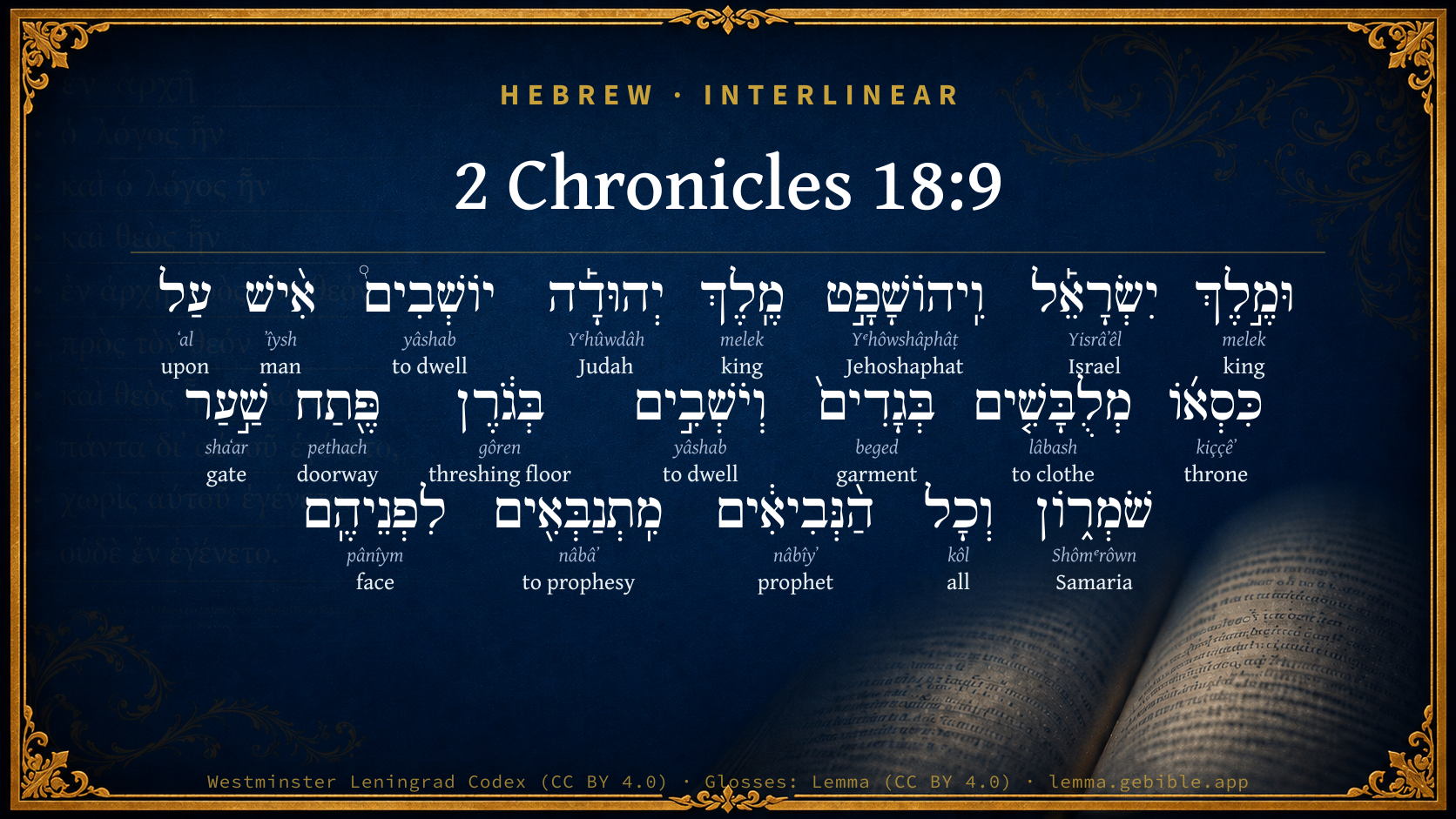
2 Chronicles 18:9

Hebrew (Westminster Leningrad Codex) 2 Chronicles 18:9 appears in the Hebrew Old Testament. The text above is from the Westminster Leningrad Codex. Each word links to its Strong’s number, a concise gloss, and parsing drawn from the Open Scriptures Hebrew Bible morphology. Click any word for its full Brown-Driver-Briggs (BDB) entry.
Download image
Cite this verse

2 Chronicles 18:9 (World English Bible). Public Domain. Lemma interlinear Bible study tool, https://lemma.gebible.app/v/2-chronicles/18/9.

Show BibTeX & RIS
BibTeX
RIS
English Translation
Now the king of Israel and Jehoshaphat the king of Judah sat each on his throne, arrayed in their robes, and they were sitting in an open place at the entrance of the gate of Samaria; and all the prophets were prophesying before them.
World English Bible · Public Domain
Download a study sheet

One document with this verse’s original text, its word-by-word gloss line, the meaning frame, cross-references with their text, attributed commentary, and full source and license credits — printable, and it pastes into notes with its structure intact.

This verse Autodidact and up

Study sheet (.html) Plain text (.txt)

A passage Seminary Student

Up to 50 verses in one chapter. A passage sheet keeps up to 6 commentary sources and 12 cross-references per verse, in the order this page ranks them, and says so on the sheet whenever that leaves anything out. Ask for a single verse and you get the Autodidact verse sheet above.

Everything on this page stays free to read, with no account — the sheet is a download of what is already on screen, not access to it.

Want to remove ads? Support Godless Engineer
Compare translations 3

The same verse in 3 English versions, stacked beneath the original-language interlinear above. Click any original word for its lexicon entry.

Each is an independent rendering of the whole verse — the interlinear is not word-aligned to these translations.

Highlighted words mark where these versions differ — a whole-verse word diff, not a word-by-word alignment.

  • World English Bible Public Domain
    Now the king of Israel and Jehoshaphat the king of Judah sat each on his throne, arrayed in their robes, and they were sitting in an open place at the entrance of the gate of Samaria; and all the prophets were prophesying before them.
  • King James Version Public Domain
    And the king of Israel and Jehoshaphat king of Judah sat either of them on his throne, clothed in their robes, and they sat in a void place at the entering in of the gate of Samaria; and all the prophets prophesied before them.
  • unfoldingWord Literal Text CC BY-SA 4.0
    And the king of Israel and Jehoshaphat the king of Judah were sitting, each on his throne, clothed with robes. And they were sitting at a threshing floor at the entrance of the gate of Samaria, and all the prophets were prophesying before them.

unfoldingWord Literal Text — © unfoldingWord, licensed CC BY-SA 4.0. Word-aligned USFM3 via Door43 (git.door43.org/unfoldingWord/en_ult).

Versions to compare (up to 4)

3 of 4 selected

Show all 18 translations

Every available English version of this verse, each an independent rendering of the whole verse.

  • World English Bible Public Domain
    Now the king of Israel and Jehoshaphat the king of Judah sat each on his throne, arrayed in their robes, and they were sitting in an open place at the entrance of the gate of Samaria; and all the prophets were prophesying before them.
  • Berean Standard Bible Public Domain
    Dressed in royal attire, the king of Israel and Jehoshaphat king of Judah were sitting on their thrones at the threshing floor by the entrance of the gate of Samaria, with all the prophets prophesying before them.
  • Majority Standard Bible Public Domain
    Dressed in royal attire, the king of Israel and Jehoshaphat king of Judah were sitting on their thrones at the threshing floor by the entrance of the gate of Samaria, with all the prophets prophesying before them.
  • King James Version Public Domain
    And the king of Israel and Jehoshaphat king of Judah sat either of them on his throne, clothed in their robes, and they sat in a void place at the entering in of the gate of Samaria; and all the prophets prophesied before them.
  • American Standard Version (1901) Public Domain
    Now the king of Israel and Jehoshaphat the king of Judah sat each on his throne, arrayed in their robes, and they were sitting in an open place at the entrance of the gate of Samaria; and all the prophets were prophesying before them.
  • Revised Version (1885) Public Domain
    Now the king of Israel and Jehoshaphat the king of Judah sat each on his throne, arrayed in their robes, and they sat in an open place at the entrance of the gate of Samaria; and all the prophets prophesied before them.
  • Geneva Bible (1599) Public Domain
    And the King of Israel, and Iehoshaphat King of Iudah sate either of them on his throne clothed in their apparel: they sate euen in the threshing floore at the entring in of the gate of Samaria: and all the Prophets prophesied before them.
  • Douay-Rheims (1899) Public Domain
    Now the king of Israel, and Josaphat king of Juda, both sat on their thrones, clothed in royal robes, and they sat in the open court by the gate of Samaria, and all the prophets prophesied before them.
  • Young's Literal Translation Public Domain
    And the king of Israel and Jehoshaphat king of Judah are sitting, each on his throne, clothed with garments, and they are sitting in a threshing-floor at the opening of the gate of Samaria, and all the prophets are prophesying before them.
  • Literal Standard Version CC BY-SA 4.0
    And the king of Israel and Jehoshaphat king of Judah are sitting, each on his throne, clothed with garments, and they are sitting in a threshing-floor at the opening of the Gate of Samaria, and all the prophets are prophesying before them.
  • Unlocked Literal Bible CC BY-SA 4.0
    Now Ahab the king of Israel and Jehoshaphat the king of Judah were sitting each on a throne, clothed in their robes, in an open place at the entrance of the gate of Samaria, and all the prophets were prophesying before them.
  • unfoldingWord Literal Text CC BY-SA 4.0
    And the king of Israel and Jehoshaphat the king of Judah were sitting, each on his throne, clothed with robes. And they were sitting at a threshing floor at the entrance of the gate of Samaria, and all the prophets were prophesying before them.
  • Darby Bible Public Domain
    And the king of Israel and Jehoshaphat the king of Judah, having put on their robes, sat each on his throne; and they sat in an open place at the entrance of the gate of Samaria; and all the prophets prophesied before them.
  • World Messianic Bible Public Domain
    Now the king of Israel and Jehoshaphat the king of Judah each sat on his throne, arrayed in their robes, and they were sitting in an open place at the entrance of the gate of Samaria; and all the prophets were prophesying before them.
  • Webster's Bible Public Domain
    And the king of Israel and Jehoshaphat king of Judah sat each of them on his throne, clothed in their robes, and they sat in a void place at the entrance of the gate of Samaria; and all the prophets prophesied before them.
  • Free Bible Version CC BY-SA 4.0
    Dressed in their royal robes, the king of Israel and King Jehoshaphat of Judah, were sitting on their thrones at the threshing floor beside the gate of Samaria, with all of the prophets prophesying in front of them.
  • Bible in Basic English Public Domain
    Now the king of Israel and Jehoshaphat, the king of Judah, were seated on their seats of authority, dressed in their robes, by the doorway into Samaria; and all the prophets were acting as prophets before them.
  • JPS Tanakh (1917) Public Domain
    Now the king of Israel and Jehoshaphat the king of Judah sat each on his throne, arrayed in their robes, and they sat in a threshing-floor at the entrance of the gate of Samaria; and all the prophets were prophesying before them.

Literal Standard Version (2020), Covenant Press — licensed CC BY-SA 4.0. Text via the HelloAO Bible API (eBible.org). Unlocked Literal Bible (unfoldingWord) — licensed CC BY-SA 4.0. Text via the HelloAO Bible API (eBible.org). unfoldingWord Literal Text — © unfoldingWord, licensed CC BY-SA 4.0. Word-aligned USFM3 via Door43 (git.door43.org/unfoldingWord/en_ult). Free Bible Version, Dr. Jonathan Gallagher — licensed CC BY-SA 4.0. Text via the HelloAO Bible API (eBible.org).

Word by word

More ways to search: Search by grammar → Find every occurrence → Compare this word →

Practice this passage: Drill this verse → Learn its vocabulary →

בְּגֹ֔רֶן
gôren
H1637
“in/at · threshing floor”
Preposition + Noun, Common, Both, Singular, Absolute
Part of Speech
Preposition + Noun
Type
Common
Gender
Both
Number
Singular
State
Absolute
Full BDB Definition

Origin: from an unused root meaning to smooth

TWOT: 383a

threshing-floor - (TWOT) barn, barn floor, corn floor, void place
  1. וּמֶ֣לֶךְ melek H4428 “and · king of” Conjunction + Noun, Common, Masculine, Singular, Construct
  2. יִשְׂרָאֵ֡ל Yisrâʼêl H3478 “Israel” Noun, Proper
  3. וִֽיהוֹשָׁפָ֣ט Yᵉhôwshâphâṭ H3092 “and · Jehoshaphat” Conjunction + Noun, Proper
  4. מֶֽלֶךְ melek H4428 “king of” Noun, Common, Masculine, Singular, Construct
  5. יְהוּדָ֡ה Yᵉhûwdâh H3063 “Judah” Noun, Proper
  6. יוֹשְׁבִים֩ yâshab H3427 “dwelling” Verb, Qal, Participle Active, Masculine, Plural, Absolute
  7. אִ֨ישׁ ʼîysh H376 “man” Noun, Common, Masculine, Singular, Absolute
  8. עַל ʻal H5921 “upon” Preposition
  9. כִּסְא֜וֹ kiççêʼ H3678 “throne · his” Noun, Common, Masculine, Singular, Construct + Suffix, Personal, 3rd Person, Masculine, Singular
  10. מְלֻבָּשִׁ֤ים lâbash H3847 “clothed” Verb, Pual, Participle Passive, Masculine, Plural, Absolute
  11. בְּגָדִים֙ beged H899 “garments” Noun, Common, Masculine, Plural, Absolute
  12. וְיֹשְׁבִ֣ים yâshab H3427 “and · dwelling” Conjunction + Verb, Qal, Participle Active, Masculine, Plural, Absolute
  13. פֶּ֖תַח pethach H6607 “doorway of” Noun, Common, Masculine, Singular, Construct
  14. שַׁ֣עַר shaʻar H8179 “gate of” Noun, Common, Masculine, Singular, Construct
  15. שֹׁמְר֑וֹן Shômᵉrôwn H8111 “Samaria” Noun, Proper
  16. וְכָל kôl H3605 “and · all of” Conjunction + Noun, Common, Masculine, Singular, Construct
  17. הַ֨נְּבִיאִ֔ים nâbîyʼ H5030 “the · prophets” Particle, Definite Article + Noun, Common, Masculine, Plural, Absolute
  18. מִֽתְנַבְּאִ֖ים nâbâʼ H5012 “prophesying” Verb, Hithpael, Participle Active, Masculine, Plural, Absolute
  19. לִפְנֵיהֶֽם pânîym H6440 “to/for · face(s) · their” Preposition + Noun, Common, Both, Plural, Construct + Suffix, Personal, 3rd Person, Masculine, Plural

About this verse

These counts appear in no published source. They are computed here, from the morphology-tagged text and Lemma’s own curated glosses. What Lemma adds →

20
words
18
distinct lemmas
Historical
section

Shared distinctive vocabulary

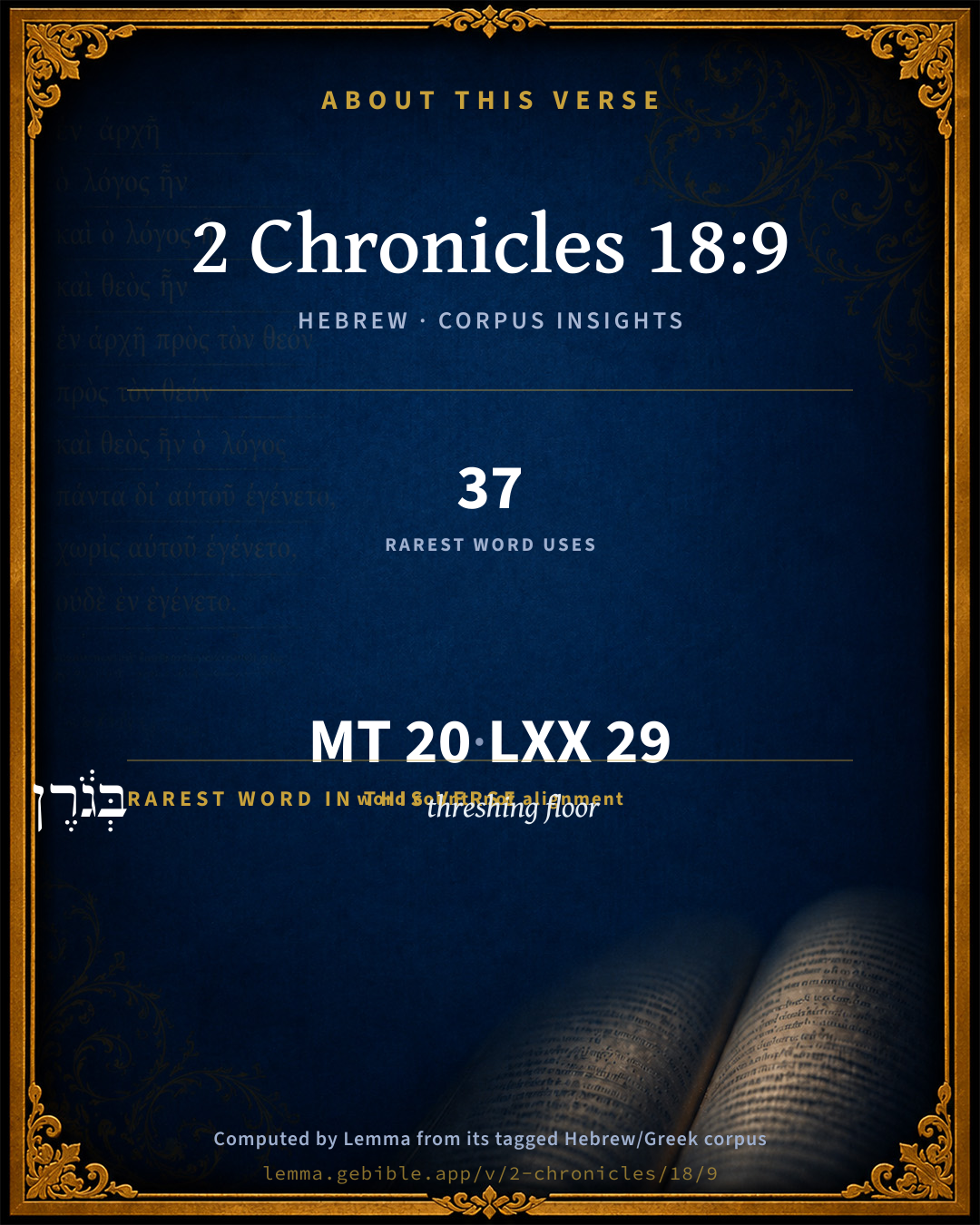
בְּגֹ֔רֶן threshing floor H1637 occurs in 37 verses of the Hebrew Bible. Also found in:

Grammatical profile

  • 4 verbs
  • 15 nouns
  • 1 preposition

Verb forms

  • יוֹשְׁבִים֩ Qal · Participle Active
  • מְלֻבָּשִׁ֤ים Pual · Participle Passive
  • וְיֹשְׁבִ֣ים Qal · Participle Active
  • מִֽתְנַבְּאִ֖ים Hithpael · Participle Active

Repetition

Words recur within this verse — often emphatic in Hebrew:

  • וּמֶ֣לֶךְ king H4428 ×2
  • יוֹשְׁבִים֩ to dwell H3427 ×2

Hebrew & Septuagint length

In English translation the verse runs 44 words from the Hebrew and 42 from the Septuagint (LXX English) — closely comparable.

A rough comparison of the two English renderings, which tokenize alike — not a word-level alignment.

Word counts can differ between the Hebrew and the Greek without any difference in meaning — e.g. the Hebrew direct-object marker אֵת has no separate Greek word, and Greek often adds the article ὁ.

In the original languages it is 20 Hebrew tokens and 29 Greek tokens — but the two are counted differently (Hebrew bundles its prefixes and suffixes into one token; the Greek is in lemma form), so that isn’t a like-for-like length.

Cross-references

10

Topical passages linked to 2 Chronicles 18:9 in the Treasury of Scripture Knowledge — connected by theme and wording, ordered by reader-vote popularity; previews shown in the World English Bible.

  • Ruth 4:1 Now Boaz went up to the gate, and sat him down there: and, behold, the near kinsman of whom Boaz spoke came by; to whom he said, Ho, such a one! turn aside, sit down here. He turned aside, and sat down.
  • 1 Kings 22:10–12 Now the king of Israel and Jehoshaphat the king of Judah were sitting each on his throne, arrayed in their robes, in an open place at the entrance of the gate of Samaria; and all the prophets were prophesying before them.
  • 2 Chronicles 18:29 The king of Israel said to Jehoshaphat, I will disguise myself, and go into the battle; but put you on your robes. So the king of Israel disguised himself; and they went into the battle.
  • Isaiah 14:9 Sheol from beneath is moved for you to meet you at your coming; it stirs up the dead for you, even all the chief ones of the earth; it has raised up from their thrones all the kings of the nations.
  • Jeremiah 27:14–16 Don't listen to the words of the prophets who speak to you, saying, You shall not serve the king of Babylon; for they prophesy a lie to you.
  • Ezekiel 26:16 Then all the princes of the sea shall come down from their thrones, and lay aside their robes, and strip off their embroidered garments: they shall clothe themselves with trembling; they shall sit on the ground, and shall tremble every moment, and be astonished at you.
  • Daniel 7:9 I saw until thrones were placed, and one who was ancient of days sat: his clothing was white as snow, and the hair of his head like pure wool; his throne was fiery flames, [and] the wheels of it burning fire.
  • Matthew 6:29 yet I tell you that even Solomon in all his glory was not dressed like one of these.
  • Matthew 11:8 But what did you go out to see? A man in soft clothing? Behold, those who wear soft clothing are in king's houses.
  • Matthew 19:28 Jesus said to them, "Most assuredly I tell you that you who have followed me, in the regeneration when the Son of Man will sit on the throne of his glory, you also will sit on twelve thrones, judging the twelve tribes of Israel.

Cross-references courtesy of OpenBible.info (CC BY 4.0).

Hebrew and Greek witnesses Masoretic Hebrew ↔ Greek Septuagint

The same verse in the two great witnesses to the Old Testament, shown verse-for-verse.

These are two independent witnesses, not word-aligned to each other, and the Septuagint is shown in lemma (dictionary) form.

Hebrew 2 Chronicles 18:9 Masoretic · Westminster Leningrad Codex

וּמֶ֣לֶךְ יִשְׂרָאֵ֡ל וִֽיהוֹשָׁפָ֣ט מֶֽלֶךְ יְהוּדָ֡ה יוֹשְׁבִים֩ אִ֨ישׁ עַל כִּסְא֜וֹ מְלֻבָּשִׁ֤ים בְּגָדִים֙ וְיֹשְׁבִ֣ים בְּגֹ֔רֶן פֶּ֖תַח שַׁ֣עַר שֹׁמְר֑וֹן וְכָל הַ֨נְּבִיאִ֔ים מִֽתְנַבְּאִ֖ים לִפְנֵיהֶֽם

Now the king of Israel and Jehoshaphat the king of Judah sat each on his throne, arrayed in their robes, and they were sitting in an open place at the entrance of the gate of Samaria; and all the prophets were prophesying before them.

World English Bible · Public Domain

Greek LXX 2 Chronicles 18:9 Septuagint · lemma form

καί βασιλεύς ἰσραήλ καί ιωσαφατ βασιλεύς ἰουδά καταἧμαι ἕκαστος ἐπί θρόνος αὐτός καί ἐνδύω στολή καταἧμαι ἐν ὁ εὐρύχωρος θύρα πύλη σαμαρεία καί πᾶς ὁ προφήτης προφητεύω ἐναντίον αὐτός

And the king of Israel and Josaphat king of Juda were sitting each on his throne, and clothed in their robes, sitting in the open space at the entrance of the gate of Samaria: and all the prophets were prophesying before them.

LXX2012 (modern English Septuagint) · Public Domain

On this verse, Trapp's Complete Commentary discusses the Septuagint’s reading. Read the note in Commentary ↓

Hebrew: Westminster Leningrad Codex (CC BY 4.0). Greek: Septuagint (public domain); English from LXX2012 (modern English Septuagint) (Public Domain). How the Septuagint differs from the Hebrew →

Commentary

Notes on 2 Chronicles 18:9 from classic Christian and Jewish commentators (each source and its license shown beneath its notes). The classic Christian expositions comment on the surrounding passage and are grouped to its opening verse, so a note may address several verses; the Jewish commentaries on the Tanakh (Rashi and others) are per-verse, so they appear only where the commentator wrote on this verse.

Lemma curates 59 commentaries, every one of them public domain or Creative Commons licensed, each selected and text-cleaned for this edition rather than reprinted as found. About our sources →

Trapp's Complete Commentary

John Trapp

2Ch 18:9 And the king of Israel and Jehoshaphat king of Judah sat either of them on his throne, clothed in [their] robes, and they sat in a void place at the entering in of the gate of Samaria; and all the prophets prophesied before them.

Ver. 9. Clothed in their robes.] And as the Septuagint have it, ενοπλοι, in their arms, that they might provoke the people to take up arms.

John Trapp, A Commentary or Exposition upon All the Books of the Old and New Testament (1647–1656) — public domain. Text from a community e-Sword module.

Geneva Bible (1599)

Geneva Bible translators

That is, in their majesty and royal apparel.

Geneva Bible (1599) marginal notes — public domain. Text via Bolls.life.

Adam Clarke's Commentary

Verse 9. The king of Israel and Jehoshaphat] "Ahab consulted false prophets; but Jehoshaphat sought instruction from the presence of the Lord, and prayed at the entering in of Samaria; and before these all the false prophets prophesied lies." - Targum.

Adam Clarke's Commentary on the Bible (1810–1826) — public domain. Text from a community e-Sword/MySword module.

Ellicott's Commentary for English Readers

(9) And the king of Israel . . . sat either of them on his throne.—Rather, Now the king of Israel . . . were sitting each on his throne.

Clothed in their robes.—The pronoun, which is indispensable if this be the meaning, is wanting in the Hebrew. The Syriac has probably preserved the original reading: “Clothed in raiment spotted white and black.” (Vid. infr.)

And they sat.—Were sitting. Explanatory addition by chronicler.

A void place.—A threshingfloor. LXX., ἐν τῷ εὐρυχώρῳ, “in the open ground;” Vulg., “in a threshing. floor.” The word is probably corrupt, and may have originated out of bĕruddîm, “spotted,” i.e., perhaps embroidered; an epithet of robes.

Prophesied.—Were prophesying. “Vaticina-bantur,” Vulg.

A Bible Commentary for English Readers, edited by Charles John Ellicott (1878–1897) — public domain. Text from a community e-Sword module.

The Cambridge Bible for Schools and Colleges

gen. ed. J. J. S. Perowne

9. either of them … clothed] R.V. each … arrayed.

in a void place at the entering in] Render, in a threshingfloor at the entrance. The threshingfloor was convenient as being a large flat open space; cp. Gen_50:10; 1Ch_13:9; 1Ch_21:18 ff.

The Cambridge Bible for Schools and Colleges (gen. ed. J. J. S. Perowne; Cambridge University Press, 1878–1918) — public domain. Text from a community e-Sword module.

The Pulpit Commentary

The contents of this and the following two verses narrate either what had already taken place, or the continuation of the scene that had not come to its end, but had been interrupted in order to carry out fully the urgent exhortation of Jehoshaphat "to-day," so that Ahab sent at once there and then a messenger for Micaiah. Any way, the unreal prophets have their full opportunity and their say at least twice over, as also Micaiah below (vers. 14, 16, 18-22, 27). A void place; i.e. a level floor; Revised Version, an open place. The Hebrew word designates often just a "threshing-floor," R,g; but quite possibly here, a recognized court at the gate of the city, used for judgment, is intended.

Vers. 9-27.

Micaiah, the son of Imla an Old Testament hero.

I THE COURAGE HE DISPLAYED. (Vers. 9-13.) He delivered Jehovah"s message under circumstances that might and probably would have intimidated him had he not been a hero.

1. Before two kings to whom that message was unacceptable. The scene was calculated to steal away Micaiah"s fortitude, could anything have done so. In an open space or threshing-floor, at the entering in of the gate of Samaria, Ahab and Jehoshaphat, arrayed in royal robes, sat each. upon.his throne. Immediately encircling them were the four hundred prophets; while each, king was attended by his army (Josephus "Ant" 8:15. 3.) Ordinarily, "there is such a divinty doth hedge a king," that Micaiah might have been excused had he trembled when ushered into the presence of two such royal personages, decked out with the trappings of lofty station, waited on by bowing courtiers, and escorted by battalions of warriors; much more when one of them was Ahab, whose displeaure he had already felt, and the might of whose arm he had lately experienced; most of all when he knew or suspected that his words could not be acceptable to the kingly auditors on whose ears they were about to fall. Yet Micaiah flinched not. Composed as if he stood before peasants, he told out the message Jehovah put into his lips. Compare the attitudes of Hanani before Asa, (2Ch_16:7) of Elijah before Ahab, (1Ki_18:18 1Ki_21:20) of Daniel before

2. Belshazzar, (Dan_5:13) of John the Baptist before Herod, (Mat_14:4) of Paul before Felix and Agrippa, (Act_24:25 Act_26:28) of Polycarp before Antoninus, of Luther before the Diet of Worms, of John Knox before the court of Mary.

3. In the presence of four hundred false prophets whom that message opposed. Had numbers been a test of truth, then was Micaiah wrens, since he stood alone against the united body of the Israelitish prophets. Their answer to Ahab"s question was unanimous. Without one dissenting voice they had assured him Jehovah would reward his efforts with victory. Ramoth-Gilead would be delivered into his hand, and the power of Syria crushed. Zedekiah, one of these prophets, playing the clown on the occasion, putting iron horns on his head and butting like an ox, added, "Thus saith the Lord, With these horns thou shalt push Syria until they be consumed; "while all his brother-prophets, applauding his performance, urged the king to "go up to Ramoth-Gilead, and prosper." Micaiah, however, knew that all that was false, and in spite of appearing singular, non-complaisant, obstinate, perverse, would not cry, "Amen!" would not shape his words either to please the king or accord with the fashion of the hour. It mattered nothing to Micaiah that he stood alone his feet were planted on the rock of truth; or that men might regard him as "odd," "punctilious," "over-scrupulous," provided he was right. Compare Elijah on Mount Carmel before the four hundred and fifty prophets of Baal, with the four hundred prophets of the grove. (1Ki_18:19)

4. Though he knew that message would not improve his own prospects. On the way from prison to the king"s presence he had obtained a hint from his conductor what kind of "oracle" would best suit would most gratify the king and recompense himself. All the state-prophets had observed in what quarter the wind sat, and had prophesied accordingly. They discerned what their royal master wanted, and why should they who ate his bread decline to gratify his whims? With one consent had they declared "good" to Ahab. If he, Micaiah, consulted for "good" to himself he would act upon that hint; taking his cue from the "prophets," he would let his word be as theirs. But Micaiah was too honest to play the knave. Micaiah understood not the art of studying self. Micaiah knew his duty was to speak the word given him by God, without regarding consequences to any, least of all to himself. And he did it!

II THE ORACLE HE DELIVERED. (Vers. 14-22.)

1. A seeming permission. Micaiah answered Ahab in the words of the false prophets (ver. 14), in, irony (Keil, Bertheau), or in reproof of Ahab"s hypocrisy (Bahr). Either Micaiah meant the opposite of what he said that the advice Ahab had received was worthless; or he intended to be understood as declining to give other oracle than that already spoken by the prophets, which was the one Ahab wanted. But in any case Ahab suspected Micaiah"s sincerity.

2. symbolic warning. Adjured to speak the truth, he related to the king a vision he had seen Israel scattered upon the mountains as sheep without a shepherd;" and a voice he had heard have no master; let them return every man to his house in peace." Whether the words of (Num_27:17) were in Micaiah"s mind when he described his vision or not, the import of the vision and the voice was as patent to Ahab as to him. Ahab was to fall at Ramoth-Gilead; Israel to become like a flock without a shepherd; the campaign to end in failure and shame.

3. A serious explanation. Accused by Ahab of speaking from a spirit of malignant hatred towards him, Micaiah depicted another vision, which let the king see the real deceivers were his own prophets, not he, Micaiah. The vision, most likely received some time before and not then only for the first time, consisted of a dramatic representation of the Divine government, in which were set forth the following truths:

(1) That God works by means of secondary agents. The prophet saw Jehovah, as Isaiah (Isa_6:1) afterwards beheld him, seated upon his throne, with all the host of heaven, standing on his right hand and on his left. The host of heaven was the innumerable company of angels of which David sang, (Psa_68:17) two battalions of which met Jacob at Mahanaim, (Gen_32:2) and many regiments of which protected Elisha and his servant at Dothan. (2Ki_6:17) Their designation "host" indicated their number and order; their position, "on his right hand and on his left," marked their submission and readiness to execute Jehovah"s will. (Psa_103:20, Psa_103:21)

(2) That agencies of evil equally with those of good are under the Divine control. Though God is not and cannot be the author of sin, he may yet, through the wicked actions of his creatures, accomplish his designs. His purpose was that Ahab should fall at Ramoth-Gilead; he effected that purpose by suffering Ahab to be misled by his false prophets, and these to be deceived by a lying spirit. Neither could the prophets have spoken to Ahab, nor the lying spirit whispered to the prophets, without the Divine permission. This truth Micaiah dramatically portrayed by representing Jehovah as taking counsel with his angels, and asking, "Who shall entice Ahab King of Israel, that he may go up and fall at Ramoth-Gilead?

(3) That God does not always hinder from being deceived those who wish to be deceived. Ahab and his prophets desired to believe Jehovah in favour of the campaign, and Jehovah allowed them to be persuaded by the lying spirit that he was. Having wilfully turned their backs upon Jehovah and become worshippers of idols, Jehovah now left them to reap the fruit of their folly gave them up to strong delusion to believe a lie ( (Isaiah. (2Th_2:11) "Not by any sudden stroke of vengeance, but by the very network of evil counsel which he has woven for himself, is the King of Israel to be led to his ruin" (Stanley, "Jewish Church," p. 316).

(4) That God, in permitting the wicked to be the victims of their own evil machinations, only exercises upon them righteous retribution. "It is just that one sin should be punished by another" (Bishop Hall). This principle universally operative in Providence.

4. A solemn denunciation. Without further parley, or veiling of his thoughts in metaphorical speech, he declares that the king had been imposed upon by his prophets, and that Jehovah had spoken evil against him. There are times when God"s messengers must deliver God"s messages to their hearers with utmost plainness and directness of speech.

III THE RECOMPENSE HE RECEIVED. (Vers. 23-27.)

1. Insult from the prophets, through their leader Zedekiah, the son of Chenaanah.

(1) What it was. A blow from the fist, and a stroke from the tongue the first hard to bear, the second harder; the first a common resort of cowards, the second of persons overcome in argument. For Zedekiah to smite Micaiah on the cheek, as afterwards the soldiers smote Jesus in Pilate"s praetorium, (Mat_26:27) and later the bystanders Paul in the council chamber at Ananias"s command, (Act_23:2) was "intolerably insolent much more to do so in the presence of two kings." "The act was unbeseeming the person, more the presence; prophets may reprove, they may not smite" (Hall). It was, besides, painfully like a confession that Zedekiah was conscious of having been found out.

(2) Why it was. To gratify his thirst for revenge. It was easier to do so in this way than by attempting to disprove the truth of Micaiah"s oracle. Any fool can exercise his fist; it takes a wise man to use his tongue with effect. Zedekiah probably imagined he did so when he mockingly inquired, "Which way went the Spirit of the Lord from me to speak unto thee?" That in so saying he claimed to be as much under the Spirit of Jehovah as Micaiah, may be true; that Micaiah understood him to be talking lightly seems apparent from the reply returned him: "Thou shalt see on that day when thou shalt go into an inner chamber to hide thyself." The event would decide which of the two predictions was correct. When the people rose up against the prophets who had raise led their king, Zedekiah, as he fled for safety to some inner chamber, or from chamber to chamber, would understand how to answer his own jest.

2. Punishment from the king. Micaiah was remanded back to his confinement in the city jail. Amen the governor of the city, and Joash the king"s son not necessarily a son of Ahab, but a prince of the blood as commandants of the prison, were instructed to thrust him back into his old cell, and "feed him with bread of affliction and water of affliction;" in modern phrase, to subject him to imprisonment with hard labour, until Ahab should return in peace (ver. 26). It was severe upon Micaiah, yet he retracted not. Without a murmur at his hard fate, he cheerfully returned to his cell, only calling the people to observe that if Ahab returned home from the war in peace, he was not a true prophet (ver. 27).

Learn:

1. The nobility of true courage.

2. The certainty that good men will suffer for their goodness.

3. The reality of an overruling Providence.

4. The infallibility of God"s Word. W.

The Pulpit Commentary (1880–1919), ed. H.D.M. Spence-Jones & Joseph S. Exell — public domain. Text from a community e-Sword module.

unfoldingWord translationNotes

Door43 World Missions Community

Kenaanah

This is the name of a man. (See: How to Translate Names)

horns of iron

This is a reference to the horns of a bull but they made of metal.

you will push the Arameans until they are consumed

The prophet's actions are a symbolic metaphor that illustrates the way that Ahab would defeat the Arameans. Ahab's army will win with great strength, as a bull attacks another animal. AT: "With horns like these, your army will keep attacking the army of Aram like a bull attacks another animal, until you completely destroy them" (See: Symbolic Action and Metaphor)

until they are consumed

This can be stated in active form. AT: "until you consume them" (See:Active or Passive)

has given it into the hand of the king

Here the king's "hand" refers to his control. This means that God will enable them to defeat the people at Ramoth Gilead. AT: "has allowed the king to capture it" or "will allow your armies to capture it" (See: Metonymy and Assumed Knowledge and Implicit Information)

translationWords

Ahab

Israel

Judah

throne

clothe

gate

Zedekiah

Aram

unfoldingWord translationNotes — © Distant Shores Media and the Door43 World Missions Community, licensed CC BY-SA 4.0. Source: git.door43.org/Door43/en_tn.

Rashi

Rabbi Shlomo Yitzchaki (Rashi)

dressed in [their] attire the royal raiment and seated in a threshing floor He is telling us that when the prophets prophesied before them, they were sitting outside the city, and spies of the king of Aram came there and heard that he [the prophet] informed the king of Israel that he alone would fall in battle. That is the reason that the king of Aram commanded his forces (v. 30): “Attack neither small nor great; only the king of Israel,” to fulfill the words of Micaiah. That is why it is written, “in a threshing floor,” for it was a place where spies could spy. If the meeting had been inside the city, the spies of the king of Aram would not have been able to infiltrate, for they would have detected that they were spies; but when they were outside the city, even if they [the Israelites] became aware of them, they could say, “We are going elsewhere, and the reason we drew near to the threshing floor is because of the great tumult and gathering of the armies here at the gate of the city; we were amazed, and turned off the road to see what was going on.” Consequently, the spies informed the king of Aram [what they had heard], who commanded to slay no one but the king of Israel. Otherwise, why did it enter his mind to command not to slay anyone of Israel, but the king? But he had spies who had heard Micaiah saying, (verses 16f.): “I saw all the Israelites scattered, etc. And the Lord said: These have no master.” This was a sign that the king would be slain, and that the Israelites would return each one to his house in peace. And they heard that he said, (v. 27): “If you return in peace...” The spies heard all and informed the king of Aram. The king of Aram then commanded to act in accordance with the word of Micaiah, and to slay only the king.

Rashi on the Tanakh — English translations: “The Judaica Press complete Tanach with Rashi, translated by A. J. Rosenberg” (CC BY 4.0); “Pentateuch with Rashi's commentary by M. Rosenbaum and A.M. Silbermann, 1929-1934” (public domain); “The Metsudah Tanach series, Lakewood, N.J” (CC BY 4.0); and “The Book of Joshua, Metsudah Publications, 1997” (CC BY 4.0). Text via Sefaria.

Lesson kit

Teaching starters — assembled from the data on this page, not authored interpretation. Every prompt links to the verse data it draws on. Edit before teaching.

2 Chronicles, in the Historical, opens this verse with 20 words (18 distinct Hebrew lemmas). Its most distinctive word is gôren (“threshing floor”). A historical commentator’s framing appears above. Read the whole chapter for the surrounding context.

Discussion questions

  1. How does “threshing floor” (gôren) shape what this verse is saying?
  2. Genesis 50:10 shares the word «threshing floor» with this verse. How do the two illuminate each other?
  3. “king” occurs 2× in this one verse. What is the effect of the repetition?
  4. The translations on this page render this verse differently — a whole-verse word diff, not a word-by-word alignment. What might account for the different wordings?
  5. The verb «יוֹשְׁבִים֩» is Qal Participle Active. How does its form color the action?
  6. Reading how Trapp's Complete Commentary and Geneva Bible (1599) read this verse, where do the two commentators agree and where do they part?

Things to notice

Reading settings

Reading text

Shown beneath each verse's original-language words.

Old Testament
Old Testament edition

Read the OT as the Masoretic Hebrew (MT) or the Greek Septuagint (LXX).

English shown for the Greek Septuagint (in the Hebrew ↔ Greek comparison).

Comparing translations? Open the Compare panel on any verse page to stack up to four side by side.