
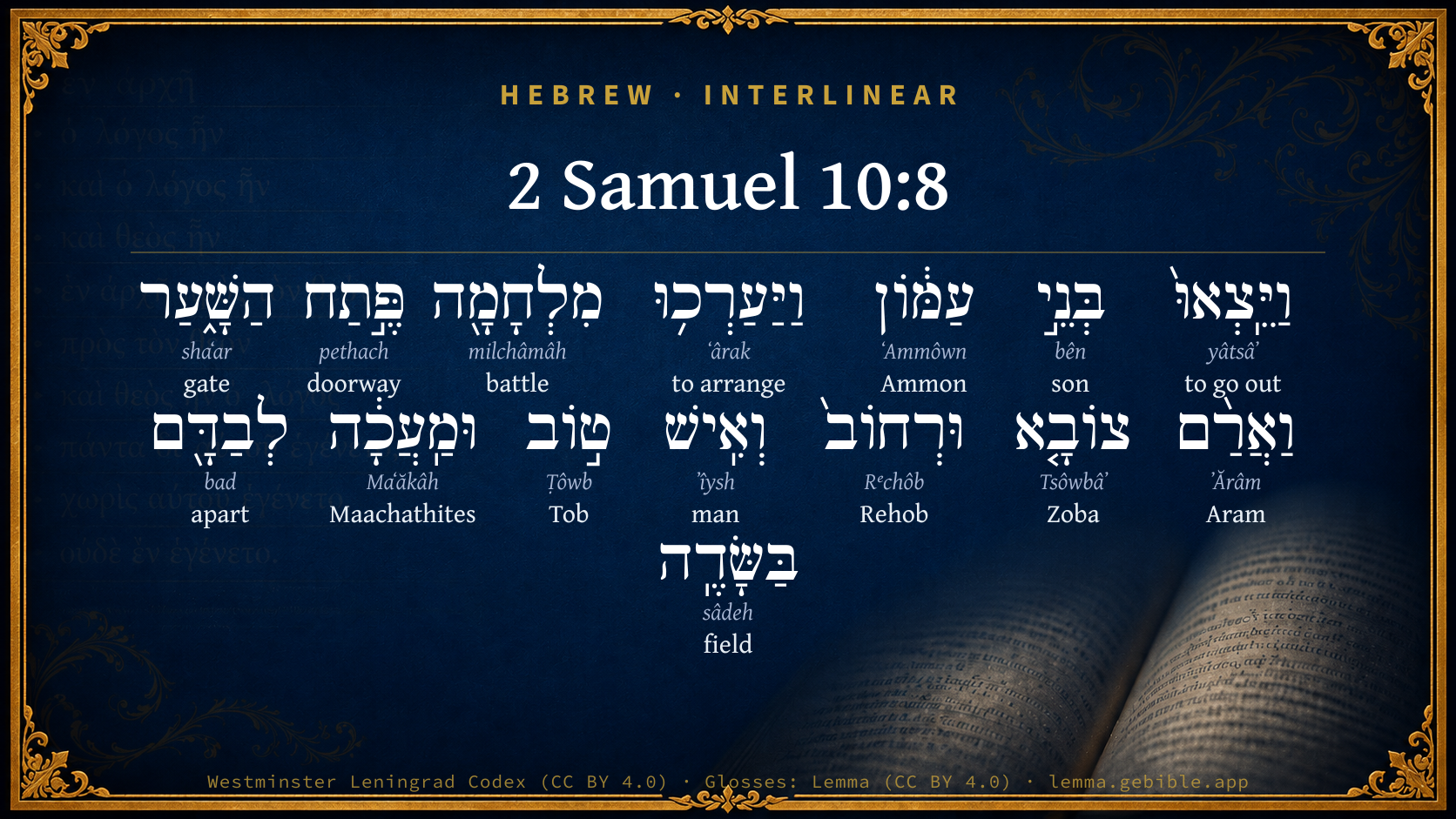
2 Samuel 10:8

Hebrew (Westminster Leningrad Codex) 2 Samuel 10:8 appears in the Hebrew Old Testament. The text above is from the Westminster Leningrad Codex. Each word links to its Strong’s number, a concise gloss, and parsing drawn from the Open Scriptures Hebrew Bible morphology. Click any word for its full Brown-Driver-Briggs (BDB) entry.
Download image
Cite this verse

2 Samuel 10:8 (World English Bible). Public Domain. Lemma interlinear Bible study tool, https://lemma.gebible.app/v/2-samuel/10/8.

Show BibTeX & RIS
BibTeX
RIS
English Translation
The children of Ammon came out, and put the battle in array at the entrance of the gate: and the Syrians of Zobah and of Rehob, and the men of Tob and Maacah, were by themselves in the field.
World English Bible · Public Domain
Download a study sheet

One document with this verse’s original text, its word-by-word gloss line, the meaning frame, cross-references with their text, attributed commentary, and full source and license credits — printable, and it pastes into notes with its structure intact.

This verse Autodidact and up

Study sheet (.html) Plain text (.txt)

A passage Seminary Student

Up to 50 verses in one chapter. A passage sheet keeps up to 6 commentary sources and 12 cross-references per verse, in the order this page ranks them, and says so on the sheet whenever that leaves anything out. Ask for a single verse and you get the Autodidact verse sheet above.

Everything on this page stays free to read, with no account — the sheet is a download of what is already on screen, not access to it.

Want to remove ads? Support Godless Engineer
Compare translations 3

The same verse in 3 English versions, stacked beneath the original-language interlinear above. Click any original word for its lexicon entry.

Each is an independent rendering of the whole verse — the interlinear is not word-aligned to these translations.

Highlighted words mark where these versions differ — a whole-verse word diff, not a word-by-word alignment.

  • World English Bible Public Domain
    The children of Ammon came out, and put the battle in array at the entrance of the gate: and the Syrians of Zobah and of Rehob, and the men of Tob and Maacah, were by themselves in the field.
  • King James Version Public Domain
    And the children of Ammon came out, and put the battle in array at the entering in of the gate: and the Syrians of Zoba, and of Rehob, and Ishtob, and Maacah, were by themselves in the field.
  • unfoldingWord Literal Text CC BY-SA 4.0
    And the sons of Ammon came out and arrayed battle the entrance of the gate. And Aram of Zobah and Rehob and a man of Tob and Maacah by themselves in the field.

unfoldingWord Literal Text — © unfoldingWord, licensed CC BY-SA 4.0. Word-aligned USFM3 via Door43 (git.door43.org/unfoldingWord/en_ult).

Versions to compare (up to 4)

3 of 4 selected

Show all 18 translations

Every available English version of this verse, each an independent rendering of the whole verse.

  • World English Bible Public Domain
    The children of Ammon came out, and put the battle in array at the entrance of the gate: and the Syrians of Zobah and of Rehob, and the men of Tob and Maacah, were by themselves in the field.
  • Berean Standard Bible Public Domain
    The Ammonites marched out and arrayed themselves for battle at the entrance of the city gate, while the Arameans of Zobah and Rehob and the men of Tob and Maacah were by themselves in the open country.
  • Majority Standard Bible Public Domain
    The Ammonites marched out and arrayed themselves for battle at the entrance of the city gate, while the Arameans of Zobah and Rehob and the men of Tob and Maacah were by themselves in the open country.
  • King James Version Public Domain
    And the children of Ammon came out, and put the battle in array at the entering in of the gate: and the Syrians of Zoba, and of Rehob, and Ishtob, and Maacah, were by themselves in the field.
  • American Standard Version (1901) Public Domain
    And the children of Ammon came out, and put the battle in array at the entrance of the gate: and the Syrians of Zobah and of Rehob, and the men of Tob and Maacah, were by themselves in the field.
  • Revised Version (1885) Public Domain
    And the children of Ammon came out, and put the battle in array at the entering in of the gate: and the Syrians of Zobah, and of Rehob, and the men of Tob and Maacah, were by themselves in the field.
  • Geneva Bible (1599) Public Domain
    And the children of Ammon came out, and put their armie in araye at the entring in of the gate: and the Aramites of Zoba, and of Rehob, and of Ish-tob, and of Maacah were by themselues in the fielde.
  • Douay-Rheims (1899) Public Domain
    And the children of Ammon came out, and set their men in array at the entering in of the gate: but the Syrians of Soba, and of Rohob, and of Istob, and of Maacha were by themselves in the field.
  • Young's Literal Translation Public Domain
    And the Bene-Ammon come out, and set battle in array, at the opening of the gate, and Aram of Zoba, and Rehob, and Ish-Tob, and Maacah, `are' by themselves in the field;
  • Literal Standard Version CC BY-SA 4.0
    And the sons of Ammon come out, and set in array [for] battle, at the opening of the gate, and Aram of Zoba, and Rehob, and Ish-Tob, and Maacah, [are] by themselves in the field;
  • Unlocked Literal Bible CC BY-SA 4.0
    The Ammonites came out and formed a line of battle at the entrance to their city gate, while the Arameans of Zobah and of Rehob, and the men of Tob and Maacah, stood by themselves in the open fields.
  • unfoldingWord Literal Text CC BY-SA 4.0
    And the sons of Ammon came out and arrayed battle the entrance of the gate. And Aram of Zobah and Rehob and a man of Tob and Maacah by themselves in the field.
  • Darby Bible Public Domain
    And the children of Ammon came out, and put the battle in array at the entrance of the gate; and the Syrians of Zoba and of Rehob, and the men of Tob and Maacah were by themselves in the field.
  • World Messianic Bible Public Domain
    The children of Ammon came out, and put the battle in array at the entrance of the gate. The Syrians of Zobah and of Rehob and the men of Tob and Maacah were by themselves in the field.
  • Webster's Bible Public Domain
    And the children of Ammon came out, and put the battle in array at the entrance of the gate: and the Syrians of Zoba, and of Rehob, and Ish-tob, and Maacah, were by themselves in the field.
  • Free Bible Version CC BY-SA 4.0
    The Ammonites set up their battle lines near the entrance to their town gate, while the Arameans of Zobah and Rehob and the men of Tob and Maacah took up positions by themselves in the open fields.
  • Bible in Basic English Public Domain
    And the children of Ammon came out and put their forces in position at the way into the town: and the Aramaeans of Zobah and of Rehob, with the men of Tob and Maacah, were by themselves in the field.
  • JPS Tanakh (1917) Public Domain
    And the children of Ammon came out, and put the battle in array at the entrance of the gate; and the Arameans of Zobah, and of Rehob, and the men of Tob and Maacah, were by themselves in the field.

Literal Standard Version (2020), Covenant Press — licensed CC BY-SA 4.0. Text via the HelloAO Bible API (eBible.org). Unlocked Literal Bible (unfoldingWord) — licensed CC BY-SA 4.0. Text via the HelloAO Bible API (eBible.org). unfoldingWord Literal Text — © unfoldingWord, licensed CC BY-SA 4.0. Word-aligned USFM3 via Door43 (git.door43.org/unfoldingWord/en_ult). Free Bible Version, Dr. Jonathan Gallagher — licensed CC BY-SA 4.0. Text via the HelloAO Bible API (eBible.org).

Word by word

More ways to search: Search by grammar → Find every occurrence → Compare this word →

Practice this passage: Drill this verse → Learn its vocabulary →

ט֣וֹב
Ṭôwb
H2897
“Tob”
Noun, Proper
Part of Speech
Noun
Type
Proper
Full BDB Definition

Origin: the same as H2896

TWOT: None

Tob = "good" - a region east of the Jordan, north or northeast of Gilead, probably Aramean, location uncertain
  1. וַיֵּֽצְאוּ֙ yâtsâʼ H3318 “and · to go out” Conjunction + Verb, Qal, Sequential Imperfect, 3rd Person, Masculine, Plural
  2. בְּנֵ֣י bên H1121 “sons of” Noun, Common, Masculine, Plural, Construct
  3. עַמּ֔וֹן ʻAmmôwn H5983 “Ammon” Noun, Proper
  4. וַיַּעַרְכ֥וּ ʻârak H6186 “and · to arrange” Conjunction + Verb, Qal, Sequential Imperfect, 3rd Person, Masculine, Plural
  5. מִלְחָמָ֖ה milchâmâh H4421 “battle” Noun, Common, Feminine, Singular, Absolute
  6. פֶּ֣תַח pethach H6607 “doorway of” Noun, Common, Masculine, Singular, Construct
  7. הַשָּׁ֑עַר shaʻar H8179 “the · gate” Particle, Definite Article + Noun, Common, Masculine, Singular, Absolute
  8. וַאֲרַ֨ם ʼĂrâm H758 “and · Aram” Conjunction + Noun, Proper
  9. צוֹבָ֤א Tsôwbâʼ H6678 “Zoba” Noun, Proper
  10. וּרְחוֹב֙ Rᵉchôb H7340 “and · Rehob” Conjunction + Noun, Proper
  11. וְאִֽישׁ ʼîysh H376 “and · man of” Conjunction + Noun, Common, Masculine, Singular, Construct
  12. וּמַֽעֲכָ֔ה Maʻăkâh H4601 “and · Maachathites” Conjunction + Noun, Proper
  13. לְבַדָּ֖ם bad H905 “to/for · apart · their” Preposition + Noun, Common, Masculine, Singular, Construct + Suffix, Personal, 3rd Person, Masculine, Plural
  14. בַּשָּׂדֶֽה sâdeh H7704 “in/at the · field” Preposition, Determined + Noun, Common, Masculine, Singular, Absolute

About this verse

These counts appear in no published source. They are computed here, from the morphology-tagged text and Lemma’s own curated glosses. What Lemma adds →

15
words
15
distinct lemmas
Historical
section

Notable vocabulary

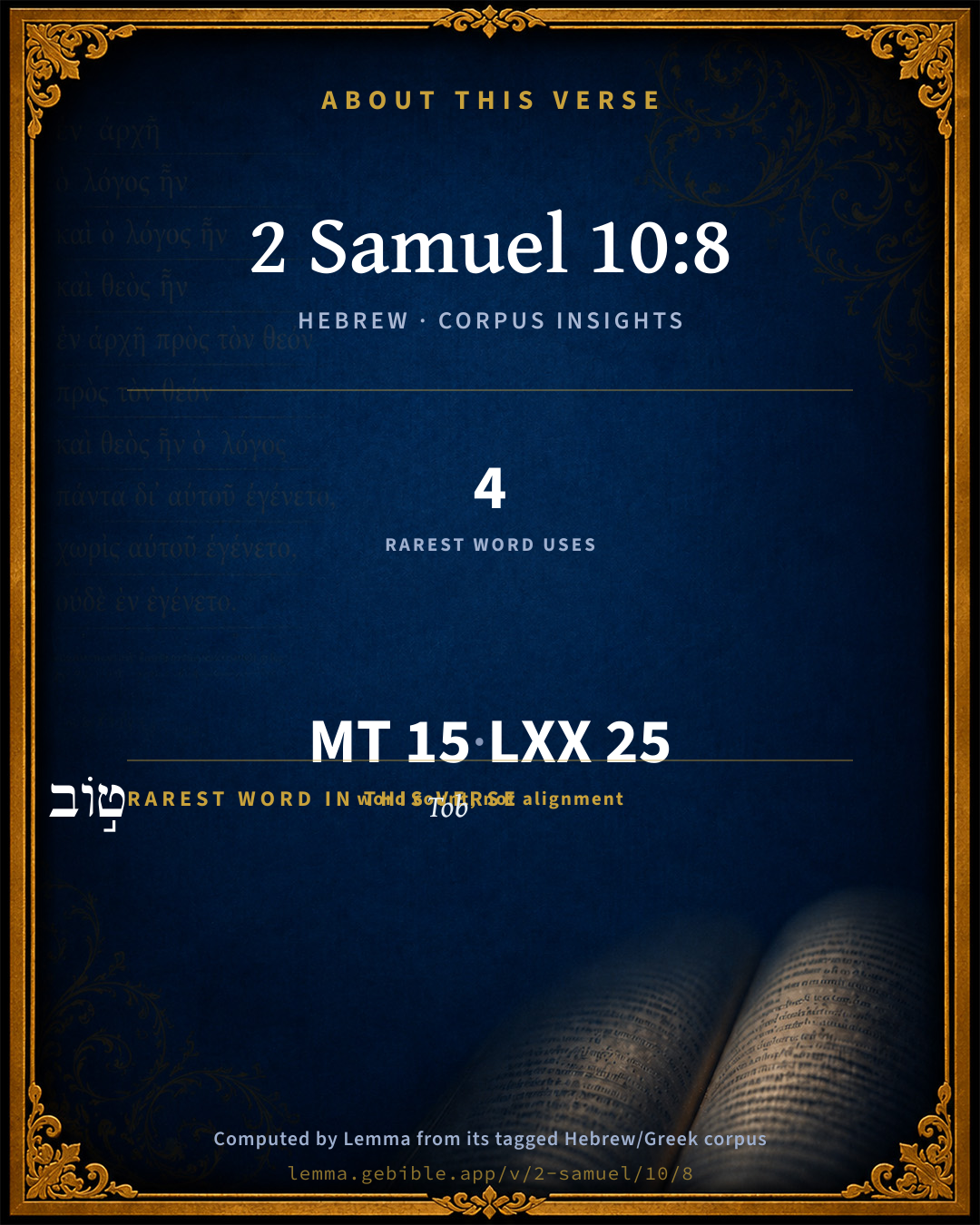
The rarest word here is ט֣וֹב Tob H2897 — appearing just 4 times in the whole Hebrew Bible.

Shared distinctive vocabulary

ט֣וֹב Tob H2897 occurs in 4 verses of the Hebrew Bible. Also found in:

Grammatical profile

  • 2 verbs
  • 13 nouns

Verb forms

  • וַיֵּֽצְאוּ֙ Qal · Sequential Imperfect
  • וַיַּעַרְכ֥וּ Qal · Sequential Imperfect

Hebrew & Septuagint length

In English translation the verse runs 39 words from the Hebrew and 35 from the Septuagint (LXX English) — closely comparable.

A rough comparison of the two English renderings, which tokenize alike — not a word-level alignment.

Word counts can differ between the Hebrew and the Greek without any difference in meaning — e.g. the Hebrew direct-object marker אֵת has no separate Greek word, and Greek often adds the article ὁ.

In the original languages it is 15 Hebrew tokens and 25 Greek tokens — but the two are counted differently (Hebrew bundles its prefixes and suffixes into one token; the Greek is in lemma form), so that isn’t a like-for-like length.

Cross-references

5

Topical passages linked to 2 Samuel 10:8 in the Treasury of Scripture Knowledge — connected by theme and wording, ordered by reader-vote popularity; previews shown in the World English Bible.

  • 2 Samuel 10:6 When the children of Ammon saw that they were become odious to David, the children of Ammon sent and hired the Syrians of Beth Rehob, and the Syrians of Zobah, twenty thousand footmen, and the king of Maacah with one thousand men, and the men of Tob twelve thousand men.
  • Numbers 13:21 So they went up, and spied out the land from the wilderness of Zin to Rehob, to the entrance of Hamath.
  • Joshua 19:28 and Ebron, and Rehob, and Hammon, and Kanah, even to great Sidon;
  • Judges 1:31 Asher didn't drive out the inhabitants of Acco, nor the inhabitants of Sidon, nor of Ahlab, nor of Achzib, nor of Helbah, nor of Aphik, nor of Rehob;
  • 1 Chronicles 19:7 So they hired them thirty-two thousand chariots, and the king of Maacah and his people, who came and encamped before Medeba. The children of Ammon gathered themselves together from their cities, and came to battle.

Cross-references courtesy of OpenBible.info (CC BY 4.0).

Hebrew and Greek witnesses Masoretic Hebrew ↔ Greek Septuagint

The same verse in the two great witnesses to the Old Testament, shown verse-for-verse.

These are two independent witnesses, not word-aligned to each other, and the Septuagint is shown in lemma (dictionary) form.

Hebrew 2 Samuel 10:8 Masoretic · Westminster Leningrad Codex

וַיֵּֽצְאוּ֙ בְּנֵ֣י עַמּ֔וֹן וַיַּעַרְכ֥וּ מִלְחָמָ֖ה פֶּ֣תַח הַשָּׁ֑עַר וַאֲרַ֨ם צוֹבָ֤א וּרְחוֹב֙ וְאִֽישׁ ט֣וֹב וּמַֽעֲכָ֔ה לְבַדָּ֖ם בַּשָּׂדֶֽה

The children of Ammon came out, and put the battle in array at the entrance of the gate: and the Syrians of Zobah and of Rehob, and the men of Tob and Maacah, were by themselves in the field.

World English Bible · Public Domain

Greek LXX 2 Samuel 10:8 Septuagint · lemma form

καί ἐκἔρχομαι ὁ υἱός αμμων καί παρατάσσω πόλεμος παρά ὁ θύρα ὁ πύλη καί συρία σουβα καί ροωβ καί ιστωβ καί μααχα μόνος ἐν ἀγρός

And the children of Ammon went forth, and set the battle in array by the door of the gate: those of Syria, Suba, and Roob, and Istob, and Amalec, being by themselves in the field.

LXX2012 (modern English Septuagint) · Public Domain

Hebrew: Westminster Leningrad Codex (CC BY 4.0). Greek: Septuagint (public domain); English from LXX2012 (modern English Septuagint) (Public Domain). How the Septuagint differs from the Hebrew →

Targum (Aramaic paraphrase)

1

The Targum is the ancient Jewish Aramaic paraphrase of the Hebrew Scriptures — an interpretive translation, not the Hebrew text itself. Onkelos (literal) and Pseudo-Jonathan (expansive) render the Torah, and Jonathan the Prophets. Coverage is partial: where no permissively-licensed English translation exists for a verse, only the Aramaic is shown. This is verse-level text, not a word-by-word alignment to the Hebrew.

  1. Targum Jonathan Prophets (Joshua–Malachi)
    וּנְפַקוּ בְּנֵי עַמוֹן וּסְדָרוּ קְרָבָא בְּמַעֲלָנָא דְתַרְעָא וַאֲרַם צוֹבָא וּרְחוֹב וְאִישׁ טוֹב וּמַעֲכָה בִּלְחוֹדֵיהוֹן בְּחַקְלָא:

    (no public-domain English translation for this verse)

    Targum Jonathan — Aramaic: “Mikraot Gedolot” (public domain). English: “Sefaria Community Translation” (CC0 1.0 (public-domain dedication)); “London "Chaldee Paraphrase," 1871” (public domain). Text via Sefaria.

Commentary

Notes on 2 Samuel 10:8 from classic Christian and Jewish commentators (each source and its license shown beneath its notes). The classic Christian expositions comment on the surrounding passage and are grouped to its opening verse, so a note may address several verses; the Jewish commentaries on the Tanakh (Rashi and others) are per-verse, so they appear only where the commentator wrote on this verse.

Lemma curates 59 commentaries, every one of them public domain or Creative Commons licensed, each selected and text-cleaned for this edition rather than reprinted as found. About our sources →

Trapp's Complete Commentary

John Trapp

2Sa 10:8 And the children of Ammon came out, and put the battle in array at the entering in of the gate: and the Syrians of Zoba, and of Rehob, and Ishtob, and Maacah, [were] by themselves in the field.

Ver. 8. At the entering in of the gate,] viz., Of Medeba; {1Ch 19:7; 1Ch 19:9} for that bush they thought good to keep on their backs, however the day should happen; and that stake to have still in store, however the dice chanced to turn. But how wretchedly reckless was Pompey, who never considered into what place he should retire if beaten by Julius Caesar, as he was at the Pharsalian field.

Were by themselves in the field.] As not fit to be trusted near the town, being such a multitude of mercenaries, and, in reference to David, who had lately subdued them, a rabble of rebels.

John Trapp, A Commentary or Exposition upon All the Books of the Old and New Testament (1647–1656) — public domain. Text from a community e-Sword module.

MacLaren's Expositions of Holy Scripture

Alexander MacLaren

2 Samuel

‘MORE THAN CONQUERORS THROUGH HIM’

2Sa 10:8 - 2Sa 10:19.

David’s growing power would naturally be regarded by neighbouring states as a menace. Success provokes envy, and in this selfish world strength usually encroaches on weakness, and weakness dreads strength. So it was quite according to the way of the world that David’s friendly embassy to the king of Ammon should be suspected of covering hostile intentions. Those who have no kindness in their own hearts are slow to believe in kindness in others. ‘What does he want to get by it?’ is the question put by cynical ‘shrewd men,’ when they see a good man doing a gracious, self-forgetting act.

But the Ammonite courtiers need not have rejected David’s overtures so insolently as by shaving half his ambassadors’ beards and docking their robes. The insult meant war to the knife. Probably it was deliberately intended as a declaration of hostilities, as it was immediately followed by the preparation of a formidable coalition against Israel. Possibly, indeed, the coalition preceded and occasioned the rejection of David’s conciliatory message. But, in any case, the Ammonite king summoned his Syrian allies from a number of small states of which we barely know the names, the chief of which was Zobah.

That state had apparently started into prominence under its king Hadar-ezer, as he is called in this chapter, which is obviously a clerical error for Hadad-ezer, as in 2Sa 8:3, etc. The name Hadad occurs again in Ben-hadad, and belonged to a Syrian god; so that the king of Zobah’s name, meaning ‘Hadad [is] help,’ may be taken as the banner flaunted in the face of the army of Israel, and as making the war a struggle of the false against the true God.

The war with the same enemies narrated in 2Sa 8:3 - 2Sa 8:13 is now generally supposed to be the same as that recorded in the latter part of this passage. It certainly seems more probable that there has been some dislocation of the text, than that so crushing a defeat as that retold in chapter viii. should have been followed by a revival of the same coalition within a short time. If, however, there was such a revival, it may remind us of the conditions of all warfare for God and goodness, either in our own lives or in the world. Sins and vicious institutions, once defeated, have a terrible power of swift recovery. The thorns cut down sprout fast again. Let no man say, ‘I have extirpated that sin from my nature,’ for, if he does, it will surprise him when he is lulled in false security. Hadad-ezer is not so easily got rid of. He does not know when he is beaten.

David took the bull by the horns, and did not wait to be attacked. It was good policy to carry the war into the enemies’ country, as it generally is. God’s soldiers have to be aggressive, and there is no better way of losing what they have won than by being contented with it. We must advance if we are not to retrograde. From I Chronicles we learn that the Ammonites had begun the campaign by besieging Medeba, a trans-Jordanic Israelitish city. The answer of Joab was to lay siege to Rabbath, the capital of Ammon, an almost impregnable fastness, perched on a cliff, and surrounded on all sides but one by steep ravines.

Apparently his bold strategy led to the abandonment of the attack on Medeba, and to the hurried march of its besiegers to relieve Rabbath. Probably the Syrian allies had been before Medeba, and suddenly appeared in Joab’s rear. Their advance led the besieged to attempt a sortie, so that Joab was between two fires. It was a difficult position. Whichever foe he attacked, his retreat was cut off, and another enemy was ready to hurl itself on his rear. There was no time for manoeuvring, and nothing for it but to face both assailants. So, without hesitation he made his dispositions. The new-comers, the Syrians, were evidently the more formidable, and Joab picked the best men to deal with them under his own command, while his brother Abishai was to give account of the Ammonites, who were pouring out of Rabbath. There is sometimes advantage in being ‘Mr. Facing-both-ways.’ We are often surrounded by allied evils or sins; for all our vices are kindred, and help each other, and all public or social iniquities are in league against the army of righteousness. We have to be many-sided in our attacks on what is wrong, as well as in our development of what is right.

Danger woke the best in Joab, Fierce and truculent as he often was, he had a hero’s mettle in him, and in that dark hour he flamed like a pillar of light. His ringing words to his brother as they parted, not knowing if they would ever meet again, are like a clarion call. They extract encouragement out of the separation of forces, which might have depressed, and cheerily pledge the two divisions to mutual help. What was to happen, Joab, if the Syrians were too strong for thee, and the Ammonites for Abishai? That very possible contingency is not contemplated in his words. Rash confidence is unwise, but God’s soldiers have a right to go into battle not anticipating utter defeat. Such expectation is apt to fulfil itself, and, on the other hand, to believe that we shall conquer goes a long way towards making us conquerors.

Does not Joab’s pledge of mutual help carry in it a lesson applicable to all the divisions of God’s great army? In the presence of the coalition of evil, is not the separation of the friends of good, madness? When bad men unite, should not good men hold together? The defeat or victory of one is the defeat or victory of all. We serve under the same banner, and, instead of shutting up our sympathies within the narrow limits of our own regiment, and even having a certain satisfaction at the difficulties into which another has got, we should feel that, if ‘one member suffer, all the members suffer with it,’ and should be ready to help all our fellow-soldiers who need help. Self-preservation as well as comradeship, and, above all, loyalty to Him for whom we fight, should lead to that; for, if Abishai is crushed, Joab will be in sorer peril.

His other word is equally pregnant. ‘Be of good courage’ is an exhortation always in season for Christ’s soldiers, for, whatever are their foes, ‘He that is with them is more than they that are with’ their enemies. One man with Christ to back him may always be sure of victory. Calculations of probabilities and of resources may often yield occasion for despondency if we calculate only what appears to sense, but if we bring Christ into the calculation we shall be of good cheer. ‘The Lord is my light and my salvation; whom shall I fear?’

We may note, too, the stimulating motive drawn from the thought of what Israel’s army fought for,-’Our people, and the cities of our God.’ Patriotism and devotion coalesced, and, like two contiguous flames in some duplex lamp, each made the other burn the brighter. So we may feel that we have the highest good of ‘our people,’ our brethren, in view, and that, in helping them and warring against evil, we are fighting for what belongs to God.

High courage, the effort to do their very best, and not to spare blood or life in the fight, blended nobly in Joab and his brother with recognition of God’s supreme determination of the event. Nothing can stand before men who live and fight in such a temper as that. The early conquests of Mohammedanism were secured by just such a blending of courage and submission. These were vulgar and poor, compared with the victories that would attend a Church which was animated by these principles in the higher form in which Christianity presents them.

The account of the victory is remarkable. It is surely not by accident that no word is said about fighting. Note that it was as Joab ‘drew nigh unto the battle’ that the Syrians fled as if in sudden panic, and infected the Ammonites with their terror. We hear nothing of men slain, or of any actual crossing of swords. Contrast 2Sa 10:18, which tells of a real fight. It is, perhaps, not pressing omissions too far to suggest that the narrative favours the supposition of a bloodless victory. The dangers that often appal Christ’s servants have a way of often disappearing when they are marched boldly up to. Like ghosts, they vanish when accosted.

So ended one campaign. But Hadad-ezer, the soul of the coalition, was not crushed, and the latter part of the passage tells of his renewed attempt. Partial defeat stirs up our foes to stronger struggles. The league was extended to include Syrian states farther east, and a still more formidable expedition was fitted out to attack this dangerous upstart king of Israel, who was casting his shadow so far. Such is always the case. We are never in more danger of fresh assailants than when we have won some victory over evil in ourselves or around us. David repeated his former tactics. Not waiting to be attacked, and to have the soil of Israel profaned and wasted by enemies, he crossed Jordan to meet the would-be invader, and, when he met him, struck hard, and crushed him and his host, slew the commander, and dispersed the thunder-cloud. The coalition broke down. Hadad-ezer’s tributaries were glad to shake off his yoke and transfer their allegiance to David.

‘Nothing succeeds like success.’ The alliances between worldly men banded against God’s soldiers are held together by self-interest, and, when that can be best secured by deserting a man when he is down, away go all the allies, tumbling over each other in their haste to be the first to desert and bring feigned submission to the conqueror. The jackals leave the sick lion. The Syrians had had enough of helping Ammon, and Rabbath might fall without their lifting a finger. So hollow are the world’s coalitions against God and His anointed!

Alexander MacLaren, Expositions of Holy Scripture (1904–1910) — public domain. Text from a community e-Sword module.

Tyndale Open Study Notes

Tyndale Open Resources

10:8 The Israelites had a double battle: against the Ammonites in front of their fortifications at the entrance of the city gate and against the Aramean army in the open fields.

Tyndale Open Study Notes — © Tyndale Open Resources, licensed CC BY-SA 4.0. Text via the HelloAO Bible API.

Geneva Bible (1599)

Geneva Bible translators

These were divers parts of the country of Syria, whereby appeareth that the Syrians served where they might have entertainment, as now the Sweitzers do.

Geneva Bible (1599) marginal notes — public domain. Text via Bolls.life.

Adam Clarke's Commentary

Verse 8. At the entering in of the gate] This was the city of Medeba, as we learn from 1Ch 19:7.

Adam Clarke's Commentary on the Bible (1810–1826) — public domain. Text from a community e-Sword/MySword module.

Ellicott's Commentary for English Readers

(8) At the entering in of the gate.—The Ammonites and their allies formed separate armies, the former taking their stand immediately before the city, the latter “by themselves” at some distance, where the ground was more favourable for the manœuvres of their chariots.

A Bible Commentary for English Readers, edited by Charles John Ellicott (1878–1897) — public domain. Text from a community e-Sword module.

The Cambridge Bible for Schools and Colleges

gen. ed. J. J. S. Perowne

8. at the entering in of the gate] This is generally supposed to be the gate of the Ammonite capital Rabbah. But the account in Chronicles states explicitly that the Syrian mercenaries mustered at Medeba, which was nearly 20 miles south-west of Rabbah, and clearly implies that it was the city which the Ammonites occupied. Further it is evident from 2Sa_10:9, which describes Joab as in danger of being crushed between the two forces, that the Syrians were at no great distance from the city. And how came the Syrian force to march past Rabbah to Medeba, if the Ammonites meant to make their stand at Rabbah? or how could Joab possibly have advanced to Rabbah, leaving this huge Syrian force in his rear?

Medeba, the modern Mâdeba, was four miles south-east of Heshbon, on a rounded but rocky hill. It existed before the Israelite conquest (Num_21:30), was assigned to Reuben (Jos_13:9), and now seems to have been in the hands of the Ammonites. It is mentioned on the famous Moabite stone as having been recaptured by Mesha, and in the time of Isaiah was a Moabite sanctuary (Isa_15:2).

in the field] “The plain of Medeba” (Jos_13:9; Jos_13:16) would be an advantageous place for the manœuvres of a large army, especially with chariots and cavalry.

The Cambridge Bible for Schools and Colleges (gen. ed. J. J. S. Perowne; Cambridge University Press, 1878–1918) — public domain. Text from a community e-Sword module.

John Gill's Exposition

And the children of Ammon came out,.... Either out of Rabbah their metropolis, as Josephus (u); or rather out of Medeba, as it seems from Ch1 19:7; a city that lay on the borders of their country, and was a frontier town, see Num 21:30;

and put the battle in array, at the entering in of the gate; of the city of Medeba; they were first within the city, but, upon the approach of Joab and his army, they came out and drew up in a line of battle at the gate of it:

and the Syrians of Zoba, and of Rehob, and Ishtob, and Maacah, were by themselves in the field; at some distance from the city, the Ammonites not choosing to trust: mercenaries in it; and perhaps they placed these ambush in the field, to get Joab between two fires, as we now express it.

(u) Antiqu. l. 7. c. 6. sect. 2.

John Gill's Exposition of the Whole Bible (1746–1763) — public domain (CC PDM 1.0). Text via the HelloAO Bible API.

Albert Barnes' Notes on the Bible

Came out - From their city, Rabbah Deu 3:11, Deu 3:15 or 20 miles from Medeba, where 1Ch 19:7 the Syrian army was encamped. Medeba (modern Madeba) was taken from Sihon Num 21:30, and fell to Reuben Jos 13:9, Jos 13:16; in the reign of Ahaz it seems to have returned to Moab Isa 15:2, and in the time of the Maccabees to the Amorites (1 Macc. 9:36, 37). In church history it was a bishop’s see.

In the field - i. e. in the plain below the round rocky hill on which the city stood.

Albert Barnes' Notes on the Bible (1834–1885) — public domain. Text from a community e-Sword/MySword module.

Haydock's Catholic Bible Commentary

Ammon. David was disposed to have lived in peace with this nation: but they voluntarily provoked his arms, after he had made such havoc upon all the neighbouring idolaters, and thus draw down the scourge of Providence; who suffers those to be blinded whom he has resolved to punish. The preparations for this war seem to have been greater than usual, and it continued for a longer period, and in the end proved destructive to all. (Haydock) --- Gate of Medaba. (Paralipomenon) Besides the 33,000 auxiliaries (ver. 6) and the natives, 32,000 chariots of war were hired from beyond the Euphrates, 1 Paralipomenon xix. 7.

George Leo Haydock (1774–1849), Haydock's Catholic Family Bible and Commentary, 1859 edition — public domain. Excludes Psalms (Douay-Rheims chapter numbering differs from Protestant) and Deuterocanonical books (Catholic canon only).

Matthew Poole's English Annotations

Of the gate, to wit, of Medeba, as it is expressed, 1Ch 19:7, which was a frontier city. See Num 21:30. This place they chose for the fight, that they might both defend that city and their country, whereof that was the entrance, and, if need were, might retreat into it. The Syrians were by themselves in the field; that by their numerous forces they might fall upon the Israelites on the other side. Which were the most valiant and expert soldiers.

Matthew Poole's English Annotations on the Holy Bible (1683–1685) — public domain. Text from a community e-Sword/MySword module.

Whedon's Commentary on the Bible

Daniel D. Whedon

8. At the entering in of the gate — That is, most obviously, at the gate of their capital city, Rabbah.

Syrians… by themselves in the field — The record in 1Ch_19:7 is, they pitched before Medeba, a city some distance south of Rabbah, and in the tribe of Reuben. See on Jos_13:16.

Daniel D. Whedon (gen. ed.), Commentary on the Old and New Testaments (1874–1909) — public domain. Text from a community e-Sword module.

The Pulpit Commentary

The Syrians... were by themselves in the field. We learn from 1Ch_19:7 that the rendezvous of the Arameans was at Medeba, a small town situated upon a hill in the Mishor, or treeless prairie land, called "the plain" in Jos_13:16. As it was four miles southeast ofHeshbon, and more than twenty miles distant from Rabbah, it is plain that they were marching northward, and that Joab was only just in time to prevent a junction of the two armies. The Ammonites, who were expecting their allies, and knew of their approach, had come outside of Rabbah, but had only posted themselves in fighting order "at the entering in of the gate."

The Pulpit Commentary (1880–1919), ed. H.D.M. Spence-Jones & Joseph S. Exell — public domain. Text from a community e-Sword module.

Lesson kit

Teaching starters — assembled from the data on this page, not authored interpretation. Every prompt links to the verse data it draws on. Edit before teaching.

2 Samuel, in the Historical, opens this verse with 15 words (15 distinct Hebrew lemmas). Its most distinctive word is Ṭôwb (“Tob”). A historical commentator’s framing appears above. Read the whole chapter for the surrounding context.

Discussion questions

  1. The word Ṭôwb carries the sense “Tob.” How does it shape the verse?
  2. Judges 11:3 shares the word «Tob» with this verse. How do the two illuminate each other?
  3. These translations render this verse differently; the difference is in the English rendering, not the original. What questions does that raise?
  4. The verb «וַיֵּֽצְאוּ֙» is Qal Sequential Imperfect. How does its form color the action?
  5. Reading how Trapp's Complete Commentary and MacLaren's Expositions of Holy Scripture read this verse, where do the two commentators agree and where do they part?

Things to notice

Reading settings

Reading text

Shown beneath each verse's original-language words.

Old Testament
Old Testament edition

Read the OT as the Masoretic Hebrew (MT) or the Greek Septuagint (LXX).

English shown for the Greek Septuagint (in the Hebrew ↔ Greek comparison).

Comparing translations? Open the Compare panel on any verse page to stack up to four side by side.