
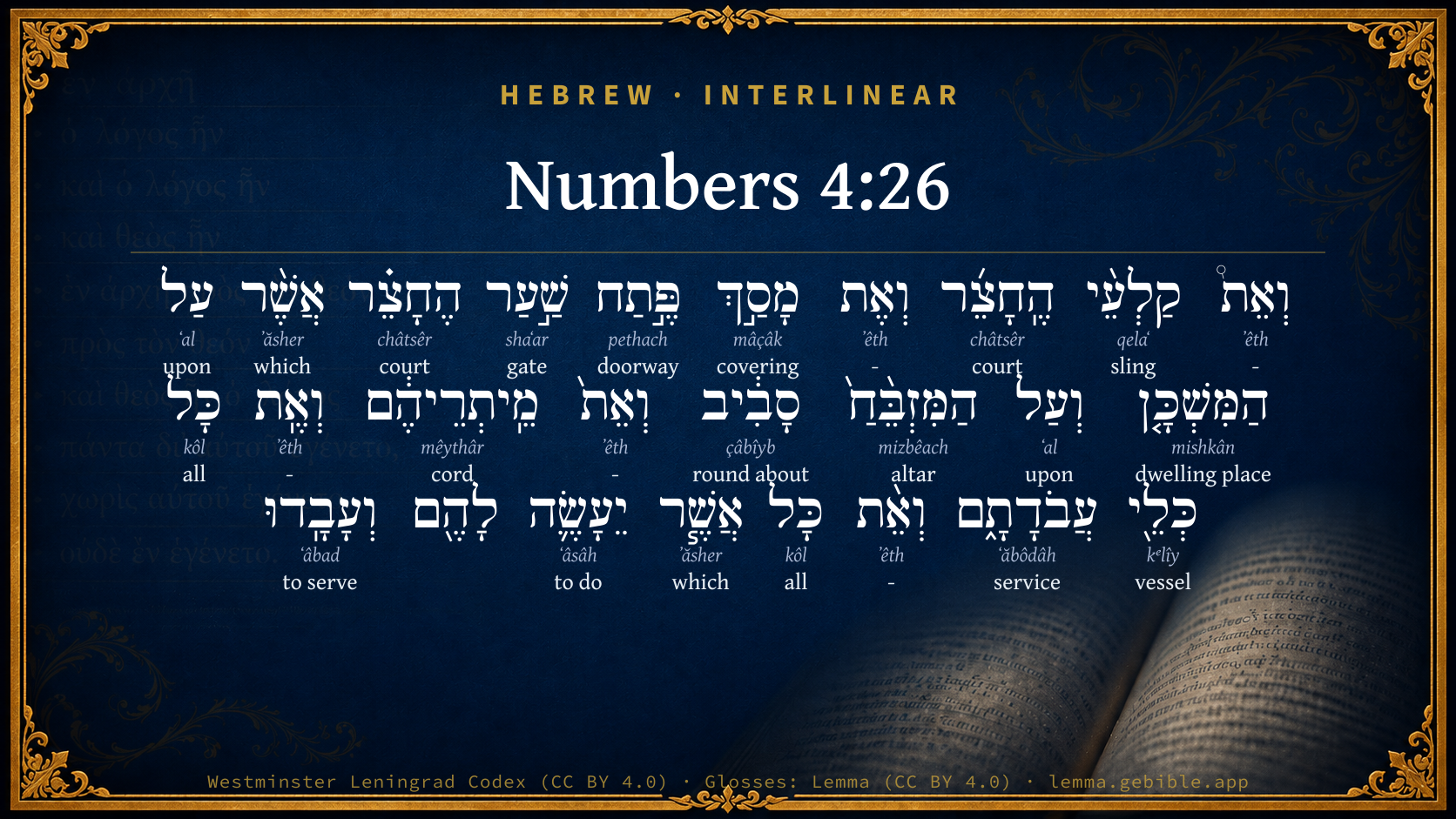
Numbers 4:26

Hebrew (Westminster Leningrad Codex) Numbers 4:26 appears in the Hebrew Old Testament. The text above is from the Westminster Leningrad Codex. Each word links to its Strong’s number, a concise gloss, and parsing drawn from the Open Scriptures Hebrew Bible morphology. Click any word for its full Brown-Driver-Briggs (BDB) entry.
Download image
Cite this verse

Numbers 4:26 (World English Bible). Public Domain. Lemma interlinear Bible study tool, https://lemma.gebible.app/v/numbers/4/26.

Show BibTeX & RIS
BibTeX
RIS
English Translation
and the hangings of the court, and the screen for the door of the gate of the court, which is by the tabernacle and around the altar, and their cords, and all the instruments of their service, and whatever shall be done with them. Therein shall they serve.
World English Bible · Public Domain
Download a study sheet

One document with this verse’s original text, its word-by-word gloss line, the meaning frame, cross-references with their text, attributed commentary, and full source and license credits — printable, and it pastes into notes with its structure intact.

This verse Autodidact and up

Study sheet (.html) Plain text (.txt)

A passage Seminary Student

Up to 50 verses in one chapter. A passage sheet keeps up to 6 commentary sources and 12 cross-references per verse, in the order this page ranks them, and says so on the sheet whenever that leaves anything out. Ask for a single verse and you get the Autodidact verse sheet above.

Everything on this page stays free to read, with no account — the sheet is a download of what is already on screen, not access to it.

Want to remove ads? Support Godless Engineer
Compare translations 3

The same verse in 3 English versions, stacked beneath the original-language interlinear above. Click any original word for its lexicon entry.

Each is an independent rendering of the whole verse — the interlinear is not word-aligned to these translations.

Highlighted words mark where these versions differ — a whole-verse word diff, not a word-by-word alignment.

  • World English Bible Public Domain
    and the hangings of the court, and the screen for the door of the gate of the court, which is by the tabernacle and around the altar, and their cords, and all the instruments of their service, and whatever shall be done with them. Therein shall they serve.
  • King James Version Public Domain
    And the hangings of the court, and the hanging for the door of the gate of the court, which is by the tabernacle and by the altar round about, and their cords, and all the instruments of their service, and all that is made for them: so shall they serve.
  • unfoldingWord Literal Text CC BY-SA 4.0
    and the hangings of the courtyard and the curtain of the opening of the gate of the courtyard that on the Dwelling and on the altar all around, and their ropes and all the vessels of their service and all that is done for them; and they shall serve.

unfoldingWord Literal Text — © unfoldingWord, licensed CC BY-SA 4.0. Word-aligned USFM3 via Door43 (git.door43.org/unfoldingWord/en_ult).

Versions to compare (up to 4)

3 of 4 selected

Show all 18 translations

Every available English version of this verse, each an independent rendering of the whole verse.

  • World English Bible Public Domain
    and the hangings of the court, and the screen for the door of the gate of the court, which is by the tabernacle and around the altar, and their cords, and all the instruments of their service, and whatever shall be done with them. Therein shall they serve.
  • Berean Standard Bible Public Domain
    the curtains of the courtyard, and the curtains for the entrance at the gate of the courtyard that surrounds the tabernacle and altar, along with their ropes and all the equipment for their service. The Gershonites will do all that needs to be done with these items.
  • Majority Standard Bible Public Domain
    the curtains of the courtyard, and the curtains for the entrance at the gate of the courtyard that surrounds the tabernacle and altar, along with their ropes and all the equipment for their service. The Gershonites will do all that needs to be done with these items.
  • King James Version Public Domain
    And the hangings of the court, and the hanging for the door of the gate of the court, which is by the tabernacle and by the altar round about, and their cords, and all the instruments of their service, and all that is made for them: so shall they serve.
  • American Standard Version (1901) Public Domain
    and the hangings of the court, and the screen for the door of the gate of the court, which is by the tabernacle and by the altar round about, and their cords, and all the instruments of their service, and whatsoever shall be done with them: therein shall they serve.
  • Revised Version (1885) Public Domain
    and the hangings of the court, and the screen for the door of the gate of the court, which is by the tabernacle and by the altar round about, and their cords, and all the instruments of their service, and whatsoever shall be done with them, therein shall they serve.
  • Geneva Bible (1599) Public Domain
    The curtaines also of the court, and the vaile of the entring in of the gate of the court, which is neere the Tabernacle and neere the altar round about, with their cordes, and all the instruments for their seruice, and all that is made for them: so shall they serue.
  • Douay-Rheims (1899) Public Domain
    The curtains of the court, and the veil in the entry that is before the tabernacle. All things that pertain to the altar, the cords and the vessels of the ministry,
  • Young's Literal Translation Public Domain
    and the hangings of the court, and the vail at the opening of the gate of the court which `is' by the tabernacle, and by the altar round about, and their cords, and all the vessels of their service, and all that is made for them -- and they have served.
  • Literal Standard Version CC BY-SA 4.0
    and the hangings of the court, and the veil at the opening of the gate of the court which [is] by the Dwelling Place, and by the altar all around, and their cords, and all the vessels of their service, and all that is made for them—and they have served.
  • Unlocked Literal Bible CC BY-SA 4.0
    They must carry the curtains of the court, the curtain for the doorway of the court's gate, which is near the tabernacle and near the altar, their ropes, and all the instruments for their service. Whatever should be done with these things, they must do it.
  • unfoldingWord Literal Text CC BY-SA 4.0
    and the hangings of the courtyard and the curtain of the opening of the gate of the courtyard that on the Dwelling and on the altar all around, and their ropes and all the vessels of their service and all that is done for them; and they shall serve.
  • Darby Bible Public Domain
    and the hangings of the court, and the curtain of the entrance, of the gate of the court, which surroundeth the tabernacle and the altar, and the cords thereof, and all the instruments of their service; and all that is to be done for these things shall they perform.
  • World Messianic Bible Public Domain
    the hangings of the court, the screen for the door of the gate of the court which is by the tabernacle and around the altar, their cords, and all the instruments of their service, and whatever shall be done with them. They shall serve in there.
  • Webster's Bible Public Domain
    And the hangings of the court, and the hanging for the door of the gate of the court, which is by the tabernacle and by the altar round about, and their cords, and all the instruments of their service, and all that is made for them: so shall they serve.
  • Free Bible Version CC BY-SA 4.0
    the courtyard curtains, the curtain at the entrance to the courtyard surrounding the Tabernacle and altar, the ropes, and everything connected with their use. The families of Gershon are responsible for everything required involving these items.
  • Bible in Basic English Public Domain
    And the hangings for the open space round the House and the altar, and the curtain for its doorway, with the cords and all the things used for them; whatever is necessary for these, they are to do.
  • JPS Tanakh (1917) Public Domain
    and the hangings of the court, and the screen for the door of the gate of the court, which is by the tabernacle and by the altar round about, and their cords, and all the instruments of their service, and whatsoever there may be to do with them, therein shall they serve.

Literal Standard Version (2020), Covenant Press — licensed CC BY-SA 4.0. Text via the HelloAO Bible API (eBible.org). Unlocked Literal Bible (unfoldingWord) — licensed CC BY-SA 4.0. Text via the HelloAO Bible API (eBible.org). unfoldingWord Literal Text — © unfoldingWord, licensed CC BY-SA 4.0. Word-aligned USFM3 via Door43 (git.door43.org/unfoldingWord/en_ult). Free Bible Version, Dr. Jonathan Gallagher — licensed CC BY-SA 4.0. Text via the HelloAO Bible API (eBible.org).

Word by word

More ways to search: Search by grammar → Find every occurrence → Compare this word →

Practice this passage: Drill this verse → Learn its vocabulary →

מֵֽיתְרֵיהֶ֔ם
mêythâr
H4340
“cords · their”
Noun, Common, Masculine, Plural, Construct + Suffix, Personal, 3rd Person, Masculine, Plural
Part of Speech
Noun
Type
Common
Gender
Masculine
Number
Plural
State
Construct
Full BDB Definition

Origin: from H3498

TWOT: 936h

cord, string
  1. וְאֵת֩ ʼêth H853 “and · -” Conjunction + Particle, Direct Object
  2. קַלְעֵ֨י qelaʻ H7050 “slings of” Noun, Common, Masculine, Plural, Construct
  3. הֶֽחָצֵ֜ר châtsêr H2691 “the · court” Particle, Definite Article + Noun, Common, Both, Singular, Absolute
  4. וְאֶת ʼêth H853 “and · -” Conjunction + Particle, Direct Object
  5. מָסַ֣ךְ mâçâk H4539 “covering of” Noun, Common, Masculine, Singular, Construct
  6. פֶּ֣תַח pethach H6607 “doorway of” Noun, Common, Masculine, Singular, Construct
  7. שַׁ֣עַר shaʻar H8179 “gate of” Noun, Common, Masculine, Singular, Construct
  8. הֶחָצֵ֗ר châtsêr H2691 “the · court” Particle, Definite Article + Noun, Common, Both, Singular, Absolute
  9. אֲשֶׁ֨ר ʼăsher H834 “which” Particle, Relative
  10. עַל ʻal H5921 “upon” Preposition
  11. הַמִּשְׁכָּ֤ן mishkân H4908 “the · dwelling place” Particle, Definite Article + Noun, Common, Masculine, Singular, Absolute
  12. וְעַל ʻal H5921 “and · upon” Conjunction + Preposition
  13. הַמִּזְבֵּ֨חַ֙ mizbêach H4196 “the · altar” Particle, Definite Article + Noun, Common, Masculine, Singular, Absolute
  14. סָבִ֔יב çâbîyb H5439 “round about” Noun, Common, Both, Singular, Absolute
  15. וְאֵת֙ ʼêth H853 “and · -” Conjunction + Particle, Direct Object
  16. וְאֶֽת ʼêth H853 “and · -” Conjunction + Particle, Direct Object
  17. כָּל kôl H3605 “all of” Noun, Common, Masculine, Singular, Construct
  18. כְּלֵ֖י kᵉlîy H3627 “vessels of” Noun, Common, Masculine, Plural, Construct
  19. עֲבֹדָתָ֑ם ʻăbôdâh H5656 “service · their” Noun, Common, Feminine, Singular, Construct + Suffix, Personal, 3rd Person, Masculine, Plural
  20. וְאֵ֨ת ʼêth H853 “and · -” Conjunction + Particle, Direct Object
  21. כָּל kôl H3605 “all of” Noun, Common, Masculine, Singular, Construct
  22. אֲשֶׁ֧ר ʼăsher H834 “which” Particle, Relative
  23. יֵעָשֶׂ֛ה ʻâsâh H6213 “to do” Verb, Niphal, Imperfect, 3rd Person, Masculine, Singular
  24. וְעָבָֽדוּ ʻâbad H5647 “and · to serve” Conjunction + Verb, Qal, Sequential Perfect, 3rd Person, Common, Plural

About this verse

These counts appear in no published source. They are computed here, from the morphology-tagged text and Lemma’s own curated glosses. What Lemma adds →

26
words
17
distinct lemmas
Pentateuch
section

Notable vocabulary

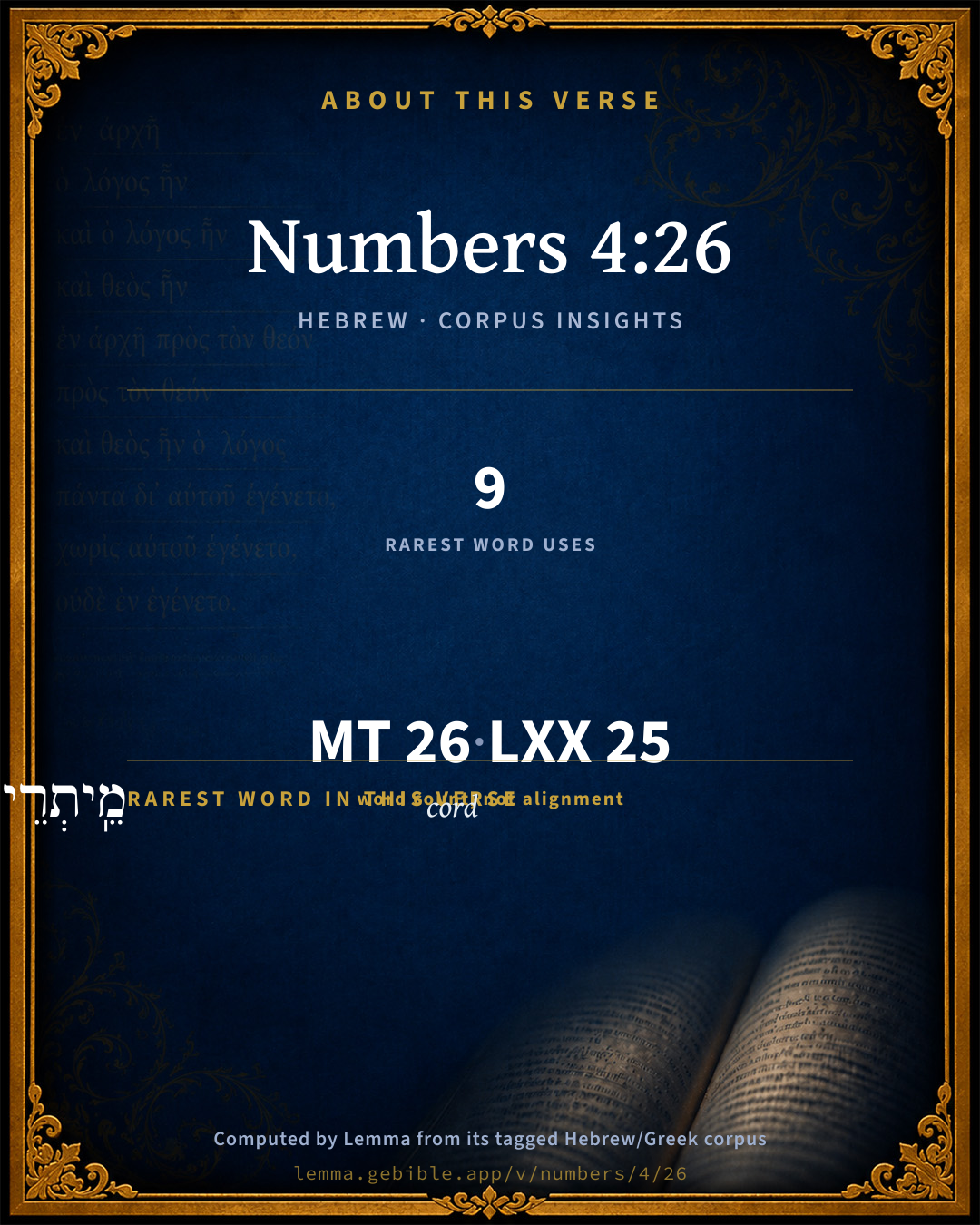
The rarest word here is מֵֽיתְרֵיהֶ֔ם cord H4340 — appearing just 9 times in the whole Hebrew Bible.

Shared distinctive vocabulary

מֵֽיתְרֵיהֶ֔ם cord H4340 occurs in 9 verses of the Hebrew Bible. Also found in:

Grammatical profile

  • 2 verbs
  • 14 nouns
  • 3 prepositions
  • 7 particles

Verb forms

  • יֵעָשֶׂ֛ה Niphal · Imperfect
  • וְעָבָֽדוּ Qal · Sequential Perfect

Repetition

Words recur within this verse — often emphatic in Hebrew:

  • הֶֽחָצֵ֜ר court H2691 ×2
  • עַל upon H5921 ×2
  • כָּל all H3605 ×2
  • אֲשֶׁ֨ר which H834 ×2

Hebrew & Septuagint length

In English translation the verse runs 48 words from the Hebrew and 31 from the Septuagint (LXX English) — the Septuagint runs noticeably shorter here. See the side-by-side →

A rough comparison of the two English renderings, which tokenize alike — not a word-level alignment.

Word counts can differ between the Hebrew and the Greek without any difference in meaning — e.g. the Hebrew direct-object marker אֵת has no separate Greek word, and Greek often adds the article ὁ.

In the original languages it is 26 Hebrew tokens and 25 Greek tokens — but the two are counted differently (Hebrew bundles its prefixes and suffixes into one token; the Greek is in lemma form), so that isn’t a like-for-like length.

Cross-references

2

Topical passages linked to Numbers 4:26 in the Treasury of Scripture Knowledge — connected by theme and wording, ordered by reader-vote popularity; previews shown in the World English Bible.

  • Exodus 27:9 "You shall make the court of the tent: for the south side southward there shall be hangings for the court of fine twined linen one hundred cubits long for one side:
  • Exodus 35:18 the pins of the tent, the pins of the court, and their cords;

Cross-references courtesy of OpenBible.info (CC BY 4.0).

Hebrew and Greek witnesses Masoretic Hebrew ↔ Greek Septuagint

The same verse in the two great witnesses to the Old Testament, shown verse-for-verse.

Here the Septuagint runs noticeably shorter than the Hebrew — LXX2012 (modern English Septuagint) 31 words vs World English Bible 48. A rough length comparison of the two English translations, not a word-level alignment — read both below.

These are two independent witnesses, not word-aligned to each other, and the Septuagint is shown in lemma (dictionary) form.

Hebrew Numbers 4:26 Masoretic · Westminster Leningrad Codex

וְאֵת֩ קַלְעֵ֨י הֶֽחָצֵ֜ר וְאֶת מָסַ֣ךְ פֶּ֣תַח שַׁ֣עַר הֶחָצֵ֗ר אֲשֶׁ֨ר עַל הַמִּשְׁכָּ֤ן וְעַל הַמִּזְבֵּ֨חַ֙ סָבִ֔יב וְאֵת֙ מֵֽיתְרֵיהֶ֔ם וְאֶֽת כָּל כְּלֵ֖י עֲבֹדָתָ֑ם וְאֵ֨ת כָּל אֲשֶׁ֧ר יֵעָשֶׂ֛ה לָהֶ֖ם וְעָבָֽדוּ

and the hangings of the court, and the screen for the door of the gate of the court, which is by the tabernacle and around the altar, and their cords, and all the instruments of their service, and whatever shall be done with them. Therein shall they serve.

World English Bible · Public Domain

Greek LXX Numbers 4:26 Septuagint · lemma form

καί ὁ ἱστίον ὁ αὐλή ὅσος ἐπί ὁ σκηνή ὁ μαρτύριον καί ὁ περισσός καί πᾶς ὁ σκεῦος ὁ λειτουργικός ὅσος λειτουργέω ἐν αὐτός ποιέω

And all the curtains of the court which were upon the tabernacle of witness, and the appendages, and all the vessels of service that they minister with they shall attend to.

LXX2012 (modern English Septuagint) · Public Domain

Hebrew: Westminster Leningrad Codex (CC BY 4.0). Greek: Septuagint (public domain); English from LXX2012 (modern English Septuagint) (Public Domain). How the Septuagint differs from the Hebrew →

Targum (Aramaic paraphrase)

2

The Targum is the ancient Jewish Aramaic paraphrase of the Hebrew Scriptures — an interpretive translation, not the Hebrew text itself. Onkelos (literal) and Pseudo-Jonathan (expansive) render the Torah, and Jonathan the Prophets. Coverage is partial: where no permissively-licensed English translation exists for a verse, only the Aramaic is shown. This is verse-level text, not a word-by-word alignment to the Hebrew.

  1. Targum Onkelos Torah (Genesis–Deuteronomy)
    וְיָת סְרָדֵי דְדַרְתָּא וְיָת פְּרָסָא דְמַעֲלָנָא דִתְרַע דַרְתָּא דִי עַל מַשְׁכְּנָא וְעַל מַדְבְּחָא סְחוֹר סְחוֹר וְיָת אַטוּנֵיהוֹן וְיָת כָּל מָנֵי פּוּלְּחַנְהוֹן וְיַת כָּל דִי יִתְמְסַר לְהוֹן וְיִפְלְחוּן

    (no public-domain English translation for this verse)

    Targum Onkelos — Aramaic: “Onkelos Genesis” (public domain); “Onkelos Exodus” (public domain); “Onkelos Leviticus” (public domain); “Onkelos Numbers” (public domain); “Onkelos Deuteronomy” (public domain). English: “Sefaria Community Translation” (CC0 1.0 (public-domain dedication)); “J.W. Etheridge. The Targums of Onkelos and Jonathan Ben Uzziel on the Pentateuch. London: Longmans, Green, 1862” (public domain). Text via Sefaria.

  2. Targum Pseudo-Jonathan Torah (Genesis–Deuteronomy)
    וְיַת וִוילַוָת דַרְתָּא וְיַת פְּרָסָא דְמַעֲלָנָא דִתְרַע דַרְתָּא דְעַל מַשְׁכְּנָא חֲזוֹר חֲזוֹר וְיַת אֲטוּנֵיהוֹן וְיַת כָּל מָאנֵי פּוּלְחַנְהוֹן וְיַת כָּל מַה דְיִתְמְסַר לְהוֹן וְיִפְלְחוּן

    and the curtains of the court, and the hanging for the gate of the court which is by the tabernacle round about, and their cords and all the vessels of their service, and all that is delivered to them to serve with.

    Targum Pseudo-Jonathan — Aramaic: “Targum Jonathan on Genesis” (public domain); “Targum Jonathan on Exodus” (public domain); “Targum Jonathan on Leviticus” (public domain); “Targum Jonathan on Numbers” (public domain); “Targum Jonathan on Deuteronomy” (public domain). English: “The Targum of Jonathan ben Uzziel, trans. J. W. Etheridge, London, 1862” (public domain). Text via Sefaria.

Commentary

Notes on Numbers 4:26 from classic Christian and Jewish commentators (each source and its license shown beneath its notes). The classic Christian expositions comment on the surrounding passage and are grouped to its opening verse, so a note may address several verses; the Jewish commentaries on the Tanakh (Rashi and others) are per-verse, so they appear only where the commentator wrote on this verse.

Lemma curates 59 commentaries, every one of them public domain or Creative Commons licensed, each selected and text-cleaned for this edition rather than reprinted as found. About our sources →

Joseph Benson's Commentary

Num 4:26-28. Which is round about — Which court compassed both the tabernacle and the altar. Under the hand — Under his conduct and direction.

Joseph Benson's Commentary on the Old and New Testaments (1811–1818) — public domain. Text from a community e-Sword module.

Geneva Bible (1599)

Geneva Bible translators

Which court compassed both the Tabernacle of the Congregation and the altar of burnt offering.

Geneva Bible (1599) marginal notes — public domain. Text via Bolls.life.

Ellicott's Commentary for English Readers

(26) Which is by the tabernacle and by the altar round about.—Or, which are . . . The curtains or hangings enclosed the whole of the court.

A Bible Commentary for English Readers, edited by Charles John Ellicott (1878–1897) — public domain. Text from a community e-Sword module.

The Cambridge Bible for Schools and Colleges

gen. ed. J. J. S. Perowne

26. whatsoever shall be done with them] all that may have to be done with regard to them; e.g. the undoing of the hooks and loops, the rolling up of the strips of curtain and so on.

The Cambridge Bible for Schools and Colleges (gen. ed. J. J. S. Perowne; Cambridge University Press, 1878–1918) — public domain. Text from a community e-Sword module.

John Gill's Exposition

As for the sons of Merari,.... The third and youngest son of Levi:

thou shalt number them after their families, by the house of their fathers; which is the form of expression used of them all; See Gill on Num 4:2.

John Gill's Exposition of the Whole Bible (1746–1763) — public domain (CC PDM 1.0). Text via the HelloAO Bible API.

Haydock's Catholic Bible Commentary

All things. Hebrew, "veils round the altar" of holocausts in the court. (Calmet)

George Leo Haydock (1774–1849), Haydock's Catholic Family Bible and Commentary, 1859 edition — public domain. Excludes Psalms (Douay-Rheims chapter numbering differs from Protestant) and Deuterocanonical books (Catholic canon only).

Matthew Poole's English Annotations

The gate of the court, i.e. which court compassed both the tabernacle and the altar, Exo 27:16.

Matthew Poole's English Annotations on the Holy Bible (1683–1685) — public domain. Text from a community e-Sword/MySword module.

The Pulpit Commentary

And their cords, and all the instruments of their service. Taking this verse in connection with verse 37, we must understand the word "their" as applying to the things mentioned in the previous verse. The Merarites carried the cords, &c. of the hangings of the court. ;

The Pulpit Commentary (1880–1919), ed. H.D.M. Spence-Jones & Joseph S. Exell — public domain. Text from a community e-Sword module.

John Wesley's Explanatory Notes

Which is round about - Which court compassed both the tabernacle and the altar.

John Wesley, Explanatory Notes Upon the Whole Bible (1754–1765) — public domain. Text via the GEBible commentary corpus.

Rashi

Rabbi Shlomo Yitzchaki (Rashi)

אשר על המשכן [AND THE HANGINGS OF THE ENCLOSURE, AND THE SCREEN FOR THE ENTRANCE OF THE GATE OF THE ENCLOSURE] WHICH ARE על המשכן — that is to say, the hangings and the screen of the court which together screen and shelter the Tabernacle and the copper altar on all sides.

ואת כל אשר יעשה להם — Understand this as the Targum does; “and everything that is handed over to them” — i.e. to the sons of Gershon.

Rashi on the Tanakh — English translations: “The Judaica Press complete Tanach with Rashi, translated by A. J. Rosenberg” (CC BY 4.0); “Pentateuch with Rashi's commentary by M. Rosenbaum and A.M. Silbermann, 1929-1934” (public domain); “The Metsudah Tanach series, Lakewood, N.J” (CC BY 4.0); and “The Book of Joshua, Metsudah Publications, 1997” (CC BY 4.0). Text via Sefaria.

Ramban (Nachmanides)

Rabbi Moshe ben Nachman (Ramban / Nachmanides)

V’EITH KOL ASHER ‘YEI’ASEH’ LAHEM. [literally: “and all which will be made to them”]. The question Ramban discusses is what the pronoun lahem (“to them” or “for them”) refers to and what the meaning of yei’aseh is. “[This is to be understood] as the Targum [of Onkelos rendered it]: ‘and with whatever is handed over to them,’ that is, to the sons of Gershon [so shall they serve].” This is Rashi’s language. But if so [if the pronoun lahem refers to the Gershonites, and not to all the vessels of the Tabernacle and altar mentioned in the first part of the verse], then the word yei’aseh [does not have its usual meaning of “doing,” but is to be understood as “possessions” or “articles in a person’s control,” the sense of the verse being: “and all ‘the objects handed over’ to them — they, the Gershonites shall serve with”], as in the verse: And there was a man in Maon ‘uma’aseihu’ were in Carmel, which means “his possessions with which he ‘does’ [his occupation].” A more correct interpretation [of our verse] is that it means: “and with whatever [accessories] are made ‘for them’ — the Tabernacle and the altar — for they had many vessels [so shall they — the sons of Gershon — serve].”

Ramban (Nachmanides) on the Tanakh — English translation: “Commentary on the Torah by Ramban (Nachmanides). Translated and annotated by Charles B. Chavel. New York, Shilo Pub. House, 1971-1976” (CC BY 4.0). Text via Sefaria.

Lesson kit

Teaching starters — assembled from the data on this page, not authored interpretation. Every prompt links to the verse data it draws on. Edit before teaching.

Numbers, in the Pentateuch, opens this verse with 26 words (17 distinct Hebrew lemmas). Its most distinctive word is mêythâr (“cord”). The Greek Septuagint runs shorter here. A historical commentator’s framing appears above. Read the whole chapter for the surrounding context.

Discussion questions

  1. How does “cord” (mêythâr) shape what this verse is saying?
  2. Exodus 35:18 shares the word «cord» with this verse. How do the two illuminate each other?
  3. “court” occurs 2× in this one verse. What is the effect of the repetition?
  4. Compared with the Hebrew, the Septuagint runs shorter here. What questions does that raise?
  5. These translations render this verse differently; the difference is in the English rendering, not the original. What questions does that raise?
  6. The verb «יֵעָשֶׂ֛ה» is Niphal Imperfect. How does its form color the action?
  7. Reading how Joseph Benson's Commentary and Geneva Bible (1599) read this verse, where do the two commentators agree and where do they part?

Things to notice

Reading settings

Reading text

Shown beneath each verse's original-language words.

Old Testament
Old Testament edition

Read the OT as the Masoretic Hebrew (MT) or the Greek Septuagint (LXX).

English shown for the Greek Septuagint (in the Hebrew ↔ Greek comparison).

Comparing translations? Open the Compare panel on any verse page to stack up to four side by side.