
Ezekiel 44:11

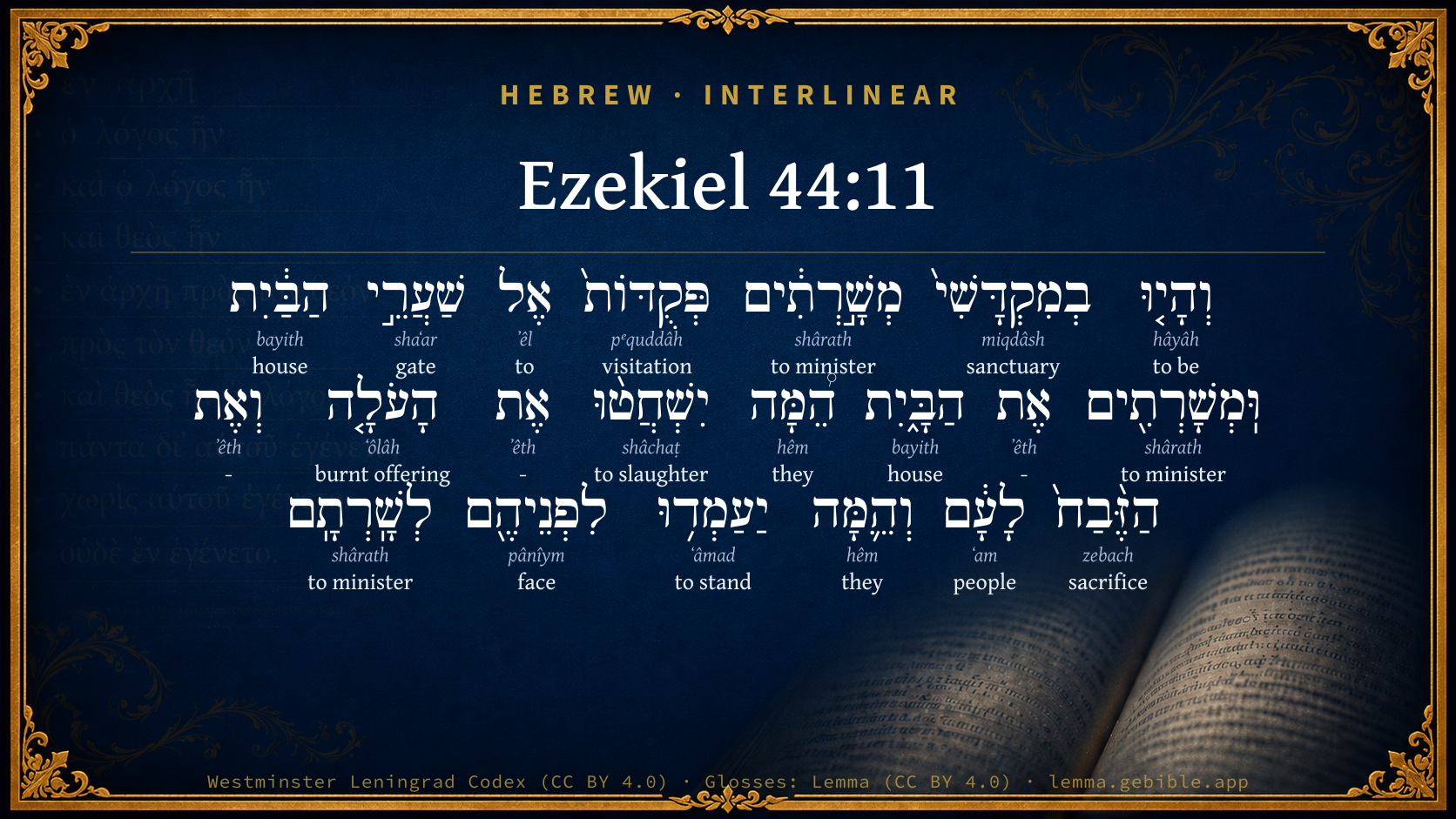
Hebrew (Westminster Leningrad Codex) Ezekiel 44:11 appears in the Hebrew Old Testament. The text above is from the Westminster Leningrad Codex. Each word links to its Strong’s number, a concise gloss, and parsing drawn from the Open Scriptures Hebrew Bible morphology. Click any word for its full Brown-Driver-Briggs (BDB) entry.
Download image
Cite this verse

Ezekiel 44:11 (World English Bible). Public Domain. Lemma interlinear Bible study tool, https://lemma.gebible.app/v/ezekiel/44/11.

Show BibTeX & RIS
BibTeX
RIS
English Translation
Yet they shall be ministers in my sanctuary, having oversight at the gates of the house, and ministering in the house: they shall kill the burnt offering and the sacrifice for the people, and they shall stand before them to minister to them.
World English Bible · Public Domain
Download a study sheet

One document with this verse’s original text, its word-by-word gloss line, the meaning frame, cross-references with their text, attributed commentary, and full source and license credits — printable, and it pastes into notes with its structure intact.

This verse Autodidact and up

Study sheet (.html) Plain text (.txt)

A passage Seminary Student

Up to 50 verses in one chapter. A passage sheet keeps up to 6 commentary sources and 12 cross-references per verse, in the order this page ranks them, and says so on the sheet whenever that leaves anything out. Ask for a single verse and you get the Autodidact verse sheet above.

Everything on this page stays free to read, with no account — the sheet is a download of what is already on screen, not access to it.

Want to remove ads? Support Godless Engineer
Compare translations 3

The same verse in 3 English versions, stacked beneath the original-language interlinear above. Click any original word for its lexicon entry.

Each is an independent rendering of the whole verse — the interlinear is not word-aligned to these translations.

Highlighted words mark where these versions differ — a whole-verse word diff, not a word-by-word alignment.

  • World English Bible Public Domain
    Yet they shall be ministers in my sanctuary, having oversight at the gates of the house, and ministering in the house: they shall kill the burnt offering and the sacrifice for the people, and they shall stand before them to minister to them.
  • King James Version Public Domain
    Yet they shall be ministers in my sanctuary, having charge at the gates of the house, and ministering to the house: they shall slay the burnt offering and the sacrifice for the people, and they shall stand before them to minister unto them.
  • unfoldingWord Literal Text CC BY-SA 4.0
    They are servants in my sanctuary, watching the gates of the house and serving in the house and they slaughter the burnt offerings and the people’s sacrifices, and they will stand before the people and serve them.

unfoldingWord Literal Text — © unfoldingWord, licensed CC BY-SA 4.0. Word-aligned USFM3 via Door43 (git.door43.org/unfoldingWord/en_ult).

Versions to compare (up to 4)

3 of 4 selected

Show all 18 translations

Every available English version of this verse, each an independent rendering of the whole verse.

  • World English Bible Public Domain
    Yet they shall be ministers in my sanctuary, having oversight at the gates of the house, and ministering in the house: they shall kill the burnt offering and the sacrifice for the people, and they shall stand before them to minister to them.
  • Berean Standard Bible Public Domain
    Yet they shall be ministers in My sanctuary, having charge of the gates of the temple and ministering there. They shall slaughter the burnt offerings and other sacrifices for the people and stand before them to minister to them.
  • Majority Standard Bible Public Domain
    Yet they shall be ministers in My sanctuary, having charge of the gates of the temple and ministering there. They shall slaughter the burnt offerings and other sacrifices for the people and stand before them to minister to them.
  • King James Version Public Domain
    Yet they shall be ministers in my sanctuary, having charge at the gates of the house, and ministering to the house: they shall slay the burnt offering and the sacrifice for the people, and they shall stand before them to minister unto them.
  • American Standard Version (1901) Public Domain
    Yet they shall be ministers in my sanctuary, having oversight at the gates of the house, and ministering in the house: they shall slay the burnt-offering and the sacrifice for the people, and they shall stand before them to minister unto them.
  • Revised Version (1885) Public Domain
    Yet they shall be ministers in my sanctuary, having oversight at the gates of the house, and ministering in the house: they shall slay the burnt offering and the sacrifice for the people, and they shall stand before them to minister unto them.
  • Geneva Bible (1599) Public Domain
    And they shall serue in my Sanctuarie, and keepe the gates of the House, and minister in the House: they shall slay the burnt offring and the sacrifice for the people: and they shall stand before them to serue them.
  • Douay-Rheims (1899) Public Domain
    They shall be officers in my sanctuary, and doorkeepers of the gates of the house, and ministers to the house: they shall slay the holocausts, and the victims of the people: and they shall stand in their sight, to minister to them.
  • Young's Literal Translation Public Domain
    And they have been in My sanctuary ministrants, overseers at the gates of the house, and ministrants at the house; they slay the burnt-offering and the sacrifice for the people, and they stand before them to serve them.
  • Literal Standard Version CC BY-SA 4.0
    And they have been servants in My sanctuary, overseers at the gates of the house, and servants at the house; they slay the burnt-offering and the sacrifice for the people, and they stand before them to serve them.
  • Unlocked Literal Bible CC BY-SA 4.0
    They are servants in my sanctuary, watching the gates of the house and serving in the house and they slaughter the burnt offerings and the people's sacrifices, and they will stand before the people and serve them.
  • unfoldingWord Literal Text CC BY-SA 4.0
    They are servants in my sanctuary, watching the gates of the house and serving in the house and they slaughter the burnt offerings and the people’s sacrifices, and they will stand before the people and serve them.
  • Darby Bible Public Domain
    but they shall be ministers in my sanctuary, having oversight at the gates of the house, and doing the service of the house: they shall slaughter the burnt-offering and the sacrifice for the people, and they shall stand before them to minister unto them.
  • World Messianic Bible Public Domain
    Yet they shall be ministers in my sanctuary, having oversight at the gates of the house, and ministering in the house. They shall kill the burnt offering and the sacrifice for the people, and they shall stand before them to minister to them.
  • Webster's Bible Public Domain
    Yet they shall be ministers in my sanctuary, having charge at the gates of the house, and ministering to the house: they shall slay the burnt-offering and the sacrifice for the people, and they shall stand before them to minister to them.
  • Free Bible Version CC BY-SA 4.0
    However, they will serve in my sanctuary, supervising the Temple gates and working in the Temple. They will slaughter the burnt offerings and sacrifices brought by the people and be there to serve them.
  • Bible in Basic English Public Domain
    But they may be caretakers in my holy place, and overseers at the doors of the house, doing the work of the house: they will put to death the burned offering and the beasts offered for the people, and they will take their place before them as their servants.
  • JPS Tanakh (1917) Public Domain
    and they shall be ministers in My sanctuary, having charge at the gates of the house, and ministering in the house: they shall slay the burnt-offering and the sacrifice for the people, and they shall stand before them to minister unto them.

Literal Standard Version (2020), Covenant Press — licensed CC BY-SA 4.0. Text via the HelloAO Bible API (eBible.org). Unlocked Literal Bible (unfoldingWord) — licensed CC BY-SA 4.0. Text via the HelloAO Bible API (eBible.org). unfoldingWord Literal Text — © unfoldingWord, licensed CC BY-SA 4.0. Word-aligned USFM3 via Door43 (git.door43.org/unfoldingWord/en_ult). Free Bible Version, Dr. Jonathan Gallagher — licensed CC BY-SA 4.0. Text via the HelloAO Bible API (eBible.org).

Word by word

More ways to search: Search by grammar → Find every occurrence → Compare this word →

Practice this passage: Drill this verse → Learn its vocabulary →

פְּקֻדּוֹת֙
pᵉquddâh
H6486
“visitations”
Noun, Common, Feminine, Plural, Absolute
Part of Speech
Noun
Type
Common
Gender
Feminine
Number
Plural
State
Absolute
Full BDB Definition

Origin: pass part of H6485

TWOT: 1802a

oversight, care, custody, mustering, visitation, store - visitation, punishment - oversight, charge, office, overseer, class of officers - mustering - store
  1. וְהָי֤וּ hâyâh H1961 “and · to be” Conjunction + Verb, Qal, Sequential Perfect, 3rd Person, Common, Plural
  2. בְמִקְדָּשִׁי֙ miqdâsh H4720 “in/at · sanctuary · my” Preposition + Noun, Common, Masculine, Singular, Construct + Suffix, Personal, 1st Person, Common, Singular
  3. מְשָׁ֣רְתִ֔ים shârath H8334 “ministering” Verb, Piel, Participle Active, Masculine, Plural, Absolute
  4. אֶל ʼêl H413 “to” Preposition
  5. שַׁעֲרֵ֣י shaʻar H8179 “gates of” Noun, Common, Masculine, Plural, Construct
  6. הַבַּ֔יִת bayith H1004 “the · house” Particle, Definite Article + Noun, Common, Masculine, Singular, Absolute
  7. וּֽמְשָׁרְתִ֖ים shârath H8334 “and · ministering” Conjunction + Verb, Piel, Participle Active, Masculine, Plural, Absolute
  8. אֶת ʼêth H853 “-” Particle, Direct Object
  9. הַבָּ֑יִת bayith H1004 “the · house” Particle, Definite Article + Noun, Common, Masculine, Singular, Absolute
  10. הֵ֠מָּה hêm H1992 “they” Pronoun, Personal, 3rd Person, Masculine, Plural
  11. יִשְׁחֲט֨וּ shâchaṭ H7819 “to slaughter” Verb, Qal, Imperfect, 3rd Person, Masculine, Plural
  12. אֶת ʼêth H853 “-” Particle, Direct Object
  13. הָעֹלָ֤ה ʻôlâh H5930 “the · burnt offering” Particle, Definite Article + Noun, Common, Feminine, Singular, Absolute
  14. וְאֶת ʼêth H853 “and · -” Conjunction + Particle, Direct Object
  15. הַזֶּ֨בַח֙ zebach H2077 “the · sacrifice” Particle, Definite Article + Noun, Common, Masculine, Singular, Absolute
  16. לָעָ֔ם ʻam H5971 “to/for the · people” Preposition, Determined + Noun, Common, Masculine, Singular, Absolute
  17. וְהֵ֛מָּה hêm H1992 “and · they” Conjunction + Pronoun, Personal, 3rd Person, Masculine, Plural
  18. יַעַמְד֥וּ ʻâmad H5975 “to stand” Verb, Qal, Imperfect, 3rd Person, Masculine, Plural
  19. לִפְנֵיהֶ֖ם pânîym H6440 “to/for · face(s) · their” Preposition + Noun, Common, Both, Plural, Construct + Suffix, Personal, 3rd Person, Masculine, Plural
  20. לְשָֽׁרְתָֽם shârath H8334 “to minister · them” Preposition + Verb, Piel, Infinitive Construct + Suffix, Personal, 3rd Person, Masculine, Plural

About this verse

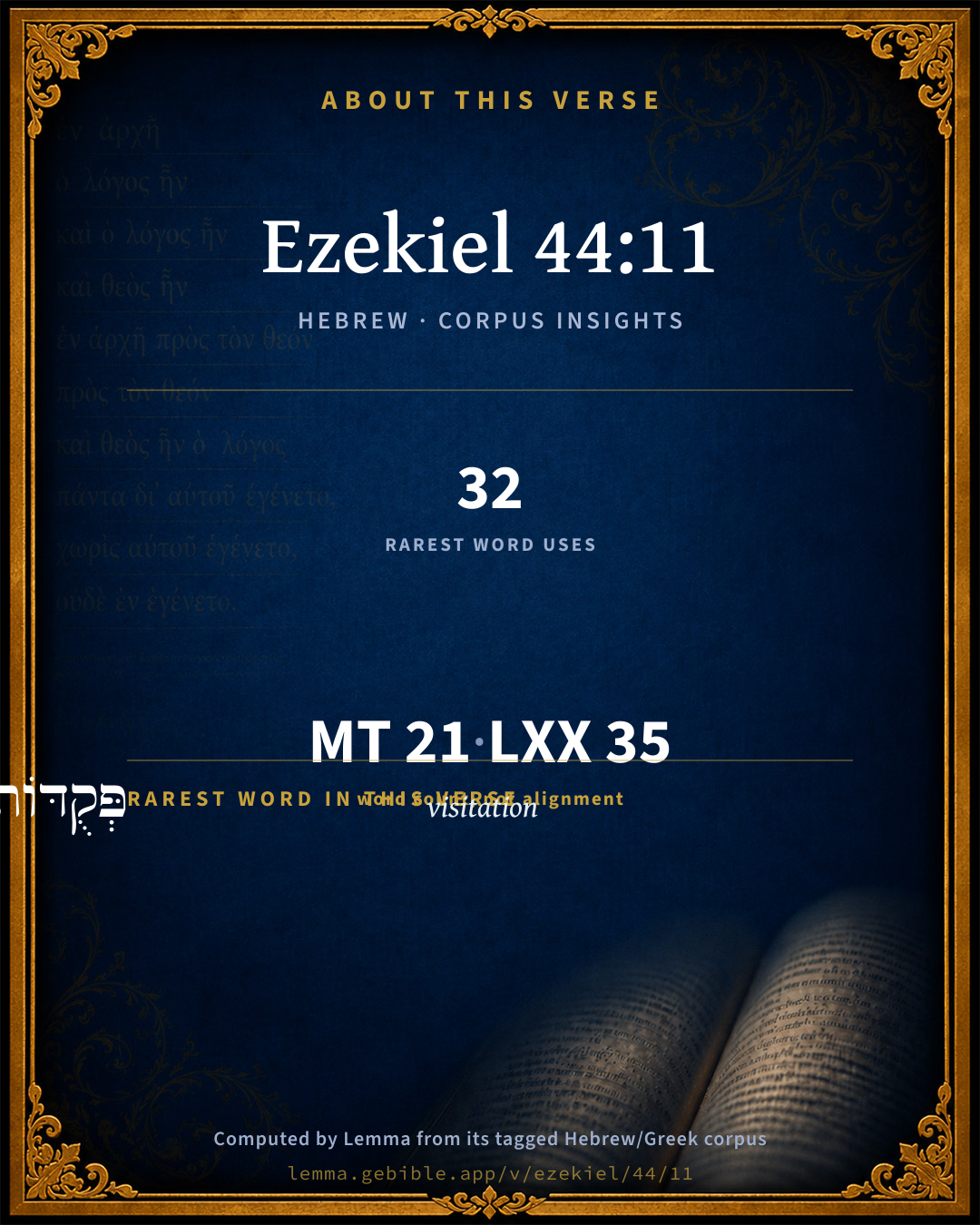
These counts appear in no published source. They are computed here, from the morphology-tagged text and Lemma’s own curated glosses. What Lemma adds →

21
words
15
distinct lemmas
Prophets
section

Shared distinctive vocabulary

פְּקֻדּוֹת֙ visitation H6486 occurs in 31 verses of the Hebrew Bible. Also found in:

Grammatical profile

  • 6 verbs
  • 9 nouns
  • 2 pronouns
  • 1 preposition
  • 3 particles

Verb forms

  • וְהָי֤וּ Qal · Sequential Perfect
  • מְשָׁ֣רְתִ֔ים Piel · Participle Active
  • וּֽמְשָׁרְתִ֖ים Piel · Participle Active
  • יִשְׁחֲט֨וּ Qal · Imperfect
  • יַעַמְד֥וּ Qal · Imperfect
  • לְשָֽׁרְתָֽם Piel · Infinitive Construct

Repetition

Words recur within this verse — often emphatic in Hebrew:

  • מְשָׁ֣רְתִ֔ים to minister H8334 ×3
  • הַבַּ֔יִת house H1004 ×2
  • הֵ֠מָּה they H1992 ×2

Hebrew & Septuagint length

In English translation the verse runs 43 words from the Hebrew and 43 from the Septuagint (LXX English) — the same length.

A rough comparison of the two English renderings, which tokenize alike — not a word-level alignment.

Word counts can differ between the Hebrew and the Greek without any difference in meaning — e.g. the Hebrew direct-object marker אֵת has no separate Greek word, and Greek often adds the article ὁ.

In the original languages it is 21 Hebrew tokens and 35 Greek tokens — but the two are counted differently (Hebrew bundles its prefixes and suffixes into one token; the Greek is in lemma form), so that isn’t a like-for-like length.

Cross-references

9

Topical passages linked to Ezekiel 44:11 in the Treasury of Scripture Knowledge — connected by theme and wording, ordered by reader-vote popularity; previews shown in the World English Bible.

  • Numbers 16:9 [seems it but] a small thing to you, that the God of Israel has separated you from the congregation of Israel, to bring you near to himself, to do the service of the tent of Yahweh, and to stand before the congregation to minister to them;
  • 2 Chronicles 29:34 But the priests were too few, so that they could not flay all the burnt offerings: therefore their brothers the Levites helped them, until the work was ended, and until the priests had sanctified themselves; for the Levites were more upright in heart to sanctify themselves than the priests.
  • Numbers 18:6 I, behold, I have taken your brothers the Levites from among the children of Israel: to you they are a gift, given to Yahweh, to do the service of the tent of meeting.
  • 1 Chronicles 26:1–19 For the divisions of the doorkeepers: of the Korahites, Meshelemiah the son of Kore, of the sons of Asaph.
  • 2 Chronicles 30:17 For there were many in the assembly who had not sanctified themselves: therefore the Levites had the charge of killing the Passovers for everyone who was not clean, to sanctify them to Yahweh.
  • Ezekiel 40:45 He said to me, This chamber, whose prospect is toward the south, is for the priests, the keepers of the charge of the house;
  • Ezekiel 44:14 Yet will I make them keepers of the charge of the house, for all the service of it, and for all that shall be done therein.
  • Numbers 3:5–37 Yahweh spoke to Moses, saying,
  • 2 Chronicles 35:10–11 So the service was prepared, and the priests stood in their place, and the Levites by their divisions, according to the king's commandment.

Cross-references courtesy of OpenBible.info (CC BY 4.0).

Hebrew and Greek witnesses Masoretic Hebrew ↔ Greek Septuagint

The same verse in the two great witnesses to the Old Testament, shown verse-for-verse.

These are two independent witnesses, not word-aligned to each other, and the Septuagint is shown in lemma (dictionary) form.

Hebrew Ezekiel 44:11 Masoretic · Westminster Leningrad Codex

וְהָי֤וּ בְמִקְדָּשִׁי֙ מְשָׁ֣רְתִ֔ים פְּקֻדּוֹת֙ אֶל שַׁעֲרֵ֣י הַבַּ֔יִת וּֽמְשָׁרְתִ֖ים אֶת הַבָּ֑יִת הֵ֠מָּה יִשְׁחֲט֨וּ אֶת הָעֹלָ֤ה וְאֶת הַזֶּ֨בַח֙ לָעָ֔ם וְהֵ֛מָּה יַעַמְד֥וּ לִפְנֵיהֶ֖ם לְשָֽׁרְתָֽם

Yet they shall be ministers in my sanctuary, having oversight at the gates of the house, and ministering in the house: they shall kill the burnt offering and the sacrifice for the people, and they shall stand before them to minister to them.

World English Bible · Public Domain

Greek LXX Ezekiel 44:11 Septuagint · lemma form

καί εἰμί ἐν ὁ ἅγιος ἐγώ λειτουργέω θυρωρός ἐπί ὁ πύλη ὁ οἶκος καί λειτουργέω ὁ οἶκος οὗτος σφάζω ὁ ὁλοκαύτωμα καί ὁ θυσία ὁ λαός καί οὗτος ἵστημι ἐναντίον ὁ λαός ὁ λειτουργέω αὐτός

yet they shall minister in my sanctuary, being porters at the gates of the house, and serving the house: they shall kill the victims and the whole burnt offerings for the people, and they shall stand before the people to minister to them.

LXX2012 (modern English Septuagint) · Public Domain

Hebrew: Westminster Leningrad Codex (CC BY 4.0). Greek: Septuagint (public domain); English from LXX2012 (modern English Septuagint) (Public Domain). How the Septuagint differs from the Hebrew →

Targum (Aramaic paraphrase)

1

The Targum is the ancient Jewish Aramaic paraphrase of the Hebrew Scriptures — an interpretive translation, not the Hebrew text itself. Onkelos (literal) and Pseudo-Jonathan (expansive) render the Torah, and Jonathan the Prophets. Coverage is partial: where no permissively-licensed English translation exists for a verse, only the Aramaic is shown. This is verse-level text, not a word-by-word alignment to the Hebrew.

  1. Targum Jonathan Prophets (Joshua–Malachi)
    וִיהוֹן בְּמַקְדְשִׁי מְשַׁמְשִׁין מְמַנָן עַל תַּרְעֵי בֵיתָא וּמְשַׁמְשִׁין יַת בֵּיתָא אִינוּן יִכְסוּן יַת עֲלָתָא וְיַת נִכְסַת קוּדְשַׁיָא דִי לְעַמָא וְאִינוּן יְקוּמוּן קֳדָמֵיהוֹן לְשַׁמָשׁוּתְהוֹן:

    (no public-domain English translation for this verse)

    Targum Jonathan — Aramaic: “Mikraot Gedolot” (public domain). English: “Sefaria Community Translation” (CC0 1.0 (public-domain dedication)); “London "Chaldee Paraphrase," 1871” (public domain). Text via Sefaria.

Commentary

Notes on Ezekiel 44:11 from classic Christian and Jewish commentators (each source and its license shown beneath its notes). The classic Christian expositions comment on the surrounding passage and are grouped to its opening verse, so a note may address several verses; the Jewish commentaries on the Tanakh (Rashi and others) are per-verse, so they appear only where the commentator wrote on this verse.

Lemma curates 59 commentaries, every one of them public domain or Creative Commons licensed, each selected and text-cleaned for this edition rather than reprinted as found. About our sources →

Trapp's Complete Commentary

John Trapp

Eze 44:11 Yet they shall be ministers in my sanctuary, [having] charge at the gates of the house, and ministering to the house: they shall slay the burnt offering and the sacrifice for the people, and they shall stand before them to minister unto them.

Ver. 11. Yet they shall be ministers in my sanctuary.] Though lapsed, they shall not be altogether discarded, {see 2Ki 23:9 Neh 13:28} partly for the honour of the priesthood, but principally for the encouragement of such as, having fallen by infirmity, rise again by repentance. Capite minuuntur, sed non penitus efficiuntur.

John Trapp, A Commentary or Exposition upon All the Books of the Old and New Testament (1647–1656) — public domain. Text from a community e-Sword module.

The Cambridge Bible for Schools and Colleges

gen. ed. J. J. S. Perowne

11. The verse is closely connected with Eze_44:10 (note on Eze_44:10). The services which the Levites shall be allowed to perform are such as having charge of the gates, slaying the burnt-offering, and the peace-offering for the people and in general ministering to them, e.g. cooking the sacrificial flesh for their meals (Eze_46:24). To “stand before” is to serve, Num_16:9.

The Cambridge Bible for Schools and Colleges (gen. ed. J. J. S. Perowne; Cambridge University Press, 1878–1918) — public domain. Text from a community e-Sword module.

John Gill's Exposition

Yet they shall be ministers in my sanctuary,.... Though degraded from their office as priests and ministers of the word, yet being restored from their sins and errors, shall have a place in the house of God, and do their work there in a less honourable and a more servile way; as in former times, when ministers had sinned foully, and were degraded from their office, upon repentance they were not restored to that, but only admitted to lay communion; see Kg2 23:9,

having charge at the gates of the house; like those sort of Levites who were porters and doorkeepers in the temple, or like our sextons or pew openers now:

and ministering to the house; employed as the Gibeonites were in hewing wood and bringing water for the use of the sanctuary, or in repairing of it; learning and exercising the business of smiths, masons, and carpenters:

they shall slay the burnt offering, and the sacrifice for the people; not bring it to the altar, and offer it there; only slay it, and skin it for the priests; which is not to be understood literally, there being no such sacrifice in Gospel times; but to denote the menial service and inferior post that such shall be employed in; if they have no trade, they shall learn one, in order to get a livelihood for themselves, and be serviceable to the interest of religion in a lower way; but ministers of the word they shall not be:

and they shall stand before them to minister unto them; either before the priests, whose servants they shall be, or before the people; signifying that those that sin publicly shall be rebuked before all.

John Gill's Exposition of the Whole Bible (1746–1763) — public domain (CC PDM 1.0). Text via the HelloAO Bible API.

Haydock's Catholic Bible Commentary

Slay. Levites might do this, but the priests poured the blood round the altar, ver. 15. They could not well slay all the victims.

George Leo Haydock (1774–1849), Haydock's Catholic Family Bible and Commentary, 1859 edition — public domain. Excludes Psalms (Douay-Rheims chapter numbering differs from Protestant) and Deuterocanonical books (Catholic canon only).

Matthew Poole's English Annotations

Ministers; servants, employed in the lowest and least honourable work.

In my sanctuary; not the temple itself, but about the courts of it.

Having charge at the gates; shall be porters to open and shut and sweep, and ready to go on errands.

Ministering; probably made to learn the arts of mason or smith, to mend and repair, to fetch wood and water with Jebusites.

They shall slay; do that servile work for the sacrificing priest.

The sacrifice for the people; all the sacrifices the people bring.

Stand before; Hebrew expression of servants’ attendance.

To minister unto them; to wait on and obey the priests.

Matthew Poole's English Annotations on the Holy Bible (1683–1685) — public domain. Text from a community e-Sword/MySword module.

John Wesley's Explanatory Notes

Ministers - Servants employed in the lowest work. Sanctuary - Not the temple itself, but about the courts of it. Having charge - They shall be porters to open and shut, and sweep, and go on errands. To minister - To wait on the priests.

John Wesley, Explanatory Notes Upon the Whole Bible (1754–1765) — public domain. Text via the GEBible commentary corpus.

Rashi

Rabbi Shlomo Yitzchaki (Rashi)

they shall slaughter the burnt offering a service that is valid [if performed] by non priests, slaves, or women.

Rashi on the Tanakh — English translations: “The Judaica Press complete Tanach with Rashi, translated by A. J. Rosenberg” (CC BY 4.0); “Pentateuch with Rashi's commentary by M. Rosenbaum and A.M. Silbermann, 1929-1934” (public domain); “The Metsudah Tanach series, Lakewood, N.J” (CC BY 4.0); and “The Book of Joshua, Metsudah Publications, 1997” (CC BY 4.0). Text via Sefaria.

Lesson kit

Teaching starters — assembled from the data on this page, not authored interpretation. Every prompt links to the verse data it draws on. Edit before teaching.

Ezekiel, in the Prophets, opens this verse with 21 words (15 distinct Hebrew lemmas). Its most distinctive word is pᵉquddâh (“visitation”). A historical commentator’s framing appears above. Read the whole chapter for the surrounding context.

Discussion questions

  1. How does “visitation” (pᵉquddâh) shape what this verse is saying?
  2. How does Numbers 3:32, which shares the word «visitation», read alongside this verse?
  3. What does the repetition of “to minister” (3× in this one verse) do in this verse?
  4. The translations on this page render this verse differently — a whole-verse word diff, not a word-by-word alignment. What might account for the different wordings?
  5. «וְהָי֤וּ» is a Qal Sequential Perfect verb. How does that grammatical form shape the action described?
  6. Compare how Trapp's Complete Commentary and The Cambridge Bible for Schools and Colleges read this verse. Where do they agree or differ?

Things to notice

Reading settings

Reading text

Shown beneath each verse's original-language words.

Old Testament
Old Testament edition

Read the OT as the Masoretic Hebrew (MT) or the Greek Septuagint (LXX).

English shown for the Greek Septuagint (in the Hebrew ↔ Greek comparison).

Comparing translations? Open the Compare panel on any verse page to stack up to four side by side.