
Deuteronomy 26:12

Hebrew (Westminster Leningrad Codex) Deuteronomy 26:12 appears in the Hebrew Old Testament. The text above is from the Westminster Leningrad Codex. Each word links to its Strong’s number, a concise gloss, and parsing drawn from the Open Scriptures Hebrew Bible morphology. Click any word for its full Brown-Driver-Briggs (BDB) entry.
Download image
Cite this verse

Deuteronomy 26:12 (World English Bible). Public Domain. Lemma interlinear Bible study tool, https://lemma.gebible.app/v/deuteronomy/26/12.

Show BibTeX & RIS
BibTeX
RIS
English Translation
When you have made an end of tithing all the tithe of your increase in the third year, which is the year of tithing, then you shall give it to the Levite, to the foreigner, to the fatherless, and to the widow, that they may eat within your gates, and be filled.
World English Bible · Public Domain
Download a study sheet

One document with this verse’s original text, its word-by-word gloss line, the meaning frame, cross-references with their text, attributed commentary, and full source and license credits — printable, and it pastes into notes with its structure intact.

This verse Autodidact and up

Study sheet (.html) Plain text (.txt)

A passage Seminary Student

Up to 50 verses in one chapter. A passage sheet keeps up to 6 commentary sources and 12 cross-references per verse, in the order this page ranks them, and says so on the sheet whenever that leaves anything out. Ask for a single verse and you get the Autodidact verse sheet above.

Everything on this page stays free to read, with no account — the sheet is a download of what is already on screen, not access to it.

Want to remove ads? Support Godless Engineer
Compare translations 3

The same verse in 3 English versions, stacked beneath the original-language interlinear above. Click any original word for its lexicon entry.

Each is an independent rendering of the whole verse — the interlinear is not word-aligned to these translations.

Highlighted words mark where these versions differ — a whole-verse word diff, not a word-by-word alignment.

  • World English Bible Public Domain
    When you have made an end of tithing all the tithe of your increase in the third year, which is the year of tithing, then you shall give it to the Levite, to the foreigner, to the fatherless, and to the widow, that they may eat within your gates, and be filled.
  • King James Version Public Domain
    When thou hast made an end of tithing all the tithes of thine increase the third year, which is the year of tithing, and hast given it unto the Levite, the stranger, the fatherless, and the widow, that they may eat within thy gates, and be filled;
  • unfoldingWord Literal Text CC BY-SA 4.0
    When you have finished tithing all the tithe of your harvest in the third year (the year of tithing), then you shall give to the Levite, to the foreigner, to the fatherless, and to the widow, and they may eat within your gates and be satisfied.

unfoldingWord Literal Text — © unfoldingWord, licensed CC BY-SA 4.0. Word-aligned USFM3 via Door43 (git.door43.org/unfoldingWord/en_ult).

Versions to compare (up to 4)

3 of 4 selected

Show all 18 translations

Every available English version of this verse, each an independent rendering of the whole verse.

  • World English Bible Public Domain
    When you have made an end of tithing all the tithe of your increase in the third year, which is the year of tithing, then you shall give it to the Levite, to the foreigner, to the fatherless, and to the widow, that they may eat within your gates, and be filled.
  • Berean Standard Bible Public Domain
    When you have finished laying aside a tenth of all your produce in the third year, the year of the tithe, you are to give it to the Levite, the foreigner, the fatherless, and the widow, that they may eat and be filled within your gates.
  • Majority Standard Bible Public Domain
    When you have finished laying aside a tenth of all your produce in the third year, the year of the tithe, you are to give it to the Levite, the foreigner, the fatherless, and the widow, that they may eat and be filled within your gates.
  • King James Version Public Domain
    When thou hast made an end of tithing all the tithes of thine increase the third year, which is the year of tithing, and hast given it unto the Levite, the stranger, the fatherless, and the widow, that they may eat within thy gates, and be filled;
  • American Standard Version (1901) Public Domain
    When thou hast made an end of tithing all the tithe of thine increase in the third year, which is the year of tithing, then thou shalt give it unto the Levite, to the sojourner, to the fatherless, and to the widow, that they may eat within thy gates, and be filled.
  • Revised Version (1885) Public Domain
    When thou hast made an end of tithing all the tithe of thine increase in the third year, which is the year of tithing, then thou shalt give it unto the Levite, to the stranger, to the fatherless, and to the widow, that they may eat within thy gates, and be filled;
  • Geneva Bible (1599) Public Domain
    When thou hast made an end of tithing all the tythes of thine increase, the thirde yeere, which is the yeere of tithing, and hast giuen it vnto the Leuite, to the stranger, to the fatherlesse, and to the widowe, that they may eate within thy gates, and be satisfied,
  • Douay-Rheims (1899) Public Domain
    And thou shalt feast in all the good things which the Lord thy God hath given thee, and thy house, thou and the Levite, and the stranger that is with thee.
  • Young's Literal Translation Public Domain
    `When thou dost complete to tithe all the tithe of thine increase in the third year, the year of the tithe, then thou hast given to the Levite, to the sojourner, to the fatherless, and to the widow, and they have eaten within thy gates, and been satisfied,
  • Literal Standard Version CC BY-SA 4.0
    When you complete to tithe all the tithe of your increase in the third year, the year of the tithe, then you have given to the Levite, to the sojourner, to the fatherless, and to the widow, and they have eaten within your gates and been satisfied,
  • Unlocked Literal Bible CC BY-SA 4.0
    When you have finished giving all the tithe of your harvest in the third year, that is, the year of tithing, then you must give it to the Levite, to the foreigner, to the fatherless, and to the widow, so that they may eat within your city gates and be filled.
  • unfoldingWord Literal Text CC BY-SA 4.0
    When you have finished tithing all the tithe of your harvest in the third year (the year of tithing), then you shall give to the Levite, to the foreigner, to the fatherless, and to the widow, and they may eat within your gates and be satisfied.
  • Darby Bible Public Domain
    When thou hast made an end of tithing all the tithes of thy produce in the third year, the year of tithing, thou shalt give it to the Levite, to the stranger, to the fatherless, and to the widow, that they may eat in thy gates, and be filled;
  • World Messianic Bible Public Domain
    When you have finished tithing all the tithe of your increase in the third year, which is the year of tithing, then you shall give it to the Levite, to the foreigner, to the fatherless, and to the widow, that they may eat within your gates and be filled.
  • Webster's Bible Public Domain
    When thou hast made an end of tithing all the tithes of thy increase the third year, which is the year of tithing, and hast given it to the Levite, the stranger, the fatherless, and the widow, that they may eat within thy gates, and be filled:
  • Free Bible Version CC BY-SA 4.0
    Once you've finished storing up a tenth of all your crops in the third year (the year of the tithe), you shall give it to the Levites, the foreigners, the orphans, and the widows, so they will have enough to eat in your towns.
  • Bible in Basic English Public Domain
    When you have taken out a tenth from the tenth of all your produce in the third year, which is the year when this has to be done, give it to the Levite, and the man from a strange land, and the child without a father, and the widow, so that they may have food in your towns and be full;
  • JPS Tanakh (1917) Public Domain
    When thou hast made an end of tithing all the tithe of thine increase in the third year, which is the year of tithing, and hast given it unto the Levite, to the stranger, to the fatherless, and to the widow, that they may eat within thy gates, and be satisfied,

Literal Standard Version (2020), Covenant Press — licensed CC BY-SA 4.0. Text via the HelloAO Bible API (eBible.org). Unlocked Literal Bible (unfoldingWord) — licensed CC BY-SA 4.0. Text via the HelloAO Bible API (eBible.org). unfoldingWord Literal Text — © unfoldingWord, licensed CC BY-SA 4.0. Word-aligned USFM3 via Door43 (git.door43.org/unfoldingWord/en_ult). Free Bible Version, Dr. Jonathan Gallagher — licensed CC BY-SA 4.0. Text via the HelloAO Bible API (eBible.org).

Word by word

More ways to search: Search by grammar → Find every occurrence → Compare this word →

Practice this passage: Drill this verse → Learn its vocabulary →

לַ֠עְשֵׂר
ʻâsar
H6237
“to tithe”
Preposition + Verb, Piel, Infinitive Construct
Part of Speech
Preposition + Verb
Stem
Piel
Form
Infinitive Construct
Full BDB Definition

Origin: a primitive root (ident. with H6238 )

TWOT: 1711c

to tithe, take the tenth part of, give a tithe, take a tithe - (Qal) to tithe - (Piel) to give a tithe - (Hiphil) to take a tithe
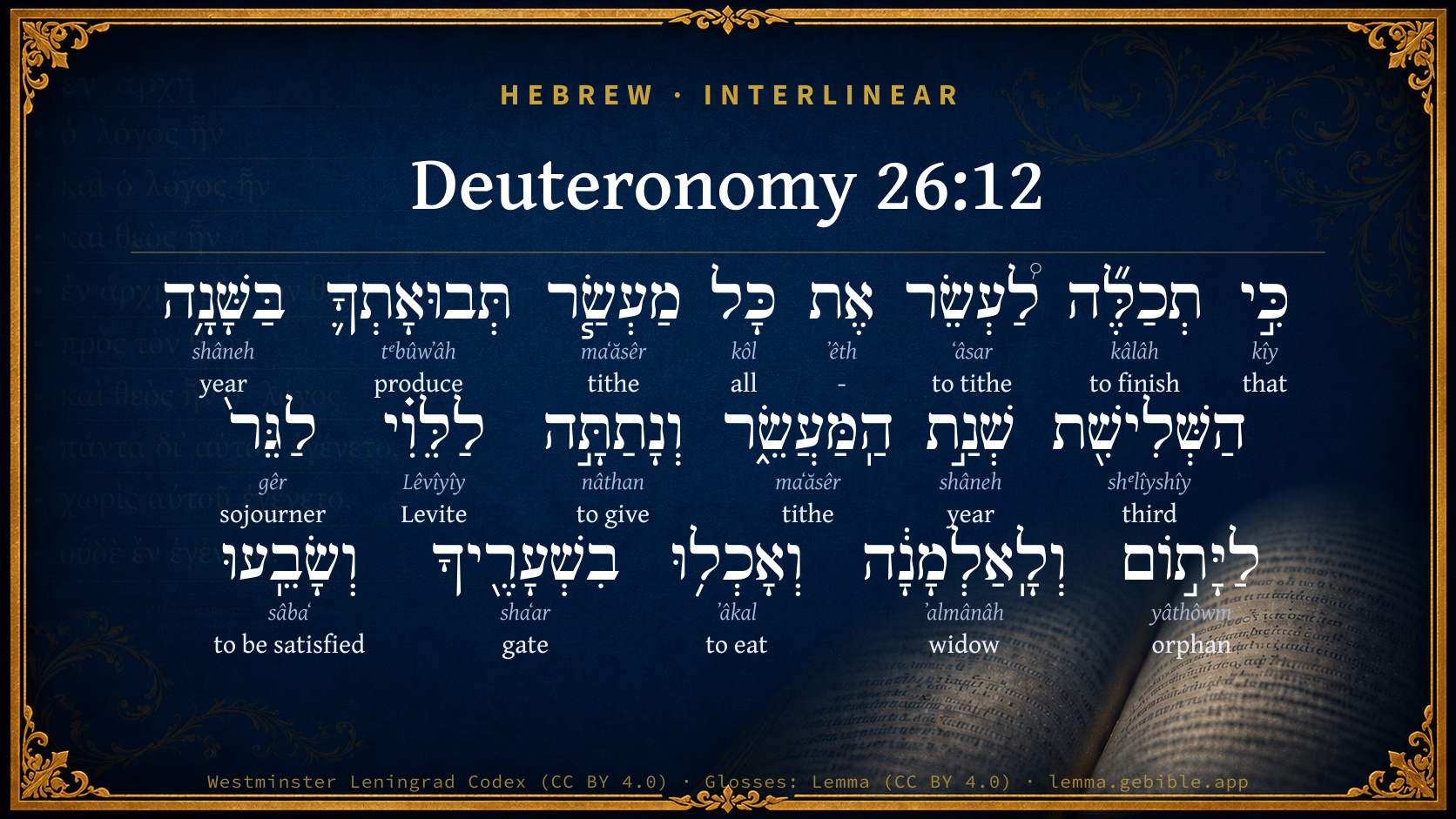
  1. כִּ֣י kîy H3588 “that” Conjunction
  2. תְכַלֶּ֞ה kâlâh H3615 “to finish” Verb, Piel, Imperfect, 2nd Person, Masculine, Singular
  3. אֶת ʼêth H853 “-” Particle, Direct Object
  4. כָּל kôl H3605 “all of” Noun, Common, Masculine, Singular, Construct
  5. מַעְשַׂ֧ר maʻăsêr H4643 “tithe of” Noun, Common, Masculine, Singular, Construct
  6. תְּבוּאָתְךָ֛ tᵉbûwʼâh H8393 “produce · your” Noun, Common, Feminine, Singular, Construct + Suffix, Personal, 2nd Person, Masculine, Singular
  7. בַּשָּׁנָ֥ה shâneh H8141 “in/at the · year” Preposition, Determined + Noun, Common, Feminine, Singular, Absolute
  8. הַשְּׁלִישִׁ֖ת shᵉlîyshîy H7992 “the · third” Particle, Definite Article + Adjective, Ordinal number, Feminine, Singular, Absolute
  9. שְׁנַ֣ת shâneh H8141 “year of” Noun, Common, Feminine, Singular, Construct
  10. הַֽמַּעֲשֵׂ֑ר maʻăsêr H4643 “the · tithe” Particle, Definite Article + Noun, Common, Masculine, Singular, Absolute
  11. וְנָתַתָּ֣ה nâthan H5414 “and · to give” Conjunction + Verb, Qal, Sequential Perfect, 2nd Person, Masculine, Singular
  12. לַלֵּוִ֗י Lêvîyîy H3881 “to/for the · Levite” Preposition, Determined + Noun, Gentilic, Masculine, Singular, Absolute
  13. לַגֵּר֙ gêr H1616 “to/for the · sojourner” Preposition, Determined + Noun, Common, Masculine, Singular, Absolute
  14. לַיָּת֣וֹם yâthôwm H3490 “to/for the · orphan” Preposition, Determined + Noun, Common, Masculine, Singular, Absolute
  15. וְלָֽאַלְמָנָ֔ה ʼalmânâh H490 “and · to/for the · widow” Conjunction + Preposition, Determined + Noun, Common, Feminine, Singular, Absolute
  16. וְאָכְל֥וּ ʼâkal H398 “and · to eat” Conjunction + Verb, Qal, Sequential Perfect, 3rd Person, Common, Plural
  17. בִשְׁעָרֶ֖יךָ shaʻar H8179 “in/at · gates · your” Preposition + Noun, Common, Masculine, Plural, Construct + Suffix, Personal, 2nd Person, Masculine, Singular
  18. וְשָׂבֵֽעוּ sâbaʻ H7646 “and · to be satisfied” Conjunction + Verb, Qal, Sequential Perfect, 3rd Person, Common, Plural

About this verse

These counts appear in no published source. They are computed here, from the morphology-tagged text and Lemma’s own curated glosses. What Lemma adds →

19
words
17
distinct lemmas
Pentateuch
section

Notable vocabulary

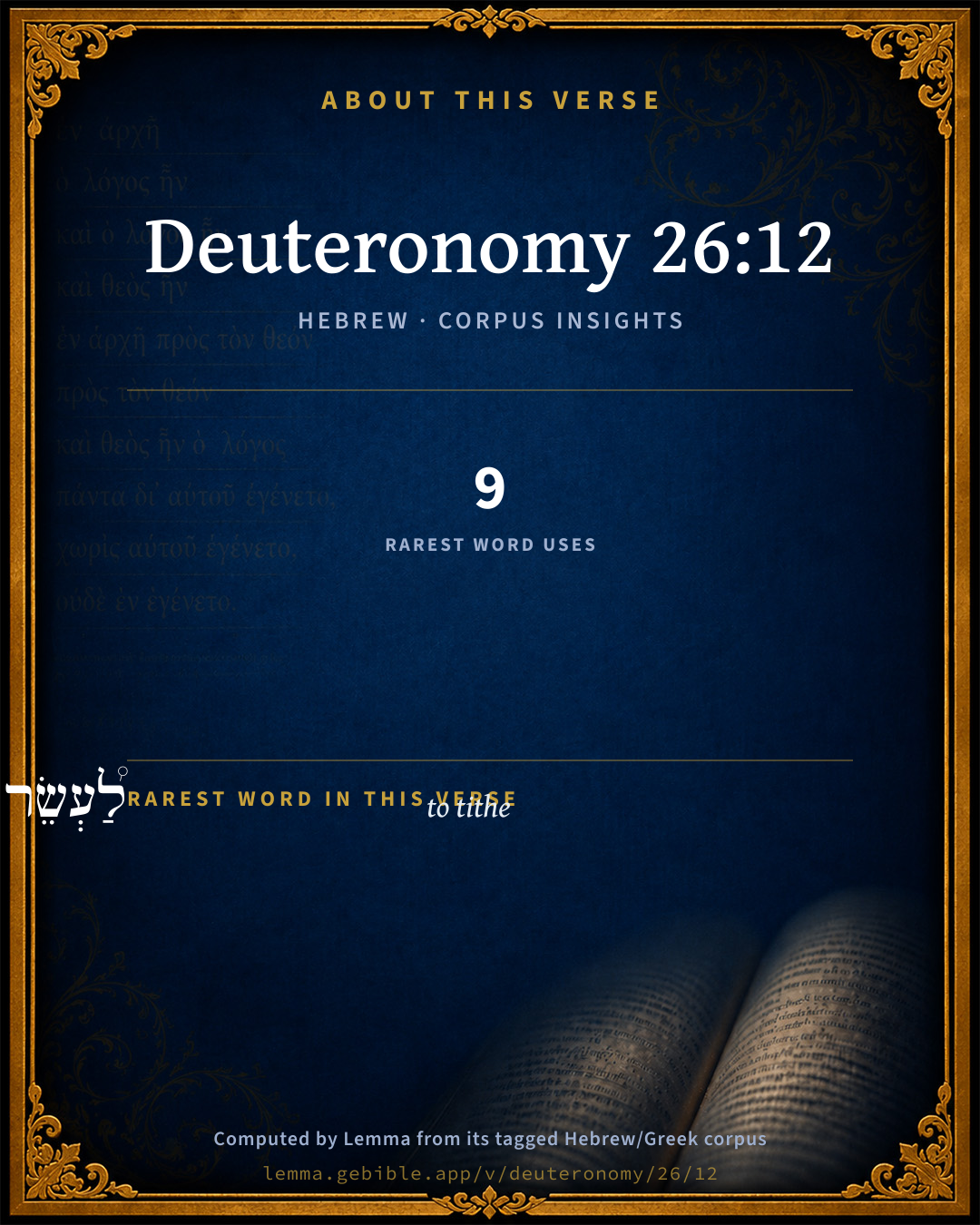
The rarest word here is לַ֠עְשֵׂר to tithe H6237 — appearing just 9 times in the whole Hebrew Bible.

Shared distinctive vocabulary

לַ֠עְשֵׂר to tithe H6237 occurs in 7 verses of the Hebrew Bible. Also found in:

Grammatical profile

  • 5 verbs
  • 11 nouns
  • 1 adjective
  • 1 conjunction
  • 1 particle

Verb forms

  • תְכַלֶּ֞ה Piel · Imperfect
  • לַ֠עְשֵׂר Piel · Infinitive Construct
  • וְנָתַתָּ֣ה Qal · Sequential Perfect
  • וְאָכְל֥וּ Qal · Sequential Perfect
  • וְשָׂבֵֽעוּ Qal · Sequential Perfect

Repetition

Words recur within this verse — often emphatic in Hebrew:

  • מַעְשַׂ֧ר tithe H4643 ×2
  • בַּשָּׁנָ֥ה year H8141 ×2

Hebrew & Septuagint length

In English translation the verse runs 52 words from the Hebrew and 42 from the Septuagint (LXX English) — closely comparable.

A rough comparison of the two English renderings, which tokenize alike — not a word-level alignment.

Word counts can differ between the Hebrew and the Greek without any difference in meaning — e.g. the Hebrew direct-object marker אֵת has no separate Greek word, and Greek often adds the article ὁ.

Cross-references

9

Topical passages linked to Deuteronomy 26:12 in the Treasury of Scripture Knowledge — connected by theme and wording, ordered by reader-vote popularity; previews shown in the World English Bible.

  • Leviticus 27:30 "'All the tithe of the land, whether of the seed of the land or of the fruit of the trees, is Yahweh's. It is holy to Yahweh.
  • Numbers 18:24 For the tithe of the children of Israel, which they offer as a heave-offering to Yahweh, I have given to the Levites for an inheritance: therefore I have said to them, Among the children of Israel they shall have no inheritance.
  • Philippians 4:18–19 But I have all things, and abound. I am filled, having received from Epaphroditus the things that came from you, a sweet-smelling fragrance, an acceptable and well-pleasing sacrifice to God.
  • Deuteronomy 14:22–29 You shall surely tithe all the increase of your seed, that which comes forth from the field year by year.
  • Proverbs 14:21 He who despises his neighbor sins, But blessed is he who has pity on the poor.
  • Hebrews 7:5 They indeed of the sons of Levi who receive the priest's office have a commandment to take tithes of the people according to the law, that is, of their brothers, though these have come out of the loins of Abraham,
  • Deuteronomy 12:17–19 You may not eat within your gates the tithe of your grain, or of your new wine, or of your oil, or the firstborn of your herd or of your flock, nor any of your vows which you vow, nor your freewill-offerings, nor the heave-offering of your hand;
  • Deuteronomy 16:14 and you shall rejoice in your feast, you, and your son, and your daughter, and your man-servant, and your maid-servant, and the Levite, and the foreigner, and the fatherless, and the widow, who are within your gates.
  • Hebrews 7:9 So to say, through Abraham even Levi, who receives tithes, has paid tithes,

Cross-references courtesy of OpenBible.info (CC BY 4.0).

Hebrew and Greek witnesses Masoretic Hebrew ↔ Greek Septuagint

The same verse in the two great witnesses to the Old Testament, shown verse-for-verse.

These are two independent witnesses, not word-aligned to each other, and the Septuagint is shown in lemma (dictionary) form.

Hebrew Deuteronomy 26:12 Masoretic · Westminster Leningrad Codex

כִּ֣י תְכַלֶּ֞ה לַ֠עְשֵׂר אֶת כָּל מַעְשַׂ֧ר תְּבוּאָתְךָ֛ בַּשָּׁנָ֥ה הַשְּׁלִישִׁ֖ת שְׁנַ֣ת הַֽמַּעֲשֵׂ֑ר וְנָתַתָּ֣ה לַלֵּוִ֗י לַגֵּר֙ לַיָּת֣וֹם וְלָֽאַלְמָנָ֔ה וְאָכְל֥וּ בִשְׁעָרֶ֖יךָ וְשָׂבֵֽעוּ

When you have made an end of tithing all the tithe of your increase in the third year, which is the year of tithing, then you shall give it to the Levite, to the foreigner, to the fatherless, and to the widow, that they may eat within your gates, and be filled.

World English Bible · Public Domain

Greek LXX Deuteronomy 26:12 Septuagint · lemma form

ἐάν δέ συντελέω ἀποδεκατόω πᾶς ὁ ἐπιδέκατος ὁ γένημα ὁ γῆ σύ ἐν ὁ ἔτος ὁ τρίτος ὁ δεύτερος ἐπιδέκατος δίδωμι ὁ λευίτης καί ὁ προσήλυτος καί ὁ ὀρφανός καί ὁ χήρα καί ἐσθίω ἐν ὁ πόλις σύ καί ἐνπίμπλημι

And when you shall have completed all the tithings of your fruits in the third year, you shall give the second tenth to the Levite, and stranger, and fatherless, and widow; and they shall eat it in your cities, and be merry.

LXX2012 (modern English Septuagint) · Public Domain

On this verse, The Pulpit Commentary discusses the Septuagint’s reading. Read the note in Commentary ↓

Hebrew: Westminster Leningrad Codex (CC BY 4.0). Greek: Septuagint (public domain); English from LXX2012 (modern English Septuagint) (Public Domain). How the Septuagint differs from the Hebrew →

Targum (Aramaic paraphrase)

2

The Targum is the ancient Jewish Aramaic paraphrase of the Hebrew Scriptures — an interpretive translation, not the Hebrew text itself. Onkelos (literal) and Pseudo-Jonathan (expansive) render the Torah, and Jonathan the Prophets. Coverage is partial: where no permissively-licensed English translation exists for a verse, only the Aramaic is shown. This is verse-level text, not a word-by-word alignment to the Hebrew.

  1. Targum Onkelos Torah (Genesis–Deuteronomy)
    אֲרֵי תְשֵׁצֵי לְעַשָׂרָא יָת כָּל מַעְשַׂר עֲלַלְתָּךְ בְּשַׁתָּא תְלִיתָאָה שְׁנַת מַעְשְׂרָא וְתִתֵּן לְלֵוָאֵי לְגִיוֹרָא לְיִתַּמָא וּלְאַרְמְלָא וְיֵכְלוּן בְּקִרְוָיךְ וְיִשְׂבְּעוּן

    (no public-domain English translation for this verse)

    Targum Onkelos — Aramaic: “Onkelos Genesis” (public domain); “Onkelos Exodus” (public domain); “Onkelos Leviticus” (public domain); “Onkelos Numbers” (public domain); “Onkelos Deuteronomy” (public domain). English: “Sefaria Community Translation” (CC0 1.0 (public-domain dedication)); “J.W. Etheridge. The Targums of Onkelos and Jonathan Ben Uzziel on the Pentateuch. London: Longmans, Green, 1862” (public domain). Text via Sefaria.

  2. Targum Pseudo-Jonathan Torah (Genesis–Deuteronomy)
    אֲרוּם תְּשֵׁיצוּן לְעַשְרָא יַת כָּל מַעֲשַר עֲלַלְתָּךְ בְּשַׁתָּא תְלִיתֵיתָא דִשְׁמִיטִיתָא וְתִתְּנוּן מַעַשְרָא קַמָאָה לְלֵיוָאֵי מַעַשְרָא תִּנְיָינָא הוּא מַעֲשַר מִסְכְּנַיָא לְגִיוֹרָא לְיַתְמָא וּלְאַרְמַלְתָּא וְיֵיכְלוּן בְּקִרְוָוךְ וְיִשְבְּעוּן

    When you make an end of tything all the tenths of your produce in the third year, which is the year of release, you shall give the first tenth to the Levites, the second tenth, which is the tythe of the poor, to the stranger, the orphan, and widow, that they may eat in your cities, and be satisfied.

    Targum Pseudo-Jonathan — Aramaic: “Targum Jonathan on Genesis” (public domain); “Targum Jonathan on Exodus” (public domain); “Targum Jonathan on Leviticus” (public domain); “Targum Jonathan on Numbers” (public domain); “Targum Jonathan on Deuteronomy” (public domain). English: “The Targum of Jonathan ben Uzziel, trans. J. W. Etheridge, London, 1862” (public domain). Text via Sefaria.

Commentary

Notes on Deuteronomy 26:12 from classic Christian and Jewish commentators (each source and its license shown beneath its notes). The classic Christian expositions comment on the surrounding passage and are grouped to its opening verse, so a note may address several verses; the Jewish commentaries on the Tanakh (Rashi and others) are per-verse, so they appear only where the commentator wrote on this verse.

Lemma curates 59 commentaries, every one of them public domain or Creative Commons licensed, each selected and text-cleaned for this edition rather than reprinted as found. About our sources →

Matthew Henry's Commentary

Concerning the disposal of their tithe the third year we had the law before, Deu 14:28, Deu 14:29. The second tithe, which in the other two years was to be spent in extraordinaries at the feasts, was to be spent the third year at home, in entertaining the poor. Now because this was done from under the eye of the priests, and a great confidence was put in the people's honesty, that they would dispose of it according to the law, to the Levite, the stranger, and the fatherless (Deu 26:12), it is therefore required that when at the next feast after they appeared before the Lord they should there testify (as it were) upon oath, in a religious manner, that they had fully administered, and been true to their trust.

I. They must make a solemn protestation to this purport, Deu 26:13, Deu 26:14. 1. That no hallowed things were hoarded up: "I have brought them away out of my house, nothing now remains there but my own part." 2. That the poor, and particularly poor ministers, poor strangers, and poor widows, had had their part according to the commandment. It is fit that God, who by his providence gives us all we have, should by his law direct the using of it, and, though we are not now under such particular appropriations of our revenue as they then were, yet, in general, we are commanded to give alms of such things as we have; and then, and not otherwise, all things are clean to us. Then we may take the comfort of our enjoyments, when God has thus had his dues out of them. This is a commandment which must not be transgressed, no, not with an excuse of its being forgotten, Deu 26:13. 3. That none of this tithe had been misapplied to any common use, much less to any ill use. This seems to refer to the tithe of the other two years, which was to be eaten by the owners themselves; they must profess, (1.) That they had not eaten of it in their mourning, when, by their mourning for the dead, they were commonly unclean; or they had not eaten of it grudgingly, as those that all their days eat in darkness. (2.) That they had not sacrilegiously alienated it to any common use, for it was not their own. And, (3.) That they had not given it for the dead, for the honour of their dead gods, or in hope of making it beneficial to their dead friends. Now the obliging of them to make this solemn protestation at the three years' end would be an obligation upon them to deal faithfully, knowing that they must be called upon thus to purge themselves. It is our wisdom to keep conscience clear at all times, that when we come to give up our account we may lift up our face without spot. The Jews say that this protestation of their integrity was to be made with a low voice, because it looked like a self-commendation, but that the foregoing confession of God's goodness was to be made with a loud voice to his glory. He that durst not make this protestation must bring his trespass-offering, Lev 5:15.

II. To this solemn protestation they must add a solemn prayer (Deu 26:15), not particularly for themselves, but for God's people Israel; for in the common peace and prosperity every particular person prospers and has peace. We must learn hence to be public-spirited in prayer, and to wrestle with God for blessings for the land and nation, our English Israel, and for the universal church, which we are directed to have an eye to in our prayers, as the Israel of God, Gal 6:16. In this prayer we are taught, 1. To look up to God as in a holy habitation, and thence to infer that holiness becomes his house, and that he will be sanctified in those that are about him. 2. To depend upon the favour of God, and his gracious cognizance, as sufficient to make us and our people happy. 3. To reckon it wonderful condescension in God to case an eye even upon so great and honourable a body as Israel was. It is looking down. 4. To be earnest with God for a blessing upon his people Israel, and upon the land which he has given us. For how should the earth yield its increase, or, if it does, what comfort can we take in it, unless therewith God, even our own God, gives us his blessing? Psa 67:6.

Matthew Henry's Commentary on the Whole Bible (1708–1710) — public domain (CC PDM 1.0). Text via the HelloAO Bible API.

Ellicott's Commentary for English Readers

Deu_26:12-15. DECLARATION OF THE TITHE.

(12) When thou hast made an end.—The time fixed for making the confession prescribed in Deu_26:13-15, according to Jewish usage, was the Passover-eve of the fourth year, i.e., the first feast after the completion of the year of tithing. It would seem that something was still to be gathered from the trees after the Feast of Tabernacles, and thus there would still be some produce untithed at that feast in any given year. But the tithe of the third year must be separated to the very last item before the Passover of the fourth.

The third year, which is the year of tithing.—See Deu_14:28-29. In the third and sixth years, the second tithe, which in other years was eaten by the owners (in kind or value) at Jerusalem, was given to the poor, and was called the poor’s tithe. In Talmudical language, the Ma’aser ani took the place of Ma’aser shêni in these years.

Thus the words “and hast given it unto the Levite,” are applied to the first tithe, which was never omitted, and which is prescribed by Numbers 18. The words that follow, “the stranger, the fatherless, and the widow,” are interpreted of the poor’s tithe. The prescribed confession is not to be made until all the tithe has been given, both first and second, i.e., the annual tithe to the Levites, and the second, which was in these years devoted to the poor.

That they may eat within thy gates, and be filled.—The quantity with which they were to be satisfied was duly prescribed by the Jewish scribes!

(13) Thou shalt say before the Lord thy God, I have brought away.—Literally, I have consumed, or burned out. It is the same strong word used so frequently in this book for “putting away” evil, and from which the name Taberah, “burning,” is derived. It is taken by Jewish commentators to include everything that could possibly be required as holy under any law, whether tithe, or firstfruit of trees not yet made common, or anything that from any cause had not been brought to Jerusalem during the three previous years.

I . . . have given . . . unto the Levite (the first tithe), and unto the stranger. . . . (the poor’s tithe).—Rashi.

According to all thy commandments—i.e., “giving everything in its due order” (Rashi). The following words are also taken to refer to the details of the law respecting these matters.

(14) I have not eaten thereof in my mourning.—“When I was clean and they were unclean, or when they were clean and I was unclean” (Rashi). The tomb or presence of a dead body made both persons and things unclean (Numbers 19).

Neither have I taken away.—Literally, consumed any of them in uncleanness.

Nor given ought thereof for (or to) the dead.—Rashi explains, “to provide for him a coffin or grave-clothes.” Another explanation, which is certainly possible, is, “I have not made any offering to an idol from them.” “They joined themselves to Baal-peor, and ate the sacrifices of the dead” (Psa_106:28).

I have hearkened . . . and have done according to all that thou hast commanded me.—A claim which might be truly made as to outward observances and requirements. I am therefore the more disposed to take the confession in these verses in its most literal sense, and to limit it to the particular things with which it was connected—the tithes and offerings.

(15) Look down from thy holy habitation, from heaven.—A phrase like this occurs frequently in Solomon’s prayer; but there is a difference there in the Hebrew, which is less beautiful than in this place. The exact phrase is found in 2Ch_30:27. And in 2Ch_36:15, we have “His dwelling-place” applied to Jerusalem and the Temple. This suggests that the thought here may be twofold. Look down from the dwelling-place of Thy holiness here below, and not only thence, but from thine own dwelling-place in heaven.

And bless thy people Israel, and the land (literally, the ground) which thou hast given us.—“We have done what Thou hast decreed for us. Do Thou that which it rests with Thee to do” (Rashi).

A Bible Commentary for English Readers, edited by Charles John Ellicott (1878–1897) — public domain. Text from a community e-Sword module.

Trapp's Complete Commentary

John Trapp

Deu 26:12 When thou hast made an end of tithing all the tithes of thine increase the third year, [which is] the year of tithing, and hast given [it] unto the Levite, the stranger, the fatherless, and the widow, that they may eat within thy gates, and be filled;

Ver. 12. The stranger, the fatherless.] Thus God doth not only plead the poor man’s cause; {Deu 15:10-11} but he allots a portion of the third year’s tithe, not only to the Levite, who is never excluded, but to the stranger, fatherless, and widow, as Jerome observeth and calleth it πτωκοδεκαδη, the poor man’s tithe.

John Trapp, A Commentary or Exposition upon All the Books of the Old and New Testament (1647–1656) — public domain. Text from a community e-Sword module.

Joseph Benson's Commentary

Deu 26:12. The third year, which was the year of tithing — Hebrews of that tithe; that is, of the tithe for the poor, commanded to be paid every third year, and instead of being carried to the place of the sanctuary, there to be eaten with joy before the Lord, was to be spent at home in entertaining their poor neighbours, and the Levites who lived in or near the place of the owner: see Deu 14:27-29; where this tithe is enjoined. Of the other yearly tithes, see on Deu 14:22-23.

Joseph Benson's Commentary on the Old and New Testaments (1811–1818) — public domain. Text from a community e-Sword module.

The Pulpit Commentary

Vers. 12-15. On the occasion of presenting the tithes, a special service was also to be made. The tithe here referred to is the vegetable or predial tithe, which, at the end of each third year, as here prescribed, was to be converted into a gift to the poor and needy. This, properly the second tithe (LXX, toteron ejpidekaton), but usually called the third tithe (RAPC Tob 1:7, 8; Josephus, "Antiq.," 4:8, 22), is quite distinct from the Levitical tithe prescribed in Lev_27:30-33 and Num_18:21-32; and it is a mistake to suppose that the law here was designed to contravene or supersede that in the earlier books (see Kitto, "Bibl. Cycl.," 3:1010). As this tithe completed the triennial series of tithes which the Israelites had to offer, it was fitting that in presenting it a solemn declaration should be made by the offerer to the effect that he had honorably and conscientiously discharged all the obligations in this respect which the Law laid upon him. The third year, which is the year of tithing. As each week ended with a Sabbath, so a sabbatical year ended each cycle or week of years; and as on it no tithes were levied, "the year of tithing" here specified would be the third and the sixth years in each septennial period.

Vers. 12-15. Integrity in the will a condition of acceptable and successful prayer.

We do not recall any passage in this book, on which we have as yet touched, that conveys a more striking impression than this of the purity and heart-searchingness of the Law of God. For elucidation of the several points of detail, the reader may consult the expository section. For our purpose now it is enough to say that it is assumed that the people will faithfully carry out the precepts and ordinances of God with regard to the tithes, to the offerings, to the poor, the fatherless, and widow, and the specific injunctions with respect to ceremonial purity. When this is done, so that they can declare it before the Lord, (See Keil on this phrase in ver. 13) then they may also plead with God for a blessing. They, having, with a clear conscience and an upright will, fulfilled to the extent of their knowledge the requirements of their holy religion, may then come and entreat their God for his benediction and smile, according to his promise. Hence we have presented to us for homiletic teaching the all-important topic Integrity in the fulfillment of Divine commands a condition of acceptable prayer. We propose to show how constantly this principle is recognized in the Word of God, by a comparison of Scripture with Scripture.

Prayer is an inestimable privilege. That weak and sinful man should be permitted to unburden his spirit to the Father of spirits is a mercy so great, that no words can adequately express it. It is only on the ground of the One Sacrifice of Christ, of which the Hebrew sacrifices were but foreshadowings, that such fellowship between God and sinful man is vouchsafed. We may pray, because we "are not under Law, but under grace." But though through the aboundings of mercy sinful men are permitted to pray, yet it is on the understanding that they repent of their sin. And true though it be that we are under grace and not under Law, yet grace brings with it its own law; it is no license to lawlessness. Throughout the Word of God this precious privilege is guarded from abuse. Prayer is not thrown open promiscuously. The shriek of a terrified man or the query of an inquisitive man is not prayer. "The fear of the wicked, it shall come upon him; but the desire of the righteous shall be granted." "The sacrifice of the wicked is an abomination to the Lord; but the prayer of the upright is his delight." Let us trace the recognition of this chronologically.

I JOB KNEW OF IT. He asks in Job_27:9, concerning a Hypocrite,"will God hear his cry when trouble cometh upon him?

II DAVID TEACHES IT LIKEWISE. in Psa_66:18, "If I regard iniquity in my heart, the Lord will not hear me." He expects no answer to his prayer if in his inmost soul there is any tolerance of sin.

III SOLOMON INDICATES THIS TRUTH. In the prayer at the dedication of the temple, See Keil on this phrase in ver. 13. 1Ki_8:35, 1Ki_8:36, "If they pray towards this place, and confess thy Name, and turn from their sin... then hear thou," etc. In the Book of Proverbs the same truth is repeatedly taught. (Pro_11:20 Pro_15:8, 29 21:13, 27) True penitence and integrity of will are necessary conditions of appropriate prayer.

IV ISAIAH IS BIDDEN TO PROCLAIM IT. in Isa_1:18, there are words of priceless worth, which may well be a comfort to every penitent; but they are often quoted without sufficient prominence being given to the words which precede: "Wash you, make you clean; put away the evil of your doings from before mine eyes; cease to do evil; learn to do well," etc.; then follow the words, "Come now, and let us reason together," etc. Past sin is forgiven when it is forsaken, and only then.

V EZEKIEL DECLARES THE SAME. There came to him certain of the elders of Israel, and stood before him to inquire of the Lord. (see Eze_14:1-11) Ezekiel is bidden to tell them that it is useless to inquire of God if they were cherishing any hidden sin; it would be a stumbling-block of iniquity, that would prevent any answer coming from God. How grievously the disheartened Saul found this out! (1Sa_28:6)

VI MALACHI DECLARES THE LIKE LAW. He tells the people that they have withholden the tithes from God, and that consequently God is withholding the blessing from them oil (1-12). Thus in the varied ages of the Jewish Church this truth is uniformly taught, that cherished sin will block up the way of an answer to prayer.

VII NOR IS THIS PRINCIPLE REPEALED UNDER THE NEW ECONOMY. Our Lord taught it. See Mat_5:23, Mat_5:24, in which we are forbidden to present any offering to God while anger towards a brother is cherished in the heart. in Mat_6:15, we are assured that he who forgives not is not forgiven. in Joh_15:7, Joh_15:16, our Lord shows his disciples that the condition of their freedom and success in prayer is fruitful obedience. The Apostle James also warns those to whom he is writing that the non-success of their prayer is owing to impurity in the will, and if they would that God should draw nigh to them, they must return unto him. (Jam_4:3-8)

Possibly at this stage, or earlier, a difficulty may have suggested itself. It may be said (cf. Luk_18:11, Luk_18:12) in that passage the Pharisee, who had been most punctilious in his discharge of sundry obligations, and most austerely proper in his outward conduct, is yet rejected. How is this? The reply is threefold.

1. He did not pray at all. Not one petition did he offer.

2. He thanked God he was so good! As if there were any merit in simply doing one"s duty, or any cause for self-gratulation.

3. He looked down with scorn on others. He "exalted himself." His spirit was wrong, though his observances might be right. Conscious rectitude of purpose, and self-complacency over-performances, need never be confounded, and only where they are so can this difficulty arise.

In conclusion

1. While we thank God for permission to pray, let us ever guard the dignity of prayer.

2. The mournful thought "is suggested, How many there are who seem to be doing what they can to make it useless for them to pray! A man who tells lies over the counter cannot pray. A man who bribes or who accepts a bribe cannot pray. A man who forgives not, asks uselessly for forgiveness. The only advice to be given to such is to repeat the apostolic demand, "Repent, therefore, of this thy wickedness, and pray.

3. How diligently should we, at times, search into our own hearts, to see if we are zealously putting away "the leaven of malice and wickedness!" The possibility that any secret sin may be shutting off any answer to our prayers should make us cry fervently, "Search me, O God, and know my heart; try me, and know my thoughts; and see if there be any wicked way in me, and lead me in the way everlasting.

4. Let none rush to the opposite extreme. Let none be disheartened at the stringency of the demands of God"s grace; rather let the heart be unreservedly opened to God in gratitude for his holiness, and for his desire for the absolute purity of his people; rather let us be supremely solicitous to be "upright in heart." It is not where there is a distressing consciousness of falling in execution below our desires and yearnings that prayer is blocked out. Far from this. But the desire to cherish sin, or the refusal to do the will of God, makes prayer itself useless and sinful, because the heart whole does not submit entirely to God.

The year of tithing.

Why so called? A double tithe was taken each year the ordinary Levitical tithe, (Num_18:21-28) which Deuteronomy, without mention, takes for granted; and the festal tithe, ordained as a provision for the sanctuary feasts. (Deu_14:21-27) On the third year a tithe was to be devoted to festivities at home. (Deu_14:28, Deu_14:29) It is usually, but too hastily, assumed that this third tithe was but the second diversely applied. That in itself is unlikely, as the feasts at the sanctuary required to be held on the third and sixth years, as well as on the others, and the provision for these could not well be dispensed with. Neither does it explain the expression, "year of tithing;" for while, on this supposition, the tithe was differently applied, there was nothing unusual in the manner of taking it. Each year was a year of tithing (sabbatical years excepted), and this no more than the rest. The ordinary view, besides, is directly in the teeth of the testimony of Josephus, who may be supposed to have known the practice of his time. His statement distinctly is that one-tenth was to be given to the priests and Levites; one-tenth was to be applied to feasts at the sanctuary; and a tenth besides was, every third year, to be given to the poor. If this was so, we have a natural explanation of the phrase, "the year of tithing," and self-consistency is introduced into the laws. The tithe-laws in Deuteronomy are often represented as if in conflict with those in Leviticus and Numbers. Part of the plausibility of the objection lies in the use of the definite article in the English versionall the tithe" (Deu_14:28 Deu_26:12) which gives an impression of allusion to the ordinary, the well-known tithe. That impression is not created if we take the plain Hebrew whole tithe which by its very nakedness suggests a new regulation. Deuteronomy legislates for its own purposes in connection with the centralizing of the worship at the sanctuary. The newer criticism seems to have abandoned the old ground, which made the Levitical laws the earliest. It assumes that the distinction of priests and Levites, with the body of legislation based on that distinction, took shape not earlier than the exile a view hopelessly in conflict with the histories of the return. Indeed, so great was the disproportion in the numbers of priests and Levites returning with Zerubbabel twelve or thirteen priests for every Levite that the Levitical laws could only have been put in force with material alterations and modifications. They are in some respects singularly inapplicable to the very times in which they are supposed to have originated. J.O.

Vers. 12-15. A good conscience toward God.

This solemn avowal, ordained to be made at the completion of the round of tithe obligations, was a wise safeguard against unpunctuality and neglect.

The subject suggested is The importance of self-examination in respect of the fulfillment of duties of religion.

I SELF-EXAMINATION A DUTY. The text suggests that we examine ourselves:

1. As to religious givings.

2. As to our fulfillment of the duties of hospitality and charity.

3. As to the condition in which these duties have been performed whether from the right motive (regard to God"s commandment), and ina right state (the state of sanctification). Extend the principle to all duties of religion.

Self-examination, to be of service, should be:

1. Comprehensive.

2. Conscientious as "before the Lord thy God" (ver. 13), who cannot be deceived.

1. Periodical, as:

1. At the end of a year.

2. The close of a financial year.

3. Birthdays.

4. Even the end of a week. A review of this kind not an unsuitable Sabbath day"s employment.

II SELF-EXAMINATION A SAFEGUARD.

1. Prevents neglect. Things which we ought to do which, at bottom, we are willing to do get frequently overlooked:

(1) From inadvertency.

(2) From unpunctuality.

(3) From habits of procrastination.

A review of the kind proposed would bring many of these forgotten duties to recollection, and would act as a check on the causes of forgetfulness.

1. Brings practice into comparison with the standard of obligation. When duty is known, it does not follow that it is always done, or that we are always aware of the extent of our shortcomings. We may be greatly deceiving ourselves in this very particular. There may grow upon us the vicious habit of comparing ourselves with others rather than with the standard of the Divine Law. And nowhere is self-deception more common than in the matter of religious and charitable givings. People will be heard expatiating on the vexatiousness of the calls of this kind made on them, who, were they to put their givings all together, would find that they did not amount to so much as they have often spent on the gratification of some whim, perhaps on a single dinner-party. Self-examination would counteract the tendency to take our performances of duty so readily for granted. It would e.g. require the rich man to measure his givings directly with his income, and with the proportion of that income which he felt to be due to God.

2. Reminds us of the obligations themselves. For, besides the shortcomings in practice referred to, there is often no little danger that the standard of duty itself may get to be lost sight of.

3. Makes hypocrisy more difficult. The withholder of the tithes would scarcely venture to stand before God and make this solemn declaration. His tongue might well cleave to the roof of his mouth if he attempted it. He would feel that he must either go and do what he ought or hold his peace. The hypocritical professor shuns self-examination.

Two thoughts in closing:

1. We cannot expect blessing, save as duties are honorably fulfilled (ver. 15).

2. Reflecting on fulfilled duties, we need to beware of Pharisaic pride. J.O. (Luk_18:11, Luk_18:12)

Vers. 12-15. Complete consecration a condition of continued blessing.

The system of social dependence is ordained of God. By a deliberate act of wisdom, God devoted the Levites to poverty, or rather to an equitable interest in the whole land. The necessities of some are created as the most fitting outlets for the charity of others.

I MEN ARE APPOINTED TO BE GOD"S ALMONERS. Not more really does the sovereign of an empire employ persons of rank to be his stewards and almoners than God employs us. To expend upon ourselves the whole of our earthly possessions is sin is the worst of sins is sacrilege. We hold in our keeping God"s property. We are not at liberty to use it as we please. Nor is the amount which appertains to God determined by the caprice of human inclination. A definite portion is God"s, and becomes in the highest sense trust property. One-tenth of all our gains is the fixed proportion claimed by God. God identifies himself with the Levite, the widow, the fatherless. The Levites are his messengers. The poor are his friends. To deny them is to wrong him; and he will surely avenge the insult. On stated occasions, viz. triennially, each proprietor was required to render an account of his stewardship, and to make a solemn declaration that he had faithfully discharged his momentous trust. As often as we supplicate new favors we virtually protest our faithfulness.

II SURRENDER TO GOD A CONDITION OF SUCCESSFUL PRAYER. In this passage the Hebrews were taught not to ask for God"s blessing upon their land until they had confessed their complete surrender to God"s revealed will. Pride bars the door which keeps out Divine favors. Pride chokes the channels so that the stream of God"s bounty cannot flow. In like manner God acts in our earthly life. He will not give health except through the channel of food. He will not give strength except through the channel of exercise. He will not allow us to use steam or electricity except by surrender to his material laws. We do not really pray so long as any part of our nature is rebellious against his will. Lip-prayer is counterfeit. Genuine prayer is the up-going of the whole man.

III GOD"S SOLEMN PLEDGES ARE CONDITIONED BY EARNEST PRAYER. God had sworn to the patriarchs to give this goodly land to their seed, yet his oath implied trust, surrender, prayer, upon their part. Indeed, if these things had been wanting in the Hebrews, no external possession would have been a blessing: Canaan would have been a curse. Material light is no boon unless there be an organ of human vision to enjoy it unless the eye be open. Nothing really benefits a man until it actually enters his nature and becomes a part of himself. This is God"s efficient act. "Ask, and ye shall receive." For all things promised of God, "he will yet be inquired of." Prayer gives the final fitness to receive. D.

Vers. 12-19. Looking up for the blessing.

The interests of the dependent classes, "the Levite, the stranger, the fatherless, and the widow," being considered and secured by the tithing of the third year, the Jew was directed then to look up for the Divine blessing on the land. The tithe was first paid, and then the blessing sought.

I SYSTEMATIC BENEFICENCE SHOULD BE THE PRELIMINARY OF SUPPLICATION FOR BLESSING, AND NOT CONDITIONED UPON IT. There is a temptation to make liberality a matter of speculation, to vow a certain portion if a certain blessing is conferred. Now, this may be all very well regarding what is beyond a tithe, but the tithe is a settled proportion to be promptly and gratefully paid, and the blessing can then be honestly asked when the debt to God has been discharged.

II THE TRULY LIBERAL WILL LOOK FOR SPIRITUAL BLESSING FOR HIS COUNTRY, AND NOT BE CONTENT WITH TEMPORAL. In fact, it was revival, as we should now call it, that the Jew after his tithing sought. And systematic beneficence should be regarded as the indispensable preliminary of revival, if Mal_3:10 has any meaning. It is manifest that illiberality may hinder spiritual blessing, and consequently liberality should be fostered as the manifest test of sincerity regarding blessing. If one is not willing to pay his share that every hindrance of blessing may be removed, he cannot be in earnest about it.

III MOSES, AS THE MEDIATOR, GUARANTEES THE COVENANT BLESSINGS TO THE COVENANT-KEEPING PEOPLE. God had brought Israel out of Egypt, and was about to introduce them to the land of promise, that they might prove his "peculiar people," and be "high above all nations which he hath made, in praise, and in name, and in honor," and above all, be "a holy people." This was his covenant engagement. Hence Moses urges them to keep the commandments God has given them with all their heart and soul, and they shall find how faithful God is.

Obedience is consequently to be the manifestation of their faith in God as "Faithful Promiser." If he gave the blessings in all their fullness first, faith would have no room to grow, and his people would be able to live well enough by sight. But when they are asked to obey and be blessed in and through their obedience, faith has its beautiful sphere. R.M.E.

The Pulpit Commentary (1880–1919), ed. H.D.M. Spence-Jones & Joseph S. Exell — public domain. Text from a community e-Sword module.

Tyndale Open Study Notes

Tyndale Open Resources

26:12 Every third year the tithe was gathered for the Levites and other dependents; see also study note on 14:28.

Tyndale Open Study Notes — © Tyndale Open Resources, licensed CC BY-SA 4.0. Text via the HelloAO Bible API.

Jamieson, Fausset & Brown

Robert Jamieson, A. R. Fausset & David Brown

When thou hast made an end of tithing all the tithes of thine increase the third year--Among the Hebrews there were two tithings. The first was appropriated to the Levites (Num 18:21). The second, being the tenth of what remained, was brought to Jerusalem in kind; or it was converted into money, and the owner, on arriving in the capital, purchased sheep, bread, and oil (Deu 14:22-23). This was done for two consecutive years. But this second tithing was eaten at home, and the third year distributed among the poor of the place (Deu 14:28-29).

Jamieson, Fausset & Brown — Commentary Critical and Explanatory on the Whole Bible (1871) — public domain (CC PDM 1.0). Text via the HelloAO Bible API.

Adam Clarke's Commentary

Verse 12. The third year, which is the year of tithing] This is supposed to mean the third year of the seventh or Sabbatical year, in which the tenths were to be given to the poor. See the law, De 14:28. But from the letter in both these places it would appear that the tithe was for the Levites, and that this tithe was drawn only once in three years.

Adam Clarke's Commentary on the Bible (1810–1826) — public domain. Text from a community e-Sword/MySword module.

The Cambridge Bible for Schools and Colleges

gen. ed. J. J. S. Perowne

12. in the third year … the year of tithing] See on Deu_14:28; the two phrases are in apposition. For the latter LXX reads the second tithing (τὸ δεύτερον ἐπιδέκατον), a reading which even after the vocalic changes which it involves in the Heb. results in an impossible construction. It is due to an attempt to accommodate D’s arrangement for the third year’s tithe to the later practice.

then thou shalt give it] Rather, and thou hast given it; the apodosis does not commence till the next v.

Levite, etc.] See on Deu_14:29.

12–15. The Triennial Distribution of Tithes

When the tithe of the third year is complete and given to the local poor then the giver shall attest before God that it has all been given and that he has not broken any of the relevant laws, and shall pray for a blessing on Israel. The apodosis of the sentence does not begin till Deu_26:13. For the contents see on Deu_14:28 f. and Add. Note there.

The Cambridge Bible for Schools and Colleges (gen. ed. J. J. S. Perowne; Cambridge University Press, 1878–1918) — public domain. Text from a community e-Sword module.

John Gill's Exposition

When thou hast made an end of tithing all the tithes of thine increase,.... Which, according to Maimonides (k), is to be understood of the feast, in which all tithes are finished, which is the feast of the passover:

the third year, which is the year of tithing; that is, the third from every seventh, when the land lay fallow. Every year a tithe was paid to the Levites; and besides that a second tithe, which was carried to Jerusalem and eaten there; and every third year it was eaten at home, in their towns and cities in the country instead of it, with the Levite, poor and stranger, and was called the poor's tithe; and hence the Targum of Jonathan here calls this year the year of the poor's tithe, as was also the sixth year, and was reckoned not complete till the passover in the following year, as the Jewish writers (l) say:

and hath given it unto the Levite, the stranger, the fatherless, and the widow; that is, the poor's tithe of the third year, which these were to eat of with the owner, Deu 14:28; though the Jews commonly distinguish the Levite from the rest, and suppose that both first and second tithes are meant, the one to be given to the former, and the other to the latter; so the Targum of Jonathan and Jarchi:

that they may eat within thy gates, and be filled: for this was a considerable entertainment, a sort of a feast, a full meal, however; hence it is concluded, as Jarchi says, that they did not give less of corn to a poor man than half a kab of wheat, which was above three pints.

(k) In Misn. Maaser Sheni, c. 5. sect. 6. (l) Misn. ib. & Maimon. & Bartenora in ib.

John Gill's Exposition of the Whole Bible (1746–1763) — public domain (CC PDM 1.0). Text via the HelloAO Bible API.

Albert Barnes' Notes on the Bible

See the marginal reference to Numbers and note. A strict fulfillment of the onerous and complicated tithe obligations was a leading part of the righteousness of the Pharisees: compare Mat 23:23.

Albert Barnes' Notes on the Bible (1834–1885) — public domain. Text from a community e-Sword/MySword module.

Haydock's Catholic Bible Commentary

Third. It has been remarked (chap. xiv. 28., and Leviticus xxvii. 30,) that the Jews gave two tithes every year, the second was for feasts at Jerusalem, or on the third year at home, if there was not also a third tithe due on that year. (Haydock)

George Leo Haydock (1774–1849), Haydock's Catholic Family Bible and Commentary, 1859 edition — public domain. Excludes Psalms (Douay-Rheims chapter numbering differs from Protestant) and Deuterocanonical books (Catholic canon only).

Matthew Poole's English Annotations

Of

the tithes, See Poole on "Deu 14:28". The year of tithing, Heb. the year of that tithe; so called, either,

1. Because these tithes were gathered only in that year. Or rather,

2. Because then only they were so bestowed or used; and whereas these second tithes for two years together were eaten only by the owners and Levites, and that in Jerusalem, in the third year they were eaten also by the strangers, fatherless, and widows, and that in their own dwellings. The LXX. join these words with the following, and for shemath, the year, read shenith, the second, and take vau for redundant, as sometimes it is, and read the place thus, The second tithe thou shalt give to the Levite, &c.

Matthew Poole's English Annotations on the Holy Bible (1683–1685) — public domain. Text from a community e-Sword/MySword module.

Whedon's Commentary on the Bible

Daniel D. Whedon

12. Tithing all the tithes — The presentation of tithes was to be accompanied with thanksgiving and prayer. In the third year the second tithe was to be employed in festal meals for the poor. Comp. Deu_14:28. “Since the second tithe did not extend to both flocks and herds it was thrown together with the vegetable portion of the first tithe once in three years. Of this the Levites received their usual share, leaving the entire second tithe for the poor.” — CURTISS’S Levitical Priests, p. 54.

Daniel D. Whedon (gen. ed.), Commentary on the Old and New Testaments (1874–1909) — public domain. Text from a community e-Sword module.

John Wesley's Explanatory Notes

The year of tithing - Hebrew. the year of that tithe, so called, either

1. because these tithes were gathered only in that year. Or rather,

2. because then only they were so bestowed; and whereas these second tithes for two years together were eaten only by the owners and Levites, and that in Jerusalem, in the third year they were eaten also by the strangers, fatherless, and widows, and that in their own dwellings.

John Wesley, Explanatory Notes Upon the Whole Bible (1754–1765) — public domain. Text via the GEBible commentary corpus.

Keil & Delitzsch

C. F. Keil & F. Delitzsch

The delivery of the tithes, like the presentation of the first-fruits, was also to be sanctified by prayer before the Lord. It is true that only a prayer after taking the second tithe in the third year is commanded here; but that is simply because this tithe was appropriated everywhere throughout the land to festal meals for the poor and destitute (Deu 14:28), when prayer before the Lord would not follow per analogiam from the previous injunction concerning the presentation of first-fruits, as it would in the case of the tithes with which sacrificial meals were prepared at the sanctuary (Deu 14:22.). לעשׂר is the infinitive Hiphil for להעשׂר, as in Neh 10:39 (on this form, vid., Ges. 53, 3 Anm. 2 and 7, and Ew. 131, b. and 244, b.). "Saying before the Lord" does not denote prayer in the sanctuary (at the tabernacle), but, as in Gen 27:7, simply prayer before God the omnipresent One, who is enthroned in heaven (Deu 26:15), and blesses His people from above from His holy habitation. The declaration of having fulfilled the commandments of God refers primarily to the directions concerning the tithes, and was such a rendering of an account as springs from the consciousness that a man very easily transgresses the commandments of God, and has nothing in common with the blindness of pharisaic self-righteousness "I have cleaned out the holy out of my house:" the holy is that which is sanctified to God, that which belongs to the Lord and His servants, as in Lev 21:22. בּער signifies not only to remove, but to clean out, wipe out. That which was sanctified to God appeared as a debt, which was to be wiped out of a man's house (Schultz).

Keil & Delitzsch — Biblical Commentary on the Old Testament (1861–1891) — public domain (CC PDM 1.0). Text via the HelloAO Bible API. (Old Testament only.)

Kretzmann's Popular Commentary

Paul E. Kretzmann

The Confession and Prayer with Tithes

v. 12. When thou hast made an end of tithing all the tithes of thine increase the third year, which is the year of tithing, the reference here being to the triennial charity tithe, Deu 14:28-29, and hast given it unto the Levite, the stranger, the fatherless, and the widow that they may eat within thy gates and be filled, have all they need to sustain their lives,

v. 13. then thou shalt say before the Lord, thy God, I have brought away the hallowed things, those devoted to the Lord by His command, out of mine house, and also have given them unto the Levite, and unto the stranger, to the fatherless, and to the widow, according to all Thy commandments which Thou hast commanded me; I have not transgressed Thy commandments, neither have I forgotten them, the very fact that this confession was required served as an inducement to keep the regulation concerning tithes;

v. 14. I have not eaten thereof in my mourning, namely, while engaged in mourning for some dead person, for during that time the Israelite was Levitically unclean, neither have I taken away aught thereof for any unclean use, nor given aught thereof for the dead, namely, by sending it to some friend’s house of mourning, for the use of the mourners, for the house where a dead person lay was regarded as unclean, and hence nothing consecrated to the Lord was permitted to enter; but I have hearkened to the voice of the Lord, my God, and have done according to all that thou hast commanded me.

v. 15. Look down from Thy holy habitation, from heaven, which was looked upon as the throne of Jehovah, Isa 63:15; Zec 2:13, and bless Thy people Israel, and the land which Thou hast given us, as thou swarest unto our fathers, a land that floweth with milk and honey. The believing Israelite included his entire nation in his prayer, just as the Lord taught us Christians to do in the prayer which He Himself formulated.

Paul E. Kretzmann, Popular Commentary of the Bible (1921–1924) — public domain. Text from a community e-Sword module.

unfoldingWord translationNotes

Door43 World Missions Community

General Information:

Moses speaks to the Israelites as if they were one man, so the words "you" and "your" here are singular. (See: Forms of You)

in the third year

This "third" is the ordinal number for three. Every three years the people of Israel gave a tenth of the harvest to the poor. (See: Ordinal Numbers)

fatherless

These are children whose parents have both died and do not have relatives to care for them.

widow

This means a woman whose husband has died and has no children to care for her now that she is old.

eat within your city gates and be filled

Here "gates" means towns or cities. AT: "so that those within your towns may have enough food to eat" (See: Synecdoche)

I have brought out of

These are the first words of another statement that the Israelite was supposed to say.

neither have I forgotten them

This means that he has obeyed all of God's commandments.

translationWords

tenth

harvest

Levi

alien

gate

command

transgress

unfoldingWord translationNotes — © Distant Shores Media and the Door43 World Missions Community, licensed CC BY-SA 4.0. Source: git.door43.org/Door43/en_tn.

Rashi

Rabbi Shlomo Yitzchaki (Rashi)

כי תכלה לעשר את כל מעשר תבואתך בשנה השלישת WHEN THOU HAST FINISHED TITHING ALL THE TITHES OF THY INCREASE IN THE THIRD YEAR — this means: when you have finished the setting apart of the tithes of the third year. It (Scripture) has fixed the time for removing the tithes from the house (ביעור) and the confession regarding their proper disposition (ודוי) for the eve of the Passover festival of the fourth year, because it is stated, (Deuteronomy 14:28) “At the end (מקצה) of three years thou shall bring forth [all the tithe of thy increase in the same year, and shalt lay it up within thy gates]”. It uses here (in the verse just quoted) the words “at the end of” (מקצה) and it states further (Deuteronomy 31:10—11): “At the end of every seven years … [in the festival of Tabernacles, … thou shalt read this law before Israel]” with reference to the law of “public assembly”, in order to suggest an analogy. How is it in the case further on? It takes place at a festival period as stated! So, too, here, the rite takes place at a festival period. If so, one might argue: What is the case there? It takes place on the festival of Tabernacles; so, too, here the rite takes place on Tabernacles! Scripture, however, states here: When thou hast finished tithing the tithes of the third year, which thus points to a festival on which all tithes are finished and this is the Passover festival, for there are many trees the fruits of which are gathered after Tabernacles, and consequently the setting apart of tithes of the third year is at an end on Passover of the fourth year. And whoever had delayed his tithes until then Scripture declares him bound to clear them out by that time from his house (cf. Sifrei Devarim 302; Talmud Yerushalmi Maaser Sheni 5:6).

שנת המעשר [THE THIRD YEAR] WHICH IS THE YEAR OF TITHE — These apparently redundant words (for every year except the Sabbatical year it “a year of tithing”) suggest: that year in which only one of the two tithes that had to be separated in the previous two years is due (שנת המעשר, lit., the year of the tithe), viz., the “First Tithe”. For in the first year of the Shemitta-period the law of the “First Tithe” applies — as it is stated, (Numbers 28:26) “[And to the Levites shalt thou speak …] when ye take of the children of Israel the tithe” (which is the First Tithe) — and that of the “Second Tithe”, as it is stated, (Deuteronomy 14:22—23; cf. Rashi on the latter verse) “[Thou shalt truly tithe all the increase of thy seed … year by year], and thou shalt eat before the Lord thy God … the tithe of thy corn, of thy wine, and of thine oil”. You thus have two tithes every year, one that you must give the Levite and the other which you must consume yourself in Jerusalem (the “Second Tithe”). It now comes and teaches you here that, in the third year, of those two tithes mentioned only one is due, and which is it? It is the “First Tithe”. And that instead of the “Second Tithe” one has to give in the third year (and similarly in the sixth) the “Tithe of the Poor”, for it states here ונתת ללוי “AND THOU HAST GIVEN UNTO THE LEVITE”, i.e. given him that which is due to him — here you have mention of the “First Tithe”, לגר ליתום ולאלמנה “[AND THOU HAST GIVEN] … UNTO THE STRANGER, THE FATHERLESS, AND THE WIDOW” — this is the “Tithe of the Poor” (cf. Sifrei Devarim 303:1; see also Rashi on Deuteronomy 14:23 and 29).

ואכלו בשעריך ושבעו THAT THEY MAY EAT WITHIN THY GATES, AND BE SATISFIED — Give them sufficient to satisfy them. From here they (the Rabbis) derived the law: one must give the poor in the barn no less than half a kab of wheat or a kab of barley (Sifrei Devarim 303:2; Talmud Yerushalmi Peah 8:5; see also Rashi on Deuteronomy 14:29).

Rashi on the Tanakh — English translations: “The Judaica Press complete Tanach with Rashi, translated by A. J. Rosenberg” (CC BY 4.0); “Pentateuch with Rashi's commentary by M. Rosenbaum and A.M. Silbermann, 1929-1934” (public domain); “The Metsudah Tanach series, Lakewood, N.J” (CC BY 4.0); and “The Book of Joshua, Metsudah Publications, 1997” (CC BY 4.0). Text via Sefaria.

Lesson kit

Teaching starters — assembled from the data on this page, not authored interpretation. Every prompt links to the verse data it draws on. Edit before teaching.

Deuteronomy, in the Pentateuch, opens this verse with 19 words (17 distinct Hebrew lemmas). Its most distinctive word is ʻâsar (“to tithe”). A historical commentator’s framing appears above. Read the whole chapter for the surrounding context.

Discussion questions

  1. The word ʻâsar carries the sense “to tithe.” How does it shape the verse?
  2. Genesis 28:22 shares the word «to tithe» with this verse. How do the two illuminate each other?
  3. “tithe” occurs 2× in this one verse. What is the effect of the repetition?
  4. These translations render this verse differently; the difference is in the English rendering, not the original. What questions does that raise?
  5. The verb «תְכַלֶּ֞ה» is Piel Imperfect. How does its form color the action?
  6. Reading how Matthew Henry's Commentary and Ellicott's Commentary for English Readers read this verse, where do the two commentators agree and where do they part?

Things to notice

Reading settings

Reading text

Shown beneath each verse's original-language words.

Old Testament
Old Testament edition

Read the OT as the Masoretic Hebrew (MT) or the Greek Septuagint (LXX).

English shown for the Greek Septuagint (in the Hebrew ↔ Greek comparison).

Comparing translations? Open the Compare panel on any verse page to stack up to four side by side.