
Job 38:17

Hebrew (Westminster Leningrad Codex) Job 38:17 appears in the Hebrew Old Testament. The text above is from the Westminster Leningrad Codex. Each word links to its Strong’s number, a concise gloss, and parsing drawn from the Open Scriptures Hebrew Bible morphology. Click any word for its full Brown-Driver-Briggs (BDB) entry.
Download image
Cite this verse

Job 38:17 (World English Bible). Public Domain. Lemma interlinear Bible study tool, https://lemma.gebible.app/v/job/38/17.

Show BibTeX & RIS
BibTeX
RIS
English Translation
Have the gates of death been revealed to you? Or have you seen the gates of the shadow of death?
World English Bible · Public Domain
Download a study sheet

One document with this verse’s original text, its word-by-word gloss line, the meaning frame, cross-references with their text, attributed commentary, and full source and license credits — printable, and it pastes into notes with its structure intact.

This verse Autodidact and up

Study sheet (.html) Plain text (.txt)

A passage Seminary Student

Up to 50 verses in one chapter. A passage sheet keeps up to 6 commentary sources and 12 cross-references per verse, in the order this page ranks them, and says so on the sheet whenever that leaves anything out. Ask for a single verse and you get the Autodidact verse sheet above.

Everything on this page stays free to read, with no account — the sheet is a download of what is already on screen, not access to it.

Want to remove ads? Support Godless Engineer
Compare translations 3

The same verse in 3 English versions, stacked beneath the original-language interlinear above. Click any original word for its lexicon entry.

Each is an independent rendering of the whole verse — the interlinear is not word-aligned to these translations.

Highlighted words mark where these versions differ — a whole-verse word diff, not a word-by-word alignment.

  • World English Bible Public Domain
    Have the gates of death been revealed to you? Or have you seen the gates of the shadow of death?
  • King James Version Public Domain
    Have the gates of death been opened unto thee? or hast thou seen the doors of the shadow of death?
  • unfoldingWord Literal Text CC BY-SA 4.0
    Have the gates of death been revealed to you? Or have you seen the gates of deep darkness?

unfoldingWord Literal Text — © unfoldingWord, licensed CC BY-SA 4.0. Word-aligned USFM3 via Door43 (git.door43.org/unfoldingWord/en_ult).

Versions to compare (up to 4)

3 of 4 selected

Show all 18 translations

Every available English version of this verse, each an independent rendering of the whole verse.

  • World English Bible Public Domain
    Have the gates of death been revealed to you? Or have you seen the gates of the shadow of death?
  • Berean Standard Bible Public Domain
    Have the gates of death been revealed to you? Have you seen the gates of the shadow of death?
  • Majority Standard Bible Public Domain
    Have the gates of death been revealed to you? Have you seen the gates of the shadow of death?
  • King James Version Public Domain
    Have the gates of death been opened unto thee? or hast thou seen the doors of the shadow of death?
  • American Standard Version (1901) Public Domain
    Have the gates of death been revealed unto thee? Or hast thou seen the gates of the shadow of death?
  • Revised Version (1885) Public Domain
    Have the gates of death been revealed unto thee? or hast thou seen the gates of the shadow of death?
  • Geneva Bible (1599) Public Domain
    Haue the gates of death bene opened vnto thee? or hast thou seene the gates of the shadowe of death?
  • Douay-Rheims (1899) Public Domain
    Have the gates of death been opened to thee, and hast thou seen the darksome doors?
  • Young's Literal Translation Public Domain
    Revealed to thee were the gates of death? And the gates of death-shade dost thou see?
  • Literal Standard Version CC BY-SA 4.0
    Were the gates of death revealed to you? And do you see the gates of death-shade?
  • Unlocked Literal Bible CC BY-SA 4.0
    Have the gates of death been revealed to you? Have you seen the gates of the shadow of death?
  • unfoldingWord Literal Text CC BY-SA 4.0
    Have the gates of death been revealed to you? Or have you seen the gates of deep darkness?
  • Darby Bible Public Domain
    Have the gates of death been revealed unto thee? and hast thou seen the gates of the shadow of death?
  • World Messianic Bible Public Domain
    Have the gates of death been revealed to you? Or have you seen the gates of the shadow of death?
  • Webster's Bible Public Domain
    Have the gates of death been opened to thee? or hast thou seen the doors of the shades of death?
  • Free Bible Version CC BY-SA 4.0
    Have you been shown where the gates of death are? Have you seen the gates of utter darkness?
  • Bible in Basic English Public Domain
    Have the doors of death been open to you, or have the door-keepers of the dark ever seen you?
  • JPS Tanakh (1917) Public Domain
    Have the gates of death been revealed unto thee? Or hast thou seen the gates of the shadow of death?

Literal Standard Version (2020), Covenant Press — licensed CC BY-SA 4.0. Text via the HelloAO Bible API (eBible.org). Unlocked Literal Bible (unfoldingWord) — licensed CC BY-SA 4.0. Text via the HelloAO Bible API (eBible.org). unfoldingWord Literal Text — © unfoldingWord, licensed CC BY-SA 4.0. Word-aligned USFM3 via Door43 (git.door43.org/unfoldingWord/en_ult). Free Bible Version, Dr. Jonathan Gallagher — licensed CC BY-SA 4.0. Text via the HelloAO Bible API (eBible.org).

Word by word

More ways to search: Search by grammar → Find every occurrence → Compare this word →

Practice this passage: Drill this verse → Learn its vocabulary →

צַלְמָ֣וֶת
tsalmâveth
H6757
“shadow of death”
Noun, Common, Masculine, Singular, Absolute
Part of Speech
Noun
Type
Common
Gender
Masculine
Number
Singular
State
Absolute
Full BDB Definition

Origin: from H6738 and H4194

TWOT: 1921b

death-shadow, deep shadow, deep darkness, shadow of death - death-shadow - death-shadow, deep shadow, darkness - death-shadow (of distress, extreme danger) (figuratively) - death-shadow (of place of the dead) (figuratively)
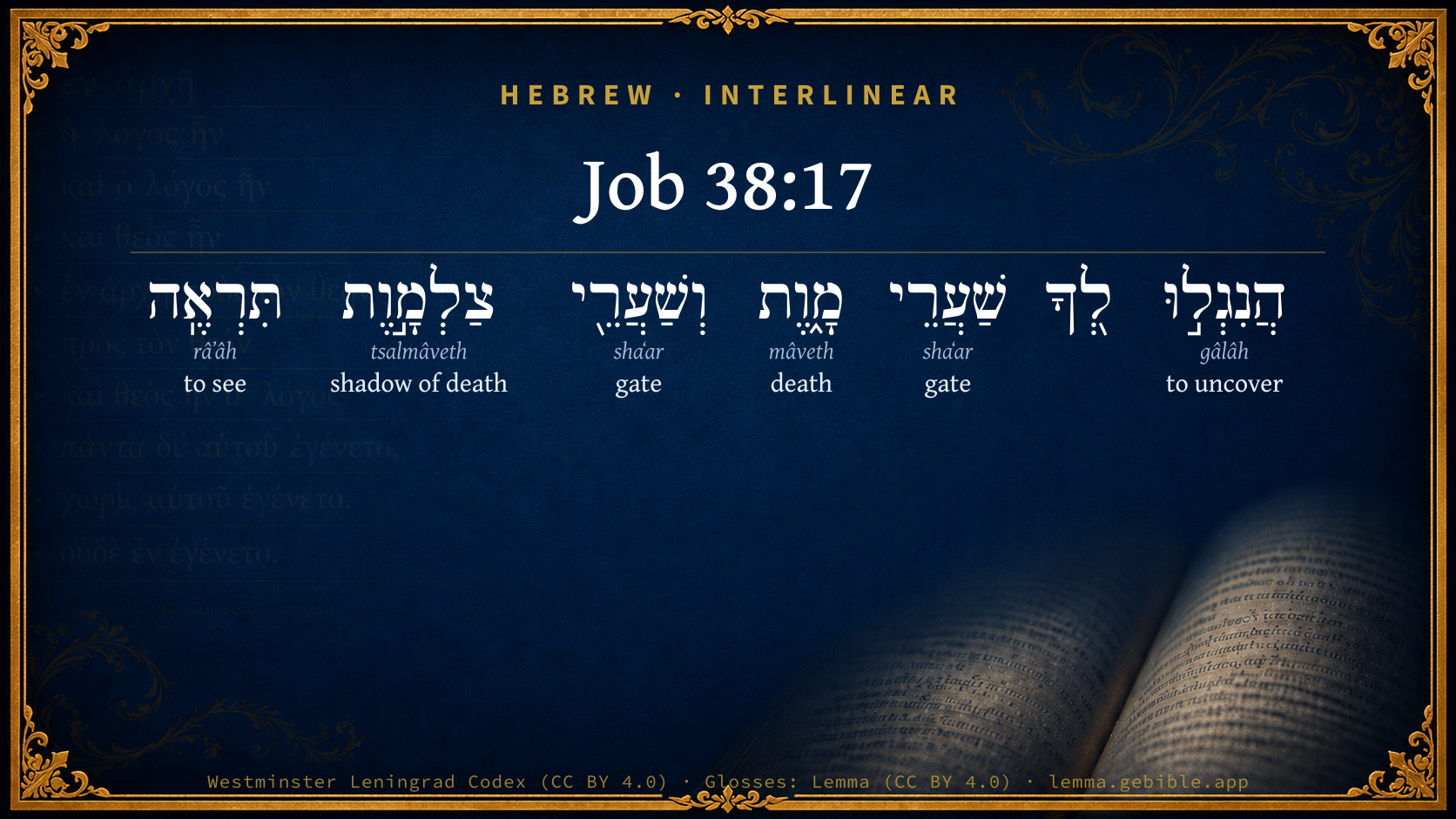
  1. הֲנִגְל֣וּ gâlâh H1540 “to uncover” Particle, Interrogative + Verb, Niphal, Perfect, 3rd Person, Common, Plural
  2. שַׁעֲרֵי shaʻar H8179 “gates of” Noun, Common, Masculine, Plural, Construct
  3. מָ֑וֶת mâveth H4194 “death” Noun, Common, Masculine, Singular, Absolute
  4. וְשַׁעֲרֵ֖י shaʻar H8179 “and · gates of” Conjunction + Noun, Common, Masculine, Plural, Construct
  5. תִּרְאֶֽה râʼâh H7200 “to see” Verb, Qal, Imperfect, 2nd Person, Masculine, Singular

About this verse

These counts appear in no published source. They are computed here, from the morphology-tagged text and Lemma’s own curated glosses. What Lemma adds →

7
words
5
distinct lemmas
Wisdom
section

Notable vocabulary

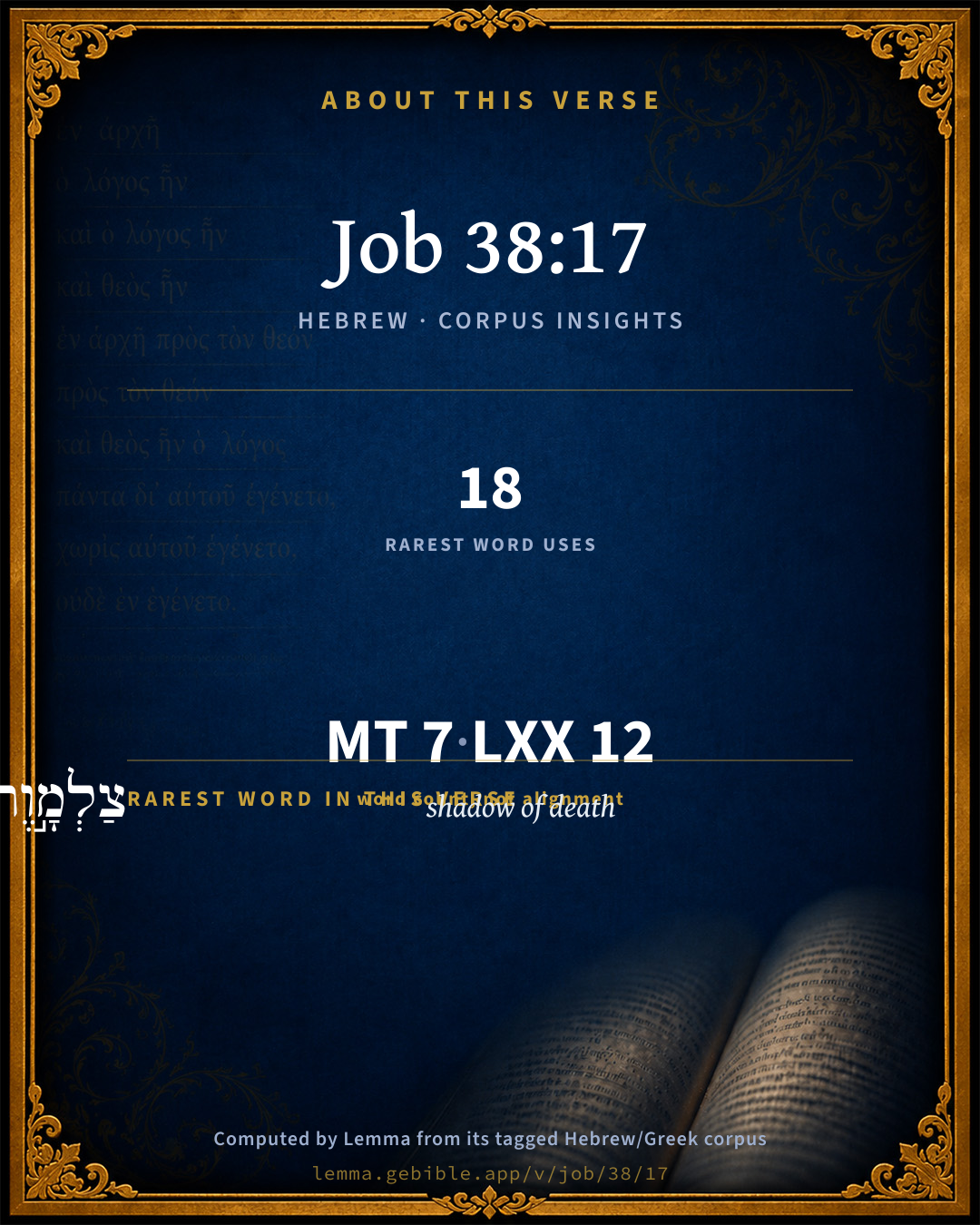
The rarest word here is צַלְמָ֣וֶת shadow of death H6757 — appearing just 18 times in the whole Hebrew Bible.

Shared distinctive vocabulary

צַלְמָ֣וֶת shadow of death H6757 occurs in 17 verses of the Hebrew Bible. Also found in:

Grammatical profile

  • 2 verbs
  • 4 nouns
  • 1 preposition

Verb forms

  • הֲנִגְל֣וּ Niphal · Perfect
  • תִּרְאֶֽה Qal · Imperfect

Repetition

A word recurs within this verse — often emphatic in Hebrew:

  • שַׁעֲרֵי gate H8179 ×2

Hebrew & Septuagint length

In English translation the verse runs 20 words from the Hebrew and 22 from the Septuagint (LXX English) — closely comparable.

A rough comparison of the two English renderings, which tokenize alike — not a word-level alignment.

Word counts can differ between the Hebrew and the Greek without any difference in meaning — e.g. the Hebrew direct-object marker אֵת has no separate Greek word, and Greek often adds the article ὁ.

In the original languages it is 7 Hebrew tokens and 12 Greek tokens — but the two are counted differently (Hebrew bundles its prefixes and suffixes into one token; the Greek is in lemma form), so that isn’t a like-for-like length.

Cross-references

10

Topical passages linked to Job 38:17 in the Treasury of Scripture Knowledge — connected by theme and wording, ordered by reader-vote popularity; previews shown in the World English Bible.

  • Psalms 9:13 Have mercy on me, Yahweh. See my affliction by those who hate me, And lift me up from the gates of death;
  • Psalms 107:18 Their soul abhors all kinds of food. They draw near to the gates of death.
  • Job 3:5 Let darkness and the shadow of death claim it for their own. Let a cloud dwell on it. Let all that makes black the day terrify it.
  • Job 12:22 He uncovers deep things out of darkness, And brings out to light the shadow of death.
  • Psalms 23:4 Even though I walk through the valley of the shadow of death, I will fear no evil, for you are with me. Your rod and your staff, they comfort me.
  • Psalms 107:10 Some sat in darkness and in the shadow of death, Being bound in affliction and iron,
  • Psalms 107:14 He brought them out of darkness and the shadow of death, And broke their bonds in sunder.
  • Psalms 116:3 The cords of death surrounded me, The pains of Sheol got a hold of me. I found trouble and sorrow.
  • Amos 5:8 Seek him who made the Pleiades and Orion, And turns the shadow of death into the morning, And makes the day dark with night; Who calls for the waters of the sea, And pours them out on the surface of the earth, Yahweh is his name,
  • Matthew 4:16 The people who sat in darkness saw a great light, To those who sat in the region and shadow of death, To them light has dawned."

Cross-references courtesy of OpenBible.info (CC BY 4.0).

Hebrew and Greek witnesses Masoretic Hebrew ↔ Greek Septuagint

The same verse in the two great witnesses to the Old Testament, shown verse-for-verse.

These are two independent witnesses, not word-aligned to each other, and the Septuagint is shown in lemma (dictionary) form.

Hebrew Job 38:17 Masoretic · Westminster Leningrad Codex

הֲנִגְל֣וּ לְ֭ךָ שַׁעֲרֵי מָ֑וֶת וְשַׁעֲרֵ֖י צַלְמָ֣וֶת תִּרְאֶֽה

Have the gates of death been revealed to you? Or have you seen the gates of the shadow of death?

World English Bible · Public Domain

Greek LXX Job 38:17 Septuagint · lemma form

ἀναοἴγω δέ σύ φόβος πύλη θάνατος πυλωρός δέ ᾅδης ὁράω σύ πτήσσω

And do the gates of death open to you for fear; and did the porters of hell quake when they saw you?

LXX2012 (modern English Septuagint) · Public Domain

On this verse, Haydock's Catholic Bible Commentary discusses the Septuagint’s reading. Read the note in Commentary ↓

Hebrew: Westminster Leningrad Codex (CC BY 4.0). Greek: Septuagint (public domain); English from LXX2012 (modern English Septuagint) (Public Domain). How the Septuagint differs from the Hebrew →

Commentary

Notes on Job 38:17 from classic Christian and Jewish commentators (each source and its license shown beneath its notes). The classic Christian expositions comment on the surrounding passage and are grouped to its opening verse, so a note may address several verses; the Jewish commentaries on the Tanakh (Rashi and others) are per-verse, so they appear only where the commentator wrote on this verse.

Lemma curates 59 commentaries, every one of them public domain or Creative Commons licensed, each selected and text-cleaned for this edition rather than reprinted as found. About our sources →

Trapp's Complete Commentary

John Trapp

Job 38:17 Have the gates of death been opened unto thee? or hast thou seen the doors of the shadow of death?

Ver. 17. Have the gates of death been opened unto thee] sc. That thou shouldest know when, how, and of what disease every man shall die; together with the state and condition of the dead.

Or hast thou seen the doors of the shadow of death?] No, nor any man living hath ever seen those dark and dismal receptacles of the dead, called here the shadow of death; that is, so dreadful, that they were enough to strike a man dead.

John Trapp, A Commentary or Exposition upon All the Books of the Old and New Testament (1647–1656) — public domain. Text from a community e-Sword module.

The Biblical Illustrator

Joseph S. Exell

Job_38:17

Have the gates of death been opened unto thee?

The gates of death

The allusion here is to the state which in the Hebrew is called Sheol, and in the Greek, Hades; which means the dark abode of the dead.

I. The mental darkness that enshrouds us. All the phenomena of the heavens, the earth, and the multiform operations of the Creator, referred to in this Divine address, were designed and fitted to impress Job with the necessary limitation of his knowledge, and the ignorance that encircled him on all questions; and the region of death is but one of the many points to which he is directed as an example of his ignorance. How ignorant are we of the great world of departed men! What a thick veil of mystery enfolds the whole! What questions often start within us to which we can get no satisfactory reply, either from philosophy or the Bible! I am thankful that we are left in ignorance--

1. Of the exact condition of each individual in that great and ever-growing realm. In general, the Bible tells us that the good are happy and the wicked miserable. This is enough. We would have no more light.

2. Of our exact proximity to the great realm of the departed. We would not have the day or the hour disclosed.

II. The solemn change that awaits us. The gates have not opened to us, but must.

1. The gates are in constant motion. No sooner are they closed to one, than another enters.

2. The gates open to all classes. There are gates to be only entered by persons of distinction.

3. The gates open only one way--into eternity.

4. The gates separate the probationary from the retributionary.

5. The gates are under supreme authority.

III. The wonderful mercy that preserves us.

1. We have always been near those gates.

2. Thousands have gone through since we began the journey of life.

3. We have often been made to feel ourselves near. In times of personal affliction; and in times of bereavement.

IV. The service christianity renders us.

1. It assures us there is life on the other side the gates.

2. It assures us there is blessedness on the other side the gates.

3. It takes away the instinctive repugnance we feel in stepping through those gates. It delivers those who through fear of death are all their lifetime subject to bondage. It takes the sting of death away, etc. (Homilist.)

The invisible gates

Nothing could well be conceived of as more truly sublime than the whole discourse of which the above quotation is a part. Job is convicted by the great Teacher both of ignorance and of weakness. How little did he know of the plans and workings of providence. Whithersoever he turned himself, he was surrounded with mystery. There was another state of being, too, over which clouds and darkness rested. It was a land from which no traveller had ever returned; a land of spiritual essences, and incorporeal natures alone. Have the gates of death been opened unto thee?

1. The metaphor suggests to us how ignorant we are of the period at which our mortal lives must terminate. Canst thou look into the secret chambers of the Almighty, and say which of the ten thousand ways of leaving this world, is the precise one thou shalt be under the necessity of taking? How often does the king of terrors take one and pass another by. The number of years we are to fill; the nature of the death we are to die; the spot where and the manner how; all are infallibly known to God; nay, were so long before we were born, or the earth itself was formed on which we dwell. From us these futurities are wisely and mercifully concealed. Deaths thousand doors stand open as the poet says, but through which of them we are to pass is only known unto Him who hath appointed to all flesh the bounds of their habitation.

2. The metaphor suggests to us that we are very much in the dark as to the nature of the invisible world. Canst thou clearly discern, through the opened gates, the condition of that world which lies beyond the present, the occupation of its inhabitants, the pursuits in which they are engaged, or the views they entertain? We know there is such a state. We are told it shall forever be well with the righteous, and ill with the wicked. But we are left very much in the dark as to particulars. Many curious and interesting questions naturally occur to a thinking and. Some think that from the moment the breath departs, all spiritual life and consciousness are suspended until the day of resurrection. But such a theory can easily be shown to be preposterous and untenable. All things go to prove that, as it is appointed unto all men once to die, so immediately after death cometh judgment, not the general judgment of the last day, but the particular judgment that shall pass on every individual.

3. The metaphor suggests that it becomes us to express ourselves with great caution when at any time we speak of the dead. There are two propositions of which we cannot be too confident.

(1) That they who die in the Lord are blessed.

(2) That such as die unregenerate shall be eternally miserable. But we may err widely in the application of them. We cannot know, with absolute certainty, the state of another mans soul. God has not constituted us judges in the matter. Learn--

1. The propriety of considering our latter end.

2. The folly of rash speculations upon the nature of the invisible world. What God has taught us, it becomes us diligently to ponder; what He has thought proper to conceal, let us religiously abstain from intermeddling with.

3. To see abundant cause of thankfulness to God for the resurrection of Jesus from the dead. What, but for this, must have been our future prospects? He who lay in mortal slumber in Josephs tomb has come back to tell that death shall be swallowed up in victory, and that they who believe on Him shall never perish. (J. L. Adamson.)

Gates of death

This world, and that which is to come, are thus scripturally connected on the border land. David came very near them once, yet broke out Thou liftest me up from the gates of death. Good Hezekiah into thanksgiving, said, I shall go to the gates of the grave, using a more material form for the same idea. These gates of death spoken of in Job_38:17, Psa_107:18, and Psa_9:13, are synonymous with the gates of hell, spoken of by our Lord in Mat_16:18, meaning the gates of Hades, or the vast regions of the unseen state. They are all at the terminus of lifes pilgrimage, and the believer who has passed through the gates of righteousness, spoken of in Psa_118:19, when he approaches these amazing portals, may use the triumphant language of David, Lift up your heads, O ye gates, and be ye lift up, ye everlasting doors. These gates, as John says, have names written thereon. Over the first is written--

1. Mystery. One pillar seems to rest on time, and the other on eternity, opening into the unknown, where from this side the deepest shadows lie; and some say, There is nothing beyond; others, With what body do they come? others, What are their employments, company, and conditions? and yet others, Do they know us there, and can they visit us there?

2. Change is written over another. To the most it opens as a surprise. On this side men say, A man is dead, and on the other, A man is born. As they go through, the old become young, the poor rich, the despised honourable, and the little great; so that all are not on the other side what they were on this.

3. Immortality is written upon the next, clearly read by the Christian, yet to the mass of mankind in the past, traceable only in shadowy hieroglyphics.

4. Infinity is another. Here all is rudimental--our works, successes, attainments, yet suggestive of immense possibilities, awakening curiosity, and animating to activity. Our field of action is here limited by the very conditions of our existence; yet with the barriers of sense removed, we shall have unlimited ideas of space, power, employment, knowledge, and progress.

5. Reward is the title of another, which will receive us into the presence of the King, saying, My reward is with Me, and I will give unto every man as his work shall be; rewards according to our works, and not for them, yet all the better because through the riches of His grace; every man in his own order, yet each compensated according to his capacity. There are those who shall be great in the kingdom of heaven, and others who shall be least. (J. Waugh.)

The Biblical Illustrator, edited by Joseph S. Exell (c. 1880s–1900s) — public domain. Text from a community e-Sword module.

Joseph Benson's Commentary

Job 38:17. Have the gates of death been opened unto thee? — Hath the earth opened all her dark caverns to thee? Or, hast thou ever gone down to the centre, or into the depths and bowels of that earth in which the generality of men are buried? Hast thou looked into שׁאול, sheol, or hades, the intermediate state, the region of departed spirits? And dost thou know how the souls of men are disposed of after death, and what are their various states and conditions? Or, hast thou observed and marked the several ways leading to, and introducing death? Death is a grand secret. 1st, We know not beforehand when, and how, and by what means we or others shall be brought to death; by what road we must go the way whence we shall not return; what disease or disaster will be the door to let us into the house appointed for all living; man knows not his time. 2d, We cannot describe what death is, how the knot is untied between body and soul, nor how the spirit of a man leaves the tenement of clay, and goes:

“To be, we know not what, and live, we know not how.”

Thus Mr. Norris, who adds:

“When life’s close knot, by writ from destiny, Disease shall cut or age untie; When after some delays, some dying strife, The soul stands shivering on the ridge of life; With what a dreadful curiosity Does she launch out into the sea of vast eternity!”

Let us make it sure that the gates of heaven shall be opened to us on the other side death, and then we need not fear the opening of the gates of death to receive us, though it is a way we are to go but once. 3d, We have no correspondence at all with separate souls, nor any acquaintance with their state. It is an unknown, undiscovered region, to which they are removed. We can neither hear from them, nor send to them. While we are here, in a world of sense we speak of the world of spirits as blind men do of colours; and when we remove thither, shall be amazed to find how much we were mistaken.

Joseph Benson's Commentary on the Old and New Testaments (1811–1818) — public domain. Text from a community e-Sword module.

Jamieson, Fausset & Brown

Robert Jamieson, A. R. Fausset & David Brown

seen--The second clause heightens the thought in the first. Man during life does not even "see" the gates of the realm of the dead ("death," Job 10:21); much less are they "opened" to him. But those are "naked before God" (Job 26:6).

Jamieson, Fausset & Brown — Commentary Critical and Explanatory on the Whole Bible (1871) — public domain (CC PDM 1.0). Text via the HelloAO Bible API.

Adam Clarke's Commentary

Verse 17. Have the gates of death been opened unto thee?] Dost thou know in what the article of death consists? This is as inexplicable as the question, What is animal life?

The doors of the shallow of death?] צלמות tsalmaveth, the intermediate state, the openings into the place of separate spirits. Here two places are distinguished: מות maveth, death, and צלמות tsalmaveth, the shadow of death. It will not do to say, death is the privation of life, for what then would be the shadow of that privation?

Adam Clarke's Commentary on the Bible (1810–1826) — public domain. Text from a community e-Sword/MySword module.

The Cambridge Bible for Schools and Colleges

gen. ed. J. J. S. Perowne

17. have the gates of death] Or, were the gates? Death is personified; it is Sheol, the place of the dead, ch. Job_28:22. This is a lower deep than the recesses of the sea; Job, no doubt, went down there also.

hast thou seen] Or, didst thou see?

The Cambridge Bible for Schools and Colleges (gen. ed. J. J. S. Perowne; Cambridge University Press, 1878–1918) — public domain. Text from a community e-Sword module.

John Gill's Exposition

Have the gates of death been opened unto thee?.... Meaning not by which death has entered into the world, and which have been the causes and occasion of it; as the sin of man, the appointment of God, and various providences, calamities and diseases; but by which men enter into the state of the dead. Men know not experimentally what death is, nor in what way they shall go out of the world, nor at what time, nor in what place; they know not what the state of the dead is, there is no correspondence between them and the living; they do not know either what they enjoy or endure, or who precisely and with certainty are in the separate abodes of bliss or misery; the gates of these dark and invisible regions to us have never been thrown open, for mortals to look into them;

or hast thou seen the doors of the shadow of death? the same thing in other words; the Targum and Jarchi interpret this of hell.

John Gill's Exposition of the Whole Bible (1746–1763) — public domain (CC PDM 1.0). Text via the HelloAO Bible API.

Albert Barnes' Notes on the Bible

Have the gates of death been opened unto thee - That is, the gates of the world where death reigns; or the gates that lead to the abodes of the dead. The allusion here is to “Sheol,” or “Hades,” the dark abodes of the dead. This was supposed to be beneath the ground, and was entered by the grave, and was inclosed by gates and bars; see the notes at Job 10:21-22. The transition from the reference to the bottom of the sea to the regions of the dead was natural, and the mind is carried forward to a subject further beyond the ken of mortals than even the unfathomable depths of the ocean. The idea is, that God saw all that occurred in that dark world beneath us, where the dead were congregated, and that his vast superiority to man was evinced by his being able thus to penetrate into, and survey those hidden regions. It is common in the Classical writers to represent those regions as entered by gates. Thus, Lucretius, i. 1105,

- Haec rebus erit para janua letl,

Hae se turba foras dabit omnis materai.

- “The doors of death are ope,

And the vast whole unbounded ruin whelms.”

Good.

So Virgil, Aeneid ii. 661,

- Pater isti janua leto,

“The door of death stands open.”

Or hast thou seen the doors of the shadow of death? - The doors which lead down to the gloomy realms where death spreads its dismal shades. This expression is more emphatic than the former, for the word צלמות tsalmâveth “shadow of death,” is more intensive in its meaning than the word מות mâveth, “death.” There is the superadded idea of a deep and dismal shadow; of profound and gloomy darkness; see the word explained in the notes at Job 3:5; compare Job 10:21-22. Man was unable to penetrate those gloomy abodes and to reveal what was there; but God saw all with the clearness of noon-day.

Albert Barnes' Notes on the Bible (1834–1885) — public domain. Text from a community e-Sword/MySword module.

Haydock's Catholic Bible Commentary

Doors? Septuagint, "through fear; or have the porters of hell flown away at thy sight?" (Haydock)

George Leo Haydock (1774–1849), Haydock's Catholic Family Bible and Commentary, 1859 edition — public domain. Excludes Psalms (Douay-Rheims chapter numbering differs from Protestant) and Deuterocanonical books (Catholic canon only).

Matthew Poole's English Annotations

Hast thou seen, or dost thou perfectly know, the place and state of the dead, the depths and bowels of that earth in which the generality of dead men are buried, or the several ways and methods of death, or the various states and conditions of men after death? And the same thing is repeated.

Matthew Poole's English Annotations on the Holy Bible (1683–1685) — public domain. Text from a community e-Sword/MySword module.

Whedon's Commentary on the Bible

Daniel D. Whedon

17. Gates of death — Used figuratively, or according to the usage of that age. The Assyrian legend of the descent of Ishtar into hades, “the house men enter but cannot depart from,” speaks of seven gates. On the Egyptian sarcophagus of Oimenepthah, each department of the regions of the dead is divided from the next by a tall door, turning upon pivots, and guarded, as in the annexed engraving, by a serpent. The British Museum contains a stone door brought from Syria, which turned upon pivots like this door. Comp. 1Ch_22:3; 1Ki_7:50. As in Job_26:5-6, (which see,) mention of the secrets of the great deep is linked with the under world of the dead, which lay near by, according to the popular view. Man’s science knows as little of the world of the dead now as then.

Hast thou seen — And yet Job has talked of death and its desirableness as if well acquainted with its extended domain; (Job_3:13-19; Job_10:21-22; Job_14:12-13; Job_17:13-16, etc.;) but not even the gates of death has Job ever seen.

Shadow of death — See note, Job_3:5.

Daniel D. Whedon (gen. ed.), Commentary on the Old and New Testaments (1874–1909) — public domain. Text from a community e-Sword module.

The Pulpit Commentary

Have the gates of death been opened unto thee? By "the gates of death," Sheol, the abode of the dead, seems to be intended. (comp. Job_10:21, 22 17:16) Has Job explored this region, and penetrated its secrets? Or is it as unknown to him as to the rest of mankind? The second hemistichOr hast thou seen the doors of the shadow of death? is a mere echo of the first, adding a new idea.

The Pulpit Commentary (1880–1919), ed. H.D.M. Spence-Jones & Joseph S. Exell — public domain. Text from a community e-Sword module.

John Wesley's Explanatory Notes

Death - Hast thou seen, or dost thou know the place and state of the dead; the depths and bowels of that earth in which the generality of dead men are buried. Death is a grand secret? We know not when or by what means we shall be brought to death: by what road we must go the way, whence we shall not return. We cannot describe what death is; how the knot is untied between soul and body, or how the spirit goes "To be we know not what, and live we know not how." With what dreadful curiosity does the soul launch out into an untried abyss? We have no correspondence with separate souls, nor any acquaintance with their state. It is an unknown, undiscovered region, to which they are removed. While we are here in a world of sense, we speak of the world of spirits, as blind men do of colours, and when we remove thither, shall be amazed to find how much we were mistaken.

John Wesley, Explanatory Notes Upon the Whole Bible (1754–1765) — public domain. Text via the GEBible commentary corpus.

Rashi

Rabbi Shlomo Yitzchaki (Rashi)

the gates of death This is Gehinnom.

Rashi on the Tanakh — English translations: “The Judaica Press complete Tanach with Rashi, translated by A. J. Rosenberg” (CC BY 4.0); “Pentateuch with Rashi's commentary by M. Rosenbaum and A.M. Silbermann, 1929-1934” (public domain); “The Metsudah Tanach series, Lakewood, N.J” (CC BY 4.0); and “The Book of Joshua, Metsudah Publications, 1997” (CC BY 4.0). Text via Sefaria.

Lesson kit

Teaching starters — assembled from the data on this page, not authored interpretation. Every prompt links to the verse data it draws on. Edit before teaching.

Job, in the Wisdom, opens this verse with 7 words (5 distinct Hebrew lemmas). Its most distinctive word is tsalmâveth (“shadow of death”). A historical commentator’s framing appears above. Read the whole chapter for the surrounding context.

Discussion questions

  1. How does “shadow of death” (tsalmâveth) shape what this verse is saying?
  2. Job 3:5 shares the word «shadow of death» with this verse. How do the two illuminate each other?
  3. “gate” occurs 2× in this one verse. What is the effect of the repetition?
  4. The translations on this page render this verse differently — a whole-verse word diff, not a word-by-word alignment. What might account for the different wordings?
  5. The verb «הֲנִגְל֣וּ» is Niphal Perfect. How does its form color the action?
  6. Reading how Trapp's Complete Commentary and The Biblical Illustrator read this verse, where do the two commentators agree and where do they part?

Things to notice

Reading settings

Reading text

Shown beneath each verse's original-language words.

Old Testament
Old Testament edition

Read the OT as the Masoretic Hebrew (MT) or the Greek Septuagint (LXX).

English shown for the Greek Septuagint (in the Hebrew ↔ Greek comparison).

Comparing translations? Open the Compare panel on any verse page to stack up to four side by side.