
Deuteronomy 16:14

Hebrew (Westminster Leningrad Codex) Deuteronomy 16:14 appears in the Hebrew Old Testament. The text above is from the Westminster Leningrad Codex. Each word links to its Strong’s number, a concise gloss, and parsing drawn from the Open Scriptures Hebrew Bible morphology. Click any word for its full Brown-Driver-Briggs (BDB) entry.
Download image
Cite this verse

Deuteronomy 16:14 (World English Bible). Public Domain. Lemma interlinear Bible study tool, https://lemma.gebible.app/v/deuteronomy/16/14.

Show BibTeX & RIS
BibTeX
RIS
English Translation
and you shall rejoice in your feast, you, and your son, and your daughter, and your man-servant, and your maid-servant, and the Levite, and the foreigner, and the fatherless, and the widow, who are within your gates.
World English Bible · Public Domain
Download a study sheet

One document with this verse’s original text, its word-by-word gloss line, the meaning frame, cross-references with their text, attributed commentary, and full source and license credits — printable, and it pastes into notes with its structure intact.

This verse Autodidact and up

Study sheet (.html) Plain text (.txt)

A passage Seminary Student

Up to 50 verses in one chapter. A passage sheet keeps up to 6 commentary sources and 12 cross-references per verse, in the order this page ranks them, and says so on the sheet whenever that leaves anything out. Ask for a single verse and you get the Autodidact verse sheet above.

Everything on this page stays free to read, with no account — the sheet is a download of what is already on screen, not access to it.

Want to remove ads? Support Godless Engineer
Compare translations 3

The same verse in 3 English versions, stacked beneath the original-language interlinear above. Click any original word for its lexicon entry.

Each is an independent rendering of the whole verse — the interlinear is not word-aligned to these translations.

Highlighted words mark where these versions differ — a whole-verse word diff, not a word-by-word alignment.

  • World English Bible Public Domain
    and you shall rejoice in your feast, you, and your son, and your daughter, and your man-servant, and your maid-servant, and the Levite, and the foreigner, and the fatherless, and the widow, who are within your gates.
  • King James Version Public Domain
    And thou shalt rejoice in thy feast, thou, and thy son, and thy daughter, and thy manservant, and thy maidservant, and the Levite, the stranger, and the fatherless, and the widow, that are within thy gates.
  • unfoldingWord Literal Text CC BY-SA 4.0
    And you shall rejoice in your festival—you and your son and your daughter and your male servant and your female servant and the Levite and the foreigner and the fatherless and the widow who within your gates.

unfoldingWord Literal Text — © unfoldingWord, licensed CC BY-SA 4.0. Word-aligned USFM3 via Door43 (git.door43.org/unfoldingWord/en_ult).

Versions to compare (up to 4)

3 of 4 selected

Show all 18 translations

Every available English version of this verse, each an independent rendering of the whole verse.

  • World English Bible Public Domain
    and you shall rejoice in your feast, you, and your son, and your daughter, and your man-servant, and your maid-servant, and the Levite, and the foreigner, and the fatherless, and the widow, who are within your gates.
  • Berean Standard Bible Public Domain
    And you shall rejoice in your feast—you, your sons and daughters, your menservants and maidservants, and the Levite, as well as the foreigner, the fatherless, and the widows among you.
  • Majority Standard Bible Public Domain
    And you shall rejoice in your feast—you, your sons and daughters, your menservants and maidservants, and the Levite, as well as the foreigner, the fatherless, and the widows among you.
  • King James Version Public Domain
    And thou shalt rejoice in thy feast, thou, and thy son, and thy daughter, and thy manservant, and thy maidservant, and the Levite, the stranger, and the fatherless, and the widow, that are within thy gates.
  • American Standard Version (1901) Public Domain
    and thou shalt rejoice in thy feast, thou, and thy son, and thy daughter, and thy man-servant, and thy maid-servant, and the Levite, and the sojourner, and the fatherless, and the widow, that are within thy gates.
  • Revised Version (1885) Public Domain
    and thou shalt rejoice in thy feast, thou, and thy son, and thy daughter, and thy manservant, and thy maidservant, and the Levite, and the stranger, and the fatherless, and the widow, that are within thy gates.
  • Geneva Bible (1599) Public Domain
    And thou shalt reioyce in thy feast, thou, and thy sonne, and thy daughter, and thy seruant, and thy maid, and the Leuite, and the stranger, and the fatherlesse, and the widow, that are within thy gates.
  • Douay-Rheims (1899) Public Domain
    And thou shalt make merry in thy festival time, thou, thy son, and thy daughter, thy manservant, and thy maidservant, the Levite also and the stranger, and the fatherless and the widow that are within thy gates.
  • Young's Literal Translation Public Domain
    and thou hast rejoiced in thy feast, thou, and thy son, and thy daughter, and thy man-servant, and thy handmaid, and the Levite, and the sojourner, and the fatherless, and the widow, who `are' within thy gates.
  • Literal Standard Version CC BY-SA 4.0
    and you have rejoiced in your celebration, you, and your son, and your daughter, and your manservant, and your handmaid, and the Levite, and the sojourner, and the fatherless, and the widow, who [are] within your gates.
  • Unlocked Literal Bible CC BY-SA 4.0
    You will rejoice during your festival—you, your son, your daughter, your male servant, your female servant, the Levite, and the foreigner, and the fatherless and the widow who are within your gates.
  • unfoldingWord Literal Text CC BY-SA 4.0
    And you shall rejoice in your festival—you and your son and your daughter and your male servant and your female servant and the Levite and the foreigner and the fatherless and the widow who within your gates.
  • Darby Bible Public Domain
    And thou shalt rejoice in thy feast, thou, and thy son, and thy daughter, and thy bondman, and thy handmaid, and the Levite, and the stranger, and the fatherless, and the widow, that are in thy gates.
  • World Messianic Bible Public Domain
    You shall rejoice in your feast, you, your son, your daughter, your male servant, your female servant, the Levite, the foreigner, the fatherless, and the widow who are within your gates.
  • Webster's Bible Public Domain
    And thou shalt rejoice in thy feast, thou, and thy son, and thy daughter, and thy man-servant, and thy maid-servant, and the Levite, the stranger, and the fatherless, and the widow, that are within thy gates:
  • Free Bible Version CC BY-SA 4.0
    Enjoy your feast—you, your sons and daughters, your male and female slaves, and the Levites who live in your towns, as well as the foreigners, orphans, and widows among you.
  • Bible in Basic English Public Domain
    You are to keep the feast with joy, you and your son and your daughter, your man-servant and your woman-servant, and the Levite, and the man from a strange country, and the child without a father, and the widow, who are living among you.
  • JPS Tanakh (1917) Public Domain
    And thou shalt rejoice in thy feast, thou, and thy son, and thy daughter, and thy man-servant, and thy maid-servant, and the Levite, and the stranger, and the fatherless, and the widow, that are within thy gates.

Literal Standard Version (2020), Covenant Press — licensed CC BY-SA 4.0. Text via the HelloAO Bible API (eBible.org). Unlocked Literal Bible (unfoldingWord) — licensed CC BY-SA 4.0. Text via the HelloAO Bible API (eBible.org). unfoldingWord Literal Text — © unfoldingWord, licensed CC BY-SA 4.0. Word-aligned USFM3 via Door43 (git.door43.org/unfoldingWord/en_ult). Free Bible Version, Dr. Jonathan Gallagher — licensed CC BY-SA 4.0. Text via the HelloAO Bible API (eBible.org).

Word by word

More ways to search: Search by grammar → Find every occurrence → Compare this word →

Practice this passage: Drill this verse → Learn its vocabulary →

וְהַיָּת֥וֹם
yâthôwm
H3490
“and · the · orphan”
Conjunction + Particle, Definite Article + Noun, Common, Masculine, Singular, Absolute
Part of Speech
Conjunction + Particle + Noun
Type
Common
Gender
Masculine
Number
Singular
State
Absolute
Full BDB Definition

Origin: from an unused root meaning to be lonely

TWOT: 934a

an orphan, fatherless
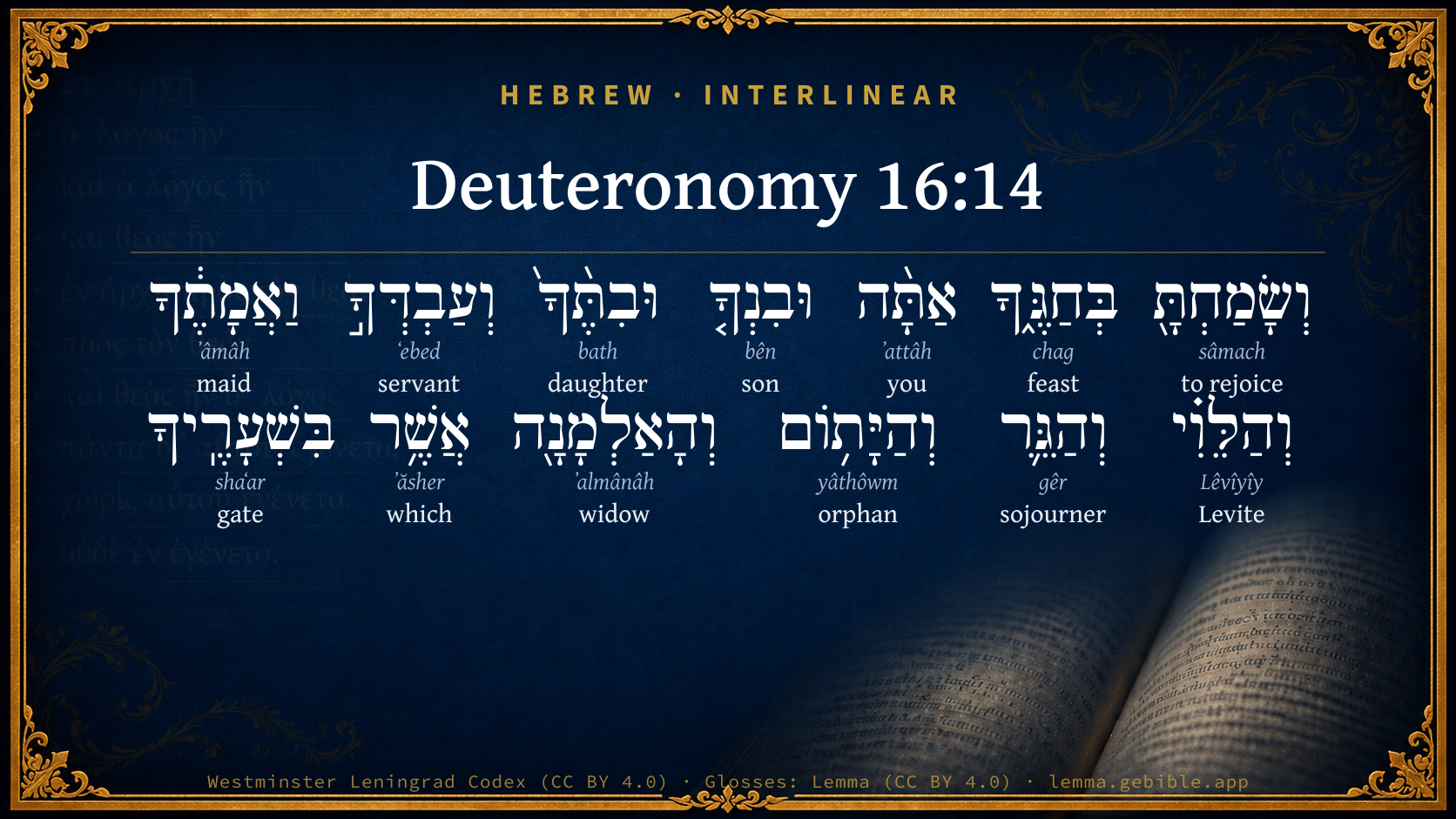
  1. וְשָׂמַחְתָּ֖ sâmach H8055 “and · to rejoice” Conjunction + Verb, Qal, Sequential Perfect, 2nd Person, Masculine, Singular
  2. בְּחַגֶּ֑ךָ chag H2282 “in/at · feast · your” Preposition + Noun, Common, Masculine, Singular, Construct + Suffix, Personal, 2nd Person, Masculine, Singular
  3. אַתָּ֨ה ʼattâh H859 “you” Pronoun, Personal, 2nd Person, Masculine, Singular
  4. וּבִנְךָ֤ bên H1121 “and · son · your” Conjunction + Noun, Common, Masculine, Singular, Construct + Suffix, Personal, 2nd Person, Masculine, Singular
  5. וּבִתֶּ֨ךָ֙ bath H1323 “and · daughter · your” Conjunction + Noun, Common, Feminine, Singular, Construct + Suffix, Personal, 2nd Person, Masculine, Singular
  6. וְעַבְדְּךָ֣ ʻebed H5650 “and · servant · your” Conjunction + Noun, Common, Masculine, Singular, Construct + Suffix, Personal, 2nd Person, Masculine, Singular
  7. וַאֲמָתֶ֔ךָ ʼâmâh H519 “and · maid · your” Conjunction + Noun, Common, Feminine, Singular, Construct + Suffix, Personal, 2nd Person, Masculine, Singular
  8. וְהַלֵּוִ֗י Lêvîyîy H3881 “and · the · Levite” Conjunction + Particle, Definite Article + Noun, Gentilic, Masculine, Singular, Absolute
  9. וְהַגֵּ֛ר gêr H1616 “and · the · sojourner” Conjunction + Particle, Definite Article + Noun, Common, Masculine, Singular, Absolute
  10. וְהָאַלְמָנָ֖ה ʼalmânâh H490 “and · the · widow” Conjunction + Particle, Definite Article + Noun, Common, Feminine, Singular, Absolute
  11. אֲשֶׁ֥ר ʼăsher H834 “which” Particle, Relative
  12. בִּשְׁעָרֶֽיךָ shaʻar H8179 “in/at · gates · your” Preposition + Noun, Common, Masculine, Plural, Construct + Suffix, Personal, 2nd Person, Masculine, Singular

About this verse

These counts appear in no published source. They are computed here, from the morphology-tagged text and Lemma’s own curated glosses. What Lemma adds →

13
words
13
distinct lemmas
Pentateuch
section

Shared distinctive vocabulary

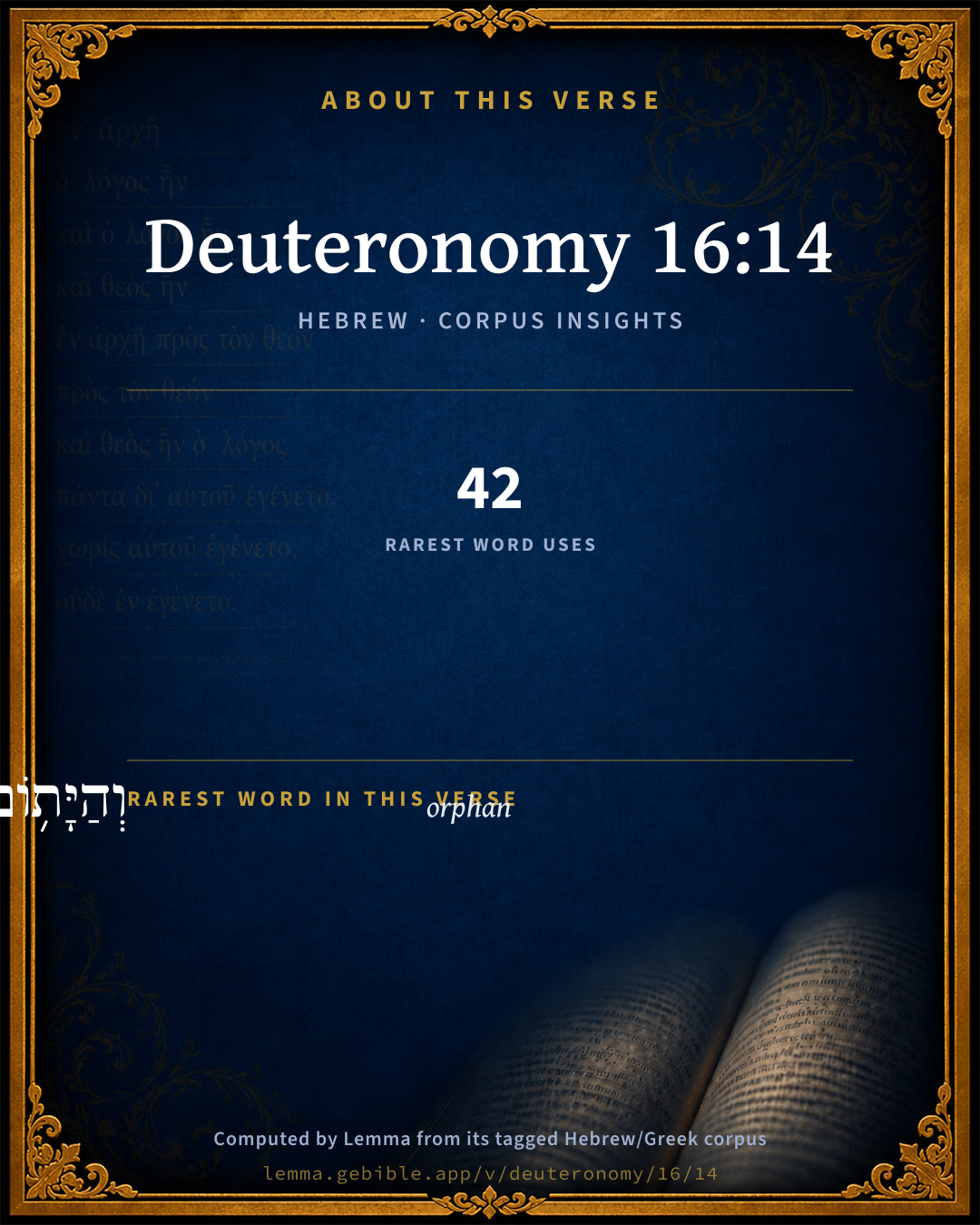
וְהַיָּת֥וֹם orphan H3490 occurs in 42 verses of the Hebrew Bible. Also found in:

Grammatical profile

  • 1 verb
  • 10 nouns
  • 1 pronoun
  • 1 particle

Verb forms

  • וְשָׂמַחְתָּ֖ Qal · Sequential Perfect

Hebrew & Septuagint length

In English translation the verse runs 37 words from the Hebrew and 36 from the Septuagint (LXX English) — closely comparable.

A rough comparison of the two English renderings, which tokenize alike — not a word-level alignment.

Word counts can differ between the Hebrew and the Greek without any difference in meaning — e.g. the Hebrew direct-object marker אֵת has no separate Greek word, and Greek often adds the article ὁ.

Cross-references

10

Topical passages linked to Deuteronomy 16:14 in the Treasury of Scripture Knowledge — connected by theme and wording, ordered by reader-vote popularity; previews shown in the World English Bible.

  • Nehemiah 8:9–12 Nehemiah, who was the governor, and Ezra the priest the scribe, and the Levites who taught the people, said to all the people, This day is holy to Yahweh your God; don't mourn, nor weep. For all the people wept, when they heard the words of the law.
  • Deuteronomy 16:11 and you shall rejoice before Yahweh your God, you, and your son, and your daughter, and your man-servant, and your maid-servant, and the Levite who is within your gates, and the foreigner, and the fatherless, and the widow, who are in the midst of you, in the place which Yahweh your God shall choose, to cause his name to dwell there.
  • Deuteronomy 26:11 and you shall rejoice in all the good which Yahweh your God has given to you, and to your house, you, and the Levite, and the foreigner who is in the midst of you.
  • Ecclesiastes 9:7 Go your way--eat your bread with joy, and drink your wine with a merry heart; for God has already accepted your works.
  • Isaiah 12:1–6 In that day you will say, "I will give thanks to you, Yahweh; for though you were angry with me, your anger has turned away and you comfort me.
  • Isaiah 25:6–8 In this mountain will Yahweh of Hosts make to all peoples a feast of fat things, a feast of wines on the lees, of fat things full of marrow, of wines on the lees well refined.
  • Isaiah 30:29 You shall have a song as in the night when a holy feast is kept; and gladness of heart, as when one goes with a pipe to come to the mountain of Yahweh, to the Rock of Israel.
  • Isaiah 35:10 and the ransomed of Yahweh shall return, and come with singing to Zion; and everlasting joy shall be on their heads: they shall obtain gladness and joy, and sorrow and sighing shall flee away.
  • 1 Thessalonians 5:16 Rejoice always.
  • Deuteronomy 12:12 You shall rejoice before Yahweh your God, you, and your sons, and your daughters, and your men-servants, and your maid-servants, and the Levite who is within your gates, because he has no portion nor inheritance with you.

Cross-references courtesy of OpenBible.info (CC BY 4.0).

Hebrew and Greek witnesses Masoretic Hebrew ↔ Greek Septuagint

The same verse in the two great witnesses to the Old Testament, shown verse-for-verse.

These are two independent witnesses, not word-aligned to each other, and the Septuagint is shown in lemma (dictionary) form.

Hebrew Deuteronomy 16:14 Masoretic · Westminster Leningrad Codex

וְשָׂמַחְתָּ֖ בְּחַגֶּ֑ךָ אַתָּ֨ה וּבִנְךָ֤ וּבִתֶּ֨ךָ֙ וְעַבְדְּךָ֣ וַאֲמָתֶ֔ךָ וְהַלֵּוִ֗י וְהַגֵּ֛ר וְהַיָּת֥וֹם וְהָאַלְמָנָ֖ה אֲשֶׁ֥ר בִּשְׁעָרֶֽיךָ

and you shall rejoice in your feast, you, and your son, and your daughter, and your man-servant, and your maid-servant, and the Levite, and the foreigner, and the fatherless, and the widow, who are within your gates.

World English Bible · Public Domain

Greek LXX Deuteronomy 16:14 Septuagint · lemma form

καί εὐφραίνω ἐν ὁ ἑορτή σύ σύ καί ὁ υἱός σύ καί ὁ θυγάτηρ σύ ὁ παῖς σύ καί ὁ παιδίσκη σύ καί ὁ λευίτης καί ὁ προσήλυτος καί ὁ ὀρφανός καί ὁ χήρα ὁ εἰμί ἐν ὁ πόλις σύ

And you shall rejoice in your feast, you, and your son, and your daughter, your man-servant, and your maidservant, and the Levite, and the stranger, and the orphan, and the widow that is in your cities.

LXX2012 (modern English Septuagint) · Public Domain

Hebrew: Westminster Leningrad Codex (CC BY 4.0). Greek: Septuagint (public domain); English from LXX2012 (modern English Septuagint) (Public Domain). How the Septuagint differs from the Hebrew →

Targum (Aramaic paraphrase)

2

The Targum is the ancient Jewish Aramaic paraphrase of the Hebrew Scriptures — an interpretive translation, not the Hebrew text itself. Onkelos (literal) and Pseudo-Jonathan (expansive) render the Torah, and Jonathan the Prophets. Coverage is partial: where no permissively-licensed English translation exists for a verse, only the Aramaic is shown. This is verse-level text, not a word-by-word alignment to the Hebrew.

  1. Targum Onkelos Torah (Genesis–Deuteronomy)
    וְתֶחֱדֵי בְּחַגָךְ אַתְּ וּבְרָךְ וּבְרַתָּךְ וְעַבְדָךְ וְאַמְתָךְ וְלֵוָאָה וְגִיוֹרָא וְיִתַּמָא וְאַרְמְלָא דִי בְקִרְוָיךְ

    (no public-domain English translation for this verse)

    Targum Onkelos — Aramaic: “Onkelos Genesis” (public domain); “Onkelos Exodus” (public domain); “Onkelos Leviticus” (public domain); “Onkelos Numbers” (public domain); “Onkelos Deuteronomy” (public domain). English: “Sefaria Community Translation” (CC0 1.0 (public-domain dedication)); “J.W. Etheridge. The Targums of Onkelos and Jonathan Ben Uzziel on the Pentateuch. London: Longmans, Green, 1862” (public domain). Text via Sefaria.

  2. Targum Pseudo-Jonathan Torah (Genesis–Deuteronomy)
    וְתֵיחְדוּן בְּחֶדְוַת חַגֵּיכוֹן בְּשָׁאוּבְתָּא וְחָלִילָא אַתּוּן וּבְנֵיכוֹן וּבְנָתֵיכוֹן וְאַמְהוֹתֵיכוֹן וְלֵיוָאָה וְגִיּוֹרָא וְיַתְמָא וְאַרְמַלְתָּא דִי בְקִרְוֵיכוֹן

    And you shall rejoice in the joy of your feasts with the clarinet and flute, you and your sons and daughters, your handmaids, the Levite, the stranger, the orphan, and the widow, who are in your cities.

    Targum Pseudo-Jonathan — Aramaic: “Targum Jonathan on Genesis” (public domain); “Targum Jonathan on Exodus” (public domain); “Targum Jonathan on Leviticus” (public domain); “Targum Jonathan on Numbers” (public domain); “Targum Jonathan on Deuteronomy” (public domain). English: “The Targum of Jonathan ben Uzziel, trans. J. W. Etheridge, London, 1862” (public domain). Text via Sefaria.

Commentary

Notes on Deuteronomy 16:14 from classic Christian and Jewish commentators (each source and its license shown beneath its notes). The classic Christian expositions comment on the surrounding passage and are grouped to its opening verse, so a note may address several verses; the Jewish commentaries on the Tanakh (Rashi and others) are per-verse, so they appear only where the commentator wrote on this verse.

Lemma curates 59 commentaries, every one of them public domain or Creative Commons licensed, each selected and text-cleaned for this edition rather than reprinted as found. About our sources →

The Biblical Illustrator

Joseph S. Exell

Deu_16:14-15

Set him king over thee, whom the Lord thy God shall choose.

Christ our Brother and our King

What I desire now to lay before you is the counsel of God in Christ, which is set forth to us in these words. What is contained in them is that we are to have a king over us, and that this king is to be our brother; by which is expressed the reigning of love. It is exceedingly important that we be taught to feel that our place is that of being reigned over--that it does not belong to us to be independent or to be our own masters; and again, that the control under which we are to be is one which is to govern us through the heart--that the obedience which is to be rendered is to be the obedience of the will--not an outward obedience, an obedience in word or in action, but an inward obedience, an obedience in our will. To this end it is needful that, in obeying, we should have that confidence in him whom we obey, and that understanding of the principle of his government, and that consenting to it, which will carry our hearts along with his requirements; and this our God has considered in giving us a brother to reign over us. When it is here said that God will not give us a king who is not our brother, that we are not in any wise to have a stranger to reign over us, we are taught the great truth, which is the foundation of our religion, that Christ took our very nature and became in very truth our very Brother, so that there is nothing in the whole of our human nature with which He has not personal acquaintance. The knowledge which our Creator has of us, as our Creator, is a knowledge that we cannot comprehend. But when we see Christ having our nature, then we see how He should have this knowledge of us. We might have felt as if God were a stranger--we might have said to ourselves, How very different are His circumstances from ours: He is the Creator of all things--He is independent--He is not at the mercy of any outward thing, and therefore He can have no sympathy with us--He cannot know what our situation is--this language we might have held, in our ignorance of God, were not God revealed in Christ as our Brother. God says thou mayest not set a stranger over thee which is not thy brother; and He says also, I am the Lord thy God, thou shalt have no other god before Me. And thus when our God says that we shall have no stranger to reign over us, and yet that He will reign over us, He teaches us that He is not a stranger--that there is no lack of interest and sympathy in His heart with all the evil of our state. I shall now occupy your attention with the acquaintance and sympathy with our condition which Christ has as our Brother. He has, in truth, no sympathy with man in his natural state, while He has a perfect understanding of our natural condition. He knows thoroughly the flesh which we have, but has no sympathy whatever with our feelings in sowing to it. But, considered as regenerate persons, contending with the flesh, then we are in the condition in which Christ not only knows our state but has perfect, sympathy with it. It is of much importance that you should see where Christs sympathy begins; that it is in our experience as living in the Spirit. What is the principle of our being judged by our equals? It is not needful that they should have any fellowship in that respecting which they are to judge--that they should have themselves transgressed; but that they be in a condition fairly to estimate the circumstances of those upon whom they sit in judgment, because they are their own. The acquaintance which Christ has with us, as our Brother, while it does not justify us in holding that He has any sympathy with the workings of the carnal heart, justifies us in holding that He is deeply alive to the evil of being under the power of the carnal heart--that He knows what it is, with such a knowledge as enables Him fully to estimate what an awful condition it is to be sowing to the flesh. Now this in our Lord is a source of exceeding great comfort. To show what comfort it is, I just press on you that, as truly as the will of Christ was opposed to sin in His own flesh, so truly is it opposed to sin in our flesh, because there is but one flesh--that Christ as truly wills my sanctification as He willed His own--as truly wills that I should be holy, in this body of sin and death, as He willed Himself to be holy in it. Now while this is a Source of exceeding great comfort, when we consider that it is the strength of Christ that is to give us the victory, it is also a source of exceeding great self-reproach, because it shows us how we have grieved Christ. For what must it be to Him to see in the members of His body that rebellion against the Father which He never had in Himself, while He has in Him all that is needful for us, and is longing to impart it all to us, that He should see us choosing to live in the flesh--choosing to live in sin, rather than to receive out of that full provision for holiness which we have in Him! And while we consider Christs understanding of our condition, for comfort in our conflict with sin, and for self-reproach in the consciousness of sinning, let us consider how His being our Brother prepares Him for being our Judge. There is ever a voice in the flesh offering to excuse sin. There is ever proceeding from the Lord a voice condemning sin--a voice declaring that sin is altogether a thing that need not be; and I beseech you consider what an entire putting down it is of all unbelief that Christ was holy in our nature. The will that Christ has as to us, in our condition of sowing to the flesh, is a holy will that we should be holy; but it is also the will of love--of love to us. It is exceedingly important that we should never lose sight of this, that the person is not forgotten. It is not the sin simply that is considered by Christ, but the person who sins. Just as it is with a good man who has a son that is a prodigal. Inasmuch as he is a righteous man, the exhibition of evil in his son is a source of pain to him; but inasmuch as he is his son, it is a peculiar source of pain to him, seeing that he has an interest in the person apart from the character altogether, and that this interest is not destroyed by the evil of the character, but that both work on him jointly. Christs having a personal tie to us, as well as an acquaintance with our condition, is a part of the revelation of God which is in Him; and is that first part of the truth concerning our God which addresses itself to our desire of salvation; and is therefore to be kept in the foreground, that men, convinced of Gods interest in them, may give heed to the things that the Lord has what it expresses still further. First, there is actual sympathy for us in Christ our Brother. In this word sympathy there is contained the idea of a person--the idea of one being feeling along with another being: and so knowing Christs sympathy, and ever turning to it, we learn personal communion with God, which is that which His heart longs for; for His heart has not the fulfilment of its desire for us, but in our having this personal communion with Him. Oh, be very jealous of reposing your hearts in any other bosom than that of God; be very jealous of telling your grief to any other ear than God. Oh, be very jealous for Christ, that He should have the confidential trust of every heart. But Christs sympathy in our conflict is the sympathy of one who can succour us. This is a part of what properly belongs to His character as King. It belongs to His character as King to be strong in us, to supply our need and sustain our weakness. I would, therefore, now consider what we are taught in this Brothers being a King. Why is it not enough to tell us that He is our Brother? Why must we have a King? Now, this word king, taken along with the word brother, is, to my mind, what is expressed in Gods being a Father, and brings out to us the necessity that there is for our being in a subordinate place, learning the will of another, and receiving that will to be our will. Our service, to be a right service, must be a free-will service; but still, in announcing His will, God announces it as King. In short, the sceptre is held out, and we are called to bow to it; and the love is revealed in order that the heart may bow to that sceptre; but it is as a sceptre that it is held out. Now, in Christ as King, there is the provision for strength, as well as the provision for authority. Our King is one who has power, not merely to be used against us if we refuse Him to reign over us, but to be used for us in our submitting to Him. He is a King to minister to our need, to supply the wants of the poor and needy. The true king is one in respect of whom we have nothing, but to whom we are altogether debtors. And this Brother, who is to be our King, we do not see rightly as King if we see him merely as exercising a control without us. We must see Him as the fountain of power within us; one who is to act in us by His might in the conflict with that evil with which we are contending, in assurance of His sympathy. This is the influence of the knowledge that He is King, that it makes His sympathy strength, as that of one of whom we know that He has strength for us. There is another blessedness besides that of conscious dependence on God which is connected with realising the Kingship of Christ, that thus, and thus alone, can we, as intelligent beings, meditating on the wide universe, have peace as to its government. Unless we had the omniscience of God we could not have the peace of God directly; but we may have the peace of God, without the omniscience of God, indirectly: that is, we may have the peace of God through the knowledge of God, and confiding, in regard to what we know not, in the character of Him whom we know to be King. In this way there is blessedness in having a Brother as a King, in respect of ourselves and in respect of all things; for it is when we see the Lamb in the midst of the throne, having seven horns and seven eyes, which are the seven Spirits of God--it is then that we can have perfect peace about all things, because then we see the character of Him who governs, and can say that all must be well. But what I am so desirous that you should seek to realise is the sweetness of being reigned over--the blessedness of having to do with a King; and that it is not the sympathy of the Brother, as reconciling to the condition of being reigned over, that you are to learn, but that while learning the character of the King in the Brother you are to learn that being reigned over is itself a blessedness. (J. M. Campbell.)

The Biblical Illustrator, edited by Joseph S. Exell (c. 1880s–1900s) — public domain. Text from a community e-Sword module.

Joseph Benson's Commentary

Deu 16:14-16. Thou shalt rejoice — In God, and in the effects of his favour, serving and praising him with a glad heart. Shall all thy males appear before the Lord — That is, from twenty to fifty years of age. The women were not obliged to be present at these solemnities; 1st, Because the weakness of their sex rendered them unable to bear so long a journey as many of them would have had to take, without more fatigue than would have been consistent with their health. 2d, Because the care of their children and servants demanded their presence at home. 3d, Because they were represented in the men. No doubt the chief intention of these sacred feasts was to promote piety toward God, and mutual love toward each other, among the Israelites. By the various solemn services in which they were engaged at these seasons, their minds would be awakened to a sense of the infinite importance of religion, and excited to reverence and stand in awe of the Divine Majesty, while many would be inspired unfeignedly to praise and love the Author of all their mercies. By being brought so often together from all parts of the country, their acquaintance with, and regard for each other, would be both continued and increased, and the bond of union among them, as a community, greatly strengthened. Thus also they would be preserved from the idolatrous rites and superstitious practices of their heathen neighbours, and their attachment to their own happy constitution, both civil and religious, would be confirmed.

Joseph Benson's Commentary on the Old and New Testaments (1811–1818) — public domain. Text from a community e-Sword module.

The Cambridge Bible for Schools and Colleges

gen. ed. J. J. S. Perowne

14. and thou shalt rejoice] As in Deu_16:11 but slightly varied.

The Cambridge Bible for Schools and Colleges (gen. ed. J. J. S. Perowne; Cambridge University Press, 1878–1918) — public domain. Text from a community e-Sword module.

John Gill's Exposition

And thou shalt rejoice in thy feast,.... At this feast of tabernacles and ingathering of the fruits of the earth, in token of gratitude and thankfulness for the goodness of God bestowed on them; the Targum of Jonathan adds, with the flute and the pipe, making use of instrumental music to increase the joy on this occasion:

thou and thy son, &c. See Gill on Deu 16:11

John Gill's Exposition of the Whole Bible (1746–1763) — public domain (CC PDM 1.0). Text via the HelloAO Bible API.

Lesson kit

Teaching starters — assembled from the data on this page, not authored interpretation. Every prompt links to the verse data it draws on. Edit before teaching.

Deuteronomy, in the Pentateuch, opens this verse with 13 words (13 distinct Hebrew lemmas). Its most distinctive word is yâthôwm (“orphan”). A historical commentator’s framing appears above. Read the whole chapter for the surrounding context.

Discussion questions

  1. How does “orphan” (yâthôwm) shape what this verse is saying?
  2. How does Exodus 22:22, which shares the word «orphan», read alongside this verse?
  3. These translations render this verse differently. What is at stake in choosing one wording over another?
  4. «וְשָׂמַחְתָּ֖» is a Qal Sequential Perfect verb. How does that grammatical form shape the action described?
  5. Compare how The Biblical Illustrator and Joseph Benson's Commentary read this verse. Where do they agree or differ?

Things to notice

Reading settings

Reading text

Shown beneath each verse's original-language words.

Old Testament
Old Testament edition

Read the OT as the Masoretic Hebrew (MT) or the Greek Septuagint (LXX).

English shown for the Greek Septuagint (in the Hebrew ↔ Greek comparison).

Comparing translations? Open the Compare panel on any verse page to stack up to four side by side.