Exodus 40:33

Hebrew (Westminster Leningrad Codex) Exodus 40:33 appears in the Hebrew Old Testament. The text above is from the Westminster Leningrad Codex. Each word links to its Strong’s number, a concise gloss, and parsing drawn from the Open Scriptures Hebrew Bible morphology. Click any word for its full Brown-Driver-Briggs (BDB) entry.
Download image
Cite this verse

Exodus 40:33 (World English Bible). Public Domain. Lemma interlinear Bible study tool, https://lemma.gebible.app/v/exodus/40/33.

Show BibTeX & RIS
BibTeX
RIS
English Translation
He raised up the court around the tent and the altar, and set up the screen of the gate of the court. So Moses finished the work.
World English Bible · Public Domain
Download a study sheet

One document with this verse’s original text, its word-by-word gloss line, the meaning frame, cross-references with their text, attributed commentary, and full source and license credits — printable, and it pastes into notes with its structure intact.

This verse Autodidact and up

Study sheet (.html) Plain text (.txt)

A passage Seminary Student

Up to 50 verses in one chapter. A passage sheet keeps up to 6 commentary sources and 12 cross-references per verse, in the order this page ranks them, and says so on the sheet whenever that leaves anything out. Ask for a single verse and you get the Autodidact verse sheet above.

Everything on this page stays free to read, with no account — the sheet is a download of what is already on screen, not access to it.

Want to remove ads? Support Godless Engineer
Compare translations 3

The same verse in 3 English versions, stacked beneath the original-language interlinear above. Click any original word for its lexicon entry.

Each is an independent rendering of the whole verse — the interlinear is not word-aligned to these translations.

Highlighted words mark where these versions differ — a whole-verse word diff, not a word-by-word alignment.

  • World English Bible Public Domain
    He raised up the court around the tent and the altar, and set up the screen of the gate of the court. So Moses finished the work.
  • King James Version Public Domain
    And he reared up the court round about the tabernacle and the altar, and set up the hanging of the court gate. So Moses finished the work.
  • unfoldingWord Literal Text CC BY-SA 4.0
    And he raised up the courtyard around the Dwelling and the altar. And he set up the curtain of the gate of the courtyard. And Moses finished the work.

unfoldingWord Literal Text — © unfoldingWord, licensed CC BY-SA 4.0. Word-aligned USFM3 via Door43 (git.door43.org/unfoldingWord/en_ult).

Versions to compare (up to 4)

3 of 4 selected

Show all 18 translations

Every available English version of this verse, each an independent rendering of the whole verse.

  • World English Bible Public Domain
    He raised up the court around the tent and the altar, and set up the screen of the gate of the court. So Moses finished the work.
  • Berean Standard Bible Public Domain
    And Moses set up the courtyard around the tabernacle and the altar, and he hung the curtain for the entrance to the courtyard. So Moses finished the work.
  • Majority Standard Bible Public Domain
    And Moses set up the courtyard around the tabernacle and the altar, and he hung the curtain for the entrance to the courtyard. So Moses finished the work.
  • King James Version Public Domain
    And he reared up the court round about the tabernacle and the altar, and set up the hanging of the court gate. So Moses finished the work.
  • American Standard Version (1901) Public Domain
    And he reared up the court round about the tabernacle and the altar, and set up the screen of the gate of the court. So Moses finished the work.
  • Revised Version (1885) Public Domain
    And he reared up the court round about the tabernacle and the altar, and set up the screen of the gate of the court. So Moses finished the work.
  • Geneva Bible (1599) Public Domain
    Finally, he reared vp the court rounde about the Tabernacle and the Altar, and hanged vp the vaile at the court gate: so Moses finished the worke.
  • Douay-Rheims (1899) Public Domain
    Neither could Moses go into the tabernacle of the covenant, the cloud covering all things and the majesty of the Lord shining, for the cloud had covered all.
  • Young's Literal Translation Public Domain
    And he raiseth up the court round about the tabernacle, and about the altar, and placeth the covering of the gate of the court; and Moses completeth the work.
  • Literal Standard Version CC BY-SA 4.0
    And he raises up the court all around the Dwelling Place, and around the altar, and places the covering of the gate of the court; and Moses completes the work.
  • Unlocked Literal Bible CC BY-SA 4.0
    Moses set up the courtyard around the tabernacle and the altar. He set up the curtain at the courtyard entrance. In this way, Moses finished the work.
  • unfoldingWord Literal Text CC BY-SA 4.0
    And he raised up the courtyard around the Dwelling and the altar. And he set up the curtain of the gate of the courtyard. And Moses finished the work.
  • Darby Bible Public Domain
    And he set up the court round about the tabernacle and the altar, and hung up the curtain of the gate of the court. And so Moses finished the work.
  • World Messianic Bible Public Domain
    He raised up the court around the tabernacle and the altar, and set up the screen of the gate of the court. So Moses finished the work.
  • Webster's Bible Public Domain
    And he reared up the court round about the tabernacle and the altar, and set up the hanging of the court-gate: so Moses finished the work.
  • Free Bible Version CC BY-SA 4.0
    Moses set up the courtyard around the Tabernacle and the altar, and he put up the curtain for the courtyard entrance. This marked the end of the work done by Moses.
  • Bible in Basic English Public Domain
    And he put up the hangings forming the open space round the House and the altar, and put the curtain over the doorway. So Moses made the work complete.
  • JPS Tanakh (1917) Public Domain
    And he reared up the court round about the tabernacle and the altar, and set up the screen of the gate of the court. So Moses finished the work.

Literal Standard Version (2020), Covenant Press — licensed CC BY-SA 4.0. Text via the HelloAO Bible API (eBible.org). Unlocked Literal Bible (unfoldingWord) — licensed CC BY-SA 4.0. Text via the HelloAO Bible API (eBible.org). unfoldingWord Literal Text — © unfoldingWord, licensed CC BY-SA 4.0. Word-aligned USFM3 via Door43 (git.door43.org/unfoldingWord/en_ult). Free Bible Version, Dr. Jonathan Gallagher — licensed CC BY-SA 4.0. Text via the HelloAO Bible API (eBible.org).

Word by word

More ways to search: Search by grammar → Find every occurrence → Compare this word →

Practice this passage: Drill this verse → Learn its vocabulary →

מָסַ֖ךְ
mâçâk
H4539
“covering of”
Noun, Common, Masculine, Singular, Construct
Part of Speech
Noun
Type
Common
Gender
Masculine
Number
Singular
State
Construct
Full BDB Definition

Origin: from H5526

TWOT: 1492a

covering, rag, screen - covering - screen (of the tabernacle)
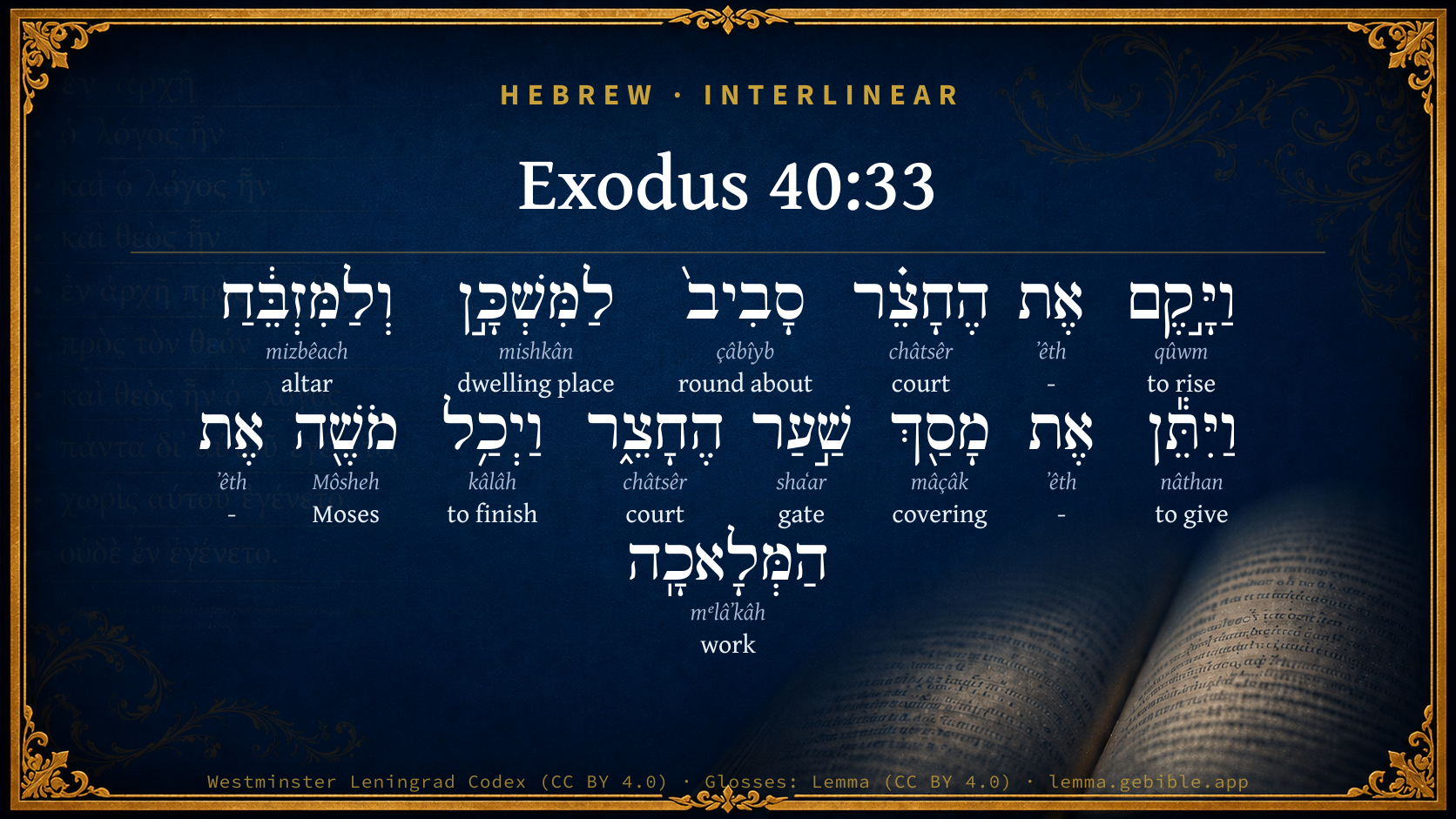
  1. וַיָּ֣קֶם qûwm H6965 “and · to rise” Conjunction + Verb, Hiphil, Sequential Imperfect, 3rd Person, Masculine, Singular
  2. אֶת ʼêth H853 “-” Particle, Direct Object
  3. הֶחָצֵ֗ר châtsêr H2691 “the · court” Particle, Definite Article + Noun, Common, Both, Singular, Absolute
  4. סָבִיב֙ çâbîyb H5439 “round about” Noun, Common, Both, Singular, Absolute
  5. לַמִּשְׁכָּ֣ן mishkân H4908 “to/for the · dwelling place” Preposition, Determined + Noun, Common, Masculine, Singular, Absolute
  6. וְלַמִּזְבֵּ֔חַ mizbêach H4196 “and · to/for the · altar” Conjunction + Preposition, Determined + Noun, Common, Masculine, Singular, Absolute
  7. וַיִּתֵּ֕ן nâthan H5414 “and · to give” Conjunction + Verb, Qal, Sequential Imperfect, 3rd Person, Masculine, Singular
  8. אֶת ʼêth H853 “-” Particle, Direct Object
  9. שַׁ֣עַר shaʻar H8179 “gate of” Noun, Common, Masculine, Singular, Construct
  10. הֶחָצֵ֑ר châtsêr H2691 “the · court” Particle, Definite Article + Noun, Common, Both, Singular, Absolute
  11. וַיְכַ֥ל kâlâh H3615 “and · to finish” Conjunction + Verb, Piel, Sequential Imperfect, 3rd Person, Masculine, Singular
  12. מֹשֶׁ֖ה Môsheh H4872 “Moses” Noun, Proper
  13. אֶת ʼêth H853 “-” Particle, Direct Object
  14. הַמְּלָאכָֽה mᵉlâʼkâh H4399 “the · work” Particle, Definite Article + Noun, Common, Feminine, Singular, Absolute

About this verse

These counts appear in no published source. They are computed here, from the morphology-tagged text and Lemma’s own curated glosses. What Lemma adds →

15
words
12
distinct lemmas
Pentateuch
section

Notable vocabulary

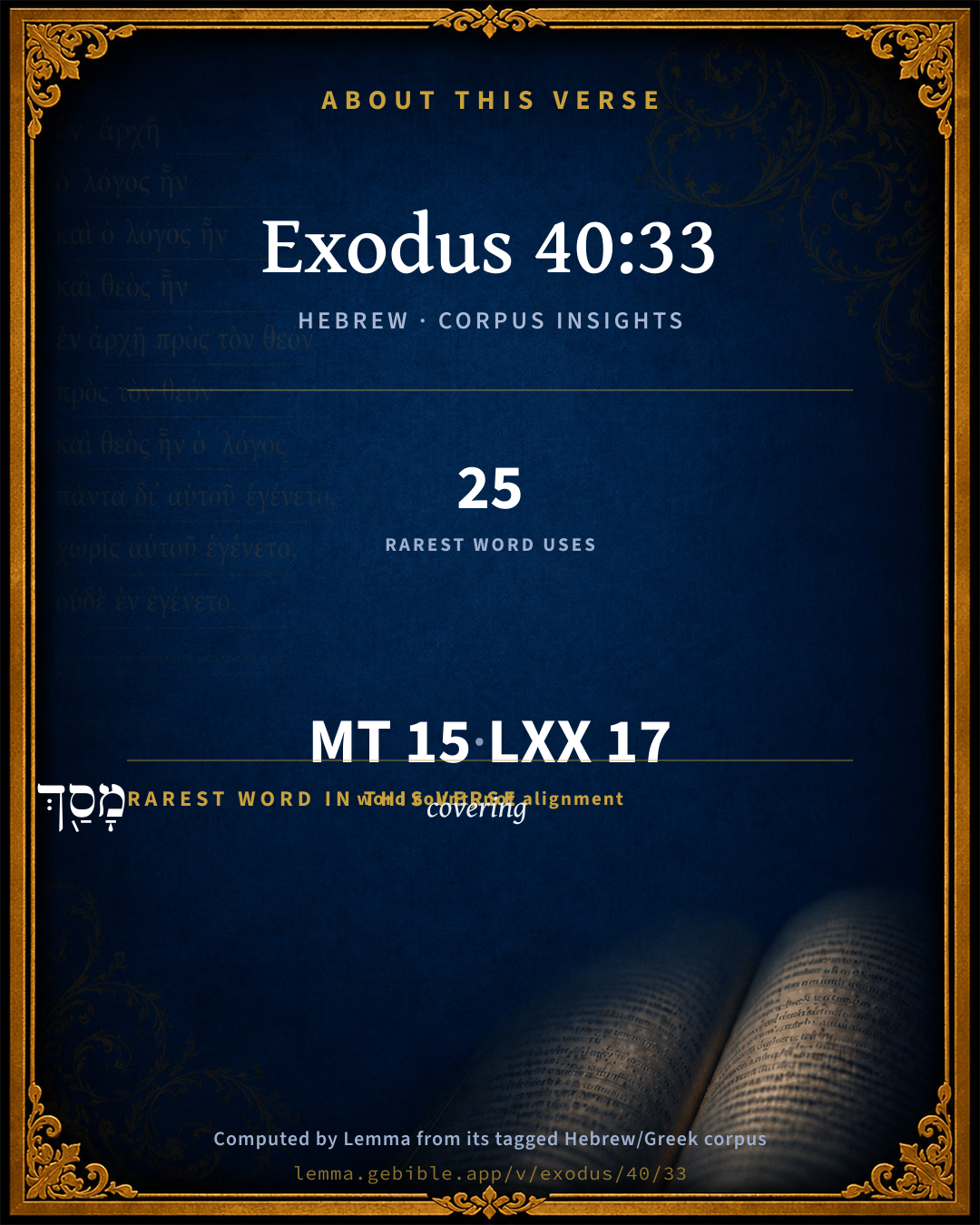
The rarest word here is מָסַ֖ךְ covering H4539 — appearing just 25 times in the whole Hebrew Bible.

Shared distinctive vocabulary

מָסַ֖ךְ covering H4539 occurs in 25 verses of the Hebrew Bible. Also found in:

Grammatical profile

  • 3 verbs
  • 9 nouns
  • 3 particles

Verb forms

  • וַיָּ֣קֶם Hiphil · Sequential Imperfect
  • וַיִּתֵּ֕ן Qal · Sequential Imperfect
  • וַיְכַ֥ל Piel · Sequential Imperfect

Repetition

A word recurs within this verse — often emphatic in Hebrew:

  • הֶחָצֵ֗ר court H2691 ×2

Hebrew & Septuagint length

In the original languages it is 15 Hebrew tokens and 17 Greek tokens — but the two are counted differently (Hebrew bundles its prefixes and suffixes into one token; the Greek is in lemma form), so that isn’t a like-for-like length.

Cross-references

19

Topical passages linked to Exodus 40:33 in the Treasury of Scripture Knowledge — connected by theme and wording, ordered by reader-vote popularity; previews shown in the World English Bible.

  • Exodus 40:8 You shall set up the court around it, and hang up the screen of the gate of the court.
  • Exodus 27:9–16 "You shall make the court of the tent: for the south side southward there shall be hangings for the court of fine twined linen one hundred cubits long for one side:
  • Exodus 39:32 Thus all the work of the tent of the tent of meeting was finished. The children of Israel did according to all that Yahweh commanded Moses; so they did.
  • Numbers 1:50 but appoint the Levites over the Tabernacle of the Testimony, and over all its furnishings, and over all that belongs to it. They shall carry the tabernacle, and all its furnishings; and they shall take care of it, and shall encamp around it.
  • 1 Kings 6:9 So he built the house, and finished it; and he covered the house with beams and planks of cedar.
  • Zechariah 4:9 "The hands of Zerubbabel have laid the foundation of this house. His hands shall also finish it; and you will know that Yahweh of Hosts has sent me to you.
  • Matthew 16:8 Jesus, perceiving it, said, "Why do you reason among yourselves, you of little faith, 'because you have brought no bread?'
  • John 4:34 Jesus said to them, "My food is to do the will of him who sent me, and to accomplish his work.
  • John 10:9 I am the door. If anyone enters in by me, he will be saved, and will go in and go out, and will find pasture.
  • John 14:6 Jesus said to him, "I am the way, the truth, and the life. No one comes to the Father, except through me.
  • John 17:4 I glorified you on the earth. I have accomplished the work which you have given me to do.
  • 1 Corinthians 12:12 For as the body is one, and has many members, and all the members of the body, being many, are one body; so also is Christ.
  • 1 Corinthians 12:28 God has set some in the assembly: first apostles, second prophets, third teachers, then miracle workers, then gifts of healings, helps, governments, and various kinds of languages.
  • Ephesians 2:18 For through him we both have our access in one Spirit to the Father.
  • Ephesians 4:11–13 He gave some to be apostles; and some, prophets; and some, evangelists; and some, shepherds and teachers;
  • 2 Timothy 4:7 I have fought the good fight. I have finished the course. I have kept the faith.
  • Hebrews 3:2–5 who was faithful to him who appointed him, as also was Moses in all his house.
  • Hebrews 4:14–16 Having then a great high priest, who has passed through the heavens, Jesus, the Son of God, let us hold tightly to our confession.
  • Hebrews 9:6–7 Now these things having been thus prepared, the priests go in continually into the first tabernacle, accomplishing the services,

Cross-references courtesy of OpenBible.info (CC BY 4.0).

Hebrew and Greek witnesses Masoretic Hebrew ↔ Greek Septuagint

The same verse in the two great witnesses to the Old Testament, shown verse-for-verse.

These are two independent witnesses, not word-aligned to each other, and the Septuagint is shown in lemma (dictionary) form.

Hebrew Exodus 40:33 Masoretic · Westminster Leningrad Codex

וַיָּ֣קֶם אֶת הֶחָצֵ֗ר סָבִיב֙ לַמִּשְׁכָּ֣ן וְלַמִּזְבֵּ֔חַ וַיִּתֵּ֕ן אֶת מָסַ֖ךְ שַׁ֣עַר הֶחָצֵ֑ר וַיְכַ֥ל מֹשֶׁ֖ה אֶת הַמְּלָאכָֽה

He raised up the court around the tent and the altar, and set up the screen of the gate of the court. So Moses finished the work.

World English Bible · Public Domain

Greek LXX Exodus 40:33 Septuagint · lemma form

ἡνίκα δέ ἄν ἀναβαίνω ὁ νεφέλη ἀπό ὁ σκηνή ἀναζευγνύω ὁ υἱός ἰσραήλ σύν ὁ ἀπαρτία αὐτός

No English rendering of this Greek verse — the small residue in the structurally divergent books.

Hebrew: Westminster Leningrad Codex (CC BY 4.0). Greek: Septuagint (public domain); English from a public-domain English Septuagint. How the Septuagint differs from the Hebrew →

Targum (Aramaic paraphrase)

2

The Targum is the ancient Jewish Aramaic paraphrase of the Hebrew Scriptures — an interpretive translation, not the Hebrew text itself. Onkelos (literal) and Pseudo-Jonathan (expansive) render the Torah, and Jonathan the Prophets. Coverage is partial: where no permissively-licensed English translation exists for a verse, only the Aramaic is shown. This is verse-level text, not a word-by-word alignment to the Hebrew.

  1. Targum Onkelos Torah (Genesis–Deuteronomy)
    וַאֲקֵם יָת דַרְתָּא סְחוֹר סְחוֹר לְמַשְׁכְּנָא וּלְמַדְבְּחָא וִיהַב יָת פְּרָסָא דִתְרַע דַרְתָּא וְשֵׁיצֵי משֶׁה יָת עִבִידָא:

    (no public-domain English translation for this verse)

    Targum Onkelos — Aramaic: “Onkelos Genesis” (public domain); “Onkelos Exodus” (public domain); “Onkelos Leviticus” (public domain); “Onkelos Numbers” (public domain); “Onkelos Deuteronomy” (public domain). English: “Sefaria Community Translation” (CC0 1.0 (public-domain dedication)); “J.W. Etheridge. The Targums of Onkelos and Jonathan Ben Uzziel on the Pentateuch. London: Longmans, Green, 1862” (public domain). Text via Sefaria.

  2. Targum Pseudo-Jonathan Torah (Genesis–Deuteronomy)
    וְאָקֵים יַת דַרְתָּא חֲזוֹר חֲזוֹר לְמַשְׁכְּנָא וּלְמַדְבְּחָא וִיהַב יַת פְּרָסָא דְבִתְרַע מַשְׁכְּנָא וּגְמַר משֶׁה יַת עִיבִידְתָּא

    And he reared up the court round about the tabernacle and the altar, and placed the hanging which was for the gate of the tabernacle. And Mosheh completed the work.

    Targum Pseudo-Jonathan — Aramaic: “Targum Jonathan on Genesis” (public domain); “Targum Jonathan on Exodus” (public domain); “Targum Jonathan on Leviticus” (public domain); “Targum Jonathan on Numbers” (public domain); “Targum Jonathan on Deuteronomy” (public domain). English: “The Targum of Jonathan ben Uzziel, trans. J. W. Etheridge, London, 1862” (public domain). Text via Sefaria.

Commentary

Notes on Exodus 40:33 from classic Christian and Jewish commentators (each source and its license shown beneath its notes). The classic Christian expositions comment on the surrounding passage and are grouped to its opening verse, so a note may address several verses; the Jewish commentaries on the Tanakh (Rashi and others) are per-verse, so they appear only where the commentator wrote on this verse.

Lemma curates 59 commentaries, every one of them public domain or Creative Commons licensed, each selected and text-cleaned for this edition rather than reprinted as found. About our sources →

Joseph Benson's Commentary

Exo 40:33-34. So Moses finished the work — As when God had finished this earth, which he designed for man’s habitation, he made man, and put him in possession of it; so when Moses had finished the tabernacle, which was designed for God’s dwelling-place among men, God came and took possession of it. By these visible tokens of his coming among them, he testified both the return of his favour, which they had forfeited by the golden calf, and his gracious acceptance of their care and pains about the tabernacle. Thus God showed himself well pleased with what they had done, and abundantly rewarded them. A cloud covered the tent — The same cloud which, as the chariot or pavilion of the Shechinah, had come up before them out of Egypt, now settled upon the tabernacle, and hovered over it, even in the hottest and clearest day; for it was none of those clouds which the sun scatters. This cloud was intended to be a token of God’s presence, constantly visible day and night to all Israel. It was also a protection of the tabernacle: they had sheltered it with one covering upon another, but, after all, the cloud that covered it was its best guard; and a guide to the camp of Israel in their march through the wilderness. While the cloud continued on the tabernacle, they rested; when it removed, they removed and followed it, as being purely under a divine conduct. And the glory of the Lord filled the tabernacle — The Shechinah now made an awful entry into the tabernacle, passing through the outer part of it into the most holy place, and there seating itself between the cherubim. It was in light and fire, and, for aught we know, no otherwise, that the Shechinah made itself visible. With these the tabernacle was now filled; yet, as before, the bush, so now the curtains were not consumed; for to those that have received the anointing, the majesty of God is not destroying. Yet now so dazzling was the light, and so dreadful was the fire, that Moses was not able to enter into the tent of the congregation, at the door of which he attended till the splendour was a little abated, and the glory of the Lord retired within the veil. But what Moses could not do, our Lord Jesus has done, whom God caused to draw near and approach, and, as the forerunner, he is for us entered, and has invited us to come boldly even to the mercy-seat. He was able to enter into the holy place not made with hands; he is himself the true tabernacle, filled with the glory of God, even with that divine grace and truth which were figured by this fire and light. In him the Shechinah took up its rest for ever, for in him dwells all the fulness of the Godhead bodily.

Joseph Benson's Commentary on the Old and New Testaments (1811–1818) — public domain. Text from a community e-Sword module.

Jamieson, Fausset & Brown

Robert Jamieson, A. R. Fausset & David Brown

So Moses finished the work--Though it is not expressly recorded in this passage, yet, from what took place on all similar occasions, there is reason to believe that on the inauguration day the people were summoned from their tents--were all drawn up as a vast assemblage, yet in calm and orderly arrangement, around the newly erected tabernacle.

Jamieson, Fausset & Brown — Commentary Critical and Explanatory on the Whole Bible (1871) — public domain (CC PDM 1.0). Text via the HelloAO Bible API.

Ellicott's Commentary for English Readers

(33) He reared up the court . . . and set up the hanging.—On the court, see Exo_27:9-18. For “the hanging” see Exo_27:16.

A Bible Commentary for English Readers, edited by Charles John Ellicott (1878–1897) — public domain. Text from a community e-Sword module.

The Cambridge Bible for Schools and Colleges

gen. ed. J. J. S. Perowne

33. See v. 8; cf. Exo_27:9 a, 16. (‘Set up’ here = ‘hang up’ in v. 8. ‘Put up’ in v. 8a, and ‘set up’ in v. 8b, would make the renderings in the two verses uniform.)

The Cambridge Bible for Schools and Colleges (gen. ed. J. J. S. Perowne; Cambridge University Press, 1878–1918) — public domain. Text from a community e-Sword module.

John Gill's Exposition

But if the cloud were not taken up, then they journeyed not,.... Even if it continued so two days, or a month, or a year, as very probably it sometimes did; which will in some measure account for the long continuance of the Israelites in the wilderness, see Num 9:22.

till the day that it was taken up: or, "of its ascent" (f), being "lifted up", or going upwards, higher in the air, right over the tabernacle, or perhaps more to the front of it; the word used before in this and the preceding verse has the signification of ascending upwards.

(f) "sustolli ejus", Montanus.

John Gill's Exposition of the Whole Bible (1746–1763) — public domain (CC PDM 1.0). Text via the HelloAO Bible API.

Haydock's Catholic Bible Commentary

Moses, out of respect, abstained from entering that day. (Calmet) --- The cloud of legal observances, though designed to prefigure Christ and the gospel, seems however to hinder the Jews from recognizing them. (St. Augustine) (Tirinus)

George Leo Haydock (1774–1849), Haydock's Catholic Family Bible and Commentary, 1859 edition — public domain. Excludes Psalms (Douay-Rheims chapter numbering differs from Protestant) and Deuterocanonical books (Catholic canon only).

The Pulpit Commentary

He reared up the court, etc., as directed in ver. 8. So Moses finished the work. With the hanging of the curtain at the entrance to the court, the erection of the tabernacle was complete. It was probably not till after this that Moses performed the acts of worship mentioned in the course of the narrative put water in the laver (ver. 30), offered sacrifice (ver. 29), lighted the lamps (ver. 25), and burnt incense on the golden altar (ver. 26).

The two finishings.

"So Moses finished the work." Cf. Exo_39:32 was all the work of the tabernacle finished." View the tabernacle as a type of the spiritual house the Church. This tabernacle is being made. A time is coming when, in a more special sense, it will be reared, the "day of Christ the day of "the manifestation of the sons of God". (Rom_8:19 Cf. Rev_21:2, Rev_21:3)

I THE TABERNACLE WAS NOT REARED TILL ALL THE LABOURS IN CONNECTION WITH THE MAKING OF IT HAD BEEN FINISHED.

1. The tabernacle was made with a view to its being reared. This was the end. So the calling, saving, and perfecting of individuals for the kingdom of God has always reference to their ultimate manifestation with Christ in Rom_8:17-26; 2Co_4:15-18 2Co_5:1-11; Eph_5:25-28; Php_1:6, 10; Col_3:1-4, etc.

2. The labours of making were entirely finished, before the rearing was begun. The rearing was but the bringing into visibility of an already finished work.

(1) All the parts of the tabernacle were made.

(2) All the furniture of the tabernacle was made.

(3) The dress of the servants of the tabernacle was made.

Not till all this was done was the command given to rear. So the day of the manifestation of believers will not arrive till all labours preparatory to the setting up of the kingdom of God in glory have been concluded. The Gospel preached through all the world, (Mat_24:14) the "elect" (ver. 31) gathered in, the last soul saved, believer"s; sanctified, avery "living stone" (1Pe_2:4) shaped and fashioned for the place it is ultimately to occupy In the heavenly building, etc.

3. These labours having been concluded, the rearing was proceeded with without delay. The rearing included

(1) the putting of the parts of the tabernacle together.

(2) The arrangement of its furniture.

(3) The ordering of its service.

So, when once the preparatory labours in connection with the kingdom of God have been finished, no time will be lost in setting it up in its final glory. Christ will appear, and his people will appear with him. (Col_3:4) He and they will be glorified together. (Rom_8:17)

1. The rearing of the tabernacle was the setting of it in visible glory before the eyes of the Israelites. So will Christ come to be "glorified in his saints, and admired in all them that believe". (2Th_1:10)

2. The rearing of the tabernacle completed the preparation of it as asanctuary for Jehovah. The same will be true of the glorification of the Church. (Rev_21:3, Rev_21:4)

II THE TABERNACLE, MADE BY THE PEOPLE, WAS REARED BY MOSES.

1. Christ admits us to be fellow-workers with himself in the labours of his Church. These are carried on by human agency. (2Co_6:1)

2. He alone has to do with the glorification of his Church.

III WHEN THE TABERNACLE WAS REARED, IT WAS FOUND THAT NOTHING WAS WANTING TO ITS PERFECTION AS A SANCTUARY. So will the glorification of the Church make manifest the beauty, symmetry, completeness, and perfection of the spiritual structure. It will be found to be "a glorious Church, not having spot, or wrinkle, or any such thing"; (Eph_5:27) complete as a place of habitation for Jehovah; a unity, and a perfect one. J.O.

The Pulpit Commentary (1880–1919), ed. H.D.M. Spence-Jones & Joseph S. Exell — public domain. Text from a community e-Sword module.

Lesson kit

Teaching starters — assembled from the data on this page, not authored interpretation. Every prompt links to the verse data it draws on. Edit before teaching.

Exodus, in the Pentateuch, opens this verse with 15 words (12 distinct Hebrew lemmas). Its most distinctive word is mâçâk (“covering”). A historical commentator’s framing appears above. Read the whole chapter for the surrounding context.

Discussion questions

  1. How does “covering” (mâçâk) shape what this verse is saying?
  2. Exodus 26:36 shares the word «covering» with this verse. How do the two illuminate each other?
  3. “court” occurs 2× in this one verse. What is the effect of the repetition?
  4. These translations render this verse differently. What is at stake in choosing one wording over another?
  5. The verb «וַיָּ֣קֶם» is Hiphil Sequential Imperfect. How does its form color the action?
  6. Reading how Joseph Benson's Commentary and Jamieson, Fausset & Brown read this verse, where do the two commentators agree and where do they part?

Things to notice

Reading settings

Reading text

Shown beneath each verse's original-language words.

Old Testament
Old Testament edition

Read the OT as the Masoretic Hebrew (MT) or the Greek Septuagint (LXX).

English shown for the Greek Septuagint (in the Hebrew ↔ Greek comparison).

Comparing translations? Open the Compare panel on any verse page to stack up to four side by side.